×
Request Free Sample ×

Kindly complete the form below to receive a free sample of this Report

* Please use a valid business email

Leading companies partner with us for data-driven Insights

clients tt-cursor
Hero Background

Germany Solar Inverter Market

ID: MRFR/EnP/46851-HCR
200 Pages
Snehal Singh
February 2026

Germany Solar Inverter Market Research Report By Type (Central Inverter, Micro Inverter, String Inverter), By System Type (On-Grid, Off-Grid) and By Application (Residential, Commercial, Utilities)- Forecast to 2035

Share:
Download PDF ×

We do not share your information with anyone. However, we may send you emails based on your report interest from time to time. You may contact us at any time to opt-out.

Germany Solar Inverter Market Infographic
Purchase Options

Germany Solar Inverter Market Summary

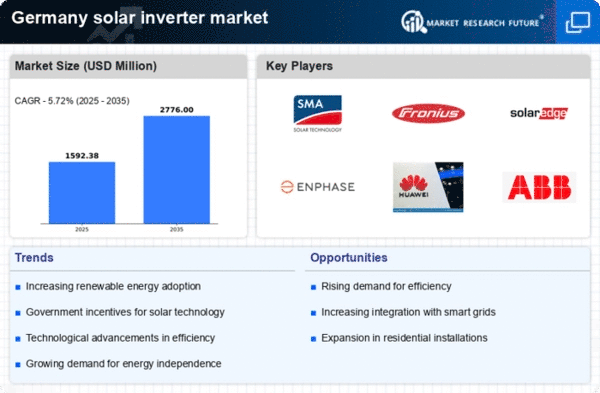
As per Market Research Future analysis, the Germany solar inverter market size was estimated at 1506.22 USD Million in 2024. The Germany solar inverter market is projected to grow from 1592.38 USD Million in 2025 to 2776.0 USD Million by 2035, exhibiting a compound annual growth rate (CAGR) of 5.7% during the forecast period 2025 - 2035

Key Market Trends & Highlights

The Germany solar inverter market is experiencing robust growth driven by technological advancements and regulatory support.

  • Technological advancements in inverter design are enhancing efficiency and performance in the Germany solar inverter market.
  • The residential segment remains the largest, while the commercial segment is emerging as the fastest-growing in terms of adoption.
  • Regulatory support and increased consumer awareness are fostering a favorable environment for solar inverter deployment.
  • Rising demand for renewable energy and government incentives are key drivers propelling market expansion.

Market Size & Forecast

2024 Market Size 1506.22 (USD Million)
2035 Market Size 2776.0 (USD Million)
CAGR (2025 - 2035) 5.72%

Major Players

SMA Solar Technology AG (DE), Fronius International GmbH (AT), SolarEdge Technologies Inc (IL), Enphase Energy Inc (US), Huawei Technologies Co Ltd (CN), ABB Ltd (CH), TMEIC Corporation (JP), KACO new energy GmbH (DE)

Our Impact
Enabled $4.3B Revenue Impact for Fortune 500 and Leading Multinationals
Partnering with 2000+ Global Organizations Each Year
30K+ Citations by Top-Tier Firms in the Industry

Germany Solar Inverter Market Trends

The solar inverter market is currently undergoing a notable transformation. This change is driven by an increasing emphasis on renewable energy sources and sustainability. In Germany, the push for clean energy solutions has led to a surge in solar installations, thereby enhancing the demand for efficient inverter technologies. This shift is further supported by government initiatives aimed at reducing carbon emissions and promoting energy independence. As a result, manufacturers are focusing on innovation, developing advanced inverter systems that offer improved performance and reliability. Moreover, the integration of smart technologies into solar inverters is becoming more prevalent. This trend reflects a broader movement towards digitalization in the energy sector, where monitoring and management capabilities are essential for optimizing energy production. The solar inverter market is thus poised for growth, as stakeholders recognize the importance of adapting to changing energy landscapes and consumer preferences. The future appears promising, with ongoing advancements likely to shape the market dynamics in the coming years.

Technological Advancements

The solar inverter market is witnessing rapid technological advancements, particularly in the development of high-efficiency inverters. Innovations such as microinverters and power optimizers are gaining traction, allowing for better energy management and increased output from solar panels. These technologies enhance system performance, making solar energy more accessible and appealing to consumers.

Regulatory Support

Regulatory frameworks in Germany are increasingly supportive of renewable energy initiatives, which positively impacts the solar inverter market. Government policies and incentives encourage the adoption of solar technologies, leading to a higher demand for inverters. This supportive environment fosters growth and innovation within the sector.

Increased Consumer Awareness

There is a growing awareness among consumers regarding the benefits of solar energy and the role of inverters in maximizing efficiency. As individuals and businesses become more informed about energy savings and environmental impacts, the demand for high-quality solar inverters is likely to rise, driving market expansion.

Germany Solar Inverter Market Drivers

Growing Environmental Awareness

In Germany, there is a marked increase in environmental awareness among consumers, which is positively influencing the solar inverter market. As individuals and businesses become more conscious of their carbon footprints, the demand for clean energy solutions rises. Surveys indicate that over 70% of German citizens prioritize sustainability when making energy choices. This shift in consumer behavior is driving the adoption of solar energy systems, which in turn fuels the need for efficient solar inverters. The solar inverter market is thus positioned to benefit from this heightened environmental consciousness, as more people seek to invest in renewable energy technologies.

Rising Demand for Renewable Energy

The solar inverter market in Germany is experiencing a notable surge in demand due to the increasing emphasis on renewable energy sources. As Germany aims to achieve its ambitious climate goals, the transition from fossil fuels to renewable energy is paramount. In 2025, renewable energy sources are expected to account for approximately 50% of the total energy consumption in Germany, with solar energy playing a crucial role. This shift not only aligns with national policies but also reflects a growing consumer preference for sustainable energy solutions. Consequently, the solar inverter market is poised for growth as more households and businesses invest in solar installations, necessitating efficient inverter technologies to optimize energy conversion and usage.

Government Incentives and Subsidies

The solar inverter market in Germany benefits significantly from various government incentives and subsidies aimed at promoting solar energy adoption. The German government has implemented programs that provide financial support for solar installations, including grants and tax benefits. In 2025, it is estimated that these incentives could reduce the initial investment costs for solar systems by up to 30%. Such financial assistance encourages both residential and commercial sectors to invest in solar technology, thereby driving the demand for solar inverters. As the government continues to support the transition to renewable energy, the solar inverter market is likely to expand, fostering innovation and competition among manufacturers.

Expansion of Solar Energy Infrastructure

The ongoing expansion of solar energy infrastructure significantly impacts the solar inverter market in Germany. With the government and private sector investing heavily in solar farms and residential solar installations, the market is set to grow. By 2025, it is projected that the installed solar capacity in Germany will exceed 100 GW, necessitating a robust supply of solar inverters to support this infrastructure. This expansion not only creates opportunities for manufacturers but also encourages competition, leading to improved product offerings. As the solar energy landscape evolves, the solar inverter market is likely to thrive, driven by the increasing need for reliable and efficient inverter solutions.

Technological Innovations in Inverter Design

The solar inverter market in Germany is witnessing rapid advancements in inverter technology that enhance efficiency and performance. Innovations such as hybrid inverters and smart inverters are becoming increasingly prevalent, allowing for better energy management and integration with smart home systems. In 2025, the efficiency of solar inverters is expected to reach levels exceeding 98%, significantly improving energy conversion rates. These technological advancements not only optimize energy production but also reduce operational costs for users. As consumers become more tech-savvy, the demand for advanced inverter solutions is likely to rise, further propelling the growth of the solar inverter market.

Market Segment Insights

By Type: String Inverter (Largest) vs. Micro Inverter (Fastest-Growing)

In the Germany solar inverter market, the segment distribution reveals that string inverters hold the largest share, dominating the market due to their cost-effectiveness and efficiency in residential applications. Central inverters also have a significant presence, particularly in large-scale commercial installations, while micro inverters, though smaller in market share, are rapidly gaining traction among consumers seeking enhanced system performance and flexibility. Growth trends in this segment are driven by the increasing adoption of renewable energy solutions, technological advancements, and supportive government policies promoting solar energy usage. String inverters remain popular for their reliability, while micro inverters are noted for their ability to optimize energy production on a per-panel basis. The shift towards decentralized energy generation bolsters the demand for micro inverters, marking them as the fastest-growing type in the market.

String Inverter (Dominant) vs. Micro Inverter (Emerging)

String inverters are designed for simplicity in residential and commercial solar installations, providing reliable performance at a lower cost, which makes them appealing to budget-conscious consumers. Their centralized design allows for fewer components, simplifying maintenance and installation. In contrast, micro inverters represent an emerging technology that offers significant performance advantages by enabling each solar panel to operate independently. This leads to improved energy harvest, especially in partially shaded environments, making them an attractive choice for increasingly complex residential installations. The trend towards greater efficiency in solar systems is propelling micro inverters into the forefront, as they enhance the overall energy output and system reliability.

By System Type: On-Grid (Largest) vs. Off-Grid (Fastest-Growing)

The Germany solar inverter market showcases a significant preference for On-Grid systems, which dominate the segment with the largest market share. This system is widely adopted due to its cost-effectiveness and the ability to connect to the national grid, providing users with additional benefits such as net metering and reduced electricity bills. Meanwhile, Off-Grid systems are increasingly gaining traction, accounting for a growing share of the market as consumers seek greater energy independence and sustainability in off-grid solutions. Growth in the Off-Grid segment is driven by advancing technology and decreasing costs, which enhance the feasibility of installing these systems in remote areas. Additionally, rising environmental awareness and government incentives are further propelling the uptake of Off-Grid inverters among residential and commercial users. As more individuals and businesses recognize the benefits of renewable energy, the Off-Grid segment is expected to see robust growth moving forward.

System Type: On-Grid (Dominant) vs. Off-Grid (Emerging)

On-Grid systems are characterized by their seamless integration with the utility grid, making them a popular choice among users who want to take advantage of existing infrastructure. This system type not only ensures a stable energy supply but also allows for potential cost savings through net metering. In contrast, Off-Grid systems represent an emerging segment that caters to consumers looking for self-sufficiency. These systems often incorporate battery storage to maximize energy usage, particularly in areas where grid access is limited. As energy prices fluctuate and environmental considerations become increasingly important, both systems are shaping the future landscape of energy generation and consumption.

By Application: Residential (Largest) vs. Commercial (Fastest-Growing)

The Germany solar inverter market exhibits a diverse application landscape, with the residential segment holding the largest share. This segment's growth can be attributed to increasing consumer adoption of solar energy solutions, supported by favorable governmental policies and incentives aimed at promoting renewable energy usage. Following closely, the commercial segment is witnessing significant traction, reflecting businesses' commitment to sustainability and cost savings through energy efficiency initiatives. In addition to traditional residential uptake, the commercial application is rapidly evolving, positioning itself as the fastest-growing segment. Factors driving this trend include a sharp rise in corporate social responsibility initiatives, energy independence goals among businesses, and advancements in solar technology that enhance efficiency and deployment ease. This surge in commercial applications indicates a broader transition towards renewable energy in various sectors.

Application: Residential (Dominant) vs. Commercial (Emerging)

In the Germany solar inverter market, the residential segment is characterized by widespread adoption among homeowners, driven by the need for energy autonomy and sustainability. This segment benefits from governmental incentives and the decreasing cost of solar technologies, making it an attractive option for domestic applications. Conversely, the commercial segment is emerging rapidly, fueled by businesses looking to reduce operational costs through renewable energy solutions. With a focus on sustainability and compliance with environmental regulations, commercial entities are increasingly investing in solar infrastructures, presenting significant growth potential. As both segments evolve, the distinction between residential and commercial applications is becoming more pronounced, with innovative solutions catering specifically to their unique energy needs.

Get more detailed insights about Germany Solar Inverter Market

Key Players and Competitive Insights

The solar inverter market in Germany is characterized by a dynamic competitive landscape, driven by increasing demand for renewable energy solutions and technological advancements. Key players such as SMA Solar Technology AG (DE), Fronius International GmbH (AT), and SolarEdge Technologies Inc (IL) are at the forefront, each adopting distinct strategies to enhance their market positioning. SMA Solar Technology AG (DE) focuses on innovation and sustainability, emphasizing the development of high-efficiency inverters that cater to both residential and commercial sectors. Meanwhile, Fronius International GmbH (AT) is leveraging its strong reputation for quality and reliability, aiming to expand its product offerings through strategic partnerships and technological enhancements. SolarEdge Technologies Inc (IL) appears to be concentrating on digital transformation, integrating advanced monitoring and optimization technologies into its inverter solutions, thereby enhancing user experience and operational efficiency.
The business tactics employed by these companies reflect a concerted effort to localize manufacturing and optimize supply chains, which is crucial in a moderately fragmented market. This competitive structure allows for a diverse range of products and services, enabling companies to cater to varying customer needs while maintaining a focus on cost efficiency and quality. The collective influence of these key players shapes the market dynamics, fostering an environment where innovation and customer-centric solutions are paramount.
In October 2025, SMA Solar Technology AG (DE) announced a strategic partnership with a leading energy storage provider to enhance its product portfolio. This collaboration is expected to integrate advanced storage solutions with SMA's inverters, thereby offering customers a more comprehensive energy management system. The strategic importance of this move lies in its potential to position SMA as a leader in the growing energy storage market, aligning with the increasing consumer demand for integrated renewable energy solutions.
In September 2025, Fronius International GmbH (AT) launched a new line of smart inverters designed specifically for the European market. This product line incorporates cutting-edge technology that allows for seamless integration with existing solar systems, enhancing efficiency and user control. The introduction of these smart inverters signifies Fronius's commitment to innovation and its strategic focus on meeting the evolving needs of customers in a competitive landscape.
In August 2025, SolarEdge Technologies Inc (IL) unveiled a new AI-driven inverter that optimizes energy production based on real-time data analytics. This development not only enhances the efficiency of solar energy systems but also positions SolarEdge as a pioneer in the integration of artificial intelligence within solar technology. The strategic importance of this innovation lies in its potential to attract tech-savvy consumers and commercial clients looking for advanced energy solutions.
As of November 2025, current trends in the solar inverter market indicate a strong emphasis on digitalization, sustainability, and AI integration. Strategic alliances among key players are increasingly shaping the competitive landscape, fostering innovation and collaboration. Looking ahead, it is likely that competitive differentiation will evolve, shifting from price-based competition to a focus on technological innovation, supply chain reliability, and enhanced customer experiences. This transition underscores the importance of adaptability and forward-thinking strategies in maintaining a competitive edge in the rapidly evolving solar inverter market.

Key Companies in the Germany Solar Inverter Market include

Industry Developments

In the Germany Solar Inverter Market, recent developments indicate increased investments in renewable energy, propelled by the country's commitment to transitioning to greener technologies. In October 2023, SolarEdge Technologies announced the opening of a new production facility in Germany, aimed at enhancing local manufacturing capabilities and meeting the rising demand for solar inverters. Additionally, in September 2023, JinkoSolar launched a new range of high-efficiency solar inverters, further solidifying its position in the German market.

Current affairs highlight that the German government is intensifying its efforts to promote the adoption of renewable energy, resulting in significant growth opportunities for companies like ABB, Siemens, and Fronius. The ongoing advancements in inverter technology are driving efficiency improvements, coupled with strong market growth. Noteworthy is the merger between Schneider Electric and Kaco New Energy in March 2022, which allowed Schneider to enhance its portfolio in the solar inverter segment.

The increasing market valuation of companies, alongside their technological developments, reflects a more competitive landscape in Germany's solar inverter arena, thus attracting more investments into this transformative sector as Germany aims to boost its renewable energy share in the energy mix.

Future Outlook

Germany Solar Inverter Market Future Outlook

The Solar Inverter Market is projected to grow at a 5.72% CAGR from 2025 to 2035, driven by renewable energy policies, technological advancements, and increasing energy demands.

New opportunities lie in:

  • Development of smart inverter technologies for enhanced grid integration.
  • Expansion into energy storage solutions to complement solar systems.
  • Partnerships with electric vehicle manufacturers for integrated charging solutions.

By 2035, the solar inverter market is expected to achieve substantial growth, reflecting robust demand and innovation.

Market Segmentation

Germany Solar Inverter Market Type Outlook

  • Central Inverter
  • Micro Inverter
  • String Inverter

Germany Solar Inverter Market Application Outlook

  • Residential
  • Commercial
  • Utilities

Germany Solar Inverter Market System Type Outlook

  • On-Grid
  • Off-Grid

Report Scope

MARKET SIZE 2024 1506.22(USD Million)
MARKET SIZE 2025 1592.38(USD Million)
MARKET SIZE 2035 2776.0(USD Million)
COMPOUND ANNUAL GROWTH RATE (CAGR) 5.72% (2025 - 2035)
REPORT COVERAGE Revenue Forecast, Competitive Landscape, Growth Factors, and Trends
BASE YEAR 2024
Market Forecast Period 2025 - 2035
Historical Data 2019 - 2024
Market Forecast Units USD Million
Key Companies Profiled SMA Solar Technology AG (DE), Fronius International GmbH (AT), SolarEdge Technologies Inc (IL), Enphase Energy Inc (US), Huawei Technologies Co Ltd (CN), ABB Ltd (CH), TMEIC Corporation (JP), KACO new energy GmbH (DE)
Segments Covered Type, System Type, Application
Key Market Opportunities Integration of smart grid technology enhances efficiency in the solar inverter market.
Key Market Dynamics Rising demand for efficient solar inverters driven by regulatory incentives and technological advancements in renewable energy.
Countries Covered Germany
Leave a Comment

FAQs

What is the expected market size of the Germany Solar Inverter Market in 2024?

The expected market size of the Germany Solar Inverter Market in 2024 is valued at 1.51 USD Billion.

What is the projected market size for the Germany Solar Inverter Market by 2035?

The projected market size for the Germany Solar Inverter Market by 2035 is anticipated to be 3.0 USD Billion.

What is the expected CAGR for the Germany Solar Inverter Market from 2025 to 2035?

The expected CAGR for the Germany Solar Inverter Market from 2025 to 2035 is 6.44%.

Which company holds a significant market share in the Germany Solar Inverter Market?

Major players in the Germany Solar Inverter Market include ABB, JinkoSolar, LG Electronics, and SolarEdge Technologies.

How is the market value distributed among the different types of solar inverters in 2024?

In 2024, the market value for Central Inverters is 0.58 USD Billion, Micro Inverters is 0.31 USD Billion, and String Inverters is 0.62 USD Billion.

What is the expected market value for Central Inverters by 2035?

The expected market value for Central Inverters by 2035 is projected to be 1.15 USD Billion.

What is the projected market value for Micro Inverters in 2035?

The projected market value for Micro Inverters in 2035 is expected to be 0.62 USD Billion.

What is the anticipated market size for String Inverters by 2035?

The anticipated market size for String Inverters by 2035 is expected to reach 1.23 USD Billion.

What growth opportunities are influencing the Germany Solar Inverter Market?

Growth opportunities in the Germany Solar Inverter Market are driven by increasing demand for renewable energy sources and advancements in inverter technology.

How are current global trends impacting the Germany Solar Inverter Market?

Current global trends, including the shift toward cleaner energy, are positively impacting the Germany Solar Inverter Market by boosting investments and innovations.

Download Free Sample

Kindly complete the form below to receive a free sample of this Report

Compare Licence

×
Features License Type
Single User Multiuser License Enterprise User
Price $4,950 $5,950 $7,250
Maximum User Access Limit 1 User Upto 10 Users Unrestricted Access Throughout the Organization
Free Customization
Direct Access to Analyst
Deliverable Format
Platform Access
Discount on Next Purchase 10% 15% 15%
Printable Versions