×
Request Free Sample ×

Kindly complete the form below to receive a free sample of this Report

* Please use a valid business email

Leading companies partner with us for data-driven Insights

clients tt-cursor
Hero Background

Germany Sleep Testing Services Market

ID: MRFR/HC/48668-HCR
200 Pages
Rahul Gotadki
February 2026

Germany Sleep Testing Services Market Research Report By Diagnostic Service (Home Sleep Testing, In-Lab Testing, Electroencephalogram, Full Polysomnography, CPAP/BiPAP Titration, Multiple Sleep Latency Test (MSLT), Maintenance of Wakefulness Test (MWT)), By Treatment Monitoring (Obstructive Sleep Apnea, Insomnia, Restless Legs Syndrome, Circadian Rhythm Sleeping Disorders, Narcolepsy, Rapid eye movement (REM) sleep disorder) and By End-User (Hospitals, Sleep Centers, Home Care Settings) - Growth & Industry Forecast 2025 To 2035

Share:
Download PDF ×

We do not share your information with anyone. However, we may send you emails based on your report interest from time to time. You may contact us at any time to opt-out.

Germany Sleep Testing Services Market Infographic
Purchase Options

Germany Sleep Testing Services Market Summary

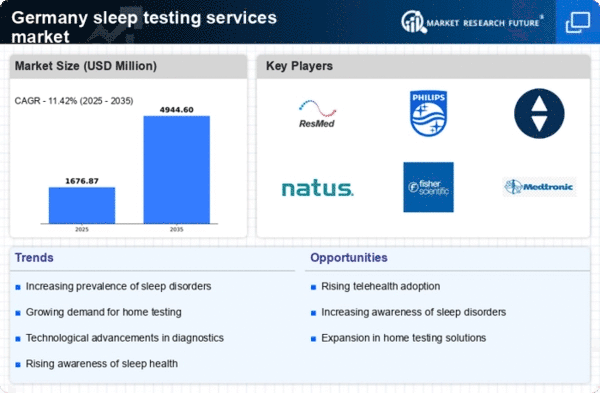
As per Market Research Future analysis, the Germany sleep testing services market size was estimated at 1505.0 USD Million in 2024. The Sleep Testing-services market is projected to grow from 1676.87 USD Million in 2025 to 4944.6 USD Million by 2035, exhibiting a compound annual growth rate (CAGR) of 11.4% during the forecast period 2025 - 2035

Key Market Trends & Highlights

The Germany sleep testing-services market is experiencing a transformative shift driven by technological advancements and a growing emphasis on preventive healthcare.

  • Technological advancements in sleep testing are enhancing diagnostic accuracy and patient outcomes.
  • The largest segment in the market is home sleep testing, while the fastest-growing segment is telehealth solutions.
  • There is an increased focus on preventive healthcare, leading to a rise in demand for sleep testing services.
  • Major market drivers include growing awareness of sleep disorders and the integration of advanced diagnostic technologies.

Market Size & Forecast

2024 Market Size 1505.0 (USD Million)
2035 Market Size 4944.6 (USD Million)
CAGR (2025 - 2035) 11.42%

Major Players

ResMed (AU), Philips (NL), Sleep Number (US), Natus Medical (US), Fisher & Paykel Healthcare (NZ), Medtronic (US), SomnoMed (AU), Itamar Medical (IL), Zywave (US)

Our Impact
Enabled $4.3B Revenue Impact for Fortune 500 and Leading Multinationals
Partnering with 2000+ Global Organizations Each Year
30K+ Citations by Top-Tier Firms in the Industry

Germany Sleep Testing Services Market Trends

The sleep testing-services market is currently experiencing notable growth, driven by an increasing awareness of sleep disorders and their impact on overall health. In Germany, the prevalence of conditions such as sleep apnea and insomnia has prompted both healthcare providers and patients to seek effective diagnostic solutions. This heightened demand is reflected in the expansion of sleep clinics and the integration of advanced technologies in testing procedures. Furthermore, the collaboration between healthcare professionals and technology developers appears to enhance the accuracy and efficiency of sleep assessments, thereby improving patient outcomes. Moreover, the rise of telemedicine has transformed the landscape of the sleep testing-services market. Patients now have greater access to remote consultations and home-based testing options, which may lead to increased patient engagement and adherence to treatment plans. This shift not only addresses the convenience factor but also aligns with the growing trend of personalized healthcare. As the market evolves, it seems likely that innovations in wearable devices and mobile applications will further facilitate the monitoring of sleep patterns, providing valuable data for both patients and clinicians. Overall, the sleep testing-services market is poised for continued advancement, reflecting the changing dynamics of healthcare delivery in Germany.

Technological Advancements in Sleep Testing

The integration of cutting-edge technology into the sleep testing-services market is reshaping traditional diagnostic methods. Innovations such as portable monitoring devices and advanced software for data analysis are enhancing the accuracy of sleep assessments. These developments not only streamline the testing process but also provide patients with more convenient options for monitoring their sleep health.

Increased Focus on Preventive Healthcare

There is a growing emphasis on preventive healthcare within the sleep testing-services market. Healthcare providers are increasingly recognizing the importance of early detection and intervention for sleep disorders. This trend is likely to lead to more proactive screening initiatives, encouraging individuals to seek testing services before symptoms escalate.

Rise of Telehealth Solutions

The adoption of telehealth solutions is significantly impacting the sleep testing-services market. Remote consultations and home-based testing options are becoming more prevalent, allowing patients to access services without the need for in-person visits. This trend not only improves accessibility but also aligns with the broader shift towards digital health solutions.

Germany Sleep Testing Services Market Drivers

Supportive Regulatory Framework

A supportive regulatory framework is fostering growth in the sleep testing-services market in Germany. Government initiatives aimed at improving healthcare access and quality are encouraging the development of sleep testing services. Policies that promote preventive healthcare and early diagnosis of sleep disorders are likely to enhance the market landscape. For instance, reimbursement policies for sleep studies are becoming more favorable, making these services more accessible to patients. Additionally, regulatory bodies are establishing guidelines that ensure the quality and safety of sleep testing procedures. This supportive environment is expected to stimulate investment in the sleep testing-services market, leading to the introduction of new services and technologies that cater to the needs of the population.

Growing Awareness of Sleep Disorders

The increasing awareness of sleep disorders among the German population is a pivotal driver for the sleep testing-services market. As more individuals recognize the impact of sleep-related issues on overall health, the demand for diagnostic services has surged. Reports indicate that approximately 30% of adults in Germany experience sleep disturbances, prompting a greater need for professional evaluation. This heightened awareness is likely to lead to an increase in consultations with sleep specialists and the utilization of sleep testing services. Furthermore, educational campaigns by health organizations are contributing to this trend, emphasizing the importance of sleep health. Consequently, the sleep testing-services market is expected to expand as more individuals seek to understand and address their sleep issues, thereby enhancing their quality of life.

Integration of Advanced Diagnostic Technologies

The integration of advanced diagnostic technologies is transforming the sleep testing-services market in Germany. Innovations such as portable sleep monitors and advanced polysomnography equipment are enhancing the accuracy and efficiency of sleep studies. These technologies allow for more comprehensive data collection, enabling healthcare providers to diagnose sleep disorders with greater precision. The market for sleep testing services is projected to grow as these technologies become more accessible and affordable. For instance, the introduction of home sleep testing devices has made it easier for patients to undergo evaluations in the comfort of their homes, potentially increasing participation rates. As a result, the sleep testing-services market is likely to benefit from these advancements, leading to improved patient outcomes and satisfaction.

Rising Incidence of Lifestyle-Related Sleep Issues

The rising incidence of lifestyle-related sleep issues is significantly influencing the sleep testing-services market. Factors such as increased stress levels, sedentary lifestyles, and poor dietary habits are contributing to a surge in sleep disorders among the German population. Studies suggest that nearly 40% of adults report experiencing insomnia or other sleep-related problems, which is prompting a greater demand for sleep testing services. This trend is particularly evident in urban areas where fast-paced lifestyles are prevalent. As individuals seek solutions to improve their sleep quality, the market for sleep testing services is expected to expand. Healthcare providers are likely to respond by offering more comprehensive testing options and personalized treatment plans, further driving growth in the sleep testing-services market.

Increased Collaboration Between Healthcare Providers

Increased collaboration between healthcare providers is emerging as a key driver for the sleep testing-services market. Partnerships among hospitals, sleep clinics, and primary care physicians are facilitating a more integrated approach to diagnosing and treating sleep disorders. This collaborative model allows for better patient referrals and streamlined access to sleep testing services. As healthcare providers work together, they can share resources and expertise, ultimately enhancing the quality of care for patients. The sleep testing-services market is likely to benefit from this trend, as more patients are directed to appropriate testing and treatment options. Furthermore, interdisciplinary approaches may lead to the development of comprehensive care pathways that address the multifaceted nature of sleep disorders.


Market Segment Insights

By Product & Services: Polysomnography Devices (Largest) vs. Actigraphy Systems (Fastest-Growing)

The Germany sleep testing-services market exhibits a diverse distribution among its product and service offerings. Notably, Polysomnography Devices hold the largest share, reflecting their critical role in diagnosing sleep disorders. This segment is followed by Actigraphy Systems, which, while having a smaller market share, demonstrate significant potential for growth. Oximeters and Respiratory Polygraphs also contribute meaningfully to the market composition, yet they are positioned as secondary players compared to the leading segments. Growth trends within the market indicate a strong upward trajectory primarily fueled by increasing awareness of sleep health and disorders. Actigraphy Systems, being the fastest-growing segment, are gaining traction due to their convenience and non-invasiveness, appealing to both healthcare providers and patients. Innovations in technology further enhance product capabilities, creating robust market interest and driving investment in these segments.

Polysomnography Devices (Dominant) vs. Actigraphy Systems (Emerging)

Polysomnography Devices stand out as the dominant force within the Germany sleep testing-services market, offering comprehensive insights into patients' sleep patterns and disorders through extensive data collection. Their established presence and trusted efficacy ensure continued use among medical professionals. Conversely, Actigraphy Systems are emerging as a valuable alternative, particularly for home monitoring and long-term sleep tracking. Their portability and user-friendly interfaces attract a broader user base, including those hesitant to undergo formal testing. This shift emphasizes the growing preference for accessible and innovative sleep solutions, positioning Actigraphy Systems as a critical player for future market dynamics.

By Indication: Sleep Apnea (Largest) vs. Insomnia (Fastest-Growing)

In the Germany sleep testing-services market, Sleep Apnea accounts for the largest share among the various indications, reflecting the high prevalence of this disorder in the region. Following closely, Insomnia is emerging as a significant segment due to increasing awareness and a growing patient base seeking diagnosis and treatment. Narcolepsy and parasomnia hold smaller shares, yet their relevance is increasing as more individuals understand these conditions. The growth trends within this segment can be attributed to various factors, including the rising rates of sleep disorders linked to lifestyle changes and increased stress levels. Additionally, advancements in diagnostic technologies and the growing acceptance of sleep disorders as serious health issues contribute to market expansion. Furthermore, healthcare policies promoting better sleep health initiatives are driving patients towards seeking sleep testing services.

Sleep Apnea (Dominant) vs. Insomnia (Emerging)

Sleep Apnea is recognized as the dominant indication in the Germany sleep testing-services market, characterized by its significant prevalence and serious health implications, such as cardiovascular diseases. It attracts a considerable amount of research and healthcare resources, thereby ensuring continuous development in testing methodologies and treatment options. On the other hand, Insomnia is emerging rapidly, reflecting growing patient awareness and the impact of societal factors such as stress and lifestyle choices. This segment benefits from innovations in home testing solutions and a better understanding of sleep health, positioning it as a key player in the future of sleep testing services.

By Age Group: Adults (Largest) vs. Children (Fastest-Growing)

The market for sleep testing services displays a diverse distribution among age groups, with adults aged 18 to 60 holding the largest share. This dominant position is attributed to the increasing prevalence of sleep disorders in this demographic, driven by lifestyle factors, stress, and health awareness. Meanwhile, the children segment, encompassing ages 1 to 17, is experiencing rapid growth. This surge is influenced by rising concerns about pediatric sleep health, leading to greater parental awareness and demand for appropriate testing services. Growth trends in this segment are being propelled by advances in sleep diagnostics and a growing recognition of the importance of sleep among all age groups. The geriatric segment, aged 60 and above, also plays a significant role, with an increasing elderly population impacting the overall market dynamics. Factors such as aging and heightened healthcare access are essential drivers, indicating that addressing sleep health is becoming a priority across all demographic segments.

Adults (Dominant) vs. Geriatric (Emerging)

The adults segment, aged 18 to 60, stands out as the dominant group in the sleep testing services landscape. This age range is significantly impacted by factors like work-related stress and health issues, leading to a higher demand for sleep diagnostics. Adults are generally more proactive about health management, actively seeking professional consultation for sleep-related concerns. On the other hand, the geriatric segment, aged 60 and above, is emerging due to a growing elderly population and increased awareness of sleep health. Older individuals are often more susceptible to sleep disorders, and the heightened focus on senior healthcare is driving growth within this segment, making it crucial for service providers to tailor solutions specifically for geriatric needs.

By End User: Sleep Testing Centers (Largest) vs. Home Care Settings (Fastest-Growing)

In the Germany sleep testing-services market, Sleep Testing Centers hold the largest market share, driven by their established reputation and infrastructure tailored for diagnosing sleep disorders. Hospitals also contribute significantly, providing comprehensive care, while Home Care Settings are increasing in popularity as they offer convenience and comfort for patients, allowing them to undergo testing in familiar environments. Growth trends in this segment are largely influenced by the rising awareness of sleep disorders and the need for timely diagnosis. The demand for Home Care Settings is escalating, particularly due to advancements in technology enabling remote monitoring and testing. Sleep Testing Centers continue to dominate, but the shift towards more accessible testing options shapes the competitive landscape, fostering innovation and expansion in service offerings.

Sleep Testing Centers (Dominant) vs. Home Care Settings (Emerging)

Sleep Testing Centers are recognized as the dominant force in the Germany sleep testing-services market due to their specialized facilities and comprehensive services tailored for sleep-related issues. They provide a range of diagnostic tests and have the capability for immediate follow-up care. In contrast, Home Care Settings are emerging quickly, appealing to patients preferring convenience and comfort at home. This segment incorporates advanced technologies that facilitate remote testing and results interpretation, making it an attractive option for consumers. As both segments evolve, the competition intensifies, prompting Sleep Testing Centers to innovate while Home Care Settings continue to disrupt traditional models by offering accessible and efficient solutions.

Get more detailed insights about Germany Sleep Testing Services Market

Key Players and Competitive Insights

The sleep testing-services market in Germany is characterized by a dynamic competitive landscape, driven by increasing awareness of sleep disorders and the growing demand for effective diagnostic solutions. Key players such as ResMed (AU), Philips (NL), and Medtronic (US) are at the forefront, each adopting distinct strategies to enhance their market presence. ResMed (AU) focuses on innovation in digital health technologies, aiming to integrate AI-driven solutions into their sleep apnea devices. Philips (NL), on the other hand, emphasizes partnerships with healthcare providers to expand its reach and improve patient outcomes. Medtronic (US) is actively pursuing mergers and acquisitions to bolster its product portfolio, indicating a strategy centered on comprehensive service offerings that cater to diverse patient needs.The business tactics employed by these companies reflect a concerted effort to optimize operations and enhance customer engagement. Localizing manufacturing processes and streamlining supply chains are common practices among these players, which contribute to a moderately fragmented market structure. The collective influence of these key players shapes competitive dynamics, as they vie for market share through innovation and strategic collaborations.

In October Philips (NL) announced a strategic partnership with a leading telehealth provider to enhance remote monitoring capabilities for sleep disorders. This move is significant as it aligns with the growing trend of telemedicine, allowing for more accessible and efficient patient care. By integrating telehealth solutions, Philips (NL) positions itself to capture a larger segment of the market, catering to the increasing demand for remote diagnostics.

In September ResMed (AU) launched a new AI-powered sleep apnea device that personalizes treatment based on real-time data analytics. This innovation is crucial as it not only enhances patient compliance but also sets a new standard in the industry for personalized healthcare solutions. The introduction of such advanced technology underscores ResMed's commitment to leading the market through continuous innovation.

In August Medtronic (US) completed the acquisition of a prominent sleep diagnostics company, significantly expanding its capabilities in the sleep testing-services sector. This acquisition is likely to enhance Medtronic's product offerings and strengthen its competitive position, as it integrates new technologies and expertise into its existing portfolio. The strategic importance of this move lies in Medtronic's ability to provide comprehensive solutions that address a wider range of sleep disorders.

As of November the competitive trends in the sleep testing-services market are increasingly defined by digitalization, sustainability, and the integration of AI technologies. Strategic alliances are becoming more prevalent, as companies recognize the value of collaboration in enhancing service delivery and innovation. Looking ahead, competitive differentiation is expected to evolve, shifting from traditional price-based competition to a focus on technological advancements, innovative solutions, and reliable supply chains. This transition may redefine market dynamics, compelling companies to prioritize research and development to maintain a competitive edge.

Key Companies in the Germany Sleep Testing Services Market include

Industry Developments

The Germany Sleep Testing Services Market is experiencing notable developments, particularly with advancements in technology and increased awareness of sleep disorders. In September 2023, Merck KGaA announced a partnership with Royal Philips to enhance diagnostic capabilities in sleep testing, aiming to integrate their technologies for improved patient outcomes. Additionally, Ceres Media has expanded its operations by opening new facilities focused on sleep testing, responding to the rising demand for sleep studies driven by a surge in sleep apnea diagnoses. 

The market valuation for companies such as ResMed and Medtronic has seen growth due to increased healthcare funding and a rising geriatric population, which lends itself to a higher prevalence of sleep disorders. Furthermore, in April 2023, SomnoMed and Neurotech collaborated to develop a next-generation oral appliance for treating obstructive sleep apnea, showcasing innovation within the sector. 

Over the past two years, significant attention has been given to the impact of digital health solutions, with a reported increase in mobile health applications supporting sleep disorder management, marking a shift toward more patient-centric approaches within the Germany Sleep Testing Services Market.

Future Outlook

Germany Sleep Testing Services Market Future Outlook

The Sleep Testing Services Market is projected to grow at 11.42% CAGR from 2025 to 2035, driven by increasing awareness of sleep disorders and technological advancements.

New opportunities lie in:

  • Development of AI-driven sleep analysis tools for personalized treatment plans.
  • Expansion of telehealth services for remote sleep testing and consultations.
  • Partnerships with healthcare providers for integrated sleep health programs.

By 2035, the market is expected to achieve substantial growth, reflecting evolving consumer needs and technological innovations.

Market Segmentation

Germany Sleep Testing Services Market End User Outlook

  • Sleep Testing Centers
  • Hospitals
  • Home Care Settings
  • Others

Germany Sleep Testing Services Market Age Group Outlook

  • Children (1 to 17)
  • Adults (18 to 60)
  • Geriatric (60 Above)

Germany Sleep Testing Services Market Indication Outlook

  • Sleep Apnea
  • Insomnia
  • Narcolepsy
  • Parasomnia
  • Others

Germany Sleep Testing Services Market Product & Services Outlook

  • Polysomnography Devices
  • Actigraphy Systems
  • Oximeters
  • Respiratory Polygraphs
  • Others

Report Scope

MARKET SIZE 2024 1505.0(USD Million)
MARKET SIZE 2025 1676.87(USD Million)
MARKET SIZE 2035 4944.6(USD Million)
COMPOUND ANNUAL GROWTH RATE (CAGR) 11.42% (2025 - 2035)
REPORT COVERAGE Revenue Forecast, Competitive Landscape, Growth Factors, and Trends
BASE YEAR 2024
Market Forecast Period 2025 - 2035
Historical Data 2019 - 2024
Market Forecast Units USD Million
Key Companies Profiled ResMed (AU), Philips (NL), Sleep Number (US), Natus Medical (US), Fisher & Paykel Healthcare (NZ), Medtronic (US), SomnoMed (AU), Itamar Medical (IL), Zywave (US)
Segments Covered Product & Services, Indication, Age Group, End User
Key Market Opportunities Integration of telehealth solutions enhances accessibility in the sleep testing-services market.
Key Market Dynamics Rising demand for home-based sleep testing services driven by consumer preference for convenience and cost-effectiveness.
Countries Covered Germany
Leave a Comment

FAQs

What is the projected market size of the Germany Sleep Testing Services Market by the year 2035?

The Germany Sleep Testing Services Market is expected to be valued at 637.7 USD Million by the year 2035.

What was the market value of the Germany Sleep Testing Services Market in 2024?

In 2024, the Germany Sleep Testing Services Market is valued at 378.5 USD Million.

What is the expected CAGR for the Germany Sleep Testing Services Market from 2025 to 2035?

The expected CAGR for the Germany Sleep Testing Services Market from 2025 to 2035 is 4.857%.

Which diagnostic service segment has the highest projected value in 2035?

The In-Lab Testing segment is projected to have the highest value at 180.0 USD Million in 2035.

What will be the market value of Home Sleep Testing in 2035?

The Home Sleep Testing segment is expected to reach a market value of 140.0 USD Million in 2035.

Who are the major players in the Germany Sleep Testing Services Market?

Major players in the market include W. L. Gore & Associates, Neurotech, Cleveland Clinic, and Philips Healthcare, among others.

What is the value of the Full Polysomnography segment in 2024?

The Full Polysomnography segment is valued at 85.0 USD Million in 2024.

What is the market value forecast for the CPAP/BiPAP Titration segment in 2035?

The CPAP/BiPAP Titration segment is forecasted to have a market value of 82.7 USD Million in 2035.

How much is the Electroencephalogram segment valued at in 2024?

In 2024, the Electroencephalogram segment is valued at 55.0 USD Million.

What challenges might affect the growth of the Germany Sleep Testing Services Market?

Challenges may include changing regulations and technological advancements impacting traditional testing methods.

Download Free Sample

Kindly complete the form below to receive a free sample of this Report

Compare Licence

×
Features License Type
Single User Multiuser License Enterprise User
Price $4,950 $5,950 $7,250
Maximum User Access Limit 1 User Upto 10 Users Unrestricted Access Throughout the Organization
Free Customization
Direct Access to Analyst
Deliverable Format
Platform Access
Discount on Next Purchase 10% 15% 15%
Printable Versions