×
Request Free Sample ×

Kindly complete the form below to receive a free sample of this Report

* Please use a valid business email

Leading companies partner with us for data-driven Insights

clients tt-cursor
Hero Background

Germany Security Orchestration Automation Response Market

ID: MRFR/ICT/60151-HCR
200 Pages
Aarti Dhapte
February 2026

Germany Security Orchestration Automation and Response Market Size, Share and Trends Analysis Report By Deployment Mode (Cloud-Based, On-Premises, Hybrid), By Solution Type (Security Automation, Incident Response, Threat Intelligence), By End Use Sector (BFSI, Healthcare, IT and Telecommunication, Government, Retail) and By Organization Size (Small Enterprises, Medium Enterprises, Large Enterprises) - Forecast to 2035

Share:
Download PDF ×

We do not share your information with anyone. However, we may send you emails based on your report interest from time to time. You may contact us at any time to opt-out.

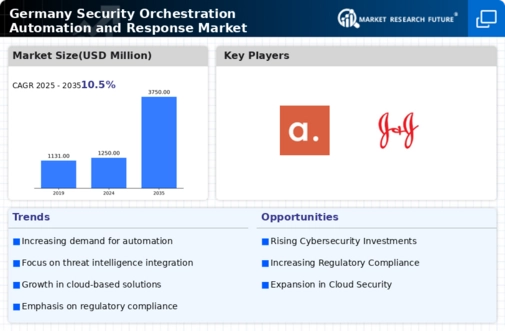
Germany Security Orchestration Automation Response Market Infographic
Purchase Options

Germany Security Orchestration Automation Response Market Summary

As per analysis, the Germany Security Orchestration Automation Response Market is projected to grow from USD 154.0 Million in 2024 to USD 418.88 Million by 2035, exhibiting a compound annual growth rate (CAGR) of 9.52% during the forecast period (2025 - 2035).

Key Market Trends & Highlights

The Germany security orchestration automation response market is experiencing a robust shift towards increased automation and compliance-driven solutions.

  • The Incident Response segment remains the largest, driven by the need for rapid and effective threat mitigation.
  • The Threat Intelligence segment is the fastest-growing, reflecting a heightened focus on proactive security measures.
  • On-Premises solutions continue to dominate, although Cloud-Based offerings are gaining traction due to their flexibility and scalability.
  • Rising cybersecurity threats and regulatory compliance requirements are key drivers propelling market growth.

Market Size & Forecast

2024 Market Size 154.0 (USD Million)
2035 Market Size 418.88 (USD Million)
CAGR (2025 - 2035) 9.52%

Major Players

IBM (DE), Splunk (DE), Palo Alto Networks (DE), ServiceNow (DE), Fortinet (DE), Cisco (DE), Rapid7 (DE), Sumo Logic (DE), LogRhythm (DE)

Our Impact
Enabled $4.3B Revenue Impact for Fortune 500 and Leading Multinationals
Partnering with 2000+ Global Organizations Each Year
30K+ Citations by Top-Tier Firms in the Industry

Germany Security Orchestration Automation Response Market Trends

The Germany Security Orchestration Automation Response Market is currently experiencing a notable evolution, driven by the increasing complexity of cyber threats and the necessity for organizations to enhance their incident response capabilities. As businesses in Germany face a growing array of security challenges, the demand for integrated solutions that streamline security operations is becoming more pronounced. This market appears to be characterized by a shift towards automation, enabling organizations to respond to incidents more swiftly and effectively. Furthermore, the emphasis on compliance with stringent data protection regulations in Germany is likely influencing the adoption of security orchestration tools, as companies seek to ensure they meet legal requirements while safeguarding sensitive information. In addition, the collaboration between public and private sectors in Germany seems to be fostering innovation within the security orchestration automation response market. Initiatives aimed at sharing threat intelligence and best practices are emerging, which may enhance the overall security posture of organizations. As the landscape continues to evolve, it is essential for stakeholders to remain vigilant and adaptable, ensuring that their security strategies align with the latest technological advancements and regulatory frameworks. The future of this market appears promising, with potential growth driven by advancements in artificial intelligence and machine learning, which could further enhance automation capabilities and incident response times.

Increased Automation in Incident Response

The trend towards automation in incident response is becoming increasingly evident within the germany security orchestration automation response market. Organizations are recognizing the need to streamline their security operations, allowing for quicker and more efficient responses to threats. This shift is likely driven by the complexity of modern cyber threats, which necessitate a more agile approach to security management.

Focus on Compliance and Data Protection

Compliance with data protection regulations is a critical concern for organizations in Germany. The emphasis on adhering to legal frameworks is influencing the adoption of security orchestration tools. Companies are increasingly seeking solutions that not only enhance their security posture but also ensure they meet stringent regulatory requirements, thereby protecting sensitive information.

Collaboration Between Sectors

The collaboration between public and private sectors in Germany is fostering innovation in the security orchestration automation response market. Initiatives aimed at sharing threat intelligence and best practices are emerging, which may enhance the overall security landscape. This cooperative approach is likely to strengthen the resilience of organizations against evolving cyber threats.

Germany Security Orchestration Automation Response Market Drivers

Rising Cybersecurity Threats

The increasing frequency and sophistication of cyber threats in Germany is a primary driver for the Germany security orchestration automation response market. As organizations face a growing number of cyberattacks, including ransomware and phishing, the demand for automated response solutions has surged. In 2025, it was reported that cyber incidents in Germany rose by 30 percent compared to the previous year, prompting businesses to seek advanced security measures. This trend indicates a pressing need for orchestration and automation tools that can efficiently manage and respond to security incidents, thereby enhancing overall cybersecurity posture. The urgency to protect sensitive data and maintain operational continuity is likely to propel investments in security orchestration automation response solutions across various sectors.

Regulatory Compliance Requirements

Germany's stringent regulatory landscape, particularly with the General Data Protection Regulation (GDPR), significantly influences the Germany security orchestration automation response market. Organizations are compelled to implement robust security measures to ensure compliance with data protection laws. Non-compliance can result in hefty fines and reputational damage, which drives the adoption of automated response solutions. In 2025, it was estimated that over 60 percent of German companies faced challenges in meeting compliance requirements, highlighting the necessity for effective orchestration tools. These tools not only streamline compliance processes but also enhance incident response capabilities, making them essential for organizations striving to adhere to legal standards while safeguarding sensitive information.

Integration of Advanced Technologies

The integration of advanced technologies such as artificial intelligence (AI) and machine learning (ML) is transforming the Germany security orchestration automation response market. These technologies enable organizations to analyze vast amounts of security data in real-time, facilitating quicker and more accurate incident responses. In 2025, it was projected that the adoption of AI-driven security solutions would increase by 40 percent among German enterprises. This shift indicates a growing recognition of the value that automation brings in enhancing threat detection and response times. As organizations seek to leverage these technologies, the demand for orchestration platforms that can seamlessly integrate AI and ML capabilities is likely to rise, further driving market growth.

Increased Investment in Cybersecurity

The heightened awareness of cybersecurity risks has led to increased investment in security solutions across Germany, significantly impacting the Germany security orchestration automation response market. In 2025, it was reported that German companies allocated an average of 15 percent of their IT budgets to cybersecurity initiatives, reflecting a commitment to enhancing their security infrastructure. This trend suggests that organizations are prioritizing the implementation of automated response systems to mitigate risks and improve incident management. As businesses recognize the importance of proactive security measures, the demand for orchestration and automation solutions is expected to grow, fostering a more resilient cybersecurity environment in Germany.

Growing Demand for Operational Efficiency

The pursuit of operational efficiency is a critical driver for the Germany security orchestration automation response market. Organizations are increasingly recognizing that manual incident response processes are not only time-consuming but also prone to human error. In 2025, studies indicated that companies utilizing automated response solutions experienced a 50 percent reduction in incident response times. This efficiency gain is compelling organizations to adopt orchestration tools that streamline workflows and enhance collaboration among security teams. As the need for rapid and effective incident management becomes more pronounced, the market for security orchestration automation response solutions is likely to expand, enabling organizations to respond to threats more effectively while optimizing resource allocation.

Market Segment Insights

By Application: Incident Response (Largest) vs. Threat Intelligence (Fastest-Growing)

In the German security orchestration automation response market, the application segment is primarily dominated by Incident Response, which has carved out a significant share due to the increasing frequency of cyber incidents that necessitate prompt remediation. Following closely is Threat Intelligence, which has been gaining traction as organizations recognize the value of proactive threat detections and insights. Compliance Management and Security Monitoring, while essential, hold smaller but stable shares, emphasizing the importance of regulatory needs and real-time surveillance in the sector.

Incident Response (Dominant) vs. Threat Intelligence (Emerging)

The Incident Response segment is characterized by its critical role in minimizing damage from security breaches, making it a dominant force in the market. Organizations are increasingly investing in comprehensive incident response solutions to strengthen their cyber resilience. Conversely, the Threat Intelligence segment is emerging rapidly as businesses strive to stay ahead of cyber threats by leveraging data analytics for better foresight. These solutions provide actionable intelligence that empowers security teams to anticipate and mitigate potential risks, thus becoming indispensable in a landscape marked by evolving cyber threats.

By Deployment Type: On-Premises (Largest) vs. Cloud-Based (Fastest-Growing)

In the Germany security orchestration automation response market, the market share distribution is characterized by a significant preference for On-Premises solutions, which currently hold the largest share. Organizations prioritize this deployment type due to its perceived reliability and control over sensitive data. Conversely, Cloud-Based solutions are rapidly gaining traction, appealing to businesses seeking flexibility and scalability in their operations, making them the fastest-growing segment in the market.

On-Premises (Dominant) vs. Cloud-Based (Emerging)

On-Premises solutions are dominated by traditional enterprises that seek robust security measures while maintaining complete control over their infrastructure. These solutions are characterized by their ability to integrate seamlessly within existing IT environments, providing tailored security automation that meets stringent compliance regulations. In contrast, Cloud-Based solutions represent an emerging trend, driven by the increasing demand for cost-effective and scalable security solutions. Organizations are increasingly adopting these systems to benefit from real-time updates and the ability to leverage advanced analytics offered by cloud providers, reflecting a shift towards more agile operational strategies.

By End User: Government (Largest) vs. Healthcare (Fastest-Growing)

In the Germany security orchestration automation response market, the government sector holds the largest share, driven by increasing investments in national security and public safety initiatives. This sector's emphasis on cybersecurity and threat intelligence is pivotal, ensuring the protection of critical infrastructure and sensitive data from cyber threats. In contrast, the healthcare sector is emerging rapidly, capitalizing on the need for enhanced security measures to protect patient data and comply with regulations. As healthcare institutions digitize, their reliance on automated security solutions is escalating, accounting for a burgeoning segment of the market.

Government: Dominant vs. Healthcare: Emerging

The government sector in Germany stands as a dominant force in the security orchestration automation response market, characterized by stringent regulations and a commitment to national security. Its investments focus on comprehensive security frameworks that integrate with existing infrastructures. Meanwhile, the healthcare sector represents an emerging area, driven by the increasing digitization of health records and the necessity to protect sensitive patient information. Automation in healthcare security enhances incident response capabilities, reduces human error, and ensures compliance with evolving regulations. As both sectors grow, the contrast between the government’s established protocols and the healthcare sector’s rapid adaptation to new technological solutions becomes increasingly pronounced.

By Organization Size: Large Enterprises (Largest) vs. Small Enterprises (Fastest-Growing)

In the Germany security orchestration automation response market, the distribution of market share among organization sizes reveals distinct dynamics. Large Enterprises currently hold the largest share, reflecting their substantial resources and established security frameworks. Their extensive data environments necessitate robust orchestration solutions to effectively manage and respond to security incidents. Meanwhile, Small Enterprises are emerging as a significant segment, harnessing new cloud-based solutions to streamline their security processes, thus increasing their market presence. Growth trends indicate that Small Enterprises are experiencing the fastest growth in adoption of security orchestration solutions. Factors driving this growth include an increasing awareness of cybersecurity threats, targeted solutions tailored to their needs, and a favorable shift towards affordable technologies. Conversely, Large Enterprises continue to invest heavily in advanced orchestration platforms, seeking to enhance their incident response times and integrate various security solutions seamlessly.

Large Enterprises: Dominant vs. Small Enterprises: Emerging

Large Enterprises in the Germany security orchestration automation response market play a dominant role, characterized by their extensive infrastructures and significant investments in advanced security technologies. Their orchestration frameworks are often complex, integrating multiple security tools to protect vast amounts of sensitive data. This intricate setup allows them to respond to sophisticated cyber threats effectively. In contrast, Small Enterprises are seen as an emerging segment, often adopting cloud-based security orchestration solutions that offer flexibility and scalability. These solutions are tailored to meet their unique challenges, allowing smaller organizations to enhance their security postures without the need for extensive IT resources. As cyber threats continue to evolve, the agility and cost-effectiveness of orchestration solutions are key drivers for Small Enterprises entering the market.

By Industry Vertical: Information Technology (Largest) vs. Telecommunications (Fastest-Growing)

In the Germany security orchestration automation response market, the Information Technology sector emerges as the largest industry vertical, capturing significant market share due to the increasing focus on cybersecurity and compliance. It is characterized by a diverse array of solutions and technologies aimed at protecting sensitive data and infrastructure. Meanwhile, the Telecommunications sector, while smaller in overall share, is noted for its rapid growth. This is primarily driven by the rising threats to telecom infrastructure and the necessity for robust security measures to safeguard communication networks.

Information Technology (Dominant) vs. Telecommunications (Emerging)

The Information Technology vertical stands as the dominant force in the Germany security orchestration automation response market, fueled by ongoing digital transformation initiatives and the critical need for advanced security protocols. Organizations within this sector prioritize investments in automation and orchestration to enhance their security posture, thus streamlining incident response processes. On the other hand, the Telecommunications sector is emerging as a key player, given its role in facilitating communication in an increasingly connected world. The sector faces unique challenges such as safeguarding communication networks against cyber threats, which propels demand for sophisticated security automation solutions. This dynamic interplay between IT and telecommunications underscores the evolving landscape of security needs in Germany.

Get more detailed insights about Germany Security Orchestration Automation Response Market

Key Players and Competitive Insights

The competitive dynamics within the security orchestration automation response market in Germany are characterized by a blend of innovation, strategic partnerships, and a focus on digital transformation. Key players such as IBM (DE), Palo Alto Networks (DE), and Cisco (DE) are actively shaping the landscape through their operational strategies. IBM (DE) emphasizes its commitment to AI-driven security solutions, which appears to enhance its market positioning. Meanwhile, Palo Alto Networks (DE) focuses on expanding its cloud security offerings, indicating a strategic pivot towards addressing the growing demand for secure cloud environments. Cisco (DE), on the other hand, is leveraging its extensive networking capabilities to integrate security solutions, suggesting a holistic approach to cybersecurity that encompasses both hardware and software solutions.

In terms of business tactics, companies are increasingly localizing their operations to better serve the German market. This localization may involve optimizing supply chains and enhancing customer support services. The market structure appears moderately fragmented, with several players vying for market share. However, the collective influence of major companies like IBM (DE) and Cisco (DE) suggests a competitive environment where innovation and strategic partnerships are paramount.

In December 2025, IBM (DE) announced a collaboration with a leading German telecommunications provider to enhance its security offerings through integrated AI solutions. This partnership is likely to bolster IBM's presence in the telecommunications sector, allowing it to provide tailored security solutions that address specific industry challenges. The strategic importance of this move lies in its potential to create a more robust security framework for telecommunications, which is increasingly vulnerable to cyber threats.

In November 2025, Palo Alto Networks (DE) launched a new suite of cloud security tools designed to protect enterprises against evolving cyber threats. This launch reflects the company's commitment to innovation and its understanding of the critical need for advanced security measures in cloud environments. The strategic significance of this development is underscored by the growing reliance on cloud services, suggesting that Palo Alto Networks (DE) is positioning itself as a leader in this vital area of cybersecurity.

In October 2025, Cisco (DE) unveiled a new initiative aimed at enhancing its security portfolio through the integration of machine learning technologies. This initiative is indicative of Cisco's strategy to stay ahead of the curve in cybersecurity, as machine learning can significantly improve threat detection and response times. The importance of this move cannot be overstated, as it aligns with the broader trend of leveraging advanced technologies to enhance security measures.

As of January 2026, the competitive trends in the market are increasingly defined by digitalization, AI integration, and sustainability. Strategic alliances are playing a crucial role in shaping the current landscape, as companies seek to combine their strengths to deliver comprehensive security solutions. Looking ahead, it appears that competitive differentiation will evolve from traditional price-based competition to a focus on innovation, technology, and supply chain reliability. This shift may redefine how companies approach market entry and customer engagement, emphasizing the need for agility and responsiveness in an ever-changing cybersecurity landscape.

Key Companies in the Germany Security Orchestration Automation Response Market include

Industry Developments

The Germany Security Orchestration Automation and Response Market has seen significant developments recently. Notable companies such as Cisco, Palo Alto Networks, and Fortinet are enhancing their cybersecurity offerings to address the rising demand for advanced security solutions in response to escalating cyber threats. The market is influenced by the growing recognition of the need for automated security measures and incident response capabilities, driven in part by rising security incidents in various sectors. In September 2023, Cisco announced the expansion of its security portfolio with new automation features aimed at improving response times. 

Additionally, Rapid7's growth strategy has focused on increasing its presence in Germany, with significant investments toward local R&D facilities. There have been no recent mergers or acquisitions reported among the specified companies within the last few months, although past activities indicated an ongoing trend of consolidation in the cybersecurity sector. Over the last two years, Germany has ramped up its government initiatives to bolster digital security, pushing companies toward advanced Security Orchestration Automation and Response solutions to comply with new regulatory standards. This shift is expected to increase market valuations and drive innovation further in the German market.

Future Outlook

Germany Security Orchestration Automation Response Market Future Outlook

The Germany security orchestration automation response market is projected to grow at a 9.52% CAGR from 2025 to 2035, driven by increasing cyber threats and demand for operational efficiency.

New opportunities lie in:

  • Integration of AI-driven threat intelligence platforms
  • Development of customizable automation workflows for SMEs
  • Expansion of managed security service offerings for compliance needs

By 2035, the market is expected to be robust, driven by innovation and strategic partnerships.

Market Segmentation

Germany Security Orchestration Automation Response Market End User Outlook

  • Government
  • Healthcare
  • Financial Services
  • Retail

Germany Security Orchestration Automation Response Market Application Outlook

  • Incident Response
  • Threat Intelligence
  • Security Monitoring
  • Compliance Management

Germany Security Orchestration Automation Response Market Deployment Type Outlook

  • On-Premises
  • Cloud-Based
  • Hybrid

Germany Security Orchestration Automation Response Market Industry Vertical Outlook

  • Information Technology
  • Telecommunications
  • Manufacturing
  • Energy

Germany Security Orchestration Automation Response Market Organization Size Outlook

  • Small Enterprises
  • Medium Enterprises
  • Large Enterprises

Report Scope

MARKET SIZE 2024154.0(USD Million)
MARKET SIZE 2025170.18(USD Million)
MARKET SIZE 2035418.88(USD Million)
COMPOUND ANNUAL GROWTH RATE (CAGR)9.52% (2024 - 2035)
REPORT COVERAGERevenue Forecast, Competitive Landscape, Growth Factors, and Trends
BASE YEAR2024
Market Forecast Period2025 - 2035
Historical Data2019 - 2024
Market Forecast UnitsUSD Million
Key Companies ProfiledIBM (DE), Splunk (DE), Palo Alto Networks (DE), ServiceNow (DE), Fortinet (DE), Cisco (DE), Rapid7 (DE), Sumo Logic (DE), LogRhythm (DE)
Segments CoveredApplication, Deployment Type, End User, Organization Size, Industry Vertical
Key Market OpportunitiesIntegration of artificial intelligence in the germany security orchestration automation response market enhances threat detection and response efficiency.
Key Market DynamicsGrowing emphasis on regulatory compliance drives demand for advanced security orchestration automation response solutions in Germany.
Countries CoveredGermany
Leave a Comment

FAQs

What is the current valuation of the Germany security orchestration automation response market?

As of 2024, the market valuation was 154.0 USD Million.

What is the projected market size for the Germany security orchestration automation response market by 2035?

The market is projected to reach 418.88 USD Million by 2035.

What is the expected CAGR for the Germany security orchestration automation response market during the forecast period?

The expected CAGR for the market from 2025 to 2035 is 9.52%.

Which companies are considered key players in the Germany security orchestration automation response market?

Key players include IBM, Splunk, Palo Alto Networks, ServiceNow, Fortinet, Cisco, Rapid7, Sumo Logic, and LogRhythm.

What are the main application segments in the Germany security orchestration automation response market?

The main application segments include Incident Response, Threat Intelligence, Security Monitoring, and Compliance Management.

How does the market perform in terms of deployment types?

The market is segmented into On-Premises, Cloud-Based, and Hybrid deployment types, with Cloud-Based expected to dominate.

What are the end-user segments in the Germany security orchestration automation response market?

End-user segments include Government, Healthcare, Financial Services, and Retail.

What is the market outlook for small, medium, and large enterprises in this sector?

The market shows potential growth across all organization sizes, with large enterprises projected to lead in market share.

Which industry verticals are driving growth in the Germany security orchestration automation response market?

Key industry verticals include Information Technology, Telecommunications, Manufacturing, and Energy.

What is the expected growth trend for the security orchestration automation response market in Germany?

The market is likely to experience robust growth, driven by increasing demand for security solutions across various sectors.

Download Free Sample

Kindly complete the form below to receive a free sample of this Report

Compare Licence

×
Features License Type
Single User Multiuser License Enterprise User
Price $4,950 $5,950 $7,250
Maximum User Access Limit 1 User Upto 10 Users Unrestricted Access Throughout the Organization
Free Customization
Direct Access to Analyst
Deliverable Format
Platform Access
Discount on Next Purchase 10% 15% 15%
Printable Versions