×
Request Free Sample ×

Kindly complete the form below to receive a free sample of this Report

* Please use a valid business email

Leading companies partner with us for data-driven Insights

clients tt-cursor
Hero Background

Germany Nanomedicine Market

ID: MRFR/HC/51704-HCR
200 Pages
Rahul Gotadki
February 2026

Germany Nanomedicine Market Research Report: Size, Share, Trend Analysis By Applications (Drug Delivery, Diagnostic Imaging, Therapeutic Applications, Regenerative Medicine), By Types (Nanoparticles, Nanoshells, Nanorobots, Nanocapsules), By End Use (Pharmaceuticals, Biotechnology, Healthcare, Research Laboratories) and By Technology (Targeted Drug Delivery, Nanocarriers, Nanotherapeutics, Nanodiagnostics) - Growth Outlook & Industry Forecast 2025 To 2035

Share:
Download PDF ×

We do not share your information with anyone. However, we may send you emails based on your report interest from time to time. You may contact us at any time to opt-out.

Germany Nanomedicine Market Infographic
Purchase Options

Germany Nanomedicine Market Summary

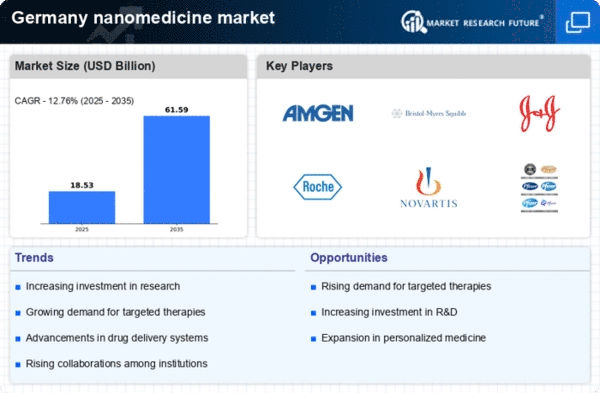
As per Market Research Future analysis, the Germany nanomedicine market Size was estimated at 16.43 USD Billion in 2024. The Germany nanomedicine market is projected to grow from 18.53 USD Billion in 2025 to 61.59 USD Billion by 2035, exhibiting a compound annual growth rate (CAGR) of 12.7% during the forecast period 2025 - 2035

Key Market Trends & Highlights

The Germany nanomedicine market is poised for substantial growth driven by technological advancements and increasing healthcare demands.

  • Advancements in drug delivery systems are enhancing the efficacy of treatments in the nanomedicine sector.
  • The oncology segment remains the largest, while the regenerative medicine segment is emerging as the fastest-growing area.
  • Regulatory evolution and safety standards are shaping the landscape of nanomedicine in Germany.
  • Rising demand for targeted therapies and investment in research and development are key drivers propelling market growth.

Market Size & Forecast

2024 Market Size 16.43 (USD Billion)
2035 Market Size 61.59 (USD Billion)
CAGR (2025 - 2035) 12.76%

Major Players

Amgen Inc (US), Bristol-Myers Squibb Company (US), Johnson & Johnson (US), Roche Holding AG (CH), Novartis AG (CH), Pfizer Inc (US), Merck & Co Inc (US), Sanofi (FR), AstraZeneca PLC (GB)

Our Impact
Enabled $4.3B Revenue Impact for Fortune 500 and Leading Multinationals
Partnering with 2000+ Global Organizations Each Year
30K+ Citations by Top-Tier Firms in the Industry

Germany Nanomedicine Market Trends

The nanomedicine market is currently experiencing a transformative phase, characterized by rapid advancements in technology and increasing investment in research and development. This evolution is driven by the growing demand for targeted therapies and personalized medicine, which are becoming increasingly vital in the treatment of various diseases. In Germany, the integration of nanotechnology into medical applications is fostering innovative solutions that enhance drug delivery systems, improve diagnostic techniques, and facilitate regenerative medicine. The collaboration between academic institutions and industry players is particularly noteworthy, as it promotes the translation of research findings into practical applications, thereby accelerating the development of novel therapies. Moreover, regulatory frameworks in Germany are adapting to accommodate the unique challenges posed by nanomedicine. This adaptability is crucial for ensuring safety and efficacy while fostering innovation. The emphasis on ethical considerations and public acceptance is also shaping the landscape of the nanomedicine market. As stakeholders navigate these complexities, the potential for growth remains substantial, with ongoing research likely to yield breakthroughs that could redefine treatment paradigms. The future of this market appears promising, as advancements in nanotechnology continue to unlock new possibilities for improving patient outcomes and enhancing healthcare delivery.

Advancements in Drug Delivery Systems

Innovations in nanotechnology are leading to the development of sophisticated drug delivery systems that enhance the efficacy of treatments. These systems allow for targeted delivery of therapeutics, minimizing side effects and improving patient compliance. In Germany, research institutions are focusing on creating nanoparticles that can navigate biological barriers, ensuring that medications reach their intended sites of action more effectively.

Regulatory Evolution and Safety Standards

The regulatory landscape surrounding the nanomedicine market is evolving to address the unique challenges posed by nanotechnology. In Germany, authorities are working to establish comprehensive safety standards that ensure the responsible development and application of nanomedicine. This evolution is crucial for fostering public trust and encouraging investment in innovative therapies.

Collaboration Between Academia and Industry

There is a notable trend of collaboration between academic institutions and industry players in the nanomedicine market. In Germany, partnerships are being formed to facilitate the translation of research into practical applications. This synergy is essential for driving innovation and accelerating the development of new therapies, ultimately benefiting patients and healthcare systems.

Germany Nanomedicine Market Drivers

Supportive Regulatory Framework

Germany's supportive regulatory framework is playing a pivotal role in the growth of the nanomedicine market. The regulatory bodies are actively working to streamline the approval processes for nanomedicine products, ensuring that they meet safety and efficacy standards while facilitating timely market entry. This proactive approach is encouraging innovation and investment in the sector, as companies feel more confident in navigating the regulatory landscape. Furthermore, the establishment of clear guidelines for the development and commercialization of nanomedicine products is fostering a conducive environment for research and collaboration. As a result, the nanomedicine market is expected to benefit from an influx of new products and technologies, enhancing its overall competitiveness.

Rising Demand for Targeted Therapies

The increasing prevalence of chronic diseases in Germany is driving the demand for targeted therapies, which are a hallmark of the nanomedicine market. As healthcare providers seek more effective treatment options, the ability of nanomedicine to deliver drugs directly to affected cells is becoming increasingly appealing. Reports indicate that the market for targeted therapies is expected to grow at a CAGR of approximately 10% over the next five years. This growth is likely to be fueled by advancements in nanotechnology, which enhance the efficacy and safety of treatments. Consequently, the rising demand for these therapies is propelling the expansion of the nanomedicine market in Germany, as stakeholders aim to meet the needs of an aging population and improve patient outcomes.

Aging Population and Healthcare Needs

The demographic shift in Germany, characterized by an aging population, is creating a pressing need for innovative healthcare solutions, particularly in the nanomedicine market. As the elderly population grows, the incidence of age-related diseases such as cancer, cardiovascular disorders, and neurodegenerative conditions is expected to rise. This trend necessitates the development of advanced therapeutic options that can address complex health issues effectively. The nanomedicine market is poised to respond to these challenges by offering targeted and personalized treatment modalities. It is estimated that the market could expand by over 15% in the next few years, driven by the urgent healthcare needs of this demographic.

Investment in Research and Development

Germany's commitment to innovation is evident in its substantial investment in research and development (R&D) within the nanomedicine market. The government and private sector are channeling significant funds into R&D initiatives, with expenditures reaching approximately €3 billion annually. This investment is aimed at fostering breakthroughs in drug formulation, delivery systems, and diagnostic tools. As a result, the landscape of nanomedicine is evolving rapidly, with new products and technologies emerging that promise to enhance treatment efficacy. The focus on R&D not only supports the growth of the nanomedicine market but also positions Germany as a leader in the field, attracting international collaborations and partnerships.

Technological Advancements in Nanotechnology

Technological advancements in nanotechnology are significantly influencing the nanomedicine market in Germany. Innovations in nanomaterials, such as nanoparticles and nanocarriers, are enhancing drug delivery systems, making them more efficient and effective. These advancements are not only improving the bioavailability of drugs but also reducing side effects, which is crucial for patient compliance. The integration of artificial intelligence and machine learning in the development of nanomedicine is also gaining traction, potentially revolutionizing the way treatments are designed and administered. As these technologies continue to evolve, they are likely to propel the growth of the nanomedicine market, with projections indicating a potential market size increase of €1 billion by 2027.


Market Segment Insights

By Application: Drug Delivery (Largest) vs. Diagnostic Imaging (Fastest-Growing)

In the Germany nanomedicine market, the application segment is predominantly led by Drug Delivery, which holds a substantial share. This segment has established itself as a critical component in therapeutic strategies, facilitating the targeted delivery of active substances. Following this, Diagnostic Imaging is gaining traction, increasingly recognized for its innovative approaches to visualizing diseases at the molecular level. Current growth trends indicate a rapidly expanding market, particularly for Diagnostic Imaging, driven by technological advancements and heightened demand for early diagnosis. The emphasis on personalized medicine is also propelling growth in Drug Delivery, as more efficient drug formulations enhance efficacy and reduce side effects. Collaborations between research institutions and pharmaceutical companies are key factors boosting this segment’s expansion.

Drug Delivery (Dominant) vs. Regenerative Medicine (Emerging)

Drug Delivery continues to dominate the application segment due to its established methodologies and integration into various therapeutic contexts. This approach minimizes side effects and enhances drug efficacy through targeted administration. On the other hand, Regenerative Medicine is an emerging application, highlighting the potential of nanotechnology to aid tissue repair and regenerative processes. While Drug Delivery benefits from extensive research and development, Regenerative Medicine is gaining interest due to breakthroughs in stem cell research and tissue engineering. The synergy between these segments illustrates a promising future where advancements in nanotechnology may lead to transformative therapies that significantly improve patient outcomes.

By Type: Nanoparticles (Largest) vs. Nanorobots (Fastest-Growing)

Within the Germany nanomedicine market, nanoparticles dominate the market share, owing to their extensive applications in drug delivery systems, imaging, and diagnostics. Nanoshells and nanocapsules follow, primarily due to their specific functionalities in targeted therapy and enhanced bioavailability. However, while nanoparticles hold the largest share, nanorobots are emerging as a revolutionary segment with potential to disrupt traditional methodologies across multiple therapeutic areas. The growth trends in this segment are primarily driven by advancements in nanotechnology, increased investment in research and development, and the rising prevalence of chronic diseases necessitating innovative treatment solutions. As healthcare systems evolve, the demand for more efficient, targeted, and minimally invasive therapies continues to surge, placing nanorobots in the spotlight as the fastest-growing category due to their cutting-edge capabilities in performing precise drug delivery and cellular repair tasks.

Nanoparticles (Dominant) vs. Nanoshells (Emerging)

Nanoparticles are characterized by their ability to alter physical and chemical properties at the nanoscale, making them crucial in enhancing the efficacy of drugs while minimizing side effects. Their dominance in the market is backed by extensive research and a wide array of applications across various medical fields, including oncology and neurology. On the other hand, nanoshells are gaining traction as an emerging technology due to their unique properties that allow for specific targeting of cancer cells, thus improving therapeutic outcomes. As the demand for personalized medicine grows, nanoshells are expected to gain significant attention and investment, positioning them as a formidable contender in the evolving landscape of nanomedicine.

By End-use: Pharmaceuticals (Largest) vs. Biotechnology (Fastest-Growing)

In the Germany nanomedicine market, the end-use segment is prominently led by Pharmaceuticals, which accounts for a significant share due to the sector's robust demand for innovative therapies and treatments. This segment continues to strengthen its position, driven by advancements in drug delivery systems and the integration of nanotechnology in pharmacology. Conversely, Biotechnology is emerging as the fastest-growing segment, propelled by growing investments in biopharmaceuticals and increased research and development activities focusing on nanomedicine applications. The growth trends in this segment are primarily influenced by the rising prevalence of chronic diseases, where nanomedicine plays a crucial role in providing targeted therapies. Research laboratories are also crucial as they conduct essential studies that ultimately enhance product development in Pharmaceuticals and Biotechnology. This synergy fosters innovation and leads to significant advancements in healthcare, confirming the critical role of each segment in the overall growth of the Germany nanomedicine market.

Biotechnology: Pharmaceuticals (Dominant) vs. Biotechnology (Emerging)

Pharmaceuticals, as the dominant segment, is characterized by its extensive utilization of nanotechnology for drug formulation and delivery. It remains the key focus of major players in the market, thanks to its established infrastructures and significant investments in research and development. Meanwhile, Biotechnology represents an emerging segment that is rapidly gaining traction. This sector is characterized by ambitious startups and research entities focused on developing novel therapeutic approaches and diagnostic tools utilizing nanomedicine. The synergy between these segments not only enhances the efficiency of medical solutions available but also fosters a regenerative healthcare environment that leverages cutting-edge technologies to improve patient outcomes.

By Technology: Targeted Drug Delivery (Largest) vs. Nanocarriers (Fastest-Growing)

The market for technology-based solutions in the Germany nanomedicine market is predominantly led by the Targeted Drug Delivery segment, which holds the largest market share among its counterparts. This segment's success can be attributed to advancements in therapeutic efficacy and the ability to minimize side effects. The other segment values, namely Nanocarriers, Nanotherapeutics, and Nanodiagnostics, significantly contribute to the overall market dynamics but trail behind in terms of market penetration and visibility among healthcare practitioners. Looking ahead, the growth of the technology segment is bolstered by increased investment in research and development, coupled with a rising demand for more personalized medicine options. Innovations in nanotechnology are paving the way for new applications that enhance drug delivery mechanisms, increase diagnostic accuracy, and improve therapeutic outcomes. As stakeholders continuously explore new frontiers in nanomedicine, the potential for rapid growth, particularly in the Nanocarriers segment, is evident as they become integral to modern healthcare solutions.

Technology: Targeted Drug Delivery (Dominant) vs. Nanocarriers (Emerging)

Targeted Drug Delivery stands as a dominant force within the Germany nanomedicine market, showcasing its ability to enhance the precision of therapeutic interventions. This segment utilizes nanotechnology to transport drugs directly to diseased cells, improving treatment effectiveness while minimizing damage to healthy tissues. On the other hand, Nanocarriers represent the emerging segment, characterized by innovative composition and functionality that facilitate drug transport across biological barriers. These systems are evolving rapidly, attracting significant interest due to their potential to revolutionize drug delivery methods in various fields, including oncology and neurology. The convergence of these two technologies is expected to drive significant advancements and collaboration in the healthcare landscape.

Get more detailed insights about Germany Nanomedicine Market

Key Players and Competitive Insights

The nanomedicine market in Germany is characterized by a dynamic competitive landscape, driven by rapid advancements in technology and increasing demand for targeted therapies. Key players such as Roche Holding AG (CH), Pfizer Inc (US), and Novartis AG (CH) are at the forefront, leveraging their extensive research capabilities and innovative product pipelines. Roche, for instance, focuses on personalized medicine, which aligns with the growing trend towards tailored therapeutic solutions. Meanwhile, Pfizer emphasizes strategic partnerships to enhance its nanomedicine portfolio, indicating a collaborative approach to innovation. Collectively, these strategies contribute to a competitive environment that is increasingly focused on technological advancement and patient-centric solutions.In terms of business tactics, companies are increasingly localizing manufacturing to enhance supply chain efficiency and reduce costs. This trend is particularly evident in the moderately fragmented structure of the market, where smaller firms often collaborate with larger entities to optimize their operations. The collective influence of major players like Amgen Inc (US) and AstraZeneca PLC (GB) further shapes the market dynamics, as they engage in strategic mergers and acquisitions to bolster their market positions.

In October Roche Holding AG (CH) announced a collaboration with a leading German university to develop novel nanocarriers for drug delivery. This partnership aims to enhance the efficacy of existing therapies, showcasing Roche's commitment to innovation in nanomedicine. The strategic importance of this collaboration lies in its potential to accelerate the development of cutting-edge treatments, thereby reinforcing Roche's competitive edge in the market.

In September Pfizer Inc (US) launched a new nanomedicine platform designed to improve the delivery of biologics. This initiative reflects Pfizer's ongoing investment in research and development, aiming to address the challenges associated with traditional drug delivery methods. The significance of this launch is underscored by its potential to expand Pfizer's therapeutic offerings and enhance patient outcomes, positioning the company favorably in a competitive landscape.

In August Novartis AG (CH) entered into a strategic alliance with a biotech firm specializing in nanotechnology to co-develop targeted therapies for oncology. This move not only diversifies Novartis's product pipeline but also highlights the increasing importance of strategic alliances in the nanomedicine sector. The collaboration is expected to yield innovative solutions that could redefine treatment paradigms in cancer care.

As of November the competitive trends in the nanomedicine market are increasingly defined by digitalization, sustainability, and the integration of artificial intelligence (AI) into research and development processes. Strategic alliances are becoming pivotal in shaping the landscape, as companies seek to pool resources and expertise to drive innovation. Looking ahead, competitive differentiation is likely to evolve from traditional price-based competition towards a focus on technological innovation, reliability in supply chains, and the development of sustainable practices. This shift underscores the necessity for companies to adapt and innovate continuously to maintain their competitive positions.

Key Companies in the Germany Nanomedicine Market include

Industry Developments

Recent developments in the Germany Nanomedicine Market have seen significant advancements, particularly in innovative therapies and diagnostics. Companies such as Siemens Healthineers and Roche have been actively improving their offerings to leverage nanotechnology effectively. Additionally, CureVac has been in the spotlight for its mRNA technology, notably in vaccine development, attracting attention and investment. The market has demonstrated robust growth, amplified by an increased focus on precision medicine, with major players like Bayer and Novartis flying high with promising clinical trials and product launches.

In terms of mergers and acquisitions, Evonik Industries made headlines in June 2023 when it acquired a biotechnology firm specializing in nanomedicine, strengthening its portfolio in drug delivery systems. Furthermore, in August 2023, Merck KGaA announced a strategic partnership with a German startup focused on nanomaterials for biomedical applications, aiming to enhance therapeutic solutions. These activities indicate a vibrant nanomedicine sector in Germany, bolstered by innovation and collaboration among key companies, contributing positively to the market's valuation and its potential impact on healthcare solutions.

The combined efforts in Research and Development signify a commitment to addressing modern healthcare challenges through nanotechnology advancements.

Future Outlook

Germany Nanomedicine Market Future Outlook

The Nanomedicine Market in Germany is projected to grow at a 12.76% CAGR from 2025 to 2035, driven by technological advancements, increasing healthcare investments, and rising demand for targeted therapies.

New opportunities lie in:

  • Development of personalized nanomedicine solutions for chronic diseases
  • Investment in nanotechnology-based drug delivery systems
  • Partnerships with biotech firms for innovative therapeutic applications

By 2035, the nanomedicine market is expected to achieve substantial growth and innovation.

Market Segmentation

Germany Nanomedicine Market Type Outlook

  • Nanoparticles
  • Nanoshells
  • Nanorobots
  • Nanocapsules

Germany Nanomedicine Market End-use Outlook

  • Pharmaceuticals
  • Biotechnology
  • Healthcare
  • Research Laboratories

Germany Nanomedicine Market Technology Outlook

  • Targeted Drug Delivery
  • Nanocarriers
  • Nanotherapeutics
  • Nanodiagnostics

Germany Nanomedicine Market Application Outlook

  • Drug Delivery
  • Diagnostic Imaging
  • Therapeutic Applications
  • Regenerative Medicine

Report Scope

MARKET SIZE 2024 16.43(USD Billion)
MARKET SIZE 2025 18.53(USD Billion)
MARKET SIZE 2035 61.59(USD Billion)
COMPOUND ANNUAL GROWTH RATE (CAGR) 12.76% (2025 - 2035)
REPORT COVERAGE Revenue Forecast, Competitive Landscape, Growth Factors, and Trends
BASE YEAR 2024
Market Forecast Period 2025 - 2035
Historical Data 2019 - 2024
Market Forecast Units USD Billion
Key Companies Profiled Amgen Inc (US), Bristol-Myers Squibb Company (US), Johnson & Johnson (US), Roche Holding AG (CH), Novartis AG (CH), Pfizer Inc (US), Merck & Co Inc (US), Sanofi (FR), AstraZeneca PLC (GB)
Segments Covered Application, Type, End-use, Technology
Key Market Opportunities Advancements in targeted drug delivery systems enhance therapeutic efficacy in the nanomedicine market.
Key Market Dynamics Rising investment in Research and Development drives innovation in the nanomedicine market, enhancing treatment efficacy and safety.
Countries Covered Germany
Leave a Comment

FAQs

What is the projected market size of the Germany Nanomedicine Market in 2024?

The Germany Nanomedicine Market is expected to be valued at 3.6 USD Billion in 2024.

What is the expected market size of the Germany Nanomedicine Market by 2035?

By 2035, the overall market is anticipated to reach 8.3 USD Billion.

What is the expected CAGR for the Germany Nanomedicine Market from 2025 to 2035?

The market is projected to grow at a CAGR of 7.89% from 2025 to 2035.

Which application segment leads in the market size for Drug Delivery in 2024?

The Drug Delivery segment is valued at 1.174 USD Billion in the year 2024.

What will be the market value for the Diagnostic Imaging segment in 2035?

The Diagnostic Imaging segment is expected to be valued at 1.692 USD Billion by 2035.

What is the projected value for Therapeutic Applications in 2024?

In 2024, Therapeutic Applications are projected to be valued at 0.783 USD Billion.

What market size is anticipated for Regenerative Medicine in 2035?

Regenerative Medicine is expected to reach a market size of 2.015 USD Billion in 2035.

Who are the key players in the Germany Nanomedicine Market?

Key players include Siemens Healthineers, Bayer, Roche, and Novartis among others.

What are the expected growth drivers for the Germany Nanomedicine Market?

The growth drivers include technological advancements and increasing demand for targeted therapies.

How does the current global scenario impact the Germany Nanomedicine Market?

Current global dynamics are expected to influence regulations and market opportunities within the sector.

Download Free Sample

Kindly complete the form below to receive a free sample of this Report

Compare Licence

×
Features License Type
Single User Multiuser License Enterprise User
Price $4,950 $5,950 $7,250
Maximum User Access Limit 1 User Upto 10 Users Unrestricted Access Throughout the Organization
Free Customization
Direct Access to Analyst
Deliverable Format
Platform Access
Discount on Next Purchase 10% 15% 15%
Printable Versions