×
Request Free Sample ×

Kindly complete the form below to receive a free sample of this Report

* Please use a valid business email

Leading companies partner with us for data-driven Insights

clients tt-cursor
Hero Background

Germany Modular Data Center Market

ID: MRFR/ICT/59397-HCR
200 Pages
Aarti Dhapte
February 2026

Germany Modular Data Center Market Size, Share and Research Report: By Component (Functional Module, Services), By Data Center Size (Mid-Sized, Large Enterprise), By Tier Type (Tier 4, Tier 3, Tier 2, Tier 1), and By End User (BFSI, IT and Telecom, Healthcare)- Industry Forecast to 2035

Share:
Download PDF ×

We do not share your information with anyone. However, we may send you emails based on your report interest from time to time. You may contact us at any time to opt-out.

Germany Modular Data Center Market Infographic
Purchase Options

Germany Modular Data Center Market Summary

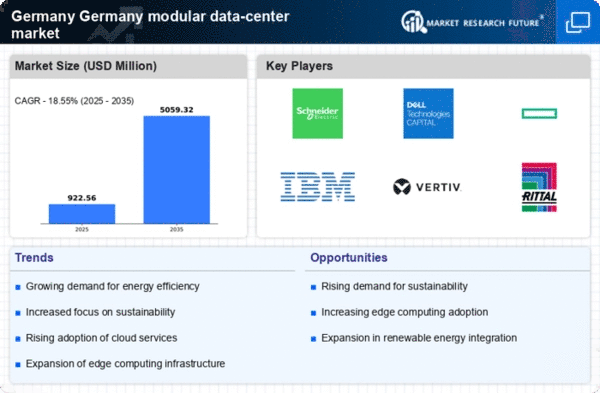
As per Market Research Future analysis, the Germany Modular Data Center Market size was estimated at 778.2 USD Million in 2024. The Modular Data-center market is projected to grow from 922.56 USD Million in 2025 to 5059.32 USD Million by 2035, exhibiting a compound annual growth rate (CAGR) of 18.5% during the forecast period 2025 - 2035

Key Market Trends & Highlights

The Germany modular data-center market is experiencing a robust growth trajectory driven by sustainability and technological advancements.

  • Sustainability initiatives are increasingly shaping the design and operation of modular data centers in Germany.
  • Rapid deployment solutions are becoming essential as businesses seek to enhance operational efficiency and reduce time-to-market.
  • The largest segment in the market is driven by the growing demand for edge computing. In contrast, the fastest-growing segment focuses on cost efficiency and scalability.
  • Key market drivers include government incentives for digital infrastructure and the increased focus on data security.

Market Size & Forecast

2024 Market Size 778.2 (USD Million)
2035 Market Size 5059.32 (USD Million)
CAGR (2025 - 2035) 18.55%

Major Players

Schneider Electric (FR), Dell Technologies (US), Hewlett Packard Enterprise (US), IBM (US), Vertiv (US), Rittal (DE), Huawei (CN), Cisco Systems (US), EdgeConneX (US)

Our Impact
Enabled $4.3B Revenue Impact for Fortune 500 and Leading Multinationals
Partnering with 2000+ Global Organizations Each Year
30K+ Citations by Top-Tier Firms in the Industry

Germany Modular Data Center Market Trends

The Germany Modular Data Center Market is currently experiencing a notable transformation. This change is driven by the increasing demand for efficient and flexible computing solutions. In Germany, the emphasis on sustainability and energy efficiency is particularly pronounced, as organizations seek to reduce their carbon footprints while maintaining high-performance standards. This shift is reflected in the growing adoption of innovative technologies, such as advanced cooling systems and renewable energy sources, which are becoming integral to the design and operation of modular data centers. Furthermore, the regulatory landscape in Germany encourages the development of energy-efficient infrastructure, aligning with the country's broader environmental goals. In addition to sustainability, the modular data-center market is witnessing a surge in demand for rapid deployment capabilities. Businesses are increasingly looking for solutions that can be quickly implemented to meet their evolving needs. This trend is particularly relevant in sectors such as telecommunications and cloud services, where agility and scalability are paramount. The modular approach allows for easy expansion and reconfiguration, making it an attractive option for organizations aiming to stay competitive in a fast-paced digital environment. Overall, the modular data-center market in Germany is poised for continued growth, driven by technological advancements and a strong focus on sustainability.

Sustainability Initiatives

The modular data-center market is increasingly influenced by sustainability initiatives. Companies are prioritizing energy-efficient designs and renewable energy sources to minimize environmental impact. This trend aligns with Germany's commitment to reducing greenhouse gas emissions and promoting eco-friendly practices.

Rapid Deployment Solutions

There is a growing demand for rapid deployment solutions within the modular data-center market. Organizations require flexible infrastructure that can be quickly set up to adapt to changing business needs. This trend is particularly relevant in sectors that prioritize speed and scalability.

Regulatory Support

The regulatory environment in Germany is fostering the growth of the modular data-center market. Government policies are encouraging investments in energy-efficient technologies and infrastructure. This support is likely to enhance the market's development and attract further innovation.

Germany Modular Data Center Market Drivers

Cost Efficiency and Scalability

Cost efficiency remains a significant driver for the modular data-center market. Organizations in Germany are increasingly drawn to modular solutions due to their ability to reduce capital expenditures and operational costs. Modular data centers allow for incremental scaling, enabling businesses to expand their infrastructure in alignment with demand. This flexibility is particularly appealing in a competitive market where financial prudence is paramount. Reports indicate that companies can achieve up to 30% savings in operational costs by adopting modular designs compared to traditional data centers. As the need for scalable solutions grows, the modular data-center market is likely to see heightened interest from enterprises looking to optimize their IT investments.

Increased Focus on Data Security

Data security concerns are becoming increasingly prominent, influencing the modular data-center market. As cyber threats evolve, organizations in Germany are prioritizing secure data storage and processing solutions. Modular data centers offer enhanced security features, including physical security measures and advanced encryption technologies. This focus on security is particularly relevant for industries such as finance and healthcare, where data protection is paramount. The modular data-center market is likely to see growth as companies seek to implement robust security protocols. It is estimated that investments in secure modular solutions could increase by 25% over the next few years, reflecting the urgent need for businesses to safeguard sensitive information.

Growing Demand for Edge Computing

The increasing reliance on edge computing is a pivotal driver for the modular data-center market. As businesses in Germany seek to enhance data processing capabilities closer to the source, modular data centers offer a flexible and efficient solution. This trend is particularly pronounced in sectors such as manufacturing and automotive, where real-time data analysis is crucial. The modular data-center market is projected to grow at a CAGR of approximately 15% over the next five years, driven by the need for low-latency processing and improved operational efficiency. Companies are increasingly investing in modular solutions to meet the demands of IoT applications and smart technologies, which require robust infrastructure to support vast amounts of data generated at the edge.

Technological Advancements in Cooling Solutions

Innovations in cooling technologies are driving the modular data-center market forward. Efficient cooling systems are essential for maintaining optimal performance and energy efficiency in data centers. In Germany, advancements such as liquid cooling and free cooling techniques are becoming increasingly popular. These technologies not only enhance energy efficiency but also reduce the overall carbon footprint of data centers. The modular data-center market is expected to benefit from these developments, as companies prioritize sustainability and the energy efficiency. With energy costs rising, the adoption of advanced cooling solutions could lead to a reduction in energy consumption by up to 40%, making modular data centers a more attractive option for businesses aiming to lower operational costs.

Government Incentives for Digital Infrastructure

Government initiatives aimed at enhancing digital infrastructure are a key driver for the modular data-center market. In Germany, policies promoting digitalization and technological innovation are encouraging investments in modular solutions. These initiatives often include financial incentives, grants, and tax benefits for companies that adopt advanced data center technologies. As the government emphasizes the importance of digital transformation, the modular data-center market is poised for growth. It is anticipated that public sector investments in digital infrastructure could reach €1 billion by 2027, further stimulating demand for modular data centers. This supportive regulatory environment is likely to attract both domestic and international players to the market.


Market Segment Insights

By Components: Functional Modules (Largest) vs. Services (Fastest-Growing)

In the Germany modular data-center market, Functional Modules continue to dominate the landscape, holding a significant market share compared to Services. These modules encompass critical hardware components, which facilitate efficient operations and robust performance. Services, while smaller in market share, are rapidly gaining traction as organizations increasingly recognize the value of comprehensive support solutions. The demand for customizability and integration of services is on the rise, reflecting the shifting focus of businesses towards enhanced operational efficiency. The growth trends in this segment are driven by several factors, including the continuous advancements in technology and the need for scalable solutions. As more enterprises adopt modular data centers, there is a growing reliance on flexible and adaptive service options. This trend is expected to foster innovation in service offerings, leading to increased investments. Moreover, the rise of hybrid IT environments is creating new opportunities for service providers to enhance their portfolios, further propelling the growth of Services within the modular data-center landscape.

Functional Modules (Dominant) vs. Services (Emerging)

The Functional Modules segment is characterized by its crucial role in ensuring the optimal performance of modular data centers. These modules integrate key components such as cooling systems, power supplies, and racks, which are essential for maintaining operational efficiency. Their well-established market presence allows for easy adaptation and scaling to meet growing demands. On the other hand, Services represent an emerging growth area that focuses on providing end-to-end support, including installation, maintenance, and consultancy. As enterprises increasingly seek to streamline operations and reduce downtime, the reliance on both segments is becoming more pronounced. This dynamic poses an exciting opportunity for service providers to innovate while keeping pace with the performance-driven needs of the Functional Modules that dominate the sector.

By Data Center Size: Large Enterprises (Largest) vs. Mid-Sized (Fastest-Growing)

In the Germany modular data-center market, the distribution of market share shows that Large Enterprises hold the largest segment, benefiting from robust demand for high-capacity solutions. This segment's growth is bolstered by the increasing need for scalable, efficient data processing facilities as businesses embrace digital transformation. On the other hand, Mid-Sized facilities are rapidly gaining traction as more businesses look to adopt modular solutions that are flexible and cost-effective. The trend towards mid-sized data centers reflects a shift in scalability needs, particularly among mid-tier firms seeking greater efficiency. Growth trends in this segment are largely driven by the digitalization wave impacting various industries, prompting companies to invest in advanced IT infrastructure. Large Enterprises are expanding their capacities to leverage economies of scale, while Mid-Sized facilities are emerging as an attractive alternative for businesses aiming to balance performance and cost. Technological advancements in modular design and energy efficiency also play a significant role in shaping growth. Furthermore, environmental sustainability initiatives encourage enterprises to adopt more versatile data center solutions that align with their operational and ecological goals.

Large Enterprises (Dominant) vs. Mid-Sized (Emerging)

Large Enterprises in the Germany modular data-center market represent a dominant force, characterized by substantial financial resources allowing for large-scale investments. These centers focus on high-capacity operations, enabling organizations to support extensive data processing needs and large-scale cloud services. They are typically equipped with advanced technologies, ensuring high performance and reliability. Conversely, Mid-Sized data centers are emerging as a significant player, particularly favored by small to medium enterprises looking for scalable and efficient solutions. Their flexibility in design and capacity makes them attractive for businesses facing fluctuating workloads. This segment's growth is further fueled by the demand for more cost-effective operations, leading to an uptick in the adoption of modular systems that offer a balance between performance, energy efficiency, and capital expenditure.

By Tier Type: Tier 4 (Largest) vs. Tier 3 (Fastest-Growing)

The Germany modular data-center market showcases a diverse range of tier types, with Tier 4 leading in market share due to its robust features and high reliability. This tier type, favored by enterprises requiring maximum uptime, commands a significant portion of the market, while Tier 3 is rapidly capturing interest as businesses seek a balance between performance and cost-effectiveness. Meanwhile, Tiers 2 and 1 hold smaller shares, reflecting niche applications with specific requirements, but still contribute to the overall market landscape. Growth trends in the segment are driven by the increasing demand for high-performance data handling and the rise of cloud computing services. The push towards greater energy efficiency and sustainability is also propelling the evolution of Tier 3 solutions, making them a preferred choice for many organizations in their digital transformation journeys. As businesses continue to prioritize uptime and reliability, the adoption of Tier 4 is expected to maintain strong steady growth, while Tier 3's value proposition aligns well with emerging market needs.

Tier 4 (Dominant) vs. Tier 3 (Emerging)

Tier 4 data centers are recognized for their highest level of redundancy and fault tolerance, making them the dominant choice for critical operations that cannot afford downtime. These facilities typically include multiple power feeds, backup generators, and advanced cooling systems, ensuring operational continuity. The substantial investment required for Tier 4 makes it a premium option, primarily utilized by large enterprises and tech companies. On the other hand, Tier 3 data centers offer a compelling alternative for businesses looking to optimize costs while still attaining reliable service. They provide a balance of redundancy with sufficient infrastructure to accommodate mid-sized businesses and growing startups, emerging as an attractive option as demand for flexible, scalable solutions increases.

By End Users: BFSI (Largest) vs. IT and Telecom (Fastest-Growing)

In the Germany modular data-center market, the BFSI segment holds the largest market share, driven by the increasing demand for data security and management in financial institutions. This segment benefits from stringent regulations and the need for reliable infrastructure to support complex financial transactions and customer data protection practices. In comparison, the IT and Telecom segment, while smaller in share, is rapidly expanding as companies shift to cloud-based solutions for data handling and processing, reflecting a growing trend towards digitalization across sectors. The growth in the BFSI sector is primarily driven by regulations that require robust data protection frameworks and modernized infrastructures. Meanwhile, the IT and Telecom sector's growth is fueled by advancements in technology and communications infrastructure, as businesses seek to leverage modular solutions for improved scalability and efficiency. Healthcare is also witnessing increased investments as it integrates advanced technologies into patient care, promoting a healthier, tech-driven environment.

BFSI (Dominant) vs. IT and Telecom (Emerging)

The BFSI segment in the Germany modular data-center market is characterized by its dominance due to high regulatory compliance requirements and the critical need for security in financial transactions. Financial institutions are increasingly adopting modular data centers to enhance their operational efficiency while ensuring data protection. On the other hand, the IT and Telecom sector is emerging as a significant player, marked by a shift towards cloud computing and telecommunications innovations. This segment is witnessing rapid technological advancements, making these modular infrastructures attractive for service providers aiming to meet the demands of a digital transformation era. Both segments showcase a clear trend towards integrated, scalable solutions that respond to the evolving market needs.

Get more detailed insights about Germany Modular Data Center Market

Key Players and Competitive Insights

The modular data-center market in Germany is characterized by a dynamic competitive landscape, driven by increasing demand for efficient, scalable, and sustainable data solutions. Key players such as Schneider Electric (FR), Dell Technologies (US), and Rittal (DE) are at the forefront, each adopting distinct strategies to enhance their market positioning. Schneider Electric (FR) emphasizes innovation in energy management and automation, focusing on sustainable solutions that align with the growing emphasis on environmental responsibility. Meanwhile, Dell Technologies (US) leverages its extensive portfolio to provide integrated solutions, enhancing its competitive edge through strategic partnerships and technological advancements. Rittal (DE), with its strong local presence, concentrates on optimizing manufacturing processes and supply chain efficiencies, which positions it favorably in a moderately fragmented market.The competitive structure of the modular data-center market appears to be moderately fragmented, with several key players influencing market dynamics. Companies are increasingly localizing manufacturing to reduce lead times and enhance supply chain resilience. This tactic not only addresses logistical challenges but also aligns with the growing trend of sustainability, as localized production often results in lower carbon footprints. The collective influence of these major players shapes a competitive environment where innovation and operational efficiency are paramount.

In October Schneider Electric (FR) announced a partnership with a leading renewable energy provider to develop a new line of modular data centers powered entirely by renewable sources. This strategic move underscores Schneider's commitment to sustainability and positions it as a leader in eco-friendly data solutions. The collaboration is expected to enhance the company's market share by appealing to environmentally conscious clients, thereby reinforcing its competitive advantage in a market increasingly focused on green technologies.

In September Dell Technologies (US) unveiled its latest modular data center solution, which integrates advanced AI capabilities for predictive maintenance and operational efficiency. This innovation not only enhances the performance of data centers but also reduces operational costs for clients. By incorporating AI, Dell is likely to attract a broader customer base, particularly those seeking cutting-edge technology to optimize their data operations, thus solidifying its position in the market.

In August Rittal (DE) expanded its manufacturing capabilities by investing €20 million in a new facility dedicated to modular data center production. This investment is indicative of Rittal's strategy to enhance its production capacity and meet the rising demand for modular solutions. The expansion is expected to improve lead times and reduce costs, allowing Rittal to compete more effectively against larger multinational corporations.

As of November the competitive trends in the modular data-center market are increasingly defined by digitalization, sustainability, and the integration of AI technologies. Strategic alliances are becoming more prevalent, as companies recognize the need to collaborate to enhance their technological capabilities and market reach. The shift from price-based competition to a focus on innovation and supply chain reliability is evident, suggesting that future competitive differentiation will hinge on the ability to deliver advanced, sustainable solutions that meet the evolving needs of clients.

Key Companies in the Germany Modular Data Center Market include

Industry Developments

Equinix's new IBX data center FR13 on the North-East Campus in Frankfurt debuted in November 2023. Its highly energy-efficient design complies with Germany's current energy requirements and lowers PUE by roughly 10% with the incorporation of district heating and a higher operating temperature.The MegaMod CoolChip, a high-density prefabricated modular data center solution with direct-to-chip liquid cooling, was then introduced by Vertiv in July 2024. It is intended to serve AI workloads and allow deployment up to 50% faster than conventional designs.

This solution, which targets edge and hyperscale deployments with scalable megawatt platforms and power-optimized infrastructure, was introduced by Vertiv in September 2024 worldwide, including in Germany.In 2024, Schneider Electric and NTT Data collaborated to establish the first private 5G-enabled modular data center at Marienpark Berlin, utilizing Schneider Electric's EcoStruxure modular technology to integrate edge computation, IoT, and ultra-low latency services.

As major suppliers influencing modular installations in Germany by the middle of 2025, Schneider Electric, Vertiv, Rittal, Cisco, Dell, IBM, and Huawei were well-known for their prefabricated IT halls, liquid-cooled systems, AI-optimized racks, and unified infrastructure management tools.These programs highlight Germany's growing use of modular data centers, which are distinguished by edge growth, standardized factory manufacturing, AI compute readiness, and sustainable operations.

Future Outlook

Germany Modular Data Center Market Future Outlook

The Modular Data Center Market in Germany is poised for growth at 18.55% CAGR from 2025 to 2035, driven by demand for energy efficiency and scalability.

New opportunities lie in:

  • Development of energy-efficient cooling solutions for modular units.
  • Integration of AI-driven management systems for operational efficiency.
  • Expansion into renewable energy sources for sustainable power supply.

By 2035, the modular data-center market is expected to achieve substantial growth and innovation.

Market Segmentation

Germany Modular Data Center Market End Users Outlook

  • BFSI
  • IT and Telecom
  • Healthcare

Germany Modular Data Center Market Tier Type Outlook

  • Tier 4
  • Tier 3
  • Tier 2
  • Tier 1

Germany Modular Data Center Market Components Outlook

  • Functional modules
  • Services

Germany Modular Data Center Market Data Center Size Outlook

  • Mid-Sized
  • Large Enterprises

Report Scope

MARKET SIZE 2024 778.2(USD Million)
MARKET SIZE 2025 922.56(USD Million)
MARKET SIZE 2035 5059.32(USD Million)
COMPOUND ANNUAL GROWTH RATE (CAGR) 18.55% (2025 - 2035)
REPORT COVERAGE Revenue Forecast, Competitive Landscape, Growth Factors, and Trends
BASE YEAR 2024
Market Forecast Period 2025 - 2035
Historical Data 2019 - 2024
Market Forecast Units USD Million
Key Companies Profiled Schneider Electric (FR), Dell Technologies (US), Hewlett Packard Enterprise (US), IBM (US), Vertiv (US), Rittal (DE), Huawei (CN), Cisco Systems (US), EdgeConneX (US)
Segments Covered Components, Data Center Size, Tier Type, End Users
Key Market Opportunities Growing demand for energy-efficient solutions drives innovation in the modular data-center market.
Key Market Dynamics Rising demand for energy efficiency drives innovation in modular data-center solutions amid evolving regulatory frameworks.
Countries Covered Germany
Leave a Comment

FAQs

What is the expected market size of the Germany Modular Data Center Market in 2024?

The Germany Modular Data Center Market is expected to be valued at approximately 972.75 million USD in 2024.

What will the market value of the Germany Modular Data Center Market be by 2035?

By 2035, the market is projected to reach around 6200.0 million USD.

What is the expected compound annual growth rate (CAGR) for the Germany Modular Data Center Market from 2025 to 2035?

The CAGR for the Germany Modular Data Center Market is expected to be 18.339% from 2025 to 2035.

Who are the key players in the Germany Modular Data Center Market?

Major players in the market include CyrusOne, Digital Realty, Schneider Electric, Vertiv, and Equinix among others.

What is the expected market size for the functional module component in the Germany Modular Data Center Market in 2024?

The functional module component is expected to be valued at 486.0 million USD in 2024.

What will the market size for services in the Germany Modular Data Center Market be in 2035?

The services segment is projected to reach approximately 3140.0 million USD by 2035.

What growth opportunities exist within the Germany Modular Data Center Market?

Emerging trends such as increased demand for energy efficiency and rapid digital transformation present significant growth opportunities.

What are the potential challenges facing the Germany Modular Data Center Market?

Challenges may include rising competition and the need for continuous technological advancement.

How does the current global scenario impact the Germany Modular Data Center Market?

The global economic climate influences investment patterns and technology adoption within the modular data center sector.

How will market growth vary by segment within the Germany Modular Data Center Market?

The market growth is anticipated to be robust across both functional modules and services segments from 2025 to 2035.

Download Free Sample

Kindly complete the form below to receive a free sample of this Report

Compare Licence

×
Features License Type
Single User Multiuser License Enterprise User
Price $4,950 $5,950 $7,250
Maximum User Access Limit 1 User Upto 10 Users Unrestricted Access Throughout the Organization
Free Customization
Direct Access to Analyst
Deliverable Format
Platform Access
Discount on Next Purchase 10% 15% 15%
Printable Versions