×
Request Free Sample ×

Kindly complete the form below to receive a free sample of this Report

* Please use a valid business email

Leading companies partner with us for data-driven Insights

clients tt-cursor
Hero Background

Germany Mobile Wallet Market

ID: MRFR/ICT/59431-HCR
200 Pages
Aarti Dhapte
February 2026

Germany Mobile Wallet Market Size, Share and Research Report: By Mode of Payment (NFC, Remote Payment) and By Type (Proximity, Remote)-Forecast to 2035

Share:
Download PDF ×

We do not share your information with anyone. However, we may send you emails based on your report interest from time to time. You may contact us at any time to opt-out.

Germany Mobile Wallet Market Infographic
Purchase Options

Germany Mobile Wallet Market Summary

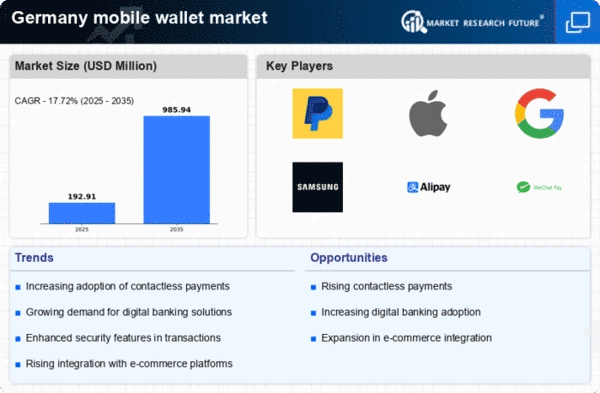
As per Market Research Future analysis, the Germany Mobile Wallet Market size was estimated at 163.87 USD Million in 2024. The Mobile Wallet market is projected to grow from 192.91 USD Million in 2025 to 985.94 USD Million by 2035, exhibiting a compound annual growth rate (CAGR) of 17.7% during the forecast period 2025 - 2035

Key Market Trends & Highlights

The Germany mobile wallet market is experiencing robust growth driven by technological advancements and changing consumer preferences.

  • The largest segment in the Germany mobile wallet market is the retail sector, which is witnessing increased adoption of contactless payments.
  • The fastest-growing segment is the e-commerce sector, reflecting a surge in online shopping trends and consumer demand for seamless transactions.
  • Integration with loyalty programs is becoming a prevalent trend, enhancing customer engagement and retention.
  • Rising smartphone penetration and government initiatives for digital payments are key drivers propelling market expansion.

Market Size & Forecast

2024 Market Size 163.87 (USD Million)
2035 Market Size 985.94 (USD Million)
CAGR (2025 - 2035) 17.72%

Major Players

PayPal (US), Apple (US), Google (US), Samsung (KR), Alipay (CN), WeChat Pay (CN), Venmo (US), Zelle (US), Cash App (US)

Our Impact
Enabled $4.3B Revenue Impact for Fortune 500 and Leading Multinationals
Partnering with 2000+ Global Organizations Each Year
30K+ Citations by Top-Tier Firms in the Industry

Germany Mobile Wallet Market Trends

The Germany Mobile Wallet Market is experiencing notable growth. This growth is driven by increasing consumer adoption and technological advancements. As digital payment solutions gain traction, users are gravitating towards mobile wallets for their convenience and security. The integration of contactless payment options has further enhanced user experience, allowing for swift transactions in various retail environments. Additionally, the rise of e-commerce has propelled the demand for mobile wallets, as consumers seek seamless payment methods that align with their online shopping habits. This shift towards digital solutions appears to be reshaping the financial landscape, encouraging traditional banking institutions to innovate and adapt to changing consumer preferences. Moreover, regulatory frameworks are evolving to support the expansion of mobile wallets, fostering a more secure environment for users. Initiatives aimed at enhancing cybersecurity and protecting consumer data are becoming increasingly prevalent. This regulatory support, combined with the growing acceptance of mobile wallets among merchants, suggests a promising future for the market. As more businesses recognize the benefits of offering mobile payment options, the landscape is likely to become increasingly competitive, with new entrants and innovations emerging to capture consumer interest. Overall, The mobile wallet market is expected to continue growing, reflecting broader trends in digital finance and consumer behavior.

Increased Adoption of Contactless Payments

The trend towards contactless payments is gaining momentum, as consumers prefer the convenience and speed of transactions. Mobile wallets facilitate this shift, allowing users to make payments with a simple tap of their devices. This method not only enhances the shopping experience but also aligns with the growing demand for hygienic payment solutions.

Integration with Loyalty Programs

Many businesses are integrating loyalty programs into mobile wallets, providing users with incentives for their purchases. This trend encourages customer retention and enhances the overall value proposition of mobile wallets. By offering rewards and discounts, merchants can foster a deeper connection with their clientele.

Enhanced Security Features

As concerns about data security rise, mobile wallets are incorporating advanced security measures to protect user information. Features such as biometric authentication and encryption are becoming standard, instilling confidence in consumers. This focus on security is crucial for the sustained growth of the mobile wallet market.

Germany Mobile Wallet Market Drivers

Rising Smartphone Penetration

The mobile wallet market in Germany is experiencing significant growth due to the increasing penetration of smartphones. As of 2025, approximately 85% of the German population owns a smartphone, facilitating the adoption of mobile wallet applications. This trend indicates a shift in consumer behavior, where individuals prefer the convenience of digital payments over traditional cash transactions. The integration of advanced features in smartphones, such as biometric authentication and NFC technology, further enhances the usability of mobile wallets. Consequently, this driver is pivotal in shaping the mobile wallet market, as it encourages users to engage with digital payment solutions, thereby fostering a more cashless society.

Increased Focus on Financial Inclusion

The mobile wallet market is also influenced by a heightened focus on financial inclusion in Germany. Efforts to provide accessible financial services to underserved populations are gaining momentum, with mobile wallets serving as a viable solution. By offering low-cost and user-friendly payment options, mobile wallets can reach individuals who may not have access to traditional banking services. This trend indicates a potential expansion of the mobile wallet market, as it aligns with broader societal goals of promoting financial literacy and inclusion. As more individuals gain access to digital payment solutions, the market is likely to witness significant growth.

Consumer Demand for Seamless Transactions

There is a growing consumer demand for seamless and efficient payment solutions, which is propelling the mobile wallet market in Germany. As consumers seek faster transaction methods, mobile wallets provide an attractive alternative to traditional payment methods. The ability to make instant payments, coupled with features like transaction history and budgeting tools, appeals to tech-savvy users. This demand for convenience is likely to drive further innovation within the mobile wallet market, as providers strive to enhance user experience and streamline payment processes. Consequently, this driver plays a crucial role in shaping the competitive landscape of mobile wallets.

Government Initiatives for Digital Payments

The German government is actively promoting digital payment solutions, which significantly impacts the mobile wallet market. Initiatives aimed at enhancing the digital infrastructure and encouraging cashless transactions are being implemented. For instance, the government has set a target to increase the share of cashless payments to 80% by 2025. This regulatory support not only boosts consumer confidence in mobile wallets but also incentivizes businesses to adopt these technologies. As a result, the mobile wallet market is likely to expand, driven by favorable policies and a supportive ecosystem that encourages the transition from cash to digital payments.

E-commerce Growth and Online Shopping Trends

The mobile wallet market is experiencing substantial growth due to the rapid expansion of e-commerce in Germany. In 2025, online retail sales are projected to reach €100 billion, with a significant portion of transactions being conducted via mobile devices. This trend suggests that consumers are increasingly utilizing mobile wallets for online purchases, driven by the convenience and speed they offer. Furthermore, the integration of mobile wallets with e-commerce platforms enhances the overall shopping experience, making it easier for consumers to complete transactions. As e-commerce continues to flourish, the mobile wallet market is poised for substantial growth, catering to the evolving preferences of digital shoppers.


Market Segment Insights

By Payment Method: Credit Card (Largest) vs. Bank Transfer (Fastest-Growing)

In the Germany mobile wallet market, Credit Card remains the largest segment, dominating the payment method landscape due to its widespread acceptance and consumer preference. Following closely, Bank Transfer is gaining traction as mobile wallets evolve, appealing to users seeking direct account access and lower transaction fees. The utilization of Debit Card and Mobile Carrier Billing persists, yet they represent minor shares compared to these leading methods. Growth trends show a remarkable shift towards Bank Transfer, driven by increased consumer confidence in digital financial solutions and the rising popularity of instant payment solutions. The integration of innovative technologies and security features bolsters the appeal of Credit Card payments as consumers increasingly favor convenience and safety, resulting in a dynamic and competitive payment environment.

Credit Card (Dominant) vs. Bank Transfer (Emerging)

Credit Card payments have established themselves as the dominant method in the Germany mobile wallet market, characterized by their convenience and consumer familiarity. Widely accepted across numerous platforms, they provide a seamless transaction experience, contributing to their strong market position. Meanwhile, Bank Transfer is emerging as a significant contender, capitalizing on the trend towards cost-effective and direct payment options. This method offers benefits such as reduced fees and faster transaction times, appealing to a growing demographic of budget-conscious consumers. The shift towards digital banking solutions has further enhanced the relevance of Bank Transfer, positioning it as a noteworthy emerging player in the payment landscape.

By Technology: Near Field Communication (Largest) vs. QR Code (Fastest-Growing)

Within the technology segment of the Germany mobile wallet market, Near Field Communication (NFC) holds the largest share, reflecting a strong consumer preference for quick and contactless payment solutions. QR Code payments, while currently smaller in market share compared to NFC, are rapidly gaining traction, especially among younger consumers and small businesses that prefer their simplicity and low setup costs. The growth of NFC is primarily driven by increasing smartphone penetration and the push for contactless transactions, which have become increasingly popular due to the COVID-19 pandemic. Conversely, the QR Code segment is experiencing the fastest growth as more retailers implement QR payment methods, driven by their flexibility and user-friendly nature. The rise in digital payments aligns with consumers' shifting preferences towards cashless solutions, further fueling this segment's expansion.

Technology: NFC (Dominant) vs. QR Code (Emerging)

NFC technology is the dominant player in the Germany mobile wallet market, offering seamless transactions through a simple tap of a smartphone, thus appealing to users who prioritize speed and convenience. It is widely adopted by various retailers and service providers, creating an extensive ecosystem for consumers. In contrast, QR Codes represent an emerging solution, particularly popular with smaller merchants and among tech-savvy consumers who appreciate their ease of use and low infrastructure requirements. While NFC benefits from broad acceptance and technological integration, QR Codes are carving out their niche by providing an adaptable platform that facilitates payments without the need for advanced hardware, making them an attractive option for diverse businesses.

By End-user: Retail (Largest) vs. E-commerce (Fastest-Growing)

In the Germany mobile wallet market, the retail sector currently holds the largest share, reflecting a strong preference among consumers for using mobile wallets for in-store purchases. E-commerce follows as a significant segment, rapidly gaining traction as digital shopping continues to rise. The steady growth in these sectors is driven by increased smartphone penetration, adoption of contactless payments, and changing consumer preferences towards cashless transactions. Growth trends show that the e-commerce sector is the fastest-growing segment within the mobile wallet ecosystem, propelled by the explosion of online shopping, particularly accelerated by the pandemic. Consumers are increasingly prioritizing seamless payment experiences while shopping online, and the demand for convenience continues to drive innovation in mobile wallet features. This trend suggests a continuously evolving landscape, where convenience and technology will dictate consumer behavior in the upcoming years.

Retail: Traditional Stores (Dominant) vs. Utilities (Emerging)

The retail sector, particularly traditional stores, plays a dominant role in the Germany mobile wallet market as consumers increasingly opt for cashless transactions for convenience and security. Traditional retail outlets integrate mobile wallet payments to streamline the checkout process, fostering customer loyalty. In contrast, the utilities segment is emerging as a new player within the mobile wallet space, driven by digitalization and the demand for efficient payment solutions for services such as energy and water. As utility providers enhance their payment infrastructure, consumers are finding alternative avenues for settling their bills through mobile wallets, thereby promoting the acceptance and usage of these platforms.

By Platform: Android (Largest) vs. iOS (Fastest-Growing)

In the Germany mobile wallet market, the distribution of platform usage highlights Android as the largest segment, capturing a significant portion of the user base. iOS, while smaller in comparison, shows remarkable growth, appealing to a tech-savvy demographic that favors user experience and integration with other Apple services. Web-based platforms are also present, but they struggle to compete with the convenience and features offered by native applications. This segment is witnessing a rapid evolution driven by increasing smartphone penetration and consumer preference for seamless payment solutions. The rise of contactless payments and the integration of advanced security features are pivotal in captivating user interest, particularly with iOS, which consistently updates its platforms to enhance user experiences. The competitive landscape continues to evolve, thus propelling both Android and iOS towards a more significant share of the digital payment ecosystem.

Android: Dominant vs. iOS: Emerging

Android dominates the platform segment of the Germany mobile wallet market, largely due to its extensive market share and wide-reaching accessibility across various devices, making it the preferred choice for many users. Its customizable nature and compatibility with a broad range of applications attract diverse demographics. In contrast, iOS, though emerging in this particular field, is gaining traction rapidly, particularly among users seeking high-security standards and a cohesive ecosystem. iOS wallets often benefit from premium features and user-friendly interfaces, attracting affluent segments of the market. The competition between these platforms drives innovation and creates opportunities for enhanced user engagement, positioning them as key players in the unfolding digital finance landscape.

Get more detailed insights about Germany Mobile Wallet Market

Key Players and Competitive Insights

The mobile wallet market in Germany is characterized by a dynamic competitive landscape, driven by rapid technological advancements and shifting consumer preferences towards digital payment solutions. Key players such as PayPal (US), Apple (US), and Alipay (CN) are strategically positioned to leverage their technological prowess and extensive user bases. PayPal (US) focuses on enhancing its platform through continuous innovation and partnerships, while Apple (US) emphasizes seamless integration of its wallet services with its ecosystem of devices. Alipay (CN), on the other hand, is expanding its footprint in Europe, aiming to capture a share of the growing demand for mobile payment solutions among European consumers. Collectively, these strategies contribute to a competitive environment that is increasingly defined by technological innovation and user-centric services.The business tactics employed by these companies reflect a nuanced understanding of the market's structure, which appears moderately fragmented yet increasingly competitive. Localizing services and optimizing supply chains are critical tactics that enhance operational efficiency and customer satisfaction. The influence of major players is palpable, as they not only set industry standards but also drive smaller competitors to innovate and adapt. This competitive structure fosters an environment where agility and responsiveness to market trends are paramount.

In October PayPal (US) announced a strategic partnership with a leading German bank to enhance its payment processing capabilities, allowing for faster transactions and improved security features. This move is significant as it not only strengthens PayPal's position in the German market but also aligns with the growing consumer demand for secure and efficient payment solutions. By collaborating with established financial institutions, PayPal (US) is likely to enhance its credibility and expand its user base in a competitive landscape.

In September Apple (US) launched a new feature within its Apple Pay service that allows users to earn rewards for transactions made through its mobile wallet. This initiative appears to be a strategic effort to increase user engagement and loyalty, particularly among younger consumers who are increasingly drawn to reward-based systems. By integrating rewards into its mobile wallet, Apple (US) may effectively differentiate its offering in a crowded market, potentially attracting new users and retaining existing ones.

In November Alipay (CN) unveiled plans to introduce a localized version of its mobile wallet tailored specifically for the German market. This initiative suggests a strategic focus on cultural adaptation and user experience, which could enhance Alipay's appeal among German consumers. By addressing local preferences and regulatory requirements, Alipay (CN) is likely positioning itself as a formidable competitor in the region, potentially reshaping the competitive dynamics.

As of November current trends in the mobile wallet market are increasingly defined by digitalization, sustainability, and the integration of artificial intelligence (AI) into payment systems. Strategic alliances among key players are shaping the landscape, fostering innovation and enhancing service offerings. The competitive differentiation is likely to evolve from traditional price-based competition towards a focus on technological innovation, user experience, and supply chain reliability. This shift indicates that companies must prioritize not only competitive pricing but also the development of cutting-edge solutions that meet the evolving needs of consumers.

Key Companies in the Germany Mobile Wallet Market include

Industry Developments

Giropay was replaced in Germany by Wero, a universal mobile wallet introduced by the European Payments Initiative (EPI) in July 2023. By July 2, 2024, Wero made immediate account-to-account mobile payments available through Sparkassen and cooperative banks, reaching around 17 million registered customers by December 2024.

New tap-to-pay services were made possible in January 2025 when third-party wallets were given access to iPhone NFC hardware in Germany due to legislative amendments made under the EU's Digital Markets Act.

Consequently, PayPal introduced its contactless mobile wallet countrywide in May 2025, along with iPhone NFC tap-to-pay and "RatenzahlungTo Go" in-store financing, which enables users to divide payments over several months and receive cashback through the app.

Throughout 2023, Apple Pay and Google Pay maintained their leading positions in mobile retail payments, with Apple Pay making up 60–65% of in-store mobile wallet transactions and Google Pay 25–30%. In early 2025, Klarna surpassed Revolut as the most popular buy-now-pay-later mobile payment app in Germany based on active user metrics.

In the meanwhile, Chinese tourists could still use Alipay and WeChat Pay at thousands of stores and transport hubs, such as Munich Airport. Under the PSD2 and open banking frameworks, N26 and Sofort carried on with their banking-led mobile payment operations.

Together, these developments highlight a fast changing German mobile wallet ecosystem, which is being fueled by worldwide wallet deployments, EU regulation, fintech growth, and growing retail acceptance.

Future Outlook

Germany Mobile Wallet Market Future Outlook

The Mobile Wallet Market in Germany is projected to grow at a 17.72% CAGR from 2025 to 2035, driven by increasing smartphone penetration, enhanced security features, and consumer preference for contactless payments.

New opportunities lie in:

  • Integration of AI-driven fraud detection systems for enhanced security.
  • Development of loyalty programs linked to mobile wallets for increased user engagement.
  • Expansion of mobile wallet services to include cryptocurrency transactions.

By 2035, the mobile wallet market is expected to be robust, reflecting substantial growth and innovation.

Market Segmentation

Germany Mobile Wallet Market End-user Outlook

  • Retail
  • E-commerce
  • Utilities
  • Travel

Germany Mobile Wallet Market Platform Outlook

  • Android
  • iOS
  • Web-Based

Germany Mobile Wallet Market Technology Outlook

  • Near Field Communication
  • QR Code
  • Cloud-Based

Germany Mobile Wallet Market Payment Method Outlook

  • Bank Transfer
  • Credit Card
  • Debit Card
  • Mobile Carrier Billing

Report Scope

MARKET SIZE 2024 163.87(USD Million)
MARKET SIZE 2025 192.91(USD Million)
MARKET SIZE 2035 985.94(USD Million)
COMPOUND ANNUAL GROWTH RATE (CAGR) 17.72% (2025 - 2035)
REPORT COVERAGE Revenue Forecast, Competitive Landscape, Growth Factors, and Trends
BASE YEAR 2024
Market Forecast Period 2025 - 2035
Historical Data 2019 - 2024
Market Forecast Units USD Million
Key Companies Profiled PayPal (US), Apple (US), Google (US), Samsung (KR), Alipay (CN), WeChat Pay (CN), Venmo (US), Zelle (US), Cash App (US)
Segments Covered Payment Method, Technology, End-user, Platform
Key Market Opportunities Integration of advanced security features enhances consumer trust in the mobile wallet market.
Key Market Dynamics Rising consumer preference for contactless payments drives innovation in mobile wallet solutions across the region.
Countries Covered Germany
Leave a Comment

FAQs

What is the market size of the Germany Mobile Wallet Market in 2024?

The Germany Mobile Wallet Market is expected to be valued at 114.8 million USD in 2024.

What is the projected market value for the Germany Mobile Wallet Market by 2035?

By 2035, the market is expected to reach a valuation of 1490.0 million USD.

What is the expected Compound Annual Growth Rate (CAGR) for the Germany Mobile Wallet Market from 2025 to 2035?

The expected CAGR for the market is 26.242% from 2025 to 2035.

What are the dominant modes of payment in the Germany Mobile Wallet Market?

The market is divided into NFC and Remote Payment, with NFC expected to grow significantly.

What is the projected value of the NFC segment in 2035?

The NFC segment is projected to be valued at 675.0 million USD in 2035.

How much is the Remote Payment segment expected to be valued at in 2035?

The Remote Payment segment is expected to reach a valuation of 815.0 million USD in 2035.

Who are the key players in the Germany Mobile Wallet Market?

Major players include Giropay, N26, Cash App, Sofort, Klarna, Samsung, Apple, PayPal, Revolut, Alipay, Google, WeChat Pay, Wirecard, and Zalando.

What trends are driving the growth of the Germany Mobile Wallet Market?

Emerging trends include increasing smartphone penetration and a growing preference for contactless payments.

What challenges does the Germany Mobile Wallet Market face?

Challenges include regulatory hurdles and the need for robust security measures.

How has the global economic scenario affected the Germany Mobile Wallet Market?

The global economic scenario has led to increased demand for digital payment solutions, benefiting the mobile wallet market.

Download Free Sample

Kindly complete the form below to receive a free sample of this Report

Compare Licence

×
Features License Type
Single User Multiuser License Enterprise User
Price $4,950 $5,950 $7,250
Maximum User Access Limit 1 User Upto 10 Users Unrestricted Access Throughout the Organization
Free Customization
Direct Access to Analyst
Deliverable Format
Platform Access
Discount on Next Purchase 10% 15% 15%
Printable Versions