×
Request Free Sample ×

Kindly complete the form below to receive a free sample of this Report

* Please use a valid business email

Leading companies partner with us for data-driven Insights

clients tt-cursor
Hero Background

Germany Mobile Application Market

ID: MRFR/ICT/59532-HCR
200 Pages
Aarti Dhapte
February 2026

Germany Mobile Application Market Research Report By Application (Gaming, Business, E-commerce, Social Media, Health Fitness), By Operating System (Android, iOS, Windows, Others), By Deployment Type (Native Apps, Web Apps, Hybrid Apps) and By End Use (Individuals, Small Businesses, Large Enterprises)-Forecast to 2035

Share:
Download PDF ×

We do not share your information with anyone. However, we may send you emails based on your report interest from time to time. You may contact us at any time to opt-out.

Germany Mobile Application Market Infographic
Purchase Options

Germany Mobile Application Market Summary

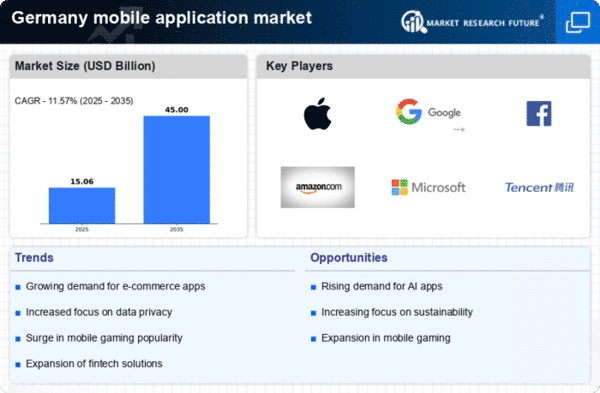
As per Market Research Future analysis, the Germany mobile application market size was estimated at 13.5 USD Billion in 2024. The Germany mobile application market is projected to grow from 15.06 USD Billion in 2025 to 45.0 USD Billion by 2035, exhibiting a compound annual growth rate (CAGR) of 11.5% during the forecast period 2025 - 2035

Key Market Trends & Highlights

The Germany mobile application market is experiencing robust growth driven by innovative trends and increasing consumer demand.

  • The largest segment in the Germany mobile application market is e-commerce, reflecting a growing consumer preference for online shopping.
  • Health and fitness apps represent the fastest-growing segment, indicating a heightened focus on personal well-being and fitness tracking.
  • There is a notable rise in subscription models, suggesting a shift in consumer behavior towards ongoing service access rather than one-time purchases.
  • Key market drivers include the surge in mobile internet penetration and the growing demand for e-commerce solutions, which are fueling app development and usage.

Market Size & Forecast

2024 Market Size 13.5 (USD Billion)
2035 Market Size 45.0 (USD Billion)
CAGR (2025 - 2035) 11.57%

Major Players

Apple Inc (US), Google LLC (US), Facebook Inc (US), Amazon.com Inc (US), Microsoft Corp (US), Tencent Holdings Ltd (CN), Alibaba Group Holding Ltd (CN), Samsung Electronics Co Ltd (KR), ByteDance Ltd (CN)

Our Impact
Enabled $4.3B Revenue Impact for Fortune 500 and Leading Multinationals
Partnering with 2000+ Global Organizations Each Year
30K+ Citations by Top-Tier Firms in the Industry

Germany Mobile Application Market Trends

The mobile application market in Germany is currently experiencing a dynamic evolution, driven by technological advancements and changing consumer preferences. The proliferation of smartphones and tablets has led to an increased demand for diverse applications across various sectors, including finance, health, and entertainment. Users are increasingly seeking personalized experiences, which has prompted developers to focus on user-centric design and functionality. Furthermore, the integration of artificial intelligence and machine learning into applications is enhancing user engagement and satisfaction, suggesting a trend towards more intelligent and adaptive solutions. In addition, the regulatory landscape in Germany is shaping the mobile application market. Stricter data protection laws, such as the General Data Protection Regulation (GDPR), are influencing how applications handle user data. This has led to a heightened emphasis on privacy and security features within applications, as developers strive to comply with legal requirements while maintaining user trust. As the market continues to mature, it appears that innovation, compliance, and user experience will remain pivotal in shaping the future of mobile applications in Germany.

Rise of Subscription Models

The mobile application market is witnessing a notable shift towards subscription-based revenue models. This trend allows developers to generate consistent income while providing users with ongoing access to premium features and content. As consumers become more accustomed to subscription services, this model is likely to gain further traction, particularly in sectors such as gaming and productivity.

Increased Focus on Security

With growing concerns over data privacy, the mobile application market is placing greater emphasis on security measures. Developers are integrating advanced encryption techniques and secure authentication processes to protect user information. This trend reflects a broader societal demand for transparency and trust in digital interactions.

Expansion of Augmented Reality

The integration of augmented reality (AR) into mobile applications is becoming increasingly prevalent. This technology enhances user engagement by providing immersive experiences in various fields, including retail and education. As AR capabilities improve, the mobile application market is likely to see a surge in innovative applications that leverage this technology.

Germany Mobile Application Market Drivers

Surge in Mobile Internet Penetration

The mobile application market in Germany experiences a notable surge in mobile internet penetration, which is a critical driver for growth. As of November 2025, approximately 95% of the population has access to mobile internet, facilitating the widespread use of applications across various sectors. This high connectivity enables users to engage with mobile applications seamlessly, enhancing user experience and driving demand. Furthermore, the increasing availability of affordable data plans contributes to this trend, allowing more individuals to access mobile applications. The mobile application market is likely to benefit from this trend, as developers create more innovative and user-friendly applications tailored to the needs of a connected population.

Growing Demand for E-commerce Solutions

The mobile application market in Germany is significantly influenced by the growing demand for e-commerce solutions. With online shopping becoming a preferred method for consumers, mobile applications that facilitate e-commerce transactions are witnessing substantial growth. In 2025, e-commerce sales in Germany are projected to reach €100 billion, with a considerable portion of these transactions occurring via mobile applications. This trend indicates a shift in consumer behavior, where convenience and accessibility drive the adoption of mobile shopping apps. Consequently, the mobile application market is likely to see an influx of new applications designed to enhance the shopping experience, including features such as augmented reality and personalized recommendations.

Emergence of Artificial Intelligence in Apps

The integration of artificial intelligence (AI) into mobile applications is emerging as a pivotal driver for the mobile application market in Germany. As of November 2025, a growing number of applications leverage AI technologies to enhance user experience and functionality. This includes personalized recommendations, chatbots for customer service, and advanced data analytics. The mobile application market is likely to see a surge in AI-driven applications, as businesses aim to differentiate themselves in a competitive landscape. The potential for AI to improve user engagement and satisfaction suggests that this trend will continue to shape the future of mobile applications in Germany.

Rising Popularity of Health and Fitness Apps

The mobile application market in Germany is experiencing a rising popularity of health and fitness applications, driven by a growing awareness of health and wellness among consumers. As of November 2025, approximately 30% of the population actively uses health-related mobile applications, indicating a strong market segment. This trend is likely to continue as individuals seek to monitor their health, track fitness goals, and access personalized wellness programs. The mobile application market is expected to see an increase in the development of innovative health apps, including features such as telemedicine and virtual coaching, catering to the evolving needs of health-conscious consumers.

Increased Investment in Mobile App Development

Investment in mobile app development is a significant driver for the mobile application market in Germany. As businesses recognize the importance of mobile presence, funding for app development has surged. In 2025, the total investment in mobile app development is estimated to exceed €5 billion, reflecting a robust commitment from both startups and established companies. This influx of capital enables developers to innovate and create high-quality applications that cater to diverse consumer needs. The mobile application market is poised to benefit from this trend, as increased competition fosters creativity and leads to the emergence of cutting-edge applications that enhance user engagement.

Market Segment Insights

By Application: Gaming (Largest) vs. E-commerce (Fastest-Growing)

In the Germany mobile application market, the application segment is characterized by diverse preferences among consumers. Gaming applications capture the largest share due to their continuous engagement and innovative features that resonate with a broad audience. Following gaming, social media and e-commerce applications also hold significant portions of the market, reflecting the increasing reliance on mobile platforms for various activities. The growth trends within the application segment are largely driven by technological advancements and changing consumer behaviors. The demand for e-commerce applications is rapidly increasing as users seek convenience in shopping, making this category the fastest-growing. Similarly, the health & fitness applications are gaining traction, driven by a growing awareness of health and wellbeing among users, further diversifying the market landscape.

Gaming: Dominant vs. E-commerce: Emerging

Gaming applications dominate the Germany mobile application market, capturing a massive user base through immersive experiences and engaging content that appeals to various age groups. As developers focus on innovative gameplay mechanics and social interactions within games, this segment continues to thrive. In contrast, e-commerce applications, though emerging, show tremendous potential for growth as they are increasingly integrating advanced technologies like AI and AR to enhance the shopping experience. The convenience of mobile shopping and in-app purchases positions e-commerce as an attractive alternative, appealing to tech-savvy consumers who prefer seamless transactions.

By Operating System: Android (Largest) vs. iOS (Fastest-Growing)

In the Germany mobile application market, Android holds the largest share, significantly leading over competing operating systems. It appeals to a broad user base due to its open-source nature and varied device compatibility. iOS, while having a smaller market share than Android, is witnessing rapid adoption, particularly among premium users who prioritize security and ecosystem integration. Growth trends indicate that the gap between Android and iOS is narrowing as iOS gains traction, especially among younger demographics and professionals. The increasing reliance on mobile applications for everyday tasks and the rise in mobile commerce are driving factors. Additionally, specific industries, like finance and gaming, are becoming more app-centric, further fueling iOS's expansion.

Android: Dominant vs. iOS: Emerging

Android's dominant position in the Germany mobile application market is characterized by its extensive device range and customization capabilities, making it preferred by various consumer segments. It serves both budget-conscious users and tech enthusiasts alike. In contrast, iOS, as an emerging player, is gaining popularity due to its seamless user experience and superior app quality. It attracts a niche market of users who are willing to invest in premium devices for enhanced performance and security. As industries increasingly embrace mobile solutions, both systems are poised for continued evolution, albeit catering to different market needs and user preferences.

By Deployment Type: Native Apps (Largest) vs. Hybrid Apps (Fastest-Growing)

In the Germany mobile application market, Native Apps hold a significant share due to their seamless integration with device features, providing users with optimal performance and experience. Web Apps, while versatile, trail behind in market presence, offering users convenience but often lacking the robustness and speed of their native counterparts. Their share is growing steadily but remains the smallest among the three segments. Growth trends indicate a rising preference for Hybrid Apps, which combine the best of both Native and Web Apps. This segment is being driven by the demand for cost-effective solutions that can serve multiple platforms without compromising on user experience. The continuous advancement in hybrid technology is also a significant factor fueling this growth, appealing to developers and businesses alike.

Native Apps (Dominant) vs. Hybrid Apps (Emerging)

Native Apps are characterized by their high performance and ability to leverage device-specific features, making them the go-to choice for users seeking superior functionality and responsiveness. They dominate the Germany mobile application market because they provide unparalleled user experience, leading to high user retention rates. In contrast, Hybrid Apps are emerging as a strong alternative, allowing developers to create cross-platform applications efficiently. While they may not match the performance of Native Apps, they offer flexibility and cost efficiency, attracting businesses looking to maximize reach without incurring high development costs. As technology improves, Hybrid Apps are rapidly gaining traction, indicating a shift in user and developer preferences.

By End-use: Individuals (Largest) vs. Small Businesses (Fastest-Growing)

In the Germany mobile application market, the distribution among various end-use segments reveals that individuals hold the largest share, driven by a growing preference for personalized and user-friendly applications. Small businesses are not far behind, represented as the fastest-growing segment as they increasingly adopt mobile apps to enhance their operations and connect with customers more effectively. The growth trends within these segments demonstrate a robust shift towards mobile app adoption across all demographics. Individuals are increasingly opting for applications that offer convenience in daily tasks, while small businesses leverage mobile technology to gain competitive advantages. Factors such as the rise of remote work, digital marketing demands, and the overall shift to online services are propelling this growth forward.

Individuals: Dominant vs. Small Businesses: Emerging

The individuals segment stands out as the dominant force in the Germany mobile application market, characterized by a diverse range of applications tailored to various interests and daily needs. Users are seeking out solutions that emphasize ease of use, social connectivity, and entertainment. In contrast, small businesses represent an emerging segment that is rapidly evolving. They are increasingly utilizing mobile applications to streamline operations, enhance customer engagement, and improve service delivery. The shift towards using mobile technology is being driven by the necessity for businesses to be agile and responsive in a competitive landscape.

Get more detailed insights about Germany Mobile Application Market

Key Players and Competitive Insights

The mobile application market in Germany is characterized by a dynamic competitive landscape, driven by rapid technological advancements and evolving consumer preferences. Key players such as Apple Inc (US), Google LLC (US), and Tencent Holdings Ltd (CN) are at the forefront, each adopting distinct strategies to enhance their market presence. Apple Inc (US) continues to focus on innovation, particularly in privacy features and user experience, which resonates well with the German consumer base. Google LLC (US), on the other hand, emphasizes its ecosystem integration, leveraging its search engine and cloud services to bolster its app offerings. Tencent Holdings Ltd (CN) is increasingly investing in gaming applications, capitalizing on the growing demand for mobile gaming in Germany, thereby diversifying its portfolio and enhancing user engagement.The business tactics employed by these companies reflect a concerted effort to optimize operations and adapt to local market conditions. Localizing app content and enhancing supply chain efficiencies are common strategies. The competitive structure of the market appears moderately fragmented, with a mix of established giants and emerging players. This fragmentation allows for a diverse range of applications catering to various consumer needs, while the influence of major players remains substantial, shaping market trends and consumer expectations.

In October Apple Inc (US) announced a significant update to its App Store policies, aimed at enhancing developer transparency and user privacy. This move is strategically important as it aligns with the increasing regulatory scrutiny in Europe regarding data protection, positioning Apple as a leader in privacy-centric app development. Such initiatives not only bolster consumer trust but also set a benchmark for competitors in the market.

In September Google LLC (US) launched a new initiative to support local app developers in Germany, providing funding and resources to foster innovation. This strategic action underscores Google's commitment to nurturing the local ecosystem, potentially leading to a richer variety of applications that cater specifically to German users. By investing in local talent, Google may enhance its competitive edge and strengthen its market position.

In August Tencent Holdings Ltd (CN) expanded its gaming portfolio by acquiring a local game development studio in Germany. This acquisition is indicative of Tencent's strategy to penetrate the European gaming market more effectively. By integrating local expertise, Tencent could tailor its offerings to better suit regional preferences, thereby increasing its market share in a highly competitive segment.

As of November the competitive trends in the mobile application market are increasingly defined by digitalization, sustainability, and the integration of artificial intelligence (AI). Strategic alliances among key players are becoming more prevalent, facilitating innovation and resource sharing. The shift from price-based competition to a focus on technological advancement and supply chain reliability is evident. Companies are likely to differentiate themselves through unique features, enhanced user experiences, and sustainable practices, indicating a transformative phase in the competitive landscape.

Key Companies in the Germany Mobile Application Market include

Industry Developments

Recent developments in the Germany Mobile Application Market include significant growth and increased competition among key players. N26 continues enhancing its banking services, targeting millennial users with new features, while Babbel has expanded its language learning offerings to meet rising demand post-pandemic.

March 2023 saw SAP acquiring a smaller tech firm to bolster its cloud capabilities, improving scalability for businesses. In April 2023, Delivery Hero announced a partnership with HelloFresh to streamline their logistics and enhance delivery services. Free Now has also expanded its ride-hailing services to more cities in Germany, increasing user engagement. Significant mergers include a strategic alliance in June 2022 where Outfittery teamed up with another fashion startup to enhance their e-commerce platform.

The German market has exhibited resilient growth, leading to valuations of firms like Zalando and SoundCloud climbing, reflecting a strong consumer appetite for innovative applications. The impact of swift digital transformation initiatives and consumer behaviors favorable towards mobile solutions continues shaping the landscape, evident from the collaborative efforts among firms. Overall, the dynamics within the Germany Mobile Application Market show promising advancements fueled by technology adoption and strategic partnerships.

Future Outlook

Germany Mobile Application Market Future Outlook

The Mobile Application Market in Germany is projected to grow at 11.57% CAGR from 2025 to 2035, driven by technological advancements and increasing smartphone penetration.

New opportunities lie in:

  • Development of AI-driven personalized app experiences
  • Expansion of subscription-based revenue models for apps
  • Integration of augmented reality features in mobile applications

By 2035, the mobile application market is expected to be robust and highly competitive.

Market Segmentation

Germany Mobile Application Market End-use Outlook

  • Individuals
  • Small Businesses
  • Large Enterprises

Germany Mobile Application Market Application Outlook

  • Gaming
  • Business
  • E-commerce
  • Social Media
  • Health & Fitness

Germany Mobile Application Market Deployment Type Outlook

  • Native Apps
  • Web Apps
  • Hybrid Apps

Germany Mobile Application Market Operating System Outlook

  • Android
  • iOS
  • Windows
  • Others

Report Scope

MARKET SIZE 2024 13.5(USD Billion)
MARKET SIZE 2025 15.06(USD Billion)
MARKET SIZE 2035 45.0(USD Billion)
COMPOUND ANNUAL GROWTH RATE (CAGR) 11.57% (2025 - 2035)
REPORT COVERAGE Revenue Forecast, Competitive Landscape, Growth Factors, and Trends
BASE YEAR 2024
Market Forecast Period 2025 - 2035
Historical Data 2019 - 2024
Market Forecast Units USD Billion
Key Companies Profiled Apple Inc (US), Google LLC (US), Facebook Inc (US), Amazon.com Inc (US), Microsoft Corp (US), Tencent Holdings Ltd (CN), Alibaba Group Holding Ltd (CN), Samsung Electronics Co Ltd (KR), ByteDance Ltd (CN)
Segments Covered Application, Operating System, Deployment Type, End-use
Key Market Opportunities Integration of artificial intelligence in mobile applications enhances user experience and personalization.
Key Market Dynamics Rising consumer demand for mobile applications drives innovation and competition among developers in the market.
Countries Covered Germany
Leave a Comment

FAQs

What is the projected market size of the Germany Mobile Application Market in 2024?

The projected market size of the Germany Mobile Application Market in 2024 is expected to be valued at 13.08 USD Billion.

What will the market size of the Germany Mobile Application Market reach by 2035?

By 2035, the market size of the Germany Mobile Application Market is expected to reach 48.5 USD Billion.

What is the expected CAGR for the Germany Mobile Application Market from 2025 to 2035?

The expected CAGR for the Germany Mobile Application Market from 2025 to 2035 is 12.652%.

Which application category will dominate the Germany Mobile Application Market by 2035?

By 2035, the Gaming application category is projected to dominate the Germany Mobile Application Market, valued at 16.0 USD Billion.

What is the market size for E-commerce applications in the Germany Mobile Application Market in 2024?

In 2024, the market size for E-commerce applications in the Germany Mobile Application Market is valued at 3.0 USD Billion.

Who are some of the major players in the Germany Mobile Application Market?

Some major players in the Germany Mobile Application Market include N26, Babbel, SAP, and HelloFresh.

How much is the Business application segment expected to generate in the Germany Mobile Application Market by 2035?

The Business application segment is expected to generate 9.5 USD Billion in the Germany Mobile Application Market by 2035.

What is the current market size for Social Media applications in the Germany Mobile Application Market in 2024?

The current market size for Social Media applications in the Germany Mobile Application Market in 2024 is 2.3 USD Billion.

What are the expected trends impacting the Germany Mobile Application Market in the coming years?

Emerging trends impacting the Germany Mobile Application Market include increased demand for Gaming and E-commerce applications.

What is the projected market size for Health and Fitness applications by 2035?

By 2035, the projected market size for Health and Fitness applications in the Germany Mobile Application Market is 2.5 USD Billion.

Download Free Sample

Kindly complete the form below to receive a free sample of this Report

Compare Licence

×
Features License Type
Single User Multiuser License Enterprise User
Price $4,950 $5,950 $7,250
Maximum User Access Limit 1 User Upto 10 Users Unrestricted Access Throughout the Organization
Free Customization
Direct Access to Analyst
Deliverable Format
Platform Access
Discount on Next Purchase 10% 15% 15%
Printable Versions