×
Request Free Sample ×

Kindly complete the form below to receive a free sample of this Report

* Please use a valid business email

Leading companies partner with us for data-driven Insights

clients tt-cursor
Hero Background

Germany Mixed Reality Market

ID: MRFR/ICT/59216-HCR
200 Pages
Aarti Dhapte
February 2026

Germany Mixed Reality Market Research Report By Application (Gaming, Healthcare, Education, Retail, Real Estate), By Technology (Hardware-based, Software-based, Mixed Reality as a Service), By End Use (Consumer, Commercial, Industrial) and By Device Type (Head-mounted Display, Smart Glasses, Smart Phones, Tablets)- Forecast to 2035

Share:
Download PDF ×

We do not share your information with anyone. However, we may send you emails based on your report interest from time to time. You may contact us at any time to opt-out.

Germany Mixed Reality Market Infographic
Purchase Options

Germany Mixed Reality Market Summary

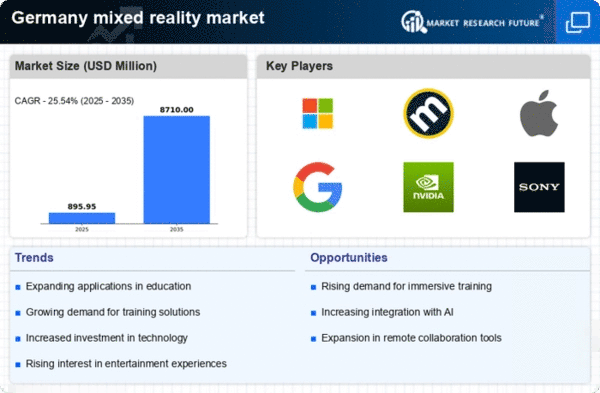
As per Market Research Future analysis, the Germany Mixed Reality Market size was estimated at 713.68 USD Million in 2024. The Mixed Reality market is projected to grow from 895.95 USD Million in 2025 to 8710.0 USD Million by 2035, exhibiting a compound annual growth rate (CAGR) of 25.5% during the forecast period 2025 - 2035

Key Market Trends & Highlights

The Germany mixed reality market is poised for substantial growth driven by technological advancements and increasing applications across various sectors.

  • The largest segment in the Germany mixed reality market is training solutions, reflecting a growing emphasis on immersive learning experiences.
  • Healthcare applications represent the fastest-growing segment, indicating a rising demand for innovative patient care and surgical training tools.
  • Collaborative platforms are gaining traction, suggesting a shift towards enhanced remote teamwork and communication.
  • Technological advancements in hardware and the growing demand for remote collaboration tools are key drivers propelling market expansion.

Market Size & Forecast

2024 Market Size 713.68 (USD Million)
2035 Market Size 8710.0 (USD Million)
CAGR (2025 - 2035) 25.54%

Major Players

Microsoft (US), Meta (US), Apple (US), Google (US), NVIDIA (US), Sony (JP), Samsung (KR), Magic Leap (US), PTC (US)

Our Impact
Enabled $4.3B Revenue Impact for Fortune 500 and Leading Multinationals
Partnering with 2000+ Global Organizations Each Year
30K+ Citations by Top-Tier Firms in the Industry

Germany Mixed Reality Market Trends

The Germany Mixed Reality Market in Germany is currently experiencing a notable evolution, driven by advancements in technology and increasing adoption across various sectors. Industries such as healthcare, education, and manufacturing are integrating mixed reality solutions to enhance training, improve operational efficiency, and provide immersive experiences. This trend appears to be fueled by a growing recognition of the potential benefits that mixed reality can offer, including improved engagement and enhanced learning outcomes. Furthermore, the presence of a robust technology ecosystem in Germany, characterized by strong research institutions and innovative startups, contributes to the market's expansion. In addition, the German government is actively supporting the development of mixed reality technologies through funding initiatives and strategic partnerships. This support seems to encourage collaboration between academia and industry, fostering an environment conducive to innovation. As organizations increasingly seek to leverage mixed reality for competitive advantage, the market is likely to witness further growth. The combination of technological advancements, supportive policies, and a strong demand for immersive solutions positions the mixed reality market favorably for the future.

Increased Investment in Training Solutions

Organizations are increasingly investing in mixed reality training solutions to enhance employee skills and knowledge retention. This trend indicates a shift towards more interactive and engaging training methods, which may lead to improved performance and productivity.

Expansion in Healthcare Applications

The healthcare sector is exploring mixed reality applications for surgical training, patient education, and rehabilitation. This expansion suggests a growing recognition of the technology's potential to improve patient outcomes and streamline medical processes.

Rise of Collaborative Platforms

There is a noticeable rise in collaborative mixed reality platforms that facilitate remote teamwork and communication. This trend highlights the demand for tools that enable seamless collaboration, particularly in industries where physical presence is challenging.

Germany Mixed Reality Market Drivers

Supportive Government Initiatives

Government initiatives in Germany are playing a crucial role in fostering the growth of the mixed reality market. Various programs and funding opportunities are being introduced to support research and development in mixed reality technologies. For instance, the German government has allocated substantial resources to promote digital innovation, which includes mixed reality applications across various industries. This support is likely to stimulate collaboration between academia and industry, leading to the development of cutting-edge solutions. As a result, the mixed reality market is expected to benefit from enhanced innovation and increased competitiveness on both national and international stages.

Expansion of Mixed Reality in Retail

The retail sector in Germany is increasingly embracing mixed reality technologies to enhance customer experiences and drive sales. Retailers are utilizing mixed reality applications for virtual try-ons, interactive displays, and personalized shopping experiences. This shift is evidenced by a reported increase of 40% in the adoption of mixed reality solutions among retailers in the past year. As consumers seek more engaging and convenient shopping experiences, the mixed reality market is poised for significant growth. The potential for mixed reality to bridge the gap between online and in-store shopping experiences is likely to attract further investment and innovation in this sector.

Technological Advancements in Hardware

The mixed reality market in Germany is experiencing a surge due to rapid advancements in hardware technology. Innovations in headsets, sensors, and computing power are enhancing user experiences and expanding application possibilities. For instance, the introduction of lightweight, high-resolution headsets has made mixed reality more accessible to consumers and businesses alike. In 2025, the market for mixed reality hardware is projected to reach approximately €1.5 billion, indicating a robust growth trajectory. This growth is likely driven by increased demand for immersive experiences in sectors such as education, entertainment, and training. As hardware becomes more sophisticated, the mixed reality market is expected to attract further investments, fostering a cycle of innovation and adoption.

Integration of Mixed Reality in Education

The integration of mixed reality technologies in educational settings is becoming a pivotal driver for the mixed reality market in Germany. Educational institutions are increasingly utilizing mixed reality to create immersive learning experiences that enhance student engagement and understanding. For example, mixed reality applications in science and history classes allow students to interact with 3D models and historical events, fostering a deeper comprehension of complex subjects. The market for educational mixed reality solutions is projected to grow by approximately 25% annually, reflecting a strong commitment to innovative teaching methods. This trend indicates that the mixed reality market is likely to see sustained growth as educational institutions continue to adopt these transformative technologies.

Growing Demand for Remote Collaboration Tools

The mixed reality market is witnessing a notable increase in demand for remote collaboration tools, particularly in the wake of evolving work environments. Companies in Germany are increasingly adopting mixed reality solutions to facilitate virtual meetings and collaborative projects, thereby enhancing productivity and engagement. According to recent data, the adoption rate of mixed reality collaboration tools in enterprises has risen by over 30% in the past year. This trend is likely to continue as organizations seek to leverage technology for seamless communication and teamwork. The mixed reality market is thus positioned to benefit from this shift, as businesses invest in solutions that enable remote collaboration and improve operational efficiency.


Market Segment Insights

By Application: Gaming (Largest) vs. Healthcare (Fastest-Growing)

In the Germany mixed reality market, the application segment showcases a diverse distribution among gaming, healthcare, education, retail, and real estate. Gaming holds the largest share, driven by the popularity of immersive experiences among consumers. Healthcare, while currently smaller in share, is rapidly gaining traction, reflecting increased investment in innovative medical training and patient engagement solutions. Growth trends within this segment are strongly influenced by technological advancements and changing consumer preferences. The gaming sector is propelled by the rise of esports and interactive entertainment, while healthcare benefits from the need for enhanced training tools and remote patient care. Education and retail also play significant roles, fostering a solid ecosystem for emerging mixed reality applications.

Gaming: Dominant vs. Healthcare: Emerging

Gaming remains the dominant force in the Germany mixed reality market, characterized by its captivating immersive experiences and a broad audience appeal. It has transformed traditional gaming into a more interactive and engaging format, attracting both casual and professional gamers alike. On the other hand, healthcare is emerging with innovative uses of mixed reality, particularly in medical training and treatment facilitation. The demand for effective training tools and enhanced patient engagement methodologies signifies significant growth potential. As technology progresses, both gaming and healthcare are expected to evolve and reshape their respective landscapes, contributing to a dynamic competitive environment.

By Technology: Hardware-based (Largest) vs. Mixed Reality as a Service (Fastest-Growing)

In the Germany mixed reality market, hardware-based solutions dominate the overall landscape. This segment encompasses a wide variety of devices such as headsets, sensors, and controllers, which have become crucial for delivering immersive experiences. Software-based solutions hold a significant share as well, providing essential platforms that enhance hardware capabilities. Meanwhile, Mixed Reality as a Service is gaining traction, showcasing potential for substantial growth in the upcoming years, driven by increasing demand for flexible and scalable solutions. Growth trends in the Germany mixed reality market suggest an upward trajectory for all segments, with hardware-based solutions continuing to evolve with advancements in technology. The software-based segment is bolstered by the rise of innovative applications across industries, including gaming, education, and healthcare. Mixed Reality as a Service is rapidly emerging as a preferred option for organizations seeking cost-effective and adaptable solutions, fueling its status as the fastest-growing segment in the market.

Technology: Hardware-based (Dominant) vs. Mixed Reality as a Service (Emerging)

The hardware-based segment is characterized by its extensive range of devices that provide essential components for mixed reality experiences, contributing significantly to the market's foundation. Major players in this segment are continually innovating to enhance functionality and user experience, thus securing their dominance. Conversely, Mixed Reality as a Service, while currently an emerging segment, offers unique benefits like easy deployment and lower upfront costs that appeal to businesses. As enterprises increasingly adopt mixed reality technologies, this segment is positioned for rapid expansion, enabling organizations to leverage advanced tools without the need for significant investment in hardware.

By End Use: Commercial (Largest) vs. Consumer (Fastest-Growing)

In the Germany mixed reality market, the commercial sector holds a significant share as the largest end-use category, driven by increasing investments in technology across various industries. This segment is characterized by diverse applications ranging from virtual training solutions to enhanced operational efficiency in businesses. Meanwhile, the consumer segment is emerging rapidly, reflecting a growing trend among individuals towards more immersive experiences in gaming and entertainment, highlighting a shift in market dynamics. Analyzing growth trends, the commercial sector's expansion is fueled by increasing demand for innovative solutions that improve productivity and enhance customer engagement. In contrast, the consumer sector is benefiting from advancements in technology, which have made mixed reality devices more accessible and appealing. Factors such as the rise of augmented reality applications and the expansion of content availability are significantly driving consumer demand, positioning this segment as the fastest-growing area in the market.

Consumer (Dominant) vs. Industrial (Emerging)

In the context of the Germany mixed reality market, the consumer segment is regarded as the dominant force, leveraging its strong market presence due to the popularity of gaming and entertainment applications. This segment attracts a wide audience, with users increasingly seeking immersive experiences that blur the line between virtual and real worlds. On the other hand, the industrial segment is emerging, characterized by its focus on applications such as remote maintenance, training simulations, and enhanced design processes. While still in the developmental stage compared to consumer use, the industrial segment is gaining traction as businesses recognize the value of mixed reality in optimizing operations and training personnel. The synergy between these segments highlights a broader trend towards the integration of digital solutions across diverse areas.

By Device Type: Head-mounted Display (Largest) vs. Smart Glasses (Fastest-Growing)

The Germany mixed reality market is characterized by a diverse distribution of device types, with head-mounted displays leading in market share. This segment captures a significant portion of user preference due to its immersive experiences and advanced technology, appealing especially to gaming and industrial applications. On the other hand, smart glasses, while currently holding a smaller share, are rapidly gaining traction due to their lightweight design and potential applications in various sectors, making them a key point of interest for future growth. Growth trends within the Germany mixed reality market are primarily driven by advancements in technology and increased consumer adoption. As manufacturing and development costs decrease, head-mounted displays continue to enhance their market presence, supported by improved graphics and user experiences. In contrast, smart glasses are emerging as vital tools in enterprise settings, promoting efficiency and innovation. This trend indicates a bright future for both segments as they cater to evolving consumer needs and technological advancements.

Head-mounted Display (Dominant) vs. Smart Glasses (Emerging)

Head-mounted displays have established themselves as the dominant force in the Germany mixed reality market due to their ability to deliver unparalleled immersive experiences, making them ideal for gaming, training, and virtual simulations. Their sophisticated hardware allows for intricate designs and features, appealing to tech-savvy consumers and organizations alike. Meanwhile, smart glasses are emerging as a versatile solution, offering augmented reality experiences in a more discreet format. These devices are gaining popularity in fields such as healthcare, logistics, and beauty, reflecting a growing trend towards hands-free technology that enhances productivity and user interaction without the bulk of traditional VR devices. As both segments continue to evolve, they present distinct advantages and opportunities for various applications.

Get more detailed insights about Germany Mixed Reality Market

Key Players and Competitive Insights

The mixed reality market in Germany is characterized by a dynamic competitive landscape, driven by rapid technological advancements and increasing demand for immersive experiences across various sectors. Key players such as Microsoft (US), Meta (US), and Apple (US) are at the forefront, each adopting distinct strategies to enhance their market presence. Microsoft (US) focuses on enterprise solutions, leveraging its Azure cloud platform to integrate mixed reality into business operations. In contrast, Meta (US) emphasizes social connectivity and user engagement through its Oculus platform, aiming to create a robust ecosystem for developers and users alike. Apple (US), with its anticipated entry into the mixed reality space, appears to be positioning itself as a premium player, likely focusing on high-quality hardware and seamless integration with its existing product ecosystem.The business tactics employed by these companies reflect a concerted effort to localize manufacturing and optimize supply chains, which is crucial in a moderately fragmented market. The competitive structure is shaped by the collective influence of these key players, who are increasingly collaborating with local firms to enhance their operational capabilities and market reach. This localized approach not only mitigates supply chain risks but also fosters innovation tailored to regional consumer preferences.

In September Microsoft (US) announced a strategic partnership with a leading German automotive manufacturer to develop mixed reality applications for vehicle design and maintenance. This collaboration is significant as it underscores the growing intersection of mixed reality and the automotive industry, potentially revolutionizing how vehicles are designed and serviced. By integrating mixed reality into the automotive sector, Microsoft (US) is likely to enhance its value proposition and solidify its position as a leader in enterprise solutions.

In October Meta (US) unveiled a new initiative aimed at expanding its developer community in Germany, offering grants and resources to local startups focused on mixed reality applications. This move is indicative of Meta's commitment to fostering innovation and building a sustainable ecosystem around its platforms. By investing in local talent and resources, Meta (US) not only strengthens its market position but also cultivates a vibrant community that could drive future growth in the mixed reality space.

In August Apple (US) revealed plans to launch a mixed reality headset, which is expected to integrate advanced features such as eye tracking and gesture recognition. This announcement has generated considerable anticipation within the market, suggesting that Apple (US) aims to disrupt the current competitive dynamics by offering a unique user experience. The strategic importance of this launch lies in Apple's ability to leverage its existing customer base and brand loyalty, potentially reshaping consumer expectations in the mixed reality segment.

As of November the competitive trends in the mixed reality market are increasingly defined by digitalization, sustainability, and the integration of artificial intelligence. Strategic alliances are becoming more prevalent, as companies recognize the need to collaborate to enhance their technological capabilities and market offerings. Looking ahead, competitive differentiation is likely to evolve from traditional price-based competition to a focus on innovation, technology, and supply chain reliability. This shift may redefine how companies position themselves in the market, emphasizing the importance of creating unique value propositions that resonate with consumers.

Key Companies in the Germany Mixed Reality Market include

Industry Developments

Recent developments in the Germany Mixed Reality Market indicate a heightened focus on innovation and collaboration among major industry players. In October 2023, Siemens announced the launch of a new Mixed Reality platform aimed at enhancing industrial applications, demonstrating the increasing integration of virtual technologies in manufacturing processes. 

In terms of mergers and acquisitions, in September 2023, Microsoft acquired a German-based company specializing in Mixed Reality solutions, which is expected to accelerate their product offerings. Recent growth trends show a consistent increase in market valuation for companies like SAP and PTC, reflecting increasing investments in Research and Development and a positive outlook for Mixed Reality applications across various sectors in Germany. The German government has also signaled support for digital innovation, further driving growth in this sector.

Future Outlook

Germany Mixed Reality Market Future Outlook

The Mixed Reality Market in Germany is projected to grow at a remarkable 25.54% CAGR from 2025 to 2035, driven by technological advancements and increasing enterprise adoption.

New opportunities lie in:

  • Development of immersive training solutions for industrial applications.
  • Integration of mixed reality in remote collaboration tools.
  • Creation of customized mixed reality experiences for retail environments.

By 2035, the mixed reality market is expected to achieve substantial growth and innovation.

Market Segmentation

Germany Mixed Reality Market End Use Outlook

  • Consumer
  • Commercial
  • Industrial

Germany Mixed Reality Market Technology Outlook

  • Hardware-based
  • Software-based
  • Mixed Reality as a Service

Germany Mixed Reality Market Application Outlook

  • Gaming
  • Healthcare
  • Education
  • Retail
  • Real Estate

Germany Mixed Reality Market Device Type Outlook

  • Head-mounted Display
  • Smart Glasses
  • Smart Phones
  • Tablets

Report Scope

MARKET SIZE 2024 713.68(USD Million)
MARKET SIZE 2025 895.95(USD Million)
MARKET SIZE 2035 8710.0(USD Million)
COMPOUND ANNUAL GROWTH RATE (CAGR) 25.54% (2025 - 2035)
REPORT COVERAGE Revenue Forecast, Competitive Landscape, Growth Factors, and Trends
BASE YEAR 2024
Market Forecast Period 2025 - 2035
Historical Data 2019 - 2024
Market Forecast Units USD Million
Key Companies Profiled Microsoft (US), Meta (US), Apple (US), Google (US), NVIDIA (US), Sony (JP), Samsung (KR), Magic Leap (US), PTC (US)
Segments Covered Application, Technology, End Use, Device Type
Key Market Opportunities Integration of mixed reality in training and education enhances engagement and retention in learning processes.
Key Market Dynamics Growing demand for immersive experiences drives innovation and competition in the mixed reality market.
Countries Covered Germany
Leave a Comment

FAQs

What is the projected market size of the Germany Mixed Reality Market by 2024?

The Germany Mixed Reality Market is expected to be valued at 647.6 million USD in 2024.

What is the expected market size of the Germany Mixed Reality Market by 2035?

By 2035, the Germany Mixed Reality Market is anticipated to reach a value of 2599.8 million USD.

What is the expected CAGR for the Germany Mixed Reality Market from 2025 to 2035?

The expected compound annual growth rate for the Germany Mixed Reality Market from 2025 to 2035 is 13.469%.

What are the major applications benefitting from the Germany Mixed Reality Market?

Major applications in the Germany Mixed Reality Market include Gaming, Healthcare, Education, Retail, and Real Estate.

What was the market value of the Gaming segment in 2024?

The Gaming segment of the Germany Mixed Reality Market is valued at 150.0 million USD in 2024.

What is the forecast market value for the Healthcare application by 2035?

The Healthcare application is projected to be valued at 500.0 million USD by 2035.

What will the Real Estate segment be worth in 2035?

The Real Estate segment is expected to reach a valuation of 749.8 million USD by 2035.

What are the key players in the Germany Mixed Reality Market?

Key players in the Germany Mixed Reality Market include SAP, NVIDIA, Siemens, BMW, and Apple.

How much is the Retail application expected to be worth in 2035?

The Retail application is anticipated to reach a market value of 350.0 million USD in 2035.

What is the current market value of the Education segment in 2024?

The Education segment of the Germany Mixed Reality Market is valued at 100.0 million USD in 2024.

Download Free Sample

Kindly complete the form below to receive a free sample of this Report

Compare Licence

×
Features License Type
Single User Multiuser License Enterprise User
Price $4,950 $5,950 $7,250
Maximum User Access Limit 1 User Upto 10 Users Unrestricted Access Throughout the Organization
Free Customization
Direct Access to Analyst
Deliverable Format
Platform Access
Discount on Next Purchase 10% 15% 15%
Printable Versions