×
Request Free Sample ×

Kindly complete the form below to receive a free sample of this Report

* Please use a valid business email

Leading companies partner with us for data-driven Insights

clients tt-cursor
Hero Background

Germany Hydrogen Fueling Station Market

ID: MRFR/EnP/53736-HCR
200 Pages
Chitranshi Jaiswal
February 2026

Germany Hydrogen Fueling Station Market Research Report By Station Size (Small Stations, Mid-sized Stations, Large Stations), By Supply Type (Off-site, On-site), By Pressure (High Pressure, Low Pressure), By Station Type (Fixed Hydrogen Stations, Mobile Hydrogen Stations) and By Solution (Engineering Procurement and Construction (EPC), Components) - Forecast to 2035

Share:
Download PDF ×

We do not share your information with anyone. However, we may send you emails based on your report interest from time to time. You may contact us at any time to opt-out.

Germany Hydrogen Fueling Station Market Infographic
Purchase Options

Germany Hydrogen Fueling Station Market Summary

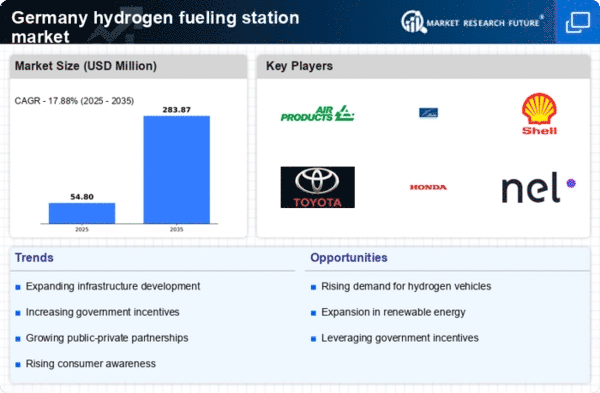
As per Market Research Future analysis, the Germany Hydrogen Fueling Station Market size was estimated at 46.48 USD Million in 2024. The Hydrogen Fueling-station market is projected to grow from 54.8 USD Million in 2025 to 283.87 USD Million by 2035, exhibiting a compound annual growth rate (CAGR) of 17.8% during the forecast period 2025 - 2035

Key Market Trends & Highlights

The Germany hydrogen fueling-station market is poised for substantial growth driven by government initiatives and technological advancements.

  • Government support and investment are significantly shaping the hydrogen fueling-station landscape in Germany.
  • Technological advancements in hydrogen production are enhancing the efficiency and viability of fueling stations.
  • The largest segment in this market is the automotive sector, while the fastest-growing segment is expected to be public transportation.
  • Key market drivers include regulatory framework enhancements and rising demand for clean transportation solutions.

Market Size & Forecast

2024 Market Size 46.48 (USD Million)
2035 Market Size 283.87 (USD Million)
CAGR (2025 - 2035) 17.88%

Major Players

Air Products and Chemicals Inc (US), Linde plc (IE), Shell plc (GB), Toyota Motor Corporation (JP), Honda Motor Co Ltd (JP), Nel ASA (NO), Plug Power Inc (US), ITM Power plc (GB), Ballard Power Systems Inc (CA)

Our Impact
Enabled $4.3B Revenue Impact for Fortune 500 and Leading Multinationals
Partnering with 2000+ Global Organizations Each Year
30K+ Citations by Top-Tier Firms in the Industry

Germany Hydrogen Fueling Station Market Trends

The Germany Hydrogen Fueling Station Market in Germany is currently experiencing a notable transformation, driven by a combination of government initiatives and increasing interest in sustainable energy solutions. The German government has committed to expanding its hydrogen infrastructure, aiming to support the transition towards a low-carbon economy. This commitment is reflected in various funding programs and strategic partnerships that encourage the development of hydrogen technologies. As a result, the number of hydrogen fueling stations is steadily increasing, catering to a growing fleet of hydrogen fuel cell vehicles. Moreover, the market appears to be influenced by advancements in hydrogen production methods, particularly green hydrogen, which is produced using renewable energy sources. This shift towards cleaner production methods is likely to enhance the appeal of hydrogen as a viable alternative to traditional fossil fuels. Additionally, collaboration between public and private sectors is fostering innovation and investment in the hydrogen fueling-station market, suggesting a promising outlook for the future. As the demand for cleaner transportation options rises, the hydrogen fueling-station market is poised for significant growth in the coming years.

Government Support and Investment

The German government is actively investing in the hydrogen fueling-station market, providing financial incentives and support for infrastructure development. This initiative aims to create a robust network of fueling stations, facilitating the adoption of hydrogen fuel cell vehicles. Such government backing is crucial for attracting private investments and fostering innovation in the sector.

Technological Advancements in Hydrogen Production

Recent advancements in hydrogen production technologies, particularly in the realm of green hydrogen, are shaping the hydrogen fueling-station market. These innovations are likely to improve the efficiency and sustainability of hydrogen production, making it a more attractive option for consumers and businesses alike.

Growing Consumer Awareness and Demand

There is a noticeable increase in consumer awareness regarding the benefits of hydrogen fuel cell vehicles. As more individuals and businesses recognize the environmental advantages of hydrogen, the demand for hydrogen fueling stations is expected to rise. This trend indicates a shift towards cleaner transportation solutions in Germany.

Germany Hydrogen Fueling Station Market Drivers

Regulatory Framework Enhancements

The hydrogen fueling-station market in Germany benefits from a robust regulatory framework that encourages the development and deployment of hydrogen infrastructure. The German government has implemented various policies aimed at reducing greenhouse gas emissions, which include incentives for hydrogen fueling stations. For instance, the National Hydrogen Strategy outlines a roadmap for increasing hydrogen production and utilization, aiming for 5 GW of electrolyzer capacity by 2030. This regulatory support is crucial for attracting investments in the hydrogen fueling-station market, as it provides a clear direction for stakeholders. Furthermore, the European Union's Green Deal complements these efforts by promoting clean energy initiatives, which could potentially lead to a 30% increase in hydrogen production by 2030. Such regulatory enhancements are likely to stimulate growth in the hydrogen fueling-station market, fostering a more sustainable transportation ecosystem.

Investment in Infrastructure Development

Investment in infrastructure development is a key driver for the hydrogen fueling-station market in Germany. The government has allocated substantial funding to establish a comprehensive network of hydrogen stations, with an estimated €9 billion earmarked for hydrogen projects by 2030. This investment is expected to facilitate the construction of over 400 hydrogen fueling stations across the country, significantly enhancing accessibility for consumers and businesses alike. Additionally, private sector investments are also on the rise, as companies recognize the potential of hydrogen as a clean fuel alternative. The collaboration between public and private entities is likely to accelerate the deployment of hydrogen infrastructure, thereby increasing the market's growth potential. As the infrastructure expands, it may lead to a 25% increase in hydrogen vehicle adoption, further driving demand in the hydrogen fueling-station market.

Collaboration Between Industry Stakeholders

Collaboration between industry stakeholders is emerging as a crucial driver for the hydrogen fueling-station market in Germany. Partnerships among automotive manufacturers, energy providers, and technology firms are fostering innovation and accelerating the deployment of hydrogen infrastructure. For instance, joint ventures are being formed to share resources and expertise, which can lead to more efficient station designs and operations. Additionally, these collaborations often result in shared funding initiatives, reducing the financial burden on individual companies. The hydrogen fueling-station market is likely to benefit from these synergies, as they can enhance the speed and scale of infrastructure development. As stakeholders work together, the market may experience a 15% increase in the number of operational stations by 2027, further solidifying hydrogen's role in the future of transportation.

Technological Innovations in Fueling Systems

Technological innovations in fueling systems are transforming the hydrogen fueling-station market in Germany. Advances in hydrogen compression and storage technologies are enhancing the efficiency and safety of fueling stations. For example, the development of high-pressure hydrogen storage systems allows for faster refueling times, which is crucial for consumer acceptance. Moreover, the integration of renewable energy sources in hydrogen production, such as wind and solar, is becoming more prevalent. This shift not only reduces production costs but also aligns with Germany's commitment to sustainability. The hydrogen fueling-station market is likely to see a 20% reduction in operational costs due to these technological advancements, making it a more attractive option for investors and operators. As these innovations continue to evolve, they may significantly impact the overall growth trajectory of the hydrogen fueling-station market.

Rising Demand for Clean Transportation Solutions

The rising demand for clean transportation solutions is a pivotal driver for the hydrogen fueling-station market in Germany. As consumers become increasingly aware of environmental issues, there is a growing preference for zero-emission vehicles, including hydrogen fuel cell vehicles. This trend is supported by various initiatives aimed at promoting sustainable mobility, such as the German government's target to have 1 million hydrogen vehicles on the road by 2030. The increasing adoption of hydrogen vehicles is expected to create a corresponding demand for hydrogen fueling stations, potentially leading to a 40% increase in station installations over the next five years. Furthermore, the automotive industry is responding to this demand by investing in hydrogen technology, which could further bolster the hydrogen fueling-station market. This alignment of consumer preferences and industry efforts is likely to drive significant growth in the sector.


Market Segment Insights

By Station Size: Large Stations (Largest) vs. Mid-sized Stations (Fastest-Growing)

In the Germany hydrogen fueling-station market, market share distribution reveals that large stations currently hold the largest share, driven by their capacity to service a wide range of vehicles and increasing demand for hydrogen fuel. These stations cater to both commercial and passenger vehicles, making them a critical component of the national infrastructure. Mid-sized stations are witnessing rapid growth as they emerge in urban areas where space is limited. Their strategic positioning allows them to capture a growing customer base seeking convenient fueling options. The growth trends in this segment are influenced by multiple factors, including government incentives, technological advancements in hydrogen production, and growing awareness about the environmental benefits of hydrogen fuel. As electric and hydrogen technologies gain traction, mid-sized stations are set to rise as a preferred choice due to their balance of capacity and accessibility. The overall market is also propelled by increased investments in renewable energy, which play a significant role in enhancing the hydrogen supply chain.

Large Stations (Dominant) vs. Mid-sized Stations (Emerging)

Large stations represent the dominant force in the Germany hydrogen fueling-station market, characterized by their extensive infrastructure and ability to serve a high demand for hydrogen fuel from both commercial and personal vehicles. They often benefit from strategic locations near major highways and industrial areas, which allows them to cater to a diverse customer base. Conversely, mid-sized stations are emerging as a significant presence, focusing on urban environments where space constraints limit the establishment of larger facilities. These stations are designed to provide quick access to fueling, appealing to hydrogen fuel vehicle owners in densely populated areas. Their growth is bolstered by an increasing number of eco-conscious consumers and the need for sustainable fuel solutions.

By Supply Type: On-site (Largest) vs. Off-site (Fastest-Growing)

The Germany hydrogen fueling-station market exhibits a distinctive segmentation in its supply type dynamics, with on-site hydrogen production representing the largest share. This model is favored for its efficiency and the reduction of transportation costs associated with fuel delivery. Off-site production, while trailing in market share, is gaining traction due to its potential for larger-scale hydrogen generation and the increasing popularity of centralized refueling stations across urban centers. The growth trends in the supply type segment are largely driven by advancements in storage technology and the regulatory framework supporting green energy sources. The demand for off-site production is projected to rise, propelled by investments in large-scale hydrogen facilities and partnerships with renewable energy suppliers. Meanwhile, on-site generation continues to grow, appealing to those seeking immediate supply and operational reliability.

Supply Type: On-site (Dominant) vs. Off-site (Emerging)

On-site hydrogen production is characterized by its ability to provide immediate fuel availability for hydrogen fueling stations, allowing for quick refueling and lower logistics costs. This segment is dominant due to its alignment with the increasing push for energy efficiency and sustainability. In contrast, off-site production is emerging rapidly, driven by advances in large-scale hydrogen generation and storage technologies. It involves centralized production facilities that can distribute hydrogen to multiple fueling stations, optimizing supply chains. Both supply types reflect the dynamic evolution of the Germany hydrogen fueling-station market, addressing different consumer needs while collectively contributing to the broader adoption of hydrogen as a viable energy source.

By Pressure: High Pressure (Largest) vs. Low Pressure (Fastest-Growing)

In the Germany hydrogen fueling-station market, the market share for high pressure segment is the most predominant, capturing the majority of the demand for fueling options. Low pressure, while smaller in relative size, is gaining traction due to its cost-effectiveness and suitability for specific applications, appealing to a niche market with unique requirements. Growth trends indicate that low pressure systems are rapidly expanding, driven by advancements in technology and increasing investment in infrastructure. The rising demand for hydrogen fuel in various sectors, coupled with government incentives for sustainable energy solutions, is pushing the adoption of both high and low pressure systems. The increasing support for low pressure as an alternative is fueling its growth, making it the fastest-growing segment in the market.

Pressure: High Pressure (Dominant) vs. Low Pressure (Emerging)

High pressure segment stands out as the dominant force in the hydrogen fueling-station market, primarily due to its extensive applications and established technology. These stations are designed to deliver hydrogen at pressures typically exceeding 700 bar, making them efficient for high-energy needs. On the other hand, low pressure systems, which operate at lower pressures, are emerging as a competitive option. These systems offer distinct advantages, such as lower costs and simpler technology, ensuring a favorable position for specific applications like transportation uses. While high pressure maintains its stronghold, the rising interest and adaptability of low pressure systems show promising growth potential within the market.

By Station Type: Fixed Hydrogen Stations (Largest) vs. Mobile Hydrogen Stations (Fastest-Growing)

In the current landscape of the Germany hydrogen fueling-station market, Fixed Hydrogen Stations dominate the market share due to their established infrastructure and stability. They represent a significant portion of the fueling network, often serving larger, commercial fleets and consistent high-demand locations such as highways and urban centers. Mobile Hydrogen Stations, while currently smaller in market share, are gaining traction, as they offer flexibility and rapid deployment in response to market needs. Their unique advantage is the ability to cater to diverse locations without the stringent requirements of a fixed installation. Growth trends in this segment are driven by the increasing demand for hydrogen vehicles and supportive government policies aimed at promoting clean energy solutions. Fixed Hydrogen Stations are expected to continue growing steadily, supported by investments in infrastructure and expansion of refueling networks. Mobile Hydrogen Stations are emerging rapidly as they can quickly fulfill the needs of areas with growing hydrogen demand, making them pivotal to the future of hydrogen mobility in Germany. This segment's success hinges on technological advancements and partnerships with vehicle manufacturers.

Station Type: Fixed Hydrogen Stations (Dominant) vs. Mobile Hydrogen Stations (Emerging)

Fixed Hydrogen Stations are characterized by their permanent installations, providing reliable and consistent refueling options primarily for larger vehicles and fleets. Their dominance in the market arises from their ability to serve high-volume demands, often located strategically along key transportation routes. On the other hand, Mobile Hydrogen Stations present an emerging solution that allows for flexible refueling options and quick responses to changing demand patterns. These stations are adaptable and can serve various locations, catering particularly well to emerging markets and areas where permanent stations may not be feasible. The growing emphasis on renewable energy and green transport solutions positions both Fixed and Mobile Hydrogen Stations as critical components of the evolving hydrogen infrastructure landscape.

By Solution: EPC (Largest) vs. Components (Fastest-Growing)

In the Germany hydrogen fueling-station market, the market share distribution indicates that the Engineering Procurement and Construction (EPC) segment holds a significant portion of the total market, establishing itself as the largest segment. This contrasts with the Components segment, which, although smaller, is rapidly gaining traction and is recognized as the fastest-growing area within the market, highlighting diverse preferences in infrastructure and technology adoption. The growth trends within these segments are shaped by several factors, including the increasing demand for hydrogen as a sustainable fuel alternative and the expanding regulatory support for green energy initiatives. The EPC segment benefits from established relationships with key stakeholders and a track record of delivering large-scale projects, while the Components segment experiences growth driven by innovation and the need for advanced technology solutions that enhance the efficiency and reliability of hydrogen fueling stations.

EPC (Dominant) vs. Components (Emerging)

The Engineering Procurement and Construction (EPC) segment is characterized by its dominance in the development and implementation of hydrogen fueling infrastructure, leveraging established expertise in project management and construction. It plays a crucial role in the overall supply chain, ensuring that the infrastructure is designed, built, and commissioned to meet the specific needs of clients. On the other hand, the Components segment is emerging as a vital part of the market, focusing on the supply of advanced parts and technologies that enable the efficient operation of fueling stations. While EPC serves as the backbone of the infrastructure, the Components segment is evolving with innovation in equipment and technology, driven by increasing investments in hydrogen technology and the push towards sustainable energy solutions.

Get more detailed insights about Germany Hydrogen Fueling Station Market

Key Players and Competitive Insights

The hydrogen fueling-station market in Germany is characterized by a dynamic competitive landscape, driven by increasing demand for clean energy solutions and government initiatives aimed at reducing carbon emissions. Key players such as Linde plc (IE), Air Products and Chemicals Inc (US), and Nel ASA (NO) are actively shaping the market through strategic partnerships and technological innovations. Linde plc (IE) focuses on expanding its hydrogen production capabilities, while Air Products and Chemicals Inc (US) emphasizes its commitment to sustainability through investments in renewable hydrogen projects. Nel ASA (NO) is leveraging its expertise in electrolyzer technology to enhance its market position, indicating a collective shift towards innovation and collaboration among these companies.
The business tactics employed by these companies include localizing manufacturing and optimizing supply chains to enhance operational efficiency. The market structure appears moderately fragmented, with several players vying for market share. However, the influence of major companies is significant, as they set industry standards and drive technological advancements. This competitive environment fosters a climate of innovation, where companies are compelled to differentiate themselves through unique offerings and strategic initiatives.
In October 2025, Linde plc (IE) announced a partnership with a leading automotive manufacturer to develop a network of hydrogen fueling stations across Germany. This collaboration is expected to enhance the accessibility of hydrogen fuel for consumers, thereby accelerating the adoption of hydrogen-powered vehicles. The strategic importance of this partnership lies in its potential to create a robust infrastructure that supports the growing demand for hydrogen as a clean energy source.
In September 2025, Air Products and Chemicals Inc (US) unveiled plans to invest €200 million in a new hydrogen production facility in Germany. This facility aims to utilize renewable energy sources for hydrogen production, aligning with the company’s sustainability goals. The investment underscores Air Products' commitment to expanding its hydrogen production capacity and reinforces its position as a leader in the market.
In August 2025, Nel ASA (NO) secured a contract to supply electrolyzers for a large-scale hydrogen production project in Germany. This contract is pivotal as it highlights Nel's technological capabilities and its role in facilitating the transition to a hydrogen economy. The project is expected to significantly increase the availability of green hydrogen, further solidifying Nel's market presence.
As of November 2025, current competitive trends in the hydrogen fueling-station market include a strong emphasis on digitalization, sustainability, and the integration of AI technologies. Strategic alliances are increasingly shaping the landscape, enabling companies to pool resources and expertise to drive innovation. Looking ahead, competitive differentiation is likely to evolve from traditional price-based competition to a focus on technological advancements, supply chain reliability, and sustainable practices. This shift suggests that companies that prioritize innovation and collaboration will be better positioned to thrive in the rapidly evolving market.

Key Companies in the Germany Hydrogen Fueling Station Market include

Industry Developments

The Germany Hydrogen Fueling Station Market has recently seen significant developments, with a notable increase in investments and installations aimed at advancing hydrogen infrastructure. Companies such as GKN Hydrogen, Linde, and Air Liquide are at the forefront, enhancing their production capabilities to meet growing demand. The German government continues to support hydrogen initiatives, pledging funding and policy frameworks to foster a carbon-neutral economy. In August 2023, H2 Mobility Deutschland announced plans to expand its network of hydrogen fueling stations to accommodate the projected rise in hydrogen fuel cell vehicles. 

Additionally, Nel ASA and Siemens have partnered recently to boost electrolyzer capacity, facilitating green hydrogen production. There have been notable mergers and acquisitions, such as Plug Power acquiring a key technology from Hydrogenics in July 2022, strengthening its market position. The growth in market valuation is pronounced, with the market anticipated to exceed EUR 7 billion by 2025, driven by increasing governmental and corporate commitments to sustainability. These initiatives are critical in reinforcing Germany's position as a leader in the European hydrogen landscape.

Future Outlook

Germany Hydrogen Fueling Station Market Future Outlook

The Hydrogen Fueling Station Market is projected to grow at a 17.88% CAGR from 2025 to 2035, driven by increasing demand for clean energy and government support.

New opportunities lie in:

  • Development of hydrogen production facilities integrated with fueling stations.
  • Expansion of mobile hydrogen refueling units for remote areas.
  • Partnerships with automotive manufacturers for co-located fueling solutions.

By 2035, the hydrogen fueling-station market is expected to be robust, driven by innovation and strategic partnerships.

Market Segmentation

Germany Hydrogen Fueling Station Market Pressure Outlook

  • High Pressure
  • Low Pressure

Germany Hydrogen Fueling Station Market Solution Outlook

  • Engineering Procurement and Construction (EPC)
  • Components

Germany Hydrogen Fueling Station Market Supply Type Outlook

  • Off-site
  • On-site

Germany Hydrogen Fueling Station Market Station Size Outlook

  • Small Stations
  • Mid-sized Stations
  • Large Stations

Germany Hydrogen Fueling Station Market Station Type Outlook

  • Fixed Hydrogen Stations
  • Mobile Hydrogen Stations

Report Scope

MARKET SIZE 2024 46.48(USD Million)
MARKET SIZE 2025 54.8(USD Million)
MARKET SIZE 2035 283.87(USD Million)
COMPOUND ANNUAL GROWTH RATE (CAGR) 17.88% (2025 - 2035)
REPORT COVERAGE Revenue Forecast, Competitive Landscape, Growth Factors, and Trends
BASE YEAR 2024
Market Forecast Period 2025 - 2035
Historical Data 2019 - 2024
Market Forecast Units USD Million
Key Companies Profiled Air Products and Chemicals Inc (US), Linde plc (IE), Shell plc (GB), Toyota Motor Corporation (JP), Honda Motor Co Ltd (JP), Nel ASA (NO), Plug Power Inc (US), ITM Power plc (GB), Ballard Power Systems Inc (CA)
Segments Covered Station Size, Supply Type, Pressure, Station Type, Solution
Key Market Opportunities Expansion of hydrogen fueling-station infrastructure driven by regulatory support and increasing consumer demand for clean energy.
Key Market Dynamics Growing investment in hydrogen infrastructure drives competitive dynamics and regulatory support for fueling-station expansion in Germany.
Countries Covered Germany
Leave a Comment

FAQs

What is the expected market size of the Germany Hydrogen Fueling Station Market in 2024?

The market is expected to be valued at 54.6 million USD in 2024.

What will the market size of the Germany Hydrogen Fueling Station Market reach by 2035?

By 2035, the market is projected to grow to 560.0 million USD.

What is the expected CAGR for the Germany Hydrogen Fueling Station Market from 2025 to 2035?

The expected CAGR for this period is 23.569 percent.

Which station size segment has the highest projected value in 2035?

The Small Stations segment is projected to reach 160.0 million USD by 2035.

What is the projected market size for Mid-sized Stations in 2035?

The Mid-sized Stations segment is expected to reach 200.0 million USD by 2035.

Who are the major players in the Germany Hydrogen Fueling Station Market?

Key players include GKN Hydrogen, ITM Power, Nel ASA, Siemens, and Linde among others.

What is the market size forecast for Large Stations by 2035?

The market forecast for Large Stations is 200.0 million USD by 2035.

How has the Germany Hydrogen Fueling Station Market been impacted by recent developments?

The market has seen growth opportunities due to increasing investment in clean energy technologies.

What applications drive growth in the Germany Hydrogen Fueling Station Market?

The primary applications driving growth include fuel cell vehicles and industrial hydrogen use.

Which region in Germany is expected to dominate the Hydrogen Fueling Station Market?

While specific regional data is not provided, major cities are anticipated to lead in market share due to infrastructure development.

Download Free Sample

Kindly complete the form below to receive a free sample of this Report

Compare Licence

×
Features License Type
Single User Multiuser License Enterprise User
Price $4,950 $5,950 $7,250
Maximum User Access Limit 1 User Upto 10 Users Unrestricted Access Throughout the Organization
Free Customization
Direct Access to Analyst
Deliverable Format
Platform Access
Discount on Next Purchase 10% 15% 15%
Printable Versions