×
Request Free Sample ×

Kindly complete the form below to receive a free sample of this Report

* Please use a valid business email

Leading companies partner with us for data-driven Insights

clients tt-cursor
Hero Background

Germany Helicobacter Pylori Test Market

ID: MRFR/HC/49451-HCR
200 Pages
Garvit Vyas
February 2026

Germany Helicobacter Pylori Test Market Research Report: Size, Share, Trend Analysis By Types (Non-endoscopic, Endoscopic), By Technology (Immunoassays, Point of care, Molecular Diagnostics) andBy End Users (Hospitals & clinics, Diagnostic laboratories, Others) - Growth Outlook & Industry Forecast 2025 To 2035

Share:
Download PDF ×

We do not share your information with anyone. However, we may send you emails based on your report interest from time to time. You may contact us at any time to opt-out.

Germany Helicobacter Pylori Test Market Infographic
Purchase Options

Germany Helicobacter Pylori Test Market Summary

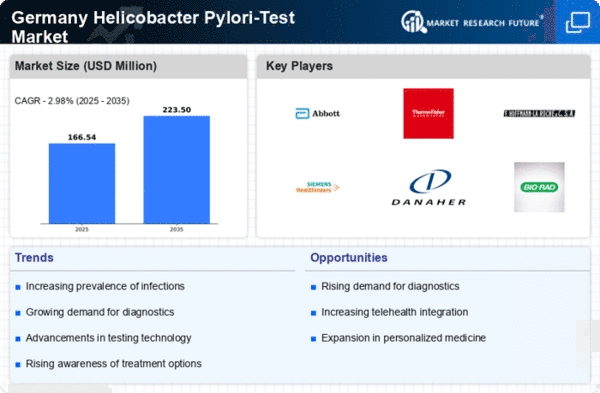
As per Market Research Future analysis, the Germany Helicobacter Pylori Test Market size was estimated at 161.72 USD Million in 2024. The Helicobacter Pylori-test market is projected to grow from 166.54 USD Million in 2025 to 223.5 USD Million by 2035, exhibiting a compound annual growth rate (CAGR) of 2.9% during the forecast period 2025 - 2035

Key Market Trends & Highlights

The Germany helicobacter pylori-test market is experiencing robust growth driven by technological advancements and increased health awareness.

  • Technological advancements in testing are enhancing the accuracy and speed of helicobacter pylori diagnostics.
  • The largest segment in the market is the non-invasive testing segment, while the fastest-growing segment is the point-of-care testing segment.
  • Increased awareness of gastrointestinal health is driving demand for helicobacter pylori testing across various demographics.
  • Rising incidence of helicobacter pylori infections and advancements in diagnostic technologies are key market drivers.

Market Size & Forecast

2024 Market Size 161.72 (USD Million)
2035 Market Size 223.5 (USD Million)
CAGR (2025 - 2035) 2.98%

Major Players

Abbott Laboratories (US), Thermo Fisher Scientific (US), F. Hoffmann-La Roche Ltd (CH), Siemens Healthineers (DE), Danaher Corporation (US), Bio-Rad Laboratories (US), Meridian Bioscience Inc. (US), Eiken Chemical Co. Ltd (JP)

Our Impact
Enabled $4.3B Revenue Impact for Fortune 500 and Leading Multinationals
Partnering with 2000+ Global Organizations Each Year
30K+ Citations by Top-Tier Firms in the Industry

Germany Helicobacter Pylori Test Market Trends

The Germany Helicobacter Pylori Test Market is currently experiencing notable developments, driven by increasing awareness of gastrointestinal health and the rising prevalence of related disorders. In Germany, healthcare professionals are emphasizing the importance of early detection and treatment of helicobacter pylori infections, which are linked to various gastrointestinal diseases. This heightened focus is likely to enhance the demand for accurate and efficient testing methods. Furthermore, advancements in diagnostic technologies are contributing to the growth of this market, as innovative testing solutions become more accessible to healthcare providers and patients alike. Moreover, the regulatory environment in Germany appears to support the expansion of the helicobacter pylori-test market. Stringent guidelines and quality standards established by health authorities ensure that testing methods are reliable and effective. This regulatory framework not only fosters trust among healthcare providers but also encourages the development of new testing technologies. As a result, the market is poised for growth, with an increasing number of healthcare facilities adopting advanced testing solutions to improve patient outcomes. Overall, the combination of rising awareness, technological advancements, and supportive regulations suggests a promising future for the helicobacter pylori-test market in Germany.

Technological Advancements in Testing

Recent innovations in diagnostic technologies are transforming the helicobacter pylori-test market. New testing methods, such as non-invasive breath tests and rapid antigen tests, are gaining traction among healthcare providers. These advancements not only enhance the accuracy of diagnoses but also improve patient comfort and convenience. As these technologies become more widely adopted, they are likely to drive market growth.

Increased Awareness of Gastrointestinal Health

There is a growing awareness among the German population regarding the importance of gastrointestinal health. Educational campaigns and initiatives by health organizations are informing individuals about the risks associated with helicobacter pylori infections. This increased awareness is expected to lead to higher testing rates, as more people seek to understand their health status and take proactive measures.

Regulatory Support for Testing Standards

The regulatory landscape in Germany is characterized by stringent standards for medical testing. Health authorities are committed to ensuring that helicobacter pylori testing methods meet high-quality benchmarks. This regulatory support not only enhances the credibility of testing solutions but also encourages innovation within the market, as companies strive to comply with evolving standards.

Germany Helicobacter Pylori Test Market Drivers

Increased Healthcare Expenditure

The rise in healthcare expenditure in Germany is a notable driver for the helicobacter pylori-test market. With the government and private sectors investing more in healthcare services, there is a growing allocation of funds towards diagnostic testing. This increase in financial resources allows healthcare facilities to upgrade their testing capabilities and adopt the latest technologies. Reports indicate that healthcare spending in Germany has grown by approximately 4% annually, which is likely to continue. As healthcare providers enhance their diagnostic services, the demand for helicobacter pylori testing is expected to rise, thereby propelling the helicobacter pylori-test market forward.

Growing Focus on Preventive Healthcare

The increasing emphasis on preventive healthcare in Germany is a significant driver for the helicobacter pylori-test market. As healthcare systems shift towards proactive measures, the demand for early detection of potential health issues, including Helicobacter pylori infections, is rising. Preventive testing is becoming a standard practice, with healthcare providers recommending routine screenings for at-risk populations. This trend is supported by public health campaigns aimed at educating the population about the risks associated with untreated infections. The helicobacter pylori-test market stands to gain from this focus on prevention, as more individuals seek testing to mitigate health risks and enhance their overall well-being.

Advancements in Diagnostic Technologies

Technological innovations in diagnostic testing are significantly influencing the helicobacter pylori-test market. The introduction of non-invasive testing methods, such as breath tests and stool antigen tests, has made it easier for healthcare providers to diagnose infections accurately. These advancements not only enhance patient comfort but also improve testing efficiency, leading to quicker results. In Germany, the adoption of these modern diagnostic tools is on the rise, with a reported increase in the use of breath tests by over 20% in recent years. This shift towards advanced testing technologies is likely to drive the helicobacter pylori-test market forward, as healthcare facilities seek to implement the latest solutions to meet patient needs and improve healthcare outcomes.

Regulatory Support for Diagnostic Testing

Regulatory frameworks in Germany are increasingly supportive of diagnostic testing, which positively impacts the helicobacter pylori-test market. The German Federal Institute for Drugs and Medical Devices (BfArM) has established guidelines that facilitate the approval and use of new testing methods. This regulatory support encourages innovation and the introduction of advanced diagnostic tools into the market. As a result, manufacturers are more likely to invest in research and development, leading to a broader range of testing options for healthcare providers. The helicobacter pylori-test market is expected to benefit from this favorable regulatory environment, as it fosters competition and enhances the availability of effective testing solutions.

Rising Incidence of Helicobacter Pylori Infections

The increasing prevalence of Helicobacter pylori infections in Germany is a crucial driver for the helicobacter pylori-test market. Studies indicate that approximately 30-40% of the German population may be infected with this bacterium, which is linked to various gastrointestinal disorders, including peptic ulcers and gastric cancer. This rising incidence necessitates effective diagnostic testing, thereby propelling market growth. As healthcare providers emphasize early detection and treatment, the demand for reliable testing methods is expected to surge. Furthermore, the growing awareness among patients regarding the health implications of untreated infections contributes to the market's expansion. The helicobacter pylori-test market is likely to benefit from this trend, as more individuals seek testing to confirm or rule out infections.


Market Segment Insights

By Test Type: Non-endoscopic (Largest) vs. Endoscopic (Fastest-Growing)

The market share distribution for test types in the Germany helicobacter pylori-test market illustrates that non-endoscopic tests dominate the landscape, capturing the majority of the demand due to their ease of use and non-invasive nature. In contrast, endoscopic tests, while currently holding a smaller share, are gaining traction, driven by their accuracy and ability to identify related gastrointestinal issues more effectively. Growth trends indicate a significant increase in the adoption of endoscopic testing methods in the upcoming years, propelled by advancements in medical technology and a rising awareness among healthcare professionals. The non-endoscopic segment continues to flourish, primarily due to the preference for patient-friendly, cost-effective solutions. Overall, this dynamic plays a crucial role in shaping the competitive framework of the sector.

Test Type: Non-endoscopic (Dominant) vs. Endoscopic (Emerging)

The non-endoscopic test type in the Germany helicobacter pylori-test market is characterized by its non-invasive procedures, making it the preferred choice for both patients and healthcare providers. As the dominant segment, it enjoys widespread acceptance due to lower costs and convenient testing options. In contrast, the endoscopic test type is viewed as an emerging alternative, providing superior diagnostic capabilities. While it currently holds a smaller market share, increasing technological advancements and growing clinician confidence in the results of endoscopic procedures are expected to enhance its demand. The duality of these test types reflects varying patient needs and preferences, further diversifying the market's approach to diagnosis and patient care.

By Technology: Immunoassays (Largest) vs. Molecular Diagnostics (Fastest-Growing)

In the Germany helicobacter pylori-test market, the Immunoassays segment holds the largest share due to its established presence and reliability in diagnosing infections. This segment benefits from widespread adoption in clinical settings, supported by healthcare providers preferring tested and dependable methods for accurate diagnostics. Conversely, the Molecular Diagnostics segment, while currently smaller in market share, is rapidly expanding due to advancements in technology and increased demand for precise and early detection methods. The growth trends in the Germany helicobacter pylori-test market are driven by rising incidences of gastritis and peptic ulcers, leading to greater screening initiatives. Moreover, the shift towards personalized medicine and the increased focus on rapid diagnostic capabilities are propelling the Molecular Diagnostics segment. Technological innovations and regulatory approvals further boost market attractiveness, as healthcare facilities seek effective solutions to meet patient needs efficiently.

Technology: Immunoassays (Dominant) vs. Point of Care (Emerging)

The Immunoassays segment stands out as the dominant force in the Germany helicobacter pylori-test market, renowned for its reliability and consistency in detecting infections. It offers advantages such as high sensitivity and specificity, making it a preferred choice among healthcare professionals. Conversely, the Point of Care segment is emerging as a significant player, driven by the demand for rapid testing solutions that ensure timely diagnosis at the patient’s side. This segment promises convenience and faster results, catering to the growing need for efficient healthcare delivery. The dynamics between these segments highlight a balancing act between established testing methods and innovative, rapid-response solutions.

By End User: Hospitals & Clinics (Largest) vs. Diagnostic Laboratories (Fastest-Growing)

In the Germany helicobacter pylori-test market, the distribution of market share across the end user segment reveals that hospitals and clinics hold the largest share, reflecting their significant role in diagnostic testing and patient management. Conversely, diagnostic laboratories are emerging as the fastest-growing segment due to the increasing reliance on specialized testing facilities for rapid and accurate results, which are crucial for effective treatment protocols. The growth trends within this segment indicate a robust demand for enhanced diagnostic capabilities. Hospitals and clinics continue to invest in advanced testing technologies, driven by the need for efficient patient care. Additionally, diagnostic laboratories are expanding their services by incorporating innovative testing methods and automation, catering to the rising patient volume, and enhancing diagnostic workflows to meet clinical requirements.

Hospitals & Clinics (Dominant) vs. Diagnostic Laboratories (Emerging)

Hospitals and clinics dominate the end user segment in the Germany helicobacter pylori-test market due to their integrated healthcare services and direct patient interactions. Their established infrastructures and clinical expertise in managing gastrointestinal disorders make them pivotal in the effective application of helicobacter pylori testing. On the other hand, diagnostic laboratories are positioned as an emerging force, capitalizing on technological advancements and the demand for high-throughput testing. These laboratories are increasingly adopting molecular testing techniques, reflecting their adaptability and focus on delivering precise diagnostic results. As healthcare dynamics evolve, both segments are expected to play crucial roles in shaping diagnostic strategies and patient treatment outcomes.

Get more detailed insights about Germany Helicobacter Pylori Test Market

Key Players and Competitive Insights

The helicobacter pylori-test market in Germany is characterized by a competitive landscape that is increasingly shaped by innovation, strategic partnerships, and a focus on digital transformation. Key players such as Abbott Laboratories (US), Thermo Fisher Scientific (US), and Siemens Healthineers (DE) are actively pursuing strategies that enhance their market positioning. Abbott Laboratories (US) emphasizes innovation in diagnostic technologies, while Thermo Fisher Scientific (US) focuses on expanding its product portfolio through strategic acquisitions. Siemens Healthineers (DE) is leveraging its expertise in digital health solutions to improve testing efficiency and accuracy. Collectively, these strategies contribute to a dynamic competitive environment, where companies are not only vying for market share but also striving to enhance patient outcomes through advanced testing solutions.
In terms of business tactics, companies are increasingly localizing manufacturing and optimizing supply chains to enhance operational efficiency. The market structure appears moderately fragmented, with several players competing for dominance. However, the influence of major companies is significant, as they set industry standards and drive innovation. This competitive structure allows for a diverse range of products and services, catering to various customer needs while fostering a culture of continuous improvement.
In October 2025, F. Hoffmann-La Roche Ltd (CH) announced a partnership with a leading German healthcare provider to integrate its helicobacter pylori testing solutions into routine clinical practice. This collaboration is expected to enhance the accessibility of testing and improve patient management strategies. The strategic importance of this partnership lies in Roche's ability to leverage its established reputation in diagnostics while expanding its reach within the German healthcare system.
In September 2025, Danaher Corporation (US) launched a new rapid testing kit for helicobacter pylori, designed to provide results within minutes. This innovation is particularly significant as it addresses the growing demand for quick and reliable testing solutions in clinical settings. The introduction of this product not only strengthens Danaher's market position but also reflects a broader trend towards rapid diagnostics in the healthcare sector.
In August 2025, Bio-Rad Laboratories (US) expanded its distribution network in Germany by partnering with local distributors to enhance market penetration. This strategic move is likely to improve Bio-Rad's accessibility to healthcare providers and laboratories, thereby increasing its market share. The expansion aligns with the company's goal of providing comprehensive testing solutions and underscores the importance of local partnerships in navigating the competitive landscape.
As of November 2025, current trends in the helicobacter pylori-test market are heavily influenced by digitalization, sustainability, and the integration of artificial intelligence (AI) in diagnostic processes. Strategic alliances are becoming increasingly vital, as companies seek to combine resources and expertise to drive innovation. The competitive differentiation is expected to evolve, shifting from traditional price-based competition to a focus on technological advancements, reliability in supply chains, and the development of innovative testing solutions. This transition indicates a promising future for the market, where companies that prioritize innovation and collaboration are likely to thrive.

Key Companies in the Germany Helicobacter Pylori Test Market include

Industry Developments

The Germany Helicobacter Pylori Test Market has recently seen notable developments, including advancements in diagnostic technologies by key players such as Thermo Fisher Scientific and Abbott Laboratories, which have expanded their product offerings to enhance test accuracy and speed. In March 2023, Genomica launched a novel rapid testing kit that significantly reduces the time required for diagnosis. Furthermore, the market is benefiting from a growing awareness of gastric conditions related to Helicobacter Pylori, spurred by public health campaigns emphasizing early detection and treatment.

Recent mergers and acquisitions have also shaped the market landscape; for instance, in January 2023, H. Pylori Test Inc. acquired Biohit HealthCare to broaden its diagnostic capabilities, a move that has been positively received with a projected increase in market share. In terms of market valuation, recent financial reports indicate a steady growth rate attributed to innovative product developments and heightened consumer demand, reflecting positively on companies like Meridian Bioscience and Roche Diagnostics.

Over the last couple of years, regulatory updates from Germany’s Ministry of Health have supported the introduction of new testing methodologies, fostering an environment conducive to growth within the Helicobacter Pylori diagnostics segment.

Future Outlook

Germany Helicobacter Pylori Test Market Future Outlook

The Helicobacter Pylori Test Market is projected to grow at 2.98% CAGR from 2025 to 2035, driven by increasing prevalence of gastrointestinal disorders and advancements in diagnostic technologies.

New opportunities lie in:

  • Development of rapid point-of-care testing kits
  • Integration of AI for enhanced diagnostic accuracy
  • Expansion of telehealth services for remote testing

By 2035, the market is expected to achieve robust growth, driven by innovation and increased healthcare access.

Market Segmentation

Germany Helicobacter Pylori Test Market End User Outlook

  • Hospitals & clinics
  • Diagnostic laboratories
  • Others

Germany Helicobacter Pylori Test Market Test Type Outlook

  • Non-endoscopic
  • Endoscopic

Germany Helicobacter Pylori Test Market Technology Outlook

  • Immunoassays
  • Point of care
  • Molecular Diagnostics

Report Scope

MARKET SIZE 2024 161.72(USD Million)
MARKET SIZE 2025 166.54(USD Million)
MARKET SIZE 2035 223.5(USD Million)
COMPOUND ANNUAL GROWTH RATE (CAGR) 2.98% (2025 - 2035)
REPORT COVERAGE Revenue Forecast, Competitive Landscape, Growth Factors, and Trends
BASE YEAR 2024
Market Forecast Period 2025 - 2035
Historical Data 2019 - 2024
Market Forecast Units USD Million
Key Companies Profiled Abbott Laboratories (US), Thermo Fisher Scientific (US), F. Hoffmann-La Roche Ltd (CH), Siemens Healthineers (DE), Danaher Corporation (US), Bio-Rad Laboratories (US), Meridian Bioscience Inc. (US), Eiken Chemical Co. Ltd (JP)
Segments Covered Test Type, Technology, End User
Key Market Opportunities Emerging diagnostic technologies enhance accuracy and speed in the helicobacter pylori-test market.
Key Market Dynamics Rising demand for non-invasive testing methods drives innovation in the helicobacter pylori-test market.
Countries Covered Germany
Leave a Comment

FAQs

What is the projected market size of the Germany Helicobacter Pylori Test Market by 2035?

The Germany Helicobacter Pylori Test Market is projected to be valued at 278.4 USD Million by 2035.

What was the market value of the Germany Helicobacter Pylori Test Market in 2024?

The market value of the Germany Helicobacter Pylori Test Market in 2024 is estimated to be 161.5 USD Million.

What is the expected CAGR for the Germany Helicobacter Pylori Test Market from 2025 to 2035?

The expected CAGR for the Germany Helicobacter Pylori Test Market from 2025 to 2035 is 5.075 percent.

Which segment of the Germany Helicobacter Pylori Test Market is expected to dominate by 2035?

The Non-endoscopic segment is expected to dominate the Germany Helicobacter Pylori Test Market by reaching 140.0 USD Million by 2035.

What are the key players in the Germany Helicobacter Pylori Test Market?

Key players in the Germany Helicobacter Pylori Test Market include Thermo Fisher Scientific, Abbott Laboratories, and F. Hoffmann La Roche.

How much is the Endoscopic segment valued at in 2024?

In 2024, the Endoscopic segment of the Germany Helicobacter Pylori Test Market is valued at 81.5 USD Million.

What is the expected market value of the Non-endoscopic segment by 2035?

The Non-endoscopic segment is expected to be valued at 140.0 USD Million by 2035.

What is the market growth rate for the Germany Helicobacter Pylori Test Market until 2035?

The Germany Helicobacter Pylori Test Market is anticipated to experience a growth rate driven by a CAGR of 5.075 percent from 2025 to 2035.

What were the market values of Non-endoscopic and Endoscopic segments in 2024?

In 2024, the Non-endoscopic segment is valued at 80.0 USD Million and the Endoscopic segment at 81.5 USD Million.

What impact are emerging trends having on the Germany Helicobacter Pylori Test Market?

Emerging trends in the Germany Helicobacter Pylori Test Market are providing opportunities for growth, particularly in the advancement of non-invasive testing methods.

Download Free Sample

Kindly complete the form below to receive a free sample of this Report

Compare Licence

×
Features License Type
Single User Multiuser License Enterprise User
Price $4,950 $5,950 $7,250
Maximum User Access Limit 1 User Upto 10 Users Unrestricted Access Throughout the Organization
Free Customization
Direct Access to Analyst
Deliverable Format
Platform Access
Discount on Next Purchase 10% 15% 15%
Printable Versions