×
Request Free Sample ×

Kindly complete the form below to receive a free sample of this Report

* Please use a valid business email

Leading companies partner with us for data-driven Insights

clients tt-cursor
Hero Background

Germany Environment Health Safety Market

ID: MRFR/ICT/58301-HCR
200 Pages
Aarti Dhapte
February 2026

Germany Environment, Health and Safety Market Size, Share and Research Report: By Component (solution, service) and By Vertical (energy & utilities, healthcare, food & beverage, chemicals & materials, construction & engineering, government, others) - Industry Forecast to 2035

Share:
Download PDF ×

We do not share your information with anyone. However, we may send you emails based on your report interest from time to time. You may contact us at any time to opt-out.

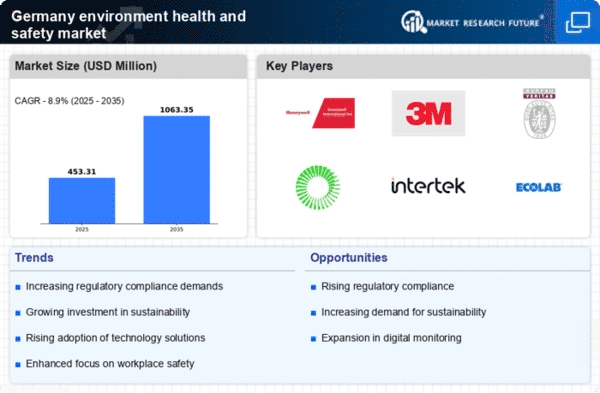
Germany Environment Health Safety Market Infographic
Purchase Options

Germany Environment Health Safety Market Summary

As per Market Research Future analysis, the Germany environment health and safety market size was estimated at 416.26 USD Million in 2024. The Germany environment health-safety market is projected to grow from 453.31 USD Million in 2025 to 1063.35 USD Million by 2035, exhibiting a compound annual growth rate (CAGR) of 8% during the forecast period 2025 - 2035

Key Market Trends & Highlights

The Germany environment health-safety market is experiencing a robust shift towards regulatory compliance and technological innovation.

  • Regulatory compliance remains a pivotal focus, driving innovation across the sector.
  • Technological advancements in monitoring are enhancing operational efficiency and data accuracy.
  • Sustainability is increasingly viewed as a business imperative, influencing corporate strategies.
  • Key market drivers include increased regulatory scrutiny and growing public awareness, which are shaping industry practices.

Market Size & Forecast

2024 Market Size 416.26 (USD Million)
2035 Market Size 1063.35 (USD Million)
CAGR (2025 - 2035) 8.9%

Major Players

Honeywell International Inc. (US), 3M Company (US), Bureau Veritas S.A. (FR), SGS S.A. (CH), Intertek Group plc (GB), Ecolab Inc. (US), Aon plc (GB), DuPont de Nemours Inc. (US), TÜV SÜD AG (DE), Arcadis N.V. (NL)

Our Impact
Enabled $4.3B Revenue Impact for Fortune 500 and Leading Multinationals
Partnering with 2000+ Global Organizations Each Year
30K+ Citations by Top-Tier Firms in the Industry

Germany Environment Health Safety Market Trends

The environment health-safety market in Germany is currently experiencing a notable transformation, driven by increasing regulatory requirements and heightened public awareness regarding environmental issues. The German government has implemented stringent regulations aimed at reducing pollution and ensuring workplace safety, which has led to a surge in demand for innovative solutions. Companies are now prioritizing sustainability and compliance, resulting in a shift towards eco-friendly products and services. This evolving landscape suggests that businesses must adapt to remain competitive, as stakeholders increasingly expect transparency and accountability in environmental practices. Moreover, advancements in technology are playing a crucial role in shaping the environment health-safety market. The integration of digital tools and data analytics is enhancing monitoring and reporting capabilities, allowing organizations to better manage risks and improve safety outcomes. As industries strive to meet both regulatory standards and consumer expectations, the focus on proactive measures is likely to intensify. This trend indicates a growing recognition of the importance of environmental health and safety, not only as a compliance issue but as a fundamental aspect of corporate responsibility and sustainability initiatives.

Regulatory Compliance and Innovation

The environment health-safety market is witnessing a strong emphasis on regulatory compliance, prompting companies to innovate their practices. The German government enforces strict environmental laws, compelling businesses to adopt advanced technologies and sustainable practices. This trend indicates a shift towards proactive compliance strategies, where organizations invest in solutions that not only meet legal requirements but also enhance their overall environmental performance.

Technological Advancements in Monitoring

Technological innovations are significantly impacting the environment health-safety market, particularly in monitoring and reporting. The adoption of digital tools, such as IoT devices and data analytics, enables organizations to track environmental metrics in real-time. This capability enhances decision-making processes and fosters a culture of safety and accountability, as companies can swiftly address potential hazards and improve compliance.

Sustainability as a Business Imperative

Sustainability is increasingly recognized as a core business imperative within the environment health-safety market. Companies are integrating sustainable practices into their operations, driven by consumer demand and regulatory pressures. This trend reflects a broader understanding that environmental health and safety are integral to long-term business success, prompting organizations to prioritize eco-friendly initiatives and corporate social responsibility.

Germany Environment Health Safety Market Drivers

Growing Public Awareness

Public awareness regarding environmental health and safety issues is on the rise in Germany, influencing consumer behavior and corporate practices. As citizens become more informed about the impacts of industrial activities on health and the environment, they demand greater transparency and accountability from businesses. This shift in consumer expectations is prompting companies to invest in sustainable practices and health safety measures. In 2025, it is projected that companies prioritizing environmental health and safety will see a 15% increase in customer loyalty, thereby driving growth in the environment health-safety market.

Technological Integration

The integration of advanced technologies into the environment health-safety market is transforming how organizations manage risks. Innovations such as IoT devices, AI-driven analytics, and real-time monitoring systems are becoming essential tools for ensuring compliance and enhancing safety protocols. In Germany, the adoption of these technologies is expected to grow by 25% over the next five years, as companies seek to leverage data for better decision-making. This technological shift not only improves operational efficiency but also fosters a culture of safety, making it a pivotal driver in the environment health-safety market.

Increased Regulatory Scrutiny

The environment health-safety market in Germany is experiencing heightened regulatory scrutiny, driven by both national and EU-level legislation. This regulatory environment compels organizations to adopt stringent health and safety measures, thereby increasing demand for compliance solutions. In 2025, it is estimated that compliance-related expenditures will account for approximately 30% of total market spending. Companies are investing in advanced monitoring systems and training programs to meet these evolving standards. The emphasis on regulatory compliance not only enhances workplace safety but also mitigates potential legal liabilities, making it a critical driver in the environment health-safety market.

Economic Incentives for Compliance

Economic incentives provided by the German government are playing a crucial role in shaping the environment health-safety market. Financial support for companies that invest in health and safety improvements encourages compliance with regulations. In 2025, it is expected that such incentives will lead to a 10% increase in market participation from small and medium-sized enterprises (SMEs). These economic drivers not only facilitate compliance but also promote innovation in safety technologies, thereby enhancing the overall landscape of the environment health-safety market.

Corporate Sustainability Initiatives

Corporate sustainability initiatives are increasingly influencing the environment health-safety market in Germany. Companies are recognizing that sustainable practices not only benefit the environment but also enhance their brand reputation and operational efficiency. In 2025, it is anticipated that organizations investing in sustainability will experience a 20% reduction in operational costs, further incentivizing their commitment to health and safety measures. This trend reflects a broader shift towards integrating environmental considerations into business strategies, thereby driving growth in the environment health-safety market.

Market Segment Insights

By Component: Solutions (Largest) vs. Services (Fastest-Growing)

In the Germany environment health-safety market, the distribution of market share among the component values reveals that Solutions dominate the landscape. Solutions offer comprehensive packages that cater to various environmental health and safety needs, providing significant market stability and strong customer loyalty. Conversely, Services, while currently holding a smaller share, are rapidly gaining momentum, signifying a shift towards more dynamic and client-specific offerings. The growth trends for these segments highlight the increasing importance of tailored solutions in environmental safety. The demand for Services is driven by the need for adaptability and rapid response to climate change impacts and regulatory changes. Moreover, advancements in technology are enabling service providers to enhance their offerings, thus appealing to a growing customer base that prioritizes proactive rather than reactive measures.

Solutions: Dominant vs. Services: Emerging

Solutions in the Germany environment health-safety market reflect a mature and well-established category, characterized by comprehensive offerings that integrate technology and regulations. They cater to a wide range of sectors, ensuring compliance and safety across various environments. On the other hand, Services have emerged as an innovative counterpart, focusing on customized solutions that address specific client needs, thus gaining traction among businesses seeking flexible and efficient operational practices. This dynamic between the two segments indicates a healthy market evolution, where established solutions provide reliability, while emerging services encourage growth through innovation and tailored customer engagement.

By Application: Healthcare (Largest) vs. Energy & Utilities (Fastest-Growing)

The market share distribution among the application segments reveals that Healthcare holds the largest share, driven by stringent regulations and increased focus on worker and patient safety. Following closely is the Energy & Utilities sector, which benefits from growing energy demands and the transition to sustainable practices, allowing it to capture significant market attention. The Chemicals & Materials segment also plays a crucial role, bolstered by extensive regulatory requirements that emphasize safety protocols in manufacturing processes. Growth trends indicate the Healthcare sector will continue to lead as public health initiatives expand, while the Energy & Utilities segment is positioned for rapid growth, fueled by investments in green technologies and infrastructure changes. The Food & Beverage sector is also witnessing a steady upwards trajectory, reflecting a heightened awareness of safety standards among consumers. As the Government sector enforces stricter regulations, segments like Construction & Engineering are adapting by integrating advanced safety solutions to remain competitive.

Healthcare (Dominant) vs. Energy & Utilities (Emerging)

Healthcare stands out as the dominant segment within the Germany environment health-safety market, characterized by rigorous compliance requirements and an unyielding commitment to patient safety, fostering significant investments in robust safety protocols. Its influence is seen in advancing technologies aimed at mitigating risks associated with healthcare delivery. Conversely, the Energy & Utilities sector represents an emerging segment that is rapidly evolving, driven by sustainability goals and increasing regulatory pressure to enhance safety measures. Companies within this segment are innovating to implement safer operational practices while transitioning to renewable energy sources. The growing inclination towards eco-friendly solutions is propelling the Energy & Utilities sector's potential as a fast-growing contributor to overall market dynamics.

Get more detailed insights about Germany Environment Health Safety Market

Key Players and Competitive Insights

The environment health-safety market in Germany is characterized by a dynamic competitive landscape, driven by increasing regulatory requirements and a heightened focus on sustainability. Major players such as Honeywell International Inc. (US), 3M Company (US), and TÜV SÜD AG (DE) are strategically positioned to leverage innovation and digital transformation to enhance their service offerings. Honeywell, for instance, emphasizes the integration of advanced technologies in its safety solutions, while 3M focuses on developing sustainable products that meet evolving environmental standards. Collectively, these strategies not only enhance their market presence but also shape a competitive environment that prioritizes compliance and innovation.Key business tactics within this market include localizing manufacturing and optimizing supply chains to enhance responsiveness to regional demands. The competitive structure appears moderately fragmented, with several key players exerting influence over various segments. This fragmentation allows for niche players to thrive, while larger corporations consolidate their market share through strategic partnerships and acquisitions.

In October TÜV SÜD AG (DE) announced a strategic partnership with a leading technology firm to develop AI-driven safety solutions aimed at improving workplace safety standards. This move is significant as it aligns with the growing trend of integrating artificial intelligence into safety protocols, potentially enhancing operational efficiency and reducing incident rates. The partnership underscores TÜV SÜD's commitment to innovation and positions it favorably in a market increasingly driven by technological advancements.

In September 3M Company (US) launched a new line of environmentally friendly personal protective equipment (PPE) designed to meet stringent European safety regulations. This initiative not only reflects 3M's dedication to sustainability but also addresses the rising demand for eco-conscious products among consumers and businesses alike. By prioritizing sustainable practices, 3M is likely to strengthen its competitive edge in a market that increasingly values environmental responsibility.

In August Honeywell International Inc. (US) expanded its digital safety platform to include enhanced analytics capabilities, allowing organizations to better predict and mitigate risks. This expansion is crucial as it demonstrates Honeywell's focus on digital transformation, which is becoming a key differentiator in the environment health-safety market. By leveraging data analytics, Honeywell positions itself as a leader in proactive safety management, appealing to clients seeking advanced solutions.
As of November current competitive trends indicate a strong shift towards digitalization, sustainability, and the integration of AI technologies. Strategic alliances are increasingly shaping the landscape, enabling companies to pool resources and expertise to address complex challenges. Looking ahead, competitive differentiation is likely to evolve from traditional price-based competition to a focus on innovation, technological advancement, and supply chain reliability. This shift suggests that companies prioritizing these elements will be better positioned to thrive in an increasingly complex market.

Key Companies in the Germany Environment Health Safety Market include

Industry Developments

The Germany Environment, Health and Safety market has seen significant activity recently, particularly with major companies like Roche, Intertek, BASF, Honeywell, Veolia, SUEZ, Merck Group, Siemens, Avery Dennison, DQS, Bureau Veritas, SGS, and DEKRA. In June 2023, BASF announced its commitment to sustainability through various initiatives aimed at reducing emissions and promoting green chemistry, aligning with the German government’s environmental policies. In April 2023, SUEZ completed an acquisition of a local waste treatment facility, enhancing its capabilities in waste management and recycling in the region. 

Furthermore, the growing emphasis on health and safety, spurred by the pandemic, has resulted in increased market valuations, with the market expected to reach €30 billion by 2025. Major developments in environmental regulations and corporate sustainability goals are shaping the landscape of the Germany Environment, Health and Safety market, reflecting a broader commitment to environmental stewardship and innovative safety solutions across sectors.

Future Outlook

Germany Environment Health Safety Market Future Outlook

The Environment Health Safety Market in Germany is projected to grow at 8.9% CAGR from 2025 to 2035, driven by regulatory changes, technological advancements, and increasing public awareness.

New opportunities lie in:

  • Development of AI-driven safety compliance software solutions.
  • Expansion of eco-friendly personal protective equipment (PPE) lines.
  • Implementation of real-time environmental monitoring systems for industries.

By 2035, the market is expected to achieve robust growth, positioning itself as a leader in environmental health and safety.

Market Segmentation

Germany Environment Health Safety Market Component Outlook

  • Solutions
  • Services

Germany Environment Health Safety Market Application Outlook

  • Energy & Utilities
  • Healthcare
  • Food & Beverage
  • Chemicals & Materials
  • Construction & Engineering
  • Government
  • Others

Report Scope

MARKET SIZE 2024 416.26(USD Million)
MARKET SIZE 2025 453.31(USD Million)
MARKET SIZE 2035 1063.35(USD Million)
COMPOUND ANNUAL GROWTH RATE (CAGR) 8.9% (2025 - 2035)
REPORT COVERAGE Revenue Forecast, Competitive Landscape, Growth Factors, and Trends
BASE YEAR 2024
Market Forecast Period 2025 - 2035
Historical Data 2019 - 2024
Market Forecast Units USD Million
Key Companies Profiled Honeywell International Inc. (US), 3M Company (US), Bureau Veritas S.A. (FR), SGS S.A. (CH), Intertek Group plc (GB), Ecolab Inc. (US), Aon plc (GB), DuPont de Nemours Inc. (US), TÜV SÜD AG (DE), Arcadis N.V. (NL)
Segments Covered Component, Application
Key Market Opportunities Integration of advanced monitoring technologies enhances compliance and safety in the environment health-safety market.
Key Market Dynamics Rising regulatory pressures drive innovation and investment in environmental health-safety technologies across various industries.
Countries Covered Germany
Leave a Comment

FAQs

What is the expected market size of the Germany Environment, Health and Safety Market in 2024?

The Germany Environment, Health and Safety Market is expected to be valued at 414.5 million USD in 2024.

How much is the Germany Environment, Health and Safety Market projected to be worth by 2035?

By 2035, the Germany Environment, Health and Safety Market is projected to reach a value of 1233.5 million USD.

What is the CAGR for the Germany Environment, Health and Safety Market between 2025 and 2035?

The expected CAGR for the Germany Environment, Health and Safety Market from 2025 to 2035 is 10.422%.

Which segment is projected to contribute the most to the solution market in 2035?

The solution segment of the Germany Environment, Health and Safety Market is projected to be valued at 740.5 million USD in 2035.

What is the expected value of the service segment in the Germany Environment, Health and Safety Market by 2035?

The service segment is expected to reach a value of 493.0 million USD by 2035.

Who are the key players in the Germany Environment, Health and Safety Market?

Major players include Roche, Intertek, BASF, Honeywell, Veolia, SUEZ, Merck Group, Siemens, Avery Dennison, DQS, Bureau Veritas, SGS, and DEKRA.

What is the expected market size of the solution component in 2024?

The solution component of the Germany Environment, Health and Safety Market is expected to be valued at 248.5 million USD in 2024.

What challenges does the Germany Environment, Health and Safety Market face?

Challenges may include regulatory changes, technological advancements, and increasing environmental concerns.

What key trends are influencing the growth of the Germany Environment, Health and Safety Market?

Trends such as increased demand for sustainable practices and regulatory compliance are driving market growth.

What is the impact of regional dynamics on the Germany Environment, Health and Safety Market?

Regional dynamics significantly influence market growth, particularly in areas with stringent environmental regulations.

Download Free Sample

Kindly complete the form below to receive a free sample of this Report

Compare Licence

×
Features License Type
Single User Multiuser License Enterprise User
Price $4,950 $5,950 $7,250
Maximum User Access Limit 1 User Upto 10 Users Unrestricted Access Throughout the Organization
Free Customization
Direct Access to Analyst
Deliverable Format
Platform Access
Discount on Next Purchase 10% 15% 15%
Printable Versions