×
Request Free Sample ×

Kindly complete the form below to receive a free sample of this Report

* Please use a valid business email

Leading companies partner with us for data-driven Insights

clients tt-cursor
Hero Background

Germany E Passport E Visa Market

ID: MRFR/ICT/57991-HCR
200 Pages
Aarti Dhapte
February 2026

Germany E-Passport E-Visa Market Research Report By Type (Biometrics, RFID), By Application (Leisure Travel, Business Travel, Identification/Proof, Immigration/Border Control) and By Hardware Components (Antenna, Processor/Chip)-Forecast to 2035

Share:
Download PDF ×

We do not share your information with anyone. However, we may send you emails based on your report interest from time to time. You may contact us at any time to opt-out.

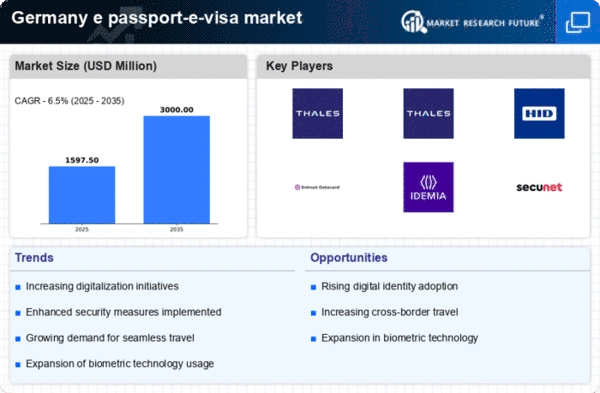
Germany E Passport E Visa Market Infographic
Purchase Options

Germany E Passport E Visa Market Summary

As per Market Research Future analysis, the E Passport-e-visa market was estimated at 1500.0 USD Million in 2024. The e passport-e-visa market is projected to grow from 1597.5 USD Million in 2025 to 3000.0 USD Million by 2035, exhibiting a compound annual growth rate (CAGR) of 6% during the forecast period 2025 - 2035

Key Market Trends & Highlights

The Germany e passport-e-visa market is experiencing robust growth driven by technological advancements and increasing travel demand.

  • Technological advancements are reshaping the e passport-e-visa landscape, enhancing user experience and security.
  • The largest segment in the market is the e passport segment, while the fastest-growing segment is the e visa segment.
  • Regulatory changes are influencing the adoption of digital travel documents, promoting efficiency and security.
  • Enhanced security measures and digital transformation initiatives are key drivers propelling market growth.

Market Size & Forecast

2024 Market Size 1500.0 (USD Million)
2035 Market Size 3000.0 (USD Million)
CAGR (2025 - 2035) 6.5%

Major Players

Thales Group (FR), Gemalto (NL), HID Global (US), Entrust Datacard (US), IDEMIA (FR), Secunet Security Networks AG (DE), Zebra Technologies (US), Veridos (DE)

Our Impact
Enabled $4.3B Revenue Impact for Fortune 500 and Leading Multinationals
Partnering with 2000+ Global Organizations Each Year
30K+ Citations by Top-Tier Firms in the Industry

Germany E Passport E Visa Market Trends

The e passport-e-visa market is currently experiencing notable growth, driven by advancements in technology and increasing demand for secure travel documentation. The integration of biometric features into e passports enhances security and facilitates smoother border control processes. Additionally, the rise in international travel and the need for efficient visa processing systems contribute to the market's expansion. As countries prioritize modernization in their immigration systems, the e passport-e-visa market is likely to see further innovations and improvements in user experience. Moreover, the regulatory landscape surrounding travel documentation is evolving, with many nations adopting standardized protocols for e passports and e visas. This shift not only streamlines the application process but also enhances the overall security of travel documents. The emphasis on digital solutions reflects a broader trend towards automation and efficiency in governmental operations. As the e passport-e-visa market continues to develop, it appears poised to play a crucial role in shaping the future of international travel and border management.

Technological Advancements

The e passport-e-visa market is witnessing rapid technological advancements, particularly in biometric identification and data encryption. These innovations enhance security measures, making it increasingly difficult for fraudulent activities to occur. As countries adopt these technologies, the market is likely to see a rise in consumer trust and acceptance.

Regulatory Changes

Regulatory changes are significantly impacting the e passport-e-visa market. Governments are increasingly implementing standardized protocols for e passports and e visas, which streamline application processes and improve security. This trend suggests a move towards greater international cooperation in travel documentation.

Increased Demand for Travel

The demand for international travel is on the rise, which is positively influencing the e passport-e-visa market. As more individuals seek to travel abroad, the need for efficient visa processing and secure travel documentation becomes paramount. This trend indicates a growing reliance on digital solutions to facilitate smoother travel experiences.

Germany E Passport E Visa Market Drivers

Enhanced Security Measures

The e passport-e-visa market in Germany is experiencing a surge in demand due to enhanced security measures implemented by the government. With increasing concerns over identity theft and fraudulent activities, the introduction of biometric data in e passports has become a critical factor. The integration of advanced encryption technologies and secure chip systems ensures that personal information is safeguarded. As of 2025, approximately 80% of new passports issued in Germany incorporate biometric features, which significantly boosts consumer confidence in the e passport-e-visa market. This trend indicates a growing reliance on secure travel documents, thereby driving the market forward.

Public Awareness Campaigns

Public awareness campaigns regarding the benefits of e passports and e visas are playing a crucial role in driving the market in Germany. The government and various travel organizations are actively educating citizens about the advantages of using electronic travel documents, such as faster processing times and enhanced security features. As of 2025, surveys indicate that 70% of the population is aware of the benefits of e passports, which has led to increased adoption rates. This heightened awareness is expected to further stimulate growth in the e passport-e-visa market as more individuals opt for these modern solutions.

Increased International Travel

The e passport-e-visa market is poised for growth as international travel continues to rise in Germany. With a robust economy and a strong tourism sector, the demand for efficient travel documentation is escalating. In 2025, it is projected that outbound travel from Germany will increase by 15%, leading to a higher volume of e visa applications. This trend is further supported by Germany's strategic partnerships with various countries to facilitate smoother travel experiences. As more travelers seek the convenience of electronic visas, the e passport-e-visa market is likely to expand significantly.

Digital Transformation Initiatives

Germany's commitment to digital transformation is a pivotal driver for the e passport-e-visa market. The government has been actively promoting digital services to streamline processes and enhance user experience. Initiatives such as the introduction of online visa applications and digital identity verification systems are reshaping the landscape. In 2025, it is estimated that over 60% of visa applications in Germany are submitted electronically, reflecting a shift towards digital solutions. This transition not only simplifies the application process but also reduces processing times, thereby fostering growth in the e passport-e-visa market.

Collaboration with Technology Providers

Collaboration between the government and technology providers is emerging as a significant driver for the e passport-e-visa market in Germany. Partnerships with tech firms specializing in biometric solutions and secure data management are enhancing the capabilities of e passports and e visas. These collaborations aim to improve the efficiency and security of travel documentation processes. In 2025, it is anticipated that investments in technology for the e passport-e-visa market will exceed €100 million, reflecting a strong commitment to innovation. This investment is likely to yield advanced solutions that cater to the evolving needs of travelers.


Market Segment Insights

By Type: Biometrics (Largest) vs. RFID (Fastest-Growing)

In the Germany e passport-e-visa market, Biometrics represents the largest segment, capturing a significant share of market preference among users. This segment relies on advanced identification technologies to enhance security and streamline processing times, leading to its widespread adoption. On the other hand, RFID technology is emerging swiftly, showcasing robust growth potential as it offers improved efficiency and convenience in identity verification processes. The growth trends for these segments are influenced by increasing security concerns and technological advancements. Biometrics continues to dominate due to its reliability in authenticating identities and preventing fraud. Meanwhile, the fastest-growing RFID segment is driven by innovations that emphasize speed and contactless solutions, appealing to a tech-savvy customer base and facilitating seamless transactions in various applications.

Biometrics (Dominant) vs. RFID (Emerging)

Biometrics serves as the dominant force in the market, known for its robust security measures, including fingerprint and facial recognition technologies. This segment's established reputation ensures trust among users and governmental organizations, highlighting its crucial role in enhancing security protocols. Conversely, RFID represents an emerging technology that capitalizes on the demand for convenience and efficiency in identification processes. While still gaining traction, RFID solutions are increasingly integrated into various applications due to their quick scanning abilities and reduced human interaction, making them particularly appealing in environments requiring fast-paced operations.

By Application: Leisure Travel (Largest) vs. Business Travel (Fastest-Growing)

In the Germany e passport-e-visa market, the segmentation shows that Leisure Travel holds the largest market share, driven by a strong demand for tourism and leisure activities. This segment appeals to a wide demographic, reflecting the cultural and historical interest in various destinations and attractions. Conversely, Business Travel is rapidly gaining traction, showcasing a notable increase in demand due to globalization and the rising need for corporate travel in international markets. Growth trends in this segment indicate a shift towards convenience and security, with more travelers opting for e-visas for streamlined processing. The increasing importance of digital identification methods and enhanced travel efficiency are key factors fostering growth, particularly in the Business Travel segment, which benefits significantly from the expansion of multinational corporations and international trade.

Leisure Travel (Dominant) vs. Business Travel (Emerging)

Leisure Travel represents the dominant segment in the market, appealing to vacationers seeking seamless travel experiences facilitated by e-passports and e-visas. This segment thrives on the growing trend of experiential travel, with tourists prioritizing ease of entry into popular destinations. In contrast, Business Travel is emerging swiftly, characterized by professionals who require efficient and time-sensitive travel solutions. The increasing reliance on e-visa systems by companies reflects the necessity for swift business operations, making this segment essential for modern corporate functioning. Both segments are influenced by technological advancements, yet they cater to distinct traveler needs, creating unique dynamics in the market.

By Hardware Components: Processor/Chip (Largest) vs. Antenna (Fastest-Growing)

In the Germany e passport-e-visa market, the hardware components segment is primarily driven by the processor/chip, which dominates the market share due to its critical role in the functionality and security of e-passports. The processor/chip serves as the backbone of biometric data processing, contributing significantly to identity verification processes. In contrast, the antenna segment, although smaller in market share, is rapidly expanding as it enhances communication capabilities between the e-passport and scanning devices, responding to the growth in automated border control systems. Growth trends indicate that the demand for advanced processors/chips is being propelled by increasing security requirements and technological advancements. Meanwhile, the antenna segment is witnessing a surge in interest due to the rising adoption of contactless systems and improvements in scanning technologies. As countries emphasize greater efficiency in border control, investments in both components are likely to rise, significantly shaping the Germany e passport-e-visa market's future.

Processor/Chip (Dominant) vs. Antenna (Emerging)

The processor/chip components are crucial as they embody the core processing capabilities of e-passports, ensuring quick and secure data handling. These components are characterized by their high processing speeds and security features, making them indispensable for biometric identification and real-time data encryption during transactions. Conversely, antennas serve as the emerging segment, providing vital wireless connectivity that enhances scanning efficiency and user experience. As international travel demands grow, the development of sophisticated antenna technology is expected to gain traction, leading to its rapid growth in the market. Both segments are thus positioned to complement each other, with processors leading the market and antennas gradually carving out a significant role.

Get more detailed insights about Germany E Passport E Visa Market

Key Players and Competitive Insights

The e passport-e-visa market in Germany is characterized by a dynamic competitive landscape, driven by technological advancements and increasing demand for secure travel documentation. Key players such as Thales Group (FR), IDEMIA (FR), and Veridos (DE) are at the forefront, each adopting distinct strategies to enhance their market positioning. Thales Group (FR) focuses on innovation in biometric technologies, aiming to integrate advanced security features into their e-passport solutions. Meanwhile, IDEMIA (FR) emphasizes partnerships with governmental agencies to expand its footprint in the digital identity sector, thereby enhancing its operational focus on secure and efficient e-visa processing. Veridos (DE), a joint venture between Giesecke+Devrient and the German Federal Printing Office, is leveraging its local expertise to cater to the specific needs of the German market, which appears to be a strategic advantage in a landscape that values localized solutions.
The business tactics employed by these companies reflect a trend towards localizing manufacturing and optimizing supply chains to enhance responsiveness to market demands. The competitive structure of the market is moderately fragmented, with several players vying for market share. However, the collective influence of these key players is significant, as they drive innovation and set industry standards that shape the overall market dynamics.
In October 2025, Thales Group (FR) announced a partnership with a leading German technology firm to develop next-generation biometric solutions for e-passports. This collaboration is poised to enhance the security features of their offerings, potentially positioning Thales as a leader in biometric passport technology. The strategic importance of this partnership lies in its ability to leverage local expertise while enhancing Thales's technological capabilities, thereby reinforcing its competitive edge.
In September 2025, IDEMIA (FR) launched a new e-visa platform designed to streamline the application process for travelers. This platform integrates AI-driven analytics to improve user experience and reduce processing times. The introduction of this platform signifies IDEMIA's commitment to digital transformation and its strategic focus on enhancing operational efficiency, which could lead to increased adoption rates among governmental agencies.
In August 2025, Veridos (DE) secured a contract with the German government to supply e-passport solutions for the next five years. This contract not only solidifies Veridos's position in the domestic market but also highlights the growing trust in local providers for sensitive governmental projects. The strategic importance of this contract lies in its potential to enhance Veridos's reputation and market share, particularly in a sector where reliability and security are paramount.
As of November 2025, the competitive trends in the e passport-e-visa market are increasingly defined by digitalization, sustainability, and the integration of AI technologies. Strategic alliances among key players are shaping the landscape, fostering innovation and enhancing service delivery. Looking ahead, it appears that competitive differentiation will evolve from traditional price-based competition to a focus on technological innovation, supply chain reliability, and the ability to meet the specific needs of local markets. This shift may redefine the competitive dynamics, compelling companies to invest in R&D and strategic partnerships to maintain their market positions.

Key Companies in the Germany E Passport E Visa Market include

Industry Developments

Recent developments in the Germany E-Passport E-Visa Market indicate a focused evolution towards enhanced security and efficiency in identity verification. In October 2022, Secunet Security Networks obtained the highest performance in NIST's FRVT-MORPH test for its morphing attack detection algorithm.

This algorithm analyzes facial images to identify fraudulent passport photos. Secunet's e-Gate solutions, such as EasyPASS and easykiosk, have since incorporated the algorithm, which accurately identified 84 % of high-quality variants with a false positive rate of approximately 4%.Secunet entered into a partnership with Bundesdruckerei in August 2024 to establish a sovereign cloud-based infrastructure for the German public administration.

This initiative aimed to improve the resilience of the border-control system, secure data management, and the issuance of e-passports.During the implementation of the EU's Entry-Exit System (EES) in Germany in February 2025, integration initiatives were implemented to link the central EES database with the national EasyPASS e-Gate systems. Before using e-Gates, travelers are now required to re-register their biometrics at EES terminals. This streamlines the e-passport controlled border crossing process and ensures that the EU-wide country-of-record rules are followed.


Future Outlook

Germany E Passport E Visa Market Future Outlook

The e passport-e-visa market is projected to grow at a 6.5% CAGR from 2025 to 2035, driven by technological advancements, increased travel demand, and enhanced security measures.

New opportunities lie in:

  • Integration of biometric verification systems in e-visa applications.
  • Development of mobile applications for real-time visa status tracking.
  • Partnerships with travel agencies for bundled e-visa services.

By 2035, the market is expected to achieve substantial growth, driven by innovation and strategic partnerships.

Market Segmentation

Germany E Passport E Visa Market Type Outlook

  • Biometrics
  • RFID

Germany E Passport E Visa Market Application Outlook

  • Leisure Travel
  • Business Travel
  • Identification/Proof
  • Immigration/Border Control

Germany E Passport E Visa Market Hardware Components Outlook

  • Antenna
  • Processor/Chip

Report Scope

MARKET SIZE 2024 1500.0(USD Million)
MARKET SIZE 2025 1597.5(USD Million)
MARKET SIZE 2035 3000.0(USD Million)
COMPOUND ANNUAL GROWTH RATE (CAGR) 6.5% (2025 - 2035)
REPORT COVERAGE Revenue Forecast, Competitive Landscape, Growth Factors, and Trends
BASE YEAR 2024
Market Forecast Period 2025 - 2035
Historical Data 2019 - 2024
Market Forecast Units USD Million
Key Companies Profiled Thales Group (FR), Gemalto (NL), HID Global (US), Entrust Datacard (US), IDEMIA (FR), Secunet Security Networks AG (DE), Zebra Technologies (US), Veridos (DE)
Segments Covered Type, Application, Hardware Components
Key Market Opportunities Integration of biometric technologies enhances security and efficiency in the e passport-e-visa market.
Key Market Dynamics Rising demand for secure digital travel documents drives innovation in e passport-e-visa technologies and regulatory frameworks.
Countries Covered Germany
Leave a Comment

FAQs

What is the projected value of the Germany E-Passport E-Visa Market in 2024?

The Germany E-Passport E-Visa Market is expected to be valued at 1.42 USD Billion in 2024.

What will the market value be in 2035 for the Germany E-Passport E-Visa Market?

By 2035, the Germany E-Passport E-Visa Market is projected to reach a value of 2.52 USD Billion.

What is the expected CAGR for the Germany E-Passport E-Visa Market from 2025 to 2035?

The expected CAGR for the Germany E-Passport E-Visa Market from 2025 to 2035 is 5.37%.

Which segment of the Germany E-Passport E-Visa Market has the highest value in 2024?

In 2024, the biometrics segment of the Germany E-Passport E-Visa Market is valued at 0.85 USD Billion.

How much is the RFID segment of the market expected to be worth in 2024?

The RFID segment of the Germany E-Passport E-Visa Market is expected to be valued at 0.57 USD Billion in 2024.

Who are the key players in the Germany E-Passport E-Visa Market?

Some major players in the Germany E-Passport E-Visa Market include Secunet Security Networks, Thales, and IDEMIA.

What is driving the growth of the Germany E-Passport E-Visa Market?

The growth of the Germany E-Passport E-Visa Market is driven by increasing security needs and advancements in identification technology.

What opportunities exist in the Germany E-Passport E-Visa Market?

Opportunities in the market include innovations in biometrics and RFID technologies catering to security and travel needs.

What challenges does the Germany E-Passport E-Visa Market currently face?

Challenges in the market include concerns about privacy issues and the integration of evolving technology.

What is the expected growth rate for the biometrics segment from 2025 to 2035?

The biometrics segment of the Germany E-Passport E-Visa Market is expected to grow from 0.85 USD Billion in 2024 to 1.5 USD Billion by 2035.

Download Free Sample

Kindly complete the form below to receive a free sample of this Report

Compare Licence

×
Features License Type
Single User Multiuser License Enterprise User
Price $4,950 $5,950 $7,250
Maximum User Access Limit 1 User Upto 10 Users Unrestricted Access Throughout the Organization
Free Customization
Direct Access to Analyst
Deliverable Format
Platform Access
Discount on Next Purchase 10% 15% 15%
Printable Versions