×
Request Free Sample ×

Kindly complete the form below to receive a free sample of this Report

* Please use a valid business email

Leading companies partner with us for data-driven Insights

clients tt-cursor
Hero Background

Germany Digital Map Market

ID: MRFR/ICT/58607-HCR
200 Pages
Aarti Dhapte
February 2026

Germany Digital Map Market Size, Share and Research Report: By Application (Navigation, Fleet Management, Location-Based Services, Geographic Information System, Urban Planning), By Technology (Cartography, Remote Sensing, GPS Technology, Geospatial Analysis), By End Use (Transportation, Retail, Healthcare, Government) and By Format (2D Maps, 3D Maps, Vector Maps, Raster Maps)- Industry Forecast to 2035

Share:
Download PDF ×

We do not share your information with anyone. However, we may send you emails based on your report interest from time to time. You may contact us at any time to opt-out.

Germany Digital Map Market Infographic
Purchase Options

Germany Digital Map Market Summary

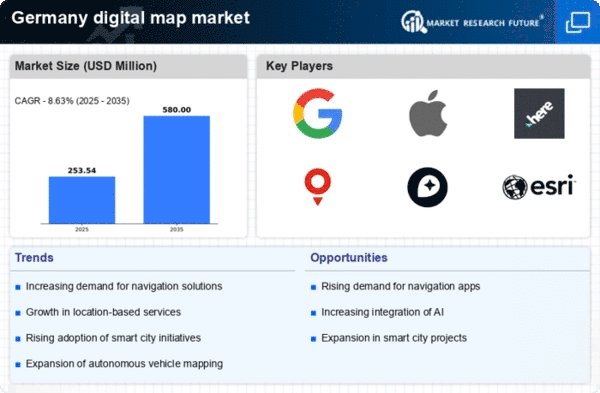
As per Market Research Future analysis, the Germany Digital Map Market size was estimated at 233.4 USD Million in 2024. The Digital Map market is projected to grow from 253.54 USD Million in 2025 to 580.0 USD Million by 2035, exhibiting a compound annual growth rate (CAGR) of 8.6% during the forecast period 2025 - 2035

Key Market Trends & Highlights

The Germany digital map market is experiencing robust growth driven by technological advancements and increasing demand for innovative mapping solutions.

  • The integration of AI in mapping solutions is transforming the landscape of the digital map market.
  • Location-based services are witnessing a surge, enhancing user engagement and accessibility.
  • The focus on sustainability and smart cities is shaping the development of digital mapping technologies.
  • Technological advancements in mapping and the growing demand for navigation solutions are key drivers of market expansion.

Market Size & Forecast

2024 Market Size 233.4 (USD Million)
2035 Market Size 580.0 (USD Million)
CAGR (2025 - 2035) 8.63%

Major Players

Google (US), Apple (US), HERE Technologies (NL), TomTom (NL), Mapbox (US), Esri (US), OpenStreetMap (GB), Navteq (US), Bing Maps (US)

Our Impact
Enabled $4.3B Revenue Impact for Fortune 500 and Leading Multinationals
Partnering with 2000+ Global Organizations Each Year
30K+ Citations by Top-Tier Firms in the Industry

Germany Digital Map Market Trends

The Germany Digital Map Market in Germany is currently experiencing a notable evolution, driven by advancements in technology and increasing demand for location-based services. The integration of artificial intelligence and machine learning into mapping solutions appears to enhance accuracy and user experience. Furthermore, the growing reliance on mobile applications for navigation and logistics is likely to propel the market forward. As urbanization continues to rise, the need for precise and real-time mapping solutions becomes more critical, suggesting a robust growth trajectory for the sector. In addition, the emphasis on sustainability and smart city initiatives is influencing the digital map market. Authorities and businesses are increasingly utilizing mapping technologies to optimize resource management and improve urban planning. This trend indicates a shift towards more environmentally conscious practices, where digital maps play a pivotal role in facilitating efficient transportation and infrastructure development. Overall, the digital map market in Germany seems poised for continued expansion, driven by technological innovation and evolving consumer needs.

Integration of AI in Mapping Solutions

The incorporation of artificial intelligence into mapping technologies is transforming the digital map market. AI enhances data processing capabilities, allowing for more accurate and efficient mapping solutions. This trend is particularly relevant in urban areas, where real-time data is essential for navigation and logistics.

Rise of Location-Based Services

There is a growing demand for location-based services across various sectors, including transportation, tourism, and retail. This trend reflects the increasing reliance on digital maps for everyday activities, suggesting that businesses are leveraging mapping technologies to improve customer engagement and operational efficiency.

Focus on Sustainability and Smart Cities

The digital map market is increasingly aligned with sustainability goals and smart city initiatives. Mapping technologies are being utilized to optimize urban planning and resource management, indicating a shift towards environmentally friendly practices that enhance the quality of urban life.

Germany Digital Map Market Drivers

Increased Focus on Data Privacy

The digital map market in Germany is also shaped by an increased focus on data privacy and security. As consumers become more aware of their digital footprints, there is a growing demand for mapping solutions that prioritize user privacy. Regulations such as the General Data Protection Regulation (GDPR) have heightened the need for companies to ensure compliance while providing mapping services. This shift is likely to influence the development of privacy-centric mapping technologies, which could reshape the digital map market landscape. Companies that successfully navigate these regulatory challenges may find new opportunities for growth, appealing to privacy-conscious consumers.

Expansion of Smart City Initiatives

The digital map market in Germany is poised for growth due to the expansion of smart city initiatives. As urban areas increasingly adopt smart technologies, the need for comprehensive mapping solutions becomes paramount. These initiatives often involve the integration of various data sources, including traffic patterns, public transport systems, and environmental data, into digital maps. By 2025, investments in smart city projects are projected to exceed €10 billion, creating a substantial opportunity for the digital map market. This trend suggests that as cities evolve into smart ecosystems, the demand for advanced mapping solutions will likely increase, driving innovation and market growth.

Technological Advancements in Mapping

The digital map market in Germany is experiencing a surge due to rapid technological advancements. Innovations in GPS technology, satellite imagery, and data analytics are enhancing the accuracy and functionality of digital maps. For instance, the integration of high-resolution satellite imagery allows for detailed urban planning and navigation solutions. As of 2025, the market is projected to grow at a CAGR of approximately 10%, driven by these technological improvements. Furthermore, the increasing adoption of mobile devices and IoT applications is propelling the demand for real-time mapping solutions. This trend indicates a robust future for the digital map market, as businesses and consumers alike seek more precise and interactive mapping experiences.

Rising Popularity of Augmented Reality

The digital map market in Germany is witnessing a rising popularity of augmented reality (AR) applications. AR technology enhances the user experience by overlaying digital information onto the physical world, making navigation and location-based services more interactive. As of 2025, the AR market is expected to grow by 25%, indicating a strong potential for integration with digital mapping solutions. This trend suggests that businesses in the digital map market may increasingly develop AR features to attract users seeking innovative navigation experiences. The convergence of AR and digital mapping could redefine how individuals interact with their environments, further propelling market growth.

Growing Demand for Navigation Solutions

The digital map market in Germany is significantly influenced by the growing demand for navigation solutions. With the rise of e-commerce and delivery services, accurate navigation has become essential for logistics and transportation sectors. In 2025, the market for navigation applications is expected to reach €1.5 billion, reflecting a strong inclination towards efficient route planning and traffic management. Additionally, the increasing reliance on digital maps for personal navigation, especially among urban populations, further fuels this demand. As consumers seek seamless travel experiences, the digital map market is likely to expand, catering to both individual users and businesses requiring sophisticated navigation tools.


Market Segment Insights

By Application: Navigation (Largest) vs. Location-Based Services (Fastest-Growing)

In the Germany digital map market, the application segment is diverse, with Navigation holding the largest market share, driven by widespread adoption in personal and commercial vehicles. Location-Based Services are rapidly gaining traction as more businesses integrate location functionalities into their offerings, enhancing user experience and engagement. Geographic Information Systems (GIS) and Fleet Management also maintain significant shares, catering to niche markets like logistics and urban planning. The growth trends in this segment indicate a robust shift towards digital solutions enhancing mobility and connectivity. As urbanization continues, demand for Geographic Information Systems is expected to rise, while Fleet Management leverages advancements in IoT and data analytics. Additionally, the ongoing digitalization landscape fosters growth in Location-Based Services, positioning them as a key driver for innovative applications in various industries.

Navigation (Dominant) vs. Fleet Management (Emerging)

Navigation applications dominate the Germany digital map market owing to their comprehensive features that facilitate real-time routing and traffic updates, appealing to both individual users and businesses. The evolution of in-car navigation systems and the integration of navigation with smart devices further cement their leading position. Conversely, Fleet Management is an emerging segment characterized by its focus on optimizing logistics and operational efficiency through advanced tracking and route planning. Companies are increasingly adopting these solutions to reduce costs and enhance service delivery, leveraging data analytics and AI capabilities to innovate and adapt to dynamic market demands.

By Technology: GPS Technology (Largest) vs. Remote Sensing (Fastest-Growing)

In the Germany digital map market, GPS Technology holds a significant market share, dominating the landscape due to its widespread adoption in navigation and real-time location services. Following closely, Cartography and Geospatial Analysis also contribute notably, but their shares are smaller compared to the leading segments. Remote Sensing, while currently less dominant, is gaining traction rapidly, thanks to advancements in satellite technology and data processing capabilities, becoming an essential component for various applications. The growth trends indicate a substantial shift towards more innovative solutions in the Germany digital map market. The demand for GPS Technology is driven by the increasing need for efficiency and accuracy in navigation systems, while Remote Sensing is emerging as a critical tool for environmental monitoring and urban planning. The convergence of these technologies is fostering new opportunities, paving the way for enhanced geospatial intelligence services that cater to diverse sectors, from logistics to agriculture.

Technology: GPS Technology (Dominant) vs. Remote Sensing (Emerging)

GPS Technology is the cornerstone of the Germany digital map market, providing crucial positioning information essential for navigation and location-based services. Its widespread use across multiple sectors, including transportation, automotive, and mobile applications, solidifies its dominant position. In contrast, Remote Sensing is rapidly emerging, leveraging advanced satellite and aerial imaging technologies to provide comprehensive data for diverse applications. This segment is characterized by its capability to gather large volumes of data remotely, enabling smarter decision-making for urban planning, agriculture, and environmental conservation. As industries increasingly integrate these technologies, the synergies between GPS and Remote Sensing are likely to enhance overall market dynamics, bridging the gap between traditional mapping and cutting-edge geospatial analysis.

By End Use: Transportation (Largest) vs. Retail (Fastest-Growing)

In the Germany digital map market, the end use segment is primarily dominated by transportation, which holds the largest market share. This sector is pivotal as it underpins various logistics and navigation services, essential for both personal and commercial applications. Meanwhile, retail is emerging rapidly, leveraging digital mapping for enhanced customer engagement and location-based marketing strategies, indicating significant growth opportunities in this area. Growth trends indicate that while transportation continues to expand steadily, retail is showcasing the fastest growth rate driven by technological advancements and increased consumer reliance on digital solutions. Healthcare and government sectors also contribute, but their growth is more stable. The rising adoption of smart technologies and mobile applications is further fueling the digital map demand in these sectors, underscoring a shift towards integrated digital solutions in everyday life.

Transportation: Dominant vs. Retail: Emerging

The transportation segment remains the dominant player in the Germany digital map market due to its extensive application in navigation and fleet management, supported by continuous technological improvements. This segment features robust integration with real-time traffic updates and route optimization. Conversely, the retail segment is rapidly emerging, capitalizing on location-based services and targeted advertising to enhance customer experiences. Retailers are utilizing digital maps for better inventory management and optimizing store layouts. The synergy between mapping services and consumer analytics is driving innovation in retail, making this segment increasingly competitive and essential for businesses looking to engage effectively with their customers.

By Format: 2D Maps (Largest) vs. 3D Maps (Fastest-Growing)

In the Germany digital map market, 2D Maps hold the largest share, catering to a wide range of applications including navigation and geographic information systems. This segment's popularity is attributed to its simplicity and effectiveness in portraying spatial information without the added complexity of 3D models. Conversely, 3D Maps have emerged as a fast-growing segment, appealing particularly to industries that require detailed visualization and immersive experiences, such as urban planning and tourism. The growth of 3D Maps is driven by advancements in technology and an increasing demand for high-quality visual representation in various sectors. The integration of augmented reality and virtual reality applications further propels this segment's evolution, allowing users to interact with geographical data in innovative ways. Additionally, the push for enhanced user experiences is leading to a broader adoption of 3D mapping solutions across different industries, strengthening its position in the market.

2D Maps (Dominant) vs. 3D Maps (Emerging)

2D Maps are characterized by their straightforward presentation of spatial data, making them a dominant choice for standard navigation applications and traditional mapping services. They provide essential information in a user-friendly format, ensuring accessibility for various users. In contrast, 3D Maps represent an emerging segment that offers depth and perspective, enhancing the visualization of geographic data and appealing to sectors focused on detailed analysis. This segment is particularly beneficial for industries requiring complex modeling and immersive experiences. As technology advances and user expectations evolve, 3D Maps are becoming increasingly integral, driving their adoption across different fields in the market.

Get more detailed insights about Germany Digital Map Market

Key Players and Competitive Insights

The digital map market in Germany exhibits a dynamic competitive landscape, characterized by rapid technological advancements and evolving consumer demands. Key players such as Google (US), HERE Technologies (NL), and TomTom (NL) are at the forefront, each adopting distinct strategies to enhance their market positioning. Google (US) continues to leverage its extensive data analytics capabilities, focusing on integrating AI-driven features into its mapping services, thereby enhancing user experience and operational efficiency. HERE Technologies (NL) emphasizes partnerships with automotive manufacturers, aiming to provide advanced navigation solutions for autonomous vehicles, which appears to be a significant growth area. TomTom (NL), on the other hand, is concentrating on expanding its geographic footprint through strategic collaborations with local firms, thereby enhancing its service offerings in the region.The business tactics employed by these companies reflect a trend towards localization and supply chain optimization. The market structure is moderately fragmented, with a mix of established players and emerging startups. This fragmentation allows for diverse offerings, yet the collective influence of major players like Google (US) and HERE Technologies (NL) shapes competitive dynamics significantly. Their ability to innovate and adapt to local market needs is crucial in maintaining a competitive edge.

In October Google (US) announced the launch of a new feature that integrates real-time traffic data with its mapping services, enhancing navigation accuracy for users. This strategic move is likely to solidify its market leadership by providing a more responsive and user-centric experience. Similarly, in September 2025, HERE Technologies (NL) expanded its partnership with a leading automotive manufacturer to develop advanced mapping solutions for electric vehicles. This collaboration not only positions HERE as a key player in the EV market but also underscores the growing importance of sustainable transportation solutions.

In August TomTom (NL) unveiled a new suite of APIs designed for developers, aimed at enhancing the integration of mapping services into various applications. This initiative reflects TomTom's commitment to fostering innovation and expanding its ecosystem, potentially attracting a broader range of clients and partners. Furthermore, in July 2025, Mapbox (US) secured a significant investment to enhance its geospatial data capabilities, indicating a strong focus on technological advancement and market expansion.

As of November current trends in the digital map market are heavily influenced by digitalization, sustainability, and AI integration. Strategic alliances are increasingly shaping the competitive landscape, as companies recognize the value of collaboration in driving innovation. The shift from price-based competition to a focus on technological differentiation and supply chain reliability is evident. Moving forward, competitive differentiation will likely evolve, with companies prioritizing innovative solutions and sustainable practices to meet the demands of a rapidly changing market.

Key Companies in the Germany Digital Map Market include

Industry Developments

In recent months, the Germany Digital Map Market has seen significant developments. OpenStreetMap has made strides in enhancing its user-generated mapping platform, improving accessibility and accuracy. HERE Technologies is focusing on integrating artificial intelligence into their services, aiming to provide advanced location data solutions. Meanwhile, StreetView is expanding its 3D map offerings, while CARTO has been enhancing its data visualization capabilities tailored for urban planning.In terms of mergers and acquisitions, in September 2023, Google acquired a tech startup specializing in autonomous mapping solutions, bolstering its position in the German market. 

November 2022 saw TomTom expand its partnership with major automotive manufacturers to integrate its navigation services more deeply into vehicles. The growth of companies like Esri, which provides powerful Geographic Information Systems, indicates a rising demand for geospatial analytics driven by urban development and smart city initiatives in Germany. The valuation of digital mapping solutions is expected to increase as companies invest in more innovative technologies that cater to the evolving needs of industries such as logistics and urban planning.

The market in Germany is anticipated to continue its trajectory of growth fueled by advancements in technology and increasing data utilization.

Future Outlook

Germany Digital Map Market Future Outlook

The digital map market in Germany is projected to grow at an 8.63% CAGR from 2025 to 2035, driven by advancements in technology, increased demand for navigation solutions, and urbanization.

New opportunities lie in:

  • Integration of AI-driven analytics for real-time data insights.
  • Development of customized mapping solutions for logistics optimization.
  • Expansion of augmented reality features for enhanced user engagement.

By 2035, the digital map market is expected to achieve substantial growth, reflecting evolving consumer needs and technological advancements.

Market Segmentation

Germany Digital Map Market Format Outlook

  • 2D Maps
  • 3D Maps
  • Vector Maps
  • Raster Maps

Germany Digital Map Market End Use Outlook

  • Transportation
  • Retail
  • Healthcare
  • Government

Germany Digital Map Market Technology Outlook

  • Cartography
  • Remote Sensing
  • GPS Technology
  • Geospatial Analysis

Germany Digital Map Market Application Outlook

  • Navigation
  • Fleet Management
  • Location-Based Services
  • Geographic Information System
  • Urban Planning

Report Scope

MARKET SIZE 2024 233.4(USD Million)
MARKET SIZE 2025 253.54(USD Million)
MARKET SIZE 2035 580.0(USD Million)
COMPOUND ANNUAL GROWTH RATE (CAGR) 8.63% (2025 - 2035)
REPORT COVERAGE Revenue Forecast, Competitive Landscape, Growth Factors, and Trends
BASE YEAR 2024
Market Forecast Period 2025 - 2035
Historical Data 2019 - 2024
Market Forecast Units USD Million
Key Companies Profiled Google (US), Apple (US), HERE Technologies (NL), TomTom (NL), Mapbox (US), Esri (US), OpenStreetMap (GB), Navteq (US), Bing Maps (US)
Segments Covered Application, Technology, End Use, Format
Key Market Opportunities Integration of augmented reality features enhances user engagement in the digital map market.
Key Market Dynamics Technological advancements and regulatory changes drive innovation and competition in the digital map market.
Countries Covered Germany
Leave a Comment

FAQs

What is the expected market size of the Germany Digital Map Market in 2024?

The Germany Digital Map Market is expected to be valued at 194.5 USD Million in 2024.

What is the projected market size of the Germany Digital Map Market by 2035?

By 2035, the overall market size of the Germany Digital Map Market is anticipated to reach 400.0 USD Million.

What is the projected compound annual growth rate (CAGR) for the Germany Digital Map Market from 2025 to 2035?

The expected CAGR for the Germany Digital Map Market from 2025 to 2035 is 6.774%.

Which application is anticipated to have the highest market value in 2035 within the Germany Digital Map Market?

The Navigation application is expected to have the highest market value at 130.0 USD Million in 2035.

What is the estimated market value for Fleet Management in the Germany Digital Map Market in 2024?

Fleet Management is estimated to have a market value of 40.0 USD Million in 2024.

Who are the key players in the Germany Digital Map Market?

Major players in the Germany Digital Map Market include OpenStreetMap, HERE Technologies, StreetView, and Google.

What is the market size for Location-Based Services in 2035?

The market size for Location-Based Services within the Germany Digital Map Market is projected to reach 95.0 USD Million by 2035.

What are some emerging trends driving growth in the Germany Digital Map Market?

Key trends include advancements in Geographic Information Systems and increased demand for Urban Planning applications.

What is the forecasted market size for Urban Planning in the Germany Digital Map Market by 2035?

Urban Planning is expected to grow to a market size of 35.0 USD Million by 2035.

How will location-based services impact the growth of the Germany Digital Map Market?

The demand for location-based services is expected to significantly contribute to the growth of the market in the coming years.

Download Free Sample

Kindly complete the form below to receive a free sample of this Report

Compare Licence

×
Features License Type
Single User Multiuser License Enterprise User
Price $4,950 $5,950 $7,250
Maximum User Access Limit 1 User Upto 10 Users Unrestricted Access Throughout the Organization
Free Customization
Direct Access to Analyst
Deliverable Format
Platform Access
Discount on Next Purchase 10% 15% 15%
Printable Versions