×
Request Free Sample ×

Kindly complete the form below to receive a free sample of this Report

* Please use a valid business email

Leading companies partner with us for data-driven Insights

clients tt-cursor
Hero Background

Germany Cognitive Assessment Training Market

ID: MRFR/ICT/57858-HCR
200 Pages
Aarti Dhapte
February 2026

Germany Cognitive Assessment Training Market Size, Share and Research Report: By Component (Solution, Services), By Assessment Type (Classroom Learning, Corporate Learning, Brain Training, Clinical Trials, Research) and By Application (Corporate, Healthcare)-Forecast to 2035

Share:
Download PDF ×

We do not share your information with anyone. However, we may send you emails based on your report interest from time to time. You may contact us at any time to opt-out.

Germany Cognitive Assessment Training Market Infographic
Purchase Options

Germany Cognitive Assessment Training Market Summary

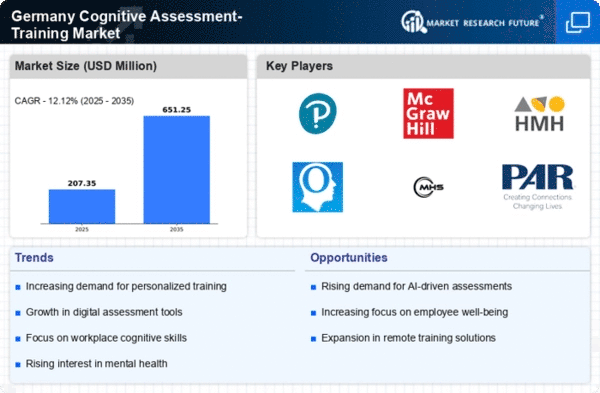
As per Market Research Future analysis, the Germany Cognitive Assessment Training Market size was estimated at 184.93 USD Million in 2024. The Germany Cognitive Assessment-Training Market is projected to grow from 207.35 USD Million in 2025 to 651.25 USD Million by 2035, exhibiting a compound annual growth rate (CAGR) of 12.1% during the forecast period 2025 - 2035

Key Market Trends & Highlights

The Germany Cognitive Assessment-Training Market is experiencing a transformative shift driven by technological integration and a focus on employee well-being.

  • The integration of technology in training is reshaping the cognitive assessment landscape, enhancing engagement and effectiveness.
  • Employee well-being is becoming a central focus, with organizations prioritizing mental health alongside cognitive skill development.
  • Customization of assessment tools is on the rise, allowing for tailored training solutions that meet specific organizational needs.
  • The market is driven by rising demand for cognitive skills in the workforce and government initiatives supporting education and training.

Market Size & Forecast

2024 Market Size 184.93 (USD Million)
2035 Market Size 651.25 (USD Million)
CAGR (2025 - 2035) 12.12%

Major Players

Pearson (GB), McGraw-Hill (US), Houghton Mifflin Harcourt (US), Cognifit (ES), MHS (CA), Psychological Assessment Resources (US), TalentSmart (US), Lumosity (US)

Our Impact
Enabled $4.3B Revenue Impact for Fortune 500 and Leading Multinationals
Partnering with 2000+ Global Organizations Each Year
30K+ Citations by Top-Tier Firms in the Industry

Germany Cognitive Assessment Training Market Trends

The Germany Cognitive Assessment Training Market is currently experiencing notable growth, driven by an increasing emphasis on mental agility and cognitive skills in various sectors. Organizations are recognizing the value of cognitive assessments in enhancing employee performance and productivity. This trend is particularly evident in educational institutions and corporate environments, where tailored training programs are being developed to address specific cognitive needs. The integration of technology into assessment tools is also transforming the landscape, allowing for more personalized and efficient training solutions. As a result, stakeholders are investing in innovative platforms that facilitate cognitive development, indicating a shift towards a more data-driven approach in training methodologies. Moreover, the demand for cognitive assessment tools is likely to rise as awareness of mental health and cognitive well-being continues to grow. Companies are increasingly prioritizing employee wellness, which includes cognitive health as a critical component. This focus on holistic development is fostering a culture of continuous learning and improvement. The cognitive assessment-training market appears poised for further expansion, with advancements in artificial intelligence and machine learning potentially enhancing the effectiveness of training programs. Overall, the landscape is evolving, reflecting a broader recognition of the importance of cognitive skills in achieving both personal and organizational success.

Integration of Technology in Training

The cognitive assessment-training market is witnessing a significant shift towards the incorporation of advanced technologies. Digital platforms and online tools are becoming essential for delivering assessments and training programs. This trend allows for real-time feedback and personalized learning experiences, catering to individual cognitive profiles. As technology continues to evolve, it is likely that these tools will become more sophisticated, enhancing the overall effectiveness of cognitive training.

Focus on Employee Well-being

There is a growing emphasis on employee well-being within the cognitive assessment-training market. Organizations are increasingly recognizing the link between cognitive health and overall productivity. This awareness is driving the development of training programs that not only enhance cognitive skills but also promote mental wellness. As a result, companies are investing in comprehensive training solutions that address both cognitive and emotional aspects of employee development.

Customization of Assessment Tools

The trend towards customization in the cognitive assessment-training market is becoming more pronounced. Organizations are seeking tailored assessment tools that align with their specific needs and objectives. This customization allows for more relevant and effective training programs, as assessments can be designed to target particular cognitive skills or challenges faced by employees. Such tailored approaches are likely to enhance engagement and improve outcomes in cognitive training.

Germany Cognitive Assessment Training Market Drivers

Increased Focus on Mental Health in Workplaces

The cognitive assessment-training market is also being shaped by an increased focus on mental health within workplaces across Germany. Organizations are beginning to understand the correlation between cognitive abilities and mental well-being, leading to the integration of cognitive training programs as part of employee wellness initiatives. Research indicates that companies that invest in mental health and cognitive training see a 30% increase in employee engagement and productivity. This growing awareness is likely to propel the cognitive assessment-training market, as businesses seek to implement comprehensive training solutions that address both cognitive skills and mental health.

Technological Advancements in Assessment Tools

Technological advancements are playing a crucial role in transforming the cognitive assessment-training market in Germany. The introduction of artificial intelligence and machine learning in assessment tools allows for more accurate evaluations of cognitive abilities. These technologies enable personalized training programs that adapt to individual learning styles and needs. As a result, organizations are increasingly adopting these innovative solutions to enhance their training effectiveness. The market for cognitive assessment tools is projected to grow by 15% annually, driven by the demand for more sophisticated and efficient assessment methods that leverage technology.

Rising Demand for Cognitive Skills in Workforce

The cognitive assessment-training market in Germany is experiencing a notable surge in demand as organizations increasingly recognize the importance of cognitive skills in enhancing workforce productivity. With a growing emphasis on critical thinking, problem-solving, and decision-making abilities, companies are investing in cognitive training programs to equip their employees with essential skills. According to recent data, approximately 70% of employers in Germany prioritize cognitive skills during recruitment, indicating a shift towards a more skill-oriented workforce. This trend is likely to drive the cognitive assessment-training market, as businesses seek effective solutions to evaluate and enhance their employees' cognitive capabilities.

Growing Importance of Data-Driven Decision Making

The cognitive assessment-training market is witnessing a shift towards data-driven decision making, as organizations in Germany recognize the value of analytics in enhancing training outcomes. By utilizing data analytics, companies can identify skill gaps and tailor cognitive training programs to meet specific needs. This approach not only improves the effectiveness of training but also ensures a higher return on investment. Approximately 60% of organizations in Germany are now employing data analytics to inform their training strategies, indicating a trend that is likely to further stimulate the cognitive assessment-training market as businesses seek to optimize their training investments.

Government Initiatives Supporting Education and Training

In Germany, government initiatives aimed at improving education and training systems are significantly influencing the cognitive assessment-training market. The German government has implemented various programs to promote lifelong learning and skills development, which includes funding for cognitive training initiatives. For instance, the Federal Ministry of Education and Research has allocated over €500 million to support innovative training programs that focus on cognitive skills. Such initiatives not only enhance the quality of education but also create a favorable environment for the growth of the cognitive assessment-training market, as educational institutions and training providers align their offerings with government objectives.


Market Segment Insights

By Type: Cognitive Assessment Tools (Largest) vs. Brain Games (Fastest-Growing)

In the Germany cognitive assessment-training market, cognitive assessment tools hold the largest market share, primarily due to their widespread use in educational and clinical settings. These tools offer structured methodologies for evaluating cognitive function, which appeals to both professionals and individuals seeking to understand cognitive strengths and weaknesses. Following closely are cognitive training programs, memory improvement tools, and brain games, each carving out distinct niches that cater to specific user needs. The growth trends in this segment are significantly driven by rising awareness of mental health and cognitive wellness. Increasing adoption of digital solutions for cognitive training, alongside technological advancements in gamified learning, contribute to the expansion of brain games, the fastest-growing segment. Additionally, the integration of AI and personalized training programs is enhancing the effectiveness of cognitive assessment tools, further solidifying their importance in the market.

Cognitive Assessment Tools (Dominant) vs. Brain Games (Emerging)

Cognitive assessment tools are recognized as the dominant force in the Germany cognitive assessment-training market, known for their reliability and structured approach to evaluating mental capabilities. They are extensively utilized in various sectors, including healthcare, education, and corporate training, to assess cognitive abilities and identify areas for improvement. Conversely, brain games represent an emerging segment that has rapidly gained popularity among consumers seeking engaging and interactive ways to enhance cognitive skills. These games leverage fun and innovative approaches to stimulate various cognitive processes, making them particularly appealing to younger audiences and those seeking personal development. As both segments continue to evolve, the interplay between established methodologies and innovative gaming solutions will shape the future landscape of cognitive training.

By Application: Healthcare (Largest) vs. Education (Fastest-Growing)

The application segment within the Germany cognitive assessment-training market is currently dominated by healthcare, which accounts for a significant share of overall market activity. This sector benefits from the increasing integration of cognitive training techniques in therapeutic settings and the growing demand for mental health solutions. In contrast, the education sector is emerging rapidly, driven by the rising focus on enhancing learning outcomes and cognitive development among students across various educational levels. Growth trends in the application segment are shaped by several key factors. The healthcare industry is experiencing an upsurge in demand for cognitive assessment tools as mental health awareness increases. Additionally, the corporate training sector is leveraging cognitive assessment for employee development, with companies recognizing the importance of cognitive skills in enhancing productivity. Meanwhile, the education sector is becoming increasingly digitalized, facilitating access to innovative cognitive training solutions that cater to diverse learning needs.

Healthcare: Traditional (Dominant) vs. Education: Digital (Emerging)

The healthcare application of cognitive assessment-training is characterized by its traditional yet robust methodologies, focusing on patient-centric solutions aimed at improving mental health and cognitive rehabilitation. This segment has established authority and trust, with practitioners increasingly incorporating cognitive assessments into treatment regimens. In contrast, the education sector is emerging strongly with digital cognitive assessment tools that align with contemporary educational practices. This shift is driven by technology's role in enhancing personalized learning experiences and providing real-time data on student progress. As a result, while healthcare remains a dominant force in the market, education, particularly through digital channels, is poised to capture significant attention and investment.

By End User: Healthcare Providers (Largest) vs. Individuals (Fastest-Growing)

In the Germany cognitive assessment-training market, the majority share is held by healthcare providers due to their essential role in evaluating and improving cognitive function. This segment benefits from a robust demand for cognitive training tools integrated into therapeutic practices, capturing a significant portion of the overall market. Meanwhile, individuals are increasingly engaging with cognitive training solutions as awareness of mental fitness grows, emphasizing personal development and skill enhancement in a competitive environment. The growth trends highlight a surge in interest among individuals seeking cognitive assessment training, driven by the expansion of digital platforms and self-help resources. This trend is further fostered by a growing recognition of the importance of cognitive health across various age groups, contributing to the rapid increase in market participation. Healthcare providers will continue to hold a dominant position, while individual users are expected to be the fastest-growing segment in the foreseeable future.

Healthcare Providers: Dominant vs. Individuals: Emerging

Healthcare providers are positioned as the dominant end-user segment in the Germany cognitive assessment-training market, utilizing assessment tools for both diagnostic and therapeutic purposes. Their integration of cognitive training into healthcare services not only enhances patient outcomes but also drives consistent demand for advanced training solutions. In contrast, individuals represent an emerging segment driven by the rising emphasis on personal development, mental agility, and competitive skill enhancement. This demographic is increasingly inclined to invest in cognitive training as part of their self-care and professional development, attracted by digital solutions that offer accessibility and flexibility in training options.

By Delivery Mode: Online (Largest) vs. Blended (Fastest-Growing)

In the Germany cognitive assessment-training market, the delivery mode segment showcases a diverse distribution, with online platforms currently dominating the landscape due to their accessibility and convenience. The online delivery mode accounts for the largest share, attracting a broad audience eager for flexibility in their learning options. Conversely, the blended delivery mode is emerging rapidly, appealing to learners who benefit from a combination of online and in-person interactions, thus fostering enhanced engagement and retention rates. As we analyze growth trends within this segment, online delivery continues to thrive, driven by increasing digital adoption and a shift towards remote and flexible learning environments. However, the blended delivery mode represents the fastest-growing segment, fueled by institutions recognizing the value of hybrid models that combine the strengths of both online and offline methods. This trend is likely to reshape educational practices in the cognitive assessment-training space, adapting to varied learner preferences.

Online (Dominant) vs. Blended (Emerging)

The online delivery mode has solidified its position as the dominant method in the Germany cognitive assessment-training market, primarily because of its extensive reach and scalability. It offers learners the convenience of accessing materials anytime and anywhere, making it highly attractive for busy professionals and students alike. Additionally, the proliferation of advanced digital tools enhances interactivity and personalization in online courses. On the other hand, the blended delivery mode, while still emerging, is gaining traction as educational institutions and training providers develop hybrid systems that combine the advantages of face-to-face instruction with the flexibility of online learning. This approach not only caters to diverse learning preferences but also facilitates a more engaged learning experience, making it a strong contender for future growth.

Get more detailed insights about Germany Cognitive Assessment Training Market

Key Players and Competitive Insights

The Cognitive Assessment-Training Market in Germany exhibits a dynamic competitive landscape, characterized by a blend of established players and emerging innovators. Key growth drivers include the increasing demand for personalized learning solutions, the integration of artificial intelligence (AI) in assessment tools, and a heightened focus on mental health and cognitive well-being. Major companies such as Pearson (GB), McGraw-Hill (US), and Cognifit (ES) are strategically positioned to leverage these trends. Pearson (GB) emphasizes innovation through its digital platforms, while McGraw-Hill (US) focuses on regional expansion and partnerships to enhance its market presence. Cognifit (ES) is particularly noted for its user-centric approach, which aligns with the growing consumer preference for tailored cognitive training solutions. Collectively, these strategies shape a competitive environment that is increasingly focused on technological advancement and customer engagement.In terms of business tactics, companies are localizing their offerings to better meet the specific needs of the German market. This includes optimizing supply chains to ensure timely delivery of products and services. The market structure appears moderately fragmented, with several key players exerting influence over various segments. The collective actions of these companies suggest a trend towards consolidation, as firms seek to enhance their competitive edge through strategic collaborations and acquisitions.

In October Pearson (GB) announced a partnership with a leading German educational institution to develop a new suite of cognitive assessment tools tailored for higher education. This collaboration is expected to enhance Pearson's product offerings and strengthen its foothold in the academic sector, reflecting a strategic move towards localized solutions that cater to specific educational needs. The partnership underscores the importance of aligning product development with regional educational standards and requirements.

In September McGraw-Hill (US) launched an innovative AI-driven assessment platform designed to provide real-time feedback to learners. This platform aims to enhance the learning experience by offering personalized insights based on individual performance. The introduction of this technology not only positions McGraw-Hill as a leader in digital transformation but also highlights the growing importance of data analytics in cognitive training solutions.

In August Cognifit (ES) expanded its product line by introducing a new mobile application focused on cognitive training for seniors. This strategic move is indicative of Cognifit’s commitment to addressing the needs of an aging population, thereby tapping into a potentially lucrative market segment. The app's design emphasizes user engagement and accessibility, which are critical factors in attracting and retaining users in this demographic.

As of November current competitive trends in the cognitive assessment-training market are heavily influenced by digitalization, sustainability, and the integration of AI technologies. Strategic alliances are increasingly shaping the landscape, as companies recognize the value of collaboration in driving innovation. Looking ahead, competitive differentiation is likely to evolve from traditional price-based strategies to a focus on technological innovation, enhanced user experience, and supply chain reliability. This shift suggests that companies will need to invest in research and development to stay ahead in a rapidly changing market.

Key Companies in the Germany Cognitive Assessment Training Market include

Industry Developments

Recent developments in the Germany Cognitive Assessment Training Market have showcased significant growth and innovation among key players. Companies like Cambridge University Press, LearningRx, and CogniFit have advanced their offerings, highlighting an increase in demand for cognitive training solutions amid rising concerns about mental health and cognitive decline in the aging population. Notably, in June 2023, Cambridge University Press expanded its portfolio by partnering with MHS Assessments to enhance their assessment tools.

Additionally, Lumosity launched a localized version of its platform tailored for German users, contributing to broader accessibility and engagement in cognitive training methods. The market has seen valuations rise, with Pearson and Psychological Corporation introducing cutting-edge assessment technologies, thereby reinforcing their positions in this competitive sector.

Over the past two years, investments from SAGE Publications and Mindset Health in Research and Development also indicate a commitment to integrating technology with cognitive assessments. The integration of digital solutions continues to be a major trend. Overall, the market in Germany is experiencing robust growth fueled by demand for innovative cognitive training methods, underscoring the importance of cognitive health in modern society.

Future Outlook

Germany Cognitive Assessment Training Market Future Outlook

The Cognitive Assessment Training Market is projected to grow at a 12.12% CAGR from 2025 to 2035, driven by technological advancements, increasing demand for personalized learning, and a focus on workforce development.

New opportunities lie in:

  • Development of AI-driven cognitive training platforms for personalized learning experiences.
  • Expansion of mobile applications for cognitive assessments in educational institutions.
  • Partnerships with corporations for tailored cognitive training programs to enhance employee performance.

By 2035, the market is expected to achieve substantial growth, positioning itself as a leader in cognitive development solutions.

Market Segmentation

Germany Cognitive Assessment Training Market Type Outlook

  • Cognitive Assessment Tools
  • Cognitive Training Programs
  • Memory Improvement Tools
  • Brain Games

Germany Cognitive Assessment Training Market End User Outlook

  • Individuals
  • Educational Institutions
  • Corporate Organizations
  • Healthcare Providers

Germany Cognitive Assessment Training Market Application Outlook

  • Education
  • Healthcare
  • Corporate Training
  • Research

Germany Cognitive Assessment Training Market Delivery Mode Outlook

  • Online
  • Offline
  • Blended

Report Scope

MARKET SIZE 2024 184.93(USD Million)
MARKET SIZE 2025 207.35(USD Million)
MARKET SIZE 2035 651.25(USD Million)
COMPOUND ANNUAL GROWTH RATE (CAGR) 12.12% (2025 - 2035)
REPORT COVERAGE Revenue Forecast, Competitive Landscape, Growth Factors, and Trends
BASE YEAR 2024
Market Forecast Period 2025 - 2035
Historical Data 2019 - 2024
Market Forecast Units USD Million
Key Companies Profiled Pearson (GB), McGraw-Hill (US), Houghton Mifflin Harcourt (US), Cognifit (ES), MHS (CA), Psychological Assessment Resources (US), TalentSmart (US), Lumosity (US)
Segments Covered Type, Application, End User, Delivery Mode
Key Market Opportunities Integration of artificial intelligence in cognitive assessment-training market enhances personalized learning experiences.
Key Market Dynamics Growing demand for personalized cognitive training solutions drives innovation and competition in the cognitive assessment-training market.
Countries Covered Germany
Leave a Comment

FAQs

What is the expected market size of the Germany Cognitive Assessment Training Market in 2024?

The Germany Cognitive Assessment Training Market is expected to be valued at 186.8 million USD in 2024.

What will be the projected market value for the Germany Cognitive Assessment Training Market by 2035?

By 2035, the Germany Cognitive Assessment Training Market is projected to reach a value of 930.0 million USD.

What is the expected compound annual growth rate (CAGR) for the Germany Cognitive Assessment Training Market from 2025 to 2035?

The expected CAGR for the Germany Cognitive Assessment Training Market from 2025 to 2035 is 15.711%.

Which segment of the Germany Cognitive Assessment Training Market is valued higher in 2024: Solutions or Services?

In 2024, the Services segment is valued higher at 112.1 million USD, compared to the Solutions segment, which is valued at 74.7 million USD.

What will be the value of the Solutions segment in the Germany Cognitive Assessment Training Market by 2035?

The Solutions segment is expected to reach a value of 367.0 million USD by 2035.

What is the anticipated value for the Services segment in the market by 2035?

The Services segment is anticipated to be valued at 563.0 million USD by 2035.

Who are the major players in the Germany Cognitive Assessment Training Market?

Major players in the market include Thomson Digital, Lumosity, Psychological Corporation, and Cambridge University Press among others.

What are some key applications of cognitive assessment training in Germany?

Key applications include educational assessments, clinical evaluations, and workplace training programs.

How is the current competitive landscape affecting the growth of the Germany Cognitive Assessment Training Market?

The competitive landscape promotes innovation and service enhancement, driving growth in the market.

What opportunities are contributing to market growth in the Germany Cognitive Assessment Training Market?

Growing awareness of cognitive health and increasing demand for personalized learning solutions are driving market growth.

Download Free Sample

Kindly complete the form below to receive a free sample of this Report

Compare Licence

×
Features License Type
Single User Multiuser License Enterprise User
Price $4,950 $5,950 $7,250
Maximum User Access Limit 1 User Upto 10 Users Unrestricted Access Throughout the Organization
Free Customization
Direct Access to Analyst
Deliverable Format
Platform Access
Discount on Next Purchase 10% 15% 15%
Printable Versions