×
Request Free Sample ×

Kindly complete the form below to receive a free sample of this Report

* Please use a valid business email

Leading companies partner with us for data-driven Insights

clients tt-cursor
Hero Background

Germany Clinical Alarm Management Market

ID: MRFR/HS/52303-HCR
200 Pages
Rahul Gotadki
February 2026

Germany Clinical Alarm Management Market Research Report: Size, Share, Trend Analysis By Product (Nurse Call Systems, Physiological Monitors, EMR Integration Systems, Bed Alarms), By Component (Solutions, Services) and By End Userss (Hospitals and Clinics, Long-Term Care (LTC) Centers, Ambulatory Care Centers) - Growth Outlook & Industry Forecast 2025 To 2035

Share:
Download PDF ×

We do not share your information with anyone. However, we may send you emails based on your report interest from time to time. You may contact us at any time to opt-out.

Germany Clinical Alarm Management Market Infographic
Purchase Options

Germany Clinical Alarm Management Market Summary

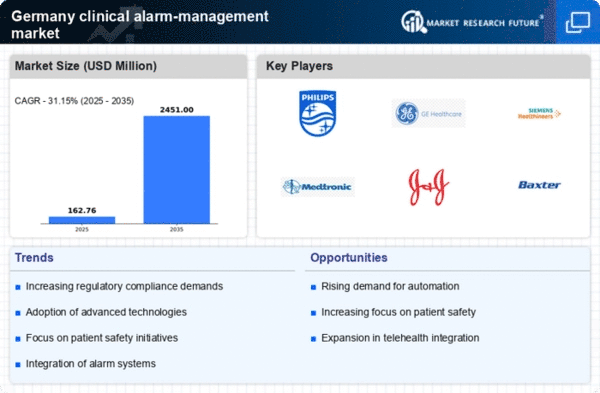
As per Market Research Future analysis, the Germany clinical alarm-management market size was estimated at 124.1 USD Million in 2024. The Germany clinical alarm-management market is projected to grow from 162.76 USD Million in 2025 to 2451.0 USD Million by 2035, exhibiting a compound annual growth rate (CAGR) of 31.1% during the forecast period 2025 - 2035

Key Market Trends & Highlights

The Germany clinical alarm-management market is poised for growth driven by technological advancements and regulatory compliance.

  • The market is witnessing a notable integration of advanced technologies to enhance alarm systems.
  • User-centric design is becoming increasingly important in the development of clinical alarm solutions.
  • The largest segment in this market is the hospital sector, while the fastest-growing segment is home healthcare.
  • Rising demand for patient safety solutions and increased regulatory focus on alarm management are key drivers of market growth.

Market Size & Forecast

2024 Market Size 124.1 (USD Million)
2035 Market Size 2451.0 (USD Million)
CAGR (2025 - 2035) 31.15%

Major Players

Philips (NL), GE Healthcare (US), Siemens Healthineers (DE), Medtronic (US), Johnson & Johnson (US), Baxter International (US), Boston Scientific (US), Nihon Kohden (JP), Ascom (CH)

Our Impact
Enabled $4.3B Revenue Impact for Fortune 500 and Leading Multinationals
Partnering with 2000+ Global Organizations Each Year
30K+ Citations by Top-Tier Firms in the Industry

Germany Clinical Alarm Management Market Trends

The clinical alarm-management market is currently experiencing a transformative phase, driven by advancements in technology and a growing emphasis on patient safety. In Germany, healthcare facilities are increasingly adopting sophisticated alarm systems that enhance monitoring capabilities and reduce alarm fatigue among medical staff. This shift is largely influenced by regulatory frameworks that prioritize effective alarm management, ensuring that alarms are not only functional but also clinically relevant. As hospitals and clinics strive to improve patient outcomes, the integration of data analytics and artificial intelligence into alarm systems appears to be a key focus area. These innovations may lead to more personalized and timely responses to patient needs, thereby optimizing care delivery. Moreover, the increasing complexity of patient care, particularly in intensive care units, necessitates a more nuanced approach to alarm management. The clinical alarm-management market in Germany is likely to see a rise in collaborative efforts. This includes collaboration among healthcare providers, technology developers, and regulatory bodies. This collaboration could foster the development of standardized protocols that enhance alarm effectiveness while minimizing unnecessary alerts. As the landscape evolves, stakeholders are expected to prioritize solutions that not only address current challenges but also anticipate future needs in patient monitoring and safety.

Integration of Advanced Technologies

The clinical alarm-management market is witnessing a notable trend towards the integration of advanced technologies such as artificial intelligence and machine learning. These technologies are being utilized to analyze alarm data, thereby improving the accuracy and relevance of alerts. By leveraging data analytics, healthcare providers can potentially reduce alarm fatigue and enhance response times, ultimately leading to better patient outcomes.

Regulatory Compliance and Standardization

In Germany, regulatory compliance is becoming increasingly critical within the clinical alarm-management market. Healthcare facilities are focusing on adhering to national and international standards that govern alarm systems. This trend suggests a movement towards the establishment of standardized protocols, which may enhance the reliability and effectiveness of alarm systems across various healthcare settings.

Emphasis on User-Centric Design

There is a growing emphasis on user-centric design in the clinical alarm-management market. Healthcare professionals are advocating for alarm systems that are intuitive and easy to use, which could lead to improved staff engagement and reduced errors. This trend indicates a shift towards designing alarm interfaces that prioritize the needs of users, thereby enhancing overall system effectiveness.

Germany Clinical Alarm Management Market Drivers

Growing Awareness of Alarm Fatigue

Awareness of alarm fatigue among healthcare professionals is increasingly impacting the clinical alarm-management market in Germany. Alarm fatigue occurs when clinicians become desensitized to frequent alarms, leading to delayed responses to critical alerts. This phenomenon has prompted healthcare organizations to reevaluate their alarm systems and implement more effective management strategies. Educational initiatives aimed at training staff on the importance of alarm management are gaining traction. As awareness grows, hospitals are likely to invest in systems that prioritize clinically relevant alarms, thereby enhancing patient safety. The clinical alarm-management market is expected to benefit from this shift towards more strategic alarm utilization.

Rising Demand for Patient Safety Solutions

The clinical alarm-management market in Germany is experiencing a notable surge in demand. This is driven by an increasing focus on patient safety. Healthcare providers are prioritizing the reduction of alarm fatigue, which has been linked to adverse patient outcomes. According to recent data, alarm-related incidents contribute to approximately 30% of sentinel events in hospitals. This alarming statistic underscores the necessity for effective alarm management systems. As hospitals strive to enhance patient care, investments in advanced alarm technologies are becoming essential. The clinical alarm-management market is projected to grow as healthcare facilities adopt solutions that minimize false alarms and improve response times, ultimately fostering a safer environment for patients.

Shift Towards Integrated Healthcare Solutions

The clinical alarm-management market in Germany is witnessing a shift towards integrated healthcare solutions that encompass alarm management as part of broader patient care systems. This trend is driven by the need for seamless communication between various healthcare technologies, allowing for a more holistic approach to patient monitoring. Integration facilitates the sharing of alarm data across platforms, improving response times and coordination among healthcare teams. As hospitals seek to enhance operational efficiency, the demand for integrated alarm management solutions is likely to rise. This evolution in the clinical alarm-management market suggests a future where alarm systems are not standalone but rather integral components of comprehensive healthcare delivery.

Increased Regulatory Focus on Alarm Management

The clinical alarm-management market in Germany is influenced by heightened regulatory scrutiny regarding alarm systems in healthcare settings. Regulatory bodies are emphasizing the need for standardized alarm management protocols to ensure patient safety. Compliance with these regulations is becoming a critical factor for healthcare institutions, as failure to adhere can result in significant penalties. The German government has introduced guidelines that mandate the implementation of effective alarm management strategies, which is expected to drive market growth. As healthcare facilities invest in compliant alarm systems, the clinical alarm-management market is likely to see an influx of innovative solutions designed to meet these regulatory requirements.

Technological Advancements in Monitoring Systems

Technological innovations are significantly shaping the clinical alarm-management market in Germany. The integration of sophisticated monitoring systems, such as wearable devices and remote patient monitoring, is enhancing the ability to manage alarms effectively. These advancements allow for real-time data analysis, enabling healthcare professionals to respond promptly to critical situations. The market is projected to witness a compound annual growth rate (CAGR) of around 12% over the next five years, driven by the adoption of these technologies. As hospitals increasingly implement smart alarm systems that utilize artificial intelligence and machine learning, the clinical alarm-management market is likely to expand, providing more efficient and reliable solutions for patient monitoring.


Market Segment Insights

By Product: Nurse Call Systems (Largest) vs. Bed Alarms (Fastest-Growing)

The Germany clinical alarm-management market exhibits a diverse distribution of market share across the segment values, with Nurse Call Systems leading the segment due to their essential role in enhancing communication between patients and healthcare staff. Physiological Monitors and EMR Integration Systems also hold significant shares, catering to the demand for real-time patient data and holistic management of electronic medical records. Bed Alarms, while smaller in share, are emerging as critical tools for patient safety, particularly in the context of fall prevention. Growth trends within this segment are primarily driven by the increasing focus on patient safety and the need for effective healthcare communication. The expansion of healthcare facilities and the integration of advanced technologies like AI in monitoring systems further fuel the demand for these products. Rapid advancements in wireless communication and mobile health applications also create promising opportunities for segments such as Bed Alarms, marking them as the fastest-growing within this landscape.

Nurse Call Systems (Dominant) vs. Bed Alarms (Emerging)

Nurse Call Systems represent the dominant force within this segment, acting as crucial links between patients and medical staff, thereby enhancing response times and patient care efficiency. Their established infrastructure and integration capabilities with existing hospital systems make them a staple in healthcare facilities. Conversely, Bed Alarms are emerging as vital tools aimed at improving patient safety through technology-driven solutions, especially for at-risk populations. Their rapid adoption stems from the growing awareness of fall risks in healthcare settings, leading to a surge in product innovation aimed at increasing effectiveness and usability. The blend of these two segment values illustrates the balance between established systems and emerging technologies in addressing the challenges of modern healthcare.

By Component: Solutions (Largest) vs. Services (Fastest-Growing)

In the Germany clinical alarm-management market, the Solutions segment commands the largest market share, primarily driven by widespread adoption in various healthcare facilities. Healthcare providers are increasingly investing in technology solutions that enhance patient safety and operational efficiency, leading to a robust demand for these solutions that integrate advanced features and automation capabilities. In contrast, the Services segment, while smaller, is experiencing rapid growth. The increasing focus on ongoing support and training for alarm systems highlights the importance of services in ensuring the effectiveness and reliability of alarm management systems. Growth in the Germany clinical alarm-management market is influenced by several key factors. The need for enhanced patient safety and compliance with regulatory standards drives hospitals and clinics to adopt advanced alarm management solutions. Additionally, the rise in chronic illnesses necessitates more sophisticated monitoring systems, propelling the demand for comprehensive services that improve alarm system performance. Furthermore, innovations in technology, such as artificial intelligence and machine learning, are increasingly being integrated into alarm management, presenting new opportunities for growth within the services sector.

Solutions: Dominant vs. Services: Emerging

The Solutions segment remains dominant in the Germany clinical alarm-management market, characterized by comprehensive technology offerings that streamline alarm handling and reduce alarm fatigue in clinical settings. These solutions often include customizable alarm systems designed to meet specific healthcare needs, improving patient outcomes and operational efficiencies. On the other hand, the Services segment is emerging as a critical component, emphasizing the importance of maintenance, training, and support for technology users. As healthcare environments evolve, providers recognize the value of services to ensure optimal performance of alarm systems. This trend is leading to increased investments in service agreements, consultancy, and training programs, providing a balanced approach to managing alarm systems effectively.

By End User: Hospitals and Clinics (Largest) vs. Long-Term Care Centers (Fastest-Growing)

The market share distribution in the End User segment illustrates a significant preference for hospitals and clinics, which dominate the landscape due to their acute care capabilities and patient volume. Long-term care centers represent a growing portion of the market, as they increasingly adopt advanced alarm management solutions to enhance patient safety and operational efficiency. Growth trends indicate a gradual shift towards long-term care centers as they invest in modern technologies, responding to an aging population and the rising demand for chronic disease management. Meanwhile, hospitals continue to prioritize alarm management systems in their efforts to improve clinical outcomes and reduce alarm fatigue, thus driving overall market growth in this segment.

Hospitals and Clinics (Dominant) vs. Long-Term Care Centers (Emerging)

Hospitals and clinics are the dominant players in the End User segment, characterized by well-established infrastructures and a high patient turnover rate. These facilities extensively utilize clinical alarm management systems to monitor patient vitals, ensure rapid response times, and maintain a high standard of care. Conversely, long-term care centers are emerging as significant users of alarm management technologies, reflecting a growing focus on enhancing patient monitoring and safety in non-acute care settings. These centers are increasingly integrating advanced alarm systems to address the complexities associated with the prolonged care of patients with chronic illnesses, thereby driving innovation and adoption in the market.

Get more detailed insights about Germany Clinical Alarm Management Market

Key Players and Competitive Insights

The clinical alarm-management market in Germany is characterized by a dynamic competitive landscape, driven by the increasing demand for patient safety and the need for efficient healthcare delivery systems. Key players such as Philips (NL), Siemens Healthineers (DE), and GE Healthcare (US) are at the forefront, focusing on innovation and digital transformation to enhance their product offerings. Philips (NL) emphasizes the integration of advanced analytics and AI into its alarm management systems, aiming to reduce alarm fatigue and improve clinical outcomes. Siemens Healthineers (DE) is strategically positioned with its robust portfolio of monitoring solutions, leveraging partnerships to expand its reach in the German market. GE Healthcare (US) is also enhancing its capabilities through strategic acquisitions, thereby strengthening its competitive edge in alarm management solutions.The market structure appears moderately fragmented, with several players competing for market share. Companies are increasingly localizing manufacturing and optimizing supply chains to enhance operational efficiency. This trend is indicative of a broader strategy among key players to respond swiftly to market demands while maintaining cost-effectiveness. The collective influence of these companies shapes a competitive environment where innovation and responsiveness are paramount.

In October Siemens Healthineers (DE) announced a partnership with a leading software firm to develop a new AI-driven alarm management platform. This strategic move is expected to enhance the predictive capabilities of their systems, thereby reducing false alarms and improving patient monitoring. The collaboration signifies a commitment to leveraging cutting-edge technology to address critical challenges in alarm management.

In September Philips (NL) launched an upgraded version of its alarm management software, incorporating machine learning algorithms to better prioritize alarms based on patient data. This initiative reflects Philips' focus on enhancing user experience and clinical efficiency, positioning the company as a leader in the integration of AI within healthcare technologies. The upgrade is likely to attract healthcare providers seeking to improve patient safety and operational workflows.

In August GE Healthcare (US) completed the acquisition of a smaller tech firm specializing in alarm analytics. This acquisition is poised to bolster GE's existing capabilities in alarm management, allowing for more sophisticated data analysis and alarm prioritization. The strategic importance of this move lies in GE's aim to create a comprehensive ecosystem that supports healthcare providers in managing alarms more effectively, thereby enhancing patient care.

As of November the competitive trends in the clinical alarm-management market are increasingly defined by digitalization, AI integration, and a focus on sustainability. Strategic alliances among key players are shaping the landscape, fostering innovation and collaborative solutions. The shift from price-based competition to a focus on technological advancement and supply chain reliability is evident, suggesting that future differentiation will hinge on the ability to innovate and deliver superior patient outcomes.

Key Companies in the Germany Clinical Alarm Management Market include

Industry Developments

The Germany Clinical Alarm Management Market is witnessing significant advancements, particularly with major companies like Siemens Healthineers and Philips focusing on enhancing alarm systems for improved patient safety. In August 2023, Cerner Corporation announced the launch of a new platform aimed at streamlining clinical alarm notifications, reflecting the increasing emphasis on effective alarm management in healthcare settings. IBM Watson Health has also reported collaborations with hospitals to implement AI-driven solutions that reduce alarm fatigue among clinicians.

In terms of mergers and acquisitions, Hillrom completed its acquisition by Baxter International in September 2021, strengthening its ability to provide integrated clinical alarm management solutions within the German healthcare landscape. Meanwhile, Elekta made headlines in July 2022 by expanding its partnership with German hospitals to introduce innovative alarm management solutions in oncology departments. The market has been positively impacted by a growing focus on patient-centered care, backed by Germany's national healthcare policies emphasizing digital transformation.

Companies have experienced growth in market valuations as investments increase in alarm management technologies and solutions, reflecting the urgency of addressing alarm-related challenges in clinical environments.

Future Outlook

Germany Clinical Alarm Management Market Future Outlook

The Clinical Alarm Management Market in Germany is projected to grow at a 31.15% CAGR from 2025 to 2035, driven by technological advancements and regulatory support.

New opportunities lie in:

  • Integration of AI-driven predictive analytics for alarm prioritization.
  • Development of customizable alarm systems tailored to specific clinical environments.
  • Expansion of alarm management training programs for healthcare professionals.

By 2035, the market is expected to achieve substantial growth, enhancing patient safety and operational efficiency.

Market Segmentation

Germany Clinical Alarm Management Market Product Outlook

  • Nurse Call Systems
  • Physiological Monitors
  • EMR Integration Systems
  • Bed Alarms

Germany Clinical Alarm Management Market End User Outlook

  • Hospitals and Clinics
  • Long-Term Care (LTC) Centers
  • Ambulatory Care Centers

Germany Clinical Alarm Management Market Component Outlook

  • Solutions
  • Services

Report Scope

MARKET SIZE 2024 124.1(USD Million)
MARKET SIZE 2025 162.76(USD Million)
MARKET SIZE 2035 2451.0(USD Million)
COMPOUND ANNUAL GROWTH RATE (CAGR) 31.15% (2025 - 2035)
REPORT COVERAGE Revenue Forecast, Competitive Landscape, Growth Factors, and Trends
BASE YEAR 2024
Market Forecast Period 2025 - 2035
Historical Data 2019 - 2024
Market Forecast Units USD Million
Key Companies Profiled Philips (NL), GE Healthcare (US), Siemens Healthineers (DE), Medtronic (US), Johnson & Johnson (US), Baxter International (US), Boston Scientific (US), Nihon Kohden (JP), Ascom (CH)
Segments Covered Product, Component, End User
Key Market Opportunities Integration of advanced analytics and artificial intelligence in clinical alarm-management systems.
Key Market Dynamics Rising regulatory scrutiny drives innovation in clinical alarm-management solutions across healthcare facilities.
Countries Covered Germany
Leave a Comment

FAQs

What is the projected market size of the Germany Clinical Alarm Management Market in 2024?

The Germany Clinical Alarm Management Market is expected to be valued at 124.2 million USD in 2024.

What is the expected market size of the Germany Clinical Alarm Management Market by 2035?

By 2035, the overall market is projected to reach a value of 812.0 million USD.

What is the compound annual growth rate (CAGR) for the Germany Clinical Alarm Management Market from 2025 to 2035?

The expected CAGR for the Germany Clinical Alarm Management Market is 18.612% from 2025 to 2035.

Which product segment is expected to have the largest market share in 2035?

The Physiological Monitors segment is projected to dominate the market with a valuation of 250.0 million USD in 2035.

What will be the market value of Nurse Call Systems in 2035?

The market for Nurse Call Systems is expected to be valued at 223.0 million USD in 2035.

Who are the major players in the Germany Clinical Alarm Management Market?

Key players include Siemens Healthineers, Cerner Corporation, IBM Watson Health, and Medtronic among others.

What market value is expected for EMR Integration Systems in 2035?

The EMR Integration Systems segment is expected to be valued at 175.0 million USD by 2035.

What is the market value for Bed Alarms in 2024?

In 2024, the market value for Bed Alarms is projected to be 23.2 million USD.

What are the key growth drivers for the Germany Clinical Alarm Management Market?

Key growth drivers include advancements in technology, increased focus on patient safety, and the integration of healthcare systems.

How do the current market trends affect the growth of the Germany Clinical Alarm Management Market?

Current trends towards digital health and automation in healthcare are expected to significantly boost the market growth during the forecast period.

Download Free Sample

Kindly complete the form below to receive a free sample of this Report

Compare Licence

×
Features License Type
Single User Multiuser License Enterprise User
Price $4,950 $5,950 $7,250
Maximum User Access Limit 1 User Upto 10 Users Unrestricted Access Throughout the Organization
Free Customization
Direct Access to Analyst
Deliverable Format
Platform Access
Discount on Next Purchase 10% 15% 15%
Printable Versions