×
Request Free Sample ×

Kindly complete the form below to receive a free sample of this Report

* Please use a valid business email

Leading companies partner with us for data-driven Insights

clients tt-cursor
Hero Background

Germany Chorea Market

ID: MRFR/MED/51940-HCR
200 Pages
Rahul Gotadki
February 2026

Germany Chorea Market Research Report By Distribution Channel (hospitals, clinics, diagnostic centers, drug stores, pharmacies, others), By Symptoms (involuntary muscle movements, milkmaid's grip, speech problems, seizures), By End User (clinics, hospitals, ambulatory surgical centers, others), By Product Type (Medication, Surgery therapy) and By Treatment (Medical care, Surgical care) - Growth & Industry Forecast 2025 To 2035

Share:
Download PDF ×

We do not share your information with anyone. However, we may send you emails based on your report interest from time to time. You may contact us at any time to opt-out.

Germany Chorea Market Infographic
Purchase Options

Germany Chorea Market Summary

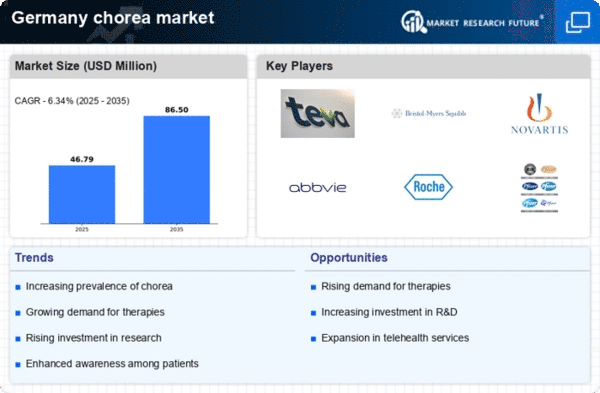
As per Market Research Future analysis, the Germany chorea market Size was estimated at 44.0 USD Million in 2024. The Germany chorea market is projected to grow from 46.79 USD Million in 2025 to 86.5 USD Million by 2035, exhibiting a compound annual growth rate (CAGR) of 6.3% during the forecast period 2025 - 2035

Key Market Trends & Highlights

The Germany chorea market is experiencing notable growth driven by advancements in treatment and increased awareness.

  • Rising awareness and education about chorea disorders are enhancing patient engagement and treatment adherence.
  • Advancements in treatment options, including emerging biopharmaceutical innovations, are reshaping the therapeutic landscape.
  • Integration of technology in care is streamlining patient management and improving outcomes in the chorea market.
  • The increasing prevalence of chorea disorders and government initiatives are key drivers propelling market growth.

Market Size & Forecast

2024 Market Size 44.0 (USD Million)
2035 Market Size 86.5 (USD Million)
CAGR (2025 - 2035) 6.34%

Major Players

Teva Pharmaceutical Industries Ltd (IL), Bristol-Myers Squibb Company (US), Novartis AG (CH), AbbVie Inc (US), Roche Holding AG (CH), Pfizer Inc (US), Eli Lilly and Company (US), AstraZeneca PLC (GB)

Our Impact
Enabled $4.3B Revenue Impact for Fortune 500 and Leading Multinationals
Partnering with 2000+ Global Organizations Each Year
30K+ Citations by Top-Tier Firms in the Industry

Germany Chorea Market Trends

The chorea market in Germany is currently experiencing notable developments, driven by a combination of increasing awareness and advancements in treatment options. The prevalence of chorea, often associated with conditions such as Huntington's disease, has led to a growing demand for effective therapies and supportive care. Healthcare providers are focusing on improving patient outcomes through innovative approaches, which may include pharmacological treatments and rehabilitation strategies. This shift towards a more comprehensive care model appears to be fostering collaboration among various stakeholders, including healthcare professionals, researchers, and patient advocacy groups. Moreover, the regulatory landscape in Germany is evolving, with authorities emphasizing the need for rigorous clinical trials and safety assessments. This regulatory focus may enhance the credibility of new treatments entering the market, potentially leading to increased investment in research and development. As the chorea market continues to expand, it seems likely that the integration of technology, such as telemedicine and digital health solutions, will play a crucial role in enhancing patient access to care and monitoring treatment efficacy. Overall, the current trajectory suggests a promising future for the chorea market, characterized by innovation and a patient-centered approach.

Rising Awareness and Education

There is a growing emphasis on raising awareness about chorea and its associated conditions. Educational initiatives targeting both healthcare professionals and the general public are becoming more prevalent. This trend may lead to earlier diagnosis and improved management of the disorder, ultimately benefiting patients.

Advancements in Treatment Options

The chorea market is witnessing significant advancements in treatment methodologies. New pharmacological agents and therapeutic strategies are being developed, which could enhance the quality of life for individuals affected by chorea. This trend indicates a shift towards more personalized and effective treatment regimens.

Integration of Technology in Care

The incorporation of technology into the chorea market is becoming increasingly important. Telemedicine and digital health tools are being utilized to improve patient monitoring and access to care. This trend suggests a potential transformation in how healthcare services are delivered, making them more efficient and patient-friendly.

Germany Chorea Market Drivers

Government Initiatives and Funding

Government initiatives aimed at improving healthcare access and funding for neurological disorders are likely to bolster the chorea market in Germany. The German government has been actively investing in research and development for rare diseases, including chorea-related conditions. In 2025, funding for neurological research is projected to increase by approximately 15%, which could lead to advancements in treatment options and patient care. These initiatives may also enhance public awareness and education regarding chorea, encouraging more individuals to seek medical assistance. As a result, the chorea market could witness a significant uptick in both diagnosis and treatment, driven by increased governmental support and funding.

Emerging Biopharmaceutical Innovations

The emergence of biopharmaceutical innovations is poised to transform the chorea market in Germany. Recent advancements in gene therapy and monoclonal antibodies have shown promise in treating chorea symptoms, potentially leading to more effective management of the condition. For instance, a novel gene therapy currently in clinical trials has demonstrated a 30% improvement in motor function among participants. As these innovative treatments gain regulatory approval, they are expected to attract considerable investment, further stimulating market growth. The chorea market may thus evolve rapidly, with new therapeutic options becoming available to patients, enhancing their quality of life and overall treatment outcomes.

Growing Demand for Personalized Medicine

The trend towards personalized medicine is likely to influence the chorea market significantly. As healthcare providers increasingly recognize the importance of tailoring treatments to individual patient profiles, the demand for personalized therapeutic approaches is expected to rise. In Germany, approximately 40% of healthcare professionals are advocating for personalized treatment plans for neurological disorders, including chorea. This shift may lead to the development of targeted therapies that address the unique genetic and phenotypic characteristics of patients. Consequently, the chorea market could see a diversification of treatment options, enhancing patient outcomes and satisfaction.

Increasing Prevalence of Chorea Disorders

The rising incidence of chorea disorders in Germany appears to be a primary driver for the chorea market. Recent studies indicate that the prevalence of Huntington's disease, a major cause of chorea, affects approximately 5 to 10 individuals per 100,000 people in Germany. This growing patient population necessitates enhanced healthcare services and treatment options, thereby expanding the market. Furthermore, as awareness of genetic factors contributing to chorea increases, more individuals may seek diagnosis and treatment, further propelling market growth. The chorea market is likely to experience a surge in demand for specialized healthcare services, including genetic counseling and targeted therapies, as the population affected by these disorders continues to grow.

Increased Collaboration Between Research Institutions and Industry

The collaboration between research institutions and the pharmaceutical industry is anticipated to drive innovation within the chorea market. In Germany, partnerships between universities and biotech companies have been on the rise, fostering an environment conducive to research and development. These collaborations often result in the sharing of resources and expertise, accelerating the discovery of new treatments for chorea. In 2025, it is estimated that such partnerships could lead to a 20% increase in clinical trials focused on chorea-related therapies. This collaborative approach may not only enhance the understanding of chorea but also facilitate the development of effective treatment options, thereby expanding the market.


Market Segment Insights

By Type: Huntington's disease (Largest) vs. Drug-induced Chorea (Fastest-Growing)

In the Germany chorea market, Huntington's disease represents the largest segment, capturing a significant portion of the overall market share due to its prevalence and the awareness surrounding it. This segment benefits from established treatment protocols and ongoing research, which ensures steady demand and continuity in patient care. In contrast, Drug-induced Chorea, while smaller, is quickly gaining attention, largely due to the increasing incidence related to the use of various pharmacological treatments, making it a niche yet growing segment. Growth trends in the 'Type' segment are driven by advancing medical research and rising diagnostic capabilities. With increasing awareness about various forms of chorea, including those induced by medications, healthcare practitioners are better equipped to identify and treat these conditions. Furthermore, the focus on patient-centric treatment approaches and personalized medicine is enhancing the market dynamics, encouraging innovations and the launch of new therapies. Thus, segments like Drug-induced Chorea are likely to witness heightened growth as more treatment options emerge.

Huntington's disease (Dominant) vs. Drug-induced Chorea (Emerging)

Huntington's disease serves as the dominant player in the Germany chorea market, characterized by its long-standing recognition and the substantial resources allocated to research and treatment development. This segment is well-supported by healthcare providers, owing to its impact on the quality of life for affected individuals and families. In contrast, Drug-induced Chorea, classified as an emerging segment, is gaining momentum with heightened recognition of its challenges. Patients experiencing this form of chorea face significant treatment hurdles, leading to increased focus on alternative therapies and interventions. As healthcare professionals become more aware of the implications of drug interactions, the need for effective management solutions is likely to spur growth in this area, attracting both investment and research interest.

By Treatment: Medical care (Largest) vs. Surgical care (Fastest-Growing)

In the Germany chorea market, the treatment segment comprises two primary values: medical care and surgical care. Currently, medical care holds a significant share of the market, reflecting its established preference among healthcare providers and patients for managing chorea through pharmacological therapies and supportive care. On the other hand, surgical care, while smaller in comparison, is rapidly gaining traction due to advancements in surgical techniques and technologies that enhance patient outcomes and satisfaction. The growth trends in the treatment segment are influenced by various factors including increasing awareness of chorea therapies, ongoing research into effective treatment modalities, and a rise in patient referrals for surgical interventions. As the medical community continues to develop innovative approaches toward treating chorea, the surgical care segment is expected to witness substantial growth, positioning it as the fastest-growing area of treatment in the market. This trend is supported by the increasing number of patients seeking surgical consultations and the successful outcomes reported in clinical studies.

Medical care (Dominant) vs. Surgical care (Emerging)

Medical care represents the dominant treatment approach in the Germany chorea market, characterized by the availability of diverse pharmacological options and customized care plans that address individual patient needs. This segment benefits from a robust framework of healthcare providers who are well-versed in the complexities of chorea treatment, ensuring that patients receive timely and effective medical attention. Furthermore, the emphasis on long-term management and care continuity in medical settings solidifies its dominant position. Conversely, surgical care is an emerging segment that is becoming increasingly recognized as a viable treatment option due to innovative surgical techniques and improved patient selection criteria. This segment appeals to individuals who may not respond adequately to medical therapies alone. With a focus on precision medicine and enhanced surgical outcomes, the surgical care segment is poised for growth, as more patients and providers become aware of the benefits, leading to an increase in surgical procedures performed for chorea.

By Distribution Channel: Pharmacies (Largest) vs. Hospitals (Fastest-Growing)

In the Germany chorea market, the distribution channels reflect a diverse landscape. Pharmacies hold the largest share, serving as the primary access point for patients seeking chorea-related medications and therapies. In contrast, hospitals are rapidly gaining traction, becoming the fastest-growing channel as they enhance their neurology departments and offer specialized care for chorea patients. The growth trends in distribution channels are largely driven by an increasing prevalence of chorea and the demand for immediate access to treatment. Enhanced pharmacy services, including telepharmacy and extended hours, facilitate patient access. Simultaneously, hospitals are expanding their facilities and investing in advanced technologies, which are attracting more patients, propelling hospitals to an emerging leadership position in distribution.

Pharmacies (Dominant) vs. Hospitals (Emerging)

Pharmacies in the Germany chorea market cater to a wide range of clients, providing accessibility and convenience. They play a crucial role in patient education and medication management, ensuring patients receive comprehensive support for their condition. With a strong focus on over-the-counter treatments and prescription medications, pharmacies are integral in dispelling stigma and promoting health awareness. On the other hand, hospitals, though emerging in the distribution channel, have begun to strengthen their market presence through specialized neurological clinics. They offer advanced treatment options and multidisciplinary care tailored to the complexities of chorea. The collaboration between pharmacists and medical professionals in hospitals enhances treatment efficiency, making hospitals an increasingly vital player in the market.

By Symptoms: Involuntary muscle movements (Largest) vs. Milkmaid's grip (Fastest-Growing)

In the Germany chorea market, the symptoms segment displays a diverse distribution of prevalence among the various symptoms. Involuntary muscle movements demonstrate the largest share, indicating a significant challenge for patients and healthcare providers alike. Other symptoms, such as milkmaid's grip, speech problems, and seizures, contribute to the overall landscape but to a lesser extent, reflecting differing patient experiences and needs. As awareness and diagnosis improve, the distribution of these symptoms may continue to evolve over time, with some emerging as more recognized challenges in chorea management. Growth trends in the symptoms segment are heavily influenced by advancements in diagnostic techniques and increased understanding of chorea manifestations. With a rising prevalence of neurological disorders and better healthcare access, the number of diagnosed cases is expected to rise, potentially affecting the awareness and identification of symptoms. Milkmaid's grip is gaining attention as it symbolizes specific involuntary behavior, which may spur further research and lead to an improved understanding of symptom variations, making it a noteworthy area for future growth.

Involuntary muscle movements (Dominant) vs. Milkmaid's grip (Emerging)

Involuntary muscle movements represent the dominant symptom in the Germany chorea market, where they are commonly encountered in patients suffering from various forms of chorea. This condition is characterized by abrupt, unpredictable, and uncontrollable movements that can significantly disrupt daily life. On the other hand, milkmaid's grip, although less prevalent, is emerging as a critical symptom that healthcare professionals are beginning to recognize. This unique grip, characterized by a continual opening and closing motion that resembles milking a cow, is becoming noteworthy in symptomology. Understanding both of these symptoms is essential for effective diagnosis and treatment, as they reflect distinct pathophysiological mechanisms and patient experiences.

By End-Users: Hospitals (Largest) vs. Clinics (Fastest-Growing)

In the Germany chorea market, the end-user segment is primarily dominated by hospitals, which hold a significant share due to their comprehensive facilities and resources dedicated to managing chorea cases. Clinics, while smaller in share, are rapidly increasing in importance as they provide specialized care and outpatient services, making them a crucial part of the healthcare landscape. Ambulatory surgical centers and other facilities contribute to the market but occupy a lesser share overall. Growth trends indicate that clinics are experiencing the fastest growth as they adapt to increasing patient needs and preferences for accessible healthcare. Factors such as advancements in treatment options and enhanced patient management protocols are driving this growth. Meanwhile, hospitals continue to evolve, focusing on integrating innovative technologies and treatments that cater to chorea patients, ensuring they remain a cornerstone in the market.

Hospitals: Dominant vs. Clinics: Emerging

Hospitals represent the dominant force in the end-user segment of the Germany chorea market. They offer a wide range of treatment options, access to specialists, and advanced medical technologies, ensuring a high level of care for patients. Their extensive resources enable them to handle complex cases efficiently. Conversely, clinics are emerging as key players by focusing on personalized care and outpatient services, providing an alternative for patients seeking convenience and tailored therapies. Their growth is fueled by the increasing demand for specialized treatments and a shift towards more accessible healthcare solutions. This dynamic is reshaping the competitive landscape, allowing clinics to capture a more significant share over time.

Get more detailed insights about Germany Chorea Market

Key Players and Competitive Insights

The competitive dynamics within the chorea market are characterized by a blend of innovation, strategic partnerships, and regional expansion. Key growth drivers include an increasing prevalence of chorea-related disorders and a heightened focus on developing targeted therapies. Major players such as Teva Pharmaceutical Industries Ltd (IL), Bristol-Myers Squibb Company (US), and Novartis AG (CH) are actively shaping the landscape through their distinct operational focuses. Teva (IL) emphasizes innovation in drug formulation, while Bristol-Myers Squibb (US) is pursuing strategic collaborations to enhance its research capabilities. Novartis (CH) is concentrating on expanding its market presence through acquisitions and partnerships, collectively fostering a competitive environment that prioritizes advanced therapeutic solutions.In terms of business tactics, companies are increasingly localizing manufacturing to enhance supply chain efficiency and reduce operational costs. The market structure appears moderately fragmented, with several key players exerting influence over specific segments. This fragmentation allows for a diverse range of therapeutic options, yet the collective strength of these companies drives a competitive atmosphere where innovation and strategic positioning are paramount.

In October Teva Pharmaceutical Industries Ltd (IL) announced a collaboration with a leading biotech firm to develop a novel gene therapy aimed at treating chorea. This strategic move underscores Teva's commitment to innovation and positions the company to potentially lead in the development of cutting-edge therapies. The collaboration is expected to leverage advanced research capabilities, enhancing Teva's portfolio and market competitiveness.

In September Bristol-Myers Squibb Company (US) expanded its partnership with a European research institution to accelerate the development of a new treatment for chorea. This initiative reflects the company's strategy to enhance its research pipeline and underscores the importance of collaborative efforts in addressing unmet medical needs. By aligning with academic institutions, Bristol-Myers Squibb (US) aims to foster innovation and expedite the delivery of new therapies to the market.

In August Novartis AG (CH) completed the acquisition of a smaller pharmaceutical company specializing in neurological disorders, including chorea. This acquisition is indicative of Novartis's strategy to bolster its therapeutic offerings and expand its footprint in the neurological market. The integration of new technologies and expertise from the acquired company is likely to enhance Novartis's competitive edge in developing effective treatments for chorea.

As of November current trends in the chorea market are increasingly defined by digitalization, sustainability, and the integration of artificial intelligence (AI) in drug development. Strategic alliances are becoming more prevalent, allowing companies to pool resources and expertise to drive innovation. The competitive landscape is shifting from traditional price-based competition to a focus on technological advancements and supply chain reliability. This evolution suggests that future differentiation will hinge on the ability to innovate and deliver high-quality, effective therapies that meet the needs of patients.

Key Companies in the Germany Chorea Market include

Industry Developments

The Germany Chorea Market has recently experienced several important developments. In June 2023, Teva Pharmaceutical Industries announced advances in their ongoing Research and Development initiatives targeting chorea treatment, boosting their market presence and reinforcing their commitment to neurological disorders. Meanwhile, Merck KGaA has made strides in expanding its therapeutic offerings by collaborating with key stakeholders to enhance treatment pathways for chorea, reflecting the increasing focus on innovative solutions within the market. 

Notably, in September 2022, the European Medicines Agency approved a novel therapy by Horizon Therapeutics, aimed at addressing chorea symptoms, which contributed to heightened market activity. Furthermore, significant market valuation growth has been observed among major players, including Roche and Boehringer Ingelheim, positively influencing the sector by enhancing standard treatment protocols and driving competitive innovations. 

The increasing prevalence of chorea, coupled with heightened public awareness and the concerted efforts of companies like Pfizer and AbbVie, illustrates a dynamic shift in the landscape where chronic conditions are met with comprehensive therapeutic approaches. Overall, the German Chorea Market reflects a landscape of innovation and strategic growth facilitated by the commitment of established pharmaceutical giants.

Future Outlook

Germany Chorea Market Future Outlook

The Chorea Market in Germany is projected to grow at a 6.34% CAGR from 2025 to 2035, driven by advancements in treatment options and increasing awareness.

New opportunities lie in:

  • Development of telehealth platforms for remote patient monitoring.
  • Investment in personalized medicine tailored for chorea patients.
  • Expansion of clinical trial networks to accelerate drug development.

By 2035, the market is expected to achieve robust growth, positioning itself as a leader in innovative treatment solutions.

Market Segmentation

Germany Chorea Market Type Outlook

  • Huntington's disease
  • Rheumatic (Sydenham's Chorea)
  • Drug-induced Chorea

Germany Chorea Market Symptoms Outlook

  • Involuntary muscle movements
  • Milkmaid's grip
  • Speech problems
  • Seizures

Germany Chorea Market End-Users Outlook

  • Clinics
  • Hospitals
  • Ambulatory surgical centers
  • Others

Germany Chorea Market Treatment Outlook

  • Medical care
  • Surgical care

Germany Chorea Market Distribution Channel Outlook

  • Hospitals
  • Clinics
  • Diagnostic centers
  • Drug stores
  • Pharmacies
  • Others

Report Scope

MARKET SIZE 2024 44.0(USD Million)
MARKET SIZE 2025 46.79(USD Million)
MARKET SIZE 2035 86.5(USD Million)
COMPOUND ANNUAL GROWTH RATE (CAGR) 6.34% (2025 - 2035)
REPORT COVERAGE Revenue Forecast, Competitive Landscape, Growth Factors, and Trends
BASE YEAR 2024
Market Forecast Period 2025 - 2035
Historical Data 2019 - 2024
Market Forecast Units USD Million
Key Companies Profiled Teva Pharmaceutical Industries Ltd (IL), Bristol-Myers Squibb Company (US), Novartis AG (CH), AbbVie Inc (US), Roche Holding AG (CH), Pfizer Inc (US), Eli Lilly and Company (US), AstraZeneca PLC (GB)
Segments Covered Type, Treatment, Distribution Channel, Symptoms, End-Users
Key Market Opportunities Advancements in gene therapy and personalized medicine enhance treatment options in the chorea market.
Key Market Dynamics Rising demand for innovative therapies drives competitive dynamics in the chorea market.
Countries Covered Germany
Leave a Comment

FAQs

What is the projected market size of the Germany Chorea Market in 2024?

The Germany Chorea Market is expected to be valued at 40.0 million USD in 2024.

What will be the estimated market value of the Germany Chorea Market by 2035?

By 2035, the Germany Chorea Market is estimated to reach a value of 300.0 million USD.

What is the expected compound annual growth rate (CAGR) for the Germany Chorea Market from 2025 to 2035?

The expected CAGR for the Germany Chorea Market from 2025 to 2035 is 20.102%.

Which distribution channel is expected to dominate the Germany Chorea Market by 2035?

By 2035, drug stores are expected to dominate the Germany Chorea Market with a projected value of 90.0 million USD.

What is the market size for hospitals in the Germany Chorea Market in 2024?

In 2024, the market size for hospitals in the Germany Chorea Market is projected to be 8.0 million USD.

Who are the key players in the Germany Chorea Market?

Key players in the Germany Chorea Market include Teva Pharmaceutical Industries, Amgen, Alkermes, and Pfizer.

What is the market value for clinics within the Germany Chorea Market in 2035?

The market value for clinics within the Germany Chorea Market is expected to reach 45.0 million USD by 2035.

How much is the diagnostic centers' segment valued in 2024?

In 2024, the diagnostic centers' segment of the Germany Chorea Market is valued at 5.0 million USD.

What are the expected growth trends for the Germany Chorea Market in the coming years?

The Germany Chorea Market is expected to experience significant growth, driven by increasing awareness and advancements in treatment options.

What is the anticipated market value for pharmacies in the Germany Chorea Market by 2035?

By 2035, the anticipated market value for pharmacies in the Germany Chorea Market is projected to be 110.0 million USD.

Download Free Sample

Kindly complete the form below to receive a free sample of this Report

Compare Licence

×
Features License Type
Single User Multiuser License Enterprise User
Price $4,950 $5,950 $7,250
Maximum User Access Limit 1 User Upto 10 Users Unrestricted Access Throughout the Organization
Free Customization
Direct Access to Analyst
Deliverable Format
Platform Access
Discount on Next Purchase 10% 15% 15%
Printable Versions