×
Request Free Sample ×

Kindly complete the form below to receive a free sample of this Report

* Please use a valid business email

Leading companies partner with us for data-driven Insights

clients tt-cursor
Hero Background

Germany Cervical Fusion Market

ID: MRFR/HC/47455-HCR
200 Pages
Rahul Gotadki
February 2026

Germany Cervical Fusion Market Research Report: Size, Share, Trend Analysis By Fusion Type (Anterior Interbody Fusion, Anterior Cervical Fusion, Posterior Fusion, Others), By Types (Metal, Polymer, Others), By Surgery (Minimally Invasive Spine Surgery, Open Spine Surgery) and By End Userss (Orthopedic Clinics, Multispecialty Hospitals, Neurology Clinics, Others) - Growth Outlook & Industry Forecast 2025 To 2035

Share:
Download PDF ×

We do not share your information with anyone. However, we may send you emails based on your report interest from time to time. You may contact us at any time to opt-out.

Germany Cervical Fusion Market Infographic
Purchase Options

Germany Cervical Fusion Market Summary

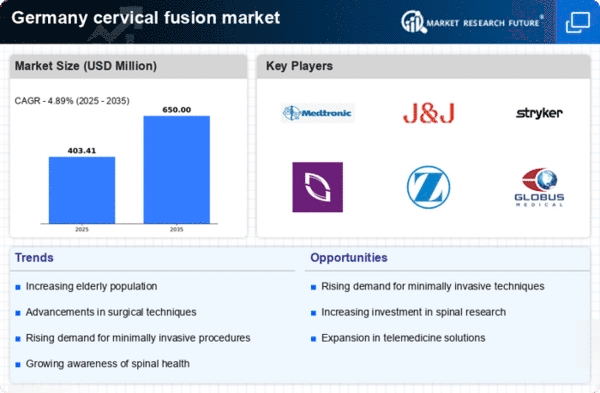
As per Market Research Future analysis, the Germany cervical fusion market size was estimated at 384.6 USD Million in 2024. The Germany cervical fusion market is projected to grow from 403.41 USD Million in 2025 to 650.0 USD Million by 2035, exhibiting a compound annual growth rate (CAGR) of 4.8% during the forecast period 2025 - 2035

Key Market Trends & Highlights

The Germany cervical fusion market is experiencing a shift towards advanced surgical techniques and minimally invasive procedures.

  • Minimally invasive techniques are gaining traction, reflecting a broader trend towards less invasive surgical options.
  • Technological advancements in surgical devices are enhancing the precision and outcomes of cervical fusion procedures.
  • The aging population is contributing to an increase in spinal disorders, driving demand for cervical fusion surgeries.
  • Rising incidence of spinal disorders and advancements in surgical techniques are key drivers propelling market growth.

Market Size & Forecast

2024 Market Size 384.6 (USD Million)
2035 Market Size 650.0 (USD Million)
CAGR (2025 - 2035) 4.89%

Major Players

Medtronic (US), DePuy Synthes (US), Stryker (US), NuVasive (US), Zimmer Biomet (US), Globus Medical (US), B. Braun (DE), K2M (US), Orthofix (US)

Our Impact
Enabled $4.3B Revenue Impact for Fortune 500 and Leading Multinationals
Partnering with 2000+ Global Organizations Each Year
30K+ Citations by Top-Tier Firms in the Industry

Germany Cervical Fusion Market Trends

The cervical fusion market in Germany is currently experiencing notable developments driven by advancements in surgical techniques and increasing demand for effective treatment options for spinal disorders. The rise in the aging population, coupled with a growing prevalence of degenerative disc diseases, has led to a heightened focus on innovative solutions. Surgeons are increasingly adopting minimally invasive procedures, which are associated with reduced recovery times and improved patient outcomes. This shift towards less invasive methods appears to be reshaping the landscape of surgical interventions in the cervical fusion market. Moreover, the regulatory environment in Germany supports the introduction of new technologies, fostering an atmosphere conducive to innovation. The integration of advanced imaging techniques and robotic-assisted surgeries is likely to enhance precision in procedures, thereby improving overall efficacy. Additionally, the collaboration between healthcare providers and technology firms may lead to the development of novel biomaterials and implants, further driving growth in the cervical fusion market. As the healthcare system continues to evolve, the emphasis on patient-centered care and personalized treatment plans is expected to play a crucial role in shaping future trends.

Minimally Invasive Techniques

The trend towards minimally invasive surgical techniques is gaining traction within the cervical fusion market. These approaches are characterized by smaller incisions and reduced tissue disruption, which can lead to quicker recovery times and less postoperative pain. As surgeons become more skilled in these methods, patient acceptance is likely to increase, further driving demand.

Technological Advancements

Technological innovations, including the use of advanced imaging and robotic systems, are transforming the cervical fusion market. These advancements enhance surgical precision and improve outcomes, making procedures safer and more effective. The ongoing development of new materials and implants is also expected to contribute to this trend.

Aging Population and Spinal Disorders

The increasing prevalence of spinal disorders, particularly among the aging population, is a significant driver of growth in the cervical fusion market. As more individuals seek treatment for conditions such as degenerative disc disease, the demand for effective surgical solutions is likely to rise, prompting further advancements in techniques and technologies.

Germany Cervical Fusion Market Drivers

Increased Healthcare Expenditure

Germany's healthcare system is characterized by substantial public and private expenditure, which is positively influencing the cervical fusion market. With healthcare spending reaching approximately €400 billion annually, there is a growing budget allocated for advanced surgical procedures, including cervical fusion. This financial commitment enables hospitals and clinics to invest in state-of-the-art technologies and training for healthcare professionals. As a result, patients have better access to high-quality surgical options, which is likely to drive the demand for cervical fusion procedures. The cervical fusion market stands to benefit from this trend, as increased funding allows for the adoption of innovative techniques and improved patient care, ultimately leading to higher surgical volumes.

Advancements in Surgical Techniques

Innovations in surgical techniques are significantly impacting the cervical fusion market in Germany. The introduction of robotic-assisted surgeries and enhanced imaging technologies has improved surgical outcomes and reduced recovery times. These advancements allow for more precise and less invasive procedures, which are appealing to both patients and surgeons. For instance, minimally invasive cervical fusion techniques have shown to reduce hospital stays by up to 30%, which is a compelling factor for healthcare providers. As these technologies become more widely adopted, the cervical fusion market is likely to see increased demand, as patients prefer options that promise quicker recovery and less postoperative pain. The ongoing research and development in this area suggest a bright future for surgical innovations in the cervical fusion market.

Rising Incidence of Spinal Disorders

The cervical fusion market in Germany is experiencing growth due to the increasing prevalence of spinal disorders. Conditions such as cervical spondylosis and herniated discs are becoming more common, leading to a higher demand for surgical interventions. According to recent health statistics, approximately 20% of the adult population in Germany suffers from some form of spinal disorder, which necessitates surgical solutions like cervical fusion. This trend is likely to drive the market as healthcare providers seek effective treatments to alleviate pain and restore mobility. Furthermore, the aging population is contributing to this rise, as older individuals are more susceptible to degenerative spinal conditions. The cervical fusion market is thus positioned to expand as more patients seek surgical options to address these issues.

Growing Awareness and Patient Education

The cervical fusion market in Germany is also being driven by heightened awareness and education among patients regarding spinal health. Campaigns aimed at informing the public about the symptoms and treatment options for spinal disorders have led to an increase in consultations with healthcare providers. Patients are now more proactive in seeking treatment for conditions that may require cervical fusion. This shift in patient behavior is likely to result in a higher number of surgical procedures being performed. Moreover, as patients become more informed about the benefits and risks associated with cervical fusion, they are more inclined to opt for surgical solutions. The cervical fusion market is thus poised for growth as awareness initiatives continue to empower patients to take charge of their spinal health.

Regulatory Support for Innovative Devices

The regulatory environment in Germany is becoming increasingly supportive of innovative medical devices, which is beneficial for the cervical fusion market. The German Medicines Act facilitates the approval of new surgical technologies, allowing for quicker access to advanced cervical fusion devices. This regulatory framework encourages manufacturers to invest in research and development, leading to the introduction of novel products that enhance surgical outcomes. As new devices enter the market, healthcare providers are likely to adopt these innovations, thereby increasing the volume of cervical fusion surgeries performed. The cervical fusion market is expected to thrive as regulatory support fosters an environment conducive to technological advancement and improved patient care.


Market Segment Insights

By Fusion Type: Anterior Cervical Fusion (Largest) vs. Anterior Interbody Fusion (Fastest-Growing)

The Germany cervical fusion market shows a segmented landscape with Anterior Cervical Fusion commanding a significant share, attributed to its established efficacy and widespread acceptance among healthcare providers. Anterior Interbody Fusion, while not as large in market share, is witnessing a surge in adoption rates due to advancements in minimally invasive techniques that enhance recovery times and patient outcomes. Growth trends in the segment are influenced by technological innovations and an increasing emphasis on patient-centric care. Anterior Interbody Fusion is emerging rapidly as surgeons look for techniques that minimize complications and improve surgical success. Concurrently, trends such as the aging population in Germany and a rise in cervical spine disorders are driving demand across all fusion types, particularly for the fastest-growing segments that incorporate modern surgical approaches.

Anterior Cervical Fusion (Dominant) vs. Anterior Interbody Fusion (Emerging)

Anterior Cervical Fusion stands out as the dominant technique in the Germany cervical fusion market, characterized by its proven track record in relieving neurological symptoms and restoring function in patients with cervical disc diseases. Its popularity is driven by favorable clinical outcomes and procedural familiarity among surgeons. In contrast, Anterior Interbody Fusion is positioned as an emerging alternative that focuses on minimizing tissue disruption and enhancing postoperative recovery. Surgeons are increasingly leveraging this method to address a broader range of spinal deformities, which is paving the way for its growth and greater adoption in clinical practices.

By Type: Metal (Largest) vs. Polymer (Fastest-Growing)

In the Germany cervical fusion market, the segment values reveal a competitive landscape with Metal types holding a significant market share. This segment benefits from robust demand due to its established reputation for durability and strength in surgical applications. Conversely, the Polymer segment is gaining traction, showcasing a growing market presence driven by innovation and clinical advancements in biomaterials. The growth trajectory of the Polymer segment is bolstered by an increasing preference for lightweight and biocompatible solutions among healthcare professionals. Additionally, ongoing research and development efforts aimed at enhancing the performance characteristics of Polymer materials contribute to their rapid adoption. These advancements, alongside supportive regulatory frameworks, indicate a positive outlook for the Polymer value in the foreseeable future.

Metal (Dominant) vs. Polymer (Emerging)

The Metal segment stands out as the dominant force in the Germany cervical fusion market, primarily due to its time-tested efficacy and reliability in spinal surgeries. Metal implants are widely recognized for their strength and longevity, making them a preferred choice among surgeons when addressing complex spinal conditions. On the other hand, the Polymer segment is emerging as a worthy contender, leveraging advancements in materials science to offer innovative solutions. These materials are often lighter and can be designed to match the properties of natural bone, reducing the risk of complications. Consequently, while Metal maintains its dominant position, the Polymer segment's growth reflects an evolving market that is increasingly receptive to new technologies.

By Surgery: Minimally Invasive Spine Surgery (Largest) vs. Open Spine Surgery (Fastest-Growing)

In the Germany cervical fusion market, the distribution of market share is heavily tilted towards Minimally Invasive Spine Surgery, which holds a dominant position due to its numerous benefits, including reduced recovery time and lower complication rates. Open Spine Surgery, while historically significant, is now observed to be on a steady decline as healthcare providers increasingly prioritize less invasive methods that minimize patient trauma and hospital stays. Growth trends in the segment indicate that Minimally Invasive Spine Surgery is expected to maintain its leadership, driven by advancements in surgical technologies and increasing demand for efficient healthcare solutions. Meanwhile, Open Spine Surgery is emerging as the fastest-growing segment as it adapts to niche markets requiring complex procedures where minimally invasive methods may not suffice, attracting specific patient demographics willing to explore advanced surgical options.

Surgery Type: Minimally Invasive Spine Surgery (Dominant) vs. Open Spine Surgery (Emerging)

Minimally Invasive Spine Surgery is characterized by its use of smaller incisions and advanced technologies, which lead to faster recovery times and reduced post-operative pain, making it highly preferred among patients and surgeons in the Germany cervical fusion market. This segment is currently dominant due to its efficiency and effectiveness. Conversely, Open Spine Surgery, though traditionally the go-to option for many spine-related surgeries, is now classified as emerging as it evolves to address specific complex conditions that require in-depth surgical techniques. This transition reflects a growing recognition of the value of both approaches, catering to diverse patient needs while advancing surgical practices.

By End User: Multispecialty Hospitals (Largest) vs. Orthopedic Clinics (Fastest-Growing)

The distribution of market share in the Germany cervical fusion market reveals that multispecialty hospitals hold the largest portion, catering to a wide range of procedures and patient demographics. This position reinforces their importance as primary facilities for cervical fusion surgeries, resulting in significant patient throughput and diverse treatment options. Conversely, orthopedic clinics are rapidly emerging, capitalizing on specialized orthopedic procedures, and growing patient demand for targeted care.

Multispecialty Hospitals (Dominant) vs. Orthopedic Clinics (Emerging)

Multispecialty hospitals dominate the Germany cervical fusion market due to their comprehensive services that blend various specialties, including orthopedics and neurology. These facilities provide an array of surgical options, attracting a larger patient base. In contrast, orthopedic clinics are emerging as key players, focused on specialized care that meets the demands of patients seeking expert treatment for spinal issues. The increasing inclination towards minimally invasive surgeries and personalized treatment plans positions orthopedic clinics as a vital option in the healthcare landscape.

Get more detailed insights about Germany Cervical Fusion Market

Key Players and Competitive Insights

The cervical fusion market in Germany exhibits a dynamic competitive landscape characterized by rapid technological advancements and a growing demand for innovative surgical solutions. Key players such as Medtronic (US), DePuy Synthes (US), and B. Braun (DE) are at the forefront, leveraging their extensive portfolios and expertise to capture market share. Medtronic (US) focuses on enhancing its product offerings through continuous innovation, while DePuy Synthes (US) emphasizes strategic partnerships to expand its reach. B. Braun (DE), with its strong local presence, aims to optimize its supply chain and manufacturing processes to better serve the German market. Collectively, these strategies contribute to a competitive environment that is increasingly shaped by innovation and collaboration.In terms of business tactics, companies are increasingly localizing manufacturing to reduce lead times and enhance responsiveness to market demands. This approach, coupled with supply chain optimization, is crucial in a moderately fragmented market where several players vie for dominance. The collective influence of these key players fosters a competitive structure that encourages innovation while also presenting challenges in terms of differentiation.

In October Medtronic (US) announced the launch of a new cervical fusion device designed to improve patient outcomes through enhanced biomechanical stability. This strategic move not only reinforces Medtronic's commitment to innovation but also positions the company to capture a larger share of the market by addressing specific clinical needs. The introduction of this device is expected to resonate well with healthcare providers seeking advanced solutions for complex spinal surgeries.

In September DePuy Synthes (US) entered into a partnership with a leading German research institution to develop next-generation spinal implants utilizing advanced materials. This collaboration highlights DePuy Synthes' focus on innovation and its strategy to leverage academic expertise to enhance product development. By aligning with research institutions, the company aims to accelerate the introduction of cutting-edge technologies into the market, thereby strengthening its competitive position.

In August B. Braun (DE) expanded its manufacturing capabilities in Germany, investing €10 million in a new facility dedicated to spinal surgery products. This investment underscores B. Braun's commitment to local production and its strategy to enhance supply chain efficiency. By increasing its manufacturing capacity, the company aims to meet the growing demand for cervical fusion solutions while ensuring high-quality standards and timely delivery.

As of November the cervical fusion market is increasingly influenced by trends such as digitalization, sustainability, and the integration of artificial intelligence (AI) in surgical procedures. Strategic alliances are becoming more prevalent, enabling companies to pool resources and expertise to drive innovation. The competitive landscape is shifting from a focus on price-based competition to one centered on technological advancements and supply chain reliability. This evolution suggests that future differentiation will hinge on the ability to innovate and deliver superior products that meet the evolving needs of healthcare providers and patients alike.

Key Companies in the Germany Cervical Fusion Market include

Industry Developments

Recent developments in the Germany Cervical Fusion Market indicate significant growth, driven by advancements in medical technologies and increasing demand for minimally invasive procedures. In September 2023, Medtronic launched a new line of cervical fusion products, focusing on enhanced patient outcomes and quicker recovery times, which is a response to the growing aging population in Germany requiring such surgical interventions.

Additionally, in August 2023, a strategic partnership was formed between Stryker and Aesculap to improve cervical fusion techniques and share innovative practices. Recently, there have been discussions regarding potential mergers that could reshape the market landscape, particularly among firms such as DePuy Synthes and Zimmer Biomet. Over the past few years, particularly since January 2021, the market has noted a robust valuation increase, attributed to the rising prevalence of cervical spine disorders and an emphasis on quality healthcare in Germany.

Overall, the ongoing research and development initiatives among these companies present a dynamic and competitive environment, reinforcing the country's stance as a vital player in the cervical fusion market.

Future Outlook

Germany Cervical Fusion Market Future Outlook

The Cervical Fusion Market in Germany is projected to grow at a 4.89% CAGR from 2025 to 2035, driven by technological advancements, increasing patient demographics, and rising healthcare expenditures.

New opportunities lie in:

  • Development of minimally invasive surgical techniques to enhance patient recovery.
  • Expansion of telemedicine platforms for pre- and post-operative care.
  • Investment in AI-driven surgical planning tools to improve outcomes.

By 2035, the cervical fusion market is expected to achieve robust growth, reflecting evolving healthcare needs.

Market Segmentation

Germany Cervical Fusion Market Type Outlook

  • Metal
  • Polymer
  • Others

Germany Cervical Fusion Market Surgery Outlook

  • Minimally Invasive Spine Surgery
  • Open Spine Surgery

Germany Cervical Fusion Market End User Outlook

  • Orthopedic Clinics
  • Multispecialty Hospitals
  • Neurology Clinics
  • Others

Germany Cervical Fusion Market Fusion Type Outlook

  • Anterior Interbody Fusion
  • Anterior Cervical Fusion
  • Posterior Fusion
  • Others

Report Scope

MARKET SIZE 2024 384.6(USD Million)
MARKET SIZE 2025 403.41(USD Million)
MARKET SIZE 2035 650.0(USD Million)
COMPOUND ANNUAL GROWTH RATE (CAGR) 4.89% (2025 - 2035)
REPORT COVERAGE Revenue Forecast, Competitive Landscape, Growth Factors, and Trends
BASE YEAR 2024
Market Forecast Period 2025 - 2035
Historical Data 2019 - 2024
Market Forecast Units USD Million
Key Companies Profiled Medtronic (US), DePuy Synthes (US), Stryker (US), NuVasive (US), Zimmer Biomet (US), Globus Medical (US), B. Braun (DE), K2M (US), Orthofix (US)
Segments Covered Fusion Type, Type, Surgery, End User
Key Market Opportunities Advancements in minimally invasive techniques enhance patient outcomes in the cervical fusion market.
Key Market Dynamics Technological advancements and regulatory changes drive growth in the cervical fusion market, enhancing surgical outcomes and patient safety.
Countries Covered Germany
Leave a Comment

FAQs

What is the projected market size of the Germany Cervical Fusion Market in 2024?

The Germany Cervical Fusion Market is projected to be valued at 448.7 million USD in 2024.

How much is the Germany Cervical Fusion Market expected to grow by 2035?

By 2035, the Germany Cervical Fusion Market is expected to reach a value of 724.2 million USD.

What is the expected compound annual growth rate (CAGR) for the Germany Cervical Fusion Market from 2025 to 2035?

The expected CAGR for the Germany Cervical Fusion Market from 2025 to 2035 is 4.448%.

Which fusion type segment is expected to dominate the Germany Cervical Fusion Market by 2035?

The Anterior Cervical Fusion segment is expected to dominate, reaching an estimated value of 240.0 million USD by 2035.

What are the values for Anterior Interbody Fusion in the Germany Cervical Fusion Market for the years 2024 and 2035?

The Anterior Interbody Fusion segment is valued at 100.0 million USD in 2024 and is expected to rise to 160.0 million USD by 2035.

Who are the key players in the Germany Cervical Fusion Market?

Major players in the market include Globus Medical, Smith and Nephew, Medtronic, and Stryker.

What market value is expected for the Posterior Fusion segment in 2024 and 2035?

The Posterior Fusion segment is valued at 140.0 million USD in 2024 and is expected to reach 210.0 million USD by 2035.

How has the Germany Cervical Fusion Market been impacted by recent trends and challenges?

The market has witnessed both opportunities for growth and challenges due to emerging technologies and regulatory changes.

What is the expected value for the Others segment in the Germany Cervical Fusion Market in 2024?

The Others segment is expected to be valued at 58.7 million USD in 2024.

What is the anticipated value for Anterior Cervical Fusion by 2035 within the market?

The Anterior Cervical Fusion segment is anticipated to reach a value of 240.0 million USD by 2035.

Download Free Sample

Kindly complete the form below to receive a free sample of this Report

Compare Licence

×
Features License Type
Single User Multiuser License Enterprise User
Price $4,950 $5,950 $7,250
Maximum User Access Limit 1 User Upto 10 Users Unrestricted Access Throughout the Organization
Free Customization
Direct Access to Analyst
Deliverable Format
Platform Access
Discount on Next Purchase 10% 15% 15%
Printable Versions