×
Request Free Sample ×

Kindly complete the form below to receive a free sample of this Report

* Please use a valid business email

Leading companies partner with us for data-driven Insights

clients tt-cursor
Hero Background

Germany Biomaterial Market

ID: MRFR/HC/48463-HCR
200 Pages
Garvit Vyas
February 2026

Germany Biomaterials Market Research Report By Application (Medical Devices, Tissue Engineering, Drug Delivery, Orthopedics, Wound Care), By Type (Natural Biomaterials, Synthetic Biomaterials, Modified Biomaterials), By Source (Plant-based, Animal-based, Microbial-based) andBy End Use (Healthcare, Pharmaceuticals, Cosmetics) - Growth & Industry Forecast 2025 To 2035

Share:
Download PDF ×

We do not share your information with anyone. However, we may send you emails based on your report interest from time to time. You may contact us at any time to opt-out.

Germany Biomaterial Market Infographic
Purchase Options

Germany Biomaterial Market Summary

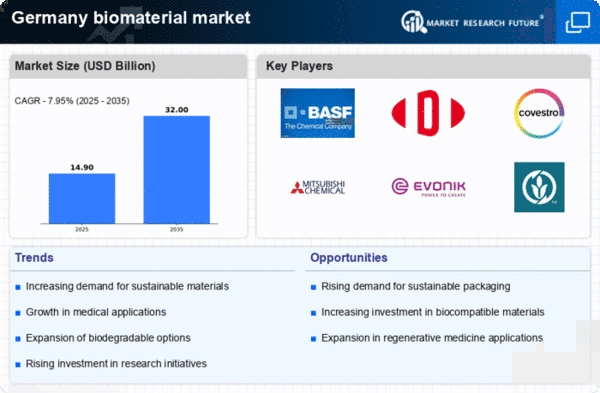
As per Market Research Future analysis, the Germany biomaterial market Size was estimated at 13.8 USD Billion in 2024. The Germany biomaterial market is projected to grow from 14.9 USD Billion in 2025 to 32.0 USD Billion by 2035, exhibiting a compound annual growth rate (CAGR) of 7.9% during the forecast period 2025 - 2035

Key Market Trends & Highlights

The Germany biomaterial market is poised for growth driven by sustainability and innovation.

  • Sustainable packaging solutions are gaining traction as consumers increasingly prefer eco-friendly options.
  • Advancements in biopolymer technology are enhancing the performance and applicability of biomaterials across various industries.
  • The integration of natural fibers into products is becoming more prevalent, reflecting a shift towards renewable resources.
  • Regulatory support for biodegradable materials and rising consumer demand for eco-friendly products are key drivers propelling market expansion.

Market Size & Forecast

2024 Market Size 13.8 (USD Billion)
2035 Market Size 32.0 (USD Billion)
CAGR (2025 - 2035) 7.95%

Major Players

BASF SE (DE), DuPont de Nemours Inc (US), Covestro AG (DE), Mitsubishi Chemical Corporation (JP), Evonik Industries AG (DE), NatureWorks LLC (US), 3M Company (US), Genomatica Inc (US)

Our Impact
Enabled $4.3B Revenue Impact for Fortune 500 and Leading Multinationals
Partnering with 2000+ Global Organizations Each Year
30K+ Citations by Top-Tier Firms in the Industry

Germany Biomaterial Market Trends

The biomaterial market in Germany is currently experiencing a notable transformation, driven by increasing environmental awareness and the demand for sustainable alternatives to traditional materials. This shift is largely influenced by stringent regulations aimed at reducing plastic waste and promoting eco-friendly practices. As a result, various industries, including packaging, automotive, and healthcare, are actively seeking innovative biomaterials that can replace conventional options. The emphasis on circular economy principles further propels the development of biodegradable and compostable materials, which are gaining traction among manufacturers and consumers alike. In addition, advancements in technology are playing a crucial role in shaping the biomaterial market. Research institutions and companies are collaborating to enhance the properties of biomaterials, making them more versatile and applicable across diverse sectors. The integration of biopolymers and natural fibers into product designs is becoming increasingly common, reflecting a broader trend towards sustainability. As the market evolves, it appears that the focus will remain on creating high-performance materials that not only meet regulatory standards but also align with consumer preferences for environmentally responsible products.

Sustainable Packaging Solutions

The demand for sustainable packaging solutions is on the rise within the biomaterial market. Companies are increasingly adopting biodegradable and compostable materials to meet consumer expectations for eco-friendly products. This trend is driven by regulatory pressures and a growing awareness of environmental issues, prompting businesses to innovate in their packaging strategies.

Advancements in Biopolymer Technology

Technological advancements in biopolymer production are significantly influencing the biomaterial market. Research and development efforts are focused on enhancing the performance characteristics of biopolymers, making them suitable for a wider range of applications. This trend indicates a shift towards more efficient and effective biomaterials that can compete with traditional options.

Integration of Natural Fibers

The integration of natural fibers into various products is becoming increasingly prevalent in the biomaterial market. This trend reflects a broader movement towards sustainability, as manufacturers seek to reduce reliance on synthetic materials. Natural fibers offer unique properties that enhance product performance while also appealing to environmentally conscious consumers.

Germany Biomaterial Market Drivers

Investment in Sustainable Infrastructure

Investment in sustainable infrastructure is emerging as a significant driver for the biomaterial market in Germany. The government and private sector are increasingly allocating funds towards projects that promote the use of sustainable materials in construction and manufacturing. Initiatives such as the Green Building Program encourage the integration of biomaterials in building designs, which not only reduces carbon footprints but also enhances energy efficiency. This trend is expected to create new opportunities for biomaterial manufacturers, as the demand for sustainable construction materials rises. The biomaterial market could see an increase in market share, potentially reaching €2 billion by 2029, as infrastructure projects increasingly prioritize sustainability.

Collaboration Between Industry and Academia

The collaboration between industry players and academic institutions in Germany is fostering innovation within the biomaterial market. Research initiatives aimed at developing new biomaterials and enhancing existing ones are gaining momentum, supported by funding from both public and private sectors. This synergy is crucial for advancing the science of biomaterials, leading to breakthroughs that can be commercialized. For example, partnerships between universities and companies have resulted in the development of novel biocomposites that exhibit superior properties for various applications. Such collaborations are likely to accelerate the growth of the biomaterial market, with expectations of reaching €1.8 billion by 2028.

Regulatory Support for Biodegradable Materials

The regulatory landscape in Germany is increasingly favorable towards the adoption of biodegradable materials, which is a key driver for the biomaterial market. The German government has implemented stringent regulations aimed at reducing plastic waste, promoting the use of sustainable alternatives. For instance, the Packaging Act mandates that packaging must be recyclable or compostable, thereby encouraging manufacturers to explore biomaterials. This regulatory push is expected to enhance market growth, with projections indicating that the biomaterial market could reach a valuation of €1.5 billion by 2027. Such supportive policies not only foster innovation but also create a competitive environment for companies specializing in biodegradable solutions.

Rising Consumer Demand for Eco-Friendly Products

In Germany, there is a notable shift in consumer preferences towards eco-friendly products, which significantly impacts the biomaterial market. Surveys indicate that approximately 70% of German consumers are willing to pay a premium for sustainable products, reflecting a growing awareness of environmental issues. This trend is driving manufacturers to invest in biomaterials that align with consumer values. As a result, companies are increasingly incorporating bioplastics and other sustainable materials into their product lines. The biomaterial market is projected to grow at a CAGR of 12% over the next five years, driven by this rising consumer demand for environmentally responsible options.

Technological Innovations in Biomaterial Production

Technological advancements in the production of biomaterials are playing a crucial role in shaping the biomaterial market in Germany. Innovations such as improved extraction methods for biopolymers and the development of new processing techniques are enhancing the efficiency and cost-effectiveness of biomaterial production. For instance, the introduction of fermentation-based processes has shown potential in reducing production costs by up to 30%. These innovations not only improve the economic viability of biomaterials but also expand their applications across various industries, including packaging, automotive, and healthcare. As a result, the biomaterial market is expected to witness robust growth, with an estimated market size of €1.2 billion by 2026.

Market Segment Insights

By Application: Medical Devices (Largest) vs. Tissue Engineering (Fastest-Growing)

In the Germany biomaterial market, the application segment is characterized by varied contributions from Medical Devices, Tissue Engineering, Drug Delivery, Orthopedics, and Wound Care. Among these, Medical Devices hold the largest market share, driven by their extensive use in hospitals and clinics. Meanwhile, Tissue Engineering is emerging as the fastest-growing segment, reflecting a shift towards regenerative medicine and innovative treatments that utilize biomaterials. The growth trends for these applications are influenced by several key drivers. The aging population and an increase in chronic diseases are propelling the demand for advanced Medical Devices, while advancements in biotechnologies and a growing focus on personalized medicine foster the rapid expansion of Tissue Engineering. Moreover, regulatory support and increased investments in research are expected to further boost these segments.

Medical Devices (Dominant) vs. Tissue Engineering (Emerging)

Medical Devices represent a dominant segment within the application sphere, encompassing a wide range of products such as surgical implants, diagnostic tools, and life-support systems. The use of biomaterials in these devices enhances their performance, biocompatibility, and longevity, making them essential in the healthcare industry. Conversely, Tissue Engineering is considered an emerging segment, driven by innovations that enable the creation of biological substitutes. This segment focuses on developing new therapies that regenerate damaged tissues and organs, appealing to a modern approach in treating health conditions. The interplay between these two segments showcases a market evolving towards higher quality and more effective medical solutions.

By Type: Natural Biomaterials (Largest) vs. Synthetic Biomaterials (Fastest-Growing)

In the Germany biomaterial market, the distribution of market share reveals that natural biomaterials hold a significant position, dominating the segment. This share is bolstered by increasing consumer preference for sustainable and environmentally friendly products. Meanwhile, synthetic biomaterials are emerging rapidly, tapping into advanced technological innovations that cater to various applications, thereby driving their demand in the market. Growth trends in this market are primarily driven by escalating research and development in biomaterials, prompting advancements in synthetic varieties. The shift towards eco-friendly solutions has also favored natural biomaterials, while synthetic options are gaining momentum due to their versatility and adaptability. Different sectors, including healthcare and packaging, are thriving, showcasing a promising trajectory for both natural and synthetic biomaterials in the coming years.

Natural Biomaterials (Dominant) vs. Synthetic Biomaterials (Emerging)

Natural biomaterials, sourced from renewable resources, are characterized by their biodegradability and reduced environmental footprint, making them a preferred choice for consumers and industries alike. These materials are essential in sectors like medicine and sustainable packaging, where their properties enhance product performance and sustainability. In contrast, synthetic biomaterials are engineered for specific functionalities, allowing for greater customization and efficiency in performance. This segment is particularly popular in medical applications such as drug delivery systems and implants, reflecting a trend towards innovative solutions. Both segments face their unique challenges, yet they play crucial roles in shaping the future landscape of materials in Germany.

By Source: Plant-based (Largest) vs. Microbial-based (Fastest-Growing)

The Germany biomaterial market showcases a diverse source segmentation with plant-based materials holding the largest share. These materials have gained popularity due to their sustainability and eco-friendly properties. On the other hand, microbial-based biomaterials are emerging rapidly, driven by innovations in biotechnology and increasing demand for alternative materials that reduce dependency on fossil resources. This competitive landscape indicates a diverse consumer preference and the drive toward environmental sustainability across all segments. Growth trends in this segment are largely influenced by changing consumer attitudes and government regulations aimed at reducing carbon footprints. The plant-based sector benefits from established infrastructure and consumer awareness, while microbial-based solutions are gaining traction due to advancements in production technologies and a growing emphasis on renewable sources. As investment in research continues, these segments are expected to evolve, appealing to eco-conscious consumers seeking sustainable alternatives.

Plant-based (Dominant) vs. Microbial-based (Emerging)

Plant-based biomaterials dominate the Germany biomaterial market due to their widespread application and strong consumer appeal. These materials, derived from renewable resources, are favored for various applications, including packaging and textiles, owing to their biodegradability and low environmental impact. In contrast, microbial-based biomaterials are an emerging force within the market. These materials, synthesized using microorganisms, offer innovative solutions that meet modern sustainability demands. While still developing, microbial options are gaining interest for their potential to replace conventional plastics and other materials, thanks to their unique properties and lower ecological footprint. This contrast illustrates the balancing act between established and innovative approaches within the biomaterials landscape.

By End-use: Healthcare (Largest) vs. Pharmaceuticals (Fastest-Growing)

In the Germany biomaterial market, the end-use segment is primarily dominated by healthcare applications, which hold the largest share. Healthcare products utilize biomaterials extensively for a variety of applications such as surgical implants, tissue engineering, and prosthetics. On the other hand, pharmaceuticals are rapidly gaining traction as a significant segment, with an increasing focus on drug delivery systems and biodegradable components. The growth trends in this segment are driven by advancements in material science and technology, resulting in innovative biomaterial solutions. The demand in healthcare continues to rise due to the aging population and the need for advanced medical treatments. Simultaneously, the pharmaceutical sector is evolving, increasing its emphasis on sustainable and eco-friendly materials, making it the fastest-growing area within the segment.

Healthcare: Medical Devices (Dominant) vs. Pharmaceuticals: Drug Delivery Systems (Emerging)

In the healthcare segment, medical devices represent a dominant force, leveraging various biomaterials for durability and biocompatibility. These devices are crucial in ensuring patient safety and improving recovery outcomes, with advancements in technology spearheading innovation. The increasing prevalence of chronic diseases necessitates the ongoing development of sophisticated medical devices. Conversely, the pharmaceutical sector's focus on drug delivery systems is emerging as a key area within the biomaterial market. These systems aim to enhance the efficacy of therapeutics while minimizing side effects, utilizing innovative biodegradable polymers. This transition towards more sustainable options is becoming essential, steering firms towards the utilization of advanced biomaterials that align with ecological standards while fulfilling therapeutic needs.

Get more detailed insights about Germany Biomaterial Market

Key Players and Competitive Insights

The biomaterial market in Germany is characterized by a dynamic competitive landscape, driven by increasing demand for sustainable materials and innovative applications across various industries. Key players such as BASF SE (DE), Covestro AG (DE), and Evonik Industries AG (DE) are at the forefront, focusing on innovation and strategic partnerships to enhance their market positions. BASF SE (DE) emphasizes its commitment to sustainability through the development of bio-based materials, while Covestro AG (DE) is actively pursuing digital transformation initiatives to optimize production processes. These strategies collectively contribute to a competitive environment that prioritizes sustainability and technological advancement.In terms of business tactics, companies are increasingly localizing manufacturing to reduce supply chain vulnerabilities and enhance responsiveness to market demands. The competitive structure of the biomaterial market appears moderately fragmented, with several key players exerting influence through strategic collaborations and technological innovations. This fragmentation allows for a diverse range of products and solutions, catering to various customer needs while fostering healthy competition among established and emerging players.

In October BASF SE (DE) announced a partnership with a leading automotive manufacturer to develop bio-based composites for vehicle interiors. This collaboration is strategically significant as it aligns with the automotive industry's shift towards sustainable materials, potentially enhancing BASF's market share in the automotive sector. The partnership not only showcases BASF's commitment to innovation but also positions it favorably within a rapidly evolving market landscape.

In September Covestro AG (DE) launched a new line of bio-based polycarbonate materials aimed at the electronics sector. This strategic move is noteworthy as it reflects Covestro's focus on expanding its product portfolio to meet the growing demand for sustainable solutions in electronics. By leveraging its expertise in polymer chemistry, Covestro is likely to strengthen its competitive edge and attract environmentally conscious customers.

In August Evonik Industries AG (DE) unveiled a new production facility dedicated to the manufacturing of biodegradable polymers. This investment underscores Evonik's commitment to sustainability and innovation, positioning the company as a leader in the biodegradable materials segment. The facility is expected to enhance production capacity and meet the increasing demand for eco-friendly materials across various applications.

As of November current competitive trends in the biomaterial market are heavily influenced by digitalization, sustainability, and the integration of advanced technologies such as AI. Strategic alliances are increasingly shaping the landscape, enabling companies to pool resources and expertise to drive innovation. Looking ahead, competitive differentiation is likely to evolve from traditional price-based competition towards a focus on innovation, technological advancements, and supply chain reliability. This shift suggests that companies prioritizing sustainable practices and cutting-edge technologies will be better positioned to thrive in the future.

Key Companies in the Germany Biomaterial Market include

Industry Developments

In recent months, the Germany Biomaterials Market has experienced notable developments, particularly with companies like Evonik Industries and BASF enhancing their portfolio in sustainable biomaterials. In September 2023, Evonik Industries announced the expansion of its biopolymer production facilities to meet growing demand, signifying a strong focus on eco-friendly materials. Additionally, BASF is investing in Research and Development for biodegradable polymers, aiming for a greener product line by the end of 2024. Corbion and NatureWorks have forged a partnership to increase the availability of biobased plastics.

Meanwhile, in August 2023, DuPont revealed plans to scale up its biomaterial production due to increasing market demand from the automotive and packaging industries. In terms of mergers and acquisitions, SABIC acquired several technology assets from a leading firm in March 2023, further solidifying its position in the biomaterials market. The market valuation of the Germany Biomaterials Market is expected to grow significantly, driven by increasing consumer demand for sustainable products and regulatory support for bio-based materials. This upward trajectory has fostered a dynamic environment for both established players and new entrants.

Future Outlook

Germany Biomaterial Market Future Outlook

The Biomaterial Market in Germany is projected to grow at a 7.95% CAGR from 2025 to 2035, driven by advancements in sustainable materials and increasing healthcare applications.

New opportunities lie in:

  • Development of biodegradable packaging solutions for consumer goods.
  • Investment in R&D for innovative medical implants using biomaterials.
  • Expansion of biocomposite materials in automotive manufacturing.

By 2035, the biomaterial market is expected to achieve substantial growth and innovation.

Market Segmentation

Germany Biomaterial Market Type Outlook

  • Natural Biomaterials
  • Synthetic Biomaterials
  • Modified Biomaterials

Germany Biomaterial Market Source Outlook

  • Plant-based
  • Animal-based
  • Microbial-based

Germany Biomaterial Market End-use Outlook

  • Healthcare
  • Pharmaceuticals
  • Cosmetics

Germany Biomaterial Market Application Outlook

  • Medical Devices
  • Tissue Engineering
  • Drug Delivery
  • Orthopedics
  • Wound Care

Report Scope

MARKET SIZE 2024 13.8(USD Billion)
MARKET SIZE 2025 14.9(USD Billion)
MARKET SIZE 2035 32.0(USD Billion)
COMPOUND ANNUAL GROWTH RATE (CAGR) 7.95% (2025 - 2035)
REPORT COVERAGE Revenue Forecast, Competitive Landscape, Growth Factors, and Trends
BASE YEAR 2024
Market Forecast Period 2025 - 2035
Historical Data 2019 - 2024
Market Forecast Units USD Billion
Key Companies Profiled BASF SE (DE), DuPont de Nemours Inc (US), Covestro AG (DE), Mitsubishi Chemical Corporation (JP), Evonik Industries AG (DE), NatureWorks LLC (US), 3M Company (US), Genomatica Inc (US)
Segments Covered Application, Type, Source, End-use
Key Market Opportunities Growing demand for sustainable packaging solutions drives innovation in the biomaterial market.
Key Market Dynamics Rising demand for sustainable materials drives innovation and competition in the biomaterial market.
Countries Covered Germany
Leave a Comment

FAQs

What is the projected market size of the Germany Biomaterials Market in 2024?

The Germany Biomaterials Market is expected to be valued at 4.5 USD billion in 2024.

What is the expected market value of the Germany Biomaterials Market by 2035?

By 2035, the Germany Biomaterials Market is projected to reach a value of 10.5 USD billion.

What is the CAGR of the Germany Biomaterials Market from 2025 to 2035?

The compound annual growth rate for the Germany Biomaterials Market from 2025 to 2035 is expected to be 8.007%.

Which application sector is expected to dominate the Germany Biomaterials Market in 2035?

The Medical Devices application sector is expected to dominate, with a projected value of 3.5 USD billion in 2035.

What is the market size of the Tissue Engineering application in 2024?

The Tissue Engineering application is valued at 1.0 USD billion in 2024.

Who are the major players in the Germany Biomaterials Market?

Key players include Evonik Industries, SABIC, FKur, Corbion, BASF, and Covestro, among others.

What is the expected value of the Drug Delivery application in 2035?

The Drug Delivery application is expected to reach a value of 2.0 USD billion by 2035.

How much is the Orthopedics application projected to be worth in 2035?

The Orthopedics application is projected to be valued at 1.5 USD billion in 2035.

What challenges are the Germany Biomaterials Market likely to face in the coming years?

Challenges may include regulatory hurdles and the need for continuous innovation in biomaterials.

What is the anticipated market value for Wound Care applications by 2035?

The Wound Care application is expected to be valued at 1.0 USD billion by 2035.

Download Free Sample

Kindly complete the form below to receive a free sample of this Report

Compare Licence

×
Features License Type
Single User Multiuser License Enterprise User
Price $4,950 $5,950 $7,250
Maximum User Access Limit 1 User Upto 10 Users Unrestricted Access Throughout the Organization
Free Customization
Direct Access to Analyst
Deliverable Format
Platform Access
Discount on Next Purchase 10% 15% 15%
Printable Versions