×
Request Free Sample ×

Kindly complete the form below to receive a free sample of this Report

* Please use a valid business email

Leading companies partner with us for data-driven Insights

clients tt-cursor
Hero Background

Germany Biogas Market

ID: MRFR/EnP/53478-HCR
128 Pages
Chitranshi Jaiswal
February 2026

Germany Biogas Market Research Report By Application (Electricity Generation, Transportation Fuel, Heating Applications, Fertilizer Production), By Feedstock (Agricultural Waste, Municipal Solid Waste, Animal Manure, Industrial Waste), By Technology (Anaerobic Digestion, Landfill Gas Recovery, Gasification) and By End Use (Residential, Commercial, Industrial)-Forecast to 2035

Share:
Download PDF ×

We do not share your information with anyone. However, we may send you emails based on your report interest from time to time. You may contact us at any time to opt-out.

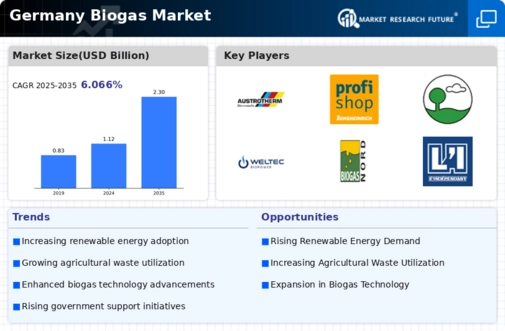
Germany Biogas Market Infographic
Purchase Options

Germany Biogas Market Summary

As per analysis, the Germany Biogas Market is projected to grow from USD 1.51 Billion in 2025 to USD 2.96 Billion by 2035, exhibiting a compound annual growth rate (CAGR) of 7.02% during the forecast period (2025 - 2035).

Key Market Trends & Highlights

The Germany biogas market is poised for growth driven by regulatory support and technological advancements.

  • Electricity generation remains the largest segment, reflecting a stable demand for renewable energy sources.
  • Combined heat and power is the fastest-growing segment, indicating a shift towards more efficient energy utilization.
  • Agricultural residues dominate the feedstock category, while food waste is emerging as the fastest-growing source for biogas production.
  • Regulatory frameworks and rising demand for renewable energy are key drivers propelling market expansion.

Market Size & Forecast

2024 Market Size 1.4 (USD Billion)
2035 Market Size 2.96 (USD Billion)
CAGR (2025 - 2035) 7.02%

Major Players

EnviTec Biogas AG (DE), Schmack Biogas GmbH (DE), Biogas Nord AG (DE), WELTEC BIOPOWER GmbH (DE), Greenline Biogas GmbH (DE), Biogas Energy GmbH (DE), Energiekontor AG (DE), Schaeffler AG (DE), Austrian Bioenergy Group (AT)

Our Impact
Enabled $4.3B Revenue Impact for Fortune 500 and Leading Multinationals
Partnering with 2000+ Global Organizations Each Year
30K+ Citations by Top-Tier Firms in the Industry

Germany Biogas Market Trends

The Germany Biogas Market is currently experiencing a notable transformation, driven by a combination of regulatory support and technological advancements. The German government has implemented various policies aimed at promoting renewable energy sources, particularly biogas, as part of its commitment to reducing greenhouse gas emissions. This commitment is reflected in the Renewable Energy Sources Act, which incentivizes the production and utilization of biogas. Furthermore, the increasing awareness of environmental sustainability among consumers and businesses alike is fostering a favorable environment for biogas development. As a result, investments in biogas plants and infrastructure are on the rise, indicating a robust growth trajectory for the sector. In addition to regulatory frameworks, technological innovations are playing a crucial role in enhancing the efficiency and viability of biogas production. The integration of advanced anaerobic digestion technologies and improved feedstock management practices is likely to optimize biogas yields and reduce operational costs. Moreover, the potential for biogas to contribute to energy security and rural development is becoming increasingly recognized. This multifaceted approach suggests that the germany biogas market is poised for sustained growth, with opportunities for both established players and new entrants to capitalize on the evolving landscape.

Regulatory Support and Incentives

The germany biogas market benefits from a robust regulatory framework that encourages the development of renewable energy sources. Government policies, including feed-in tariffs and subsidies, are designed to promote biogas production and utilization. This regulatory support is crucial for attracting investments and fostering innovation within the sector.

Technological Advancements

Innovations in biogas production technologies are significantly enhancing the efficiency of the germany biogas market. The adoption of advanced anaerobic digestion methods and improved feedstock management practices is likely to increase biogas yields. These technological improvements are essential for reducing costs and making biogas a more competitive energy source.

Growing Environmental Awareness

There is a rising consciousness regarding environmental sustainability among consumers and businesses in Germany. This awareness is driving demand for renewable energy solutions, including biogas. As stakeholders increasingly prioritize eco-friendly practices, the market for biogas is expected to expand, reflecting a shift towards greener energy alternatives.

Germany Biogas Market Drivers

Technological Innovations

Technological advancements play a crucial role in enhancing the efficiency and sustainability of the Germany biogas market. Innovations in anaerobic digestion technology, such as improved microbial strains and advanced biogas upgrading processes, have led to higher yields and better quality of biogas. For instance, the integration of digital technologies, including IoT and AI, allows for real-time monitoring and optimization of biogas production. As of 2023, the average biogas yield per ton of organic waste has increased by approximately 15% due to these advancements. Furthermore, the development of small-scale biogas systems is making it feasible for farms and rural communities to participate in the market, thereby diversifying the industry and enhancing local energy security.

Public and Private Investment

Investment in the Germany biogas market is on the rise, driven by both public and private sectors. The government has allocated substantial funding for research and development in renewable energy technologies, including biogas. In 2023, public funding for biogas projects reached over 200 million euros, aimed at enhancing infrastructure and supporting innovative projects. Additionally, private investors are increasingly recognizing the potential of biogas as a sustainable energy source, leading to a surge in new projects and partnerships. This influx of capital is expected to accelerate the growth of the biogas market, enabling the development of more efficient production methods and expanding the overall capacity of biogas facilities. As investment continues to flow into the sector, the Germany biogas market is poised for significant expansion.

Agricultural Waste Utilization

The utilization of agricultural waste as a feedstock for biogas production is a significant driver in the Germany biogas market. With Germany being one of the largest agricultural producers in Europe, there is an abundance of organic waste available for biogas generation. This not only provides a sustainable solution for waste management but also offers farmers an additional revenue stream. In 2023, approximately 60% of biogas production in Germany was derived from agricultural residues, highlighting the sector's reliance on this resource. Moreover, the integration of biogas production into agricultural practices promotes circular economy principles, where waste is converted into energy, thus reducing reliance on fossil fuels. This trend is likely to continue, further solidifying the role of agriculture in the Germany biogas market.

Regulatory Framework and Support

The Germany biogas market benefits from a robust regulatory framework that promotes renewable energy sources. The Renewable Energy Sources Act (EEG) provides financial incentives for biogas production, ensuring a stable income for producers. This framework has led to a significant increase in biogas plants, with over 9,000 operational facilities as of 2023. The government aims to achieve a 65% share of renewable energy in the electricity mix by 2030, which further underscores the importance of biogas in achieving these targets. Additionally, regional policies often complement national regulations, providing further support for local biogas initiatives. This regulatory environment not only encourages investment but also fosters innovation within the Germany biogas market.

Rising Demand for Renewable Energy

The growing demand for renewable energy sources in Germany significantly drives the biogas market. As public awareness of climate change and environmental issues increases, consumers and businesses alike are seeking sustainable energy solutions. The German government has set ambitious targets to reduce greenhouse gas emissions by 55% by 2030 compared to 1990 levels, which necessitates a substantial increase in renewable energy production. Biogas, being a flexible and dispatchable energy source, is well-positioned to meet this demand. In 2023, biogas accounted for approximately 6% of the total electricity generation in Germany, indicating its vital role in the energy transition. This rising demand not only supports existing biogas facilities but also encourages new investments in the Germany biogas market.

Market Segment Insights

By Application: Electricity Generation (Largest) vs. Combined Heat and Power (Fastest-Growing)

In the Germany biogas market, the application segment is characterized by several critical areas of utilization including electricity generation, heat generation, combined heat and power (CHP), transportation, and fertilizer production. Among these, electricity generation stands out as the largest segment, reflecting its strong market share. The extensive adoption of biogas technologies in power generation has significantly contributed to this segment's dominance, fueled by advances in technology and regulatory support.

Electricity Generation (Dominant) vs. Combined Heat and Power (Emerging)

Electricity generation from biogas is a mature and dominant application in Germany, driven by the country's commitment to renewable energy and sustainability goals. This segment benefits from established infrastructure and continuous investment in biogas power plants. On the other hand, combined heat and power (CHP) is regarded as an emerging application, rapidly gaining traction due to its efficiency in simultaneously generating electricity and thermal energy. CHP systems are increasingly recognized for their energy conservation and cost-effectiveness, making them attractive for both industrial and residential applications. As technology progresses, CHP is expected to witness substantial growth, aligning with Germany's energy transition objectives.

By Feedstock Type: Agricultural Residues (Largest) vs. Food Waste (Fastest-Growing)

In the Germany biogas market, the feedstock segment is primarily characterized by a diverse array of inputs, with Agricultural Residues holding the largest share in the sector. This category includes crop leftovers and other plant materials, which have been a traditional source of biogas. Following closely, Animal Manure also plays a significant role, while other feedstocks like Food Waste are rapidly gaining attention due to increasing waste management policies and sustainability initiatives. The market is becoming more segmented as different feedstock types show unique potentials in terms of biogas yield and efficiency. Growth drivers for this segment are multifaceted, involving both environmental and economic considerations. The push for renewable energy sources has led to heightened interest in Energy Crops, although they remain behind the established Agricultural Residues. Food Waste, on the other hand, is emerging quickly due to its abundance and governmental incentives for reducing landfill waste. With increased awareness of sustainability, the shift towards more innovative feedstock types continues as the biogas sector integrates more circular economy principles.

Agricultural Residues (Dominant) vs. Sewage Sludge (Emerging)

Agricultural Residues have established themselves as the dominant feedstock in Germany's biogas market, thanks to their availability and the established infrastructure for collection and processing. This feedstock type not only provides a substantial yield of biogas but also supports agricultural sustainability by recycling waste materials. Conversely, Sewage Sludge is emerging as a valuable resource, buoyed by urbanization and the need to manage waste more sustainably. Sewage Sludge can be processed into biogas, offering a dual benefit of renewable energy generation and waste reduction, but it faces challenges related to public perception and strict regulations. While Agricultural Residues enjoy widespread acceptance and utilization, the potential of Sewage Sludge is just beginning to be explored, signaling a shift in focus within the biogas sector.

By Technology: Anaerobic Digestion (Largest) vs. Gasification (Fastest-Growing)

In the German biogas market, the technology segment is dominated by Anaerobic Digestion, which takes the largest share due to its established processes for converting organic materials into biogas. Following this, Landfill Gas Recovery and Gasification also hold significant market positions, with Gasification exhibiting rapid growth as an innovative technology. Fermentation and Biochemical Conversion, while essential, contribute less to the overall market share. Overall, this combination leads to a robust technological landscape that supports sustainable energy production.

Technology: Anaerobic Digestion (Dominant) vs. Gasification (Emerging)

Anaerobic Digestion remains the dominant technology in the German biogas market due to its efficiency and reliability in converting various organic materials into biogas. This process not only maximizes energy recovery but also minimizes environmental impact, making it a favorable choice for municipalities and businesses alike. Conversely, Gasification is emerging as a rapid-growth technology, capturing interest for its ability to convert waste into syngas, which can be further utilized as a clean energy source. The speed of innovation and investment vehicles in Gasification point to its potential for broader application, making it an intriguing segment in the evolving renewable energy space.

Get more detailed insights about Germany Biogas Market

Key Players and Competitive Insights

The competitive dynamics within the biogas market in Germany are characterized by a robust interplay of innovation, sustainability, and strategic partnerships. Key players such as EnviTec Biogas AG (DE), Schmack Biogas GmbH (DE), and WELTEC BIOPOWER GmbH (DE) are at the forefront, each adopting distinct operational focuses that shape the market landscape. EnviTec Biogas AG (DE) emphasizes technological innovation, particularly in the development of advanced biogas plants, while Schmack Biogas GmbH (DE) has been actively pursuing strategic partnerships to enhance its service offerings. WELTEC BIOPOWER GmbH (DE) appears to be concentrating on expanding its international footprint, thereby diversifying its market presence and operational capabilities. Collectively, these strategies contribute to a competitive environment that is increasingly driven by technological advancements and collaborative efforts.

In terms of business tactics, companies are increasingly localizing manufacturing and optimizing supply chains to enhance efficiency and reduce costs. The market structure is moderately fragmented, with several players vying for market share, yet the influence of major companies remains significant. This competitive structure allows for a dynamic interplay of strategies, where smaller firms can innovate rapidly while larger entities leverage their resources for broader market penetration.

In December 2025, EnviTec Biogas AG (DE) announced a strategic partnership with a leading agricultural cooperative to develop a series of biogas plants across rural Germany. This collaboration is poised to enhance local energy production and promote sustainable agricultural practices, reflecting a growing trend towards community-based energy solutions. The strategic importance of this partnership lies in its potential to bolster EnviTec's market position while simultaneously addressing local energy needs.

In November 2025, Schmack Biogas GmbH (DE) launched a new digital platform aimed at optimizing biogas production processes. This initiative is indicative of a broader trend towards digital transformation within the industry, as companies seek to leverage data analytics for improved operational efficiency. The platform's introduction is likely to enhance Schmack's competitive edge by providing clients with real-time insights into production metrics, thereby fostering greater transparency and efficiency.

In October 2025, WELTEC BIOPOWER GmbH (DE) secured a contract for a large-scale biogas plant in Eastern Europe, marking a significant expansion of its operational reach. This move not only diversifies WELTEC's portfolio but also underscores the company's commitment to international growth. The strategic importance of this contract lies in its potential to establish WELTEC as a key player in the Eastern European biogas market, thereby enhancing its competitive positioning.

As of January 2026, current trends in the biogas market are increasingly defined by digitalization, sustainability, and the integration of AI technologies. Strategic alliances are becoming more prevalent, as companies recognize the value of collaboration in driving innovation and enhancing operational capabilities. Looking ahead, competitive differentiation is likely to evolve, shifting from traditional price-based competition to a focus on technological innovation, supply chain reliability, and sustainable practices. This transition suggests that companies that prioritize these aspects will be better positioned to thrive in an increasingly competitive landscape.

Key Companies in the Germany Biogas Market include

Industry Developments

In recent months, the German Biogas Market has witnessed significant developments and growth. Notably, in June 2023, EnviTec Biogas reported a substantial increase in project installations, reflecting the expanding market demand for biogas solutions. Furthermore, WELTEC BIOPOWER has been actively enhancing its biogas production facilities, positioning itself as a leader in the renewable energy sector.

In terms of mergers and acquisitions, Agraferm Technologies AG has acquired a local competitor to strengthen its market presence, an event publicly announced in March 2023. The focus on sustainability and renewable energy has prompted governmental initiatives, leading to a burgeoning biogas sector valued significantly.

The German government continues to support biogas initiatives through favorable regulations and incentives, aligning with the country's goals for energy transition and climate protection. Industry growth has also been observed at Biogas Nord and PlanET Biogas Global, which have expanded their operational capacities to meet increasing energy demands. As of late 2022, major investments in biogas technology and infrastructure have positioned Germany as a pivotal player in the European renewable energy landscape, further reinforcing its commitment to sustainable practices.

Future Outlook

Germany Biogas Market Future Outlook

The Germany biogas market is projected to grow at a 7.02% CAGR from 2025 to 2035, driven by renewable energy policies, technological advancements, and increasing demand for sustainable energy solutions.

New opportunities lie in:

  • Expansion of biogas upgrading technologies for grid injection
  • Development of integrated biogas and waste management systems
  • Investment in biogas-powered transportation solutions

By 2035, the Germany biogas market is expected to be robust, driven by innovation and sustainable practices.

Market Segmentation

Germany Biogas Market Technology Outlook

  • Anaerobic Digestion
  • Landfill Gas Recovery
  • Gasification
  • Fermentation
  • Biochemical Conversion

Germany Biogas Market Application Outlook

  • Electricity Generation
  • Heat Generation
  • Combined Heat and Power
  • Transportation
  • Fertilizer Production

Germany Biogas Market Feedstock Type Outlook

  • Agricultural Residues
  • Animal Manure
  • Energy Crops
  • Food Waste
  • Sewage Sludge

Report Scope

MARKET SIZE 20241.4(USD Billion)
MARKET SIZE 20251.51(USD Billion)
MARKET SIZE 20352.96(USD Billion)
COMPOUND ANNUAL GROWTH RATE (CAGR)7.02% (2024 - 2035)
REPORT COVERAGERevenue Forecast, Competitive Landscape, Growth Factors, and Trends
BASE YEAR2024
Market Forecast Period2025 - 2035
Historical Data2019 - 2024
Market Forecast UnitsUSD Billion
Key Companies ProfiledEnviTec Biogas AG (DE), Schmack Biogas GmbH (DE), Biogas Nord AG (DE), WELTEC BIOPOWER GmbH (DE), Greenline Biogas GmbH (DE), Biogas Energy GmbH (DE), Energiekontor AG (DE), Schaeffler AG (DE), Austrian Bioenergy Group (AT)
Segments CoveredApplication, Feedstock Type, Technology
Key Market OpportunitiesExpansion of decentralized biogas systems driven by regulatory support and increasing renewable energy demand.
Key Market DynamicsRegulatory incentives and technological advancements drive growth in Germany's biogas market, enhancing sustainability and energy security.
Countries CoveredGermany
Leave a Comment

FAQs

What is the current valuation of the Germany biogas market?

As of 2024, the Germany biogas market was valued at 1.4 USD Billion.

What is the projected market size for the Germany biogas market by 2035?

The market is projected to reach 2.96 USD Billion by 2035.

What is the expected CAGR for the Germany biogas market during the forecast period?

The expected CAGR for the Germany biogas market from 2025 to 2035 is 7.02%.

Which companies are considered key players in the Germany biogas market?

Key players include EnviTec Biogas AG, Schmack Biogas GmbH, and WELTEC BIOPOWER GmbH, among others.

What are the main applications of biogas in Germany?

Main applications include electricity generation, heat generation, and combined heat and power, with respective valuations of 1.18, 0.59, and 0.88 USD Billion projected.

What feedstock types are utilized in the Germany biogas market?

Feedstock types include agricultural residues, animal manure, and food waste, with projected valuations of 0.75, 0.55, and 0.45 USD Billion respectively.

What technologies are employed in the production of biogas in Germany?

Technologies include anaerobic digestion, landfill gas recovery, and gasification, with projected valuations of 1.18, 0.58, and 0.3 USD Billion respectively.

How does the biogas market in Germany compare to other renewable energy sectors?

The biogas market appears to be growing steadily, with a projected increase in valuation indicating a robust sector within the renewable energy landscape.

What role does biogas play in Germany's energy transition strategy?

Biogas is likely to play a crucial role in Germany's energy transition, contributing to renewable energy targets and sustainability goals.

What are the challenges facing the Germany biogas market?

Challenges may include regulatory hurdles, competition from other renewable sources, and the need for technological advancements.

Download Free Sample

Kindly complete the form below to receive a free sample of this Report

Compare Licence

×
Features License Type
Single User Multiuser License Enterprise User
Price $4,950 $5,950 $7,250
Maximum User Access Limit 1 User Upto 10 Users Unrestricted Access Throughout the Organization
Free Customization
Direct Access to Analyst
Deliverable Format
Platform Access
Discount on Next Purchase 10% 15% 15%
Printable Versions