×
Request Free Sample ×

Kindly complete the form below to receive a free sample of this Report

* Please use a valid business email

Leading companies partner with us for data-driven Insights

clients tt-cursor
Hero Background

Germany Application Release Automation Market

ID: MRFR/ICT/59897-HCR
200 Pages
Aarti Dhapte
February 2026

Germany Application Release Automation Market Research Report By Deployment Type (On-Premises, Cloud-Based, Hybrid), By Organization Size (Small Enterprises, Medium Enterprises, Large Enterprises), By End User (IT Telecommunications, BFSI, Retail, Healthcare, Manufacturing) and By Functionality (Continuous Integration, Continuous Delivery, Release Management, Deployment Automation)-Forecast to 2035

Share:
Download PDF ×

We do not share your information with anyone. However, we may send you emails based on your report interest from time to time. You may contact us at any time to opt-out.

Germany Application Release Automation Market Infographic
Purchase Options

Germany Application Release Automation Market Summary

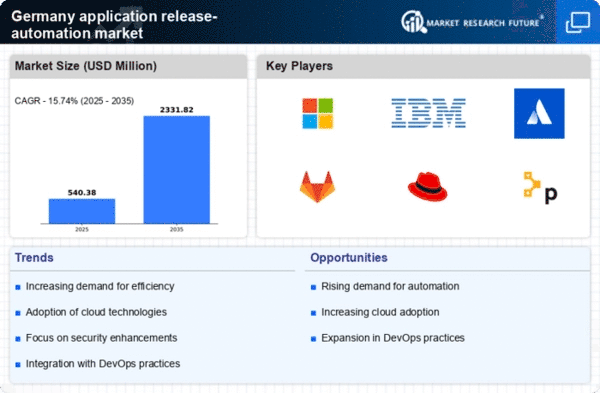
As per Market Research Future analysis, the Germany Application Release Automation Market size was estimated at 466.89 USD Million in 2024. The Application Release-automation market is projected to grow from 540.38 USD Million in 2025 to 2331.82 USD Million by 2035, exhibiting a compound annual growth rate (CAGR) of 15.7% during the forecast period 2025 - 2035

Key Market Trends & Highlights

The Germany application release-automation market is experiencing robust growth driven by technological advancements and evolving business needs.

  • The market is witnessing increased adoption of cloud-based solutions, enhancing flexibility and scalability.
  • Integration of AI and machine learning is becoming prevalent, streamlining processes and improving efficiency.
  • Focus on security and compliance is intensifying, as organizations prioritize data protection and regulatory adherence.
  • Key market drivers include the growing demand for agile development practices and the rising complexity of software environments.

Market Size & Forecast

2024 Market Size 466.89 (USD Million)
2035 Market Size 2331.82 (USD Million)
CAGR (2025 - 2035) 15.74%

Major Players

Microsoft (US), IBM (US), Atlassian (AU), GitLab (US), Red Hat (US), Puppet (US), Chef (US), CloudBees (US)

Our Impact
Enabled $4.3B Revenue Impact for Fortune 500 and Leading Multinationals
Partnering with 2000+ Global Organizations Each Year
30K+ Citations by Top-Tier Firms in the Industry

Germany Application Release Automation Market Trends

the Germany Application Release Automation Market is experiencing notable growth, driven by the increasing demand for efficient software deployment processes. Organizations are recognizing the necessity of automating their release cycles to enhance productivity and reduce time-to-market. This trend is particularly evident in Germany, where businesses are investing in advanced tools and technologies to streamline their operations. The integration of artificial intelligence and machine learning into release automation is also gaining traction, as these technologies offer improved decision-making capabilities and predictive analytics. Furthermore, the emphasis on DevOps practices is reshaping the landscape, fostering collaboration between development and operations teams. In addition, the regulatory environment in Germany is influencing the application release-automation market. Compliance with data protection laws and industry standards is paramount, prompting organizations to adopt automated solutions that ensure adherence to these regulations. As companies strive for agility and responsiveness, the focus on security and compliance within the automation processes is becoming increasingly critical. Overall, the application release-automation market is poised for continued expansion, driven by technological advancements and the evolving needs of businesses in Germany.

Increased Adoption of Cloud-Based Solutions

Organizations are increasingly turning to cloud-based platforms for application release-automation. This shift allows for greater scalability, flexibility, and cost-effectiveness, enabling businesses to deploy applications more rapidly and efficiently.

Integration of AI and Machine Learning

The incorporation of artificial intelligence and machine learning technologies into application release-automation is becoming more prevalent. These innovations enhance automation processes by providing predictive analytics and improving decision-making capabilities.

Focus on Security and Compliance

As regulatory requirements become more stringent, there is a heightened emphasis on security and compliance within the application release-automation market. Organizations are prioritizing automated solutions that ensure adherence to data protection laws and industry standards.

Germany Application Release Automation Market Drivers

Demand for Enhanced Collaboration Tools

The application release-automation market in Germany is witnessing a surge in demand for tools that facilitate enhanced collaboration among development and operations teams. As organizations adopt DevOps practices, the need for seamless communication and collaboration becomes paramount. Automation tools that integrate with existing collaboration platforms are increasingly sought after, as they enable teams to work more cohesively throughout the release process. Recent surveys indicate that 75% of German companies are prioritizing collaboration in their software development efforts, which is likely to propel the growth of the application release-automation market as businesses seek solutions that foster teamwork and efficiency.

Increased Focus on Operational Efficiency

In the competitive landscape of the application release-automation market, German organizations are placing a heightened emphasis on operational efficiency. Companies are recognizing that optimizing their release processes can lead to significant cost savings and improved resource allocation. As a result, there is a growing trend towards adopting automation tools that can streamline workflows and reduce manual intervention. Data suggests that organizations that implement release automation can achieve up to a 30% reduction in deployment times, which is a compelling incentive for businesses in Germany. This focus on efficiency is likely to drive further investment in the application release-automation market.

Regulatory Compliance and Risk Management

In Germany, the application release-automation market is significantly influenced by the need for regulatory compliance and effective risk management. Organizations are under pressure to adhere to stringent regulations, particularly in sectors such as finance and healthcare. This has led to an increased focus on automation solutions that can ensure compliance throughout the software release process. Companies are investing in tools that provide audit trails and facilitate risk assessments, which are essential for maintaining compliance. As a result, is expected to grow as businesses prioritize solutions that help mitigate risks and ensure adherence to regulatory standards.

Rising Complexity of Software Environments

The complexity of software environments in Germany is escalating, driven by the proliferation of microservices and multi-cloud architectures. This complexity presents challenges for traditional release processes, prompting organizations to seek advanced automation solutions. The application release-automation market is responding to this need by offering tools that can manage intricate deployment scenarios effectively. Recent studies indicate that over 60% of German enterprises are utilizing microservices, which necessitates sophisticated release automation strategies to ensure smooth deployments. Consequently, the market is poised for growth as companies invest in technologies that can simplify the management of these complex environments.

Growing Demand for Agile Development Practices

The application release-automation market in Germany is experiencing a notable shift towards agile development methodologies. Organizations are increasingly adopting agile practices to enhance their software development processes, which necessitates the need for efficient release automation tools. This trend is driven by the desire for faster time-to-market and improved collaboration among development teams. According to recent data, approximately 70% of German companies have reported implementing agile frameworks, which has led to a surge in demand for automation solutions that can seamlessly integrate with these methodologies. As a result, is expected to expand significantly, as businesses seek to streamline their release processes and improve overall productivity.

Market Segment Insights

By Deployment Type: Cloud-Based (Largest) vs. On-Premises (Fastest-Growing)

In the Germany application release-automation market, the distribution of market share among deployment types reveals that cloud-based solutions hold the largest share, reflecting the trend towards scalable and flexible solutions. On-premises deployment, while traditionally favored for security and control, is witnessing a rapid shift due to increasing operational efficiency demands, allowing it to carve a significant niche despite its smaller share. Growth trends in this segment are fueled by the rising acceptance of cloud technologies, especially as organizations in Germany prioritize agility and remote collaboration. The fastest-growing on-premises segment is adapting by integrating hybrid solutions, combining the strengths of both cloud and traditional methods. This synergy shows that enterprises are not only investing in cloud solutions but are also looking to enhance their on-premises systems, thus driving innovation and market evolution.

Cloud-Based (Dominant) vs. On-Premises (Emerging)

The dominant cloud-based deployment in the Germany application release-automation market is characterized by its flexibility, scalability, and cost-effectiveness. Organizations benefit from reduced infrastructure costs, seamless updates, and access to advanced features without significant capital investments. In contrast, on-premises solutions are emerging as robust alternatives, catering to industries with stringent data security and compliance requirements. These solutions are increasingly incorporating automation capabilities to enhance operational efficiency, thus improving their competitiveness against cloud offerings. As businesses seek tailored releases and greater control over their environments, on-premises solutions are innovating, leading to a more dynamic interaction between cloud and traditional models in the deployment landscape.

By Organization Size: Large Enterprises (Largest) vs. Medium Enterprises (Fastest-Growing)

In the Germany application release-automation market, the market share distribution is considerably skewed towards large enterprises, which dominate due to their extensive resources and ability to implement comprehensive automation solutions. Meanwhile, medium enterprises are capturing significant attention as their adoption rates rapidly increase, driven by improving technologies and cost efficiencies. The growth trends within this segment highlight the burgeoning interest from medium enterprises as they seek to enhance operational efficiencies and ensure competitive advantages. Factors such as the ongoing digital transformation and the necessity for agile methodologies are propelling medium enterprises to adopt release automation solutions swiftly. This shift is promising for vendors targeting this segment, as they align their offerings to cater to the specific needs of mid-sized organizations.

Large Enterprises (Dominant) vs. Medium Enterprises (Emerging)

Large enterprises are characterized by robust infrastructures and substantial budgets, enabling them to integrate advanced application release-automation tools seamlessly into their workflows. Their dominant position in the market is supported by a strong demand for reliable and scalable solutions that can handle complex deployment processes. On the other hand, medium enterprises are emerging as significant players, increasingly prioritizing automation to improve efficiency and reduce time-to-market. These organizations typically seek flexible and cost-effective solutions that can scale with their growing needs, thus stimulating market competition and innovation. The contrasting dynamics between these segments illustrate the diverse needs and strategies employed by businesses of varying sizes in the application release-automation landscape.

By End User: IT Telecommunications (Largest) vs. BFSI (Fastest-Growing)

The Germany application release-automation market is significantly influenced by its end users, with IT Telecommunications commanding a substantial share of the market. Organizations in this sector are increasingly relying on automation tools to improve their operational efficiency and speed of application deployment. This sector benefits from high demand for seamless communication and connectivity, leading to a dominant market presence. In contrast, the BFSI sector is swiftly gaining traction as businesses within finance and insurance strive to enhance their digital transformation initiatives, integrating innovative automation solutions into their workflows. Growth trends in the Germany application release-automation market show a robust increase driven by technological advancements and the necessity for efficient process management. The adoption of cloud technologies and the rising focus on agile methodologies are propelling both IT Telecommunications and BFSI to expand their use of automation tools. Moreover, the regulatory requirements in the BFSI sector are pushing organizations to implement stringent release automation practices, thereby driving demand further. The emphasis on speed and accuracy in application delivery across all sectors highlights the importance of automation in meeting evolving market needs.

IT Telecommunications (Dominant) vs. BFSI (Emerging)

The IT Telecommunications sector in the Germany application release-automation market plays a dominant role, characterized by large-scale operations that require swift and reliable application deployments. Companies in this sector prioritize automation to streamline workflows, enhance service delivery, and maintain competitiveness in a rapidly evolving technological landscape. This focus on efficiency not only leads to cost reductions but also improves customer satisfaction through better service quality. Conversely, BFSI is emerging as a key segment, driven by the need for rapid digital transformations and compliance with regulatory changes. This sector's entities are increasingly turning to automation tools to facilitate seamless processing and reduce errors in application releases, showcasing a growing reliance on such technologies for operational excellence.

By Functionality: Continuous Integration (Largest) vs. Continuous Delivery (Fastest-Growing)

In the Germany application release-automation market, Continuous Integration holds the largest share among the functionality segment values, showcasing its dominance as organizations focus on enhancing software quality and reducing integration issues. Continuous Delivery, while not as large as Continuous Integration, is rapidly gaining traction, driven by the increasing need for businesses to accelerate release cycles and improve deployment efficiency. The growth trends in this segment are propelled by the demand for seamless software development processes. With industries increasingly adopting agile methodologies, Continuous Delivery is emerging as the fastest-growing functionality. Businesses are prioritizing automation and integration solutions to optimize workflows, driving investments in this area. Moreover, rising cloud adoption and the push for digital transformation are fueling the advancement of both Continuous Integration and Continuous Delivery.

Continuous Integration (Dominant) vs. Release Management (Emerging)

Continuous Integration is characterized by its focus on automating the integration of code changes from multiple contributors, which enhances collaboration and reduces integration problems, making it a dominant force in the market. Its extensive adoption stems from the necessity for shorter release cycles and improved software quality. Conversely, Release Management, while emerging, is becoming increasingly significant as it focuses on planning and controlling the movement of releases to test and live environments. This segment is gaining recognition as organizations seek greater control and visibility over the release process, aiming to minimize downtime and achieve seamless deployments. As both functionalities evolve, their integration within CI/CD pipelines is becoming essential for competitive advantage.

Get more detailed insights about Germany Application Release Automation Market

Key Players and Competitive Insights

The application release-automation market in Germany is characterized by a dynamic competitive landscape, driven by the increasing demand for faster and more efficient software delivery processes. Key players such as Microsoft (US), IBM (US), and Atlassian (AU) are actively shaping the market through strategic innovations and partnerships. Microsoft (US) focuses on integrating AI capabilities into its Azure DevOps platform, enhancing automation and streamlining workflows. IBM (US), on the other hand, emphasizes its hybrid cloud solutions, which facilitate seamless application deployment across various environments. Atlassian (AU) continues to expand its product offerings, particularly with Jira and Bitbucket, to cater to the growing needs of agile development teams, thereby reinforcing its market position.The competitive structure of the market appears moderately fragmented, with several players vying for market share. Key business tactics include localizing services to meet regional demands and optimizing supply chains to enhance operational efficiency. The collective influence of these major companies fosters a competitive environment where innovation and customer-centric solutions are paramount.

In October Microsoft (US) announced a significant upgrade to its Azure DevOps platform, incorporating advanced AI-driven features aimed at automating testing and deployment processes. This strategic move is likely to enhance user experience and reduce time-to-market for software releases, positioning Microsoft as a leader in the automation space. Similarly, in September 2025, IBM (US) unveiled its new hybrid cloud toolkit, which integrates application release automation capabilities, allowing businesses to deploy applications across multiple cloud environments seamlessly. This initiative underscores IBM's commitment to providing flexible solutions that cater to diverse customer needs.

In August Atlassian (AU) launched a new feature within its Jira platform that enables real-time collaboration among development teams, significantly improving the efficiency of release cycles. This enhancement not only strengthens Atlassian's product suite but also reflects the growing trend towards collaborative development practices in the industry. Furthermore, in July 2025, GitLab (US) expanded its partnership with major cloud providers to enhance its CI/CD capabilities, thereby solidifying its position as a comprehensive DevOps platform.

As of November the competitive trends in the application release-automation market are increasingly defined by digitalization, sustainability, and the integration of AI technologies. Strategic alliances among key players are shaping the landscape, fostering innovation and enhancing service offerings. The shift from price-based competition to a focus on technological advancement and supply chain reliability is evident, suggesting that future competitive differentiation will hinge on the ability to innovate and adapt to evolving market demands.

Key Companies in the Germany Application Release Automation Market include

Industry Developments

The Germany Application Release Automation Market has seen significant developments in recent months, with key players like Oracle, Red Hat, Microsoft, and IBM actively enhancing their offerings. In June 2023, Oracle expanded its cloud services portfolio to include more advanced automation tools aimed at streamlining application deployment processes in Germany, responding to the increasing demand for efficiency among businesses.

Additionally, Microsoft launched new features in Azure DevOps, enabling enhanced automation for development teams across the region. In terms of mergers and acquisitions, Chef announced its acquisition by Progress Software in May 2023, which is poised to strengthen both companies' positions in the market. As of August 2023, growth in market valuation for companies like Puppet and GitLab has been observed, attributed to the rapid digital transformation across German enterprises, with emphasis on agile methodologies.

The introduction of evolving regulatory frameworks in Germany, focused on data protection and compliance, continues to drive investment in application automation technologies as organizations seek to enhance their efficiency and compliance posture. Overall, the market is poised for robust growth driven by innovation, strategic partnerships, and heightened focus on operational efficiency within German organizations.

Future Outlook

Germany Application Release Automation Market Future Outlook

The application release-automation market in Germany is poised for growth at 15.74% CAGR from 2025 to 2035, driven by increased demand for efficiency and digital transformation.

New opportunities lie in:

  • Integration of AI-driven testing tools for enhanced quality assurance.
  • Development of customizable automation frameworks for diverse business needs.
  • Expansion into cloud-based solutions to improve scalability and accessibility.

By 2035, the market is expected to achieve substantial growth, reflecting evolving technological demands.

Market Segmentation

Germany Application Release Automation Market End User Outlook

  • IT Telecommunications
  • BFSI
  • Retail
  • Healthcare
  • Manufacturing

Germany Application Release Automation Market Functionality Outlook

  • Continuous Integration
  • Continuous Delivery
  • Release Management
  • Deployment Automation

Germany Application Release Automation Market Deployment Type Outlook

  • On-Premises
  • Cloud-Based
  • Hybrid

Germany Application Release Automation Market Organization Size Outlook

  • Small Enterprises
  • Medium Enterprises
  • Large Enterprises

Report Scope

MARKET SIZE 2024 466.89(USD Million)
MARKET SIZE 2025 540.38(USD Million)
MARKET SIZE 2035 2331.82(USD Million)
COMPOUND ANNUAL GROWTH RATE (CAGR) 15.74% (2025 - 2035)
REPORT COVERAGE Revenue Forecast, Competitive Landscape, Growth Factors, and Trends
BASE YEAR 2024
Market Forecast Period 2025 - 2035
Historical Data 2019 - 2024
Market Forecast Units USD Million
Key Companies Profiled Microsoft (US), IBM (US), Atlassian (AU), GitLab (US), Red Hat (US), Puppet (US), Chef (US), CloudBees (US)
Segments Covered Deployment Type, Organization Size, End User, Functionality
Key Market Opportunities Integration of artificial intelligence in application release-automation enhances efficiency and accelerates deployment processes.
Key Market Dynamics Rising demand for automation tools drives competitive innovation in the application release-automation market.
Countries Covered Germany
Leave a Comment

FAQs

What is the expected market size of the Germany Application Release Automation Market in 2024?

The Germany Application Release Automation Market is expected to be valued at 468.0 million USD in 2024.

What is the projected market size of the Germany Application Release Automation Market by 2035?

The market is projected to grow to 2550.0 million USD by the year 2035.

What is the expected compound annual growth rate (CAGR) for the Germany Application Release Automation Market from 2025 to 2035?

The expected CAGR for the Germany Application Release Automation Market from 2025 to 2035 is 16.664%.

Which deployment type is expected to dominate the Germany Application Release Automation Market in 2024?

The Cloud-Based deployment type is expected to dominate the market with a value of 250.0 million USD in 2024.

What will be the market value for On-Premises deployment in the Germany Application Release Automation Market by 2035?

The market value for On-Premises deployment is projected to reach 500.0 million USD by 2035.

Who are the major players in the Germany Application Release Automation Market?

Major players in this market include companies such as Oracle, Microsoft, Red Hat, and IBM.

What is the expected market value for Hybrid deployment by 2035 in the Germany Application Release Automation Market?

The expected market value for Hybrid deployment is projected to be 850.0 million USD by 2035.

What is the market size for Cloud-Based deployment type in 2024?

The market size for the Cloud-Based deployment type is valued at 250.0 million USD in 2024.

What are the key growth drivers for the Germany Application Release Automation Market?

Key growth drivers include the increasing need for faster software delivery and enhanced automation solutions.

How has the global market scenario affected the Germany Application Release Automation Market?

The current global scenario is driving innovation and market growth in the Germany Application Release Automation sector.

Download Free Sample

Kindly complete the form below to receive a free sample of this Report

Compare Licence

×
Features License Type
Single User Multiuser License Enterprise User
Price $4,950 $5,950 $7,250
Maximum User Access Limit 1 User Upto 10 Users Unrestricted Access Throughout the Organization
Free Customization
Direct Access to Analyst
Deliverable Format
Platform Access
Discount on Next Purchase 10% 15% 15%
Printable Versions