×
Request Free Sample ×

Kindly complete the form below to receive a free sample of this Report

* Please use a valid business email

Leading companies partner with us for data-driven Insights

clients tt-cursor
Hero Background

Germany Air Handling Units Market

ID: MRFR/EnP/46366-HCR
200 Pages
Garvit Vyas
February 2026

Germany Air Handling Units Market Research Report By Type (Packaged Rooftop, Modular, Custom), By Effect (Single-Effect, Double-Effect), By Capacity (Upto 5000 m3/hr, 5000 m3/hr – 15000 m3/hr, Above 15000 m3/hr) andBy Application (Industrial, Residential, Commercial)- Forecast to 2035

Share:
Download PDF ×

We do not share your information with anyone. However, we may send you emails based on your report interest from time to time. You may contact us at any time to opt-out.

Germany Air Handling Units Market Infographic
Purchase Options

Germany Air Handling Units Market Summary

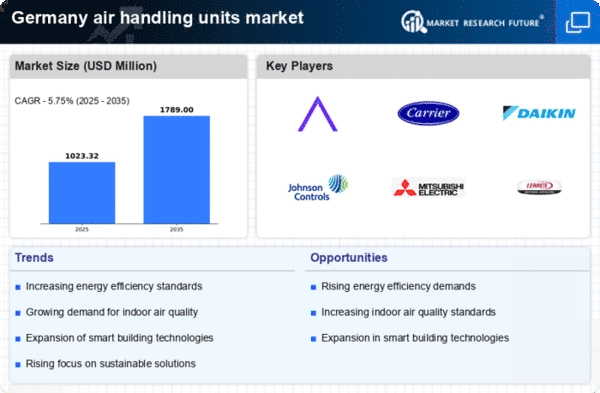
As per Market Research Future analysis, the Germany air handling-units market Size was estimated at 967.68 USD Million in 2024. The Germany air handling-units market is projected to grow from 1023.32 USD Million in 2025 to 1789.0 USD Million by 2035, exhibiting a compound annual growth rate (CAGR) of 5.7% during the forecast period 2025 - 2035

Key Market Trends & Highlights

The Germany air handling-units market is experiencing a transformative shift towards energy efficiency and smart technology integration.

  • The market is increasingly prioritizing energy efficiency, driven by regulatory compliance and sustainability initiatives.
  • Smart technology integration is becoming prevalent, enhancing operational efficiency and user experience in air handling units.
  • Modular solutions are gaining traction, catering to the diverse needs of various construction projects.
  • Rising construction activities and an increased focus on indoor air quality are key drivers propelling market growth.

Market Size & Forecast

2024 Market Size 967.68 (USD Million)
2035 Market Size 1789.0 (USD Million)
CAGR (2025 - 2035) 5.75%

Major Players

Trane Technologies (IE), Carrier Global Corporation (US), Daikin Industries, Ltd. (JP), Johnson Controls International plc (IE), Mitsubishi Electric Corporation (JP), Lennox International Inc. (US), Gree Electric Appliances, Inc. (CN), Rheem Manufacturing Company (US)

Our Impact
Enabled $4.3B Revenue Impact for Fortune 500 and Leading Multinationals
Partnering with 2000+ Global Organizations Each Year
30K+ Citations by Top-Tier Firms in the Industry

Germany Air Handling Units Market Trends

The air handling-units market is currently experiencing a notable transformation, driven by increasing awareness of energy efficiency and sustainability. In Germany, regulatory frameworks are evolving to promote the adoption of advanced technologies that enhance indoor air quality while minimizing energy consumption. This shift is reflected in the growing demand for units that incorporate smart features, allowing for better control and monitoring of air quality parameters. Furthermore, the emphasis on reducing carbon footprints is prompting manufacturers to innovate and develop more environmentally friendly solutions, aligning with national goals for energy transition and climate protection. In addition, the market is witnessing a trend towards modular and customizable air handling solutions. This approach enables end-users to tailor systems according to specific requirements, enhancing operational efficiency and adaptability. The integration of IoT technologies is also becoming prevalent, facilitating real-time data analysis and predictive maintenance. As the air handling-units market continues to evolve, stakeholders are likely to focus on enhancing product performance while adhering to stringent environmental standards, ensuring a sustainable future for the industry.

Energy Efficiency Focus

There is a growing emphasis on energy-efficient designs within the air handling-units market. This trend is largely driven by regulatory initiatives aimed at reducing energy consumption in buildings. Manufacturers are increasingly developing units that utilize advanced technologies to optimize energy use, thereby lowering operational costs and environmental impact.

Smart Technology Integration

The integration of smart technologies is becoming a defining characteristic of the air handling-units market. Systems equipped with IoT capabilities allow for enhanced monitoring and control of air quality. This trend not only improves user experience but also contributes to energy savings and operational efficiency.

Modular Solutions Demand

The demand for modular air handling solutions is on the rise, as they offer flexibility and customization for various applications. This trend enables users to adapt systems to specific needs, enhancing performance and efficiency. Modular designs also facilitate easier upgrades and maintenance, aligning with the evolving requirements of modern buildings.

Germany Air Handling Units Market Drivers

Regulatory Compliance Pressure

The air handling-units market in Germany is experiencing heightened pressure due to stringent regulatory compliance requirements. The German government has implemented various environmental regulations aimed at reducing energy consumption and emissions in buildings. As a result, manufacturers are compelled to innovate and produce energy-efficient air handling units that meet these standards. The market is projected to grow as companies invest in technologies that comply with regulations, potentially increasing market value by approximately 15% over the next five years. This regulatory landscape not only drives demand for advanced air handling solutions but also encourages the adoption of sustainable practices within the industry.

Rising Construction Activities

The air handling-units market is likely to benefit from the ongoing rise in construction activities across Germany. With urbanization and infrastructure development on the rise, there is a growing need for efficient air handling systems in both residential and commercial buildings. The construction sector is expected to grow at a CAGR of around 4% in the coming years, which will directly impact the demand for air handling units. This trend indicates a robust market environment where manufacturers can capitalize on new projects, thereby enhancing their market share and contributing to the overall growth of the air handling-units market.

Increased Focus on Indoor Air Quality

There is a growing awareness regarding indoor air quality (IAQ) among consumers and businesses in Germany, which is significantly influencing the air handling-units market. As health concerns related to air pollution and allergens rise, the demand for air handling units that can effectively filter and circulate clean air is increasing. This trend is expected to drive innovation in filtration technologies and air purification systems, potentially leading to a market growth of 10% over the next few years. The emphasis on IAQ not only enhances the appeal of air handling units but also positions them as essential components in modern building designs.

Technological Advancements in HVAC Systems

Technological advancements are playing a crucial role in shaping the air handling-units market in Germany. Innovations such as variable air volume systems, advanced control systems, and IoT integration are enhancing the efficiency and functionality of air handling units. These advancements are likely to attract investments, as companies seek to differentiate their products in a competitive landscape. The market is projected to see a growth rate of approximately 12% as manufacturers adopt these technologies to meet evolving consumer demands. This trend indicates a shift towards smarter, more efficient air handling solutions that align with modern building requirements.

Sustainability Initiatives and Green Building Trends

Sustainability initiatives are increasingly influencing the air handling-units market in Germany. The push for green building certifications, such as LEED and BREEAM, is driving demand for energy-efficient and environmentally friendly air handling solutions. As more construction projects aim for sustainability, the market for air handling units that comply with these standards is expected to expand. This trend may lead to a market growth of around 8% as stakeholders prioritize eco-friendly solutions. The alignment of air handling units with sustainability goals not only enhances their marketability but also contributes to the overall reduction of carbon footprints in the building sector.


Market Segment Insights

By Type: Packaged Rooftop (Largest) vs. Modular (Fastest-Growing)

In the Germany air handling-units market, the packaged rooftop segment holds a significant market share, thanks to its versatility and compact design. This segment is particularly favored in the commercial sector where space-saving solutions are essential. Modular units are gaining traction, especially in sectors where customization and scalability are crucial. Together, these segments reflect the dynamic needs of various industries seeking efficient air handling solutions. The growth trends in this segment are driven by increasing demand for energy-efficient systems and advancements in technology. Packaged rooftop units are more established, offering reliable performance, while modular units appeal to new installations due to their flexibility and quick deployment. The market is also influenced by regulatory standards pushing for lower emissions and enhanced sustainability, making these segments pivotal in the ongoing transition towards greener technologies.

Packaged Rooftop (Dominant) vs. Modular (Emerging)

Packaged rooftop units are characterized by their integrated design, allowing for ease of installation and maintenance. These units typically combine multiple functionalities, including heating, cooling, and ventilation, making them an all-in-one solution ideal for various applications. Their robust performance and established market presence contribute to their dominance. Conversely, modular units are emerging as a flexible solution in the Germany air handling-units market. They enable customization based on specific needs, allowing for easy scalability as demand changes. Their design simplifies the installation process, leading to reduced project timelines and costs, thus appealing to new constructions and upgrades alike.

By Effect: Single Effect (Largest) vs. Double Effect (Fastest-Growing)

In the Germany air handling-units market, the Single Effect segment holds the largest market share, catering to a wide range of applications thanks to its simplicity and cost-effectiveness. This segment appeals to various industries seeking efficient air handling solutions, ensuring its continued dominance in the market. Conversely, Double Effect units are gaining traction as more industries turn to advanced technologies for improved efficiency and performance, positioning them as a significant player in the market landscape. The growth trends in this segment are driven by escalating energy efficiency requirements and increasing sustainability standards set by regulatory bodies. The rising demand for energy-efficient systems and innovative designs enhances the appeal of Double Effect units, making them the fastest-growing option. Manufacturers are focusing on developing smarter systems with integrated controls, which is expected to further boost the adoption of Double Effect air handling units in coming years.

Single Effect (Dominant) vs. Double Effect (Emerging)

The Single Effect segment is characterized by its widespread acceptance due to its operational efficiency and lower initial cost, making it a dominant choice across various sectors. These units typically provide reliable and straightforward solutions for HVAC applications. On the other hand, Double Effect units, while currently emerging, are recognized for their advanced cooling and heating capabilities. They operate on innovative mechanisms that offer improved energy savings, making them highly appealing to environmentally conscious consumers. As companies focus on minimizing their carbon footprints, the adoption rate of Double Effect units is anticipated to rise significantly.

By Capacity: Upto 5000 m3/hr (Largest) vs. Above 15000 m3/hr (Fastest-Growing)

The capacity segment of the Germany air handling-units market is characterized by a diverse range of offerings, with 'Upto 5000 m3/hr' holding the largest market share. This segment caters predominantly to smaller commercial and residential applications, reflecting a steady demand due to rising energy efficiency standards and urbanization. In contrast, the 'Above 15000 m3/hr' segment is gaining traction, appealing to large industrial users and infrastructural developments that require robust air handling solutions. The growth trends within this segment highlight a significant shift towards larger capacities as industries expand and invest in more advanced systems. The drive for better indoor air quality and improved energy efficiency is spurring innovation, with systems boasting better controls and adaptability. Regulatory pressures aimed at reducing emissions and enhancing thermal comfort continue to propel the demand for higher-capacity units, fostering a competitive environment where technology and efficiency reign.

Upto 5000 m3/hr (Dominant) vs. Above 15000 m3/hr (Emerging)

In the Germany air handling-units market, 'Upto 5000 m3/hr' is the dominant category, primarily driven by the needs of small to mid-sized enterprises and residential buildings. This segment is favored for its efficiency and versatility, offering energy-saving features that align with current environmental standards. Conversely, the 'Above 15000 m3/hr' segment represents an emerging category, designed to meet the demanding requirements of large-scale industrial operations. These units are equipped with advanced technology for enhanced performance and are essential for maintaining air quality in extensive commercial spaces. As businesses continue to prioritize both performance and sustainability, the market for larger air handling units is expected to expand rapidly.

By Application: Commercial (Largest) vs. Residential (Fastest-Growing)

In the Germany air handling-units market, the distribution of market share among application segments highlights the commercial sector as the dominant force, driven by robust demand in office buildings, retail spaces, and other commercial establishments. This segment significantly outpaces the residential and industrial segments, showcasing its vital role in the overall market dynamics. Conversely, the residential segment is emerging as a fast-growing area, propelled by increasing awareness of energy-efficient systems and the rising demand for improved indoor air quality in homes. Growth trends reveal a significant shift towards more sustainable and energy-efficient air handling solutions. The commercial sector is increasingly investing in advanced HVAC systems that align with green building standards, while the residential segment sees a surge in adoption due to government incentives and consumer preferences for environmentally friendly appliances. As a result, both segments are expected to experience substantial growth, with innovations in technology and efficiency driving future developments.

Commercial (Dominant) vs. Residential (Emerging)

The commercial segment in the Germany air handling-units market holds a dominant position due to its extensive application across various industries, including retail, hospitality, and office environments. This segment benefits from the high volume of air handling needs in large buildings and commercial complexes, necessitating advanced HVAC solutions. In contrast, the residential segment is emerging as a vital area driven by a growing interest in smart home technologies and energy-efficient systems. Homeowners are increasingly opting for systems that offer better air quality and energy savings, making this segment ripe for growth opportunities as market players innovate and adapt to consumer preferences. The dynamism observed in both segments showcases the evolving landscape of air handling technology.

Get more detailed insights about Germany Air Handling Units Market

Key Players and Competitive Insights

The air handling-units market in Germany is characterized by a competitive landscape that is increasingly shaped by innovation, sustainability, and digital transformation. Key players such as Trane Technologies (IE), Carrier Global Corporation (US), and Daikin Industries, Ltd. (JP) are actively pursuing strategies that emphasize technological advancements and eco-friendly solutions. Trane Technologies (IE) has positioned itself as a leader in energy-efficient systems, focusing on reducing carbon footprints while enhancing indoor air quality. Carrier Global Corporation (US) is leveraging its extensive portfolio to integrate smart technologies into its products, thereby enhancing user experience and operational efficiency. Meanwhile, Daikin Industries, Ltd. (JP) is concentrating on expanding its market presence through strategic partnerships and localized manufacturing, which collectively contribute to a dynamic competitive environment.
In terms of business tactics, companies are increasingly localizing manufacturing to reduce lead times and optimize supply chains. The market structure appears moderately fragmented, with several players vying for market share while also collaborating on sustainability initiatives. This collective influence of key players fosters a competitive atmosphere where innovation and responsiveness to market demands are paramount.
In October 2025, Trane Technologies (IE) announced a partnership with a leading German university to develop next-generation air handling systems that utilize AI for predictive maintenance. This strategic move not only underscores Trane's commitment to innovation but also positions the company to leverage academic research for practical applications in the market. Such collaborations may enhance product reliability and customer satisfaction, thereby strengthening Trane's competitive edge.
In September 2025, Carrier Global Corporation (US) launched a new line of air handling units designed specifically for commercial applications, featuring advanced IoT capabilities. This initiative reflects Carrier's focus on integrating smart technology into its offerings, which could potentially lead to improved energy management and operational efficiency for clients. The introduction of these units may also serve to attract environmentally conscious consumers seeking sustainable solutions.
In August 2025, Daikin Industries, Ltd. (JP) expanded its manufacturing facility in Germany, aiming to increase production capacity for its energy-efficient air handling units. This expansion is indicative of Daikin's strategy to meet growing demand while also reducing transportation costs and carbon emissions associated with long-distance shipping. Such investments in local production capabilities may enhance Daikin's responsiveness to market fluctuations and customer needs.
As of November 2025, the air handling-units market is witnessing trends that emphasize digitalization, sustainability, and the integration of AI technologies. Strategic alliances among key players are increasingly shaping the competitive landscape, fostering innovation and collaboration. The shift from price-based competition to a focus on technological differentiation and supply chain reliability is evident. Companies that prioritize innovation and sustainability are likely to emerge as leaders in this evolving market, as they adapt to the changing preferences of consumers and regulatory environments.

Key Companies in the Germany Air Handling Units Market include

Industry Developments

Recent developments in the Germany Air Handling Units Market have shown a significant growth trajectory, driven by increasing demand for energy-efficient solutions and stringent regulations regarding indoor air quality. Major players like Systemair, TROX, and Swegon are focusing on innovative technologies to enhance efficiency and reduce emissions. Panasonic and Mitsubishi Electric are investing in advanced air filtration systems to improve air quality in commercial spaces. In October 2023, Carrier announced the acquisition of a German-based company specializing in ventilation technology, marking a strategic expansion in the region.

Siemens and Johnson Controls are also increasing their market presence through collaborations aimed at developing smart building technologies. Over the past two years, the market has experienced robust valuation growth due to heightened awareness of energy conservation and health concerns related to air quality. Industry reports indicate that the market valuation has increased by approximately 15% in the last year alone, owing to both improved product offerings and government incentives for green technologies.

Additionally, the rise in demand for HVAC solutions in response to the COVID-19 pandemic has further accelerated growth in this sector, with companies like Daikin and Trane making significant headway in product innovations to meet evolving customer needs.


Future Outlook

Germany Air Handling Units Market Future Outlook

The Air Handling Units Market in Germany is projected to grow at a 5.75% CAGR from 2025 to 2035, driven by energy efficiency regulations, technological advancements, and increasing demand for indoor air quality.

New opportunities lie in:

  • Development of energy-efficient units with IoT integration
  • Expansion into renewable energy systems for HVAC
  • Customized air handling solutions for industrial applications

By 2035, the market is expected to achieve robust growth, driven by innovation and sustainability.

Market Segmentation

Germany Air Handling Units Market Type Outlook

  • Packaged Rooftop
  • Modular
  • Custom

Germany Air Handling Units Market Effect Outlook

  • Single Effect
  • Double Effect

Germany Air Handling Units Market Capacity Outlook

  • Upto 5000 m3/hr
  • 5000 m3/hr – 15000 m3/hr
  • Above 15000 m3/hr

Germany Air Handling Units Market Application Outlook

  • Industrial
  • Residential
  • Commercial

Report Scope

MARKET SIZE 2024 967.68(USD Million)
MARKET SIZE 2025 1023.32(USD Million)
MARKET SIZE 2035 1789.0(USD Million)
COMPOUND ANNUAL GROWTH RATE (CAGR) 5.75% (2025 - 2035)
REPORT COVERAGE Revenue Forecast, Competitive Landscape, Growth Factors, and Trends
BASE YEAR 2024
Market Forecast Period 2025 - 2035
Historical Data 2019 - 2024
Market Forecast Units USD Million
Key Companies Profiled Trane Technologies (IE), Carrier Global Corporation (US), Daikin Industries, Ltd. (JP), Johnson Controls International plc (IE), Mitsubishi Electric Corporation (JP), Lennox International Inc. (US), Gree Electric Appliances, Inc. (CN), Rheem Manufacturing Company (US)
Segments Covered Type, Effect, Capacity, Application
Key Market Opportunities Integration of energy-efficient technologies in air handling-units to meet stringent regulatory standards.
Key Market Dynamics Rising demand for energy-efficient air handling units driven by stringent environmental regulations and technological advancements.
Countries Covered Germany
Leave a Comment

FAQs

What is the expected market size of the Germany Air Handling Units Market in 2024?

The Germany Air Handling Units Market is expected to be valued at approximately 570.0 million USD in 2024.

What will the market value of the Germany Air Handling Units Market be in 2035?

By the year 2035, the market value is projected to reach about 1080.0 million USD.

What is the expected CAGR for the Germany Air Handling Units Market from 2025 to 2035?

The market is anticipated to grow at a compound annual growth rate (CAGR) of 5.982% during the forecast period from 2025 to 2035.

Which segment of the market occupies the largest share in 2024?

In 2024, the Packaged Rooftop segment holds the largest market share with a valuation of approximately 210.0 million USD.

Which type of air handling unit is projected to grow the fastest by 2035?

The Modular type is expected to experience significant growth, reaching a market value of around 360.0 million USD by 2035.

Who are the major players in the Germany Air Handling Units Market?

Key players in the market include Systemair, TROX, Swegon, Panasonic, Munters, and Mitsubishi Electric, among others.

What are the expected growth drivers for the Germany Air Handling Units Market?

Increasing demand for energy-efficient solutions and advancements in building automation technology are key growth drivers.

What challenges does the Germany Air Handling Units Market face?

Challenges include the need for high initial investments and regulatory hurdles in energy efficiency standards.

What will the Custom segment's market value be in 2035?

The Custom segment is projected to be valued at approximately 320.0 million USD in 2035.

How do current global economic conditions affect the Germany Air Handling Units Market?

Current global economic conditions may impact supply chain dynamics and raw material costs affecting market growth.

Download Free Sample

Kindly complete the form below to receive a free sample of this Report

Compare Licence

×
Features License Type
Single User Multiuser License Enterprise User
Price $4,950 $5,950 $7,250
Maximum User Access Limit 1 User Upto 10 Users Unrestricted Access Throughout the Organization
Free Customization
Direct Access to Analyst
Deliverable Format
Platform Access
Discount on Next Purchase 10% 15% 15%
Printable Versions