×
Request Free Sample ×

Kindly complete the form below to receive a free sample of this Report

* Please use a valid business email

Leading companies partner with us for data-driven Insights

clients tt-cursor
Hero Background

Germany AI in Transportation Market

ID: MRFR/ICT/57096-HCR
200 Pages
Aarti Dhapte
February 2026

Germany AI in Transportation Market Size, Share and Trends Analysis Report By Offering (Hardware, Services, Software), By IoT Communication Technology (Cellular, LPWAN, LoRaWAN, Z-Wave, Zigbee, NFC, Bluetooth, Others), By Application (Autonomous Truck, Semi-autonomous Truck, Truck Platooning, Human-Machine Interface (HMI), Predictive Maintenance, Precision & Mapping, Traffic Detection, Computer Vision-Powered Parking Management, Road Condition Monitoring, Automatic Traffic Incident Detection, Driver Monitoring, Others), and By Machine Learning Technology (Deep Learning, Computer Vision, Natural Language Processing, Context Awareness)- Forecast to 2035

Share:
Download PDF ×

We do not share your information with anyone. However, we may send you emails based on your report interest from time to time. You may contact us at any time to opt-out.

Germany AI in Transportation Market Infographic
Purchase Options

Germany AI in Transportation Market Summary

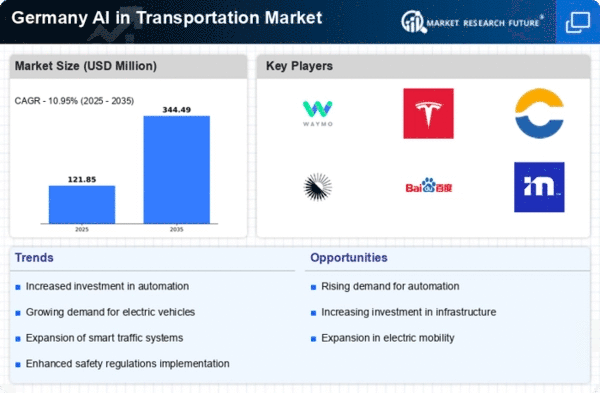
As per Market Research Future analysis, the Germany AI in Transportation Market size was estimated at 109.82 USD Million in 2024. The Ai In-transportation market is projected to grow from 121.85 USD Million in 2025 to 344.49 USD Million by 2035, exhibiting a compound annual growth rate (CAGR) of 10.9% during the forecast period 2025 - 2035

Key Market Trends & Highlights

The Germany AI in-transportation market is experiencing robust growth driven by technological advancements and increasing consumer acceptance.

  • The largest segment in the Germany AI in-transportation market is autonomous vehicles, which are witnessing increased adoption across urban areas.
  • Smart traffic management systems are emerging as the fastest-growing segment, enhancing efficiency and reducing congestion in cities.
  • Germany is recognized as the largest market for AI in transportation, while the fastest-growing region is expected to be Bavaria due to its technological hubs.
  • Key market drivers include government initiatives and funding aimed at promoting sustainable transportation solutions.

Market Size & Forecast

2024 Market Size 109.82 (USD Million)
2035 Market Size 344.49 (USD Million)
CAGR (2025 - 2035) 10.95%

Major Players

Waymo (US), Tesla (US), Cruise (US), Aurora (US), Baidu (CN), Mobileye (IL), Nuro (US), Zoox (US), Pony.ai (CN)

Our Impact
Enabled $4.3B Revenue Impact for Fortune 500 and Leading Multinationals
Partnering with 2000+ Global Organizations Each Year
30K+ Citations by Top-Tier Firms in the Industry

Germany AI in Transportation Market Trends

The Germany AI in Transportation Market is undergoing a transformative phase., driven by advancements in artificial intelligence technologies. In Germany, the integration of AI into transportation systems is reshaping logistics, public transit, and personal mobility. The government has been actively promoting smart transportation initiatives, which aim to enhance efficiency and reduce environmental impact. This push aligns with broader sustainability goals, as AI applications in traffic management and autonomous vehicles are expected to play a crucial role in achieving these objectives. Furthermore, the collaboration between tech companies and automotive manufacturers is fostering innovation, leading to the development of intelligent transport solutions that cater to the evolving needs of urban populations. In addition, the regulatory landscape is adapting to accommodate the rapid evolution of AI technologies in transportation. Authorities are focusing on creating frameworks that ensure safety and security while encouraging innovation. This environment is likely to attract investments and stimulate research and development in the sector. As the ai in-transportation market continues to evolve, it appears poised to significantly influence the future of mobility in Germany, potentially setting benchmarks for other regions to follow. The emphasis on smart infrastructure and data-driven decision-making suggests a promising trajectory for the market, with opportunities for growth and enhanced user experiences.

Increased Adoption of Autonomous Vehicles

The AI in Transportation Market is seeing a notable rise in the adoption of autonomous vehicles.. This trend is driven by advancements in AI technologies that enhance vehicle safety and navigation. As manufacturers invest in research and development, the deployment of self-driving cars is becoming more feasible, potentially transforming personal and commercial transportation.

Smart Traffic Management Systems

There is a growing emphasis on the implementation of smart traffic management systems within the ai in-transportation market. These systems utilize AI algorithms to optimize traffic flow, reduce congestion, and improve overall road safety. By analyzing real-time data, cities can make informed decisions that enhance the efficiency of transportation networks.

Integration of AI in Public Transportation

Integrating AI technologies in public transportation is a key trend.. AI applications are being utilized to improve scheduling, enhance passenger experience, and streamline operations. This shift not only aims to make public transport more efficient but also encourages greater usage among commuters, contributing to sustainable urban mobility.

Germany AI in Transportation Market Drivers

Technological Advancements in AI

Technological advancements in AI are a crucial driver for the ai in-transportation market in Germany. Innovations in machine learning, data analytics, and sensor technologies are enabling the development of smarter transportation systems. For example, AI algorithms are increasingly used to analyze traffic patterns, predict congestion, and enhance route optimization. This not only improves the efficiency of transportation networks but also enhances user experience. The integration of AI technologies is expected to increase operational efficiency by up to 30% in various transportation sectors, thereby propelling the growth of the ai in-transportation market. As these technologies continue to evolve, their application in transportation will likely expand.

Government Initiatives and Funding

The German government actively promotes the development of the ai in-transportation market through various initiatives and funding programs. In recent years, substantial investments have been allocated to research and development in artificial intelligence technologies, particularly in transportation. For instance, the Federal Ministry for Economic Affairs and Energy has earmarked over €300 million for projects aimed at enhancing mobility through AI. This financial support not only encourages innovation but also fosters collaboration between public and private sectors. As a result, the AI in Transportation Market will experience accelerated growth., with new technologies being developed to improve efficiency and safety in transportation systems.

Urbanization and Population Growth

Urbanization and population growth in Germany are driving the demand for innovative transportation solutions, thereby impacting the ai in-transportation market. As cities expand and populations increase, the need for efficient and effective transportation systems becomes more pressing. The urban population in Germany is projected to reach 80% by 2030, leading to heightened traffic congestion and increased demand for public transport. AI technologies can play a pivotal role in addressing these challenges by optimizing traffic flow and enhancing public transportation systems. This trend suggests that the ai in-transportation market will likely see a surge in demand for AI-driven solutions that cater to urban mobility needs.

Consumer Acceptance of AI Technologies

Consumer acceptance of AI technologies is a vital factor influencing the ai in-transportation market in Germany. As individuals become more familiar with AI applications in their daily lives, their willingness to adopt AI-driven transportation solutions increases. Surveys indicate that approximately 65% of Germans are open to using autonomous vehicles, reflecting a growing trust in AI technologies. This acceptance is crucial for the successful implementation of AI in transportation systems, as it encourages investment and development in the sector. The positive consumer sentiment towards AI is likely to foster a more robust market environment, facilitating the growth of the ai in-transportation market.

Rising Demand for Sustainable Transportation Solutions

There is a growing emphasis on sustainability within the transportation sector in Germany, which significantly impacts the ai in-transportation market. With increasing awareness of climate change and environmental issues, consumers and businesses are seeking greener alternatives. The German government has set ambitious targets to reduce greenhouse gas emissions by 55% by 2030, which necessitates the adoption of AI-driven solutions that optimize fuel efficiency and reduce emissions. This shift towards sustainable practices is likely to drive innovation in the ai in-transportation market, as companies develop technologies that align with these environmental goals, potentially leading to a market growth rate of 20% annually.


Market Segment Insights

By Offering: Software (Largest) vs. Hardware (Fastest-Growing)

In the Germany ai in-transportation market, offering distribution reveals software as the largest segment, commanding a significant market share. Hardware follows closely, showcasing a growing importance as technologies advance. Services, while valuable, account for a smaller slice of the offering landscape. This distribution reflects the rising reliance on intelligent software solutions and integrated systems that enhance operational efficiency. Growth trends indicate a robust expansion within the hardware sector, driven by advancements in AI-driven components and IoT technologies. Increasing investments in smart infrastructure and autonomous vehicle systems are propelling the demand for enhanced hardware solutions. Meanwhile, software continues to thrive, fueled by the need for sophisticated data analytics and machine learning applications that optimize transportation processes across various platforms.

Software (Dominant) vs. Hardware (Emerging)

The software segment stands out as the dominant force in the Germany ai in-transportation market, reflecting a shift towards advanced digital solutions that improve logistics and operational efficiency. Its maturity is marked by a range of innovative applications, from route optimization to predictive maintenance. In contrast, hardware is emerging as a pivotal component in this landscape, with increasing demands for AI-equipped devices that enhance transportation capabilities. The trend towards automation and smarter hardware is driven by the necessity for seamless integration with existing software solutions, thus forging a symbiotic relationship between software and hardware that is critical for future growth.

By IoT Communication Technology: Cellular (Largest) vs. LPWAN (Fastest-Growing)

In the Germany ai in-transportation market, the IoT communication technology segment is seeing a diverse distribution among various technologies. Cellular technology dominates with the largest market share, supported by extensive infrastructure and the widespread adoption of smartphones and connected devices. LPWAN, while not leading in market share, is rapidly gaining traction due to its low power consumption and ability to connect a large number of devices over long ranges. Growth trends in this segment are propelled by the increasing demand for connectivity in transportation systems, the rise of smart transportation solutions, and the push towards efficient logistics operations. LPWAN is becoming a cornerstone technology for IoT applications in transportation, leveraging emerging needs for real-time data collection and monitoring. Innovations within Cellular technology also continue to enhance its appeal, ensuring its position remains robust even as new players emerge.

Cellular (Dominant) vs. LPWAN (Emerging)

Cellular communication stands as the dominant technology in the Germany ai in-transportation market, characterized by its reliability and high data transmission rates. It is primarily utilized for real-time tracking, management of fleet operations, and providing seamless connectivity for smart vehicles. The infrastructure supporting Cellular technology is well-established, making it the preferred choice for many businesses. In contrast, LPWAN is an emerging player that offers unique advantages such as extended battery life and the capability to connect numerous devices in remote areas. This makes LPWAN particularly beneficial for applications requiring long-range connectivity without frequent battery replacements, such as in tracking and monitoring isolated assets. As these technologies evolve, their adoption is likely to shape the future landscape of transportation.

By Application: Predictive Maintenance (Largest) vs. Autonomous Truck (Fastest-Growing)

The Germany ai in-transportation market exhibits diverse applications with a significant share contributed by Predictive Maintenance, which leads the segment due to its increasing adoption in fleet management. Autonomous Truck applications are also gaining traction, representing a groundbreaking shift in logistics and transportation. The market distribution reflects a growing interest in enhancing efficiency and reducing downtime across various segments, thus showcasing the pivotal role these applications play in the current landscape. Growth trends indicate that the demand for Autonomous Trucks is accelerating, driven by technological advancements and increasing investments in automation. The shift towards semi-autonomous and fully autonomous solutions signifies a paradigm shift in traditional transportation methods, while Predictive Maintenance continues to leverage data analytics for optimizing vehicle performance. The drive toward sustainability and operational efficiency fuels the expansion of these applications, showing a robust future outlook across the sector.

Predictive Maintenance (Dominant) vs. Autonomous Truck (Emerging)

Predictive Maintenance stands out as a dominant application within the Germany ai in-transportation market, recognized for its ability to foresee and mitigate potential vehicle failures through real-time data analytics. This application ensures efficient fleet operations by minimizing unplanned downtime and optimizing maintenance schedules. In contrast, the Autonomous Truck segment, although still emerging, is rapidly evolving with breakthroughs in AI and machine learning. This application is poised to transform logistics and freight transportation, enhancing safety and efficiency. The interplay between these two segments highlights a unique blend of reliability through Predictive Maintenance and innovative progress with Autonomous Trucks, illustrating a pivotal transition in the market that prioritizes both operational excellence and modern technological integration.

By Machine Learning Technology: Deep Learning (Largest) vs. Natural Language Processing (Fastest-Growing)

In the Germany ai in-transportation market, the market share distribution among Machine Learning technologies showcases Deep Learning as a dominant player, commanding a significant share due to its extensive applications in various transportation solutions. In contrast, Natural Language Processing, while currently smaller, is rapidly gaining traction, especially in areas such as intelligent customer interactions and automated service platforms, indicating a dynamic shift in technology adoption. Growth trends are primarily driven by advancements in AI capabilities and an increasing reliance on data-driven decision-making in the transportation sector. The rise in connected vehicles and smart transportation systems fuels the demand for these technologies, making them integral to enhancing efficiency and user experience. Additionally, regulatory support for AI integration further accelerates the growth pace, particularly for Natural Language Processing which is positioned to reshape communication and logistics.

Deep Learning (Dominant) vs. Natural Language Processing (Emerging)

Deep Learning stands as the dominant force in the Machine Learning segment within the Germany ai in-transportation market, leveraging its ability to analyze vast datasets for pattern recognition, making it invaluable for predictive maintenance and autonomous systems. In comparison, Natural Language Processing is emerging rapidly, focusing on improving human-computer interactions. Its applications in voice recognition and translation services present significant growth opportunities as the transportation industry seeks to enhance customer service through AI-driven solutions. The collaboration between Deep Learning and Natural Language Processing promises to innovate transportation operations, reflecting a trend toward more intuitive and responsive AI systems.

Get more detailed insights about Germany AI in Transportation Market

Key Players and Competitive Insights

The ai in-transportation market is currently characterized by a dynamic competitive landscape, driven by rapid technological advancements and increasing demand for autonomous solutions. Key players such as Waymo (US), Tesla (US), and Mobileye (IL) are at the forefront, each adopting distinct strategies to enhance their market positioning. Waymo (US) focuses on extensive testing and partnerships with local municipalities to refine its autonomous driving technology, while Tesla (US) emphasizes vertical integration and software development to enhance its vehicle capabilities. Mobileye (IL), on the other hand, leverages its expertise in computer vision and AI to provide advanced driver-assistance systems, thereby shaping a competitive environment that is increasingly reliant on innovation and strategic collaborations.The business tactics employed by these companies reflect a concerted effort to optimize operations and enhance market presence. Localizing manufacturing and supply chain optimization are prevalent strategies, particularly as companies seek to mitigate risks associated with global supply chain disruptions. The market structure appears moderately fragmented, with several players vying for dominance, yet the collective influence of major companies like Waymo (US) and Tesla (US) suggests a trend towards consolidation as they seek to establish a more robust foothold in the market.

In October Waymo (US) announced a significant partnership with a leading German automotive manufacturer to develop next-generation autonomous vehicles tailored for urban environments. This collaboration is poised to enhance Waymo's technological capabilities while providing the partner with access to cutting-edge AI solutions, thereby reinforcing their competitive edge in the European market. The strategic importance of this partnership lies in its potential to accelerate the deployment of autonomous vehicles in densely populated areas, addressing urban mobility challenges.

In September Tesla (US) unveiled its latest AI-driven software update, which includes advanced features for its fleet of electric vehicles. This update not only enhances the driving experience but also positions Tesla as a leader in integrating AI with electric mobility. The strategic significance of this development is underscored by Tesla's commitment to continuous innovation, which is likely to attract a broader customer base and solidify its market leadership.

In August Mobileye (IL) expanded its operations in Germany by launching a new research and development center focused on AI technologies for transportation. This move is indicative of Mobileye's strategy to deepen its engagement in the European market, allowing for localized innovation and faster response to regional demands. The establishment of this center is strategically important as it aligns with the growing emphasis on AI integration in transportation solutions, potentially enhancing Mobileye's competitive positioning.

As of November current trends in the ai in-transportation market are heavily influenced by digitalization, sustainability, and the integration of AI technologies. Strategic alliances are increasingly shaping the competitive landscape, as companies recognize the value of collaboration in driving innovation. Looking ahead, it is anticipated that competitive differentiation will evolve, shifting from traditional price-based competition to a focus on technological innovation, supply chain reliability, and the ability to deliver sustainable solutions. This transition underscores the importance of agility and adaptability in a rapidly changing market.

Key Companies in the Germany AI in Transportation Market include

Industry Developments

October 2023: Pilot Launch of Hamburg Autonomous Shuttle

Including Hochbahn, Volkswagen Commercial Vehicles, MOIA, Holon, and KIT, the Project Premier partnership started a three-year trial of up to 20 self-driving, app-bookable shuttles that would travel across Hamburg's Elbe and Alster waterways.

February 2024: Ioki GmbH and a tele-driving start-up partner for remote on-demand services Vay stated that it will work with ioki's ride-pooling platform and Vay's tele-operation technology to provide Germany's first remotely operated, on-demand public transport service.

June 2024: Integration of ChatGPT & Volkswagen AI Lab

In order to improve speech-driven infotainment and vehicle-to-customer interaction, Volkswagen set up a worldwide networked AI competence centre and introduced ChatGPT-powered IDA voice assistants—built on Cerence Chat Pro—in models including the ID.3, ID.4, ID.5, ID.7, Tiguan, Passat, and Golf.

May 2025: Hannover Messe Unveils the MAN TruckScenes Dataset

MAN introduced their TruckScenes sensor dataset for hub-to-hub freight transport scenarios in collaboration with the Technical University of Munich. This dataset supports the development of autonomous trucks by providing real-world driving data on German highways, feeder routes and terminals.

Future Outlook

Germany AI in Transportation Market Future Outlook

The AI in Transportation Market is projected to grow at a 10.95% CAGR from 2025 to 2035., driven by advancements in automation, data analytics, and sustainability initiatives.

New opportunities lie in:

  • Development of AI-driven predictive maintenance solutions for fleet management.
  • Integration of autonomous delivery systems in urban logistics.
  • Creation of AI-based traffic management platforms for smart cities.

By 2035, the market is expected to achieve substantial growth, driven by innovative technologies and strategic investments.

Market Segmentation

Germany AI in Transportation Market Offering Outlook

  • Hardware
  • Services
  • Software

Germany AI in Transportation Market Application Outlook

  • Autonomous Truck
  • Semi-autonomous Truck
  • Truck Platooning
  • Human-Machine Interface (HMI)
  • Predictive Maintenance
  • Precision & Mapping
  • Traffic Detection
  • Computer Vision-Powered Parking Management
  • Road Condition Monitoring
  • Automatic Traffic Incident Detection
  • Driver Monitoring
  • Others

Germany AI in Transportation Market Machine Learning Technology Outlook

  • Deep Learning
  • Computer Vision
  • Natural Language Processing
  • Context Awareness

Germany AI in Transportation Market IoT Communication Technology Outlook

  • Cellular
  • LPWAN
  • LoRaWAN
  • Z-Wave
  • Zigbee
  • NFC
  • Bluetooth
  • Others

Report Scope

MARKET SIZE 2024 109.82(USD Million)
MARKET SIZE 2025 121.85(USD Million)
MARKET SIZE 2035 344.49(USD Million)
COMPOUND ANNUAL GROWTH RATE (CAGR) 10.95% (2025 - 2035)
REPORT COVERAGE Revenue Forecast, Competitive Landscape, Growth Factors, and Trends
BASE YEAR 2024
Market Forecast Period 2025 - 2035
Historical Data 2019 - 2024
Market Forecast Units USD Million
Key Companies Profiled Waymo (US), Tesla (US), Cruise (US), Aurora (US), Baidu (CN), Mobileye (IL), Nuro (US), Zoox (US), Pony.ai (CN)
Segments Covered Offering, IoT Communication Technology, Application, Machine Learning Technology
Key Market Opportunities Integration of autonomous vehicle technology with smart city infrastructure enhances efficiency in the ai in-transportation market.
Key Market Dynamics Growing regulatory emphasis on emissions reduction drives innovation in AI transportation solutions.
Countries Covered Germany
Leave a Comment

FAQs

What is the expected market size of the Germany AI in Transportation Market in 2024?

The market is expected to be valued at 165.0 million USD in 2024.

What will be the market value of the Germany AI in Transportation Market in 2035?

By 2035, the market is projected to reach a value of 877.0 million USD.

What is the expected CAGR for the Germany AI in Transportation Market from 2025 to 2035?

The expected CAGR for the market during this period is 16.401%.

What is the market size for hardware offerings in the Germany AI in Transportation Market in 2024?

Hardware offerings are valued at 50.0 million USD in 2024.

What will be the market size for services in the Germany AI in Transportation Market by 2035?

Services are projected to be valued at 392.0 million USD by 2035.

Which key players are operating in the Germany AI in Transportation Market?

Major players include SAP SE, Bosch GmbH, BMW AG, and Volkswagen AG.

How much will software offerings in the Germany AI in Transportation Market grow by 2035?

Software offerings are expected to grow to 221.0 million USD by 2035.

What market growth rate should we expect for the Germany AI in Transportation Market during the forecast period?

The market is expected to grow at a rate of 16.401% from 2025 to 2035.

What is the anticipated market value of hardware offerings in the Germany AI in Transportation Market by 2035?

Hardware offerings are projected to increase to 264.0 million USD by 2035.

What challenges and opportunities exist in the Germany AI in Transportation Market?

Key challenges include integration complexities, while opportunities lie in smart transportation solutions.

Download Free Sample

Kindly complete the form below to receive a free sample of this Report

Compare Licence

×
Features License Type
Single User Multiuser License Enterprise User
Price $4,950 $5,950 $7,250
Maximum User Access Limit 1 User Upto 10 Users Unrestricted Access Throughout the Organization
Free Customization
Direct Access to Analyst
Deliverable Format
Platform Access
Discount on Next Purchase 10% 15% 15%
Printable Versions