×
Request Free Sample ×

Kindly complete the form below to receive a free sample of this Report

* Please use a valid business email

Leading companies partner with us for data-driven Insights

clients tt-cursor
Hero Background

Germany 5G IoT Market

ID: MRFR/ICT/56779-HCR
200 Pages
Aarti Dhapte
February 2026

Germany 5G IoT Market Size, Share and Trends Analysis Report By Service (Enhanced Mobile Broadband, Ultra-Reliable Low Latency Communications, Massive Machine Type Communications), By Technology (5G New Radio Standalone Architecture, 5G New Radio Non-Standalone Architecture), By Type (Short-Range IoT Devices, Wide-Range IoT Devices) and By Vertical (Consumer Electronics, Automotive, Railway, Mining, Utilities, Healthcare, Agriculture, Manufacturing)-Forecast to 2035

Share:
Download PDF ×

We do not share your information with anyone. However, we may send you emails based on your report interest from time to time. You may contact us at any time to opt-out.

Germany 5G IoT Market Infographic
Purchase Options

Germany 5G IoT Market Summary

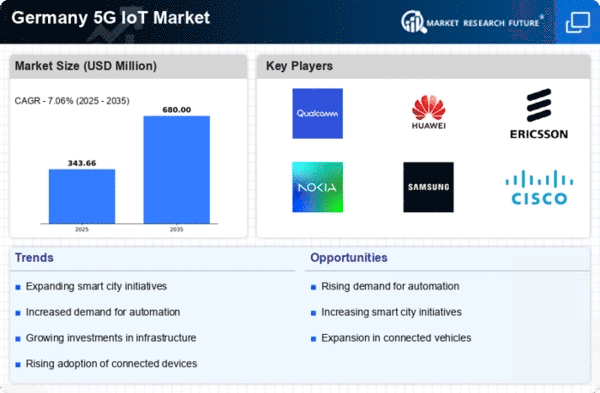
As per Market Research Future analysis, the Germany 5G IoT Market Size was estimated at 321.0 USD Million in 2024. The Germany 5G IoT Market is projected to grow from 343.66 USD Million in 2025 to 680.0 USD Million by 2035, exhibiting a compound annual growth rate (CAGR) of 7.0% during the forecast period 2025 - 2035

Key Market Trends & Highlights

The Germany 5G IoT Market is poised for substantial growth driven by technological advancements and increasing demand across various sectors.

  • The largest segment in the Germany 5G IoT Market is smart manufacturing, which is experiencing increased adoption due to efficiency needs.
  • Smart city initiatives are rapidly expanding, indicating a shift towards urban digitalization and improved infrastructure.
  • Healthcare solutions are benefiting from enhanced connectivity, facilitating better patient care and data management.
  • Key market drivers include rising demand for smart agriculture solutions and government initiatives supporting digital transformation.

Market Size & Forecast

2024 Market Size 321.0 (USD Million)
2035 Market Size 680.0 (USD Million)
CAGR (2025 - 2035) 7.06%

Major Players

Qualcomm (US), Huawei (CN), Ericsson (SE), Nokia (FI), Samsung (KR), Cisco (US), Intel (US), ZTE (CN)

Our Impact
Enabled $4.3B Revenue Impact for Fortune 500 and Leading Multinationals
Partnering with 2000+ Global Organizations Each Year
30K+ Citations by Top-Tier Firms in the Industry

Germany 5G IoT Market Trends

The 5G IoT Market is currently experiencing a transformative phase, driven by advancements in connectivity and the increasing demand for smart devices. In Germany, the integration of 5g technology into various sectors is becoming more pronounced, as industries seek to enhance operational efficiency and improve data transmission speeds. The government has been proactive in establishing a robust infrastructure to support this evolution, which is likely to foster innovation and attract investments. Furthermore, the growing emphasis on sustainability and energy efficiency is influencing the development of IoT solutions, aligning with Germany's commitment to environmental goals. As of November 2025, the landscape of the 5g iot market appears to be characterized by a surge in applications across sectors such as manufacturing, healthcare, and transportation. Companies are increasingly leveraging IoT devices to gather real-time data, enabling better decision-making and streamlined processes. The collaboration between public and private sectors is also noteworthy, as it facilitates the deployment of smart city initiatives and enhances connectivity in urban areas. Overall, the 5g iot market is poised for substantial growth, driven by technological advancements and a supportive regulatory environment.

Increased Adoption of Smart Manufacturing

The 5g iot market is witnessing a notable shift towards smart manufacturing practices. Companies are integrating IoT devices to optimize production processes, enhance supply chain management, and improve overall efficiency. This trend is supported by the German government's initiatives to promote Industry 4.0, which emphasizes automation and data exchange in manufacturing environments.

Expansion of Smart City Initiatives

There is a growing focus on smart city projects within the 5g iot market. Urban areas are increasingly adopting IoT solutions to improve infrastructure, enhance public services, and promote sustainability. This trend aligns with Germany's vision for smart cities, where technology plays a crucial role in addressing urban challenges and improving the quality of life for residents.

Enhanced Connectivity for Healthcare Solutions

The healthcare sector is experiencing a transformation through the integration of IoT devices, facilitated by advancements in 5g technology. The 5g iot market is enabling remote patient monitoring, telemedicine, and efficient data management. This trend is particularly relevant in Germany, where the healthcare system is increasingly leveraging technology to improve patient outcomes and streamline operations.

Germany 5G IoT Market Drivers

Increased Focus on Energy Efficiency

Energy efficiency is becoming a critical concern in Germany, driving the growth of the 5G IoT Market. Businesses and consumers alike are seeking solutions to reduce energy consumption and minimize environmental impact. The integration of IoT devices with 5G technology enables real-time monitoring and management of energy usage, leading to smarter energy solutions. For instance, smart meters and connected appliances can optimize energy consumption patterns, potentially reducing costs by up to 20%. This focus on sustainability aligns with Germany's commitment to achieving its climate goals, further propelling the 5g iot market. As energy efficiency becomes a priority, the demand for innovative IoT solutions is likely to increase, fostering market expansion.

Advancements in Automotive Connectivity

The automotive sector in Germany is undergoing a transformation, with advancements in connectivity significantly influencing the 5G IoT Market. The rise of connected vehicles and autonomous driving technologies necessitates robust and reliable communication networks. 5G technology offers the low latency and high bandwidth required for real-time data exchange between vehicles and infrastructure. As a result, the automotive industry is projected to invest over €30 billion in connected vehicle technologies by 2027. This investment is expected to drive the adoption of IoT solutions, enhancing safety, efficiency, and user experience. The interplay between automotive innovation and the 5g iot market suggests a dynamic growth trajectory, as both sectors evolve in tandem.

Growing Interest in Smart Home Technologies

The trend towards smart home technologies is gaining momentum in Germany, significantly impacting the 5G IoT Market. Consumers are increasingly interested in IoT-enabled devices that enhance convenience, security, and energy management within their homes. The market for smart home devices is expected to reach €5 billion by 2026, driven by the proliferation of 5G networks that enable seamless connectivity. Smart thermostats, security cameras, and lighting systems are becoming commonplace, allowing homeowners to control their environments remotely. This growing interest indicates a shift in consumer behavior towards adopting advanced technologies, which is likely to further stimulate the 5g iot market. As smart home solutions become more integrated, the demand for reliable and fast connectivity will continue to rise.

Rising Demand for Smart Agriculture Solutions

The 5G IoT Market in Germany is experiencing a notable surge in demand for smart agriculture solutions. Farmers are increasingly adopting IoT devices to monitor crop health, soil conditions, and weather patterns in real-time. This trend is driven by the need for enhanced productivity and sustainability in agriculture. According to recent data, the agricultural sector in Germany is projected to grow by approximately 5.5% annually, with IoT applications playing a crucial role. The integration of 5G technology allows for faster data transmission and improved connectivity, enabling farmers to make informed decisions quickly. As a result, the 5g iot market is likely to expand significantly, providing innovative solutions that enhance operational efficiency and resource management in agriculture.

Government Initiatives Supporting Digital Transformation

The German government is actively promoting digital transformation across various sectors, which is significantly impacting the 5G IoT Market. Initiatives such as the Digital Strategy 2025 aim to enhance the country's digital infrastructure, including the rollout of 5G networks. This strategic focus is expected to facilitate the adoption of IoT technologies in industries such as manufacturing, logistics, and healthcare. With an investment of over €10 billion in digital infrastructure, the government is creating an environment conducive to innovation. Consequently, the 5g iot market is poised for growth as businesses leverage these advancements to improve efficiency and competitiveness. The alignment of public policy with technological advancements suggests a robust future for the 5g iot market in Germany.

Market Segment Insights

By Service: Ultra-Reliable Low Latency Communications (URLLC) (Largest) vs. Enhanced Mobile Broadband (EMBB) (Fastest-Growing)

In the Germany 5G IoT Market, Ultra-Reliable Low Latency Communications (URLLC) leads the service segment, capturing a significant share due to its critical applications in industries such as automotive and healthcare. Enhanced Mobile Broadband (EMBB) follows closely, while Massive Machine Type Communications (MMTC) holds a smaller yet notable share, primarily catering to large-scale IoT deployments that require high connectivity. The growth trends in this segment are driven by increasing demand for real-time, reliable communications essential for autonomous systems and smart industrial applications. EMBB, recognized for its rapid deployment in consumer services, is experiencing faster growth driven by the proliferation of smart devices. In contrast, URLLC maintains a strong position, emphasizing reliability to support mission-critical applications in several sectors.

URLLC (Dominant) vs. MMTC (Emerging)

Ultra-Reliable Low Latency Communications (URLLC) is characterized by its ability to deliver consistent, low-latency connections, making it vital for applications requiring real-time communications and high reliability, such as autonomous driving and remote healthcare. Its dominance in the Germany 5g iot market is supported by substantial investments in infrastructure and technology development. On the other hand, Massive Machine Type Communications (MMTC) serves as an emerging segment, focusing on connecting a massive number of devices with less stringent latency requirements. As industries move towards automation and smart solutions, MMTC is gaining traction, increasingly appealing to businesses looking to enhance operational efficiencies through connected devices.

By Technology: 5G New Radio (NR) Standalone Architecture (Largest) vs. 5G New Radio (NR) Non-Standalone Architecture (Fastest-Growing)

In the Germany 5G IoT Market, the segment of 5G New Radio (NR) Standalone Architecture holds a larger share compared to its counterpart, indicating a strong preference among users for a fully-fledged 5G infrastructure that operates independently. This architecture supports advanced applications and delivers enhanced performance, setting a solid foundation for IoT growth. Meanwhile, the 5G New Radio (NR) Non-Standalone Architecture has emerged as a rapidly growing segment, catering to existing 4G networks while integrating 5G capabilities. It is particularly appealing for operators seeking a cost-effective transition to 5G, thus gaining traction in the market. The growth of these segments is driven by various factors, including the increasing demand for faster data speeds, lower latency, and the need for advanced connectivity solutions in multiple industries. The standalone architecture benefits from ongoing investments in network upgrades and is essential for applications like smart cities and industrial automation. Conversely, the non-standalone architecture is growing swiftly due to the immediate benefits it provides to telecommunications operators, allowing them to leverage existing infrastructure while gradually shifting to full 5G capabilities, making it a practical choice in the current transition phase to 5G.

Technology: 5G NR Standalone Architecture (Dominant) vs. 5G NR Non-Standalone Architecture (Emerging)

The 5G New Radio (NR) Standalone Architecture is recognized as the dominant segment within the Germany 5g iot market due to its comprehensive support for true 5G features, including ultra-reliable low latency communication and massive machine-type communication. It caters to advanced industrial, automotive, and urban applications, providing the bandwidth and reliability necessary for extensive IoT deployments. In contrast, the 5G New Radio (NR) Non-Standalone Architecture is emerging as a viable alternative, allowing operators to enhance services promptly by utilizing existing 4G LTE infrastructure while integrating 5G. This hybrid approach helps bridge the gap towards full 5G capabilities, making it particularly appealing for service providers looking to quickly meet customer demands without significant infrastructure overhaul.

By Type: Enhanced Short-Range IoT Devices (Largest) vs. Wide-Range IoT Devices (Fastest-Growing)

In the Germany 5G IoT Market, Enhanced Short-Range IoT Devices dominate the segment with significant market share. Their robust capabilities and widespread adoption across various industries have solidified their leading status. Meanwhile, Wide-Range IoT Devices, while currently representing a smaller slice of the market, showcase promising growth potential due to the demand for connectivity over larger distances. The growth trends in the Germany 5g iot market reflect a rising interest in both types of devices. Enhanced Short-Range IoT Devices benefit from advancements in technology and increasing automation in sectors such as manufacturing and logistics. Conversely, Wide-Range IoT Devices are driven by the need for efficient remote monitoring and control systems, making them attractive for applications in agriculture and smart cities.

Technology: Enhanced Short-Range IoT Devices (Dominant) vs. Wide-Range IoT Devices (Emerging)

Enhanced Short-Range IoT Devices are characterized by their efficiency and high-performance capabilities, playing a crucial role in applications requiring precise data transfer over limited areas. Their dominance stems from established use cases in industries that necessitate low latency and high reliability. In contrast, Wide-Range IoT Devices are emerging as a flexible solution for various applications, particularly in rural areas where connectivity needs are evolving. The demand for these devices is anticipated to grow as businesses seek to implement more comprehensive IoT solutions that span vast geographical areas.

By Vertical: Consumer Electronics (Largest) vs. Automotive (Fastest-Growing)

In the Germany 5G IoT Market, the segment distribution showcases Consumer Electronics as the largest value contributor. This segment capitalizes on the rising demand for connected devices and smart home technologies. Following closely is the Automotive sector, which is rapidly gaining traction due to advances in connected vehicle technologies and increased investments in smart mobility solutions. Growth trends indicate that while Consumer Electronics remains dominant, the Automotive sector is expected to outperform others in the coming years, fueled by the integration of autonomous driving technologies and increased consumer interest in electric vehicles. Additionally, segments like Healthcare and Utilities are witnessing increased attention as they leverage IoT for enhanced operational efficiency and improved service delivery, further diversifying market opportunities.

Consumer Electronics: Dominant vs. Automotive: Emerging

Consumer Electronics holds a dominant position in the Germany 5g iot market, driven by the proliferation of smart devices and the growing focus on home automation solutions. This segment benefits from consumer trends toward high-tech gadgets that enhance lifestyle convenience. In contrast, the Automotive sector, labeled as emerging, is experiencing rapid growth influenced by the shift towards electric and connected vehicles. This range includes advancements in vehicle-to-everything (V2X) communication and smart transportation systems. Both segments are positioned strategically within the market, catering to diverse consumer preferences and technological advancements that are shaping the future landscape of IoT applications.

Get more detailed insights about Germany 5G IoT Market

Key Players and Competitive Insights

The competitive dynamics within the 5g iot market in Germany are characterized by rapid technological advancements and a robust push towards digital transformation. Key growth drivers include the increasing demand for high-speed connectivity, the proliferation of smart devices, and the need for enhanced data analytics capabilities. Major players such as Qualcomm (US), Ericsson (SE), and Nokia (FI) are strategically positioned to leverage these trends. Qualcomm (US) focuses on innovation in semiconductor technology, which is crucial for 5g applications, while Ericsson (SE) emphasizes partnerships with local telecom operators to enhance network infrastructure. Nokia (FI) is actively pursuing regional expansion through collaborations with various industries, thereby shaping a competitive environment that is increasingly collaborative and innovation-driven.
In terms of business tactics, companies are localizing manufacturing and optimizing supply chains to enhance operational efficiency. The market structure appears moderately fragmented, with several key players exerting influence over specific segments. This fragmentation allows for niche players to emerge, while the collective strength of major companies fosters a competitive landscape that encourages innovation and rapid deployment of 5g solutions.
In October 2025, Qualcomm (US) announced a strategic partnership with a leading German automotive manufacturer to develop advanced 5g-enabled vehicle-to-everything (V2X) communication systems. This collaboration is significant as it positions Qualcomm at the forefront of the automotive industry's shift towards connected vehicles, potentially enhancing road safety and traffic management through real-time data exchange.
In September 2025, Ericsson (SE) launched a new 5g network slicing solution tailored for industrial applications, specifically targeting the manufacturing sector in Germany. This initiative is crucial as it allows manufacturers to create dedicated network slices for specific applications, thereby optimizing performance and reliability. Such advancements could lead to increased operational efficiency and reduced downtime in manufacturing processes.
In August 2025, Nokia (FI) secured a contract with a major German telecommunications provider to deploy a nationwide 5g network. This strategic move is indicative of Nokia's commitment to expanding its footprint in the German market, enhancing connectivity for both urban and rural areas. The deployment is expected to facilitate the growth of IoT applications across various sectors, including healthcare and smart cities.
As of November 2025, current competitive trends in the 5g iot market are heavily influenced by digitalization, sustainability, and the integration of artificial intelligence (AI). Strategic alliances among key players are shaping the landscape, fostering innovation and collaborative solutions. The shift from price-based competition to a focus on technological advancement and supply chain reliability is evident. Companies are likely to differentiate themselves through innovative offerings and sustainable practices, positioning themselves for long-term success in an increasingly interconnected world.

Key Companies in the Germany 5G IoT Market include

Industry Developments

Major telecommunications companies such as Deutsche Telekom and Vodafone are aggressively expanding their 5G infrastructure, with Deutsche Telekom announcing its intent to cover over 90 percent of the population by 2025.

Concurrently, collaborations have emerged between tech giants like Cisco and Siemens to enhance industrial IoT applications leveraging 5G capabilities, demonstrating a strong commitment to innovation in smart manufacturing and automation.

In terms of mergers and acquisitions, a notable deal took place in August 2023 when Qualcomm acquired technology assets from ZTE, aimed at bolstering its 5G solutions portfolio in Europe, particularly Germany. Additionally, growth in market valuation has been noteworthy, with Ericsson and Nokia assessing strategic alliances to optimize networks for IoT applications, indicating a robust market trajectory.

Looking back, significant events like the joint venture between Samsung and Airbus in March 2022 aimed at advancing satellite communications also reflect the dynamic nature of this market segment. With these collective advancements, Germany's 5G IoT market is poised for further expansion and innovation in the coming years.


Future Outlook

Germany 5G IoT Market Future Outlook

The 5G IoT market in Germany is poised for growth at 7.06% CAGR from 2025 to 2035, driven by advancements in connectivity, automation, and smart technologies.

New opportunities lie in:

  • Development of smart agriculture solutions leveraging IoT sensors and 5G connectivity.
  • Implementation of real-time asset tracking systems for logistics optimization.
  • Creation of advanced telemedicine platforms utilizing 5G for remote patient monitoring.

By 2035, the 5G IoT market is expected to be a cornerstone of Germany's digital economy.

Market Segmentation

Germany 5G IoT Market Type Outlook

  • Enhanced Short-Range IoT Devices
  • Wide-Range IoT Devices

Germany 5G IoT Market Service Outlook

  • Ultra-Reliable Low Latency Communications (URLLC)
  • Enhanced Mobile Broadband (EMBB)
  • Massive Machine Type Communications (MMTC)

Germany 5G IoT Market Vertical Outlook

  • Consumer Electronics
  • Automotive
  • Railway
  • Mining
  • Utilities
  • Healthcare
  • Agriculture
  • Manufacturing

Germany 5G IoT Market Technology Outlook

  • 5G New Radio (NR) Standalone Architecture
  • 5G New Radio (NR) Non-Standalone Architecture

Report Scope

MARKET SIZE 2024 321.0(USD Million)
MARKET SIZE 2025 343.66(USD Million)
MARKET SIZE 2035 680.0(USD Million)
COMPOUND ANNUAL GROWTH RATE (CAGR) 7.06% (2025 - 2035)
REPORT COVERAGE Revenue Forecast, Competitive Landscape, Growth Factors, and Trends
BASE YEAR 2024
Market Forecast Period 2025 - 2035
Historical Data 2019 - 2024
Market Forecast Units USD Million
Key Companies Profiled Qualcomm (US), Huawei (CN), Ericsson (SE), Nokia (FI), Samsung (KR), Cisco (US), Intel (US), ZTE (CN)
Segments Covered Service, Technology, Type, Vertical
Key Market Opportunities Expansion of smart city initiatives driving demand in the 5g iot market.
Key Market Dynamics Rising demand for smart city solutions drives innovation and competition in the 5G IoT market.
Countries Covered Germany
Leave a Comment

FAQs

What is the expected market size of the Germany 5G IoT Market in 2024?

The Germany 5G IoT Market is expected to be valued at 321.0 million USD in 2024.

What is the projected market size for the Germany 5G IoT Market by 2035?

By 2035, the Germany 5G IoT Market is expected to reach a value of 682.0 million USD.

What is the estimated CAGR for the Germany 5G IoT Market from 2025 to 2035?

The estimated CAGR for the Germany 5G IoT Market from 2025 to 2035 is 7.091 percent.

Which service segment is projected to be the largest in the Germany 5G IoT Market by 2035?

The Enhanced Mobile Broadband segment is projected to be the largest, valued at 270.0 million USD in 2035.

What are the expected market values for Ultra-Reliable Low Latency Communications in 2024 and 2035?

This segment is expected to be valued at 70.0 million USD in 2024 and 160.0 million USD in 2035.

What market value is predicted for Massive Machine Type Communications by 2035?

The Massive Machine Type Communications segment is predicted to have a market value of 252.0 million USD by 2035.

Who are the major players in the Germany 5G IoT Market?

Major players include Qualcomm, Cisco, Intel, ZTE, Vodafone, Nokia, Huawei, Siemens, Samsung, Deutsche Telekom, Airbus, Ericsson, Fujitsu, and IBM.

How are current trends impacting the Germany 5G IoT Market?

Current trends are driving growth through the adoption of advanced technologies and increasing connectivity demands.

What challenges does the Germany 5G IoT Market face currently?

Challenges include regulatory hurdles, cybersecurity concerns, and the need for infrastructure investment.

What opportunities exist within the Germany 5G IoT Market?

There are significant opportunities in smart city developments, industrial automation, and remote healthcare services.

Download Free Sample

Kindly complete the form below to receive a free sample of this Report

Compare Licence

×
Features License Type
Single User Multiuser License Enterprise User
Price $4,950 $5,950 $7,250
Maximum User Access Limit 1 User Upto 10 Users Unrestricted Access Throughout the Organization
Free Customization
Direct Access to Analyst
Deliverable Format
Platform Access
Discount on Next Purchase 10% 15% 15%
Printable Versions