×
Request Free Sample ×

Kindly complete the form below to receive a free sample of this Report

* Please use a valid business email

Leading companies partner with us for data-driven Insights

clients tt-cursor
Hero Background

Germany 4G Lte Market

ID: MRFR/ICT/56849-HCR
200 Pages
Aarti Dhapte
February 2026

Germany 4G LTE Market Size, Share and Trends Analysis Report By Device Type (Smartphone, Laptop, Tablets) and By Organization Size (SME, Large Enterprises)-Forecast to 2035

Share:
Download PDF ×

We do not share your information with anyone. However, we may send you emails based on your report interest from time to time. You may contact us at any time to opt-out.

Germany 4G Lte Market Infographic
Purchase Options

Germany 4G Lte Market Summary

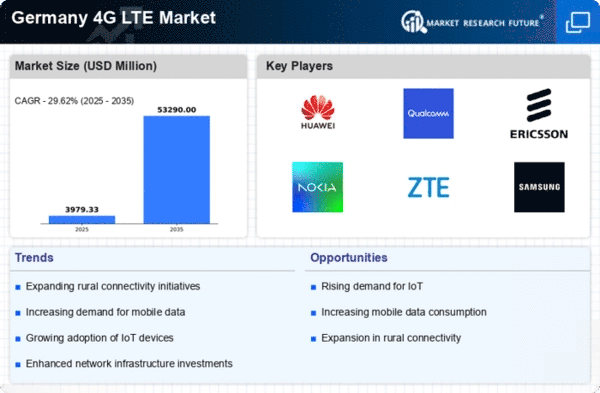
As per Market Research Future analysis, the Germany 4G Lte Market size was estimated at 3070.0 USD Million in 2024. The 4G LTE Market is projected to grow from 3979.33 USD Million in 2025 to 53290.0 USD Million by 2035, exhibiting a compound annual growth rate (CAGR) of 29.6% during the forecast period 2025 - 2035

Key Market Trends & Highlights

The Germany 4G LTE Market is experiencing robust growth driven by increasing mobile data demand and regulatory support.

  • The demand for mobile data services continues to rise, reflecting a shift towards mobile-first strategies.
  • Regulatory support for infrastructure development is enhancing network capabilities across the country.
  • The largest segment in the market is driven by rising smartphone penetration, while the fastest-growing segment is attributed to the expansion of IoT applications.
  • Key market drivers include government initiatives for digital infrastructure and the emergence of enhanced mobile services.

Market Size & Forecast

2024 Market Size 3070.0 (USD Million)
2035 Market Size 53290.0 (USD Million)
CAGR (2025 - 2035) 29.62%

Major Players

Huawei (CN), Qualcomm (US), Ericsson (SE), Nokia (FI), ZTE (CN), Samsung (KR), AT&T (US), Verizon (US), T-Mobile (DE), Vodafone (GB)

Our Impact
Enabled $4.3B Revenue Impact for Fortune 500 and Leading Multinationals
Partnering with 2000+ Global Organizations Each Year
30K+ Citations by Top-Tier Firms in the Industry

Germany 4G Lte Market Trends

The Germany 4G Lte Market in Germany is currently experiencing a dynamic phase characterized by rapid technological advancements and increasing consumer demand. The proliferation of smart devices and the growing reliance on mobile internet services have significantly influenced the landscape. As users seek faster and more reliable connectivity, service providers are compelled to enhance their infrastructure and expand coverage. This shift is further driven by the rising popularity of data-intensive applications, which necessitate robust network capabilities. Consequently, the competitive environment among telecom operators intensifies, leading to innovative service offerings and pricing strategies. Moreover, regulatory frameworks play a crucial role in shaping the 4g lte market. The German government has implemented policies aimed at promoting digital infrastructure development, which includes facilitating spectrum allocation and encouraging investment in network expansion. This regulatory support appears to foster a conducive environment for both established players and new entrants. As the market evolves, the focus on sustainability and energy efficiency in network operations is likely to gain prominence, reflecting broader societal trends. Overall, the 4g lte market in Germany is poised for continued growth, driven by technological innovation and supportive policies.

Increased Demand for Mobile Data Services

The demand for mobile data services in the 4g lte market is on the rise, driven by the proliferation of smart devices and data-intensive applications. Consumers are increasingly relying on mobile internet for various activities, including streaming, gaming, and remote work. This trend compels service providers to enhance their network capabilities to meet user expectations.

Regulatory Support for Infrastructure Development

Regulatory frameworks in Germany are actively promoting the development of digital infrastructure. Government initiatives focus on facilitating spectrum allocation and encouraging investments in network expansion. This support is likely to create a favorable environment for both existing operators and new market entrants.

Focus on Sustainability and Energy Efficiency

Sustainability is becoming a key consideration in the 4g lte market. Operators are increasingly prioritizing energy-efficient technologies and practices in their network operations. This shift not only aligns with global sustainability goals but also addresses rising operational costs, potentially enhancing long-term profitability.

Germany 4G Lte Market Drivers

Expansion of IoT Applications

The rapid expansion of Internet of Things (IoT) applications in Germany is significantly influencing the 4g lte market. As industries increasingly adopt IoT solutions for automation and data collection, the demand for reliable and high-speed mobile connectivity is expected to rise. By 2025, it is projected that the number of connected IoT devices in Germany will surpass 50 million, necessitating a robust 4g lte infrastructure to support these devices. This growth in IoT applications not only enhances operational efficiency across various sectors but also drives the need for advanced mobile networks. Consequently, telecommunications providers are likely to invest heavily in upgrading their 4g lte capabilities to accommodate the influx of IoT devices, thereby reinforcing the market's growth trajectory.

Rising Smartphone Penetration

The increasing penetration of smartphones in Germany is a pivotal driver for the 4g lte market. As of 2025, smartphone ownership in Germany is estimated to exceed 90%, leading to a surge in mobile data consumption. This trend indicates that consumers are increasingly reliant on mobile applications and services, which require robust data connectivity. Consequently, mobile network operators are compelled to enhance their 4g lte infrastructure to meet the growing demand for high-speed internet access. The proliferation of mobile devices is likely to stimulate competition among service providers, further driving investments in 4g lte technology. This competitive landscape may result in improved service offerings and pricing strategies, ultimately benefiting consumers and solidifying the 4g lte market's position in the telecommunications sector.

Emergence of Enhanced Mobile Services

The emergence of enhanced mobile services, such as mobile gaming and streaming, is significantly impacting the 4g lte market in Germany. As consumer preferences shift towards high-quality mobile experiences, the demand for faster and more reliable data connections is intensifying. By 2025, it is projected that mobile video consumption will account for over 60% of total mobile data traffic in Germany. This trend indicates that telecommunications providers must invest in their 4g lte networks to accommodate the increasing data demands. The introduction of new mobile services not only drives consumer engagement but also encourages service providers to innovate and enhance their offerings, thereby contributing to the overall growth of the 4g lte market.

Shift Towards Mobile-First Strategies

The shift towards mobile-first strategies among businesses in Germany is a notable driver of the 4g lte market. Companies are increasingly recognizing the importance of mobile platforms for customer engagement and service delivery. As of 2025, it is estimated that over 70% of online transactions in Germany will occur via mobile devices, underscoring the necessity for reliable mobile connectivity. This trend compels businesses to invest in mobile applications and services, which in turn drives demand for enhanced 4g lte capabilities. Telecommunications providers are likely to respond by expanding their network infrastructure and improving service offerings, thereby fostering a more competitive environment in the 4g lte market.

Government Initiatives for Digital Infrastructure

Government initiatives aimed at enhancing digital infrastructure in Germany are playing a crucial role in the development of the 4g lte market. The German government has committed to investing approximately €10 billion in digital infrastructure projects by 2025, focusing on expanding 4g lte coverage in rural and underserved areas. This investment is expected to bridge the digital divide, ensuring that all citizens have access to high-speed mobile internet. Furthermore, regulatory frameworks are being established to facilitate the deployment of 4g lte networks, encouraging private sector participation. As a result, the 4g lte market is likely to experience accelerated growth, driven by increased accessibility and improved service quality across the nation.

Market Segment Insights

By Device Type: Smartphone (Largest) vs. Tablet (Fastest-Growing)

In the Germany 4g lte market, smartphones command a significant share, dominating the device type segment due to their versatility and the increasing reliance on mobile internet services. Laptops maintain a stable presence, favored for business and productivity-oriented users. Tablets, while less dominant, are emerging as a compelling choice for content consumption and portability, indicating a shift in consumer preferences toward lightweight, multifunctional devices. The growth trends within this segment are shaped by rapid advancements in technology and changing consumer behaviors. The smartphone segment is driven by the smartphone penetration rate and continuous innovations, which captivate consumers with enhanced features. In contrast, the tablet market is experiencing a resurgence, fueled by the needs for mobile working solutions, educational uses, and entertainment, making it the fastest-growing device type in this market.

Smartphone (Dominant) vs. Tablet (Emerging)

The smartphone segment is characterized by its central role in the daily lives of consumers in the Germany 4g lte market. With a robust ecosystem of applications and services, smartphones cater to various user needs from social interaction to business operations. They hold a dominant market position due to their advanced capabilities and extensive functionalities. On the other hand, tablets are emerging as a significant trend, appealing particularly to those who seek a balance between the portability of smartphones and the larger screen experience of laptops. Tablets are increasingly used for digital learning, media consumption, and as auxiliary devices for smartphones, indicating their growing relevance in the market.

By Technology: LTE-Advance (Largest) vs. HSPA+ (Fastest-Growing)

In the Germany 4g lte market, LTE-Advance currently leads the technology segment, capturing the majority market share due to its advanced capabilities and widespread adoption among consumers and enterprises. LTE-FDD and LTE-TDD follow, offering variations in deployment that cater to different network strategies. On the other hand, WiMax has seen a decline in relevance, overshadowed by more efficient technologies, while HSPA+ is gaining traction especially among users looking for enhanced data speeds without transitioning to 5G. Growth trends in this segment are driven by the increasing demand for high-speed internet and the expansion of mobile applications requiring better connectivity. As LTE-Advance remains the dominant technology, HSPA+ is emerging as the fastest-growing alternative, appealing to cost-sensitive users. Investments from telecom providers in infrastructure development also bolster the growth of these technologies, paving the way for improved user experiences and innovative services in the market.

Technology: LTE-Advance (Dominant) vs. HSPA+ (Emerging)

LTE-Advance stands out in the Germany 4g lte market as the dominant technology, enabling high-speed data transmission and robust network performance. Its widespread implementation has led to greater customer satisfaction and loyalty, reinforcing its market position. In contrast, HSPA+ is quickly becoming an emerging option, particularly attractive to budget-conscious consumers and regions still transitioning to newer technologies. It provides a viable solution for users who seek enhanced speeds without the need for significant investments in network overhaul. Both segment values reflect distinct consumer needs and technological advancements, creating a dynamic and competitive landscape in the 4g lte ecosystem.

By Organization Size: SME (Largest) vs. Large Enterprises (Fastest-Growing)

In the Germany 4g lte market, SMEs represent the largest segment, capturing a significant share of the overall market despite facing competition from larger enterprises. This segment benefits from a growing emphasis on digital transformation, leading to increased adoption of 4G LTE solutions that enhance their operational efficiency and connectivity. Meanwhile, large enterprises are gradually increasing their footprint in the market, leveraging their robust resources and extensive infrastructure to offer advanced 4G LTE services tailored to their varied customer base. The growth trends in this segment are largely driven by the rising demand for faster and more reliable mobile connectivity across all organizational sizes. SMEs, while currently dominating the market, are witnessing rapid adoption of technology that encourages agility and scalability. In contrast, large enterprises are focusing on innovations such as IoT integration and enhanced data capabilities, making them a fast-growing segment as they seek to capitalize on emerging market opportunities within the rapidly evolving telecommunications landscape.

SME (Dominant) vs. Large Enterprises (Emerging)

The SME segment is characterized by its diverse range of small to medium-sized businesses that are increasingly looking to adopt 4G LTE services to improve their productivity and reach. This dominant segment capitalizes on the flexibility offered by mobile technologies, which allow them to operate efficiently in a competitive market. In contrast, large enterprises represent an emerging segment, driven by their need for high-speed connectivity and industry-specific solutions. With substantial investments in technology and infrastructure, large enterprises are adapting to the market changes by providing robust and scalable solutions. Their ability to innovate quickly positions them competitively, making them a significant player in the Germany 4g lte market.

By Connection Plan: Post-paid (Largest) vs. Pre-paid (Fastest-Growing)

In the Germany 4g lte market, the connection plan segment sees a significant distribution between post-paid and pre-paid options. Post-paid plans hold the largest share due to their appeal to consumers seeking unlimited data and enhanced service packages. This segment's reliability and ease of use have made it more favorable among urban users and professionals, contributing to a stable revenue base for service providers. On the other hand, the pre-paid segment is emerging as the fastest-growing option, appealing primarily to young consumers and occasional users who prefer flexibility without long-term commitments. The growth in this segment is driven by an increase in digital services and attractive pricing strategies that cater to budget-conscious consumers, as well as the rising trend of remote work and flexible lifestyles.

Post-paid: Dominant vs. Pre-paid: Emerging

The post-paid segment remains dominant in the Germany 4g lte market, characterized by its comprehensive packages that provide users with extensive data allowances and various additional benefits like device financing. This plan is popular among individuals who prioritize connectivity and seek predictable monthly expenses. In contrast, the pre-paid segment is rapidly emerging, offering users the flexibility of no long-term contracts and pay-as-you-go pricing that directly addresses consumer needs, especially among younger demographics. The pre-paid plans often feature competitive rates, appealing to infrequent users who wish to manage their expenses effectively. Both segments illustrate the diverse preferences within the market.

Get more detailed insights about Germany 4G Lte Market

Key Players and Competitive Insights

The competitive dynamics within the 4G LTE market in Germany are characterized by a blend of innovation, strategic partnerships, and regional expansion. Key players such as Ericsson (SE), Nokia (FI), and Qualcomm (US) are actively shaping the landscape through their focus on technological advancements and collaborative ventures. Ericsson (SE) has positioned itself as a leader in network infrastructure, emphasizing the integration of AI and machine learning to enhance network efficiency. Meanwhile, Nokia (FI) is leveraging its expertise in software-defined networking to optimize service delivery, while Qualcomm (US) continues to drive innovation in chip technology, facilitating faster and more reliable connectivity. Collectively, these strategies foster a competitive environment that prioritizes technological superiority and customer-centric solutions.
In terms of business tactics, companies are increasingly localizing manufacturing and optimizing supply chains to enhance operational efficiency. The market structure appears moderately fragmented, with several key players exerting influence over various segments. This fragmentation allows for a diverse range of offerings, yet the collective impact of major companies like T-Mobile (DE) and Vodafone (GB) creates a competitive atmosphere where innovation and service quality are paramount.
In October 2025, T-Mobile (DE) announced a strategic partnership with Ericsson (SE) to enhance its 4G LTE network capabilities. This collaboration aims to deploy advanced network solutions that will improve coverage and speed across urban and rural areas in Germany. The significance of this partnership lies in T-Mobile's commitment to maintaining its competitive edge by leveraging Ericsson's cutting-edge technology, which is expected to enhance customer satisfaction and drive subscriber growth.
In September 2025, Nokia (FI) unveiled its latest 4G LTE solutions designed to support the growing demand for mobile data. This launch is particularly noteworthy as it aligns with the increasing reliance on mobile connectivity for both personal and business applications. By introducing these solutions, Nokia (FI) not only reinforces its market position but also addresses the evolving needs of consumers and enterprises, thereby enhancing its competitive stance.
In November 2025, Qualcomm (US) revealed a new chipset that promises to significantly improve 4G LTE performance, particularly in densely populated areas. This development is crucial as it addresses the challenges of network congestion, which has become a pressing issue for many operators. Qualcomm's innovation is likely to set a new benchmark in the industry, compelling competitors to enhance their offerings to keep pace with technological advancements.
As of November 2025, the competitive trends in the 4G LTE market are increasingly defined by digitalization, sustainability, and the integration of AI technologies. Strategic alliances are becoming more prevalent, as companies recognize the need to collaborate to enhance their technological capabilities and market reach. Looking ahead, competitive differentiation is expected to evolve, shifting from traditional price-based competition to a focus on innovation, technological advancements, and supply chain reliability. This transition underscores the importance of agility and responsiveness in a rapidly changing market environment.

Key Companies in the Germany 4G Lte Market include

Industry Developments

Recent developments in the Germany 4G LTE Market have been significant as companies expand their network capabilities. Deutsche Telekom continues to enhance its service offerings, committing to invest in further infrastructure upgrades to improve network coverage across urban and rural areas. Vodafone has also announced strategic collaborations to optimize its 4G LTE services while addressing increasing customer demands.

In October 2023, Telefonica and Eplus reported a joint venture aimed at reinforcing their 4G network while simultaneously rolling out initiatives for 5G integration. Notably, Deutsche Glasfaser has been actively acquiring smaller regional players to expand its reach, which reflects a trend of consolidation in the market.

Additionally, QSC AG’s technology advancements have gained attention, supporting the growth of digital services throughout the region. Over the past two to three years, the market has seen substantial investments, with notable growth in valuation attributed to the rising demand for data and connectivity solutions.

The German government's continuous push for better broadband coverage further stimulates competing firms like Kabel Deutschland, 1&1 Drillisch, and Freenet Group to innovate and enhance their services.


Future Outlook

Germany 4G Lte Market Future Outlook

The 4G LTE market in Germany is projected to grow at a 29.62% CAGR from 2025 to 2035, driven by increasing mobile data consumption and technological advancements.

New opportunities lie in:

  • Expansion of IoT connectivity solutions for smart cities
  • Development of tailored enterprise mobile data plans
  • Investment in infrastructure upgrades for enhanced network reliability

By 2035, the market is expected to achieve robust growth and increased competitiveness.

Market Segmentation

Germany 4G Lte Market Technology Outlook

  • LTE-advance
  • LTE-TDD
  • LTE-FDD
  • WiMax
  • HSPA+

Germany 4G Lte Market Device Type Outlook

  • Smartphone
  • Laptop
  • Tablets

Germany 4G Lte Market Connection Plan Outlook

  • Post-paid
  • Pre-paid

Germany 4G Lte Market Organization Size Outlook

  • SME
  • Large Enterprises

Report Scope

MARKET SIZE 2024 3070.0(USD Million)
MARKET SIZE 2025 3979.33(USD Million)
MARKET SIZE 2035 53290.0(USD Million)
COMPOUND ANNUAL GROWTH RATE (CAGR) 29.62% (2025 - 2035)
REPORT COVERAGE Revenue Forecast, Competitive Landscape, Growth Factors, and Trends
BASE YEAR 2024
Market Forecast Period 2025 - 2035
Historical Data 2019 - 2024
Market Forecast Units USD Million
Key Companies Profiled Huawei (CN), Qualcomm (US), Ericsson (SE), Nokia (FI), ZTE (CN), Samsung (KR), AT&T (US), Verizon (US), T-Mobile (DE), Vodafone (GB)
Segments Covered Device Type, Technology, Organization Size, Connection Plan
Key Market Opportunities Expansion of Internet of Things applications driving demand in the 4g lte market.
Key Market Dynamics Intensifying competition among providers drives innovation and service enhancements in the 4G LTE market.
Countries Covered Germany
Leave a Comment

FAQs

What is the expected market size of the Germany 4G LTE Market in 2024?

The Germany 4G LTE Market is projected to be valued at 4.5 billion USD in the year 2024.

How much is the Germany 4G LTE Market expected to grow by 2035?

By 2035, the market is expected to reach a valuation of 10.0 billion USD.

What is the expected compound annual growth rate (CAGR) for the Germany 4G LTE Market from 2025 to 2035?

The CAGR for the Germany 4G LTE Market is anticipated to be 7.529% during the forecast period from 2025 to 2035.

Which device type is forecasted to have the highest value in 2035 within the Germany 4G LTE Market?

In 2035, smartphones are projected to have the highest market value at 4.5 billion USD.

What is the market value for laptops in the Germany 4G LTE Market for the year 2035?

The market value for laptops in the Germany 4G LTE Market is expected to be 2.5 billion USD in 2035.

Who are some of the key players in the Germany 4G LTE Market?

Major players in the Germany 4G LTE Market include Deutsche Telekom, Vodafone, and Telefonica, among others.

What is the anticipated market value for tablets in 2024 within the Germany 4G LTE Market?

Tablets are expected to have a market value of 1.3 billion USD in the year 2024.

How does the growth rate of the Germany 4G LTE Market compare to other regions?

The Germany 4G LTE Market is experiencing robust growth comparable to other developed regions with a CAGR of 7.529%.

What is a significant opportunity for growth in the Germany 4G LTE Market?

The increasing penetration of smartphones is a significant opportunity for the growth of the Germany 4G LTE Market.

What challenges does the Germany 4G LTE Market face in its growth?

The market faces challenges such as competition among key players and the need for continual technological advancements.

Download Free Sample

Kindly complete the form below to receive a free sample of this Report

Compare Licence

×
Features License Type
Single User Multiuser License Enterprise User
Price $4,950 $5,950 $7,250
Maximum User Access Limit 1 User Upto 10 Users Unrestricted Access Throughout the Organization
Free Customization
Direct Access to Analyst
Deliverable Format
Platform Access
Discount on Next Purchase 10% 15% 15%
Printable Versions