×
Request Free Sample ×

Kindly complete the form below to receive a free sample of this Report

* Please use a valid business email

Leading companies partner with us for data-driven Insights

clients tt-cursor
Hero Background

GCC Stockbroking Market

ID: MRFR/ICT/61191-HCR
200 Pages
Aarti Dhapte
February 2026

GCC Stockbroking Market Size, Share and Trends Analysis Report By Services (Order Execution, Advisory, Discretionary, Others), By Type of Broker (Full-service Brokers, Discount Brokers, Robo-Advisors), By Mode (Offline, Online), By Trading Type (Short-term Trading, Long-term Trading), and By End User (Retail Investor, Institutional Investor)-Forecast to 2035

Share:
Download PDF ×

We do not share your information with anyone. However, we may send you emails based on your report interest from time to time. You may contact us at any time to opt-out.

GCC Stockbroking Market Infographic
Purchase Options

GCC Stockbroking Market Summary

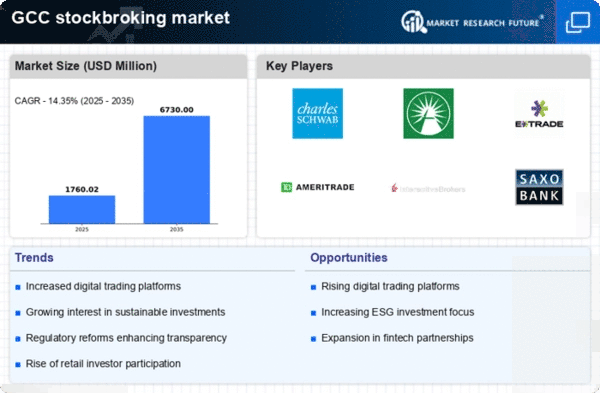
As per Market Research Future analysis, the GCC stockbroking market Size was estimated at 1539.15 USD Million in 2024. The Stockbroking market is projected to grow from 1760.02 USD Million in 2025 to 6730.0 USD Million by 2035, exhibiting a compound annual growth rate (CAGR) of 14.3% during the forecast period 2025 - 2035

Key Market Trends & Highlights

The GCC stockbroking market is experiencing a robust shift towards digitalization and increased participation from retail investors.

  • Digital transformation is reshaping the GCC stockbroking landscape, enhancing trading efficiency and accessibility.
  • The rise of retail investors is notable, particularly in the UAE, which is the largest market segment in the region.
  • Regulatory adaptations are fostering a more conducive environment for investment, especially in Saudi Arabia, the fastest-growing market segment.
  • Technological advancements in trading platforms and increased financial literacy initiatives are key drivers propelling market growth.

Market Size & Forecast

2024 Market Size 1539.15 (USD Million)
2035 Market Size 6730.0 (USD Million)
CAGR (2025 - 2035) 14.35%

Major Players

Charles Schwab (US), Fidelity Investments (US), E*TRADE Financial (US), TD Ameritrade (US), Interactive Brokers (US), Saxo Bank (DK), Deutsche Bank (DE), UBS Group (CH), Citi (US)

Our Impact
Enabled $4.3B Revenue Impact for Fortune 500 and Leading Multinationals
Partnering with 2000+ Global Organizations Each Year
30K+ Citations by Top-Tier Firms in the Industry

GCC Stockbroking Market Trends

The stockbroking market in the GCC region is currently experiencing a dynamic transformation, driven by technological advancements and evolving investor preferences. Digital platforms are becoming increasingly prevalent, allowing for greater accessibility and efficiency in trading activities. This shift towards online trading is not merely a trend but appears to be a fundamental change in how investors engage with financial markets. Furthermore, regulatory frameworks are adapting to accommodate these innovations, fostering a more competitive environment. As a result, traditional brokerage firms are compelled to enhance their service offerings, integrating advanced analytics and personalized investment solutions to meet the demands of a more sophisticated clientele. In addition to technological influences, the stockbroking market is witnessing a growing interest from retail investors. This demographic shift suggests a potential increase in market participation, as individuals seek to capitalize on investment opportunities. The rise of social trading platforms and investment apps is likely to further democratize access to financial markets, enabling a broader audience to engage in stock trading. Overall, the GCC stockbroking market is poised for continued growth, characterized by innovation and a shift towards more inclusive investment practices.

Digital Transformation

The stockbroking market is undergoing a significant digital transformation, with online trading platforms gaining traction. This shift enhances accessibility for investors, allowing them to trade seamlessly from various devices. As technology evolves, firms are increasingly adopting advanced tools to improve user experience and streamline operations.

Rise of Retail Investors

There is a noticeable increase in retail investor participation within the stockbroking market. This trend indicates a shift in market dynamics, as more individuals seek to invest directly in stocks. The proliferation of user-friendly trading apps is likely contributing to this growing interest.

Regulatory Adaptations

Regulatory bodies in the GCC are adapting to the changing landscape of the stockbroking market. New regulations are being introduced to enhance transparency and protect investors, fostering a more competitive environment. These adaptations may encourage innovation and improve overall market integrity.

GCC Stockbroking Market Drivers

Evolving Regulatory Frameworks

The stockbroking market is currently navigating an evolving regulatory landscape in the GCC. Recent reforms aimed at enhancing market integrity and investor protection are reshaping the operational framework for stockbrokers. For instance, the introduction of new compliance requirements has led to a 15% increase in operational costs for firms, compelling them to adapt their business models. These regulatory changes are designed to foster greater transparency and accountability, which may ultimately enhance investor confidence in the stockbroking market. As firms align their practices with these regulations, the market is likely to witness a shift towards more ethical and sustainable trading practices, potentially attracting a broader range of investors.

Expansion of Online Trading Services

The stockbroking market is experiencing a significant expansion of online trading services, driven by the increasing demand for convenience and accessibility among investors. The proliferation of internet connectivity and mobile devices in the GCC has facilitated this trend, with online trading volumes reportedly increasing by 50% over the past year. This surge indicates a shift in investor behavior, as more individuals opt for self-directed trading platforms that offer lower fees and greater control over their investments. As online trading becomes more mainstream, traditional brokerage firms are compelled to adapt their service offerings to remain competitive in the stockbroking market. This evolution is likely to reshape the competitive landscape, fostering innovation and improved customer experiences.

Increased Financial Literacy Initiatives

The stockbroking market is benefiting from a concerted effort to enhance financial literacy across the GCC. Governments and financial institutions are launching educational programs aimed at empowering individuals with the knowledge necessary to make informed investment decisions. Recent data suggests that financial literacy rates in the region have improved by approximately 25% over the last two years. This increase is likely to result in a more informed investor base, which could lead to higher participation rates in the stockbroking market. As individuals become more knowledgeable about investment strategies and market dynamics, the demand for stockbroking services is expected to rise, fostering a more robust and dynamic market environment.

Growing Interest in Sustainable Investments

The stockbroking market is witnessing a growing interest in sustainable investments, reflecting a broader global trend towards environmental, social, and governance (ESG) criteria. In the GCC, there has been a marked increase in the number of investment funds focusing on sustainable projects, with assets under management in this sector rising by 40% in the past year. This shift indicates a changing mindset among investors who are increasingly prioritizing ethical considerations alongside financial returns. As more stockbrokers begin to offer ESG-compliant investment options, the stockbroking market is likely to attract a new demographic of socially conscious investors, thereby expanding its reach and influence.

Technological Advancements in Trading Platforms

The stockbroking market is experiencing a notable shift due to rapid technological advancements in trading platforms. Enhanced algorithms and artificial intelligence are streamlining trading processes, allowing for faster execution and improved decision-making. In the GCC, the integration of mobile trading applications has surged, with a reported increase of 30% in user engagement over the past year. This trend indicates a growing preference for accessible and user-friendly platforms among investors. Furthermore, the adoption of blockchain technology is anticipated to enhance transparency and security in transactions, potentially attracting more participants to the stockbroking market. As technology continues to evolve, firms that invest in innovative solutions are likely to gain a competitive edge, thereby shaping the future landscape of the stockbroking market in the region.


Market Segment Insights

By Services: Order Execution (Largest) vs. Advisory (Fastest-Growing)

In the GCC stockbroking market, the 'Order Execution' segment holds the largest share among the service offerings, emphasizing its critical role in facilitating transactions for retail and institutional investors. 'Advisory' services, while comparatively smaller, are showing significant growth trends as clients increasingly seek expert guidance and tailored investment strategies to navigate market complexities. This shift towards professional advice signifies a change in investor behavior, contributing to the overall market dynamics. The growth in the 'Advisory' segment is driven by several factors, including heightened market volatility and a growing awareness of investment opportunities. Investors are more inclined to seek personalized advice that aligns with their financial goals, especially in a rapidly evolving economic landscape. Furthermore, advancements in technology have made advisory services more accessible, allowing firms to offer innovative solutions that cater to clients' specific needs. This trend is expected to continue as the market matures and evolves, enhancing the overall service landscape.

Order Execution (Dominant) vs. Discretionary (Emerging)

The 'Order Execution' segment is characterized by its robust infrastructure, allowing stockbrokers to execute trades swiftly and effectively. This segment is predominantly utilized by both retail traders and institutional investors who prioritize speed and reliability in their transactions. In contrast, 'Discretionary' services are emerging as a valuable offering, where brokers manage portfolios on behalf of clients based on pre-defined investment strategies. While 'Order Execution' remains the dominant force due to its foundational importance, 'Discretionary' services are gaining traction as investors shift towards a more hands-off approach to wealth management. This evolution reflects the growing demand for convenience and professionalism in managing investments.

By Type of Broker: Full-service Brokers (Largest) vs. Discount Brokers (Fastest-Growing)

In the GCC stockbroking market, the market share distribution reveals that full-service brokers hold a substantial portion of the market, driven by their comprehensive service offerings that cater to a wide range of investors. Conversely, discount brokers are rapidly gaining traction as they appeal to cost-conscious investors seeking lower fees and greater control over their investments. This shift is reshaping the competitive landscape. Growth trends indicate a robust expansion for discount brokers, which are attracting younger demographics who prefer online trading platforms and minimal advisory services. Meanwhile, full-service brokers are focusing on improving their digital presence to retain client interest. Additionally, the rise of robo-advisors is introducing automated solutions that augment both full-service and discount offerings, enhancing the overall market dynamics.

Full-service Brokers: Dominant vs. Discount Brokers: Emerging

Full-service brokers in the GCC stockbroking market are recognized for their extensive range of investment services, including personalized financial advice, portfolio management, and tailored investment strategies. These brokers typically cater to high-net-worth individuals and institutions seeking comprehensive market guidance. Their ability to provide in-depth analysis and tailored investment products positions them as the dominant force in the market. In contrast, discount brokers are emerging as a competitive alternative, offering low-cost trading solutions that appeal to retail investors. Their platforms often provide essential tools for self-directed investors, thus democratizing access to the financial markets. The flexibility and affordability of discount brokers make them particularly attractive to investors who prefer a hands-on approach.

By Mode: Online (Largest) vs. Offline (Fastest-Growing)

In the GCC stockbroking market, the distribution of market share between online and offline trading modes highlights a clear preference for online platforms. As digital transformation accelerates, online trading captures a significant portion of active traders, largely thanks to its convenience, lower fees, and access to a broad range of investment options. The offline segment, while smaller in share, remains relevant due to certain demographics that still prefer traditional methods of trading. Looking at growth trends, the offline mode is showing promising signs of resurgence, attributed to evolving market conditions that favor personalized services and face-to-face interactions. Various factors such as tech adoption, regulatory developments, and demographic shifts have influenced these trends, particularly as younger, tech-savvy investors seek out mobile and online platforms, while older generations continue to rely on established offline methods for their trading needs.

Online (Dominant) vs. Offline (Emerging)

The online trading segment is dominant in the GCC stockbroking market, driven by its user-friendly interfaces and advanced technological integration that cater to the evolving preferences of modern investors. This mode allows for real-time trading, extensive research tools, and automated services, making it highly appealing for both seasoned traders and newcomers alike. Conversely, the offline trading segment is emerging as it appeals to investors who value direct communication and personalized service. While it may currently hold a smaller share, its significance is growing, especially as financial advisors adapt to hybrid models that blend traditional service with digital innovation, creating a robust offering for investors who seek tailored solutions.

By Trading Type: Long-term Trading (Largest) vs. Short-term Trading (Fastest-Growing)

In the GCC stockbroking market, the Trading Type segment showcases a distinct distribution of market share between long-term and short-term trading strategies. Long-term trading dominates this segment, appealing to investors seeking stability and predictable returns. On the other hand, short-term trading has gained traction among more risk-oriented traders looking to capitalize on market fluctuations, though it holds a smaller share compared to its long-term counterpart. The growth trends in this segment are influenced by several factors, including the increasing digitalization of trading platforms, educational resources for traders, and a growing number of institutional investors. Short-term trading, in particular, has seen accelerating interest due to the rise of technology-enabled trading solutions, which empower traders to respond swiftly to market changes. As a result, this segment is expected to expand rapidly, creating a dynamic trading environment in the region.

Long-term Trading: Dominant vs. Short-term Trading: Emerging

Long-term trading remains the dominant strategy in the GCC stockbroking market, characterized by a focus on stability and the potential for substantial growth over time. Investors opting for this approach typically engage in thorough research and analysis, allowing them to make informed decisions that align with their financial goals. This strategy appeals primarily to risk-averse individuals and institutions looking to foster wealth accumulation over extended periods. Conversely, short-term trading is noted as an emerging strategy, appealing to actively engaged traders who thrive on daily market changes. This method often employs advanced analytical tools and strategies, attracting a growing number of tech-savvy investors eager to leverage quick gains. Together, these trading types illustrate the diverse preferences in market participation.

By End User: Retail Investor (Largest) vs. Institutional Investor (Fastest-Growing)

In the GCC stockbroking market, the Retail Investor segment commands a significant share, driven by a growing number of individuals entering the market. This segment benefits from the surge in online trading platforms, providing easy access to stock trading and investment opportunities. Conversely, the Institutional Investor segment, while smaller, is experiencing rapid growth as institutional players recognize the potential of emerging markets within the region and seek to capitalize on new investment opportunities. Both segments exhibit unique growth trends influenced by market dynamics. Retail Investors tend to leverage digital tools for convenience, while Institutional Investors are motivated by portfolio diversification and risk management strategies. The increasing financial literacy among the population enhances Retail participation, whereas the pursuit of sustainable investments is propelling Institutional growth. The competition among brokers to attract both types of investors is intensifying, leading to innovative service offerings.

Retail Investor (Dominant) vs. Institutional Investor (Emerging)

The Retail Investor segment is characterized by individual traders who engage in stock trading mainly for personal financial goals, influenced by increasing market access and technology adoption. This segment is dominant due to the sheer number of participants and their proactive approach to investment decisions. They utilize mobile and online platforms, which have democratized access to the stock market. In contrast, the Institutional Investor segment includes funds, banks, and other entities that manage large pools of capital. This segment is emerging as a key player in the GCC stockbroking market, driven by the need for expertise in navigating complex investment landscapes and the appeal of market innovations tailored to institutional needs.

Get more detailed insights about GCC Stockbroking Market

Key Players and Competitive Insights

The stockbroking market exhibits a dynamic competitive landscape characterized by rapid technological advancements and evolving consumer preferences. Key players such as Charles Schwab (US), Fidelity Investments (US), and Interactive Brokers (US) are at the forefront, leveraging innovation and digital transformation to enhance their service offerings. Charles Schwab (US) has focused on expanding its digital platforms, aiming to attract a younger demographic, while Fidelity Investments (US) emphasizes comprehensive wealth management solutions. Interactive Brokers (US) positions itself as a low-cost provider, appealing to cost-sensitive traders. Collectively, these strategies foster a competitive environment that prioritizes customer experience and technological integration.
The market structure appears moderately fragmented, with a mix of established firms and emerging fintech disruptors. Key players employ various business tactics, such as localizing services to cater to regional preferences and optimizing their digital infrastructures to enhance operational efficiency. This competitive structure allows for a diverse range of offerings, enabling firms to differentiate themselves through unique value propositions.
In October 2025, Fidelity Investments (US) announced a strategic partnership with a leading fintech firm to enhance its trading platform's AI capabilities. This move is likely to bolster its competitive edge by providing clients with advanced analytics and personalized trading insights, thereby improving user engagement and satisfaction. Such partnerships may signal a broader trend towards integrating AI technologies within trading platforms, enhancing decision-making processes for investors.
In September 2025, Interactive Brokers (US) launched a new commission-free trading feature aimed at attracting retail investors. This initiative not only aligns with the growing demand for cost-effective trading solutions but also positions the company to capture a larger market share among younger, tech-savvy investors. The strategic importance of this move lies in its potential to disrupt traditional pricing models, compelling competitors to reassess their fee structures.
In November 2025, Charles Schwab (US) unveiled a new suite of sustainable investment products, responding to the increasing consumer demand for ESG (Environmental, Social, and Governance) options. This strategic pivot reflects a broader industry trend towards sustainability, as investors increasingly seek to align their portfolios with their values. By offering these products, Charles Schwab (US) not only enhances its market appeal but also positions itself as a leader in responsible investing.
As of November 2025, the competitive trends within the stockbroking market are increasingly defined by digitalization, sustainability, and the integration of AI technologies. Strategic alliances are becoming pivotal, as firms collaborate to enhance their technological capabilities and service offerings. Looking ahead, competitive differentiation is likely to evolve from traditional price-based competition towards a focus on innovation, technology, and supply chain reliability, underscoring the importance of adaptability in a rapidly changing market.

Key Companies in the GCC Stockbroking Market include

Industry Developments

With a 62.7× oversubscription and a successful completion of its advisory role on the SAR 4.572 billion (USD 1.22 billion) initial public offering (IPO) of ADES Holding Company on the Saudi Exchange in October 2023, EFG Hermes solidified its position as the leading firm in the GCC capital markets.

The bank previously provided advice on Saudi Aramco's historic USD 11 billion secondary offering in June 2024, which was the biggest fully marketed offering in the Middle East since 2000.

With 11 initial public offers (IPOs) and six follow-on offerings, EFG Hermes maintained its top spot in the MENA Equity Capital Markets for 2024 that year, demonstrating its dominance in regional deal execution according to LSEG's ECM league tables.

With seven new initial public offers (IPOs) and many accelerated book built offerings (ABBs) planned for the remainder of the year, the company most recently forecasted a busy pipeline in Q1 2025. Its concentration was on the Saudi and UAE markets, and it aimed to preserve its ECM supremacy in the face of regional macroeconomic changes.

Future Outlook

GCC Stockbroking Market Future Outlook

The stockbroking market is projected to grow at a 14.35% CAGR from 2025 to 2035, driven by technological advancements, regulatory changes, and increasing investor participation.

New opportunities lie in:

  • Development of AI-driven trading algorithms for enhanced decision-making.
  • Expansion of mobile trading platforms to capture younger demographics.
  • Introduction of ESG-focused investment products to meet growing sustainability demands.

By 2035, the stockbroking market is expected to be robust, driven by innovation and evolving investor needs.

Market Segmentation

GCC Stockbroking Market Mode Outlook

  • Offline
  • Online

GCC Stockbroking Market End User Outlook

  • Retail Investor
  • Institutional Investor

GCC Stockbroking Market Services Outlook

  • Order Execution
  • Advisory
  • Discretionary
  • Others

GCC Stockbroking Market Trading Type Outlook

  • Short-term Trading
  • Long-term Trading

GCC Stockbroking Market Type of Broker Outlook

  • Full-service Brokers
  • Discount Brokers
  • Robo-Advisors

Report Scope

MARKET SIZE 2024 1539.15(USD Million)
MARKET SIZE 2025 1760.02(USD Million)
MARKET SIZE 2035 6730.0(USD Million)
COMPOUND ANNUAL GROWTH RATE (CAGR) 14.35% (2025 - 2035)
REPORT COVERAGE Revenue Forecast, Competitive Landscape, Growth Factors, and Trends
BASE YEAR 2024
Market Forecast Period 2025 - 2035
Historical Data 2019 - 2024
Market Forecast Units USD Million
Key Companies Profiled Charles Schwab (US), Fidelity Investments (US), E*TRADE Financial (US), TD Ameritrade (US), Interactive Brokers (US), Saxo Bank (DK), Deutsche Bank (DE), UBS Group (CH), Citi (US)
Segments Covered Services, Type of Broker, Mode, Trading Type, End User
Key Market Opportunities Integration of advanced digital platforms enhances accessibility and efficiency in the stockbroking market.
Key Market Dynamics Technological advancements drive competition and reshape consumer engagement in the stockbroking market.
Countries Covered GCC
Leave a Comment

FAQs

What is the projected market size of the GCC Stockbroking Market in 2024?

The GCC Stockbroking Market is expected to be valued at 1.37 billion USD in 2024.

What will be the expected market value of the GCC Stockbroking Market by 2035?

By 2035, the GCC Stockbroking Market is anticipated to reach a value of 4.22 billion USD.

What is the expected compound annual growth rate (CAGR) for the GCC Stockbroking Market from 2025 to 2035?

The expected CAGR for the GCC Stockbroking Market from 2025 to 2035 is 10.785%.

What segment of the GCC Stockbroking Market is projected to have the highest value in 2035?

The Order Execution segment of the market is projected to be valued at 1.7 billion USD in 2035.

Who are the key players in the GCC Stockbroking Market?

Major players in the market include QNB Financial Services, Saudi Fransi Capital, and First Abu Dhabi Bank among others.

What is the expected market value for the Advisory segment of the GCC Stockbroking Market in 2035?

The Advisory segment is expected to reach a value of 0.9 billion USD by 2035.

How much is the Discretionary segment expected to grow by 2035?

The Discretionary segment is projected to grow to 0.8 billion USD by 2035.

What are the anticipated growth drivers for the GCC Stockbroking Market?

The growth drivers include increased investment activities and a rising interest in financial products.

How is the Others segment of the GCC Stockbroking Market expected to perform by 2035?

The Others segment is expected to grow to 0.82 billion USD by 2035.

What challenges does the GCC Stockbroking Market currently face?

Challenges include regulatory changes and competition among market players.

Download Free Sample

Kindly complete the form below to receive a free sample of this Report

Compare Licence

×
Features License Type
Single User Multiuser License Enterprise User
Price $4,950 $5,950 $7,250
Maximum User Access Limit 1 User Upto 10 Users Unrestricted Access Throughout the Organization
Free Customization
Direct Access to Analyst
Deliverable Format
Platform Access
Discount on Next Purchase 10% 15% 15%
Printable Versions