Rising Incidence of Risk Factors
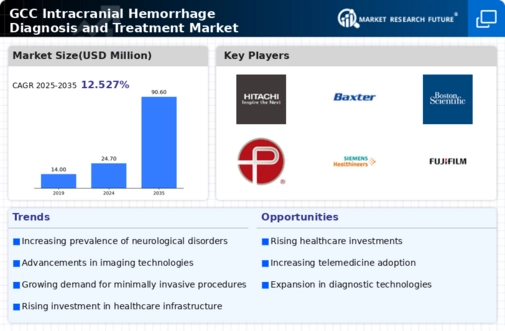
The GCC Intracranial Hemorrhage Diagnosis And Treatment Market is significantly influenced by the rising incidence of risk factors associated with intracranial hemorrhages. Factors such as hypertension, diabetes, and lifestyle-related issues are becoming increasingly prevalent in the region. According to recent health statistics, the incidence of hypertension in the GCC countries has reached alarming levels, which correlates with a higher risk of hemorrhagic strokes. This trend necessitates improved diagnostic and treatment options, thereby driving demand within the market. Additionally, public health initiatives aimed at addressing these risk factors are likely to further stimulate market growth. As healthcare systems in the GCC adapt to these challenges, the GCC Intracranial Hemorrhage Diagnosis And Treatment Market is expected to expand, reflecting the urgent need for effective management strategies.
Growing Awareness and Patient Advocacy
The GCC Intracranial Hemorrhage Diagnosis And Treatment Market is experiencing growth driven by increasing awareness and patient advocacy regarding neurological health. Public campaigns aimed at educating the population about the symptoms and risks associated with intracranial hemorrhages are gaining traction. This heightened awareness is encouraging individuals to seek medical attention promptly, thereby facilitating early diagnosis and treatment. Additionally, patient advocacy groups are playing a pivotal role in promoting research and funding for better treatment options. As more patients become informed about their health conditions, the demand for effective diagnostic and treatment solutions is likely to rise. Consequently, this trend is expected to positively impact the GCC Intracranial Hemorrhage Diagnosis And Treatment Market, as healthcare providers respond to the growing needs of an informed patient population.
Increased Focus on Training and Education
The GCC Intracranial Hemorrhage Diagnosis And Treatment Market is witnessing a heightened emphasis on training and education for healthcare professionals. This focus is crucial, given the complexity of diagnosing and treating intracranial hemorrhages. Various medical institutions in the GCC are implementing specialized training programs aimed at enhancing the skills of neurologists and radiologists. For example, workshops and seminars are being organized to familiarize practitioners with the latest diagnostic tools and treatment protocols. This investment in human capital is expected to improve patient outcomes and increase the overall efficiency of healthcare services. Consequently, the enhanced competency of medical professionals is likely to contribute positively to the growth of the GCC Intracranial Hemorrhage Diagnosis And Treatment Market, as it ensures that patients receive timely and appropriate care.
Government Initiatives and Healthcare Policies
The GCC Intracranial Hemorrhage Diagnosis And Treatment Market is benefiting from various government initiatives and healthcare policies aimed at improving neurological care. Governments in the GCC region are increasingly recognizing the importance of addressing neurological disorders, leading to the implementation of national health strategies that prioritize early diagnosis and treatment. For instance, funding for advanced medical facilities and research in neurology is being allocated to enhance healthcare infrastructure. These initiatives not only improve access to diagnostic services but also promote the adoption of innovative treatment modalities. As a result, the supportive regulatory environment is likely to foster growth in the GCC Intracranial Hemorrhage Diagnosis And Treatment Market, as it encourages investment in cutting-edge technologies and comprehensive care models.
Technological Advancements in Imaging Techniques
The GCC Intracranial Hemorrhage Diagnosis And Treatment Market is experiencing a notable transformation due to advancements in imaging technologies. Innovations such as high-resolution MRI and CT scans have significantly improved diagnostic accuracy, enabling healthcare professionals to detect intracranial hemorrhages at earlier stages. This is particularly relevant in the GCC region, where the prevalence of neurological disorders is on the rise. For instance, the introduction of portable imaging devices has enhanced accessibility in remote areas, thereby expanding the market reach. Furthermore, the integration of artificial intelligence in imaging analysis is expected to streamline workflows and reduce diagnostic errors. As a result, these technological advancements are likely to drive growth in the GCC Intracranial Hemorrhage Diagnosis And Treatment Market, as they facilitate timely and effective treatment interventions.