Increased Focus on Health and Wellness
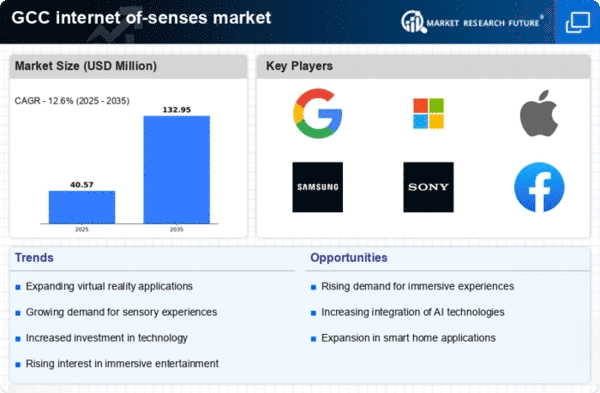
An increased focus on health and wellness is emerging as a significant driver for the internet of-senses market. In the GCC, consumers are becoming more health-conscious, leading to a demand for technologies that promote well-being through sensory experiences. This trend is evident in the rise of wellness applications that utilize sensory stimulation to enhance mental health and relaxation. Market Research Future suggests that the wellness technology sector is projected to grow by 15% annually, with sensory solutions playing a crucial role in this expansion. Companies are exploring ways to integrate sensory feedback into health applications, such as stress relief and mindfulness practices. As the emphasis on health and wellness continues to grow, the internet of-senses market is likely to see increased investment and innovation.
Consumer Interest in Personalized Experiences
Consumer interest in personalized experiences is a key driver for the internet of-senses market. In the GCC, there is a growing demand for tailored sensory experiences in entertainment, retail, and hospitality sectors. According to recent surveys, approximately 70% of consumers express a preference for personalized content that engages multiple senses. This trend is prompting businesses to invest in technologies that can deliver customized sensory experiences, such as scent marketing and immersive virtual environments. As companies strive to meet these consumer expectations, the internet of-senses market is likely to expand, with innovative solutions that cater to individual preferences. This shift towards personalization not only enhances customer satisfaction but also drives brand loyalty, making it a crucial factor for market growth.
Technological Advancements in Sensory Devices
The internet of-senses market is experiencing a surge due to rapid technological advancements in sensory devices. Innovations in haptic feedback, olfactory sensors, and augmented reality are enhancing user experiences across various sectors. In the GCC, the market for sensory devices is projected to grow at a CAGR of 25% from 2025 to 2030, driven by increased investments in research and development. Companies are focusing on creating more sophisticated devices that can simulate real-world sensations, thereby attracting consumers and businesses alike. This trend is likely to foster a competitive landscape, encouraging collaboration between tech firms and research institutions. As a result, the internet of-senses market is poised for significant growth, with potential applications in entertainment, education, and training sectors.
Rising Adoption of Virtual and Augmented Reality
The rising adoption of virtual and augmented reality (VR/AR) technologies is significantly influencing the internet of-senses market. In the GCC, industries such as gaming, education, and real estate are increasingly utilizing VR/AR to create immersive experiences that engage multiple senses. Market analysis indicates that the VR/AR sector is expected to reach a valuation of $10 billion by 2027 in the region, with sensory integration playing a pivotal role in enhancing user engagement. This trend is encouraging developers to create applications that leverage sensory feedback, thereby enriching the overall experience. As the demand for immersive content grows, the internet of-senses market is likely to expand, driven by innovations that combine visual, auditory, and tactile elements.
Government Initiatives Supporting Smart Technologies
Government initiatives in the GCC region are increasingly supporting the development of smart technologies, which is positively impacting the internet of-senses market. Various national strategies aim to enhance digital transformation and innovation, with a focus on integrating sensory technologies into urban planning and public services. For instance, the UAE's Vision 2021 emphasizes the importance of smart cities, which could incorporate sensory technologies to improve citizen engagement and service delivery. Investments in infrastructure and regulatory frameworks are expected to facilitate the adoption of these technologies, potentially leading to a market growth rate of 20% by 2030. As governments prioritize smart solutions, the internet of-senses market is likely to benefit from increased funding and collaborative projects.