Regulatory Support for AI Adoption
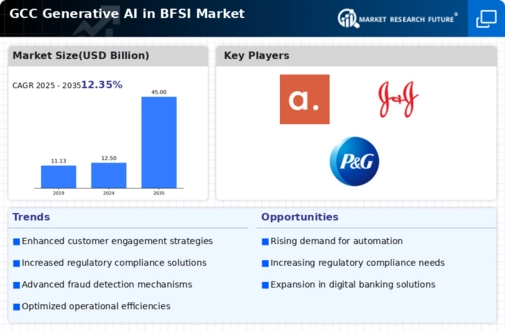
The GCC Generative AI BFSI Market benefits from robust regulatory frameworks that encourage the adoption of artificial intelligence technologies. Governments in the region, such as the UAE and Saudi Arabia, have established initiatives aimed at fostering innovation in financial services. For instance, the UAE's Financial Services Regulatory Authority has introduced guidelines that facilitate the integration of AI in banking operations. This regulatory support is crucial as it not only provides a clear pathway for financial institutions to implement generative AI solutions but also ensures compliance with international standards. As a result, the GCC generative ai bfsi market is likely to witness accelerated growth, with an estimated increase in AI investments projected to reach USD 1 billion by 2026.
Collaboration with Fintech Startups
The GCC Generative AI BFSI Market is witnessing a surge in collaboration between traditional financial institutions and fintech startups. This trend is driven by the need for innovation and agility in the rapidly evolving financial landscape. Established banks are increasingly partnering with fintech companies to leverage their expertise in generative AI technologies. Such collaborations enable banks to enhance their service offerings and improve operational efficiency. For instance, partnerships with AI-driven fintechs can facilitate the development of advanced analytics tools for risk assessment. This collaborative approach is expected to reshape the GCC generative ai bfsi market, with a projected growth rate of 15% annually as more institutions recognize the value of integrating fintech solutions.
Enhanced Fraud Detection Capabilities
Fraud detection remains a critical concern within the GCC Generative AI BFSI Market. The integration of generative AI technologies offers enhanced capabilities for identifying and mitigating fraudulent activities. AI algorithms can analyze transaction patterns in real-time, flagging suspicious behavior that may indicate fraud. This proactive approach is essential in a region where financial fraud is on the rise. Recent reports suggest that financial institutions in the GCC are investing heavily in AI-driven fraud detection systems, with expenditures expected to exceed USD 500 million by 2026. As a result, the GCC generative ai bfsi market is likely to benefit from improved security measures, fostering greater trust among consumers and stakeholders.
Cost Reduction through AI Implementation
The GCC Generative AI BFSI Market is experiencing a shift towards cost reduction as financial institutions increasingly adopt generative AI technologies. By automating routine tasks and streamlining operations, banks can significantly lower operational costs. For instance, AI-driven chatbots are being deployed to handle customer inquiries, reducing the need for extensive customer service teams. According to industry estimates, the implementation of AI in the GCC banking sector could lead to a cost reduction of up to 30% by 2026. This financial efficiency not only enhances profitability but also allows institutions to allocate resources towards innovation and customer-centric initiatives, thereby driving growth in the GCC generative ai bfsi market.
Rising Demand for Personalized Financial Services
In the GCC Generative AI BFSI Market, there is a growing demand for personalized financial services driven by changing consumer expectations. Customers increasingly seek tailored solutions that cater to their unique financial needs. Generative AI technologies enable financial institutions to analyze vast amounts of data, allowing them to offer customized products and services. For example, banks can utilize AI algorithms to create personalized investment portfolios based on individual risk profiles. This trend is reflected in a recent survey indicating that 70% of consumers in the GCC prefer banks that provide personalized services. Consequently, the GCC generative ai bfsi market is poised for expansion as institutions leverage AI to enhance customer satisfaction and loyalty.