×
Request Free Sample ×

Kindly complete the form below to receive a free sample of this Report

* Please use a valid business email

Leading companies partner with us for data-driven Insights

clients tt-cursor
Hero Background

GCC Data Science Platform Market

ID: MRFR/ICT/58290-HCR
200 Pages
Aarti Dhapte
February 2026

GCC Data Science Platform Market Size, Share and Research Report: By Business Function (marketing, sales, logistics, human resources), By Deployment (on-demand, on-premises) and By Verticals (BFSI, healthcare, retail, IT, transportation)- Industry Forecast to 2035

Share:
Download PDF ×

We do not share your information with anyone. However, we may send you emails based on your report interest from time to time. You may contact us at any time to opt-out.

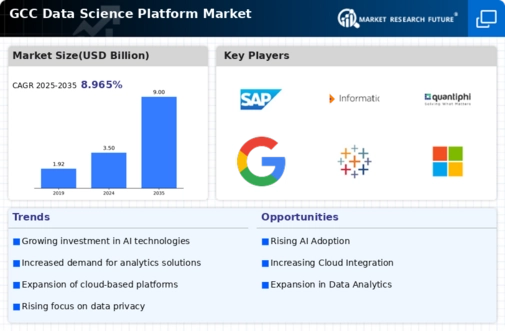
GCC Data Science Platform Market Infographic
Purchase Options

GCC Data Science Platform Market Summary

As per analysis, the Gcc data science platform market is projected to grow from USD 3.69 Billion in 2025 to USD 18.22 Billion by 2035, exhibiting a compound annual growth rate (CAGR) of 17.29% during the forecast period (2025 - 2035).

Key Market Trends & Highlights

The GCC data science platform market is experiencing robust growth driven by technological advancements and increasing demand for data analytics.

  • The market is witnessing a rise in cloud-based solutions, enhancing accessibility and scalability for businesses.
  • Machine learning remains the largest segment, while predictive analytics is emerging as the fastest-growing area within the market.
  • In the healthcare sector, data science platforms are being extensively utilized, whereas finance is rapidly adopting predictive analytics for improved decision-making.
  • Government initiatives and the growing demand for data-driven decision making are key drivers propelling market expansion.

Market Size & Forecast

2024 Market Size 3.15 (USD Billion)
2035 Market Size 18.22 (USD Billion)
CAGR (2025 - 2035) 17.29%

Major Players

SAP (DE), IBM (US), Microsoft (US), Oracle (US), SAS (US), DataRobot (US), Alteryx (US), TIBCO (US), Qlik (US)

Our Impact
Enabled $4.3B Revenue Impact for Fortune 500 and Leading Multinationals
Partnering with 2000+ Global Organizations Each Year
30K+ Citations by Top-Tier Firms in the Industry

GCC Data Science Platform Market Trends

The gcc data science platform market is currently experiencing a notable evolution, driven by the increasing demand for data-driven decision-making across various sectors. Organizations within the GCC region are increasingly recognizing the value of harnessing data analytics to enhance operational efficiency and gain competitive advantages. This shift is reflected in the growing investments in advanced analytics tools and platforms, which facilitate the extraction of actionable insights from vast datasets. Furthermore, the proliferation of cloud computing technologies is enabling businesses to access sophisticated data science capabilities without the need for extensive on-premises infrastructure, thereby democratizing access to these essential tools. In addition, the emphasis on developing local talent in data science is becoming more pronounced. Educational institutions and government initiatives are focusing on equipping the workforce with the necessary skills to thrive in this data-centric environment. This trend suggests a commitment to fostering innovation and ensuring that the GCC region remains competitive in the global data landscape. As organizations continue to adapt to the evolving technological landscape, the gcc data science platform market is poised for further growth, with an increasing number of players entering the field and offering diverse solutions to meet the unique needs of various industries.

Rise of Cloud-Based Solutions

The gcc data science platform market is witnessing a shift towards cloud-based solutions, which offer scalability and flexibility. This trend allows organizations to leverage powerful analytics tools without the burden of maintaining extensive on-premises infrastructure. As cloud adoption increases, businesses can access advanced data science capabilities more efficiently.

Focus on Local Talent Development

There is a growing emphasis on developing local talent within the gcc data science platform market. Educational institutions and government initiatives are prioritizing the cultivation of skills necessary for data science roles. This focus on talent development aims to ensure that the workforce is equipped to meet the demands of a data-driven economy.

Integration of Artificial Intelligence

The integration of artificial intelligence into data science platforms is becoming increasingly prevalent in the gcc region. Organizations are exploring AI-driven analytics to enhance decision-making processes. This trend indicates a move towards more sophisticated data analysis techniques, enabling businesses to derive deeper insights from their data.

GCC Data Science Platform Market Drivers

Increased Focus on Cybersecurity

As the reliance on data science platforms intensifies, so does the emphasis on cybersecurity within the GCC data science platform market. Organizations are increasingly aware of the potential risks associated with data breaches and cyber threats. Consequently, there is a growing demand for data science solutions that incorporate robust security measures. This trend is reflected in the implementation of stringent data protection regulations across the GCC, such as the UAE's Data Protection Law. Companies are investing in advanced cybersecurity technologies to safeguard their data assets, which in turn drives the demand for secure data science platforms. The GCC data science platform market is likely to see a rise in offerings that prioritize security, ensuring that organizations can leverage data analytics without compromising their data integrity.

Emergence of Big Data Technologies

The proliferation of big data technologies is a pivotal driver of the GCC data science platform market. As organizations generate and collect unprecedented volumes of data, the need for sophisticated data management and analysis tools becomes paramount. Technologies such as Hadoop, Spark, and NoSQL databases are gaining traction, facilitating the processing of large datasets. This trend is particularly evident in sectors like telecommunications and finance, where real-time data analysis is crucial. The GCC data science platform market is likely to expand as companies adopt these technologies to enhance their data capabilities. Furthermore, the integration of big data with artificial intelligence is expected to create new opportunities for innovation, thereby propelling the growth of the GCC data science platform market.

Government Initiatives and Support

The GCC data science platform market benefits from robust government initiatives aimed at fostering technological advancement. Various GCC nations have launched national strategies to enhance digital transformation, such as Saudi Arabia's Vision 2030 and the UAE's National Innovation Strategy. These initiatives often include funding for research and development, tax incentives for tech startups, and the establishment of innovation hubs. As a result, the market is witnessing increased investment in data science platforms, with the GCC data science platform market projected to grow at a compound annual growth rate (CAGR) of approximately 25% over the next five years. This government backing not only stimulates local businesses but also attracts foreign investment, thereby enhancing the overall ecosystem of the GCC data science platform market.

Collaboration Between Academia and Industry

The collaboration between academia and industry is emerging as a significant driver of the GCC data science platform market. Educational institutions in the region are increasingly partnering with businesses to bridge the skills gap in data science. These collaborations often result in tailored training programs and research initiatives that align with industry needs. For instance, universities in the UAE and Saudi Arabia are establishing data science programs that equip students with practical skills. This focus on education and training is expected to enhance the talent pool available to the GCC data science platform market, fostering innovation and growth. As a result, the industry is likely to benefit from a more skilled workforce, which is essential for the continued advancement of data science technologies in the region.

Growing Demand for Data-Driven Decision Making

In the contemporary business landscape, organizations across the GCC are increasingly recognizing the value of data-driven decision making. This trend is propelled by the need for enhanced operational efficiency and competitive advantage. Companies are leveraging data science platforms to analyze vast amounts of data, enabling them to derive actionable insights. The GCC data science platform market is experiencing a surge in demand as businesses seek to implement advanced analytics and machine learning solutions. According to recent estimates, the market is expected to reach a valuation of USD 1 billion by 2027, driven by sectors such as finance, healthcare, and retail. This growing demand underscores the critical role that data science platforms play in shaping strategic business outcomes within the GCC.


Market Segment Insights

By Application: Machine Learning (Largest) vs. Predictive Analytics (Fastest-Growing)

In the GCC data science platform market, the application segment exhibits diverse utilization across varying sectors. Machine Learning emerges as the largest share contributor, driven by widespread adoption in sectors like finance and healthcare. Meanwhile, Predictive Analytics, while currently smaller in share, is gaining traction, indicating a shift toward data-driven decision-making that enhances operational efficiency. Growth trends in the application segment are being fueled by advancements in algorithms and an increase in data generation. Businesses are increasingly focusing on leveraging data science for predictive insights, leading to a surge in demand for solutions that incorporate machine learning and predictive analytics. The agility and responsiveness offered by these applications are significant in fostering competitive advantages across industries.

Machine Learning (Dominant) vs. Predictive Analytics (Emerging)

Machine Learning stands out as the dominant application in the GCC data science platform market, largely due to its ability to analyze vast amounts of data and extract actionable insights. It is widely adopted in sectors such as finance, healthcare, and retail, where predictive capabilities can significantly enhance service delivery and customer engagement. On the other hand, Predictive Analytics is emerging rapidly, with organizations increasingly seeking advanced analytics to forecast trends and patterns. Its growing importance lies in empowering companies to anticipate market changes and optimize operations. Together, these applications illustrate the evolving landscape of data science in the GCC, where organizations prioritize innovative data strategies.

By End Use: Healthcare (Largest) vs. Finance (Fastest-Growing)

In the GCC data science platform market, Healthcare stands out as the dominant end use, showcasing significant market share due to the increasing adoption of data analytics for patient care and operational efficiencies. The growing need for predictive analytics in patient outcomes and operational management bolsters Healthcare’s position, making it the largest segment. Conversely, the Finance sector is rapidly catching up, propelled by the rise in data-driven decision-making and risk management practices. The transition towards digitalization in banking and finance plays a crucial role in its expanding presence. As data science increasingly becomes central to strategic initiatives across various sectors, the growth trends reveal prominent shifts. Healthcare's current dominance is expected to face challenges from the Finance segment, which is rapidly emerging as a crucial driver of innovation in risk analysis and fraud detection. The Telecommunications sector also shows promise, with advancements in customer analytics and predictive maintenance driving its growth. Retail and Manufacturing, while substantial, trail behind in terms of growth rate, as they adapt to the evolving landscape shaped by digital transformation in data accessibility and utilization.

Healthcare: Data Analytics (Dominant) vs. Finance: Risk Management (Emerging)

In the GCC data science platform market, Healthcare, particularly in data analytics, is noted for its proactive approach to using data to enhance patient outcomes and streamline operations. This segment excels due to investments in predictive modeling and machine learning to improve healthcare services. Healthcare organizations are leveraging data insights to reduce costs while improving care quality, positioning it as the dominant player within the market. On the other hand, the Finance sector is emerging as a strong contender with its focus on data-driven risk management solutions. As financial institutions increasingly rely on data science for fraud detection, compliance, and customer insights, this segment is rapidly evolving. The integration of advanced analytics in financial decision-making processes indicates a growing trend toward adopting innovative solutions, indicating that Finance will play an essential role in shaping the future of the data science platform market.

By Deployment Model: Cloud-Based (Largest) vs. On-Premises (Fastest-Growing)

In the GCC data science platform market, the deployment model segment is led by cloud-based solutions. This model accounts for a significant portion of the market share due to its cost-effectiveness, scalability, and ease of access. On-premises solutions, while less prominent, are rapidly growing among organizations that prioritize data security and control. Hybrid models also gain traction, balancing between the benefits of cloud scalability and on-premises security. The growth trends in this segment are primarily driven by the increasing adoption of cloud technologies and the willingness of businesses to invest in powerful analytical platforms. As organizations in the GCC prioritize data-driven decision-making, the demand for cloud-based solutions is expected to continue its dominance. Conversely, the surge in hybrid solutions reflects businesses' hybrid strategies aiming to optimize workload and risk management.

Cloud-Based (Dominant) vs. On-Premises (Emerging)

In the GCC data science platform market, cloud-based deployment models dominate the landscape by offering unparalleled flexibility and remote accessibility that suits modern enterprises' needs. These solutions facilitate collaborative data analysis and machine learning workflows, essential for organizations looking to leverage big data. On the other hand, on-premises solutions, although emerging, attract companies that require stringent data governance and inherently safer environments for sensitive information. As organizations begin to realize the implications of data privacy and regulatory requirements, on-premises solutions are finding new relevance. Both deployment models showcase distinct advantages, with cloud-based solutions continuing to lead and on-premises solutions gradually carving out their niche.

By User Type: Data Scientists (Largest) vs. Business Analysts (Fastest-Growing)

In the GCC data science platform market, 'Data Scientists' command the largest share, utilizing advanced analytical tools to drive insights and innovations. They represent a crucial segment due to their deep expertise and ability to uncover actionable intelligence from data. Meanwhile, 'Business Analysts' are seeing rapid adoption of data science platforms as enterprises seek to apply analytics directly to business processes, making this group the fastest-growing user type.

Data Analysts (Dominant) vs. IT Professionals (Emerging)

In the GCC data science platform market, 'Data Analysts' are considered the dominant user segment due to their critical role in transforming data into business strategies. They utilize sophisticated tools to access and visualize data efficiently. In contrast, 'IT Professionals' are emerging as a vital user group as their influence grows in integrating data science solutions within IT infrastructures. They provide essential support, ensuring scalability and security of data analytics processes, allowing organizations to leverage data science effectively.

By Industry Vertical: Education (Largest) vs. Government (Fastest-Growing)

In the GCC data science platform market, the education sector holds the largest market share, driven by the increasing adoption of digital learning tools and data-driven decision-making processes. Educational institutions are investing heavily in data science platforms to enhance their curriculum and improve student outcomes. On the other hand, the government sector is emerging as the fastest-growing segment, utilizing data science in policy-making, public safety, and resource management to drive efficiency and transparency.

Education: Traditional Learning (Dominant) vs. Government: Smart Initiatives (Emerging)

The education segment, characterized by traditional learning methods, is presently dominant within the GCC data science platform market. Institutions are focusing on enhancing teaching methods through analytics and personalized learning experiences. This sector utilizes data platforms for adaptive learning and performance analytics. Conversely, the government sector is witnessing a rise in smart initiatives designed to modernize public services. As governments adopt data science platforms for real-time analytics and predictive modeling, they aim to optimize service delivery and user engagement, marking a significant shift towards data-driven governance.

Get more detailed insights about GCC Data Science Platform Market

Key Players and Competitive Insights

The GCC data science platform market is characterized by a dynamic competitive landscape, driven by rapid technological advancements and an increasing demand for data-driven decision-making across various sectors. Key players such as SAP (DE), IBM (US), and Microsoft (US) are strategically positioned to leverage their extensive portfolios and innovative capabilities. SAP (DE) focuses on integrating advanced analytics into its enterprise resource planning solutions, thereby enhancing operational efficiency for its clients. Meanwhile, IBM (US) emphasizes its commitment to artificial intelligence and machine learning, aiming to provide comprehensive data solutions that cater to diverse industry needs. Microsoft (US) continues to expand its Azure cloud services, which are increasingly becoming a cornerstone for businesses seeking scalable data science solutions. Collectively, these strategies foster a competitive environment that prioritizes innovation and technological integration.

In terms of business tactics, companies are increasingly localizing their operations to better serve the GCC market. This includes optimizing supply chains and establishing regional data centers to enhance service delivery and compliance with local regulations. The market structure appears moderately fragmented, with several players vying for market share, yet the influence of major corporations remains substantial. Their collective presence shapes the competitive dynamics, as they set benchmarks for quality and innovation that smaller firms strive to meet.

In December 2025, SAP (DE) announced a strategic partnership with a leading regional telecommunications provider to enhance its data analytics capabilities. This collaboration is expected to facilitate the development of tailored solutions that address specific market needs, thereby strengthening SAP's foothold in the region. The partnership underscores the importance of local alliances in driving innovation and expanding market reach.

In November 2025, IBM (US) launched a new suite of AI-driven analytics tools designed specifically for the healthcare sector in the GCC. This initiative aims to improve patient outcomes through data-driven insights, reflecting IBM's strategic focus on vertical-specific solutions. The introduction of these tools is likely to position IBM as a leader in healthcare analytics, a sector poised for significant growth in the region.

In October 2025, Microsoft (US) unveiled its latest advancements in Azure Machine Learning, which include enhanced features for predictive analytics and automated machine learning. This development is particularly relevant as businesses in the GCC increasingly seek to harness the power of AI for operational efficiency. By continuously evolving its offerings, Microsoft is likely to maintain a competitive edge in the rapidly changing data science landscape.

As of January 2026, the competitive trends in the GCC data science platform market are heavily influenced by digitalization, sustainability, and the integration of AI technologies. Strategic alliances are becoming increasingly vital, as companies recognize the need for collaborative approaches to address complex market demands. Looking ahead, competitive differentiation is expected to shift from price-based strategies to a focus on innovation, technological advancement, and supply chain reliability. This evolution suggests that companies that prioritize these aspects will likely emerge as leaders in the market.

Key Companies in the GCC Data Science Platform Market include

Industry Developments

The GCC Data Science Platform Market has witnessed significant developments, particularly with advancements from major players like Amazon Web Services, Microsoft, and Google. In July 2023, SAP introduced new capabilities in their data science tools focused on enhancing user experience and efficiency, catering specifically to the diverse needs of GCC businesses. Furthermore, there has been an uptick in investment funding, where Informatica raised considerable capital to expand its services in the region, directly impacting competitive dynamics.

Notably, in September 2023, IBM announced a strategic collaboration with QNAM to develop AI-driven analytics solutions tailored for the GCC market, highlighting the demand for localized data solutions. 

Additionally, DataRobot's integration with Alteryx has streamlined analytics processes for organizations looking to tap into data-driven decision-making.The last couple of years have seen a surge in market valuation, with reports from government sources noting a projected 15% annual growth due to heightened data adoption across various sectors. In 2022, Oracle’s strategic acquisition of a regional analytics firm enhanced its footprint in the GCC, showcasing the trend towards consolidation within the industry. Overall, these actions emphasize the critical evolution of the GCC Data Science Platform Market amid rising technological advancements.

Future Outlook

GCC Data Science Platform Market Future Outlook

The GCC data science platform market is poised for growth at 17.29% CAGR from 2025 to 2035, driven by increased data utilization, technological advancements, and demand for analytics solutions.

New opportunities lie in:

  • Development of AI-driven predictive analytics tools for retail optimization.
  • Integration of IoT data analytics for smart city initiatives.
  • Creation of customized data science training programs for enterprises.

By 2035, the GCC data science platform market is expected to be robust and highly competitive.

Market Segmentation

GCC Data Science Platform Market End Use Outlook

  • Healthcare
  • Finance
  • Retail
  • Telecommunications
  • Manufacturing

GCC Data Science Platform Market User Type Outlook

  • Data Scientists
  • Business Analysts
  • IT Professionals
  • Researchers

GCC Data Science Platform Market Application Outlook

  • Predictive Analytics
  • Data Visualization
  • Machine Learning
  • Statistical Analysis
  • Big Data Processing

GCC Data Science Platform Market Deployment Model Outlook

  • Cloud-Based
  • On-Premises
  • Hybrid

GCC Data Science Platform Market Industry Vertical Outlook

  • Education
  • Government
  • Energy
  • Transportation

Report Scope

MARKET SIZE 20243.15(USD Billion)
MARKET SIZE 20253.69(USD Billion)
MARKET SIZE 203518.22(USD Billion)
COMPOUND ANNUAL GROWTH RATE (CAGR)17.29% (2024 - 2035)
REPORT COVERAGERevenue Forecast, Competitive Landscape, Growth Factors, and Trends
BASE YEAR2024
Market Forecast Period2025 - 2035
Historical Data2019 - 2024
Market Forecast UnitsUSD Billion
Key Companies ProfiledSAP (DE), IBM (US), Microsoft (US), Oracle (US), SAS (US), DataRobot (US), Alteryx (US), TIBCO (US), Qlik (US)
Segments CoveredApplication, End Use, Deployment Model, User Type, Industry Vertical
Key Market OpportunitiesIntegration of artificial intelligence in the gcc data science platform market enhances predictive analytics capabilities.
Key Market DynamicsGrowing demand for data-driven decision-making fuels competition among GCC data science platform providers.
Countries CoveredGCC
Leave a Comment

FAQs

What is the current valuation of the GCC data science platform market?

As of 2024, the market valuation stood at 3.15 USD Billion.

What is the projected market size for the GCC data science platform market by 2035?

The market is projected to reach 18.22 USD Billion by 2035.

What is the expected CAGR for the GCC data science platform market during the forecast period?

The expected CAGR for the market from 2025 to 2035 is 17.29%.

Which application segments are leading in the GCC data science platform market?

Predictive Analytics and Machine Learning are leading segments, with valuations of 4.25 USD Billion and 4.8 USD Billion, respectively, projected by 2035.

How does the deployment model impact the GCC data science platform market?

Cloud-Based deployment is anticipated to dominate, with a projected valuation of 7.0 USD Billion by 2035.

What are the key user types in the GCC data science platform market?

Data Scientists and Business Analysts are key user types, with projected valuations of 5.36 USD Billion and 4.21 USD Billion, respectively, by 2035.

Which industries are expected to drive growth in the GCC data science platform market?

The Finance and Energy sectors are expected to drive growth, with projected valuations of 5.0 USD Billion and 5.38 USD Billion by 2035.

Who are the major players in the GCC data science platform market?

Key players include SAP, IBM, Microsoft, Oracle, and SAS, among others.

What is the significance of the healthcare segment in the GCC data science platform market?

The healthcare segment is projected to reach 4.25 USD Billion by 2035, indicating its growing importance.

How does the market's growth trajectory appear for the next decade?

The market's growth trajectory appears robust, with substantial increases expected across various segments by 2035.

Download Free Sample

Kindly complete the form below to receive a free sample of this Report

Compare Licence

×
Features License Type
Single User Multiuser License Enterprise User
Price $4,950 $5,950 $7,250
Maximum User Access Limit 1 User Upto 10 Users Unrestricted Access Throughout the Organization
Free Customization
Direct Access to Analyst
Deliverable Format
Platform Access
Discount on Next Purchase 10% 15% 15%
Printable Versions