×
Request Free Sample ×

Kindly complete the form below to receive a free sample of this Report

* Please use a valid business email

Leading companies partner with us for data-driven Insights

clients tt-cursor
Hero Background

France Security Intelligence Market

ID: MRFR/ICT/60201-HCR
200 Pages
Aarti Dhapte
February 2026

France Security Intelligence Market Research Report By Solution (Threat Intelligence, Security Information and Event Management, Identity and Access Management, Network Security, Endpoint Security), By Deployment Type (On-Premises, Cloud, Hybrid), By End User (Government, BFSI, Healthcare, Retail, IT and Telecommunications) and By Service (Consulting, Integration, Managed Services, Training) - Forecast to 2035

Share:
Download PDF ×

We do not share your information with anyone. However, we may send you emails based on your report interest from time to time. You may contact us at any time to opt-out.

France Security Intelligence Market Infographic
Purchase Options

France Security Intelligence Market Summary

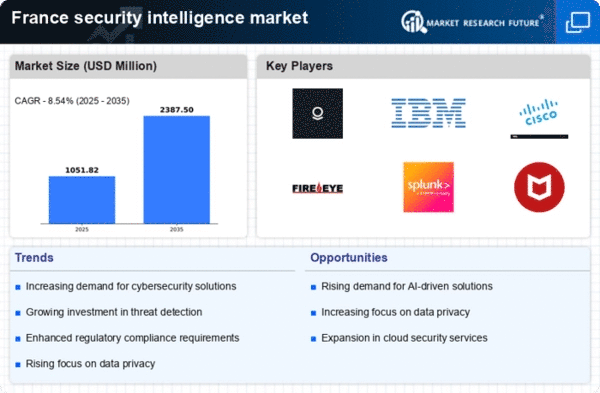
As per Market Research Future analysis, the France Security Intelligence Market size was estimated at 969.06 USD Million in 2024. The Security Intelligence market is projected to grow from 1051.82 USD Million in 2025 to 2387.5 USD Million by 2035, exhibiting a compound annual growth rate (CAGR) of 8.5% during the forecast period 2025 - 2035

Key Market Trends & Highlights

The France security intelligence market is experiencing robust growth driven by technological advancements and increasing regulatory scrutiny.

  • The integration of AI and Machine Learning is transforming security intelligence capabilities across various sectors.
  • Regulatory compliance and standards are becoming increasingly critical for organizations to mitigate risks and enhance security measures.
  • The collaboration between sectors is fostering innovation and improving the overall effectiveness of security intelligence solutions.
  • Rising cyber threats and government initiatives are key drivers propelling the market forward, highlighting the urgent need for enhanced cybersecurity measures.

Market Size & Forecast

2024 Market Size 969.06 (USD Million)
2035 Market Size 2387.5 (USD Million)
CAGR (2025 - 2035) 8.54%

Major Players

Palantir Technologies (US), IBM (US), Cisco Systems (US), FireEye (US), Splunk (US), McAfee (US), Check Point Software Technologies (IL), CrowdStrike (US), Darktrace (GB)

Our Impact
Enabled $4.3B Revenue Impact for Fortune 500 and Leading Multinationals
Partnering with 2000+ Global Organizations Each Year
30K+ Citations by Top-Tier Firms in the Industry

France Security Intelligence Market Trends

The France Security Intelligence Market is currently experiencing a dynamic evolution, driven by the increasing need for robust security measures across various sectors. Organizations are prioritizing the integration of advanced technologies to enhance their security frameworks. This shift is largely influenced by the growing complexity of threats, which necessitates a proactive approach to risk management. As a result, investments in security intelligence solutions are on the rise, reflecting a broader recognition of the importance of safeguarding sensitive information and infrastructure. Furthermore, regulatory requirements are becoming more stringent, compelling businesses to adopt comprehensive security strategies that align with national and international standards. In addition, the landscape of the security intelligence market is characterized by a surge in collaboration between public and private sectors. This partnership aims to foster innovation and improve the overall security posture of organizations. The emphasis on data analytics and artificial intelligence is particularly noteworthy, as these technologies are being leveraged to predict and mitigate potential threats. Overall, the security intelligence market is poised for continued growth, driven by technological advancements and an increasing awareness of security vulnerabilities.

Integration of AI and Machine Learning

The adoption of artificial intelligence and machine learning technologies is transforming the security intelligence market. These innovations enable organizations to analyze vast amounts of data quickly, identifying patterns and anomalies that may indicate security threats. As a result, businesses are increasingly investing in AI-driven solutions to enhance their threat detection capabilities.

Regulatory Compliance and Standards

The evolving regulatory landscape is significantly impacting the security intelligence market. Organizations are compelled to comply with stringent regulations that govern data protection and privacy. This compliance drives the demand for security intelligence solutions that can help businesses meet legal requirements while safeguarding sensitive information.

Collaboration Between Sectors

There is a notable trend towards collaboration between public and private sectors in the security intelligence market. This partnership fosters information sharing and resource allocation, enhancing the overall security framework. By working together, organizations can better address emerging threats and improve their collective security posture.

France Security Intelligence Market Drivers

Rising Cyber Threats

The security intelligence market in France is experiencing a surge in demand due to the increasing frequency and sophistication of cyber threats. Recent reports indicate that cybercrime costs the French economy approximately €3.5 billion annually, prompting organizations to invest heavily in security intelligence solutions. This trend is likely to continue as businesses recognize the necessity of proactive measures to safeguard sensitive data. The rise in ransomware attacks and data breaches has led to a heightened awareness of the importance of security intelligence, driving growth in this market. As companies seek to mitigate risks, the adoption of advanced security intelligence tools is expected to rise, further solidifying the market's position in the technology landscape.

Technological Advancements

Technological advancements are playing a pivotal role in shaping the security intelligence market in France. The integration of innovative technologies such as artificial intelligence, machine learning, and big data analytics is enhancing the capabilities of security intelligence solutions. These advancements enable organizations to analyze vast amounts of data in real-time, improving threat detection and response times. As businesses increasingly rely on technology to safeguard their operations, the demand for sophisticated security intelligence tools is likely to rise. The market is expected to witness a shift towards more automated and intelligent security solutions, reflecting the evolving landscape of cyber threats and the need for proactive defense mechanisms.

Increased Regulatory Scrutiny

The security intelligence market in France is influenced by the growing regulatory scrutiny surrounding data protection and privacy. With the implementation of the General Data Protection Regulation (GDPR), organizations are compelled to adopt robust security measures to ensure compliance. Non-compliance can result in fines reaching up to €20 million or 4% of annual global turnover, which underscores the urgency for businesses to invest in security intelligence solutions. This regulatory environment is likely to drive demand for advanced security intelligence tools that assist organizations in monitoring and managing compliance effectively. As companies navigate the complexities of regulatory requirements, the security intelligence market is expected to benefit from increased investments in compliance-related technologies.

Government Initiatives and Funding

The French government is actively promoting the development of the security intelligence market through various initiatives and funding programs. In recent years, the government has allocated substantial resources to enhance national cybersecurity capabilities, with an investment of over €1 billion aimed at bolstering the security infrastructure. This support is likely to stimulate innovation and growth within the security intelligence market, as companies leverage government funding to develop cutting-edge solutions. Furthermore, the establishment of public-private partnerships is expected to foster collaboration, enhancing the overall effectiveness of security measures across sectors. As a result, the security intelligence market is poised for significant expansion in response to these governmental efforts.

Growing Awareness of Cybersecurity

There is a notable increase in awareness regarding cybersecurity among organizations in France, which is significantly impacting the security intelligence market. As high-profile data breaches and cyber incidents make headlines, businesses are becoming more cognizant of the potential risks associated with inadequate security measures. This heightened awareness is driving organizations to prioritize investments in security intelligence solutions to protect their assets and reputation. Surveys indicate that approximately 70% of French companies plan to increase their cybersecurity budgets in the coming years, reflecting a commitment to enhancing their security posture. Consequently, the security intelligence market is likely to experience robust growth as organizations seek to implement comprehensive security strategies.


Market Segment Insights

By Solution: Threat Intelligence (Largest) vs. Endpoint Security (Fastest-Growing)

The market share distribution in the France security intelligence market reveals that Threat Intelligence holds a significant portion, characterized by its pivotal role in proactive security measures. Security Information and Event Management and Identity and Access Management follow, establishing considerable ground within the market framework, while Network Security contributes steadily. However, Endpoint Security is emerging quickly, gaining traction as the demand for comprehensive security solutions increases. Growth trends in this segment show a robust shift towards integrated security solutions that combine various aspects of threat intelligence and endpoint protection. The rise of cyber threats and the need for real-time data processing are major drivers. Additionally, increased investment in cybersecurity tools by organizations to mitigate risks is propelling the growth of the Endpoint Security segment, making it the fastest-growing area within this market.

Threat Intelligence: Largest vs. Endpoint Security: Fastest-Growing

Threat Intelligence plays a dominant role in shaping the security landscape, offering organizations valuable insights into potential threats, enabling proactive measures to safeguard critical assets. Its extensive use in various industries underscores its importance in preventing attacks. Meanwhile, Endpoint Security is experiencing rapid growth, largely due to the rising number of endpoints organizations are tasked with protecting. As remote work models gain popularity, the demand for secure endpoint management solutions has surged. This segment focuses on protecting devices like laptops, smartphones, and tablets from malicious attacks, becoming essential for maintaining organizational security in a complex threat environment.

By Deployment Type: Cloud (Largest) vs. Hybrid (Fastest-Growing)

In the France security intelligence market, the deployment type segment exhibits distinct preferences among organizations. The cloud segment dominates the market share, attributed to its scalability and cost-effectiveness, enabling businesses of various sizes to implement robust security measures without heavy initial investments. Meanwhile, on-premises solutions, although still relevant, are experiencing a decline as more organizations transition to cloud-based systems. Growth trends indicate that the hybrid deployment model is rapidly gaining traction, driven by businesses seeking to balance flexibility with control over sensitive data. This shift is significantly supported by increasing cyber threats, prompting enterprises to adopt hybrid solutions that offer enhanced security features while minimizing the risks associated with solely relying on one type of deployment.

Cloud (Dominant) vs. Hybrid (Emerging)

Cloud solutions are at the forefront within the deployment type segment of the France security intelligence market. They are widely recognized for their ability to provide on-demand resources and lower operational costs. Organizations benefit from continuous updates and advanced security protocols. In contrast, hybrid deployment models are emerging as a viable option for companies prioritizing data control while leveraging the scalability of the cloud. These models are particularly appealing to sectors with stringent regulatory compliance requirements, allowing for a tailored approach that combines the strengths of both cloud and on-premises solutions. This strategic mix is driving the growth of hybrid deployments in the market.

By End User: Government (Largest) vs. BFSI (Fastest-Growing)

In the France security intelligence market, the market share distribution reveals that the Government sector holds the largest share, driven by increased investments in public safety and national security initiatives. This segment is characterized by extensive adoption of security technologies to secure sensitive data and infrastructures, making it a vital area for growth in this market. On the other hand, the BFSI sector is emerging as the fastest-growing segment, primarily due to the rising threats related to cybercrime and data breaches. Financial institutions are increasingly investing in advanced security solutions to protect customer data and maintain regulatory compliance. This expanding need for robust security frameworks indicates a shift in focus towards more comprehensive protection in this segment.

Government: Security Measures (Dominant) vs. BFSI: Cybersecurity Solutions (Emerging)

The Government sector is positioned as a dominant player in the France security intelligence market, leveraging its extensive resources to implement stringent security measures across various levels. This segment prioritizes national threats and regulatory compliance, investing heavily in technologies that ensure data protection and public safety. In contrast, the BFSI sector is an emerging force, actively adopting cybersecurity solutions to address the increasing challenges posed by cyber threats. Financial organizations are keen to integrate sophisticated systems that offer predictive capabilities and real-time monitoring, reflecting a growing awareness of security risks. As these segments evolve, the interplay between government policies and financial institution strategies is likely to shape future developments.

By Service: Consulting (Largest) vs. Managed Services (Fastest-Growing)

In the France security intelligence market, the service segment is diverse, comprising Consulting, Integration, Managed Services, and Training. Among these, Consulting holds the largest market share, driven by organizations seeking expert guidance to navigate security challenges. Managed Services is rapidly gaining traction as businesses increasingly prefer outsourcing security functions to specialized providers, signaling a shift towards more flexible operational models. The growth trends in the service segment are influenced by heightened cybersecurity threats and the need for regulatory compliance. Organizations are investing in tailored solutions to address unique security needs, leading to expanding opportunities in Managed Services. Meanwhile, Consulting continues to benefit from its established reputation for delivering strategic insights, further solidifying its position within the market.

Consulting (Dominant) vs. Training (Emerging)

Consulting is a dominant force in the service segment, characterized by its focus on delivering strategic intelligence and customized solutions. Clients rely on consultancy firms for their expertise in risk management and compliance, ensuring a proactive approach to security measures. In contrast, Training is emerging as a significant player, as organizations recognize the importance of building internal capabilities. The emphasis on training programs enhances employees' awareness of security protocols and response strategies. This focus on internal education is indicative of a broader trend towards empowering staff in the fight against security threats, positioning Training as a crucial element for ongoing resilience in the France security intelligence market.

Get more detailed insights about France Security Intelligence Market

Key Players and Competitive Insights

The security intelligence market is characterized by a dynamic competitive landscape, driven by the increasing demand for advanced threat detection and response capabilities. Key players are actively pursuing strategies that emphasize innovation, partnerships, and regional expansion to enhance their market positions. For instance, Palantir Technologies (US) has focused on integrating artificial intelligence (AI) into its platforms, thereby improving data analytics capabilities. Similarly, IBM (US) has been investing heavily in cloud-based security solutions, which positions it favorably in a market that increasingly values flexibility and scalability. These strategies collectively contribute to a competitive environment that is both concentrated and fragmented, as companies vie for market share while also collaborating on various initiatives.In terms of business tactics, companies are increasingly localizing their operations to better serve regional markets, which appears to be a response to the growing need for tailored security solutions. The market structure is moderately fragmented, with several key players holding substantial shares while numerous smaller firms also contribute to the competitive dynamics. This fragmentation allows for a diverse range of offerings, catering to different customer needs and preferences.

In October Cisco Systems (US) announced a strategic partnership with a leading European cybersecurity firm to enhance its threat intelligence capabilities. This collaboration is expected to bolster Cisco's offerings in the European market, allowing it to leverage local expertise while expanding its footprint. The strategic importance of this partnership lies in its potential to enhance Cisco's competitive edge by providing more localized and relevant security solutions to clients.

In September CrowdStrike (US) launched a new AI-driven threat detection platform aimed at small to medium-sized enterprises (SMEs). This move is significant as it addresses a growing market segment that has been historically underserved. By focusing on SMEs, CrowdStrike not only diversifies its customer base but also positions itself as a leader in providing accessible security solutions, which could lead to increased market penetration.

In August Darktrace (GB) unveiled a new self-learning AI technology designed to autonomously respond to cyber threats in real-time. This innovation is crucial as it reflects the ongoing trend towards automation in cybersecurity, allowing organizations to respond to threats more swiftly and effectively. Darktrace's emphasis on AI integration may set a new standard in the industry, compelling competitors to enhance their own technological capabilities.

As of November the competitive trends in the security intelligence market are increasingly defined by digitalization, sustainability, and the integration of AI technologies. Strategic alliances are becoming more prevalent, as companies recognize the value of collaboration in enhancing their service offerings. Looking ahead, competitive differentiation is likely to evolve, shifting from traditional price-based competition to a focus on innovation, technological advancement, and supply chain reliability. This transition suggests that companies that prioritize these aspects will be better positioned to thrive in an increasingly complex market.

Key Companies in the France Security Intelligence Market include

Industry Developments

The France Security Intelligence Market has seen significant developments recently, with companies like Thales and Orange Cyber Defense focusing on enhancing their cybersecurity solutions amidst growing threats. In September 2023, Thales announced a partnership with Palo Alto Networks to bolster network security offerings in the region. Moreover, Sopra Steria reported a strategic initiative to expand its cybersecurity services, aiming to cater to increasing demand from both public and private sectors. The market has experienced substantial growth, with a reported valuation increase largely attributed to heightened investments in digital security infrastructures amid the European Union's focus on improving cybersecurity resilience. 

In terms of mergers, in August 2023, Fortinet acquired a cybersecurity firm specializing in threat intelligence, which is expected to strengthen its presence in the French market. Additionally, Kaspersky Lab continues to enhance its consumer and enterprise security services as cyber threats evolve. The French government's commitment to investing in national security has further accelerated market dynamics, ensuring increasing collaboration among key players like Airbus, CrowdStrike, and IBM to innovate and deliver advanced security solutions tailored to local needs.

Future Outlook

France Security Intelligence Market Future Outlook

The Security Intelligence Market in France is projected to grow at 8.54% CAGR from 2025 to 2035, driven by increasing cyber threats, regulatory compliance, and technological advancements.

New opportunities lie in:

  • Development of AI-driven threat detection systems
  • Expansion of managed security service offerings
  • Integration of IoT security solutions for smart infrastructure

By 2035, the market is expected to achieve substantial growth, reflecting evolving security needs.

Market Segmentation

France Security Intelligence Market Service Outlook

  • Consulting
  • Integration
  • Managed Services
  • Training

France Security Intelligence Market End User Outlook

  • Government
  • BFSI
  • Healthcare
  • Retail
  • IT and Telecommunications

France Security Intelligence Market Solution Outlook

  • Threat Intelligence
  • Security Information and Event Management
  • Identity and Access Management
  • Network Security
  • Endpoint Security

France Security Intelligence Market Deployment Type Outlook

  • On-Premises
  • Cloud
  • Hybrid

Report Scope

MARKET SIZE 2024 969.06(USD Million)
MARKET SIZE 2025 1051.82(USD Million)
MARKET SIZE 2035 2387.5(USD Million)
COMPOUND ANNUAL GROWTH RATE (CAGR) 8.54% (2025 - 2035)
REPORT COVERAGE Revenue Forecast, Competitive Landscape, Growth Factors, and Trends
BASE YEAR 2024
Market Forecast Period 2025 - 2035
Historical Data 2019 - 2024
Market Forecast Units USD Million
Key Companies Profiled Palantir Technologies (US), IBM (US), Cisco Systems (US), FireEye (US), Splunk (US), McAfee (US), Check Point Software Technologies (IL), CrowdStrike (US), Darktrace (GB)
Segments Covered Solution, Deployment Type, End User, Service
Key Market Opportunities Integration of artificial intelligence in security intelligence market enhances threat detection and response capabilities.
Key Market Dynamics Rising demand for advanced analytics in security intelligence drives innovation and competition among local providers.
Countries Covered France
Leave a Comment

FAQs

What is the projected market value of the France Security Intelligence Market in 2024?

The France Security Intelligence Market is expected to be valued at 1.01 billion USD in 2024.

What is the expected market value of the France Security Intelligence Market by 2035?

By 2035, the France Security Intelligence Market is expected to reach a value of 2.75 billion USD.

What is the expected CAGR for the France Security Intelligence Market from 2025 to 2035?

The expected CAGR for the France Security Intelligence Market from 2025 to 2035 is 9.553%.

Which solution segment is projected to have the highest growth in the France Security Intelligence Market?

The Security Information and Event Management segment is projected to grow from 0.25 billion USD in 2024 to 0.7 billion USD by 2035.

Who are the key players in the France Security Intelligence Market?

Major players in the market include Thales, Cisco, Sopra Steria, Orange Cyber Defense, CrowdStrike, and Palo Alto Networks.

What is the market value for Threat Intelligence in the France Security Intelligence Market in 2024?

The Threat Intelligence segment is valued at 0.15 billion USD in 2024.

How will the Identity and Access Management segment perform by 2035?

The Identity and Access Management segment is expected to grow from 0.2 billion USD in 2024 to 0.55 billion USD by 2035.

What is the expected value of Network Security in the France Security Intelligence Market by 2035?

The Network Security segment is projected to be valued at 0.65 billion USD by 2035.

What are some emerging trends in the France Security Intelligence Market?

Emerging trends include increasing cyber threats, demand for integrated security solutions, and advancements in artificial intelligence.

How will the Endpoint Security segment perform from 2024 to 2035?

Endpoint Security is expected to grow from 0.16 billion USD in 2024 to 0.45 billion USD by 2035.

Download Free Sample

Kindly complete the form below to receive a free sample of this Report

Compare Licence

×
Features License Type
Single User Multiuser License Enterprise User
Price $4,950 $5,950 $7,250
Maximum User Access Limit 1 User Upto 10 Users Unrestricted Access Throughout the Organization
Free Customization
Direct Access to Analyst
Deliverable Format
Platform Access
Discount on Next Purchase 10% 15% 15%
Printable Versions