×
Request Free Sample ×

Kindly complete the form below to receive a free sample of this Report

* Please use a valid business email

Leading companies partner with us for data-driven Insights

clients tt-cursor
Hero Background

France Medical Device Connectivity Market

ID: MRFR/MED/52794-HCR
200 Pages
Rahul Gotadki
February 2026

France Medical Device Connectivity Market Research Report By Application (Remote Patient Monitoring, Data Management, Clinical Decision Support, Smart Hospitals), By Device Type (Wearable Devices, Implantable Devices, Stationary Devices, Portable Devices), By Connectivity Technology (Wi-Fi, Bluetooth, Zigbee, Cellular) and By End Use (Hospitals, Home Care, Clinics, Diagnostic Centers) - Growth & Industry Forecast 2025 To 2035

Share:
Download PDF ×

We do not share your information with anyone. However, we may send you emails based on your report interest from time to time. You may contact us at any time to opt-out.

France Medical Device Connectivity Market Infographic
Purchase Options

France Medical Device Connectivity Market Summary

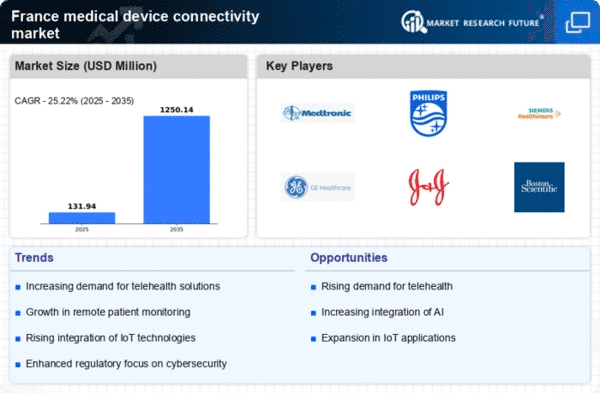
As per Market Research Future analysis, the France medical device-connectivity market size was estimated at 105.37 USD Million in 2024. The France medical device-connectivity market is projected to grow from 131.94 USD Million in 2025 to 1250.14 USD Million by 2035, exhibiting a compound annual growth rate (CAGR) of 25.2% during the forecast period 2025 - 2035

Key Market Trends & Highlights

The France medical device-connectivity market is experiencing robust growth driven by technological advancements and evolving healthcare needs.

  • The rise of telehealth solutions is reshaping patient care dynamics in France.
  • Regulatory support for innovation is fostering a conducive environment for medical device connectivity.
  • Data security and interoperability are becoming critical focal points for stakeholders in the healthcare sector.
  • The increasing demand for remote patient monitoring and integration of IoT technologies are key drivers propelling market expansion.

Market Size & Forecast

2024 Market Size 105.37 (USD Million)
2035 Market Size 1250.14 (USD Million)
CAGR (2025 - 2035) 25.22%

Major Players

Medtronic (US), Philips (NL), Siemens Healthineers (DE), GE Healthcare (US), Johnson & Johnson (US), Boston Scientific (US), Abbott Laboratories (US), B. Braun Melsungen AG (DE)

Our Impact
Enabled $4.3B Revenue Impact for Fortune 500 and Leading Multinationals
Partnering with 2000+ Global Organizations Each Year
30K+ Citations by Top-Tier Firms in the Industry

France Medical Device Connectivity Market Trends

the medical device connectivity market is experiencing notable advancements, driven by the increasing integration of technology within healthcare systems. In France, the demand for connected medical devices is on the rise, as healthcare providers seek to enhance patient care and streamline operations. This trend is largely influenced by the growing emphasis on remote monitoring and telehealth solutions, which allow for real-time data collection and analysis. As a result, stakeholders are investing in innovative technologies that facilitate seamless communication between devices and healthcare professionals. Moreover, regulatory frameworks in France are evolving to support the adoption of connected medical devices. The government is actively promoting initiatives that encourage the development and implementation of digital health solutions. This regulatory support, combined with the increasing prevalence of chronic diseases, is likely to propel the medical device-connectivity market forward. The focus on interoperability and data security is also becoming paramount, as stakeholders aim to ensure that patient information is protected while enabling efficient data exchange. Overall, the landscape appears promising, with various factors converging to foster growth in this sector.

Rise of Telehealth Solutions

the medical device connectivity market is experiencing a surge in telehealth solutions, which facilitate remote patient monitoring and consultations. This trend is driven by the need for efficient healthcare delivery, particularly in managing chronic conditions. As healthcare providers adopt these technologies, patient engagement and satisfaction are likely to improve.

Regulatory Support for Innovation

In France, regulatory bodies are increasingly supporting the development of connected medical devices. This support is evident through initiatives aimed at fostering innovation and ensuring compliance with safety standards. Such measures are expected to enhance the market's growth by encouraging manufacturers to invest in advanced technologies.

Focus on Data Security and Interoperability

As the medical device-connectivity market expands, the emphasis on data security and interoperability is intensifying. Stakeholders are prioritizing the protection of patient information while ensuring that devices can communicate effectively. This focus is crucial for building trust among users and facilitating seamless healthcare delivery.

France Medical Device Connectivity Market Drivers

Rising Focus on Personalized Medicine

The medical device-connectivity market is witnessing a rising focus on personalized medicine in France. This approach tailors medical treatment to individual characteristics, needs, and preferences, which is facilitated by connected medical devices. The market for personalized medicine is projected to grow at a CAGR of 10% through 2027, reflecting a shift towards more patient-centric healthcare solutions. Connected devices play a crucial role in gathering patient data, which can be analyzed to create customized treatment plans. This trend not only enhances patient engagement but also improves treatment efficacy. As healthcare systems in France continue to embrace personalized medicine, the medical device-connectivity market is likely to benefit from increased investment in connected technologies.

Increasing Demand for Remote Patient Monitoring

The medical device-connectivity market in France is experiencing a notable surge in demand for remote patient monitoring solutions. This trend is driven by the growing need for continuous health monitoring, particularly among chronic disease patients. According to recent data, the remote patient monitoring segment is projected to grow at a CAGR of 15% over the next five years. This growth is largely attributed to advancements in wearable technologies and mobile health applications that facilitate real-time data transmission. As healthcare providers increasingly adopt these technologies, the medical device-connectivity market is likely to expand, enabling better patient outcomes and reducing hospital readmissions. Furthermore, the integration of artificial intelligence in monitoring devices enhances their effectiveness, making them more appealing to both patients and healthcare professionals.

Growing Emphasis on Data Analytics in Healthcare

The growing emphasis on data analytics in healthcare is reshaping the medical device-connectivity market in France. Healthcare providers are increasingly leveraging data analytics to derive insights from the vast amounts of data generated by connected medical devices. This trend is expected to drive the market, as analytics can enhance clinical decision-making and operational efficiency. The data analytics market in healthcare is projected to grow to €20 billion by 2025, indicating a strong demand for solutions that integrate analytics with medical devices. By utilizing data analytics, healthcare organizations can improve patient outcomes and streamline processes, thereby reinforcing the importance of connectivity in the medical device sector.

Integration of Internet of Things (IoT) Technologies

The integration of Internet of Things (IoT) technologies is transforming the medical device-connectivity market in France. IoT-enabled devices facilitate seamless communication between medical equipment and healthcare systems, enhancing operational efficiency. The market for IoT in healthcare is expected to reach €30 billion by 2026, indicating a robust growth trajectory. This integration allows for improved data collection and analysis, which can lead to more informed clinical decisions. Additionally, IoT technologies enable predictive maintenance of medical devices, reducing downtime and ensuring continuous patient care. As healthcare providers increasingly recognize the benefits of IoT, the medical device-connectivity market is poised for significant expansion, driven by the demand for smarter healthcare solutions.

Government Initiatives to Enhance Healthcare Infrastructure

Government initiatives aimed at enhancing healthcare infrastructure are significantly impacting the medical device-connectivity market in France. Recent policies have focused on increasing funding for digital health solutions, which includes connected medical devices. The French government has allocated €1 billion to support the digital transformation of healthcare services, which is expected to bolster the adoption of connectivity solutions. These initiatives aim to improve healthcare accessibility and efficiency, thereby driving the demand for connected devices. As the government continues to prioritize digital health, the medical device-connectivity market is likely to see accelerated growth, fostering innovation and improving patient care across the country.


Market Segment Insights

By Application: Remote Patient Monitoring (Largest) vs. Clinical Decision Support (Fastest-Growing)

In the France medical device-connectivity market, the application segment is characterized by a diverse distribution of market share among Remote Patient Monitoring, Data Management, Clinical Decision Support, and Smart Hospitals. Remote Patient Monitoring stands out as the largest segment, driven by the increasing adoption of telehealth solutions, especially post-pandemic. Following closely, Data Management and Smart Hospitals also show significant presence, while Clinical Decision Support is carving a niche for itself with innovative solutions designed to enhance clinical outcomes. The growth trends in this segment highlight a robust shift toward digital solutions, with Remote Patient Monitoring continuing to attract substantial investments. The surge in demand for real-time health data and analytics fuels the expansion of Data Management capabilities. Additionally, the advancement of Clinical Decision Support systems is pivotal, driven by the need for improved decision-making processes in clinical settings. These trends are further bolstered by government initiatives promoting digital health integration.

Remote Patient Monitoring (Dominant) vs. Clinical Decision Support (Emerging)

Remote Patient Monitoring is the dominant force in the application segment, facilitating continuous health monitoring through wearable devices and telehealth platforms that improve patient outcomes and engagement. It allows healthcare providers to remotely track patients' vital signs and health conditions efficiently. In contrast, Clinical Decision Support is emerging as a key player, providing critical analytics and evidence-based recommendations to clinicians at the point of care. This segment's growth is driven by advancements in artificial intelligence and machine learning, which enhance the capabilities and accuracy of decision support tools, ultimately leading to better patient management and treatment precision.

By Device Type: Wearable Devices (Largest) vs. Implantable Devices (Fastest-Growing)

The France medical device-connectivity market demonstrates a competitive landscape across different device types, with wearable devices commanding the largest market share. These devices, including smartwatches and fitness trackers, have become essential in patient monitoring and health management. Implantable devices, such as pacemakers and insulin pumps, are gaining traction due to advancements in technology and increased adoption in clinical settings. In terms of growth trends, implantable devices are emerging as the fastest-growing segment, fueled by innovation in connectivity features and rising demand for personalized healthcare solutions. Factors driving this growth include robust R&D in medical technology, increasing incidences of chronic diseases, and a growing elderly population seeking enhanced medical monitoring. The wearable segment continues to expand, driven by consumer trends towards health awareness and preventive healthcare solutions.

Wearable Devices (Dominant) vs. Implantable Devices (Emerging)

Wearable devices have established themselves as the dominant segment within the France medical device-connectivity market due to their wide accessibility and consumer-friendly designs. They facilitate continuous health monitoring and data insights, appealing to both consumers and healthcare providers. In contrast, implantable devices represent an emerging segment characterized by their complex functionality and high-value applications. These devices offer advanced monitoring capabilities and are pivotal for managing chronic conditions, thus garnering attention from healthcare systems. The appeal lies in their effective integration with mobile health technologies, enhancing patient outcomes and providing healthcare professionals with critical real-time data.

By Connectivity Technology: Wi-Fi (Largest) vs. Bluetooth (Fastest-Growing)

In the France medical device-connectivity market, the distribution of market share among the connectivity technologies reveals that Wi-Fi dominates the segment, capturing the largest share. Its ability to provide high-speed data transmission and reliable connectivity places it at the forefront of the industry. Bluetooth, while smaller in market share, is rapidly gaining traction, particularly due to its low power consumption and ease of integration into medical devices, making it the fastest-growing connectivity technology in this sector. As healthcare continues to evolve, the growth trends for wireless connectivity technologies are driven by an increasing demand for remote patient monitoring, telehealth solutions, and seamless data exchange. The adoption of IoT devices in medical applications further fuels the need for efficient and reliable connectivity solutions. Wi-Fi's stronghold is reinforced by its wide availability and robust infrastructure, while Bluetooth's growth is supported by its expanding use in wearable health devices and small form-factor applications, indicating a positive trajectory for both technologies in the market.

Wi-Fi (Dominant) vs. Bluetooth (Emerging)

Wi-Fi technology holds a dominant position in the France medical device-connectivity market, characterized by its superior data transmission capabilities and robust network infrastructure. It is extensively utilized in applications requiring real-time data streaming, such as imaging devices and large-scale patient data systems. On the other hand, Bluetooth has emerged as a significant player in this market, particularly appealing to developers of portable and personal health monitoring devices. Its strengths lie in low energy consumption and ease of connectivity, allowing for better battery life in wearable devices. This contrast between Wi-Fi's established presence and Bluetooth's potential for future growth illustrates the dynamic nature of connectivity technologies in medical applications.

By End Use: Hospitals (Largest) vs. Home Care (Fastest-Growing)

In the France medical device-connectivity market, hospitals represent the largest segment, characterized by extensive infrastructure and a higher demand for advanced medical device connectivity solutions. This segment accounts for a significant share due to the growing number of patients and the increasing complexity of healthcare delivery. Conversely, the home care segment is rapidly gaining traction, driven by an aging population and a shift toward at-home healthcare services. This transformation is evident in the rising adoption of connected devices and telehealth solutions in patients' homes, enhancing accessibility and personalized care. The growth trends within the end-use segments are shaped by various factors. The hospital segment benefits from technological advancements, leading to improved operational efficiency and patient care. Moreover, regulatory support for telemedicine and remote monitoring drives the home care segment's expansion, as healthcare systems recognize the importance of providing care outside traditional settings. These trends indicate a dynamic shift in how care is delivered, with a marked increase in value placed on connectivity and real-time data sharing.

Hospitals: Dominant vs. Home Care: Emerging

In the France medical device-connectivity market, the hospitals segment serves as the dominant force, offering vast resources and comprehensive technological capabilities to enhance patient care and streamline operations. This segment frequently adopts cutting-edge solutions to ensure efficient communication between devices, streamlining workflows and improving patient outcomes. On the other hand, the home care segment is emerging as a vital player due to increased demand for home-based health services. Characterized by innovative connectivity solutions that facilitate remote monitoring and support, this segment appeals to a growing demographic of patients who prefer receiving care in a comfortable environment. The swift evolution of telehealth services and smart home devices positions home care as an essential counterpart to traditional healthcare delivery.

Get more detailed insights about France Medical Device Connectivity Market

Key Players and Competitive Insights

The medical device-connectivity market in France is characterized by a dynamic competitive landscape, driven by technological advancements and increasing demand for integrated healthcare solutions. Key players such as Medtronic (US), Philips (NL), and Siemens Healthineers (DE) are at the forefront, focusing on innovation and strategic partnerships to enhance their market positions. Medtronic (US) emphasizes digital transformation and the development of connected devices, while Philips (NL) leverages its expertise in imaging and patient monitoring to create seamless connectivity solutions. Siemens Healthineers (DE) is also investing heavily in AI and data analytics to improve operational efficiencies and patient outcomes, collectively shaping a competitive environment that prioritizes technological integration and patient-centric solutions.In terms of business tactics, companies are increasingly localizing manufacturing and optimizing supply chains to enhance responsiveness to market demands. The market structure appears moderately fragmented, with several key players exerting significant influence. This fragmentation allows for a diverse range of products and services, fostering competition that drives innovation and quality improvements across the sector.

In October Medtronic (US) announced a strategic partnership with a leading telehealth provider to enhance remote patient monitoring capabilities. This collaboration is expected to expand Medtronic's reach in the telehealth space, aligning with the growing trend of digital health solutions. The partnership underscores the importance of integrating connectivity into patient care, potentially improving health outcomes and operational efficiencies.

In September Philips (NL) launched a new cloud-based platform designed to facilitate interoperability among various medical devices. This initiative aims to streamline data sharing and enhance clinical workflows, reflecting Philips' commitment to advancing connected healthcare. The platform's introduction is likely to strengthen Philips' competitive edge by providing healthcare providers with comprehensive solutions that improve patient management and operational efficiency.

In August Siemens Healthineers (DE) unveiled a new AI-driven analytics tool that integrates with existing medical devices to provide real-time insights into patient data. This innovation is poised to enhance decision-making processes in clinical settings, demonstrating Siemens' focus on leveraging AI to improve healthcare delivery. The tool's deployment may significantly impact patient care by enabling more personalized treatment plans and timely interventions.

As of November current trends in the medical device-connectivity market include a pronounced shift towards digitalization, sustainability, and AI integration. Strategic alliances are increasingly shaping the competitive landscape, as companies recognize the value of collaboration in driving innovation. Looking ahead, competitive differentiation is likely to evolve, with a greater emphasis on technological advancements and supply chain reliability rather than solely on price. This shift suggests that companies that prioritize innovation and adaptability will be better positioned to thrive in an increasingly complex market.

Key Companies in the France Medical Device Connectivity Market include

Industry Developments

In recent months, the France Medical Device Connectivity Market has seen significant developments. In September 2023, Medtronic announced the expansion of its Bluetooth-enabled devices to enhance cardiac monitoring, aiming to improve patient data management in hospitals across France. Additionally, Siemens Healthineers has introduced advanced AI technology for automating diagnostic workflows, further streamlining connectivity.

The market has observed a growing trend towards interoperability, with Philips collaborating with various healthcare providers to create shared platforms for seamless data exchange. In terms of mergers and acquisitions, Bosch Healthcare Solutions acquired a smaller health tech firm in October 2023, enhancing its connectivity solutions.

The valuation of companies like GE Healthcare and IBM Watson Health is positively influenced by an increasing demand for telehealth services and remote monitoring, resulting in a substantial market growth. This surge follows a shift towards digital health solutions triggered by the COVID-19 pandemic, during which the market experienced notable advancements in connectivity tech for medical devices, specifically reported in late 2021.

As France continues to invest in health technology infrastructure, the developments indicate a robust trajectory in enhancing medical device connectivity to improve patient care and outcomes.

Future Outlook

France Medical Device Connectivity Market Future Outlook

The Medical Device Connectivity Market in France is poised for growth at a 25.22% CAGR from 2025 to 2035, driven by technological advancements and increasing demand for remote monitoring.

New opportunities lie in:

  • Development of integrated telehealth platforms for chronic disease management.
  • Expansion of IoT-enabled devices for real-time patient data collection.
  • Creation of secure cloud-based data analytics solutions for healthcare providers.

By 2035, the market is expected to achieve substantial growth, driven by innovation and increased adoption.

Market Segmentation

France Medical Device Connectivity Market End Use Outlook

  • Hospitals
  • Home Care
  • Clinics
  • Diagnostic Centers

France Medical Device Connectivity Market Application Outlook

  • Remote Patient Monitoring
  • Data Management
  • Clinical Decision Support
  • Smart Hospitals

France Medical Device Connectivity Market Device Type Outlook

  • Wearable Devices
  • Implantable Devices
  • Stationary Devices
  • Portable Devices

France Medical Device Connectivity Market Connectivity Technology Outlook

  • Wi-Fi
  • Bluetooth
  • Zigbee
  • Cellular

Report Scope

MARKET SIZE 2024 105.37(USD Million)
MARKET SIZE 2025 131.94(USD Million)
MARKET SIZE 2035 1250.14(USD Million)
COMPOUND ANNUAL GROWTH RATE (CAGR) 25.22% (2025 - 2035)
REPORT COVERAGE Revenue Forecast, Competitive Landscape, Growth Factors, and Trends
BASE YEAR 2024
Market Forecast Period 2025 - 2035
Historical Data 2019 - 2024
Market Forecast Units USD Million
Key Companies Profiled Medtronic (US), Philips (NL), Siemens Healthineers (DE), GE Healthcare (US), Johnson & Johnson (US), Boston Scientific (US), Abbott Laboratories (US), B. Braun Melsungen AG (DE)
Segments Covered Application, Device Type, Connectivity Technology, End Use
Key Market Opportunities Integration of advanced wireless technologies enhances patient monitoring in the medical device-connectivity market.
Key Market Dynamics Rising demand for seamless interoperability drives innovation in medical device connectivity solutions across healthcare systems.
Countries Covered France
Leave a Comment

FAQs

What is the expected market size of the France Medical Device Connectivity Market in 2024?

The France Medical Device Connectivity Market is expected to be valued at 175.8 million USD in 2024.

How is the France Medical Device Connectivity Market projected to grow by 2035?

By 2035, the France Medical Device Connectivity Market is projected to reach 516.9 million USD.

What is the expected CAGR for the France Medical Device Connectivity Market from 2025 to 2035?

The expected compound annual growth rate (CAGR) for the market from 2025 to 2035 is 10.301 percent.

Which application segment is expected to dominate the France Medical Device Connectivity Market by 2035?

The 'Smart Hospitals' application segment is expected to dominate, reaching 166.2 million USD by 2035.

What is the market size for the Remote Patient Monitoring application in 2024?

The Remote Patient Monitoring application is valued at 45.3 million USD in 2024.

Who are the key players in the France Medical Device Connectivity Market?

Key players include Medtronic, Cerner Corporation, IBM Watson Health, and Philips among others.

What is the expected market size for Data Management applications by 2035?

The Data Management application is expected to reach 116.5 million USD by 2035.

How large is the Clinical Decision Support segment in 2024?

The Clinical Decision Support segment is valued at 35.1 million USD in 2024.

What challenges does the France Medical Device Connectivity Market face?

The market faces challenges such as integration of technologies and regulatory compliance.

What opportunities exist for market growth in the France Medical Device Connectivity Market?

Opportunities include advancements in telehealth and increasing demand for remote monitoring solutions.

Download Free Sample

Kindly complete the form below to receive a free sample of this Report

Compare Licence

×
Features License Type
Single User Multiuser License Enterprise User
Price $4,950 $5,950 $7,250
Maximum User Access Limit 1 User Upto 10 Users Unrestricted Access Throughout the Organization
Free Customization
Direct Access to Analyst
Deliverable Format
Platform Access
Discount on Next Purchase 10% 15% 15%
Printable Versions