×
Request Free Sample ×

Kindly complete the form below to receive a free sample of this Report

* Please use a valid business email

Leading companies partner with us for data-driven Insights

clients tt-cursor
Hero Background

France Gesture Recognition Market

ID: MRFR/ICT/62989-HCR
200 Pages
Aarti Dhapte
February 2026

France Gesture Recognition Market Size, Share and Research Report: By Technology (Sensor, 2D Gesture Technology, 3D Gesture Technology), By Application (Automotive, Healthcare, Consumer Electronics, Transportation, Commercial, IT/Telecom) and By Product (Touchless, Touch-Based)- Industry Forecast to 2035

Share:
Download PDF ×

We do not share your information with anyone. However, we may send you emails based on your report interest from time to time. You may contact us at any time to opt-out.

France Gesture Recognition Market Infographic
Purchase Options

France Gesture Recognition Market Summary

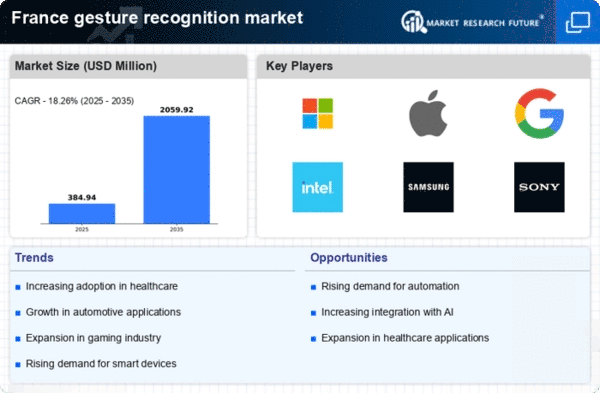
As per Market Research Future analysis, the France gesture recognition market size was estimated at 325.5 USD Million in 2024. The France gesture recognition market is projected to grow from 384.94 USD Million in 2025 to 2059.92 USD Million by 2035, exhibiting a compound annual growth rate (CAGR) of 18.2% during the forecast period 2025 - 2035

Key Market Trends & Highlights

The France gesture recognition market is experiencing robust growth driven by technological advancements and increasing demand for contactless interfaces.

  • The automotive sector emerges as the largest segment, showcasing a notable rise in gesture recognition applications.
  • Healthcare applications represent the fastest-growing segment, reflecting a shift towards innovative patient interaction methods.
  • Integration with smart home devices is becoming increasingly prevalent, enhancing user experience and convenience.
  • Technological advancements in gesture recognition and the rising demand for contactless interfaces are key drivers propelling market growth.

Market Size & Forecast

2024 Market Size 325.5 (USD Million)
2035 Market Size 2059.92 (USD Million)
CAGR (2025 - 2035) 18.26%

Major Players

Microsoft (US), Apple (US), Google (US), Intel (US), Samsung (KR), Sony (JP), GestureTek (CA), Leap Motion (US), 3D Systems (US)

Our Impact
Enabled $4.3B Revenue Impact for Fortune 500 and Leading Multinationals
Partnering with 2000+ Global Organizations Each Year
30K+ Citations by Top-Tier Firms in the Industry

France Gesture Recognition Market Trends

The gesture recognition market is currently experiencing notable growth, driven by advancements in technology and increasing demand for intuitive user interfaces. In France, the integration of gesture recognition systems into various sectors, including automotive, healthcare, and entertainment, appears to be gaining traction. This trend is likely influenced by the rising consumer preference for touchless interactions, which enhance user experience and accessibility. Furthermore, the French government’s support for innovation in technology may also play a crucial role in fostering the development of gesture recognition applications. As industries continue to explore the potential of this technology, the market is expected to evolve, offering new opportunities for businesses and consumers alike. In addition, the gesture recognition market is characterized by a growing emphasis on artificial intelligence and machine learning. These technologies are being utilized to improve the accuracy and efficiency of gesture recognition systems. In France, research institutions and tech companies are collaborating to develop sophisticated algorithms that can better interpret human gestures. This collaboration is likely to enhance the functionality of gesture recognition devices, making them more appealing to a broader audience. As the market matures, it may witness increased investment and innovation, further solidifying its position in the technology landscape.

Rising Adoption in Automotive Sector

The gesture recognition market is witnessing increased adoption within the automotive sector. Manufacturers seek to enhance driver safety and convenience by integrating gesture-based controls. By integrating gesture-based controls, vehicles can offer drivers a more intuitive way to interact with navigation and entertainment systems, potentially reducing distractions.

Growth in Healthcare Applications

There is a notable expansion of gesture recognition technology in healthcare settings, where it is being utilized for patient monitoring and rehabilitation. This trend suggests that healthcare providers are recognizing the benefits of touchless interfaces, which can improve hygiene and facilitate remote patient interactions.

Integration with Smart Home Devices

The gesture recognition market is also seeing a surge in integration with smart home devices. Consumers are increasingly interested in controlling their home environments through gestures, which may enhance convenience and accessibility. This trend indicates a shift towards more user-friendly home automation solutions.

France Gesture Recognition Market Drivers

Increased Demand for Contactless Interfaces

In France, The gesture recognition market is witnessing heightened demand for contactless interfaces. This trend is particularly evident in the wake of evolving consumer preferences. As individuals become more health-conscious, the desire for touchless technology in public spaces and personal devices is growing. This shift is evident in retail environments, where gesture recognition systems are being implemented to facilitate seamless transactions without physical contact. The market is expected to reach a valuation of €1 billion by 2026, reflecting a significant increase in investment in contactless solutions. This trend not only enhances user experience but also aligns with broader public health initiatives, positioning the gesture recognition market as a key player in the transition towards safer, more hygienic interactions.

Government Initiatives Supporting Innovation

In France, government initiatives aimed at fostering innovation are positively impacting the gesture recognition market. Various programs and funding opportunities are being introduced to support research and development in emerging technologies, including gesture recognition. These initiatives are designed to encourage collaboration between public and private sectors, facilitating the growth of startups and established companies alike. As a result, the gesture recognition market is likely to benefit from increased investment and innovation, potentially leading to breakthroughs in technology and applications. The French government has allocated €500 million towards digital transformation projects, which may include advancements in gesture recognition systems. This supportive environment is expected to stimulate growth and enhance the competitive landscape of the gesture recognition market.

Rising Interest in Augmented and Virtual Reality

The gesture recognition market in France is significantly influenced by the rising interest in augmented reality (AR) and virtual reality (VR) applications. As industries adopt these technologies, the need for effective gesture recognition systems becomes paramount. As industries such as gaming, education, and training adopt AR and VR technologies, the need for effective gesture recognition systems becomes paramount. These systems enable users to interact with virtual environments in a more immersive way, enhancing the overall experience. The market for AR and VR is expected to grow by 40% over the next five years, indicating a strong potential for gesture recognition technology to play a crucial role in these sectors. This trend suggests that as AR and VR applications become more mainstream, the gesture recognition market will likely expand in tandem, driven by the demand for more interactive and engaging user experiences.

Technological Advancements in Gesture Recognition

The gesture recognition market in France is experiencing a surge due to rapid technological advancements. Innovations in machine learning and artificial intelligence are enhancing the accuracy and efficiency of gesture recognition systems. This is particularly evident in sectors such as gaming and virtual reality, where immersive experiences are becoming increasingly popular. The market is projected to grow at a CAGR of approximately 25% from 2025 to 2030, driven by these technological improvements. As companies invest in research and development, the capabilities of gesture recognition systems are expanding, allowing for more sophisticated applications. This trend indicates a robust future for the gesture recognition market, as businesses seek to leverage these advancements to improve user interaction and engagement.

Expansion of Smart Technology in Consumer Electronics

The gesture recognition market is benefiting from the expansion of smart technology in consumer electronics. This trend is particularly evident across France. With the proliferation of smart TVs, wearables, and home automation systems, there is a growing need for intuitive control mechanisms. Gesture recognition technology allows users to interact with devices in a more natural and engaging manner. The market for smart home devices is projected to grow by 30% annually, creating a fertile ground for gesture recognition applications. This integration not only enhances user convenience but also drives the demand for advanced gesture recognition systems, as manufacturers seek to differentiate their products in a competitive landscape. Consequently, the gesture recognition market is poised for substantial growth as it aligns with the increasing adoption of smart technology.


Market Segment Insights

By Technology: 3D Gesture Technology (Largest) vs. 2D Gesture Technology (Fastest-Growing)

In the France gesture recognition market, 3D Gesture Technology dominates the market with a significant share, primarily due to its advanced capabilities and integration with various applications, making it a preferred choice for consumers and industries alike. In contrast, 2D Gesture Technology, while trailing in overall market share, displays notable growth potential as it becomes increasingly adopted in consumer electronics and interactive interfaces, showcasing the evolving landscape of gesture recognition. The growth trends in the technology segment are driven by innovations in sensor technology and increasing demand for touchless interaction solutions. The shift towards automation across various sectors has fueled interest in not only 3D Gesture Technology, which offers enhanced precision and user experience, but also in 2D systems that provide practical and cost-effective integration. As industries move towards more intuitive user interfaces, both segments are expected to see continued investment and development.

Gesture Technology: 3D (Dominant) vs. 2D (Emerging)

3D Gesture Technology stands out in the France gesture recognition market as the dominant force, characterized by its robust ability to interpret complex gestures and provide seamless interaction experiences. This technology integrates advanced sensors and algorithms to deliver precision, making it ideal for applications in gaming, virtual reality, and smart home devices. Conversely, 2D Gesture Technology is emerging as a viable alternative, particularly in consumer devices where simplicity and cost-effectiveness are prioritized. Although it currently holds a smaller market share, its growth trajectory is bolstered by the rising adoption of touchless controls in smartphones and home automation systems, thus presenting opportunities for innovation and market expansion.

By Application: Consumer Electronics (Largest) vs. Healthcare (Fastest-Growing)

The application segment of the France gesture recognition market shows a diverse distribution among various sectors. Consumer electronics holds a significant market share, driven by the increasing adoption of smart devices, where gesture recognition enhances user experience. In contrast, healthcare is rapidly catching up, leveraging gesture recognition for touchless interfaces in medical devices, thereby gaining traction among industries focused on patient care. Growth trends indicate a robust demand for gesture recognition technology in the healthcare sector, which is becoming the fastest-growing segment due to the rising need for non-contact solutions, especially post-pandemic. Additionally, the automotive sector follows suit with innovations integrating gesture control features in vehicles, enhancing safety and convenience. Overall, advancements in AI and machine learning are powerful drivers for growth across all application segments.

Consumer Electronics: Dominant vs. Healthcare: Emerging

Consumer electronics stands out as the dominant Application segment in the France gesture recognition market, substantially benefiting from the incorporation of gesture controls in devices such as smartphones, gaming consoles, and smart TVs. This segment is characterized by continuous innovation and a strong consumer demand for enhanced user engagement features. On the other hand, the healthcare segment is emerging as a vital player, utilizing gesture recognition for applications in telemedicine and surgical navigation systems. This shift towards non-contact solutions spurred by an increased focus on hygiene and safety measures has positioned healthcare as a promising area for future growth. As technology evolves, both segments are expected to experience significant advancements and transformations, catering to the needs of tech-savvy consumers and healthcare professionals.

By Product: Touchless (Largest) vs. Touch-Based (Fastest-Growing)

In the France gesture recognition market, the distribution of market share between touchless and touch-based technologies is distinct, with touchless solutions leading as the predominant choice for various applications. This preference stems from the increased demand for hygiene and contactless interactions, especially in public spaces and consumer electronics. Touch-based technologies, while they possess an established user base, represent a smaller portion of the market as users gravitate towards more modern, touchless options that offer enhanced convenience and safety. Growth trends in the segment reveal a significant shift towards touchless interfaces, driven by the rising adoption of smart devices and advancements in sensor technologies. The pandemic has accelerated this trend, prompting businesses to invest in touchless solutions to ensure user safety and enhance customer experiences. As technology advances, particularly in AI and machine learning, the capabilities of touchless gesture recognition will continue to expand, allowing for more sophisticated applications in various sectors.

Technology: Touchless (Dominant) vs. Touch-Based (Emerging)

Touchless gesture recognition technology is dominating the market due to its versatility and growing acceptance in sectors such as retail, healthcare, and smart home devices. This segment is characterized by sensors that detect hand movements without physical contact, offering a seamless user experience. On the other hand, touch-based technologies are emerging as complementary solutions, targeting specific applications where direct interaction remains prevalent. While touch-based systems are reliable and user-friendly, they face challenges in a landscape increasingly focused on hygiene and contactless solutions. As the demand for innovative user interfaces grows, the development and improvement of both technologies will play a crucial role in shaping the market dynamics.

Get more detailed insights about France Gesture Recognition Market

Key Players and Competitive Insights

The gesture recognition market in France is characterized by a dynamic competitive landscape, driven by rapid technological advancements and increasing demand for intuitive user interfaces across various sectors. Major players such as Microsoft (US), Apple (US), and Google (US) are at the forefront, leveraging their extensive resources to innovate and expand their market presence. Microsoft (US) focuses on integrating gesture recognition into its Azure cloud services, enhancing user engagement through immersive experiences. Meanwhile, Apple (US) emphasizes the development of gesture-based controls in its ecosystem, particularly within augmented reality (AR) applications, thereby solidifying its position in the consumer electronics segment. Google (US) is also making strides by incorporating gesture recognition into its smart home devices, aiming to create seamless interactions within its product suite. Collectively, these strategies indicate a trend towards creating interconnected ecosystems that enhance user experience and drive market growth.In terms of business tactics, companies are increasingly localizing manufacturing and optimizing supply chains to enhance efficiency and reduce costs. The competitive structure of the market appears moderately fragmented, with a mix of established players and emerging startups vying for market share. This fragmentation allows for diverse innovation pathways, as smaller firms often introduce niche technologies that challenge the status quo. The collective influence of these key players shapes a competitive environment where agility and responsiveness to market demands are crucial.

In October Microsoft (US) announced a partnership with a leading French automotive manufacturer to integrate gesture recognition technology into their next-generation vehicles. This collaboration is strategically significant as it positions Microsoft (US) to tap into the burgeoning automotive technology sector, where gesture control is becoming increasingly relevant for enhancing driver safety and convenience. Such partnerships not only expand Microsoft's market reach but also reinforce its commitment to innovation in diverse applications.

In September Apple (US) unveiled a new gesture recognition feature for its latest iPhone model, allowing users to control various functions through hand movements. This development is pivotal as it showcases Apple's dedication to enhancing user interaction and maintaining its competitive edge in the smartphone market. By prioritizing gesture-based controls, Apple (US) is likely to attract tech-savvy consumers who seek advanced functionalities in their devices.

In August Google (US) launched an updated version of its smart home hub, incorporating advanced gesture recognition capabilities that allow users to control devices with simple hand motions. This move is indicative of Google's strategy to create a more integrated smart home experience, potentially increasing user engagement and satisfaction. By enhancing the functionality of its products, Google (US) aims to solidify its position in the competitive smart home market.

As of November current trends in the gesture recognition market are heavily influenced by digitalization, sustainability, and the integration of artificial intelligence (AI). Strategic alliances among key players are shaping the landscape, fostering innovation and collaboration. The shift from price-based competition to a focus on technological advancement and supply chain reliability is evident, suggesting that future competitive differentiation will hinge on the ability to innovate and adapt to evolving consumer preferences. Companies that prioritize these aspects are likely to thrive in an increasingly complex market.

Key Companies in the France Gesture Recognition Market include

Industry Developments

The France Gesture Recognition Market has seen significant developments recently, particularly with advancements by major players such as NVIDIA, Google, and Apple, focusing on improving user interaction capabilities. In July 2023, Microsoft launched a new version of its gesture recognition technology that enhances user experiences in both gaming and design sectors in France, reflecting the growing demand for intuitive interfaces. The market has also witnessed ongoing investments, as Samsung announced expansions in its R&D efforts in Paris to explore innovative gesture recognition applications for smart home devices. An important trend includes the increasing integration of artificial intelligence by companies like IBM and Qualcomm, enhancing the accuracy of gesture recognition systems across various sectors in France, from healthcare to automotive.

In terms of mergers and acquisitions, no substantial transactions involving firms such as Intel or Sony have been publicly reported in recent months; however, the atmosphere remains charged as the market is expected to grow as technologies evolve. French government initiatives to foster technology startup ecosystems are likely to further stimulate advancements in this field as well. Additionally, 3D Systems has been making strides in integrating gesture technologies within its 3D printing solutions since 2021, which reflects a broader trend towards seamless device interactions.

Future Outlook

France Gesture Recognition Market Future Outlook

The Gesture Recognition Market is projected to grow at an 18.26% CAGR from 2025 to 2035. This growth is driven by advancements in AI, increasing demand for touchless interfaces, and expanding applications in various sectors.

New opportunities lie in:

  • Development of gesture-controlled smart home devices
  • Integration of gesture recognition in automotive safety systems
  • Expansion of gesture-based interfaces in healthcare applications

By 2035, the gesture recognition market is expected to achieve substantial growth and innovation.

Market Segmentation

France Gesture Recognition Market Product Outlook

  • Touchless
  • Touch-Based

France Gesture Recognition Market Technology Outlook

  • Sensor
  • 2D Gesture Technology
  • 3D Gesture Technology

France Gesture Recognition Market Application Outlook

  • Automotive
  • Healthcare
  • Consumer Electronics
  • Transportation
  • Commercial
  • IT/Telecom

Report Scope

MARKET SIZE 2024 325.5(USD Million)
MARKET SIZE 2025 384.94(USD Million)
MARKET SIZE 2035 2059.92(USD Million)
COMPOUND ANNUAL GROWTH RATE (CAGR) 18.26% (2025 - 2035)
REPORT COVERAGE Revenue Forecast, Competitive Landscape, Growth Factors, and Trends
BASE YEAR 2024
Market Forecast Period 2025 - 2035
Historical Data 2019 - 2024
Market Forecast Units USD Million
Key Companies Profiled Microsoft (US), Apple (US), Google (US), Intel (US), Samsung (KR), Sony (JP), GestureTek (CA), Leap Motion (US), 3D Systems (US)
Segments Covered Technology, Application, Product
Key Market Opportunities Integration of gesture recognition in smart home devices enhances user experience and accessibility.
Key Market Dynamics Rising demand for touchless interfaces drives innovation in gesture recognition technology across various sectors.
Countries Covered France
Leave a Comment

FAQs

What is the estimated market size of the France Gesture Recognition Market in 2024?

The France Gesture Recognition Market is expected to be valued at 217.0 million USD in 2024.

What will be the projected market value of the France Gesture Recognition Market by 2035?

By 2035, the France Gesture Recognition Market is projected to reach a value of 1030.0 million USD.

What is the expected CAGR for the France Gesture Recognition Market from 2025 to 2035?

The market is anticipated to grow at a CAGR of 15.21% during the period from 2025 to 2035.

Which technology segment is projected to have the highest market value in 2035?

In 2035, the 2D Gesture Technology segment is expected to be valued at 360.0 million USD, making it the highest segment.

What market value is projected for the Sensor technology segment in 2035?

The Sensor technology segment is projected to reach a market value of 315.0 million USD by 2035.

Who are the major competitors in the France Gesture Recognition Market?

Key players in the market include NVIDIA, Google, Apple, Samsung, and Microsoft, among others.

What is the expected market value for 3D Gesture Technology in 2035?

The 3D Gesture Technology segment is expected to be valued at 355.0 million USD by the year 2035.

What growth opportunities exist for the France Gesture Recognition Market?

Growth opportunities in the market stem from increasing applications in consumer electronics and gaming.

What is the anticipated market growth rate for France during the forecast period?

The France Gesture Recognition Market is expected to experience robust growth at an annual rate of 15.21% from 2025 to 2035.

What are some of the key applications of gesture recognition technology?

Key applications include use in gaming, virtual reality, smart home devices, and automotive systems.

Download Free Sample

Kindly complete the form below to receive a free sample of this Report

Compare Licence

×
Features License Type
Single User Multiuser License Enterprise User
Price $4,950 $5,950 $7,250
Maximum User Access Limit 1 User Upto 10 Users Unrestricted Access Throughout the Organization
Free Customization
Direct Access to Analyst
Deliverable Format
Platform Access
Discount on Next Purchase 10% 15% 15%
Printable Versions