×
Request Free Sample ×

Kindly complete the form below to receive a free sample of this Report

* Please use a valid business email

Leading companies partner with us for data-driven Insights

clients tt-cursor
Hero Background

France Circulating Tumor Cell Market

ID: MRFR/LS/54656-HCR
200 Pages
Garvit Vyas
February 2026

France Circulating Tumor Cell Market Research Report By Technology (Research and Drug Development, CTC Enrichment, CTC Detection) and By End-users (Hospital & Clinics, Research & Academic Institutes, Diagnostic Centers) - Growth & Industry Forecast 2025 To 2035

Share:
Download PDF ×

We do not share your information with anyone. However, we may send you emails based on your report interest from time to time. You may contact us at any time to opt-out.

France Circulating Tumor Cell Market Infographic
Purchase Options

France Circulating Tumor Cell Market Summary

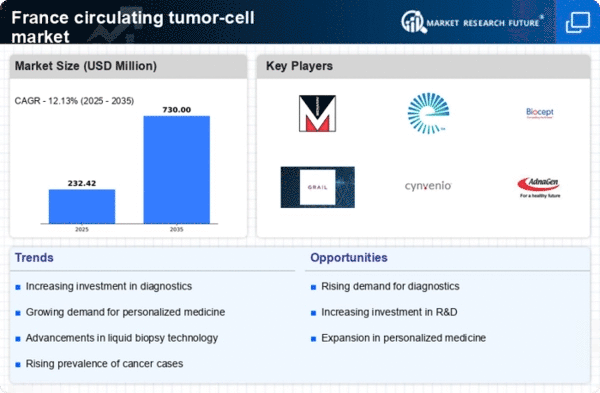
As per Market Research Future analysis, the France circulating tumor-cell market size was estimated at 207.28 USD Million in 2024. The France circulating tumor-cell market is projected to grow from 232.42 USD Million in 2025 to 730.0 USD Million by 2035, exhibiting a compound annual growth rate (CAGR) of 12.1% during the forecast period 2025 - 2035

Key Market Trends & Highlights

The France circulating tumor-cell market is poised for growth driven by technological advancements and increasing cancer incidence.

  • Technological advancements in liquid biopsy are enhancing the accuracy of circulating tumor-cell detection.
  • Regulatory support for innovative solutions is fostering a conducive environment for market expansion.
  • Collaborative research initiatives are driving innovation and knowledge sharing within the industry.
  • The rising incidence of cancer and advancements in diagnostic technologies are key drivers propelling market growth.

Market Size & Forecast

2024 Market Size 207.28 (USD Million)
2035 Market Size 730.0 (USD Million)
CAGR (2025 - 2035) 12.13%

Major Players

Menarini Silicon Biosystems (IT), Epic Sciences (US), Biocept (US), GRAIL (US), Cynvenio Biosystems (US), Adnagen (DE), OncoOne (CH), CureMetrix (US)

Our Impact
Enabled $4.3B Revenue Impact for Fortune 500 and Leading Multinationals
Partnering with 2000+ Global Organizations Each Year
30K+ Citations by Top-Tier Firms in the Industry

France Circulating Tumor Cell Market Trends

The circulating tumor-cell market is experiencing notable advancements, particularly in France, where innovative technologies are being developed to enhance cancer diagnostics and treatment monitoring. The integration of liquid biopsy techniques is gaining traction, allowing for non-invasive detection of tumor cells in the bloodstream. This method not only improves patient comfort but also provides real-time insights into tumor dynamics, which could lead to more personalized treatment approaches. Furthermore, the regulatory environment in France appears to be supportive of these innovations, fostering a conducive atmosphere for research and development in this field. In addition, collaborations between academic institutions and biotechnology firms are becoming increasingly common, suggesting a trend towards a more integrated approach to cancer care. These partnerships may facilitate the translation of laboratory findings into clinical applications, thereby accelerating the availability of new diagnostic tools and therapies. As the demand for early detection and monitoring of cancer continues to rise, the circulating tumor-cell market is likely to expand, driven by technological advancements and a growing emphasis on precision medicine. This evolution may ultimately lead to improved patient outcomes and a more efficient healthcare system.

Technological Advancements in Liquid Biopsy

Recent developments in liquid biopsy technologies are transforming the landscape of the circulating tumor-cell market. These innovations enable the detection of tumor cells in blood samples, offering a less invasive alternative to traditional biopsy methods. The potential for real-time monitoring of cancer progression and treatment response is particularly appealing, as it aligns with the growing demand for personalized medicine.

Regulatory Support for Innovative Solutions

The regulatory framework in France is evolving to accommodate new technologies in the circulating tumor-cell market. Authorities are increasingly recognizing the importance of liquid biopsies and other advanced diagnostic tools. This supportive environment may encourage investment and research, ultimately leading to faster market entry for innovative solutions.

Collaborative Research Initiatives

Collaborations between academic institutions and industry players are becoming more prevalent in the circulating tumor-cell market. These partnerships aim to bridge the gap between research and clinical application, facilitating the development of novel diagnostic and therapeutic strategies. Such initiatives may enhance the overall effectiveness of cancer care in France.

France Circulating Tumor Cell Market Drivers

Rising Incidence of Cancer

The increasing incidence of cancer in France is a primary driver for the circulating tumor-cell market. According to recent statistics, cancer cases are projected to rise by approximately 2.5% annually, leading to a heightened demand for advanced diagnostic tools. This trend is particularly evident in urban areas where lifestyle factors contribute to higher cancer rates. As healthcare providers seek more effective methods for early detection and monitoring, the circulating tumor-cell market is likely to experience significant growth. The ability to detect cancer at an earlier stage can potentially improve patient outcomes, thereby driving investments in innovative technologies. Consequently, the market is expected to expand as healthcare systems adapt to the growing need for efficient cancer management solutions.

Regulatory Framework Enhancements

The evolving regulatory landscape in France is playing a crucial role in shaping the circulating tumor-cell market. Recent enhancements in regulatory frameworks are aimed at expediting the approval process for innovative diagnostic tools. This is particularly relevant for liquid biopsy technologies, which are gaining traction due to their non-invasive nature. The French government is actively promoting policies that support the development and commercialization of advanced diagnostic solutions. As a result, the market is expected to witness a surge in new product launches and increased competition among key players. By fostering a conducive environment for innovation, these regulatory changes are likely to drive growth in the circulating tumor-cell market, ultimately benefiting patients through improved diagnostic options.

Advancements in Diagnostic Technologies

Technological innovations in diagnostic methods are significantly influencing the circulating tumor-cell market. The development of more sensitive and specific assays has enhanced the ability to detect circulating tumor cells in blood samples. For instance, the introduction of microfluidic technologies and next-generation sequencing has improved the accuracy of liquid biopsies. These advancements are crucial as they allow for non-invasive monitoring of cancer progression and treatment response. In France, the market for these technologies is projected to grow by over 15% annually, reflecting the increasing adoption of liquid biopsy techniques in clinical settings. As healthcare providers recognize the benefits of these advanced diagnostic tools, the demand for circulating tumor-cell solutions is expected to rise, further propelling market growth.

Increased Investment in Cancer Research

The circulating tumor-cell market is benefiting from increased investment in cancer research initiatives across France. Government funding and private sector investments are being directed towards innovative cancer therapies and diagnostic solutions. In 2025, it is estimated that research funding for cancer-related projects will exceed €1 billion, with a significant portion allocated to the development of liquid biopsy technologies. This influx of capital is likely to accelerate the pace of innovation within the circulating tumor-cell market, fostering collaborations between academic institutions and industry players. As new discoveries emerge, the market is expected to expand, providing healthcare professionals with advanced tools for cancer detection and management.

Growing Awareness of Personalized Medicine

The shift towards personalized medicine is reshaping the landscape of the circulating tumor-cell market. Patients and healthcare providers are increasingly recognizing the importance of tailored treatment approaches based on individual tumor characteristics. This trend is driving demand for circulating tumor-cell technologies that facilitate the identification of specific biomarkers. In France, the market is projected to grow by approximately 12% annually as healthcare systems integrate personalized medicine into standard practice. The ability to customize treatment plans based on circulating tumor-cell analysis not only enhances therapeutic efficacy but also minimizes adverse effects, making it a compelling option for cancer management. As awareness continues to grow, the circulating tumor-cell market is likely to see sustained expansion.


Market Segment Insights

By Type: Research (Largest) vs. Drug Development (Fastest-Growing)

In the France circulating tumor-cell market, research holds the largest share, driven by increasing investments in cancer research initiatives. This segment benefits from a rising number of collaborations between academic institutions and biotech firms, enhancing research capabilities. On the other hand, the drug development segment is gaining momentum with a focus on personalized medicine, which is expected to catalyze significant innovation and growth. The strategic emphasis on developing targeted therapies for specific cancer types is reshaping the dynamics across the market. Factors driving the growth of both segments include advancements in molecular biology and enhanced understanding of tumor biology. As technology progresses, there is a noticeable shift towards integrating circulating tumor-cell analysis in routine diagnostics and treatment plans. This synergy is crucial for improving patient outcomes and is a testament to the evolving landscape within the France circulating tumor-cell market, where the focus on both research and drug development is increasingly vital.

Research (Dominant) vs. Drug Development (Emerging)

Research within the France circulating tumor-cell market is marked by collaboration between academic researchers and pharmaceutical companies, focusing on understanding cancer progression and treatment responses. This segment plays a critical role in identifying various tumor markers, which significantly aids in early detection and monitoring of cancer. In contrast, drug development is emerging as a dynamic segment, spurred by the burgeoning field of targeted therapies that rely on detailed tumor profiling. This segment aims to innovate treatment modalities that can effectively address the unique characteristics of individual tumors. While research lays the foundational knowledge for breakthroughs, drug development takes that knowledge and turns it into practical solutions that benefit patient care, highlighting a symbiotic relationship between the two segments.

By Technology: CTC Enrichment (Largest) vs. CTC Detection (Fastest-Growing)

In the France circulating tumor-cell market, the market share is primarily dominated by CTC Enrichment, reflecting its critical role in isolating tumor cells from the bloodstream. This technology leverages advanced methodologies to ensure high extraction efficiency, making it indispensable for ensuring accuracy in diagnostic procedures. Conversely, CTC Detection has emerged as a significant player, capturing increasing attention from healthcare providers due to its pivotal role in monitoring disease progression and treatment response. Growth trends highlight a rising demand for precision medicine, which drives innovations in both segments. CTC Enrichment continues to benefit from technological advancements enhancing its efficiency and reliability. Meanwhile, CTC Detection is experiencing rapid expansion, fueled by increasing investments in cancer research and the urgent need for non-invasive diagnostic tools. The convergence of these trends enhances their significance in the broader healthcare landscape.

Technology: CTC Enrichment (Dominant) vs. CTC Detection (Emerging)

CTC Enrichment has established itself as the dominant technology in the France circulating tumor-cell market due to its unparalleled effectiveness in isolating circulating tumor cells, which is essential for early detection and treatment planning. It has become a preferred choice among clinicians, who prioritize accuracy and reliability in cancer diagnostics. On the other hand, CTC Detection represents an emerging segment, showing significant growth potential as healthcare continually leans toward non-invasive testing methods. This technology plays a crucial role in real-time monitoring of patients' responses to therapies, thus adapting treatment approaches as necessary. Both technologies are essential, with Enrichment focusing on extraction and Detection enhancing patient management and outcomes.

By End User: Hospitals & Clinics (Largest) vs. Research & Academic Institutes (Fastest-Growing)

In the France circulating tumor-cell market, Hospitals & Clinics hold the largest market share, driven by their extensive patient base and the increasing adoption of advanced diagnostic techniques. Research & Academic Institutes follow, with significant contributions to market advancements through innovative studies and collaborations, but they account for a smaller portion of overall demand compared to Hospitals & Clinics. The growth trends in this segment are influenced by several factors, including rising cancer incidences and the push for precision medicine. Hospitals & Clinics are upgrading their capabilities while Research & Academic Institutes are rapidly evolving as they focus on developing novel therapies and diagnostic markers. This dynamic landscape highlights a growing demand for circulating tumor-cell technologies that support both patient care and research initiatives.

Hospitals & Clinics (Dominant) vs. Research & Academic Institutes (Emerging)

Hospitals & Clinics represent the dominant force in the France circulating tumor-cell market, characterized by their ability to offer a range of diagnostic and therapeutic services under one roof. They benefit from integrated healthcare systems that facilitate quick access to advanced technologies. In contrast, Research & Academic Institutes are emerging players, focusing on cutting-edge research and the development of innovative techniques. These institutes are critical in fostering collaborations with pharmaceutical companies and driving breakthroughs in cancer research, thereby contributing to the overall advancement of the circulating tumor-cell landscape. Their agility and focus on innovation position them well to meet the future demands of personalized medicine.

Get more detailed insights about France Circulating Tumor Cell Market

Key Players and Competitive Insights

The circulating tumor-cell market in France is characterized by a dynamic competitive landscape, driven by advancements in technology and increasing demand for early cancer detection. Key players are actively engaging in strategic initiatives to enhance their market presence and operational capabilities. Companies such as Menarini Silicon Biosystems (IT), Epic Sciences (US), and Biocept (US) are at the forefront, focusing on innovation and partnerships to solidify their positions. Menarini Silicon Biosystems (IT) emphasizes technological advancements in liquid biopsy solutions, while Epic Sciences (US) is leveraging its proprietary platform for biomarker discovery, indicating a trend towards personalized medicine. Collectively, these strategies contribute to a competitive environment that is increasingly focused on innovation and collaboration.In terms of business tactics, companies are localizing manufacturing and optimizing supply chains to enhance efficiency and responsiveness to market demands. The market structure appears moderately fragmented, with several players vying for market share. However, the influence of key players is substantial, as they set benchmarks for quality and innovation, thereby shaping the overall market dynamics.

In October Menarini Silicon Biosystems (IT) announced a strategic partnership with a leading French research institution to develop next-generation liquid biopsy technologies. This collaboration is poised to enhance the company's R&D capabilities and accelerate the introduction of innovative diagnostic solutions, thereby reinforcing its competitive edge in the market. The partnership underscores the importance of academic collaboration in driving technological advancements.

In September Epic Sciences (US) launched a new biomarker assay aimed at improving the detection of circulating tumor cells in breast cancer patients. This launch is significant as it not only expands the company's product portfolio but also addresses a critical need for more accurate diagnostic tools in oncology. The introduction of this assay may enhance patient outcomes and solidify Epic's reputation as a leader in precision medicine.

In August Biocept (US) secured a strategic investment to expand its operational capabilities in Europe, particularly in France. This investment is likely to facilitate the scaling of its liquid biopsy services, allowing for greater accessibility and improved patient care. The move reflects a broader trend of companies seeking to enhance their operational footprint in key markets, thereby increasing their competitive advantage.

As of November current trends in the circulating tumor-cell market include a strong emphasis on digitalization, sustainability, and the integration of artificial intelligence in diagnostic processes. Strategic alliances are increasingly shaping the competitive landscape, enabling companies to pool resources and expertise. Looking ahead, it appears that competitive differentiation will evolve from traditional price-based strategies to a focus on innovation, technological advancements, and supply chain reliability. This shift may redefine how companies compete, emphasizing the importance of delivering high-quality, cutting-edge solutions to meet the growing demands of the healthcare sector.

Key Companies in the France Circulating Tumor Cell Market include

Industry Developments

In recent developments within the France Circulating Tumor Cell Market, significant advancements have been noted in technologies aimed at early cancer detection and personalized medicine, reflecting a growing emphasis on non-invasive diagnostics. Key players like Roche and Thermo Fisher Scientific have announced collaborations to improve the sensitivity and specificity of tumor cell detection methods, enhancing their respective product offerings in France.

Additionally, Janssen Biotech and Epic Sciences have been working on integrating liquid biopsy techniques that leverage circulating tumor cells for better treatment monitoring. The market has also seen impactful growth in valuation, driven by increased investment in Research and Development initiatives, particularly from companies like Menarini Silicon Biosystems and Cynvenio, enhancing their capabilities in the French healthcare system.

Over the past couple of years, notable mergers and acquisitions have included Roche's acquisition of certain diagnostic technologies in March 2022, solidifying its position in the tumor diagnostics segment. The overall market landscape is shifting towards more innovative solutions, enabling healthcare providers in France to deliver better patient outcomes through timely interventions based on circulating tumor cell analysis.

Future Outlook

France Circulating Tumor Cell Market Future Outlook

The Circulating Tumor Cell Market in France is projected to grow at a 12.13% CAGR from 2025 to 2035, driven by advancements in diagnostic technologies and increasing cancer prevalence.

New opportunities lie in:

  • Development of advanced liquid biopsy technologies for early cancer detection.
  • Partnerships with healthcare providers for integrated diagnostic solutions.
  • Expansion of personalized medicine approaches utilizing circulating tumor-cell analysis.

By 2035, the market is expected to achieve substantial growth, positioning itself as a leader in cancer diagnostics.

Market Segmentation

France Circulating Tumor Cell Market Type Outlook

  • Research
  • Drug Development

France Circulating Tumor Cell Market End User Outlook

  • Hospitals & Clinics
  • Research & Academic Institutes
  • Diagnostic Centers

France Circulating Tumor Cell Market Technology Outlook

  • CTC Enrichment
  • CTC Detection

Report Scope

MARKET SIZE 2024207.28(USD Million)
MARKET SIZE 2025232.42(USD Million)
MARKET SIZE 2035730.0(USD Million)
COMPOUND ANNUAL GROWTH RATE (CAGR)12.13% (2025 - 2035)
REPORT COVERAGERevenue Forecast, Competitive Landscape, Growth Factors, and Trends
BASE YEAR2024
Market Forecast Period2025 - 2035
Historical Data2019 - 2024
Market Forecast UnitsUSD Million
Key Companies ProfiledMenarini Silicon Biosystems (IT), Epic Sciences (US), Biocept (US), GRAIL (US), Cynvenio Biosystems (US), Adnagen (DE), OncoOne (CH), CureMetrix (US)
Segments CoveredType, Technology, End User
Key Market OpportunitiesAdvancements in liquid biopsy technologies enhance early cancer detection in the circulating tumor-cell market.
Key Market DynamicsRising demand for non-invasive diagnostics drives innovation in circulating tumor-cell technologies and competitive market strategies.
Countries CoveredFrance
Leave a Comment

FAQs

What is the expected market size of the France Circulating Tumor Cell Market in 2024?

The France Circulating Tumor Cell Market is expected to be valued at 276.5 million USD in 2024.

What will be the market value of the France Circulating Tumor Cell Market by 2035?

By 2035, the France Circulating Tumor Cell Market is projected to reach a value of 1042.8 million USD.

What is the expected compound annual growth rate (CAGR) for the France Circulating Tumor Cell Market from 2025 to 2035?

The market is expected to experience a CAGR of 12.826% from 2025 to 2035.

Which technology segments are expected to generate significant revenue in the France Circulating Tumor Cell Market?

The segments of Research and Drug Development, CTC Enrichment, and CTC Detection are anticipated to generate significant revenue.

What is the forecasted market size for the Research and Drug Development segment by 2035?

The Research and Drug Development segment is forecasted to be valued at 415.0 million USD by 2035.

What are the expected values for the CTC Enrichment segment in 2024 and 2035?

The CTC Enrichment segment is expected to be valued at 90.0 million USD in 2024 and 331.0 million USD by 2035.

What is the anticipated market size for the CTC Detection segment in 2035?

The CTC Detection segment is projected to reach a value of 296.8 million USD by 2035.

Who are the major players in the France Circulating Tumor Cell Market?

Major players in the market include Janssen Biotech, Menarini Silicon Biosystems, Roche, and Thermo Fisher Scientific, among others.

How is the France Circulating Tumor Cell Market expected to grow regionally?

The market is expected to grow robustly across France, in alignment with advancements in cancer diagnostics and treatments.

What key trends are likely to drive the growth of the France Circulating Tumor Cell Market?

Key trends include increased investment in cancer research, technological advancements in CTC detection, and rising awareness among healthcare providers.

Download Free Sample

Kindly complete the form below to receive a free sample of this Report

Compare Licence

×
Features License Type
Single User Multiuser License Enterprise User
Price $4,950 $5,950 $7,250
Maximum User Access Limit 1 User Upto 10 Users Unrestricted Access Throughout the Organization
Free Customization
Direct Access to Analyst
Deliverable Format
Platform Access
Discount on Next Purchase 10% 15% 15%
Printable Versions