×
Request Free Sample ×

Kindly complete the form below to receive a free sample of this Report

* Please use a valid business email

Leading companies partner with us for data-driven Insights

clients tt-cursor
Hero Background

France Car T Cell Therapy Market

ID: MRFR/Pharma/48111-HCR
200 Pages
Garvit Vyas
February 2026

France CAR T Cell Therapy Market Research Report By Therapeutic Area (Oncology, Autoimmune Diseases, Infectious Diseases), By Cell Source (Autologous, Allogeneic, Gene-Edited), By Indication (Acute Lymphoblastic Leukemia, Non-Hodgkin Lymphoma, Multiple Myeloma), andBy End-user (Hospitals, Research Institutes, Cancer Treatment Centers) - Growth & Industry Forecast 2025 To 2035

Share:
Download PDF ×

We do not share your information with anyone. However, we may send you emails based on your report interest from time to time. You may contact us at any time to opt-out.

France Car T Cell Therapy Market Infographic
Purchase Options

France Car T Cell Therapy Market Summary

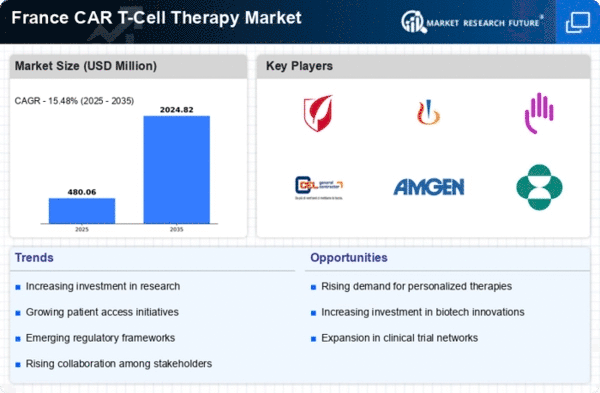
As per Market Research Future analysis, the France CAR T-Cell Therapy Market Size was estimated at 415.71 USD Million in 2024. The France car t-cell-therapy market is projected to grow from 480.06 USD Million in 2025 to 2024.82 USD Million (by 2035) by 2035, exhibiting a compound annual growth rate (CAGR) of 15.4% during the forecast period 2025 - 2035

Key Market Trends & Highlights

The France car T-cell therapy market is poised for substantial growth driven by innovation and increasing demand for personalized medicine.

  • Regulatory support and innovation are shaping the landscape of the car T-cell therapy market in France.
  • The largest segment in this market is the oncology sector, while the fastest-growing segment appears to be hematological malignancies.
  • Collaborative research initiatives are fostering advancements in treatment options and expanding market reach.
  • Key drivers include advancements in CAR T-cell technology and increasing incidence of cancer, which are likely to propel market growth.

Market Size & Forecast

2024 Market Size 415.71 (USD Million)
2035 Market Size 2024.82 (USD Million) (by 2035) (by 2035)
CAGR (2025 - 2035) 15.48%

Major Players

Gilead Sciences (US), Novartis (CH), Bristol-Myers Squibb (US), Celgene (US), Amgen (US), Merck & Co (US), AstraZeneca (GB), Janssen Pharmaceuticals (US), Bluebird Bio (US)

Our Impact
Enabled $4.3B Revenue Impact for Fortune 500 and Leading Multinationals
Partnering with 2000+ Global Organizations Each Year
30K+ Citations by Top-Tier Firms in the Industry

France Car T Cell Therapy Market Trends

The car t-cell-therapy market is currently experiencing notable advancements, driven by increasing investments in research and development. This sector is characterized by a growing number of clinical trials aimed at enhancing treatment efficacy and patient outcomes. Regulatory bodies in France are actively facilitating the approval process for innovative therapies, which may lead to a more robust market environment. Furthermore, collaborations between academic institutions and biotechnology firms are fostering innovation, potentially resulting in novel therapies that could address unmet medical needs. In addition, the rising prevalence of hematological malignancies is propelling demand for effective treatment options. The car t-cell-therapy market appears to be on a trajectory of growth, as healthcare providers increasingly recognize the potential of these therapies. Moreover, patient advocacy groups are playing a crucial role in raising awareness and supporting access to these advanced treatments. As the landscape evolves, it is likely that the market will continue to expand, driven by technological advancements and a commitment to improving patient care.

Regulatory Support and Innovation

Regulatory agencies in France are streamlining the approval process for car t-cell therapies, which may encourage the introduction of new treatments. This supportive environment is likely to foster innovation, as companies are motivated to invest in research and development.

Rising Demand for Personalized Medicine

There is a growing trend towards personalized medicine within the car t-cell-therapy market. Tailored therapies that target specific patient profiles are becoming more prevalent, reflecting a shift in treatment paradigms that prioritize individualized care.

Collaborative Research Initiatives

Collaborations between academic institutions and industry players are increasingly common in the car t-cell-therapy market. These partnerships are expected to enhance research capabilities and accelerate the development of novel therapies, potentially leading to breakthroughs in treatment.

France Car T Cell Therapy Market Drivers

Government Funding and Support

Government funding and support for cancer research and treatment are pivotal in shaping the car t-cell-therapy market. The French government has allocated substantial resources to enhance cancer care, including initiatives aimed at promoting innovative therapies. In 2025, funding for cancer research is projected to exceed €500 million, with a significant portion directed towards CAR T-cell therapy development. This financial backing not only facilitates clinical trials but also encourages collaboration between academic institutions and biotech companies. As a result, the car t-cell-therapy market is likely to benefit from increased research output and accelerated product development, ultimately improving patient access to cutting-edge therapies.

Increasing Incidence of Cancer

The rising incidence of cancer in France is a critical driver for the car t-cell-therapy market. According to recent statistics, cancer cases are expected to rise by 2.5% annually, leading to a growing patient population in need of innovative treatments. CAR T-cell therapies have shown remarkable success in treating certain types of blood cancers, such as acute lymphoblastic leukemia and non-Hodgkin lymphoma. This increasing prevalence of cancer is likely to propel the demand for CAR T-cell therapies, as healthcare providers seek effective solutions to combat these diseases. Consequently, the car t-cell-therapy market is anticipated to expand significantly, with an estimated market size of €1.2 billion by 2025, driven by the urgent need for advanced treatment options.

Emergence of Targeted Therapies

The emergence of targeted therapies is reshaping the landscape of the car t-cell-therapy market. As the medical community increasingly recognizes the limitations of traditional treatments, there is a growing shift towards personalized and targeted approaches. CAR T-cell therapies, which are designed to specifically target cancer cells, align well with this trend. The market is witnessing a surge in the development of CAR T-cell products tailored to individual patient profiles, enhancing treatment effectiveness. This shift is likely to contribute to a market growth rate of approximately 15% annually, as more patients seek personalized treatment options. Consequently, the car t-cell-therapy market is expected to thrive in this evolving therapeutic environment.

Advancements in CAR T-Cell Technology

The car t-cell-therapy market is experiencing rapid advancements in technology, which significantly enhances treatment efficacy. Innovations in genetic engineering and cell processing techniques are leading to more effective therapies. For instance, the development of next-generation CAR T-cells, which can target multiple antigens, is gaining traction. This technological evolution is expected to increase the market's value, projected to reach approximately €1.5 billion by 2026 in France. Furthermore, these advancements are likely to improve patient outcomes, thereby driving demand for CAR T-cell therapies in various hematological malignancies and solid tumors. As a result, the car t-cell-therapy market is poised for substantial growth, reflecting the ongoing commitment to research and development in this field.

Growing Awareness and Acceptance of CAR T-Cell Therapies

The growing awareness and acceptance of CAR T-cell therapies among healthcare professionals and patients are driving the car t-cell-therapy market. Educational initiatives and outreach programs have significantly improved understanding of these therapies' benefits and potential risks. As more oncologists become familiar with CAR T-cell treatments, the likelihood of their adoption in clinical practice increases. Surveys indicate that approximately 70% of oncologists in France are now more inclined to recommend CAR T-cell therapies to eligible patients. This shift in perception is expected to enhance market growth, as increased acceptance leads to higher treatment rates and, consequently, a larger market share for CAR T-cell therapies.

Market Segment Insights

By Therapeutic Area: Oncology (Largest) vs. Autoimmune Diseases (Fastest-Growing)

The France car t-cell-therapy market sees a significant portion attributed to Oncology, which emerges as the largest therapeutic area, holding a substantial market share. Autoimmune Diseases follow closely, showcasing notable growth potential as the demand for innovative treatments rises. Infectious Diseases, while present, represent a smaller fraction of the overall market distribution and are positioned for gradual growth. Growth trends in the therapeutic areas indicate a robust inclination towards Oncology due to increasing incidences of cancer and advancements in CAR-T therapies targeting diverse cancers. In contrast, Autoimmune Diseases are gaining traction as breakthrough therapies develop, driven by a growing understanding of these conditions. Supportive regulatory environments and increasing healthcare investments will further fuel market expansion across these therapeutic areas.

Oncology: Dominant vs. Autoimmune Diseases: Emerging

Oncology remains the dominant segment in the France car t-cell-therapy market, characterized by its extensive research and development initiatives aimed at combating various types of cancers. The high demand for effective cancer treatments, coupled with successful clinical outcomes from CAR-T therapies, has established a strong foothold in this segment. On the other hand, Autoimmune Diseases are classified as an emerging segment with rapid growth potential. A shift in focus towards autoimmune conditions fosters innovation and develops targeted therapies that address patient-specific needs. The increase in autoimmune disease prevalence and heightened awareness of these disorders contribute to the expanding market opportunities, positioning it as a critical area for future investments and advancements.

By Cell Source: Autologous (Largest) vs. Gene-Edited (Fastest-Growing)

In the France car t-cell-therapy market, the distribution among the primary cell sources reveals that autologous therapies hold the largest share, significantly surpassing allogeneic and gene-edited sources. Autologous therapies are preferred due to their personalized nature and proven clinical effectiveness, resulting in a strong adoption among healthcare providers and patients. Conversely, allogeneic and gene-edited segments, while smaller, show promising growth as researchers explore new methodologies and their potential applications. The growth trends in this segment are driven by advancements in gene editing technologies and increasing investments from biotech firms. The gene-edited segment, although currently smaller in market share, is growing at an accelerating pace. Innovations aimed at enhancing efficacy and reducing side effects are particularly encouraging for clinicians seeking better treatment solutions. Moreover, the rising number of clinical trials focused on these emerging therapies is indicative of a shift in the treatment landscape of the France car t-cell-therapy market.

Autologous (Dominant) vs. Gene-Edited (Emerging)

Autologous therapies dominate the France car t-cell-therapy market due to their ability to utilize the patient's own cells, minimizing risks of rejection and maximizing treatment outcomes. This personalization leads to higher success rates in treating hematological malignancies. Meanwhile, gene-edited therapies, though emergent, are gaining traction as they aim to enhance the functionality of T-cells by incorporating specific genetic modifications. This segment promises significant therapeutic advantages, such as improved specificity and reduced adverse effects, catering to a growing demand for more effective and targeted cancer treatments. The continuous evolution of research in this area indicates a robust future for gene-edited therapies, potentially reshaping patient care dynamics.

By Indication: Acute Lymphoblastic Leukemia (Largest) vs. Multiple Myeloma (Fastest-Growing)

In the France car t-cell-therapy market, Acute Lymphoblastic Leukemia (ALL) stands out as the largest segment, dominating the market share due to its significant patient population and successful therapy outcomes. Non-Hodgkin Lymphoma (NHL) follows as a substantial contributor, but not at the same scale as ALL. Meanwhile, Multiple Myeloma (MM) is gaining traction, capturing a notable share as advances in t-cell therapies lead to increased adoption among clinicians and patients alike. The growth trends within the indication segment are driven by several factors, including rising incidences of hematologic cancers and innovative treatment modalities that enhance clinical efficacy. ALL is benefitting from heightened awareness and early diagnosis, resulting in better treatment responses. Conversely, MM is projected to be the fastest-growing segment due to ongoing research and development efforts that are constantly bringing forth new therapeutic options, expanding the potential patient base and improving outcomes.

Acute Lymphoblastic Leukemia (Dominant) vs. Multiple Myeloma (Emerging)

Acute Lymphoblastic Leukemia (ALL) currently holds a dominant position in the France car t-cell-therapy market. The segment thrives on established protocols and extensive clinical experience, enabling healthcare providers to deliver effective treatment solutions for an urgent patient need. With robust support from clinical trials and regulatory approvals, ALL therapies enjoy widespread acceptance. In contrast, Multiple Myeloma (MM) is positioned as an emerging segment, characterized by rapid innovation and a growing catalog of therapies aimed at improving patient quality of life. As new treatment options such as combination therapies and personalized medicine continue to develop, MM is expected to rise significantly in market share, driven by the increasing demand for effective hematological therapies and ongoing collaboration between research institutions and pharmaceutical companies.

By End User: Hospitals (Largest) vs. Cancer Treatment Centers (Fastest-Growing)

The France car t-cell-therapy market is primarily dominated by hospitals, which hold the largest share among end users. Research institutes also play a significant role, focusing on advanced therapies and clinical trials. Cancer treatment centers are gaining traction, reflecting a growing recognition of specialized care in t-cell therapies and their increasing presence in patient care pathways. Growth trends in this market are primarily driven by the rising prevalence of cancer and the demand for innovative treatment options. Hospitals are enhancing their capabilities with cutting-edge technologies, while cancer treatment centers are rapidly expanding due to favorable policies and increasing patient volumes. Research institutes continue to drive innovation, significantly contributing to the development of new therapies which will further stimulate market growth.

Hospitals (Dominant) vs. Cancer Treatment Centers (Emerging)

Hospitals represent the dominant end user segment in the France car t-cell-therapy market, providing comprehensive services and housing advanced treatment technologies. They have established infrastructures with access to highly skilled professionals, making them competitive in delivering t-cell therapies. In contrast, cancer treatment centers are emerging as key players, focusing on personalized patient care and specialized hematology services. These centers are designed explicitly for oncology patients, often offering a holistic approach to treatment that combines t-cell therapies with supportive care. As the demand for personalized medicine increases, cancer treatment centers are likely to grow in prominence, capitalizing on their tailored services and patient-centric models.

Get more detailed insights about France Car T Cell Therapy Market

Key Players and Competitive Insights

The car t-cell-therapy market in France is characterized by a dynamic competitive landscape, driven by innovation, strategic partnerships, and a focus on expanding treatment options for hematological malignancies. Major players such as Gilead Sciences (US), Novartis (CH), and Bristol-Myers Squibb (US) are at the forefront, each employing distinct strategies to enhance their market presence. Gilead Sciences (US) emphasizes innovation through its research and development initiatives, particularly in enhancing the efficacy of CAR T-cell therapies. Novartis (CH) focuses on strategic partnerships to broaden its therapeutic offerings, while Bristol-Myers Squibb (US) leverages its extensive portfolio to integrate CAR T-cell therapies into its existing treatment paradigms. Collectively, these strategies contribute to a competitive environment that is increasingly focused on patient-centric solutions and advanced therapeutic options.Key business tactics within this market include localizing manufacturing and optimizing supply chains to ensure timely delivery of therapies. The competitive structure appears moderately fragmented, with several key players vying for market share. This fragmentation is indicative of a landscape where innovation and operational efficiency are paramount, allowing companies to differentiate themselves in a crowded marketplace. The influence of these major players is significant, as they set the tone for industry standards and practices, shaping the overall direction of the market.

In October Gilead Sciences (US) announced a collaboration with a leading French research institution to develop next-generation CAR T-cell therapies. This partnership is poised to enhance Gilead's research capabilities and accelerate the development of innovative treatment options, potentially positioning the company as a leader in the evolving landscape of cell therapies. The strategic importance of this collaboration lies in its potential to leverage local expertise and resources, thereby expediting the translation of research into clinical applications.

In September Novartis (CH) launched a new CAR T-cell therapy specifically targeting a rare form of leukemia, marking a significant expansion of its product portfolio. This move not only underscores Novartis's commitment to addressing unmet medical needs but also enhances its competitive positioning in the market. By diversifying its offerings, Novartis aims to capture a larger share of the market and solidify its reputation as a leader in innovative cancer therapies.

In August Bristol-Myers Squibb (US) completed the acquisition of a biotech firm specializing in CAR T-cell technology, further strengthening its capabilities in this domain. This acquisition is strategically important as it allows Bristol-Myers Squibb to integrate cutting-edge technology into its existing product line, thereby enhancing its competitive edge. The consolidation of resources and expertise is likely to yield synergies that will benefit the company in the long term.

As of November current trends in the car t-cell-therapy market include a pronounced shift towards digitalization, sustainability, and the integration of artificial intelligence in treatment development. Strategic alliances are increasingly shaping the competitive landscape, fostering innovation and collaboration among key players. Looking ahead, it appears that competitive differentiation will evolve, with a greater emphasis on innovation, technological advancements, and supply chain reliability. The market seems to be transitioning from a focus on price-based competition to one that prioritizes the development of novel therapies and the optimization of patient outcomes.

Key Companies in the France Car T Cell Therapy Market include

Industry Developments

In recent developments within the France CAR T Cell Therapy Market, notable advancements have been observed with key players like Novartis and Gilead Sciences making strides with their innovative therapies. The French healthcare system has been increasingly adopting CAR T-cell therapies, driven by positive clinical outcomes and regulatory support from the French National Agency for the Safety of Medicines and Health Products.

In terms of mergers and acquisitions, July 2023 saw Astellas Pharma acquiring a significant stake in a CAR T development project, signaling increased investment in this sector. Observations in the market also indicate that companies such as Bristol-Myers Squibb and Allogene Therapeutics are ramping up their Research and Development efforts, focusing on enhancing treatment efficacy and patient accessibility.

The investment landscape has been positively impacted, with funding allocations for CAR T-cell therapies jumping approximately 20% in the last fiscal year, enhancing competitive dynamics amongst firms like Kite Pharma and Celyad. Over the past few years, France has emphasized the integration of CAR T-cell therapies into its national health strategy, catalyzing growth and economic opportunities within the sector.

Future Outlook

France Car T Cell Therapy Market Future Outlook

The CAR T Cell Therapy Market is projected to grow at a 15.48% CAGR from 2025 to 2035, driven by technological advancements, increasing cancer prevalence, and regulatory support.

New opportunities lie in:

  • Development of personalized CAR T-cell therapies for niche cancer types.
  • Expansion of manufacturing capabilities to reduce production costs.
  • Strategic partnerships with healthcare providers for integrated treatment solutions.

By 2035, the market is expected to achieve substantial growth, positioning itself as a leader in innovative cancer therapies.

Market Segmentation

France Car T Cell Therapy Market End User Outlook

  • Hospitals
  • Research Institutes
  • Cancer Treatment Centers

France Car T Cell Therapy Market Indication Outlook

  • Acute Lymphoblastic Leukemia
  • Non-Hodgkin Lymphoma
  • Multiple Myeloma

France Car T Cell Therapy Market Cell Source Outlook

  • Autologous
  • Allogeneic
  • Gene-Edited

France Car T Cell Therapy Market Therapeutic Area Outlook

  • Oncology
  • Autoimmune Diseases
  • Infectious Diseases

Report Scope

MARKET SIZE 2024 415.71(USD Million)
MARKET SIZE 2025 480.06(USD Million)
MARKET SIZE 2035 2024.82(USD Million)
COMPOUND ANNUAL GROWTH RATE (CAGR) 15.48% (2025 - 2035)
REPORT COVERAGE Revenue Forecast, Competitive Landscape, Growth Factors, and Trends
BASE YEAR 2024
Market Forecast Period 2025 - 2035
Historical Data 2019 - 2024
Market Forecast Units USD Million
Key Companies Profiled Gilead Sciences (US), Novartis (CH), Bristol-Myers Squibb (US), Celgene (US), Amgen (US), Merck & Co (US), AstraZeneca (GB), Janssen Pharmaceuticals (US), Bluebird Bio (US)
Segments Covered Therapeutic Area, Cell Source, Indication, End User
Key Market Opportunities Advancements in personalized medicine enhance growth potential in the car t-cell-therapy market.
Key Market Dynamics Rising demand for innovative therapies drives competitive advancements in the car T-cell therapy market.
Countries Covered France
Leave a Comment

FAQs

What is the expected market size of the France Car T Cell Therapy Market in 2024?

The France Car T Cell Therapy Market is expected to be valued at 500.0 USD Million in 2024.

What is the projected market value for the France Car T Cell Therapy Market by 2035?

By 2035, the France Car T Cell Therapy Market is forecasted to reach a value of 2430.0 USD Million.

What is the expected compound annual growth rate (CAGR) for the France Car T Cell Therapy Market from 2025 to 2035?

The expected CAGR for the France Car T Cell Therapy Market from 2025 to 2035 is 15.457 %.

Which therapeutic area holds the largest market share in the France Car T Cell Therapy Market in 2024?

In 2024, the oncology segment is valued at 300.0 USD Million, holding the largest market share.

What market value is projected for autoimmune diseases within the France Car T Cell Therapy Market by 2035?

The market for autoimmune diseases is projected to reach 700.0 USD Million by 2035.

What key players are dominating the France Car T Cell Therapy Market?

Major players in the market include Allogene Therapeutics, Celgene, Novartis, Kite Pharma, and Bristol-Myers Squibb.

What is the estimated market value for infectious diseases in the France Car T Cell Therapy Market in 2024?

The market value for infectious diseases is estimated at 50.0 USD Million in 2024.

How is the growth rate of the oncology segment in the France Car T Cell Therapy Market expected to develop from 2025 to 2035?

The oncology segment is expected to grow significantly, reaching 1300.0 USD Million by 2035.

What are the key applications driving the growth of the France Car T Cell Therapy Market?

The key applications driving market growth include oncology, autoimmune diseases, and infectious diseases.

How does the market for Car T Cell Therapy in France compare to other regions?

The France Car T Cell Therapy Market is a significant player in the global market, showcasing consistent growth.

Download Free Sample

Kindly complete the form below to receive a free sample of this Report

Compare Licence

×
Features License Type
Single User Multiuser License Enterprise User
Price $4,950 $5,950 $7,250
Maximum User Access Limit 1 User Upto 10 Users Unrestricted Access Throughout the Organization
Free Customization
Direct Access to Analyst
Deliverable Format
Platform Access
Discount on Next Purchase 10% 15% 15%
Printable Versions