×
Request Free Sample ×

Kindly complete the form below to receive a free sample of this Report

* Please use a valid business email

Leading companies partner with us for data-driven Insights

clients tt-cursor
Hero Background

France Brucellosis Market

ID: MRFR/LS/51831-HCR
200 Pages
Rahul Gotadki
February 2026

France Brucellosis Market Research Report: Size, Share, Trend Analysis By Species (Brucella suis, Brucella abortus, Brucella melitensis, Brucella canis, others), By End-User (hospitals & diagnostic centers, academic institutes, pharmaceutical & biotechnology companies, others), By Diagnosis (serological tests, molecular techniques, bone marrow biopsy, X-rays, computerized tomography (CT), magnetic resonance imaging (MRI), cerebrospinal fluid culture, echocardiography, others), By Treatment (antibiotics, vaccines, others), By Region - Forecast to 2035

Share:
Download PDF ×

We do not share your information with anyone. However, we may send you emails based on your report interest from time to time. You may contact us at any time to opt-out.

France Brucellosis Market Infographic
Purchase Options

France Brucellosis Market Summary

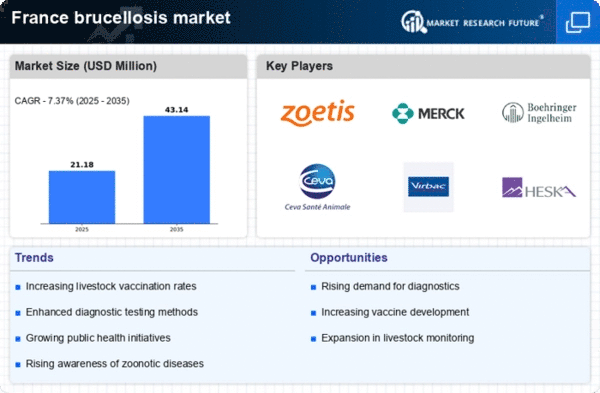
As per analysis, the France brucellosis market is projected to grow from USD 29.59 Million in 2024 to USD 57.83 Million by 2035, exhibiting a compound annual growth rate (CAGR) of 6.28% during the forecast period (2025 - 2035).

Key Market Trends & Highlights

The France brucellosis market is experiencing a shift towards enhanced surveillance and vaccination efforts, driven by regulatory compliance and consumer demand.

  • Enhanced surveillance programs are being implemented to monitor brucellosis more effectively.
  • The veterinary diagnostics segment remains the largest, reflecting a strong focus on disease detection and management.
  • Vaccination programs are emerging as the fastest-growing segment, driven by increasing awareness of disease prevention.
  • Regulatory frameworks and advancements in diagnostic technologies are key drivers influencing market dynamics.

Market Size & Forecast

2024 Market Size 29.59 (USD Million)
2035 Market Size 57.83 (USD Million)
CAGR (2025 - 2035) 6.28%

Major Players

Zoetis (US), Merck Animal Health (US), Boehringer Ingelheim (DE), Cegelec (FR), Virbac (FR), Heska Corporation (US), IDT Biologika (DE), Vetoquinol (FR)

Our Impact
Enabled $4.3B Revenue Impact for Fortune 500 and Leading Multinationals
Partnering with 2000+ Global Organizations Each Year
30K+ Citations by Top-Tier Firms in the Industry

France Brucellosis Market Trends

The France brucellosis market is characterized by a complex interplay of factors influencing its dynamics. Brucellosis, a zoonotic disease caused by Brucella bacteria, poses significant challenges to livestock health and public safety. The French government has implemented stringent measures to control and prevent the spread of this disease, particularly in cattle and sheep populations. Surveillance programs and vaccination initiatives are in place, aiming to reduce the incidence of brucellosis and protect both animal and human health. The market appears to be shaped by ongoing research efforts, which focus on developing more effective vaccines and diagnostic tools. Furthermore, the collaboration between veterinary services and agricultural stakeholders seems to enhance the overall management of brucellosis in France. In addition to government initiatives, the France brucellosis market is influenced by consumer awareness regarding food safety and animal welfare. As public concern about zoonotic diseases grows, there is a noticeable shift towards more sustainable farming practices. This trend may lead to increased demand for brucellosis-free livestock products, thereby impacting market dynamics. The emphasis on traceability and transparency in the food supply chain could further drive changes in production methods. Overall, the France brucellosis market is evolving, reflecting a combination of regulatory frameworks, scientific advancements, and shifting consumer preferences.

Enhanced Surveillance Programs

The France brucellosis market is witnessing a trend towards enhanced surveillance programs aimed at early detection and control of the disease. These initiatives involve collaboration between government agencies and veterinary services, focusing on monitoring livestock populations to identify potential outbreaks. Such proactive measures are crucial in maintaining animal health and ensuring public safety.

Increased Focus on Vaccination

There is a growing emphasis on vaccination as a key strategy in the France brucellosis market. The government promotes vaccination campaigns targeting susceptible livestock, particularly cattle and sheep. This trend reflects a commitment to reducing the prevalence of brucellosis and safeguarding both animal and human health.

Consumer Demand for Safe Products

The France brucellosis market is increasingly influenced by consumer demand for safe and traceable food products. As awareness of zoonotic diseases rises, consumers are seeking assurance that their food sources are free from brucellosis. This trend is prompting producers to adopt more stringent health measures and improve transparency in their supply chains.

France Brucellosis Market Drivers

Rising Awareness Among Farmers

There is a growing awareness among farmers regarding the implications of brucellosis on livestock health and productivity, which is positively impacting the France brucellosis market. Educational initiatives and outreach programs conducted by agricultural organizations have played a pivotal role in informing farmers about the risks associated with brucellosis and the importance of vaccination and biosecurity measures. As of 2025, surveys indicate that over 70% of farmers in France are now aware of the disease and its prevention strategies. This heightened awareness is likely to lead to increased adoption of vaccination programs and improved herd management practices, ultimately contributing to a decline in brucellosis incidence. Consequently, the France brucellosis market stands to benefit from this shift in farmer attitudes and practices.

Regulatory Framework and Compliance

The France brucellosis market is significantly influenced by stringent regulatory frameworks aimed at controlling and preventing the disease. The French government, through its Ministry of Agriculture and Food, has established comprehensive guidelines for livestock management and disease reporting. These regulations mandate regular testing and vaccination of cattle, which is crucial in maintaining herd health and preventing outbreaks. The enforcement of these regulations not only ensures public health safety but also supports the economic stability of the livestock sector. In 2025, the French government allocated substantial resources to enhance disease surveillance and control measures, reflecting a commitment to eradicating brucellosis. This proactive approach is likely to bolster the France brucellosis market by fostering a safer environment for livestock production and trade.

Advancements in Diagnostic Technologies

Technological advancements in diagnostic methods are reshaping the France brucellosis market. The introduction of rapid and accurate diagnostic tests has improved the ability to detect brucellosis in livestock, facilitating timely interventions. For instance, the use of polymerase chain reaction (PCR) tests has gained traction, allowing for quicker identification of infected animals. This is particularly relevant in France, where the livestock sector is a vital component of the economy. In 2025, the market for diagnostic tools is projected to grow by approximately 15%, driven by the increasing demand for efficient disease management solutions. Enhanced diagnostic capabilities not only aid in controlling brucellosis outbreaks but also contribute to the overall health of the livestock population, thereby supporting the France brucellosis market.

Consumer Preferences for Quality Assurance

The France brucellosis market is also shaped by evolving consumer preferences for quality assurance in food products. As consumers become more health-conscious, there is a rising demand for meat and dairy products that are certified free from brucellosis. This trend is prompting producers to adopt stringent quality control measures and participate in certification programs that guarantee the safety of their products. In 2025, it is estimated that the market for certified brucellosis-free products will expand by 20%, reflecting the increasing consumer demand for transparency and safety in food sourcing. This shift not only enhances consumer trust but also encourages producers to invest in better health management practices, thereby positively influencing the France brucellosis market.

International Trade and Export Opportunities

The France brucellosis market is significantly impacted by international trade dynamics and export opportunities. France, being a key player in the European livestock market, faces pressure to maintain high health standards to access international markets. Countries importing French livestock products often require proof of brucellosis-free status, which compels producers to adhere to rigorous health protocols. In 2025, the export of French livestock products is projected to increase by 10%, driven by the demand for high-quality, disease-free products in global markets. This trend not only enhances the competitiveness of French livestock on the international stage but also reinforces the importance of effective brucellosis control measures within the France brucellosis market.


Market Segment Insights

By Application: Veterinary Diagnostics (Largest) vs. Vaccination Programs (Fastest-Growing)

In the France brucellosis market, the application segment reflects distinct roles for each category, with Veterinary Diagnostics holding the largest share. This segment encompasses various diagnostic tools and tests utilized by veterinarians to identify brucellosis in livestock. Vaccination Programs, while smaller currently, are rapidly gaining traction as awareness of preventive measures increases. Public Health Initiatives and Research and Development play supportive roles, emphasizing the importance of coordinated efforts in combating this disease, yet they contribute less to the overall market share. Growth within this segment is notably driven by advancements in technology and an increased focus on disease control measures. The demand for accurate and rapid diagnostics has surged, prompted by the need to prevent outbreaks, thus bolstering Veterinary Diagnostics. Simultaneously, Vaccination Programs are experiencing growth due to rising initiatives aimed at improving livestock health and reducing disease transmission to humans. This dual momentum showcases a proactive approach in addressing brucellosis in France's agricultural and public health sectors.

Veterinary Diagnostics (Dominant) vs. Research and Development (Emerging)

Veterinary Diagnostics, as a dominant force in the France brucellosis market, encompasses sophisticated testing methods that ensure effective detection of this infectious disease in animals, significantly supporting disease management. The reliance on these diagnostics underscores their importance in veterinary practices, especially in regions where brucellosis outbreaks are a concern. On the other hand, Research and Development represents an emerging segment dedicated to innovating next-generation solutions for brucellosis prevention and management. This includes the development of new vaccines and diagnostic tools tailored for enhanced efficacy. Both segments highlight a commitment to improving animal health; however, while Veterinary Diagnostics is well-established and essential for immediate response efforts, Research and Development is poised to drive future advancements and long-term solutions.

By End Use: Livestock Farming (Largest) vs. Wildlife Management (Fastest-Growing)

In the France brucellosis market, the segment values reveal a diverse distribution of end-use applications. Livestock farming represents the largest share, driven by the country's intensive agricultural practices and the significant impact of brucellosis on herd health. Conversely, wildlife management is emerging as a critical segment, reflecting growing concerns over zoonotic diseases and the need to manage wildlife populations effectively to prevent disease transmission to domestic animals.

Livestock Farming (Dominant) vs. Research Institutions (Emerging)

Livestock farming stands as the dominant segment within the France brucellosis market, heavily influenced by the agricultural sector's emphasis on herd health management and disease prevention. This segment benefits from stringent regulations and proactive veterinary practices aimed at controlling brucellosis outbreaks among livestock. On the other hand, research institutions are emerging as a vital segment, playing a key role in advancing innovative diagnostic methods and treatment approaches. Their focus on research and collaboration with government agencies positions them to address the evolving challenges posed by brucellosis, making them integral to the overall disease management strategy in France.

By Testing Method: Serological Testing (Largest) vs. Molecular Testing (Fastest-Growing)

In the France brucellosis market, the testing methods exhibit varied market shares, with serological testing being the largest segment. This method allows for quick and efficient diagnoses, which contributes to its prevalent usage among veterinary professionals. In contrast, molecular testing is experiencing rapid growth due to advancements in technology that enable more accurate and faster results, appealing to a broader range of users in both public health and veterinary sectors. The growth trends for testing methods in France show a clear shift as molecular testing gains traction. Factors contributing to this increase include the rising demand for more precise diagnostics in brucellosis control programs and the integration of molecular techniques into standard practices. Furthermore, the increasing awareness of brucellosis implications on livestock health and the economy supports the adoption of advanced testing methods like molecular testing, thus influencing market dynamics positively.

Serological Testing (Dominant) vs. Culture Testing (Emerging)

Serological testing remains the dominant method in the France brucellosis market due to its established presence and vast usage across laboratories and veterinary practices. This method is appreciated for its reliability and effectiveness in detecting antibodies against brucellosis, making it vital for monitoring and control strategies. Conversely, culture testing is recognized as an emerging technique, providing definitive identification of the brucella bacteria. While slower than serological methods, its accuracy in diagnosing active infections ensures its relevance in comprehensive brucellosis management. The combination of both methods serves to strengthen diagnostic strategies while catering to varying user needs in the health and veterinary sectors, allowing for informed decision-making in brucellosis control.

By Disease Type: Brucella melitensis (Largest) vs. Brucella abortus (Fastest-Growing)

In the France brucellosis market, market share distribution is significantly skewed towards Brucella melitensis, as it represents the largest portion of infections. This is predominantly due to its prevalence in livestock such as sheep and goats, which are widely farmed in the region. Brucella abortus follows closely behind, attributed to its recognition in cattle and a growing concern over animal health in livestock trading. Other species like Brucella suis and Brucella canis contribute lesser shares, reflecting more targeted outbreaks and specific host engagement. Analyzing growth trends for these disease types, Brucella melitensis continues to dominate, largely driven by rising awareness and control measures implemented on farms. The increased focus on food safety and zoonotic infections has also propelled the demand for better diagnostics and veterinary interventions. Conversely, Brucella abortus shows promise as the fastest-growing segment, stimulated by emerging vaccination strategies and stringent regulations aimed at animal welfare and the trade of livestock in France.

Brucella melitensis (Dominant) vs. Brucella abortus (Emerging)

Brucella melitensis, as the dominant disease type in the France brucellosis market, exhibits high virulence and adaptability, which contributes to its prevalence in small ruminants. Its significant role in public health and livestock production underlines the urgent need for effective control measures and veterinary surveillance. On the other hand, Brucella abortus is categorized as an emerging segment due to its rising incidence in cattle, influenced by improved reporting and diagnosis. Recent advancements in vaccination protocols and animal health regulations are fostering growth in this segment. The awareness of Brucella abortus as a zoonotic threat poses both a challenge and an opportunity for livestock farmers, driving innovations in preventive strategies and health management.

Get more detailed insights about France Brucellosis Market

Key Players and Competitive Insights

The competitive dynamics within the brucellosis market in France are characterized by a blend of innovation, strategic partnerships, and a focus on regional expansion. Key players such as Zoetis (US), Merck Animal Health (US), and Boehringer Ingelheim (DE) are actively shaping the landscape through their operational strategies. For instance, Zoetis (US) has been emphasizing digital transformation and the integration of advanced technologies into its product offerings, which appears to enhance its market position. Meanwhile, Merck Animal Health (US) is focusing on strategic partnerships to bolster its research and development capabilities, thereby fostering innovation in vaccine development. Boehringer Ingelheim (DE) is also pursuing a strategy of regional expansion, particularly in underserved markets, which may provide it with a competitive edge in the long term.

The business tactics employed by these companies include localizing manufacturing and optimizing supply chains to enhance efficiency and responsiveness to market demands. The market structure is moderately fragmented, with several players vying for market share. However, the collective influence of these key players is significant, as they drive advancements in product development and distribution strategies, thereby shaping the overall competitive environment.

In December 2025, Zoetis (US) announced the launch of a new brucellosis vaccine that utilizes cutting-edge mRNA technology. This strategic move is likely to position the company at the forefront of innovation in the market, potentially leading to increased adoption rates among livestock producers. The introduction of this vaccine may not only enhance animal health but also contribute to the reduction of brucellosis incidence in cattle, aligning with public health objectives.

In November 2025, Merck Animal Health (US) entered into a collaborative agreement with a French biotechnology firm to develop a novel diagnostic tool for brucellosis. This partnership is indicative of Merck's commitment to enhancing its product portfolio through innovative solutions. The strategic importance of this collaboration lies in its potential to improve early detection and management of brucellosis, which could significantly impact disease control efforts in livestock.

In October 2025, Boehringer Ingelheim (DE) expanded its distribution network in France by partnering with local veterinary clinics. This strategic action is expected to enhance the accessibility of its brucellosis vaccines and treatments, thereby increasing market penetration. By strengthening its distribution channels, Boehringer Ingelheim may improve its competitive positioning and responsiveness to customer needs.

As of January 2026, current trends in the brucellosis market are increasingly defined by digitalization, sustainability, and the integration of artificial intelligence (AI) in product development and diagnostics. Strategic alliances among key players are shaping the competitive landscape, fostering innovation and enhancing supply chain reliability. The shift from price-based competition to a focus on technological advancements and sustainable practices is becoming evident. Moving forward, competitive differentiation is likely to evolve, with companies prioritizing innovation and reliability over traditional pricing strategies.

Key Companies in the France Brucellosis Market include

Industry Developments

In recent developments, the France Brucellosis Market has seen heightened activity, particularly with companies such as Intervet, IDEXX Laboratories, and Boehringer Ingelheim Vetmedica focusing on enhancing their veterinary solutions to combat brucellosis.

As of August 2023, France has reported an increase in brucellosis cases in livestock, prompting government agencies to reinforce vaccination and monitoring programs. This rise in disease incidence has resulted in a push for innovations in diagnostics and treatments, namely by firms such as Merck Animal Health and Zoetis, which are investing in Research and Development to develop more effective vaccines and diagnostic kits.

Moreover, recent acquisitions have also shaped the landscape, with Boehringer Ingelheim announcing in July 2023 a strategic acquisition aimed at boosting their portfolio in animal health specifically targeting infectious diseases including brucellosis.

The market has seen significant growth, with companies like Elanco Animal Health and Virbac expanding their operations in France to cater to the increasing demand for brucellosis management solutions.

Over the last two to three years, the market has consistently responded to epidemiological trends, adjusting product offerings and improving surveillance mechanisms, indicating a proactive approach by major players in the France Brucellosis Market.

Future Outlook

France Brucellosis Market Future Outlook

The France brucellosis market is projected to grow at a 6.28% CAGR from 2025 to 2035, driven by advancements in veterinary diagnostics and increased awareness of zoonotic diseases.

New opportunities lie in:

  • Development of mobile diagnostic units for rapid brucellosis testing in rural areas.
  • Investment in vaccine research to enhance livestock immunity against brucellosis.
  • Partnerships with agricultural cooperatives to promote disease prevention programs.

By 2035, the market is expected to be robust, driven by innovation and strategic partnerships.

Market Segmentation

France Brucellosis Market End Use Outlook

  • Livestock Farming
  • Wildlife Management
  • Research Institutions
  • Government Agencies

France Brucellosis Market Application Outlook

  • Veterinary Diagnostics
  • Vaccination Programs
  • Research and Development
  • Public Health Initiatives

France Brucellosis Market Disease Type Outlook

  • Brucella abortus
  • Brucella melitensis
  • Brucella suis
  • Brucella canis

France Brucellosis Market Testing Method Outlook

  • Serological Testing
  • Molecular Testing
  • Culture Testing
  • Field Testing

Report Scope

MARKET SIZE 202429.59(USD Million)
MARKET SIZE 202531.98(USD Million)
MARKET SIZE 203557.83(USD Million)
COMPOUND ANNUAL GROWTH RATE (CAGR)6.28% (2024 - 2035)
REPORT COVERAGERevenue Forecast, Competitive Landscape, Growth Factors, and Trends
BASE YEAR2024
Market Forecast Period2025 - 2035
Historical Data2019 - 2024
Market Forecast UnitsUSD Million
Key Companies ProfiledZoetis (US), Merck Animal Health (US), Boehringer Ingelheim (DE), Cegelec (FR), Virbac (FR), Heska Corporation (US), IDT Biologika (DE), Vetoquinol (FR)
Segments CoveredApplication, End Use, Testing Method, Disease Type
Key Market OpportunitiesEmerging diagnostic technologies enhance early detection and management of brucellosis in the France brucellosis market.

Key Market DynamicsRegulatory changes and heightened surveillance are reshaping the France brucellosis market landscape and competitive dynamics.
Countries CoveredFrance
Leave a Comment

FAQs

What is the current valuation of the France brucellosis market?

The France brucellosis market was valued at 29.59 USD Million in 2024.

What is the projected market valuation for the France brucellosis market by 2035?

The projected valuation for the France brucellosis market is 57.83 USD Million by 2035.

What is the expected CAGR for the France brucellosis market during the forecast period?

The expected CAGR for the France brucellosis market during the forecast period 2025 - 2035 is 6.28%.

Which companies are the key players in the France brucellosis market?

Key players in the France brucellosis market include Zoetis, Merck Animal Health, Boehringer Ingelheim, Cegelec, Virbac, Heska Corporation, IDT Biologika, and Vetoquinol.

What are the main applications driving the France brucellosis market?

The main applications driving the France brucellosis market include Veterinary Diagnostics, Vaccination Programs, Research and Development, and Public Health Initiatives.

How does livestock farming contribute to the France brucellosis market?

Livestock farming contributed 12.0 to 24.0 USD Million to the France brucellosis market by end use.

What testing methods are utilized in the France brucellosis market?

Testing methods in the France brucellosis market include Serological Testing, Molecular Testing, Culture Testing, and Field Testing.

Which disease types are prevalent in the France brucellosis market?

The prevalent disease types in the France brucellosis market include Brucella abortus, Brucella melitensis, Brucella suis, and Brucella canis.

What role do government agencies play in the France brucellosis market?

Government agencies accounted for 5.59 to 9.83 USD Million in the France brucellosis market by end use.

What is the significance of research institutions in the France brucellosis market?

Research institutions contributed 7.0 to 14.0 USD Million to the France brucellosis market by end use.

Download Free Sample

Kindly complete the form below to receive a free sample of this Report

Compare Licence

×
Features License Type
Single User Multiuser License Enterprise User
Price $4,950 $5,950 $7,250
Maximum User Access Limit 1 User Upto 10 Users Unrestricted Access Throughout the Organization
Free Customization
Direct Access to Analyst
Deliverable Format
Platform Access
Discount on Next Purchase 10% 15% 15%
Printable Versions