×
Request Free Sample ×

Kindly complete the form below to receive a free sample of this Report

* Please use a valid business email

Leading companies partner with us for data-driven Insights

clients tt-cursor
Hero Background

France Biogas Market

ID: MRFR/EnP/53480-HCR
200 Pages
Chitranshi Jaiswal
February 2026

France Biogas Market Research Report By Application (Electricity Generation, Transportation Fuel, Heating Applications, Fertilizer Production), By Feedstock (Agricultural Waste, Municipal Solid Waste, Animal Manure, Industrial Waste), By Technology (Anaerobic Digestion, Landfill Gas Recovery, Gasification) and By End Use (Residential, Commercial, Industrial)-Forecast to 2035

Share:
Download PDF ×

We do not share your information with anyone. However, we may send you emails based on your report interest from time to time. You may contact us at any time to opt-out.

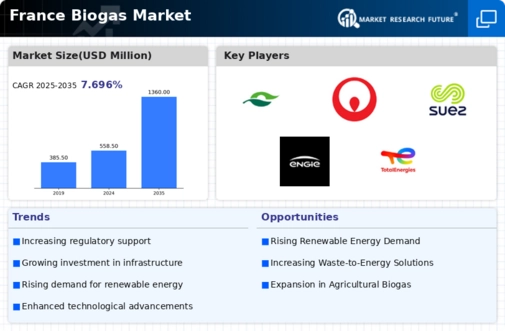
France Biogas Market Infographic
Purchase Options

France Biogas Market Summary

As per analysis, the France biogas market is projected to grow from USD 0.648 Billion in 2025 to USD 1.27 Billion by 2035, exhibiting a compound annual growth rate (CAGR) of 7.02% during the forecast period (2025 - 2035).

Key Market Trends & Highlights

The France biogas market is poised for growth driven by regulatory support and technological advancements.

  • Electricity generation remains the largest segment, indicating a stable demand for biogas as a renewable energy source.
  • Biomethane production is the fastest-growing segment, reflecting an increasing interest in sustainable gas solutions.
  • Food waste serves as the largest feedstock, highlighting the potential for waste-to-energy initiatives in urban areas.
  • Regulatory support and public awareness are key drivers propelling the market forward, fostering investment opportunities.

Market Size & Forecast

2024 Market Size 0.602 (USD Billion)
2035 Market Size 1.27 (USD Billion)
CAGR (2025 - 2035) 7.02%

Major Players

Engie (FR), Veolia (FR), Suez (FR), TotalEnergies (FR), GrDF (FR), Biogaz Vallée (FR), Fonroche Biogaz (FR), Methanation (FR), Ecovia (FR)

Our Impact
Enabled $4.3B Revenue Impact for Fortune 500 and Leading Multinationals
Partnering with 2000+ Global Organizations Each Year
30K+ Citations by Top-Tier Firms in the Industry

France Biogas Market Trends

The France biogas market is currently experiencing a notable transformation, driven by a combination of regulatory support and increasing environmental awareness. The French government has implemented various policies aimed at promoting renewable energy sources, including biogas. This shift is largely influenced by the country's commitment to reducing greenhouse gas emissions and enhancing energy independence. As a result, there is a growing interest in biogas production from agricultural waste, organic materials, and municipal solid waste. The integration of biogas into the energy mix is seen as a viable solution to address both energy needs and waste management challenges. Moreover, the France biogas market is witnessing advancements in technology and infrastructure, which are essential for optimizing biogas production and utilization. Investments in anaerobic digestion facilities and biogas upgrading technologies are becoming more prevalent. These developments not only enhance the efficiency of biogas production but also improve the quality of the gas, making it suitable for injection into the natural gas grid. The collaboration between public and private sectors is likely to foster innovation and drive growth in this sector, positioning France as a leader in the biogas landscape in the coming years.

Regulatory Support and Incentives

The France biogas market benefits from robust regulatory frameworks and incentives that encourage investment in renewable energy. Government policies are designed to facilitate the development of biogas projects, providing financial support and favorable tariffs for producers. This regulatory environment is crucial for attracting stakeholders and fostering growth in the sector.

Technological Advancements

Innovations in biogas production technologies are playing a pivotal role in enhancing the efficiency and sustainability of the France biogas market. The adoption of advanced anaerobic digestion methods and biogas purification processes is likely to improve yield and quality, making biogas a more competitive energy source.

Increased Feedstock Utilization

The France biogas market is seeing a diversification in feedstock sources, with a growing emphasis on utilizing agricultural residues, food waste, and organic materials. This trend not only supports waste management efforts but also contributes to the circular economy, aligning with France's sustainability goals.

France Biogas Market Drivers

Technological Advancements

Technological advancements play a crucial role in shaping the France biogas market. Innovations in anaerobic digestion technology, for instance, have improved the efficiency of biogas production from organic waste. The introduction of advanced monitoring systems and automation in biogas plants has led to enhanced operational efficiency and reduced costs. In 2025, the average biogas yield in France has increased by 15% compared to previous years, largely due to these technological improvements. Additionally, research and development initiatives funded by the government and private sector are fostering the emergence of new technologies that could further optimize biogas production processes. This continuous evolution in technology is likely to drive the growth of the France biogas market, making it more competitive and sustainable.

Increased Feedstock Utilization

The France biogas market is witnessing a significant increase in feedstock utilization, which is essential for enhancing biogas production. Various organic materials, including agricultural residues, food waste, and livestock manure, are being increasingly utilized as feedstock for biogas plants. In 2025, it is estimated that over 60% of biogas production in France is derived from agricultural waste, reflecting a shift towards more sustainable practices. This trend not only maximizes resource efficiency but also contributes to waste reduction and environmental sustainability. Moreover, the French government encourages the use of diverse feedstocks through financial incentives, which further stimulates the growth of the biogas sector. As feedstock availability continues to expand, the France biogas market is likely to experience enhanced production capabilities and economic viability.

Public Awareness and Acceptance

Public awareness and acceptance of biogas as a renewable energy source are increasingly influencing the France biogas market. Educational campaigns and community engagement initiatives have been implemented to inform the public about the benefits of biogas, including its role in reducing greenhouse gas emissions and promoting energy independence. As of 2025, surveys indicate that approximately 70% of the French population supports the development of biogas projects, reflecting a growing recognition of its environmental advantages. This heightened awareness is likely to facilitate the establishment of new biogas facilities and foster collaboration between stakeholders, including local communities and government entities. Consequently, public acceptance is becoming a vital driver for the expansion of the France biogas market, as it encourages investment and participation in renewable energy initiatives.

Regulatory Support and Incentives

The France biogas market benefits from robust regulatory frameworks and incentives that promote the development of biogas projects. The French government has established various policies aimed at increasing renewable energy production, including biogas. For instance, the Energy Transition for Green Growth Act encourages investments in biogas facilities through feed-in tariffs and subsidies. As of 2025, the biogas production capacity in France reached approximately 1,200 MW, indicating a growing trend supported by these regulations. Furthermore, the European Union's Renewable Energy Directive sets ambitious targets for renewable energy, further bolstering the France biogas market. This regulatory environment not only enhances investor confidence but also stimulates innovation and growth within the sector.

Investment Opportunities and Economic Growth

Investment opportunities in the France biogas market are expanding, driven by the increasing demand for renewable energy solutions. The French government has set ambitious targets for renewable energy production, aiming for 32% of total energy consumption to come from renewable sources by 2030. This goal presents significant investment potential for biogas projects, attracting both domestic and international investors. In 2025, the total investment in the biogas sector is projected to exceed 1 billion euros, reflecting a growing confidence in the market's future. Additionally, the development of biogas facilities contributes to local economic growth by creating jobs and supporting rural development. As investment continues to flow into the France biogas market, it is likely to stimulate innovation, enhance production capacity, and contribute to the overall energy transition.


Market Segment Insights

By Application: Electricity Generation (Largest) vs. Biomethane Production (Fastest-Growing)

In the France biogas market, the application segment is diverse, comprised of Electricity Generation, Heat Generation, Transportation Fuel, and Biomethane Production. Among these, Electricity Generation holds the largest market share, driven by the country's commitment to renewable energy sources. It capitalizes on existing infrastructure and regulatory support, enabling substantial contributions to the national grid. In contrast, Biomethane Production is gaining traction, emerging as a significant player in the market, appealing to both agricultural and energy sectors, thus expanding its footprint significantly.

Electricity Generation (Dominant) vs. Biomethane Production (Emerging)

Electricity Generation has solidified its position as the dominant application within the France biogas market, leveraging extensive use of biogas plants to convert organic waste into energy. This segment benefits from favorable government policies aiming to enhance renewable electricity output. On the other hand, Biomethane Production is seen as an emerging segment, fueled by advancements in technology that allow for efficient purification and upgrading of biogas to biomethane. The rising demand for cleaner transportation fuel and the trend towards sustainability are propelling Biomethane Production to the forefront, making it an attractive option for various industries seeking to reduce their carbon footprint.

By Feedstock Type: Food Waste (Largest) vs. Agricultural Residues (Fastest-Growing)

In the France biogas market, food waste constitutes the largest share among feedstock types, leveraging existing waste management systems and public awareness regarding sustainability. Meanwhile, agricultural residues, which include crop leftovers and by-products, are gaining significant traction due to government support and incentives for farmers to apply sustainable practices in waste recycling and energy generation. Their integration is increasingly viewed as a pragmatic approach to enhancing energy production while managing residue diversity. The growth trends in this segment are driven by evolving consumer preferences toward organic waste recycling and the increasing implementation of anaerobic digestion technologies. Policies aimed at reducing food waste and improving energy efficiency strongly support the agricultural residues market. In parallel, the surge in biogas projects signals a robust future, where producers are incentivized to diversify their feedstock utilization effectively.

Food Waste (Dominant) vs. Animal Manure (Emerging)

Food waste is recognized as a dominant feedstock in the French biogas market, accounting for a significant portion of the volume due to a well-established collection and processing framework. This feedstock not only provides an effective means for energy generation but also helps in mitigating environmental issues associated with waste disposal. On the other hand, animal manure is emerging as a viable alternative feedstock, encouraged by policy frameworks that promote sustainable agriculture. With the agricultural sector's increased focus on waste circularity and the energy potential of manure being recognized, it stands ready to play a more critical role in biogas production. Both segments highlight the transition towards a circular economy, with food waste leading the way while animal manure is on the rise.

By Technology: Anaerobic Digestion (Largest) vs. Gasification (Fastest-Growing)

In the France biogas market, the technology segment is characterized by a notable distribution among anaerobic digestion, landfill gas recovery, gasification, and fermentation. Anaerobic digestion stands out as the largest contributor, effectively harnessing organic matter for energy production. Meanwhile, gasification has emerged as an intriguing alternative, leading the charge in growth potential. Landfill gas recovery and fermentation, while important, hold lesser shares in comparison. As the market matures, growth trends indicate a rising focus on sustainability and renewable energy sources driving innovation in the technology segment. Influenced by regulatory frameworks and incentives, anaerobic digestion remains the cornerstone of biogas production in France. However, gasification is gaining traction due to its versatility in converting various feedstocks into biogas, which is anticipated to further fuel its rapid expansion in the coming years.

Technology: Anaerobic Digestion (Dominant) vs. Gasification (Emerging)

Anaerobic digestion is firmly established as the dominant technology in the France biogas market, leveraging its efficiency in converting organic waste into valuable energy. This method not only reduces waste but also contributes to lower greenhouse gas emissions. In contrast, gasification is an emerging technology gaining momentum for its ability to process a wide array of materials, including agricultural residues and biomass. This versatility, coupled with advancements in gasification technologies, positions it as a promising solution in the renewable energy landscape. Both technologies play pivotal roles in fostering energy security and sustainability within France, yet gasification's innovative edge is likely to attract increasing investment and attention, marking it as a key player for the future.

Get more detailed insights about France Biogas Market

Key Players and Competitive Insights

The France biogas market is characterized by a dynamic competitive landscape, driven by increasing demand for renewable energy and stringent environmental regulations. Key players such as Engie (FR), Veolia (FR), and TotalEnergies (FR) are strategically positioned to leverage their extensive experience in energy and waste management. Engie (FR) focuses on innovation and sustainability, investing in advanced biogas technologies to enhance efficiency. Veolia (FR) emphasizes partnerships and regional expansion, collaborating with local authorities to optimize waste-to-energy solutions. TotalEnergies (FR) is diversifying its portfolio, integrating biogas into its broader energy strategy, which collectively shapes a competitive environment that prioritizes sustainability and technological advancement.

The market structure appears moderately fragmented, with several players vying for market share. Key business tactics include localizing manufacturing and optimizing supply chains to enhance operational efficiency. The collective influence of these major companies fosters a competitive atmosphere where innovation and strategic partnerships are paramount. This fragmentation allows for niche players to emerge, potentially disrupting traditional business models.

In December 2025, Engie (FR) announced a partnership with a leading agricultural cooperative to develop a new biogas facility aimed at converting agricultural waste into renewable energy. This strategic move not only enhances Engie's operational footprint but also aligns with its commitment to sustainable practices, potentially increasing its market share in the agricultural sector. The collaboration signifies a shift towards integrating biogas production with local agricultural practices, which could serve as a model for future projects.

In November 2025, Veolia (FR) launched a new initiative focused on enhancing the efficiency of existing biogas plants through digital transformation. By implementing advanced data analytics and AI technologies, Veolia aims to optimize the performance of its facilities, thereby reducing operational costs and increasing output. This initiative underscores the importance of technology in driving operational excellence and reflects a broader trend within the industry towards digitalization.

In October 2025, TotalEnergies (FR) unveiled plans to invest €100 million in expanding its biogas production capacity across France. This investment is expected to significantly boost the company’s renewable energy output and solidify its position as a leader in the biogas sector. The strategic importance of this investment lies in TotalEnergies' commitment to transitioning towards a more sustainable energy model, which is likely to resonate well with stakeholders and consumers alike.

As of January 2026, current competitive trends in the France biogas market indicate a strong emphasis on digitalization, sustainability, and AI integration. Strategic alliances are increasingly shaping the landscape, fostering innovation and collaboration among key players. The shift from price-based competition to a focus on technological advancement and supply chain reliability is evident. Companies that prioritize innovation and sustainable practices are likely to differentiate themselves in this evolving market, positioning themselves for long-term success.

Key Companies in the France Biogas Market include

Industry Developments

Recent developments in the France Biogas Market include a notable push for sustainable energy solutions amid government initiatives favoring renewable energy sources. Companies such as Biogaz Vallée and GrDF are expanding their infrastructure to enhance biogas production and distribution systems. Econergie and Fonroche Biogaz are also seeing growth as demand for biogas solutions rises, driven by environmental regulations and public awareness of renewable energy benefits.

In terms of mergers and acquisitions, recent reports indicate that TotalEnergies is exploring alliances with trade bodies to strengthen its position in the biogas sector, while Ekovia is working on partnerships to scale up bioenergy projects. Notably, the Val de Marne region has been investing heavily in biogas facilities, reflecting a regional commitment to environmental goals that align with France's national energy strategy.

The market capitalization of major players like Engie, SUEZ, and Veolia continues to show growth, with their focus on innovation and enhanced operational efficiency directly impacting the competitive landscape of the biogas industry. Furthermore, in the last two years, there have been advancements in anaerobic digestion technology that have improved the efficiency and yield of biogas production, contributing positively to the overall market dynamics.


Future Outlook

France Biogas Market Future Outlook

The France biogas market is projected to grow at a 7.02% CAGR from 2025 to 2035, driven by renewable energy policies, technological advancements, and increasing waste management needs.

New opportunities lie in:

  • Expansion of biogas upgrading technologies for grid injection
  • Development of biogas-based transportation fuels
  • Investment in decentralized biogas production facilities for local communities

By 2035, the France biogas market is expected to be robust, driven by innovation and sustainable practices.

Market Segmentation

France Biogas Market Technology Outlook

  • Anaerobic Digestion
  • Landfill Gas Recovery
  • Gasification
  • Fermentation

France Biogas Market Application Outlook

  • Electricity Generation
  • Heat Generation
  • Transportation Fuel
  • Biomethane Production

France Biogas Market Feedstock Type Outlook

  • Agricultural Residues
  • Animal Manure
  • Food Waste
  • Energy Crops

Report Scope

MARKET SIZE 20240.602(USD Billion)
MARKET SIZE 20250.648(USD Billion)
MARKET SIZE 20351.27(USD Billion)
COMPOUND ANNUAL GROWTH RATE (CAGR)7.02% (2024 - 2035)
REPORT COVERAGERevenue Forecast, Competitive Landscape, Growth Factors, and Trends
BASE YEAR2024
Market Forecast Period2025 - 2035
Historical Data2019 - 2024
Market Forecast UnitsUSD Billion
Key Companies ProfiledEngie (FR), Veolia (FR), Suez (FR), TotalEnergies (FR), GrDF (FR), Biogaz Vallée (FR), Fonroche Biogaz (FR), Methanation (FR), Ecovia (FR)
Segments CoveredApplication, Feedstock Type, Technology
Key Market OpportunitiesExpansion of agricultural biogas production aligns with France's renewable energy targets and sustainability goals.
Key Market DynamicsGrowing regulatory support and technological advancements drive the expansion of the biogas market in France.
Countries CoveredFrance
Leave a Comment

FAQs

What is the current valuation of the France biogas market?

As of 2024, the France biogas market was valued at 0.602 USD Billion.

What is the projected market size for the France biogas market by 2035?

The market is projected to reach 1.27 USD Billion by 2035.

What is the expected CAGR for the France biogas market during the forecast period 2025 - 2035?

The expected CAGR for the France biogas market during 2025 - 2035 is 7.02%.

Which companies are the key players in the France biogas market?

Key players include Engie, Veolia, Suez, TotalEnergies, GrDF, Biogaz Vallée, Fonroche Biogaz, Methanation, and Ecovia.

What are the main applications of biogas in France?

The main applications include electricity generation, heat generation, transportation fuel, and biomethane production.

How much revenue is generated from electricity generation in the France biogas market?

Electricity generation revenue is estimated to range from 0.25 to 0.55 USD Billion.

What feedstock types are utilized in the France biogas market?

Feedstock types include agricultural residues, animal manure, food waste, and energy crops.

What is the revenue range for food waste as a feedstock in the France biogas market?

Food waste as a feedstock generates revenue between 0.20 and 0.45 USD Billion.

What technologies are employed in the France biogas market?

Technologies include anaerobic digestion, landfill gas recovery, gasification, and fermentation.

What is the revenue range for anaerobic digestion technology in the France biogas market?

Anaerobic digestion technology generates revenue between 0.25 and 0.55 USD Billion.

Download Free Sample

Kindly complete the form below to receive a free sample of this Report

Compare Licence

×
Features License Type
Single User Multiuser License Enterprise User
Price $4,950 $5,950 $7,250
Maximum User Access Limit 1 User Upto 10 Users Unrestricted Access Throughout the Organization
Free Customization
Direct Access to Analyst
Deliverable Format
Platform Access
Discount on Next Purchase 10% 15% 15%
Printable Versions