×
Request Free Sample ×

Kindly complete the form below to receive a free sample of this Report

* Please use a valid business email

Leading companies partner with us for data-driven Insights

clients tt-cursor
Hero Background
English
Chinese
French
Japanese
Korean
German
Spanish

Football Market Share

ID: MRFR/CG/10467-HCR
128 Pages
Snehal Singh
February 2026

Football Market Size, Share, Industry Trend & Analysis Research Report: By Product Type (Football, Training Equipment, Protective Gear, Accessories), By Distribution Channel (Online Retail, Offline Retail, Sports Stores), By End User (Professional Players, Amateur Players, Coaches, Teams), By Event Type (Domestic Leagues, International Tournaments, Friendly Matches) andBy Regional (North America, Europe, South America, Asia Pacific, Middle East and Africa)- Forecast to 2035

Share:
Download PDF ×

We do not share your information with anyone. However, we may send you emails based on your report interest from time to time. You may contact us at any time to opt-out.

Football Market Infographic
Purchase Options

Market Share

Football Market Share Analysis

However, in the dynamic world of football market teams and organizations use different tactics to position themselves well enough for them product a considerable share of the market. A popular strategy is to create a powerful brand that stands out. This is because winning football teams spend on identification creations by use of logos, colors, and mascots fostering loyalty in their fans. This brand-orientated approach not only helps sell products but also attracts sponsorship and partnership that strengthen the team’ presence in the market. Another important field performance is on-field positioning in the football industry. Uniformly successful teams that win and play well attract fans in droves. Success on the field leads to higher ticket sales, merchandise revenue and an increased global fan base. This approach is most clearly observable in the acquisition of highly quality players, respected coaches, and modern training facilities by football clubs to maintain competitiveness while strengthening their market share. Digital presence has proved to be an integral part of market share positioning in the football industry over the last few years. Clubs are quite conversant with fans via social media, websites, and mobile apps. This digital strategy not only creates a sense of community among fans, but also helps teams keep in touch with news updates and promotional materials. This has enabled football clubs to gain a global footprint as they increase their market coverage and strengthens their position in the industry. Additionally, strategic partnerships and sponsorship have a significant role to play in market share positioning of football markets. Clubs usually partner with famous brand names that provide attractive sponsorship deals for the club’ jerseys, stadium naming rights etc. These collaborations not only contribute financially but also improve the reputation and market image of football teams. Along with collaborations that international leagues, tournaments and friendly matches provide team exposure across the globe thereby attracting a considerable fan base thus creating global market for them. Fan engagement initiatives also impact the football market. The best teams concentrate on building meaningful fan experiences, both offline and online. The fans become loyal and engaged with fan-friendly events, interactive content, and exclusive access behind the scenes. This strategy not only increases the loyalty of teams to their supporters, but also improves in market share because fan feel a sense of belonging and pride.


Author
Snehal Singh
Assistant Manager - Research

High acumen in analyzing complex macro & micro markets with more than 6 years of work experience in the field of market research. By implementing her analytical skills in forecasting and estimation into market research reports, she has expertise in Packaging, Construction, and Equipment domains. She handles a team size of 20-25 resources and ensures smooth running of the projects, associated marketing activities, and client servicing.

Leave a Comment

FAQs

What is the projected market valuation of The Global Football by 2035?

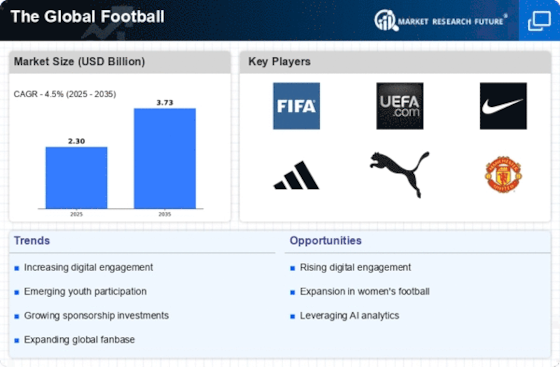
<p>The Global Football is projected to reach a valuation of 3.733 USD Billion by 2035.</p>

What was the market valuation of The Global Football in 2024?

In 2024, The Global Football was valued at 2.3 USD Billion.

What is the expected CAGR for The Global Football during the forecast period 2025 - 2035?

The expected CAGR for The Global Football during the forecast period 2025 - 2035 is 4.5%.

Which companies are considered key players in The Global Football?

Key players in The Global Football include FIFA, UEFA, Nike, Adidas, Puma, Manchester United, Real Madrid, FC Barcelona, Bayern Munich, and Liverpool FC.

What are the projected revenues for the Football segment by 2035?

The Football segment is projected to generate revenues of 1.45 USD Billion by 2035.

How does the revenue from Online Retail compare to Offline Retail in The Global Football?

By 2035, Online Retail is expected to generate 1.12 USD Billion, while Offline Retail is projected to reach 1.48 USD Billion.

What is the anticipated revenue for Professional Players in The Global Football by 2035?

The revenue for Professional Players is anticipated to reach 1.3 USD Billion by 2035.

What is the expected revenue from Domestic Leagues in The Global Football by 2035?

Domestic Leagues are expected to generate revenues of 1.85 USD Billion by 2035.

What are the projected revenues for Training Equipment and Protective Gear by 2035?

Both Training Equipment and Protective Gear are projected to generate revenues of 0.73 USD Billion by 2035.

What is the expected revenue from International Tournaments in The Global Football by 2035?

International Tournaments are expected to generate revenues of 1.25 USD Billion by 2035.

Market Summary

As per Market Research Future analysis, The Global Football Market was estimated at 3.3 USD Billion in 2024. The football industry is projected to grow from 3.4 USD Billion in 2025 to 5.1 USD Billion by 2035, exhibiting a compound annual growth rate (CAGR) of 4.0% during the forecast period 2025 - 2035

Key Market Trends & Highlights

The Global Football Market is experiencing dynamic growth driven by digital engagement and emerging trends.

  • Digital engagement and fan interaction are reshaping how audiences connect with football, particularly in North America. Sustainability initiatives are becoming increasingly prominent, influencing club operations and fan expectations across the Asia-Pacific region. The diversification of revenue streams is evident as clubs explore new financial avenues, with online retail leading the market. Rising popularity of women's football and technological advancements in broadcasting are key drivers propelling market expansion.

Market Size & Forecast

2024 Market Size 3.3 (USD Billion)
2035 Market Size 5.1 (USD Billion)
CAGR (2025 - 2035) 4.0%
Largest Regional Market Share in 2024 Europe

Major Players

FIFA (CH), UEFA (CH), Nike (US), Adidas (DE), Puma (DE), <a href="https://www.manutd.com/">Manchester United (GB)</a>, Real Madrid (ES), <a href="https://www.fcbarcelona.com/">FC Barcelona (ES)</a>, Bayern Munich (DE), Liverpool FC (GB)

Market Trends

The Global Football is currently experiencing a dynamic evolution, characterized by a surge in digital engagement and a growing emphasis on sustainability. As technology continues to advance, clubs and organizations are increasingly leveraging digital platforms to enhance fan interaction and broaden their reach. This shift not only fosters a deeper connection with supporters but also opens new avenues for revenue generation through digital content and merchandise. Furthermore, the focus on sustainability is becoming more pronounced, with clubs adopting eco-friendly practices and initiatives aimed at reducing their carbon footprint. This trend reflects a broader societal shift towards environmental responsibility, which resonates with fans and stakeholders alike. In addition to these developments, The Global Football is witnessing a diversification of revenue streams. Traditional income sources, such as ticket sales and broadcasting rights, are being complemented by innovative approaches, including e-sports and virtual experiences. This diversification is likely to enhance financial stability for clubs and leagues, allowing them to invest in talent and infrastructure. Overall, The Global Football appears poised for continued growth, driven by technological advancements, sustainability efforts, and the exploration of new revenue opportunities.

Digital Engagement and Fan Interaction

The Global Football is increasingly focusing on enhancing digital engagement. Clubs are utilizing social media and mobile applications to connect with fans, providing real-time updates and exclusive content. This trend not only strengthens the bond between teams and supporters but also creates new revenue opportunities through digital merchandise and advertising.

Sustainability Initiatives

Sustainability is becoming a central theme within The Global Football. Many clubs are implementing eco-friendly practices, such as reducing waste and promoting renewable energy. This shift reflects a growing awareness of environmental issues and aligns with the values of a more conscious fan base.

Diversification of Revenue Streams

The Global Football is witnessing a diversification of revenue sources. Beyond traditional ticket sales and broadcasting rights, clubs are exploring e-sports and virtual experiences. This trend may provide financial stability and allow for greater investment in talent and infrastructure.

Football Market Market Drivers

Youth Development Programs

Investment in youth development programs is a critical driver for the football market. Many clubs are increasingly focusing on nurturing young talent through academies, which has shown to yield long-term benefits. Reports indicate that clubs with robust youth systems can save up to 50% on player acquisition costs by promoting homegrown talent. This strategy not only enhances the competitive edge of clubs but also fosters a deeper connection with local communities. As youth participation in football continues to rise, the market is likely to see a sustained influx of new players and fans, further solidifying its growth.

Emerging Markets and Global Expansion

Emerging markets are playing a pivotal role in the expansion of the football market. Countries in Asia, Africa, and South America are witnessing a growing interest in football, driven by increased access to international leagues and tournaments. The number of football fans in Asia alone is expected to reach 1.5 billion by 2026, presenting lucrative opportunities for clubs and sponsors. This expansion is not only beneficial for local economies but also enhances the global footprint of football. As clubs seek to tap into these markets, the football market is likely to see a diversification of its audience and revenue sources.

Rising Popularity of Women's Football

The increasing visibility and popularity of women's football is a notable driver in the football market. Participation rates among women have surged, with a reported 30% increase in female players globally over the past five years. Major tournaments, such as the Women's World Cup, have attracted record viewership, indicating a growing fan base. This trend is likely to enhance sponsorship opportunities and media rights deals, contributing to the overall revenue of the football market. As more clubs invest in women's teams, the market is expected to expand further, potentially leading to a more balanced representation in football.

Global Sponsorship and Advertising Growth

The football market is experiencing a surge in sponsorship and advertising revenues. Major brands are increasingly associating themselves with football, recognizing its vast audience reach. In 2025, sponsorship revenues in the football sector are projected to exceed USD 30 billion, driven by partnerships with clubs, leagues, and events. This influx of capital allows clubs to invest in facilities, player acquisitions, and community initiatives. Furthermore, the integration of digital marketing strategies is enhancing brand visibility, making football an attractive platform for advertisers. This trend is likely to continue, further elevating the financial landscape of the football market.

Technological Advancements in Broadcasting

Technological innovations in broadcasting are transforming the football market. The advent of high-definition and 4K streaming services has significantly improved the viewing experience for fans. According to recent data, The Global Football Market is projected to reach USD 60 billion by 2026, with football comprising a substantial portion of this growth. Enhanced analytics and virtual reality experiences are also becoming more prevalent, allowing fans to engage with the sport in unprecedented ways. These advancements not only attract new audiences but also create additional revenue streams through subscriptions and advertising, thereby bolstering the football market.

Market Segment Insights

By Product Type: Football (Largest) vs. Training Equipment (Fastest-Growing)

<p>In The Global Football, the product type segment is broadly divided into Football, Training Equipment, Protective Gear, and Accessories. Currently, Football commands the largest share, exemplifying its primary importance in the market. In contrast, Training Equipment is emerging rapidly, reflecting a growing focus on skill development, with individual and collective training practices enhancing player performance. This indicates a balanced diversification within the product spectrum as players and teams increasingly invest in comprehensive training methods.</p>

<p>Football (Dominant) vs. Training Equipment (Emerging)</p>

<p>Football stands as the dominant product within the segment, representing the core demand of players, clubs, and fans globally. It is central to the sport's culture and commercialization, attracting massive investments in branding and promotion. On the other hand, Training Equipment is an emerging force, driven by the rising trend of personalized training and performance analysis. Coaches and professionals are recognizing the value of specialized equipment that enhances practice efficiency and skill acquisition. This segment is expected to continue its rapid growth as the emphasis on athletic development becomes more pronounced in the football community.</p>

By Distribution Channel: Online Retail (Largest) vs. Offline Retail (Fastest-Growing)

The Global Football Market has seen a significant shift in its distribution channels over recent years, with Online Retail emerging as the largest segment. This growth is largely attributed to the increasing adoption of e-commerce platforms, making it easier for consumers to purchase football-related products from the comfort of their homes. In contrast, Offline Retail continues to hold a considerable market share, operating through traditional brick-and-mortar stores, which still attract customers who prefer in-person shopping experiences. The growth trends within the distribution channel are mainly driven by the rise of digital technology and changing consumer behaviors, particularly among younger demographics who are more inclined to shop online. Offline Retail, while still significant, is observed to grow at a faster pace than previously expected due to the integration of omnichannel retail strategies that enhance customer engagement and satisfaction. As sports stores adapt and modernize their offerings, they are also witnessing a resurgence in consumer interest, further enriching the overall market landscape.

Online Retail (Dominant) vs. Sports Stores (Emerging)

Online Retail has become a dominant force in The Global Football Market, tapping into the digital shopping trend with a comprehensive range of football products available at consumers' fingertips. Its convenience, accessibility, and often wider selection cater well to modern buyers who favor quick and easy purchasing experiences. Conversely, Sports Stores are emerging as vital competitors, evolving to include innovative marketing techniques and in-store experiences aimed at enhancing customer interaction. These stores are focusing on specialized products and personalized services to differentiate themselves, thus attracting a loyal customer base. As both segments continue to grow, the competition between them intensifies, fostering an exciting landscape for consumers and retailers alike.

By End User: Professional Players (Largest) vs. Amateur Players (Fastest-Growing)

In The Global Football Market, the end user segment is comprised of professional players, amateur players, coaches, and teams. Currently, professional players hold the largest market share due to their critical role in driving viewership, sponsorship, and merchandise sales. Amateur players are rapidly gaining momentum, reflecting a growing interest in grassroots football initiatives and youth participation, significantly contributing to overall market dynamics. The growth of the end user segment is primarily driven by increasing investment in football academies and training programs for both professional and amateur players. Additionally, rising media attention on youth tournaments and the accessibility of football through community programs are propelling amateur engagement. The surge in digital content consumption related to football also fosters a supportive environment for both professional and amateur segments to thrive.

Professional Players (Dominant) vs. Coaches (Emerging)

Professional players are the backbone of The Global Football Market, representing a dominant force in driving the sport's popularity and economic viability. They not only participate at high levels but also serve as brand ambassadors, attracting considerable investments and endorsements. The market influence of professional players is continuously enhanced through international tournaments and championships that draw massive global audiences. In contrast, coaches represent an emerging segment characterized by increasing recognition of their strategic importance in shaping teams' performance and development. With the ongoing evolution of training methodologies and tactical innovations, coaches are becoming pivotal in nurturing talent, thus creating a ripple effect in the market. This shift underscores an evolving competitive landscape, where both roles complement each other in building a sustainable football ecosystem.

By Event Type: Domestic Leagues (Largest) vs. International Tournaments (Fastest-Growing)

In The Global Football Market, the distribution of market share among event types reveals a clear hierarchy. Domestic Leagues hold the largest share, primarily due to their established fan base and regular broadcasting. This consistent engagement provides a significant advantage over other event types, allowing for substantial sponsorship and advertising revenues. In contrast, International Tournaments are gaining traction, appealing to global audiences and generating excitement across borders, thus capturing a growing segment of the market.

Domestic Leagues: Dominant vs. International Tournaments: Emerging

Domestic Leagues are characterized by their structured annual schedules, featuring local clubs competing for supremacy within a specific nation. This format fosters local loyalty and has a well-established revenue model through matchday income, subscriptions, and sponsorships. Conversely, International Tournaments, such as the World Cup and continental championships, attract a broad array of international fans, creating short-term spikes in viewership and engagement. This emergent segment is strengthened by enhanced broadcasting rights and global marketing strategies, enticing marketers to invest heavily as they look to capitalize on the growing interest both on-site and through media channels.

Get more detailed insights about Football Market Research Report-Global Forecast till 2035

Regional Insights

North America : Growing Fan Engagement

The North American football market is experiencing significant growth, driven by increasing fan engagement and investment in youth programs. The United States holds the largest market share at approximately 60%, followed by Canada at around 25%. Regulatory support, including initiatives from U.S. Soccer, is fostering a more robust infrastructure for the sport, enhancing its appeal across demographics. Leading countries in this region include the United States and Canada, with major clubs like LA Galaxy and Toronto FC contributing to the competitive landscape. Key players such as Nike and Adidas are heavily investing in marketing and sponsorships, further solidifying their presence. The growing popularity of Major League Soccer (MLS) is also attracting international talent, enhancing the overall market dynamics.

Europe : Football Market's Heartland

Europe remains the epicenter of The Global Football Market, driven by a rich history and a passionate fan base. The region accounts for approximately 70% of the global market share, with countries like Germany and England leading the way. Regulatory bodies such as UEFA are pivotal in promoting fair play and financial regulations, ensuring sustainable growth in the sport. Leading countries include England, Germany, and Spain, home to iconic clubs like Manchester United, Bayern Munich, and FC Barcelona. The competitive landscape is marked by intense rivalries and significant broadcasting deals, which enhance revenue streams. Major brands like Adidas and Puma are deeply embedded in the European football culture, sponsoring top clubs and players, thus driving further market growth.

Asia-Pacific : Emerging Football Markets

The Asia-Pacific region is witnessing a surge in football popularity, driven by increasing urbanization and a growing middle class. Countries like China and Japan are at the forefront, with China holding about 30% of the regional market share, followed by Japan at 20%. Government initiatives aimed at promoting sports and enhancing infrastructure are key growth drivers in this region. China's investment in football academies and leagues is reshaping the competitive landscape, attracting international players and coaches. Japan's J-League also plays a crucial role in fostering local talent. Major global brands like Nike and Adidas are capitalizing on this growth by sponsoring local leagues and teams, further embedding themselves in the market.

Middle East and Africa : Untapped Potential

The Middle East and Africa region is emerging as a significant player in The Global Football Market, driven by increasing investments and a young population. Countries like South Africa and the UAE are leading, with South Africa holding about 25% of the regional market share. The region's potential is further enhanced by government support for sports development and hosting international events. South Africa's Premier Soccer League and the UAE's Arabian Gulf League are pivotal in promoting local talent and attracting international stars. The competitive landscape is evolving, with clubs like Al Ahly and Kaizer Chiefs gaining prominence. Global brands are increasingly investing in sponsorships and partnerships, recognizing the region's untapped potential for growth.

Key Players and Competitive Insights

The Global Football Market is characterized by a dynamic and competitive landscape where numerous stakeholders, including clubs, sponsors, merchandise manufacturers, and broadcasting entities, interact to create a multi-billion dollar industry. The market is driven by the popularity of football as a global sport, with various leagues and tournaments drawing millions of viewers and participants across different demographics. The competition in this market is intense, with key players constantly seeking innovative ways to enhance their brand presence, attract fans, and secure lucrative sponsorship deals.The integration of technology into the viewing experience, the rise of digital platforms for engagement, and the push for sustainability are influencing how companies position themselves and their offerings within this robust sector. Understanding the strengths and strategies of leading players in the market is crucial for gaining insights into current trends and potential future developments.Paris SaintGermain, widely recognized in the Global Football Market, has established itself as a football powerhouse with significant strengths that contribute to its competitive standing.The club features a talented roster of players and has successfully attracted top international talent, which enhances its appeal to a global audience. Its strategic partnerships and sponsorship deals have positioned it as a prominent brand, leading to increased visibility and fan engagement worldwide. The team’s investment in youth development and community programs further solidifies its reputation and strengthens its market presence.Paris SaintGermain has effective marketing strategies that leverage digital media and merchandise, allowing it to reach a broader audience and cultivate a dedicated fanbase, making it a formidable competitor in the football market.Puma operates with a strong foothold in the Global Football Market, renowned for its innovative sports apparel and footwear designed for football enthusiasts and athletes. The company's product lineup includes high-performance boots, clothing, and accessories that cater to both professional players and amateur enthusiasts. Puma's market presence is amplified through strategic partnerships with various football clubs and athletes, enhancing its brand visibility and consumer reach.The company has made significant investments in research and development, consistently launching new technologies that appeal to football players looking for comfort and performance on the field. Recent mergers and acquisitions have bolstered Puma's position in the market, allowing for greater operational efficiency and an expanded portfolio of offerings. The continuous drive for innovation and strong collaborations contribute to Puma's reputation as a leading player in the global football industry, maintaining its competitiveness and relevance in an ever-evolving market.

Key Companies in the Football Market include

Industry Developments

Recent developments in the Global Football Market continue to shape the landscape, particularly with major companies like UEFA and FIFA pushing for expansion in their respective tournaments. Clubs like Paris Saint-Germain, Manchester United, and Bayern Munich are witnessing significant financial growth due to lucrative sponsorship agreements and digital content strategies. Notably, the valuation of top clubs has surged over the last year, with Real Madrid and Barcelona leading in market capitalization through effective brand management. In September 2023, Puma announced a sponsporship deal with Bayern Munich, further solidifying the brand's commitment to football.

Additionally, Electronic Arts is focusing on enhancing its EA Sports FC franchise, benefitting from the ongoing popularity of football gaming. In the past two years, the partnership between Adidas and Juventus has gained traction, with the brands unveiling innovative merchandise that meets growing consumer demand. Mergers and acquisitions have also been a topic of interest; however, no significant activities related to the specified companies have been publicly reported recently. Overall, the Global Football Market reflects a vibrant and evolving environment, driven by strategic collaborations and strong financial performances among leading clubs and brands.

Future Outlook

Football Market Future Outlook

The Global Football Market is projected to grow at a 4.0% CAGR from 2025 to 2035, driven by increased digital engagement, sponsorship deals, and youth participation.

New opportunities lie in:

  • <p>Expansion of e-sports integration in football events Development of smart stadium technologies for enhanced fan experience Creation of subscription-based content platforms for exclusive match access</p>

By 2035, the market is expected to solidify its position as a leading global entertainment sector.

Market Segmentation

Football Market End User Outlook

  • Professional Players
  • Amateur Players
  • Coaches
  • Teams

Football Market Event Type Outlook

  • Domestic Leagues
  • International Tournaments
  • Friendly Matches

Football Market Product Type Outlook

  • Football
  • Training Equipment
  • Protective Gear
  • Accessories

Football Market Distribution Channel Outlook

  • Online Retail
  • Offline Retail
  • Sports Stores

Report Scope

MARKET SIZE 2024 3.3(USD Billion)
MARKET SIZE 2025 3.4(USD Billion)
MARKET SIZE 2035 5.1 (USD Billion)
COMPOUND ANNUAL GROWTH RATE (CAGR) 4.0% (2025 - 2035)
REPORT COVERAGE Revenue Forecast, Competitive Landscape, Growth Factors, and Trends
BASE YEAR 2024
Market Forecast Period 2025 - 2035
Historical Data 2019 - 2024
Market Forecast Units USD Billion
Key Companies Profiled FIFA (CH), UEFA (CH), Nike (US), Adidas (DE), Puma (DE), Manchester United (GB), Real Madrid (ES), FC Barcelona (ES), Bayern Munich (DE), Liverpool FC (GB)
Segments Covered Product Type, Distribution Channel, End User, Event Type, Regional
Key Market Opportunities Integration of advanced analytics and artificial intelligence in player performance and fan engagement strategies.
Key Market Dynamics Rising consumer engagement through digital platforms is reshaping fan experiences and driving market growth.
Countries Covered North America, Europe, APAC, South America, MEA

FAQs

What is the projected market valuation of The Global Football by 2035?

<p>The Global Football is projected to reach a valuation of 3.733 USD Billion by 2035.</p>

What was the market valuation of The Global Football in 2024?

In 2024, The Global Football was valued at 2.3 USD Billion.

What is the expected CAGR for The Global Football during the forecast period 2025 - 2035?

The expected CAGR for The Global Football during the forecast period 2025 - 2035 is 4.5%.

Which companies are considered key players in The Global Football?

Key players in The Global Football include FIFA, UEFA, Nike, Adidas, Puma, Manchester United, Real Madrid, FC Barcelona, Bayern Munich, and Liverpool FC.

What are the projected revenues for the Football segment by 2035?

The Football segment is projected to generate revenues of 1.45 USD Billion by 2035.

How does the revenue from Online Retail compare to Offline Retail in The Global Football?

By 2035, Online Retail is expected to generate 1.12 USD Billion, while Offline Retail is projected to reach 1.48 USD Billion.

What is the anticipated revenue for Professional Players in The Global Football by 2035?

The revenue for Professional Players is anticipated to reach 1.3 USD Billion by 2035.

What is the expected revenue from Domestic Leagues in The Global Football by 2035?

Domestic Leagues are expected to generate revenues of 1.85 USD Billion by 2035.

What are the projected revenues for Training Equipment and Protective Gear by 2035?

Both Training Equipment and Protective Gear are projected to generate revenues of 0.73 USD Billion by 2035.

What is the expected revenue from International Tournaments in The Global Football by 2035?

International Tournaments are expected to generate revenues of 1.25 USD Billion by 2035.

  1. SECTION I: EXECUTIVE SUMMARY AND KEY HIGHLIGHTS
    1. | 1.1 EXECUTIVE SUMMARY
    2. | | 1.1.1 Market Overview
    3. | | 1.1.2 Key Findings
    4. | | 1.1.3 Market Segmentation
    5. | | 1.1.4 Competitive Landscape
    6. | | 1.1.5 Challenges and Opportunities
    7. | | 1.1.6 Future Outlook
  2. SECTION II: SCOPING, METHODOLOGY AND MARKET STRUCTURE
    1. | 2.1 MARKET INTRODUCTION
    2. | | 2.1.1 Definition
    3. | | 2.1.2 Scope of the study
    4. | | | 2.1.2.1 Research Objective
    5. | | | 2.1.2.2 Assumption
    6. | | | 2.1.2.3 Limitations
    7. | 2.2 RESEARCH METHODOLOGY
    8. | | 2.2.1 Overview
    9. | | 2.2.2 Data Mining
    10. | | 2.2.3 Secondary Research
    11. | | 2.2.4 Primary Research
    12. | | | 2.2.4.1 Primary Interviews and Information Gathering Process
    13. | | | 2.2.4.2 Breakdown of Primary Respondents
    14. | | 2.2.5 Forecasting Model
    15. | | 2.2.6 Market Size Estimation
    16. | | | 2.2.6.1 Bottom-Up Approach
    17. | | | 2.2.6.2 Top-Down Approach
    18. | | 2.2.7 Data Triangulation
    19. | | 2.2.8 Validation
  3. SECTION III: QUALITATIVE ANALYSIS
    1. | 3.1 MARKET DYNAMICS
    2. | | 3.1.1 Overview
    3. | | 3.1.2 Drivers
    4. | | 3.1.3 Restraints
    5. | | 3.1.4 Opportunities
    6. | 3.2 MARKET FACTOR ANALYSIS
    7. | | 3.2.1 Value chain Analysis
    8. | | 3.2.2 Porter's Five Forces Analysis
    9. | | | 3.2.2.1 Bargaining Power of Suppliers
    10. | | | 3.2.2.2 Bargaining Power of Buyers
    11. | | | 3.2.2.3 Threat of New Entrants
    12. | | | 3.2.2.4 Threat of Substitutes
    13. | | | 3.2.2.5 Intensity of Rivalry
    14. | | 3.2.3 COVID-19 Impact Analysis
    15. | | | 3.2.3.1 Market Impact Analysis
    16. | | | 3.2.3.2 Regional Impact
    17. | | | 3.2.3.3 Opportunity and Threat Analysis
  4. SECTION IV: QUANTITATIVE ANALYSIS
    1. | 4.1 Consumer and Retail, BY Product Type (USD Billion)
    2. | | 4.1.1 Football
    3. | | 4.1.2 Training Equipment
    4. | | 4.1.3 Protective Gear
    5. | | 4.1.4 Accessories
    6. | 4.2 Consumer and Retail, BY Distribution Channel (USD Billion)
    7. | | 4.2.1 Online Retail
    8. | | 4.2.2 Offline Retail
    9. | | 4.2.3 Sports Stores
    10. | 4.3 Consumer and Retail, BY End User (USD Billion)
    11. | | 4.3.1 Professional Players
    12. | | 4.3.2 Amateur Players
    13. | | 4.3.3 Coaches
    14. | | 4.3.4 Teams
    15. | 4.4 Consumer and Retail, BY Event Type (USD Billion)
    16. | | 4.4.1 Domestic Leagues
    17. | | 4.4.2 International Tournaments
    18. | | 4.4.3 Friendly Matches
    19. | 4.5 Consumer and Retail, BY Region (USD Billion)
    20. | | 4.5.1 North America
    21. | | | 4.5.1.1 US
    22. | | | 4.5.1.2 Canada
    23. | | 4.5.2 Europe
    24. | | | 4.5.2.1 Germany
    25. | | | 4.5.2.2 UK
    26. | | | 4.5.2.3 France
    27. | | | 4.5.2.4 Russia
    28. | | | 4.5.2.5 Italy
    29. | | | 4.5.2.6 Spain
    30. | | | 4.5.2.7 Rest of Europe
    31. | | 4.5.3 APAC
    32. | | | 4.5.3.1 China
    33. | | | 4.5.3.2 India
    34. | | | 4.5.3.3 Japan
    35. | | | 4.5.3.4 South Korea
    36. | | | 4.5.3.5 Malaysia
    37. | | | 4.5.3.6 Thailand
    38. | | | 4.5.3.7 Indonesia
    39. | | | 4.5.3.8 Rest of APAC
    40. | | 4.5.4 South America
    41. | | | 4.5.4.1 Brazil
    42. | | | 4.5.4.2 Mexico
    43. | | | 4.5.4.3 Argentina
    44. | | | 4.5.4.4 Rest of South America
    45. | | 4.5.5 MEA
    46. | | | 4.5.5.1 GCC Countries
    47. | | | 4.5.5.2 South Africa
    48. | | | 4.5.5.3 Rest of MEA
  5. SECTION V: COMPETITIVE ANALYSIS
    1. | 5.1 Competitive Landscape
    2. | | 5.1.1 Overview
    3. | | 5.1.2 Competitive Analysis
    4. | | 5.1.3 Market share Analysis
    5. | | 5.1.4 Major Growth Strategy in the Consumer and Retail
    6. | | 5.1.5 Competitive Benchmarking
    7. | | 5.1.6 Leading Players in Terms of Number of Developments in the Consumer and Retail
    8. | | 5.1.7 Key developments and growth strategies
    9. | | | 5.1.7.1 New Product Launch/Service Deployment
    10. | | | 5.1.7.2 Merger & Acquisitions
    11. | | | 5.1.7.3 Joint Ventures
    12. | | 5.1.8 Major Players Financial Matrix
    13. | | | 5.1.8.1 Sales and Operating Income
    14. | | | 5.1.8.2 Major Players R&D Expenditure. 2023
    15. | 5.2 Company Profiles
    16. | | 5.2.1 FIFA (CH)
    17. | | | 5.2.1.1 Financial Overview
    18. | | | 5.2.1.2 Products Offered
    19. | | | 5.2.1.3 Key Developments
    20. | | | 5.2.1.4 SWOT Analysis
    21. | | | 5.2.1.5 Key Strategies
    22. | | 5.2.2 UEFA (CH)
    23. | | | 5.2.2.1 Financial Overview
    24. | | | 5.2.2.2 Products Offered
    25. | | | 5.2.2.3 Key Developments
    26. | | | 5.2.2.4 SWOT Analysis
    27. | | | 5.2.2.5 Key Strategies
    28. | | 5.2.3 Nike (US)
    29. | | | 5.2.3.1 Financial Overview
    30. | | | 5.2.3.2 Products Offered
    31. | | | 5.2.3.3 Key Developments
    32. | | | 5.2.3.4 SWOT Analysis
    33. | | | 5.2.3.5 Key Strategies
    34. | | 5.2.4 Adidas (DE)
    35. | | | 5.2.4.1 Financial Overview
    36. | | | 5.2.4.2 Products Offered
    37. | | | 5.2.4.3 Key Developments
    38. | | | 5.2.4.4 SWOT Analysis
    39. | | | 5.2.4.5 Key Strategies
    40. | | 5.2.5 Puma (DE)
    41. | | | 5.2.5.1 Financial Overview
    42. | | | 5.2.5.2 Products Offered
    43. | | | 5.2.5.3 Key Developments
    44. | | | 5.2.5.4 SWOT Analysis
    45. | | | 5.2.5.5 Key Strategies
    46. | | 5.2.6 Manchester United (GB)
    47. | | | 5.2.6.1 Financial Overview
    48. | | | 5.2.6.2 Products Offered
    49. | | | 5.2.6.3 Key Developments
    50. | | | 5.2.6.4 SWOT Analysis
    51. | | | 5.2.6.5 Key Strategies
    52. | | 5.2.7 Real Madrid (ES)
    53. | | | 5.2.7.1 Financial Overview
    54. | | | 5.2.7.2 Products Offered
    55. | | | 5.2.7.3 Key Developments
    56. | | | 5.2.7.4 SWOT Analysis
    57. | | | 5.2.7.5 Key Strategies
    58. | | 5.2.8 FC Barcelona (ES)
    59. | | | 5.2.8.1 Financial Overview
    60. | | | 5.2.8.2 Products Offered
    61. | | | 5.2.8.3 Key Developments
    62. | | | 5.2.8.4 SWOT Analysis
    63. | | | 5.2.8.5 Key Strategies
    64. | | 5.2.9 Bayern Munich (DE)
    65. | | | 5.2.9.1 Financial Overview
    66. | | | 5.2.9.2 Products Offered
    67. | | | 5.2.9.3 Key Developments
    68. | | | 5.2.9.4 SWOT Analysis
    69. | | | 5.2.9.5 Key Strategies
    70. | | 5.2.10 Liverpool FC (GB)
    71. | | | 5.2.10.1 Financial Overview
    72. | | | 5.2.10.2 Products Offered
    73. | | | 5.2.10.3 Key Developments
    74. | | | 5.2.10.4 SWOT Analysis
    75. | | | 5.2.10.5 Key Strategies
    76. | 5.3 Appendix
    77. | | 5.3.1 References
    78. | | 5.3.2 Related Reports
  6. LIST OF FIGURES
    1. | 6.1 MARKET SYNOPSIS
    2. | 6.2 NORTH AMERICA MARKET ANALYSIS
    3. | 6.3 US MARKET ANALYSIS BY PRODUCT TYPE
    4. | 6.4 US MARKET ANALYSIS BY DISTRIBUTION CHANNEL
    5. | 6.5 US MARKET ANALYSIS BY END USER
    6. | 6.6 US MARKET ANALYSIS BY EVENT TYPE
    7. | 6.7 CANADA MARKET ANALYSIS BY PRODUCT TYPE
    8. | 6.8 CANADA MARKET ANALYSIS BY DISTRIBUTION CHANNEL
    9. | 6.9 CANADA MARKET ANALYSIS BY END USER
    10. | 6.10 CANADA MARKET ANALYSIS BY EVENT TYPE
    11. | 6.11 EUROPE MARKET ANALYSIS
    12. | 6.12 GERMANY MARKET ANALYSIS BY PRODUCT TYPE
    13. | 6.13 GERMANY MARKET ANALYSIS BY DISTRIBUTION CHANNEL
    14. | 6.14 GERMANY MARKET ANALYSIS BY END USER
    15. | 6.15 GERMANY MARKET ANALYSIS BY EVENT TYPE
    16. | 6.16 UK MARKET ANALYSIS BY PRODUCT TYPE
    17. | 6.17 UK MARKET ANALYSIS BY DISTRIBUTION CHANNEL
    18. | 6.18 UK MARKET ANALYSIS BY END USER
    19. | 6.19 UK MARKET ANALYSIS BY EVENT TYPE
    20. | 6.20 FRANCE MARKET ANALYSIS BY PRODUCT TYPE
    21. | 6.21 FRANCE MARKET ANALYSIS BY DISTRIBUTION CHANNEL
    22. | 6.22 FRANCE MARKET ANALYSIS BY END USER
    23. | 6.23 FRANCE MARKET ANALYSIS BY EVENT TYPE
    24. | 6.24 RUSSIA MARKET ANALYSIS BY PRODUCT TYPE
    25. | 6.25 RUSSIA MARKET ANALYSIS BY DISTRIBUTION CHANNEL
    26. | 6.26 RUSSIA MARKET ANALYSIS BY END USER
    27. | 6.27 RUSSIA MARKET ANALYSIS BY EVENT TYPE
    28. | 6.28 ITALY MARKET ANALYSIS BY PRODUCT TYPE
    29. | 6.29 ITALY MARKET ANALYSIS BY DISTRIBUTION CHANNEL
    30. | 6.30 ITALY MARKET ANALYSIS BY END USER
    31. | 6.31 ITALY MARKET ANALYSIS BY EVENT TYPE
    32. | 6.32 SPAIN MARKET ANALYSIS BY PRODUCT TYPE
    33. | 6.33 SPAIN MARKET ANALYSIS BY DISTRIBUTION CHANNEL
    34. | 6.34 SPAIN MARKET ANALYSIS BY END USER
    35. | 6.35 SPAIN MARKET ANALYSIS BY EVENT TYPE
    36. | 6.36 REST OF EUROPE MARKET ANALYSIS BY PRODUCT TYPE
    37. | 6.37 REST OF EUROPE MARKET ANALYSIS BY DISTRIBUTION CHANNEL
    38. | 6.38 REST OF EUROPE MARKET ANALYSIS BY END USER
    39. | 6.39 REST OF EUROPE MARKET ANALYSIS BY EVENT TYPE
    40. | 6.40 APAC MARKET ANALYSIS
    41. | 6.41 CHINA MARKET ANALYSIS BY PRODUCT TYPE
    42. | 6.42 CHINA MARKET ANALYSIS BY DISTRIBUTION CHANNEL
    43. | 6.43 CHINA MARKET ANALYSIS BY END USER
    44. | 6.44 CHINA MARKET ANALYSIS BY EVENT TYPE
    45. | 6.45 INDIA MARKET ANALYSIS BY PRODUCT TYPE
    46. | 6.46 INDIA MARKET ANALYSIS BY DISTRIBUTION CHANNEL
    47. | 6.47 INDIA MARKET ANALYSIS BY END USER
    48. | 6.48 INDIA MARKET ANALYSIS BY EVENT TYPE
    49. | 6.49 JAPAN MARKET ANALYSIS BY PRODUCT TYPE
    50. | 6.50 JAPAN MARKET ANALYSIS BY DISTRIBUTION CHANNEL
    51. | 6.51 JAPAN MARKET ANALYSIS BY END USER
    52. | 6.52 JAPAN MARKET ANALYSIS BY EVENT TYPE
    53. | 6.53 SOUTH KOREA MARKET ANALYSIS BY PRODUCT TYPE
    54. | 6.54 SOUTH KOREA MARKET ANALYSIS BY DISTRIBUTION CHANNEL
    55. | 6.55 SOUTH KOREA MARKET ANALYSIS BY END USER
    56. | 6.56 SOUTH KOREA MARKET ANALYSIS BY EVENT TYPE
    57. | 6.57 MALAYSIA MARKET ANALYSIS BY PRODUCT TYPE
    58. | 6.58 MALAYSIA MARKET ANALYSIS BY DISTRIBUTION CHANNEL
    59. | 6.59 MALAYSIA MARKET ANALYSIS BY END USER
    60. | 6.60 MALAYSIA MARKET ANALYSIS BY EVENT TYPE
    61. | 6.61 THAILAND MARKET ANALYSIS BY PRODUCT TYPE
    62. | 6.62 THAILAND MARKET ANALYSIS BY DISTRIBUTION CHANNEL
    63. | 6.63 THAILAND MARKET ANALYSIS BY END USER
    64. | 6.64 THAILAND MARKET ANALYSIS BY EVENT TYPE
    65. | 6.65 INDONESIA MARKET ANALYSIS BY PRODUCT TYPE
    66. | 6.66 INDONESIA MARKET ANALYSIS BY DISTRIBUTION CHANNEL
    67. | 6.67 INDONESIA MARKET ANALYSIS BY END USER
    68. | 6.68 INDONESIA MARKET ANALYSIS BY EVENT TYPE
    69. | 6.69 REST OF APAC MARKET ANALYSIS BY PRODUCT TYPE
    70. | 6.70 REST OF APAC MARKET ANALYSIS BY DISTRIBUTION CHANNEL
    71. | 6.71 REST OF APAC MARKET ANALYSIS BY END USER
    72. | 6.72 REST OF APAC MARKET ANALYSIS BY EVENT TYPE
    73. | 6.73 SOUTH AMERICA MARKET ANALYSIS
    74. | 6.74 BRAZIL MARKET ANALYSIS BY PRODUCT TYPE
    75. | 6.75 BRAZIL MARKET ANALYSIS BY DISTRIBUTION CHANNEL
    76. | 6.76 BRAZIL MARKET ANALYSIS BY END USER
    77. | 6.77 BRAZIL MARKET ANALYSIS BY EVENT TYPE
    78. | 6.78 MEXICO MARKET ANALYSIS BY PRODUCT TYPE
    79. | 6.79 MEXICO MARKET ANALYSIS BY DISTRIBUTION CHANNEL
    80. | 6.80 MEXICO MARKET ANALYSIS BY END USER
    81. | 6.81 MEXICO MARKET ANALYSIS BY EVENT TYPE
    82. | 6.82 ARGENTINA MARKET ANALYSIS BY PRODUCT TYPE
    83. | 6.83 ARGENTINA MARKET ANALYSIS BY DISTRIBUTION CHANNEL
    84. | 6.84 ARGENTINA MARKET ANALYSIS BY END USER
    85. | 6.85 ARGENTINA MARKET ANALYSIS BY EVENT TYPE
    86. | 6.86 REST OF SOUTH AMERICA MARKET ANALYSIS BY PRODUCT TYPE
    87. | 6.87 REST OF SOUTH AMERICA MARKET ANALYSIS BY DISTRIBUTION CHANNEL
    88. | 6.88 REST OF SOUTH AMERICA MARKET ANALYSIS BY END USER
    89. | 6.89 REST OF SOUTH AMERICA MARKET ANALYSIS BY EVENT TYPE
    90. | 6.90 MEA MARKET ANALYSIS
    91. | 6.91 GCC COUNTRIES MARKET ANALYSIS BY PRODUCT TYPE
    92. | 6.92 GCC COUNTRIES MARKET ANALYSIS BY DISTRIBUTION CHANNEL
    93. | 6.93 GCC COUNTRIES MARKET ANALYSIS BY END USER
    94. | 6.94 GCC COUNTRIES MARKET ANALYSIS BY EVENT TYPE
    95. | 6.95 SOUTH AFRICA MARKET ANALYSIS BY PRODUCT TYPE
    96. | 6.96 SOUTH AFRICA MARKET ANALYSIS BY DISTRIBUTION CHANNEL
    97. | 6.97 SOUTH AFRICA MARKET ANALYSIS BY END USER
    98. | 6.98 SOUTH AFRICA MARKET ANALYSIS BY EVENT TYPE
    99. | 6.99 REST OF MEA MARKET ANALYSIS BY PRODUCT TYPE
    100. | 6.100 REST OF MEA MARKET ANALYSIS BY DISTRIBUTION CHANNEL
    101. | 6.101 REST OF MEA MARKET ANALYSIS BY END USER
    102. | 6.102 REST OF MEA MARKET ANALYSIS BY EVENT TYPE
    103. | 6.103 KEY BUYING CRITERIA OF CONSUMER AND RETAIL
    104. | 6.104 RESEARCH PROCESS OF MRFR
    105. | 6.105 DRO ANALYSIS OF CONSUMER AND RETAIL
    106. | 6.106 DRIVERS IMPACT ANALYSIS: CONSUMER AND RETAIL
    107. | 6.107 RESTRAINTS IMPACT ANALYSIS: CONSUMER AND RETAIL
    108. | 6.108 SUPPLY / VALUE CHAIN: CONSUMER AND RETAIL
    109. | 6.109 CONSUMER AND RETAIL, BY PRODUCT TYPE, 2024 (% SHARE)
    110. | 6.110 CONSUMER AND RETAIL, BY PRODUCT TYPE, 2024 TO 2035 (USD Billion)
    111. | 6.111 CONSUMER AND RETAIL, BY DISTRIBUTION CHANNEL, 2024 (% SHARE)
    112. | 6.112 CONSUMER AND RETAIL, BY DISTRIBUTION CHANNEL, 2024 TO 2035 (USD Billion)
    113. | 6.113 CONSUMER AND RETAIL, BY END USER, 2024 (% SHARE)
    114. | 6.114 CONSUMER AND RETAIL, BY END USER, 2024 TO 2035 (USD Billion)
    115. | 6.115 CONSUMER AND RETAIL, BY EVENT TYPE, 2024 (% SHARE)
    116. | 6.116 CONSUMER AND RETAIL, BY EVENT TYPE, 2024 TO 2035 (USD Billion)
    117. | 6.117 BENCHMARKING OF MAJOR COMPETITORS
  7. LIST OF TABLES
    1. | 7.1 LIST OF ASSUMPTIONS
    2. | | 7.1.1
    3. | 7.2 North America MARKET SIZE ESTIMATES; FORECAST
    4. | | 7.2.1 BY PRODUCT TYPE, 2025-2035 (USD Billion)
    5. | | 7.2.2 BY DISTRIBUTION CHANNEL, 2025-2035 (USD Billion)
    6. | | 7.2.3 BY END USER, 2025-2035 (USD Billion)
    7. | | 7.2.4 BY EVENT TYPE, 2025-2035 (USD Billion)
    8. | 7.3 US MARKET SIZE ESTIMATES; FORECAST
    9. | | 7.3.1 BY PRODUCT TYPE, 2025-2035 (USD Billion)
    10. | | 7.3.2 BY DISTRIBUTION CHANNEL, 2025-2035 (USD Billion)
    11. | | 7.3.3 BY END USER, 2025-2035 (USD Billion)
    12. | | 7.3.4 BY EVENT TYPE, 2025-2035 (USD Billion)
    13. | 7.4 Canada MARKET SIZE ESTIMATES; FORECAST
    14. | | 7.4.1 BY PRODUCT TYPE, 2025-2035 (USD Billion)
    15. | | 7.4.2 BY DISTRIBUTION CHANNEL, 2025-2035 (USD Billion)
    16. | | 7.4.3 BY END USER, 2025-2035 (USD Billion)
    17. | | 7.4.4 BY EVENT TYPE, 2025-2035 (USD Billion)
    18. | 7.5 Europe MARKET SIZE ESTIMATES; FORECAST
    19. | | 7.5.1 BY PRODUCT TYPE, 2025-2035 (USD Billion)
    20. | | 7.5.2 BY DISTRIBUTION CHANNEL, 2025-2035 (USD Billion)
    21. | | 7.5.3 BY END USER, 2025-2035 (USD Billion)
    22. | | 7.5.4 BY EVENT TYPE, 2025-2035 (USD Billion)
    23. | 7.6 Germany MARKET SIZE ESTIMATES; FORECAST
    24. | | 7.6.1 BY PRODUCT TYPE, 2025-2035 (USD Billion)
    25. | | 7.6.2 BY DISTRIBUTION CHANNEL, 2025-2035 (USD Billion)
    26. | | 7.6.3 BY END USER, 2025-2035 (USD Billion)
    27. | | 7.6.4 BY EVENT TYPE, 2025-2035 (USD Billion)
    28. | 7.7 UK MARKET SIZE ESTIMATES; FORECAST
    29. | | 7.7.1 BY PRODUCT TYPE, 2025-2035 (USD Billion)
    30. | | 7.7.2 BY DISTRIBUTION CHANNEL, 2025-2035 (USD Billion)
    31. | | 7.7.3 BY END USER, 2025-2035 (USD Billion)
    32. | | 7.7.4 BY EVENT TYPE, 2025-2035 (USD Billion)
    33. | 7.8 France MARKET SIZE ESTIMATES; FORECAST
    34. | | 7.8.1 BY PRODUCT TYPE, 2025-2035 (USD Billion)
    35. | | 7.8.2 BY DISTRIBUTION CHANNEL, 2025-2035 (USD Billion)
    36. | | 7.8.3 BY END USER, 2025-2035 (USD Billion)
    37. | | 7.8.4 BY EVENT TYPE, 2025-2035 (USD Billion)
    38. | 7.9 Russia MARKET SIZE ESTIMATES; FORECAST
    39. | | 7.9.1 BY PRODUCT TYPE, 2025-2035 (USD Billion)
    40. | | 7.9.2 BY DISTRIBUTION CHANNEL, 2025-2035 (USD Billion)
    41. | | 7.9.3 BY END USER, 2025-2035 (USD Billion)
    42. | | 7.9.4 BY EVENT TYPE, 2025-2035 (USD Billion)
    43. | 7.10 Italy MARKET SIZE ESTIMATES; FORECAST
    44. | | 7.10.1 BY PRODUCT TYPE, 2025-2035 (USD Billion)
    45. | | 7.10.2 BY DISTRIBUTION CHANNEL, 2025-2035 (USD Billion)
    46. | | 7.10.3 BY END USER, 2025-2035 (USD Billion)
    47. | | 7.10.4 BY EVENT TYPE, 2025-2035 (USD Billion)
    48. | 7.11 Spain MARKET SIZE ESTIMATES; FORECAST
    49. | | 7.11.1 BY PRODUCT TYPE, 2025-2035 (USD Billion)
    50. | | 7.11.2 BY DISTRIBUTION CHANNEL, 2025-2035 (USD Billion)
    51. | | 7.11.3 BY END USER, 2025-2035 (USD Billion)
    52. | | 7.11.4 BY EVENT TYPE, 2025-2035 (USD Billion)
    53. | 7.12 Rest of Europe MARKET SIZE ESTIMATES; FORECAST
    54. | | 7.12.1 BY PRODUCT TYPE, 2025-2035 (USD Billion)
    55. | | 7.12.2 BY DISTRIBUTION CHANNEL, 2025-2035 (USD Billion)
    56. | | 7.12.3 BY END USER, 2025-2035 (USD Billion)
    57. | | 7.12.4 BY EVENT TYPE, 2025-2035 (USD Billion)
    58. | 7.13 APAC MARKET SIZE ESTIMATES; FORECAST
    59. | | 7.13.1 BY PRODUCT TYPE, 2025-2035 (USD Billion)
    60. | | 7.13.2 BY DISTRIBUTION CHANNEL, 2025-2035 (USD Billion)
    61. | | 7.13.3 BY END USER, 2025-2035 (USD Billion)
    62. | | 7.13.4 BY EVENT TYPE, 2025-2035 (USD Billion)
    63. | 7.14 China MARKET SIZE ESTIMATES; FORECAST
    64. | | 7.14.1 BY PRODUCT TYPE, 2025-2035 (USD Billion)
    65. | | 7.14.2 BY DISTRIBUTION CHANNEL, 2025-2035 (USD Billion)
    66. | | 7.14.3 BY END USER, 2025-2035 (USD Billion)
    67. | | 7.14.4 BY EVENT TYPE, 2025-2035 (USD Billion)
    68. | 7.15 India MARKET SIZE ESTIMATES; FORECAST
    69. | | 7.15.1 BY PRODUCT TYPE, 2025-2035 (USD Billion)
    70. | | 7.15.2 BY DISTRIBUTION CHANNEL, 2025-2035 (USD Billion)
    71. | | 7.15.3 BY END USER, 2025-2035 (USD Billion)
    72. | | 7.15.4 BY EVENT TYPE, 2025-2035 (USD Billion)
    73. | 7.16 Japan MARKET SIZE ESTIMATES; FORECAST
    74. | | 7.16.1 BY PRODUCT TYPE, 2025-2035 (USD Billion)
    75. | | 7.16.2 BY DISTRIBUTION CHANNEL, 2025-2035 (USD Billion)
    76. | | 7.16.3 BY END USER, 2025-2035 (USD Billion)
    77. | | 7.16.4 BY EVENT TYPE, 2025-2035 (USD Billion)
    78. | 7.17 South Korea MARKET SIZE ESTIMATES; FORECAST
    79. | | 7.17.1 BY PRODUCT TYPE, 2025-2035 (USD Billion)
    80. | | 7.17.2 BY DISTRIBUTION CHANNEL, 2025-2035 (USD Billion)
    81. | | 7.17.3 BY END USER, 2025-2035 (USD Billion)
    82. | | 7.17.4 BY EVENT TYPE, 2025-2035 (USD Billion)
    83. | 7.18 Malaysia MARKET SIZE ESTIMATES; FORECAST
    84. | | 7.18.1 BY PRODUCT TYPE, 2025-2035 (USD Billion)
    85. | | 7.18.2 BY DISTRIBUTION CHANNEL, 2025-2035 (USD Billion)
    86. | | 7.18.3 BY END USER, 2025-2035 (USD Billion)
    87. | | 7.18.4 BY EVENT TYPE, 2025-2035 (USD Billion)
    88. | 7.19 Thailand MARKET SIZE ESTIMATES; FORECAST
    89. | | 7.19.1 BY PRODUCT TYPE, 2025-2035 (USD Billion)
    90. | | 7.19.2 BY DISTRIBUTION CHANNEL, 2025-2035 (USD Billion)
    91. | | 7.19.3 BY END USER, 2025-2035 (USD Billion)
    92. | | 7.19.4 BY EVENT TYPE, 2025-2035 (USD Billion)
    93. | 7.20 Indonesia MARKET SIZE ESTIMATES; FORECAST
    94. | | 7.20.1 BY PRODUCT TYPE, 2025-2035 (USD Billion)
    95. | | 7.20.2 BY DISTRIBUTION CHANNEL, 2025-2035 (USD Billion)
    96. | | 7.20.3 BY END USER, 2025-2035 (USD Billion)
    97. | | 7.20.4 BY EVENT TYPE, 2025-2035 (USD Billion)
    98. | 7.21 Rest of APAC MARKET SIZE ESTIMATES; FORECAST
    99. | | 7.21.1 BY PRODUCT TYPE, 2025-2035 (USD Billion)
    100. | | 7.21.2 BY DISTRIBUTION CHANNEL, 2025-2035 (USD Billion)
    101. | | 7.21.3 BY END USER, 2025-2035 (USD Billion)
    102. | | 7.21.4 BY EVENT TYPE, 2025-2035 (USD Billion)
    103. | 7.22 South America MARKET SIZE ESTIMATES; FORECAST
    104. | | 7.22.1 BY PRODUCT TYPE, 2025-2035 (USD Billion)
    105. | | 7.22.2 BY DISTRIBUTION CHANNEL, 2025-2035 (USD Billion)
    106. | | 7.22.3 BY END USER, 2025-2035 (USD Billion)
    107. | | 7.22.4 BY EVENT TYPE, 2025-2035 (USD Billion)
    108. | 7.23 Brazil MARKET SIZE ESTIMATES; FORECAST
    109. | | 7.23.1 BY PRODUCT TYPE, 2025-2035 (USD Billion)
    110. | | 7.23.2 BY DISTRIBUTION CHANNEL, 2025-2035 (USD Billion)
    111. | | 7.23.3 BY END USER, 2025-2035 (USD Billion)
    112. | | 7.23.4 BY EVENT TYPE, 2025-2035 (USD Billion)
    113. | 7.24 Mexico MARKET SIZE ESTIMATES; FORECAST
    114. | | 7.24.1 BY PRODUCT TYPE, 2025-2035 (USD Billion)
    115. | | 7.24.2 BY DISTRIBUTION CHANNEL, 2025-2035 (USD Billion)
    116. | | 7.24.3 BY END USER, 2025-2035 (USD Billion)
    117. | | 7.24.4 BY EVENT TYPE, 2025-2035 (USD Billion)
    118. | 7.25 Argentina MARKET SIZE ESTIMATES; FORECAST
    119. | | 7.25.1 BY PRODUCT TYPE, 2025-2035 (USD Billion)
    120. | | 7.25.2 BY DISTRIBUTION CHANNEL, 2025-2035 (USD Billion)
    121. | | 7.25.3 BY END USER, 2025-2035 (USD Billion)
    122. | | 7.25.4 BY EVENT TYPE, 2025-2035 (USD Billion)
    123. | 7.26 Rest of South America MARKET SIZE ESTIMATES; FORECAST
    124. | | 7.26.1 BY PRODUCT TYPE, 2025-2035 (USD Billion)
    125. | | 7.26.2 BY DISTRIBUTION CHANNEL, 2025-2035 (USD Billion)
    126. | | 7.26.3 BY END USER, 2025-2035 (USD Billion)
    127. | | 7.26.4 BY EVENT TYPE, 2025-2035 (USD Billion)
    128. | 7.27 MEA MARKET SIZE ESTIMATES; FORECAST
    129. | | 7.27.1 BY PRODUCT TYPE, 2025-2035 (USD Billion)
    130. | | 7.27.2 BY DISTRIBUTION CHANNEL, 2025-2035 (USD Billion)
    131. | | 7.27.3 BY END USER, 2025-2035 (USD Billion)
    132. | | 7.27.4 BY EVENT TYPE, 2025-2035 (USD Billion)
    133. | 7.28 GCC Countries MARKET SIZE ESTIMATES; FORECAST
    134. | | 7.28.1 BY PRODUCT TYPE, 2025-2035 (USD Billion)
    135. | | 7.28.2 BY DISTRIBUTION CHANNEL, 2025-2035 (USD Billion)
    136. | | 7.28.3 BY END USER, 2025-2035 (USD Billion)
    137. | | 7.28.4 BY EVENT TYPE, 2025-2035 (USD Billion)
    138. | 7.29 South Africa MARKET SIZE ESTIMATES; FORECAST
    139. | | 7.29.1 BY PRODUCT TYPE, 2025-2035 (USD Billion)
    140. | | 7.29.2 BY DISTRIBUTION CHANNEL, 2025-2035 (USD Billion)
    141. | | 7.29.3 BY END USER, 2025-2035 (USD Billion)
    142. | | 7.29.4 BY EVENT TYPE, 2025-2035 (USD Billion)
    143. | 7.30 Rest of MEA MARKET SIZE ESTIMATES; FORECAST
    144. | | 7.30.1 BY PRODUCT TYPE, 2025-2035 (USD Billion)
    145. | | 7.30.2 BY DISTRIBUTION CHANNEL, 2025-2035 (USD Billion)
    146. | | 7.30.3 BY END USER, 2025-2035 (USD Billion)
    147. | | 7.30.4 BY EVENT TYPE, 2025-2035 (USD Billion)
    148. | 7.31 PRODUCT LAUNCH/PRODUCT DEVELOPMENT/APPROVAL
    149. | | 7.31.1
    150. | 7.32 ACQUISITION/PARTNERSHIP
    151. | | 7.32.1

Consumer and Retail Market Segmentation

Consumer and Retail By Product Type (USD Billion, 2025-2035)

  • Football
  • Training Equipment
  • Protective Gear
  • Accessories

Consumer and Retail By Distribution Channel (USD Billion, 2025-2035)

  • Online Retail
  • Offline Retail
  • Sports Stores

Consumer and Retail By End User (USD Billion, 2025-2035)

  • Professional Players
  • Amateur Players
  • Coaches
  • Teams

Consumer and Retail By Event Type (USD Billion, 2025-2035)

  • Domestic Leagues
  • International Tournaments
  • Friendly Matches
Infographic

Free Sample Request

Kindly complete the form below to receive a free sample of this Report

Get Free Sample

Customer Strories

Compare Licence

×
Features License Type
Single User Multiuser License Enterprise User
Price $4,950 $5,950 $7,250
Maximum User Access Limit 1 User Upto 10 Users Unrestricted Access Throughout the Organization
Free Customization
Direct Access to Analyst
Deliverable Format
Platform Access
Discount on Next Purchase 10% 15% 15%
Printable Versions