×
Request Free Sample ×

Kindly complete the form below to receive a free sample of this Report

* Please use a valid business email

Leading companies partner with us for data-driven Insights

clients tt-cursor
Hero Background

Food Firming Agents Market

ID: MRFR/FnB/38672-HCR
100 Pages
Harshita Gorade
February 2026

Food Firming Agents Market Size, Share, Industry Trend & Analysis Research Report By Type (Natural Firming Agents, Synthetic Firming Agents, Modified Starches, Pectin, Calcium Salts), By Application (Fruits and Vegetables, Meat Products, Beverages, Dairy Products, Bakery Products), By End Use (Food Processing Industry, Food Service, Household), By Form (Powder, Liquid, Granular) and By Regional (North America, Europe, South America, Asia Pacific, Middle East and Africa) - Forecast to 2035

Share:
Download PDF ×

We do not share your information with anyone. However, we may send you emails based on your report interest from time to time. You may contact us at any time to opt-out.

Food Firming Agents Market Infographic
Purchase Options

Food Firming Agents Market Summary

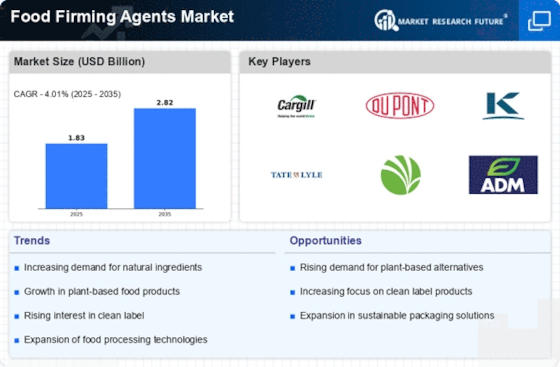
As per Market Research Future analysis, the Food Firming Agents Market Size was estimated at 1.831 USD Billion in 2024. The Food Firming Agents industry is projected to grow from 1.904 USD Billion in 2025 to 2.821 USD Billion by 2035, exhibiting a compound annual growth rate (CAGR) of 4.01% during the forecast period 2025 - 2035

Key Market Trends & Highlights

The Food Firming Agents Market is experiencing notable growth driven by innovation and changing consumer preferences.

  • The market is witnessing a rise in plant-based firming agents, reflecting a shift towards healthier food options.
  • Technological advancements in food processing are enhancing the efficiency and effectiveness of firming agents.
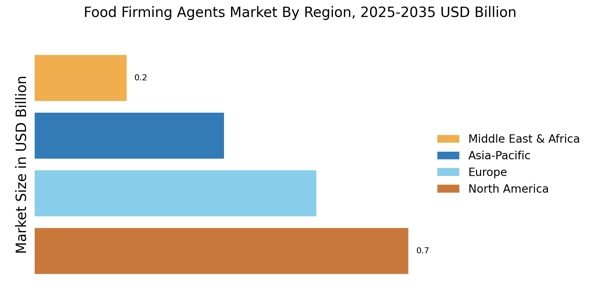
  • The North American region remains the largest market, while the Asia-Pacific region is emerging as the fastest-growing area.
  • Increasing demand for processed foods and health consciousness among consumers are key drivers propelling market expansion.

Market Size & Forecast

2024 Market Size 1.831 (USD Billion)
2035 Market Size 2.821 (USD Billion)
CAGR (2025 - 2035) 4.01%

Major Players

Cargill (US), DuPont (US), Kerry Group (IE), Tate & Lyle (GB), Ingredion (US), Archer Daniels Midland (US), FMC Corporation (US), BASF (DE), CP Kelco (US)

Our Impact
Enabled $4.3B Revenue Impact for Fortune 500 and Leading Multinationals
Partnering with 2000+ Global Organizations Each Year
30K+ Citations by Top-Tier Firms in the Industry

Food Firming Agents Market Trends

The Food Firming Agents Market is currently experiencing a notable evolution, driven by a growing consumer preference for natural and clean-label products. This shift is prompting manufacturers to explore innovative solutions that enhance the texture and stability of food products without compromising on health standards. As consumers become increasingly aware of ingredient transparency, the demand for plant-based firming agents is likely to rise, reflecting a broader trend towards sustainability and health-conscious eating. Furthermore, advancements in food technology are enabling the development of new firming agents that not only improve product quality but also align with dietary restrictions and preferences, such as gluten-free and vegan options. In addition to the focus on natural ingredients, the Food Firming Agents Market is also witnessing a surge in applications across various food segments, including dairy, bakery, and meat products. This diversification suggests that firms are actively seeking to enhance the sensory attributes of their offerings, thereby appealing to a wider audience. The increasing popularity of convenience foods, which often require firming agents to maintain texture during processing and storage, further underscores the market's potential for growth. As the industry adapts to these changing consumer demands, it appears poised for continued expansion, with innovation at the forefront of its development strategies.

Rise of Plant-Based Firming Agents

The Food Firming Agents Market is seeing a significant shift towards plant-based alternatives. As consumers increasingly prioritize health and sustainability, manufacturers are exploring natural sources for firming agents. This trend not only caters to the demand for clean-label products but also aligns with the growing interest in vegan and vegetarian diets.

Technological Advancements in Food Processing

Innovations in food technology are playing a crucial role in the evolution of the Food Firming Agents Market. New processing techniques and formulations are being developed to enhance the effectiveness of firming agents. These advancements enable better texture and stability in food products, meeting the expectations of modern consumers.

Expansion Across Diverse Food Segments

The application of firming agents is broadening within the Food Firming Agents Market, encompassing various sectors such as dairy, bakery, and meat products. This expansion indicates a strategic response from manufacturers to enhance product quality and appeal to diverse consumer preferences, particularly in the realm of convenience foods.

Food Firming Agents Market Drivers

Regulatory Support for Food Safety

The Food Firming Agents Market is also benefiting from increasing regulatory support aimed at enhancing food safety standards. Governments and regulatory bodies are implementing stricter guidelines regarding food additives, which has led to a heightened focus on the safety and efficacy of firming agents. This regulatory environment encourages manufacturers to invest in research and development to ensure compliance with safety standards. As a result, the Food Firming Agents Market is likely to see a rise in the adoption of approved firming agents that meet these stringent regulations. This trend not only enhances consumer trust but also drives innovation within the industry, as companies strive to develop safer and more effective firming solutions.

Health Consciousness Among Consumers

In recent years, there has been a marked increase in health consciousness among consumers, which is influencing the Food Firming Agents Market. As individuals become more aware of the nutritional content of their food, there is a growing demand for products that are perceived as healthier. This shift has prompted food manufacturers to explore natural and organic firming agents as alternatives to synthetic options. The market for natural food additives, including firming agents, is expected to expand significantly, with projections indicating a growth rate of around 5% annually. This trend suggests that the Food Firming Agents Market must adapt to meet the evolving preferences of health-conscious consumers, potentially leading to innovations in product formulations.

Increasing Demand for Processed Foods

The Food Firming Agents Market is experiencing a notable surge in demand for processed foods, driven by changing consumer lifestyles and preferences. As urbanization continues to rise, consumers are increasingly seeking convenient food options that require minimal preparation. This trend has led to a greater reliance on processed foods, which often utilize firming agents to enhance texture and stability. According to recent data, the processed food sector is projected to grow at a compound annual growth rate of approximately 4.5% over the next few years. Consequently, the Food Firming Agents Market is likely to benefit from this growth, as manufacturers seek to improve the quality and shelf-life of their products through the incorporation of effective firming agents.

Innovation in Food Preservation Techniques

Innovation in food preservation techniques is emerging as a key driver for the Food Firming Agents Market. As food manufacturers seek to extend the shelf life of their products while maintaining quality, the role of firming agents becomes increasingly critical. Advances in preservation technologies, such as high-pressure processing and modified atmosphere packaging, are creating new opportunities for the application of firming agents. These innovations are expected to contribute to a projected growth rate of approximately 6% in the food preservation sector over the next few years. Consequently, the Food Firming Agents Market is likely to experience increased demand as manufacturers look to enhance the texture and stability of preserved foods.

Rising Popularity of Ethnic and Specialty Foods

The rising popularity of ethnic and specialty foods is significantly influencing the Food Firming Agents Market. As consumers become more adventurous in their culinary choices, there is a growing demand for diverse food products that often require specific textural attributes. Firming agents play a crucial role in achieving the desired consistency and mouthfeel in these foods. Market analysis indicates that the ethnic food segment is expected to grow at a rate of around 7% annually, reflecting the increasing consumer interest in global cuisines. This trend suggests that the Food Firming Agents Market must adapt to cater to the unique requirements of ethnic and specialty food products, potentially leading to the development of new firming solutions tailored to these markets.


Market Segment Insights

By Type: Natural Firming Agents (Largest) vs. Modified Starches (Fastest-Growing)

The Food Firming Agents Market is characterized by a diverse range of products, with Natural Firming Agents currently holding the largest market share. These agents, derived from natural sources, appeal to a growing consumer demand for clean label ingredients and healthier options. Following closely are Modified Starches, which are experiencing rapid growth in recent years, driven by their versatility and functionality in various food applications. Other segments, such as Synthetic Firming Agents, Pectin, and Calcium Salts, also contribute to the market but hold smaller shares compared to the leading categories. Growth trends indicate a shift towards natural and clean label options, prompting manufacturers to innovate with Natural Firming Agents. Modified Starches are gaining traction due to their adaptability in food formulations, catering to gluten-free and texturizing needs. The rising health consciousness and the demand for plant-based ingredients further propel the growth of these segments. Overall, the Food Firming Agents Market is witnessing significant changes in consumer preferences, influencing the future trajectory of these agents.

Natural Firming Agents (Dominant) vs. Synthetic Firming Agents (Emerging)

Natural Firming Agents are dominating the Food Firming Agents Market due to their perceived health benefits and clean label appeal. These agents, sourced from plants and other natural materials, resonate with health-conscious consumers seeking wholesome food options. In contrast, Synthetic Firming Agents, while still relevant, are seen as more artificial alternatives. However, they play a crucial role in formulation stability and cost-effectiveness. As the demand for natural products continues to rise, Natural Firming Agents are expected to maintain their lead, while Synthetic options will adapt and innovate to meet changing consumer needs.

By Application: Fruits and Vegetables (Largest) vs. Meat Products (Fastest-Growing)

In the Food Firming Agents Market, the application segments reveal distinct distribution patterns. Fruits and Vegetables hold the largest market share, facilitated by increasing consumer demand for fresh produce that retains its texture and firmness. Following closely, Meat Products are also significant contributors, often requiring firming agents for improved texture and shelf-life. Beverages, dairy Products, and bakery products represent smaller shares but collectively contribute to a diverse application scope within the market.

Fruits and Vegetables (Dominant) vs. Meat Products (Emerging)

Fruits and Vegetables stand out as the dominant application in the Food Firming Agents Market, primarily due to rising health consciousness among consumers. This segment leverages firming agents to enhance the textural quality of fresh produce, leading to longer shelf life and better marketability. In contrast, Meat Products are rapidly emerging as a critical application area, driven by innovations in food technology and processing methods. The demand for premium meat products that offer superior mouthfeel and sensory experience fuels this growth, showcasing a shift in consumer preferences towards high-quality protein sources.

By End Use: Food Processing Industry (Largest) vs. Household (Fastest-Growing)

The Food Firming Agents Market exhibits a diverse distribution of market share among its end uses, with the Food Processing Industry taking the lead as the largest segment. This dominance is attributed to the increasing need for enhanced texture and stability in processed foods, where firming agents play a vital role. In contrast, the Household segment is rapidly gaining traction, driven by the rising trend of home cooking and the growing consumer demand for quality ingredients in homemade meals, highlighting a shift towards more personalized food preparation.

Food Processing Industry (Dominant) vs. Household (Emerging)

The Food Processing Industry is characterized by its significant reliance on food firming agents to improve the texture and quality of various products, including canned goods, sauces, and dairy items. This sector benefits from established supply chains and consistent demand as manufacturers seek to maintain product quality and extend shelf life. On the other hand, the Household segment is emerging rapidly as consumers increasingly focus on health-conscious food preparation at home. Households are exploring diverse applications for firming agents in recipes, driven by a growing interest in culinary innovation and personalized nutrition, positioning this segment for substantial growth in the coming years.

By Form: Powder (Largest) vs. Liquid (Fastest-Growing)

In the Food Firming Agents Market, the segment distribution reveals that the Powder form holds the largest share, attributed to its versatility and prolonged shelf life that appeal to manufacturers and consumers alike. Liquid forms have been gaining traction, accounting for a smaller segment initially but showing significant movement as they cater to the trend towards convenience and ready-to-use products.

Powder (Dominant) vs. Liquid (Emerging)

Powdered food firming agents dominate the market largely due to their effectiveness and easy incorporation into various food products. They offer stability and convenience in storage, making them a preferred choice for many food manufacturers. On the other hand, liquid firming agents are emerging rapidly, appealing to those seeking hassle-free solutions in food preparation. Their ease of use and ability to blend seamlessly into mixtures make them increasingly popular in both retail and food service sectors. As health-conscious trends rise, the demand for effective liquid agents is expected to rise, positioning them as a pivotal player in future market dynamics.

Get more detailed insights about Food Firming Agents Market

Regional Insights

North America : Innovation and Demand Surge

North America is the largest market for food firming agents, holding approximately 40% of the global market share. The region's growth is driven by increasing consumer demand for processed foods, health-conscious products, and clean-label ingredients. Regulatory support for food safety and quality standards further catalyzes market expansion, with organizations like the FDA ensuring compliance and innovation in food technologies. The United States dominates this market, with key players such as Cargill, DuPont, and Ingredion leading the charge. The competitive landscape is characterized by significant investments in R&D and strategic partnerships aimed at enhancing product offerings. Canada also plays a vital role, contributing to the market with its focus on natural and organic food firming solutions, thus fostering a diverse and competitive environment.

Europe : Regulatory Framework and Growth

Europe is the second-largest market for food firming agents, accounting for around 30% of the global market share. The region's growth is propelled by stringent food safety regulations and a rising consumer preference for healthier food options. The European Food Safety Authority (EFSA) plays a crucial role in regulating food additives, ensuring that food firming agents meet high safety standards, which in turn boosts consumer confidence and market demand. Leading countries in this region include Germany, France, and the UK, where companies like BASF and Kerry Group are prominent. The competitive landscape is marked by innovation in product formulations and a shift towards plant-based alternatives. The presence of established firms and a robust regulatory framework fosters a dynamic market environment, encouraging new entrants and technological advancements.

Asia-Pacific : Rapid Growth and Opportunities

Asia-Pacific is witnessing rapid growth in the food firming agents market, holding approximately 20% of the global market share. The region's expansion is driven by increasing urbanization, changing dietary habits, and a growing middle class that demands processed and convenience foods. Additionally, supportive government policies aimed at enhancing food production and safety standards are significant growth catalysts, fostering a favorable environment for market players. China and India are the leading countries in this region, with a burgeoning food processing industry. Key players like FMC Corporation and CP Kelco are actively investing in local production facilities to meet rising demand. The competitive landscape is characterized by a mix of multinational corporations and local firms, creating a diverse market that is ripe for innovation and growth, particularly in natural and organic food firming solutions.

Middle East and Africa : Untapped Potential and Growth

The Middle East and Africa region is gradually emerging as a significant market for food firming agents, currently holding about 10% of the global market share. The growth is driven by increasing food consumption, urbanization, and a shift towards processed foods. Additionally, government initiatives aimed at improving food security and safety standards are fostering a conducive environment for market growth, with various regulations being introduced to enhance food quality and safety. Countries like South Africa and the UAE are leading the market, with a growing number of local and international players entering the space. The competitive landscape is evolving, with companies focusing on innovative solutions to meet the unique needs of the region. The presence of key players and a rising demand for food firming agents are expected to drive further growth in this untapped market.

Food Firming Agents Market Regional Image

Key Players and Competitive Insights

The Food Firming Agents Market is witnessing significant growth driven by increasing consumer demand for high-quality food products along with a shift towards natural and clean label ingredients. With the rising focus on food preservation, texture enhancement, and nutritional benefits, food firming agents are becoming vital contributors in various food applications. As the market expands, competition is intensifying among key players who are investing in research and development, expanding their product portfolios, and forming strategic collaborations. These competitive dynamics are further underscored by the growing trend of health-conscious consumers favoring products that provide both safety and improved sensory qualities.
BASF has established a strong position in the Food Firming Agents Market through its extensive portfolio of innovative products and a robust global distribution network. The company's strength lies in its commitment to research and development, which allows it to consistently introduce new products and technologies that meet the evolving needs of the food industry. BASF's effective supply chain management and strategic partnerships with agriculture and food industry stakeholders enhance its market presence and foster brand loyalty among customers.
Furthermore, the company's dedication to sustainable practices aligns well with current consumer trends, solidifying its reputation as a leader in providing high-quality, effective food firming solutions.
DuPont is a recognized player in the Food Firming Agents Market, leveraging its deep expertise in food science and advanced technologies. The company's strengths are reflected through a diverse range of food firming agents that improve texture, stability, and shelf life across various food products. DuPont’s continuous innovation initiatives focus on meeting the demand for natural ingredients and clean labels, which resonate well with a rapidly changing consumer landscape. Moreover, DuPont's strong relationships with food manufacturers and its ability to provide tailored solutions further enhance its competitive advantage.
With a focus on quality, safety, and application specificity, DuPont remains a prominent force in shaping the future of food firming agents.

Key Companies in the Food Firming Agents Market include

Industry Developments

The Food Firming Agents Market has seen significant activity in recent months, with companies like BASF and DuPont making strategic moves to enhance their portfolios. Recent developments include Cargill investing in sustainable food solutions to address rising consumer demand for health-conscious products. Kerry Group has launched new plant-based firming agents to cater to the increasing trend towards vegetarian and vegan diets. Additionally, Royal DSM has acquired a company specializing in natural food additives, reinforcing its position in the market.

In terms of market valuation, companies like Ingredion have reported substantial growth, driven by innovations in food technologies that improve texture and stability. The market overall is reacting positively to these advancements and shifts in consumer preferences, indicating heightened competition among key players like Tate & Lyle and Archer Daniels Midland. Several firms are exploring partnerships and cooperative agreements to further improve their reach and product offerings amidst this dynamic landscape. The focus is heavily on sustainable practices and clean label products, underscoring a collective shift towards healthier food formulations within the food firming agent’s sector.

Future Outlook

Food Firming Agents Market Future Outlook

The Food Firming Agents Market is projected to grow at a 4.01% CAGR from 2025 to 2035, driven by increasing demand for processed foods and clean-label products.

New opportunities lie in:

  • Development of plant-based firming agents for vegan products.
  • Expansion into emerging markets with tailored product offerings.
  • Investment in R&D for innovative firming solutions in food preservation.

By 2035, the Food Firming Agents Market is expected to achieve robust growth and diversification.

Market Segmentation

Food Firming Agents Market Form Outlook

  • Powder
  • Liquid
  • Granular

Food Firming Agents Market Type Outlook

  • Natural Firming Agents
  • Synthetic Firming Agents
  • Modified Starches
  • Pectin
  • Calcium Salts

Food Firming Agents Market End Use Outlook

  • Food Processing Industry
  • Food Service
  • Household

Food Firming Agents Market Application Outlook

  • Fruits and Vegetables
  • Meat Products
  • Beverages
  • Dairy Products
  • Bakery Products

Report Scope

MARKET SIZE 20241.831(USD Billion)
MARKET SIZE 20251.904(USD Billion)
MARKET SIZE 20352.821(USD Billion)
COMPOUND ANNUAL GROWTH RATE (CAGR)4.01% (2025 - 2035)
REPORT COVERAGERevenue Forecast, Competitive Landscape, Growth Factors, and Trends
BASE YEAR2024
Market Forecast Period2025 - 2035
Historical Data2019 - 2024
Market Forecast UnitsUSD Billion
Key Companies ProfiledCargill (US), DuPont (US), Kerry Group (IE), Tate & Lyle (GB), Ingredion (US), Archer Daniels Midland (US), FMC Corporation (US), BASF (DE), CP Kelco (US)
Segments CoveredType, Application, End Use, Form, Regional
Key Market OpportunitiesGrowing demand for clean-label products drives innovation in the Food Firming Agents Market.
Key Market DynamicsRising consumer demand for clean-label products drives innovation in food firming agents and regulatory compliance.
Countries CoveredNorth America, Europe, APAC, South America, MEA
Leave a Comment

FAQs

What is the current valuation of the Food Firming Agents Market as of 2024?

The Food Firming Agents Market was valued at 1.831 USD Billion in 2024.

What is the projected market size for the Food Firming Agents Market by 2035?

The market is projected to reach 2.821 USD Billion by 2035.

What is the expected CAGR for the Food Firming Agents Market during the forecast period 2025 - 2035?

The expected CAGR for the Food Firming Agents Market during 2025 - 2035 is 4.01%.

Which companies are considered key players in the Food Firming Agents Market?

Key players in the market include Cargill, DuPont, Kerry Group, Tate & Lyle, Ingredion, Archer Daniels Midland, FMC Corporation, BASF, and CP Kelco.

What are the main types of food firming agents and their market valuations?

Natural firming agents are valued at 0.55 to 0.85 USD Billion, while synthetic firming agents range from 0.4 to 0.6 USD Billion.

How do the applications of food firming agents vary in terms of market size?

Meat products are projected to generate 0.5 to 0.8 USD Billion, while fruits and vegetables are expected to account for 0.4 to 0.6 USD Billion.

What is the market valuation for food firming agents in the food processing industry?

The food processing industry is anticipated to contribute between 0.8 and 1.2 USD Billion to the market.

What forms do food firming agents take and their respective market values?

Liquid forms of food firming agents are valued between 0.65 and 1.0 USD Billion, while powder forms range from 0.55 to 0.85 USD Billion.

What is the expected market performance for food firming agents in the household segment?

The household segment is projected to generate between 0.431 and 0.721 USD Billion.

How does the market for food firming agents in beverages compare to other applications?

The beverages segment is expected to account for 0.3 to 0.5 USD Billion, indicating a smaller share compared to meat and dairy products.

Download Free Sample

Kindly complete the form below to receive a free sample of this Report

Compare Licence

×
Features License Type
Single User Multiuser License Enterprise User
Price $4,950 $5,950 $7,250
Maximum User Access Limit 1 User Upto 10 Users Unrestricted Access Throughout the Organization
Free Customization
Direct Access to Analyst
Deliverable Format
Platform Access
Discount on Next Purchase 10% 15% 15%
Printable Versions