
×
Request Free Sample ×

Kindly complete the form below to receive a free sample of this Report

* Please use a valid business email

Leading companies partner with us for data-driven Insights

clients tt-cursor
Hero Background

Flat Panel Detector Market

ID: MRFR/HC/6431-HCR
90 Pages
Kinjoll Dey
February 2026

Flat Panel Detector (FPD) Market Research Report Information By Portability (Fixed and Portable), By Application (Medical, Orthopedic, Cardiac, Veterinary, Mammogram, Dental, and Others), By End User (Hospitals & Clinics and Diagnostic Centers), And By Region (Europe, North America, Asia-Pacific, And the Rest Of The World) - Growth & Industry Forecast 2025 To 2035

Share:
Download PDF ×

We do not share your information with anyone. However, we may send you emails based on your report interest from time to time. You may contact us at any time to opt-out.

Flat Panel Detector Market Infographic
Purchase Options

Flat Panel Detector Market Summary

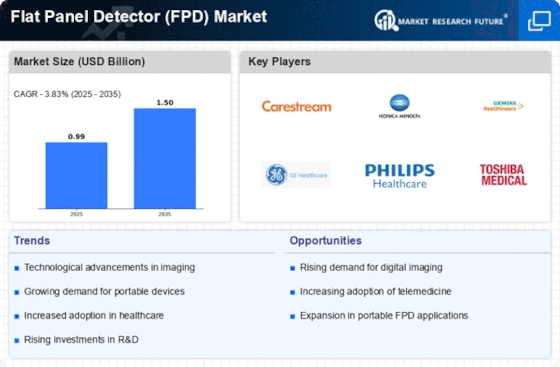
As per MRFR analysis, the Flat Panel Detector Market Size was estimated at 990.0 USD Million in 2024. The Flat Panel Detector industry is projected to grow from 1027.94 USD Million in 2025 to 1497.2 USD Million by 2035, exhibiting a compound annual growth rate (CAGR) of 3.83 during the forecast period 2025 - 2035.

Key Market Trends & Highlights

The Flat Panel Detector Market is experiencing robust growth driven by technological advancements and increasing demand across various sectors.

  • Technological advancements are propelling the development of more efficient and compact flat panel detectors.
  • The healthcare sector is witnessing a growing demand for flat panel detectors, particularly in diagnostic imaging applications.
  • Asia-Pacific emerges as the fastest-growing region, reflecting a surge in healthcare investments and industrial applications.
  • Key market drivers include rising demand for diagnostic imaging and increased investment in healthcare infrastructure.

Market Size & Forecast

2024 Market Size 990.0 (USD Million)
2035 Market Size 1497.2 (USD Million)
CAGR (2025 - 2035) 3.83%

Major Players

Carestream Health (US), Siemens Healthineers (DE), GE Healthcare (US), Philips Healthcare (NL), Canon Medical Systems (JP), Agfa-Gevaert Group (BE), Fujifilm Holdings Corporation (JP), Konica Minolta (JP), Hitachi Medical Corporation (JP)

Our Impact
Enabled $4.3B Revenue Impact for Fortune 500 and Leading Multinationals
Partnering with 2000+ Global Organizations Each Year
30K+ Citations by Top-Tier Firms in the Industry

Flat Panel Detector Market Trends

The Flat Panel Detector Market is currently experiencing a transformative phase, driven by advancements in technology and increasing demand for high-quality imaging solutions. The integration of flat panel detectors in various applications, such as medical imaging, industrial inspection, and security, appears to be expanding. This growth is likely influenced by the need for more efficient and accurate diagnostic tools, which are essential in healthcare settings. Furthermore, the shift towards digital imaging technologies is fostering innovation, as manufacturers strive to enhance the performance and functionality of flat panel detectors. In addition, the rising awareness of the benefits associated with flat panel detectors, including reduced radiation exposure and improved image quality, seems to be propelling market expansion. As healthcare providers and industries recognize the advantages of these devices, the Flat Panel Detector Market is poised for further growth. The ongoing research and development efforts aimed at creating more compact and cost-effective solutions may also contribute to the market's evolution. Overall, the Flat Panel Detector Market is on a promising trajectory, with numerous opportunities for stakeholders to explore and capitalize on emerging trends.

Technological Advancements

The Flat Panel Detector Market is witnessing rapid technological advancements that enhance imaging capabilities. Innovations in sensor technology and image processing algorithms are likely to improve the quality and speed of image acquisition. As manufacturers invest in research and development, the introduction of next-generation detectors may redefine standards in various applications.

Growing Demand in Healthcare

There is a notable increase in demand for flat panel detectors within the healthcare sector. The need for precise diagnostic tools is driving healthcare providers to adopt advanced imaging solutions. This trend suggests that hospitals and clinics are prioritizing investments in flat panel technology to improve patient outcomes and operational efficiency.

Expansion in Industrial Applications

The Flat Panel Detector Market is also expanding into industrial applications, such as non-destructive testing and quality control. Industries are increasingly recognizing the advantages of flat panel detectors for inspecting materials and components. This diversification indicates a broader acceptance of these technologies beyond traditional medical uses.

Flat Panel Detector Market Drivers

Rising Demand for Diagnostic Imaging

The Flat Panel Detector Market is witnessing a notable increase in demand for diagnostic imaging solutions. This trend is primarily driven by the growing prevalence of chronic diseases and the need for early detection and accurate diagnosis. As healthcare providers seek to enhance patient outcomes, the adoption of flat panel detectors in radiology departments is becoming more prevalent. According to recent estimates, the market for diagnostic imaging is expected to reach USD 45 billion by 2027, with flat panel detectors playing a crucial role in this growth. The ability of these detectors to provide high-resolution images with lower radiation doses is likely to further propel their adoption in hospitals and clinics, thereby expanding the Flat Panel Detector Market.

Growing Focus on Patient Safety and Comfort

The Flat Panel Detector Market is increasingly influenced by the growing focus on patient safety and comfort in medical imaging. Healthcare providers are prioritizing technologies that minimize radiation exposure while maintaining high image quality. Flat panel detectors are designed to achieve this balance, making them a preferred choice in radiology departments. The emphasis on patient-centered care is likely to drive the adoption of these detectors, as they contribute to a more comfortable and safer imaging experience. As awareness of radiation risks continues to rise, the Flat Panel Detector Market is expected to see a shift towards solutions that prioritize patient safety, potentially leading to a market growth rate of 6% over the next few years.

Increased Investment in Healthcare Infrastructure

The Flat Panel Detector Market is benefiting from increased investment in healthcare infrastructure across various regions. Governments and private entities are allocating substantial resources to modernize healthcare facilities and improve diagnostic capabilities. This investment is likely to lead to the procurement of advanced imaging equipment, including flat panel detectors, which are essential for accurate diagnostics. As healthcare systems evolve to meet the demands of growing populations, the market for flat panel detectors is expected to expand. Recent reports indicate that healthcare spending is projected to rise by 7% annually, further driving the demand for innovative imaging solutions within the Flat Panel Detector Market.

Technological Innovations in Flat Panel Detector Market

The Flat Panel Detector Market is experiencing a surge in technological innovations that enhance imaging capabilities. Advancements in sensor technology, such as the development of amorphous silicon and direct conversion detectors, are improving image quality and reducing radiation exposure. These innovations are likely to drive the adoption of flat panel detectors in various applications, including medical imaging and industrial inspections. The integration of artificial intelligence and machine learning algorithms into imaging systems is also expected to optimize diagnostic accuracy and workflow efficiency. As a result, the market is projected to grow at a compound annual growth rate of approximately 6.5% over the next few years, reflecting the increasing reliance on advanced imaging technologies.

Expansion of Flat Panel Detectors in Industrial Applications

The Flat Panel Detector Market is experiencing significant expansion in industrial applications, particularly in non-destructive testing (NDT) and quality control processes. Industries such as aerospace, automotive, and manufacturing are increasingly utilizing flat panel detectors for their ability to deliver high-quality imaging and real-time analysis. This trend is driven by the need for stringent quality assurance measures and compliance with safety regulations. The market for industrial flat panel detectors is projected to grow at a rate of 5% annually, as companies seek to enhance operational efficiency and reduce downtime. The versatility of flat panel detectors in various industrial settings is likely to contribute to the overall growth of the Flat Panel Detector Market.

Market Segment Insights

By Application: Medical Imaging (Largest) vs. Industrial Non-Destructive Testing (Fastest-Growing)

In the Flat Panel Detector Market, the Application segment showcases a diverse array of uses, with Medical Imaging holding the largest market share. This segment is driven by the increasing demand for advanced imaging technologies, contributing significantly to the overall market dynamics. Following closely is Industrial Non-Destructive Testing, which has been rapidly gaining traction due to its essential role in quality control and inspection processes across various industries. This shift in application focus highlights the evolving needs of healthcare and industrial sectors alike. The growth trends in the Application segment are underpinned by technological advancements and a rising emphasis on efficiency and accuracy. The Medical Imaging segment is seeing growth from improvements in imaging quality, efficiency, and patient throughput, while the Industrial Non-Destructive Testing segment is expanding due to augmented safety regulations and the need for reliable material inspection techniques. Security Screening and Veterinary Imaging also play vital roles, contributing to the overall expansion of the market by catering to specialized needs in their respective fields.

Medical Imaging (Dominant) vs. Veterinary Imaging (Emerging)

In the Flat Panel Detector Market, Medical Imaging stands out as the dominant segment, credited with transforming diagnostics through high-quality imaging solutions. This segment encompasses various technologies like X-rays and CT scans, directly impacting the quality of patient care and procedural efficiency. Emerging as a noteworthy segment is Veterinary Imaging, which, while not as expansive, is steadily gaining recognition due to increased pet ownership and the growing emphasis on animal healthcare. Veterinary Imaging utilizes similar flat panel detector technologies but tailors them for use in animal diagnostics. This growing market is driven by advancements in veterinary services and tools, enabling more accurate and timely diagnoses. As public awareness of animal health rises, the Veterinary Imaging segment is expected to gain further ground.

By Technology: Direct Conversion (Largest) vs. Indirect Conversion (Fastest-Growing)

In the Flat Panel Detector Market, the 'Technology' segment is strategically divided between Direct Conversion and Indirect Conversion technologies. Direct Conversion currently holds the largest market share due to its superior ability to convert X-rays directly into electrical signals without an intermediate step, thus enhancing image quality and reducing noise. This technology is predominantly adopted in radiography and fluoroscopy applications, which further consolidates its leading position in the market. In contrast, Indirect Conversion technology, though smaller in market share, is rapidly gaining traction as it offers cost-effective solutions and easier integration with existing systems. These contrasting characteristics drive the competitive landscape of the segment.

Technology: Direct Conversion (Dominant) vs. Indirect Conversion (Emerging)

Direct Conversion technology is established as the dominant player in the Flat Panel Detector Market, renowned for its improved performance in capturing high-resolution images. This technology employs a direct conversion approach, providing faster and more efficient imaging capabilities, thus meeting the stringent demands of medical imaging applications. On the other hand, Indirect Conversion technology presents itself as an emerging contender in this market. It remains increasingly popular for its affordability and flexibility in integration, appealing to a broader customer base, especially among facilities that prioritize budget constraints while still requiring reliable imaging solutions. The interplay between these technologies illustrates a dynamic market evolving to meet both high-performance and economical needs.

By End Use: Hospitals (Largest) vs. Diagnostic Imaging Centers (Fastest-Growing)

In the Flat Panel Detector Market, hospitals command the largest share, reflecting their critical role in patient care and advanced imaging techniques. These institutions use flat panel detectors extensively to improve diagnostic accuracy and patient throughput and remain central to the adoption of imaging technologies. Diagnostic imaging centers, while currently smaller in market share, are rapidly expanding as imaging becomes increasingly vital for preventive care and early diagnosis, positioning them as a key area of growth.

Hospitals (Dominant) vs. Research Laboratories (Emerging)

Hospitals are the dominant players in the Flat Panel Detector Market, leveraging their established infrastructure and significant patient volumes to integrate advanced imaging technologies effectively. Their extensive use of flat panel detectors enhances the quality of care and operational efficiency. In contrast, research laboratories represent an emerging segment, driven by growing investments in medical research and innovative imaging applications. As these facilities increasingly adopt flat panel detectors to facilitate research and development processes, their influence in the market is expected to rise.

Get more detailed insights about Flat Panel Detector Market

Regional Insights

North America : Market Leader in Innovation

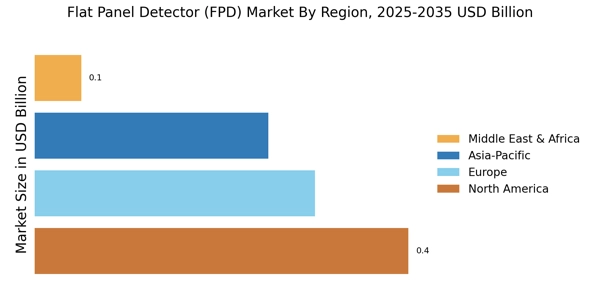
North America continues to lead the Flat Panel Detector market, holding a significant share of 495.0 million in 2024. The region's growth is driven by advanced healthcare infrastructure, increasing demand for diagnostic imaging, and supportive regulatory frameworks. The integration of AI and digital technologies in medical imaging is further propelling market expansion, with hospitals and clinics investing heavily in modern equipment to enhance patient care. The competitive landscape in North America is robust, featuring key players such as Carestream Health, GE Healthcare, and Siemens Healthineers. The U.S. remains the largest market, supported by high healthcare expenditure and a focus on technological advancements. The presence of major manufacturers and continuous innovation in product offerings are crucial for maintaining market leadership.

Europe : Emerging Market with Growth Potential

Europe's Flat Panel Detector market is valued at 250.0 million, reflecting a growing demand for advanced imaging solutions. Factors such as an aging population, rising chronic diseases, and government initiatives to improve healthcare access are driving this growth. Regulatory support for innovative medical technologies is also a catalyst, encouraging investments in state-of-the-art diagnostic equipment across the region. Leading countries in Europe include Germany, France, and the UK, where healthcare systems are increasingly adopting flat panel detectors. The competitive landscape features major players like Siemens Healthineers and Philips Healthcare, who are focusing on enhancing product features and expanding their market reach. The European market is poised for further growth as healthcare providers seek to improve diagnostic accuracy and patient outcomes.

Asia-Pacific : Rapid Growth in Healthcare Sector

The Asia-Pacific region, with a market size of 200.0 million, is witnessing rapid growth in the Flat Panel Detector market. This surge is driven by increasing healthcare investments, a growing population, and rising awareness of advanced diagnostic technologies. Governments are implementing policies to enhance healthcare infrastructure, which is further propelling demand for flat panel detectors in hospitals and clinics across the region. Countries like Japan, China, and India are leading the market, with significant contributions from local manufacturers and international players. The competitive landscape is characterized by a mix of established companies like Canon Medical Systems and emerging firms. The focus on affordable healthcare solutions and technological advancements is expected to drive further growth in this dynamic market.

Middle East and Africa : Untapped Potential in Healthcare

The Middle East and Africa (MEA) region, with a market size of 45.0 million, presents untapped potential in the Flat Panel Detector market. The growth is primarily driven by increasing healthcare investments, rising incidences of chronic diseases, and a push for modernizing healthcare facilities. Governments are focusing on improving healthcare access and quality, which is creating opportunities for advanced diagnostic technologies. Leading countries in the MEA region include South Africa and the UAE, where healthcare systems are increasingly adopting innovative imaging solutions. The competitive landscape is evolving, with both local and international players striving to capture market share. The emphasis on enhancing healthcare infrastructure and patient care is expected to drive significant growth in the coming years.

Flat Panel Detector Market Regional Image

Key Players and Competitive Insights

The Flat Panel Detector Market is currently characterized by a dynamic competitive landscape, driven by technological advancements and increasing demand for high-quality imaging solutions. Key players such as Carestream Health (US), Siemens Healthineers (DE), and GE Healthcare (US) are strategically positioned to leverage innovation and expand their market presence. Carestream Health (US) focuses on enhancing its product portfolio through continuous research and development, while Siemens Healthineers (DE) emphasizes digital transformation and integrated healthcare solutions. GE Healthcare (US) is also investing heavily in AI-driven technologies to improve diagnostic accuracy, which collectively shapes a competitive environment that prioritizes innovation and technological integration.

In terms of business tactics, companies are increasingly localizing manufacturing and optimizing supply chains to enhance operational efficiency. The market appears moderately fragmented, with several key players exerting influence over various segments. This fragmentation allows for diverse strategies, enabling companies to cater to specific regional demands while maintaining competitive pricing and quality standards.

In January 2026, Siemens Healthineers (DE) announced a partnership with a leading AI technology firm to develop advanced imaging solutions that integrate AI capabilities into their flat panel detectors. This strategic move is likely to enhance Siemens' product offerings, positioning them as a leader in the integration of AI in medical imaging, which could significantly improve diagnostic workflows and patient outcomes.

In December 2025, GE Healthcare (US) launched a new line of flat panel detectors designed specifically for pediatric imaging, addressing a critical gap in the market. This initiative not only demonstrates GE's commitment to specialized healthcare solutions but also reflects a growing trend towards personalized medicine, which is increasingly important in today's healthcare landscape.

In November 2025, Fujifilm Holdings Corporation (JP) expanded its manufacturing capabilities in Europe, aiming to meet the rising demand for flat panel detectors in the region. This expansion is indicative of Fujifilm's strategy to enhance its supply chain resilience and responsiveness to market needs, potentially allowing for quicker delivery times and improved customer satisfaction.

As of February 2026, current trends in the Flat Panel Detector Market are heavily influenced by digitalization, sustainability, and the integration of AI technologies. Strategic alliances among key players are shaping the competitive landscape, fostering innovation and collaboration. The shift from price-based competition to a focus on technological advancement and supply chain reliability is evident, suggesting that future competitive differentiation will hinge on the ability to innovate and adapt to evolving market demands.

Key Companies in the Flat Panel Detector Market include

Industry Developments

The release of new V series Glass-Free Flat Panel Detectors (FPD) that are now compatible with all our general radiography systems is something we are proud of and has happened in July 2023 by Shimadzu Medical Systems USA, a subsidiary of Shimadzu Corporation. With these new Glass-Free FPDs, there is indeed a complete V series lineup for all the versatile requirements. The 99-micron small pixel pitch allows the detection of the finest X-ray images. Moreover, the lightweight design decreases the physical effort put on radiology technologists and increases their strength against sudden drops.

In November 2022, the AZURE flat Panel detector was introduced by Varex Imaging Corporation at RSNA 2022. For real-time imaging applications, it features faster integration with high speed and low noise.

In March 2021, Pixium Group unveiled Thales Group’s latest radiation imaging product, Pixium 3040F, which produces high-quality images with optimized spatial resolution, improved contrast, and superior sensitivity at low doses as compared to the standard D.R. system.

AccE Glass-Free Detector, introduced by Samsung in October 2022, is an innovative concept that makes use of advanced X-ray imaging technology to improve diagnostic accuracy and efficiency.

July 2023 saw Shimadzu Medical Systems USA offering general radiography systems enhanced by adding advanced imaging technology using V series Glass-Free Flat Panel Detectors.

In November last year, Block Imaging announced an X-RAY partnership with Fujifilm Healthcare Solutions. Most Fujifilm products come with sophisticated image processing technologies. Block Imaging has promised to provide various new products that encompass novel cost-saving and energy-saving technology. For example, FDR ES detector, FDR D-EVO III, AND FDR D-EVO II detectors offered by Fujifilm block also include Clinica X OTC And FDR Clinica X FS suites besides mobile digital radiography units such as FDR Go Plus and FDR AQRO.

Therefore, Block can try to bring innovative technology to all healthcare providers across the U.S. since it has partnered with Fujifilm Healthcare Solutions.

November 2022: Varex Imaging Corporation debuted the AZURE flat panel detector (FPD) at RSNA 2022. The product offers faster integration for real-time image applications while maintaining high speed and low noise.

March 2021: Thales Group introduced the Pixium 3040F, a radiotherapy imaging system with high image quality, optimized spatial resolution, higher contrast, and superior responsivity at low doses.

March 2021: In Japan, Canon Inc introduced the XCDI-RF wireless B1, a wireless flat panel detector (FPD) for radiography and fluoroscopy.

Future Outlook

Flat Panel Detector Market Future Outlook

The Flat Panel Detector Market is projected to grow at a 3.83% CAGR from 2024 to 2035, driven by technological advancements, increasing healthcare demands, and rising adoption in industrial applications.

New opportunities lie in:

  • Expansion into emerging markets with tailored product offerings.
  • Development of integrated imaging solutions for enhanced diagnostic capabilities.
  • Investment in R&D for next-generation detector technologies.

By 2035, the Flat Panel Detector Market is expected to achieve robust growth, reflecting evolving industry needs.

Market Segmentation

Flat Panel Detector Market End Use Outlook

  • Hospitals
  • Diagnostic Imaging Centers
  • Research Laboratories
  • Manufacturing Industries

Flat Panel Detector Market Technology Outlook

  • Direct Conversion
  • Indirect Conversion
  • Flat Panel Technology

Flat Panel Detector Market Application Outlook

  • Medical Imaging
  • Industrial Non-Destructive Testing
  • Security Screening
  • Veterinary Imaging

Report Scope

MARKET SIZE 2024990.0(USD Million)
MARKET SIZE 20251027.94(USD Million)
MARKET SIZE 20351497.2(USD Million)
COMPOUND ANNUAL GROWTH RATE (CAGR)3.83% (2024 - 2035)
REPORT COVERAGERevenue Forecast, Competitive Landscape, Growth Factors, and Trends
BASE YEAR2024
Market Forecast Period2025 - 2035
Historical Data2019 - 2024
Market Forecast UnitsUSD Million
Key Companies ProfiledCarestream Health (US), Siemens Healthineers (DE), GE Healthcare (US), Philips Healthcare (NL), Canon Medical Systems (JP), Agfa-Gevaert Group (BE), Fujifilm Holdings Corporation (JP), Konica Minolta (JP), Hitachi Medical Corporation (JP)

Segments CoveredApplication, Technology, End Use
Key Market OpportunitiesAdvancements in digital imaging technology drive growth in the Flat Panel Detector Market.
Key Market DynamicsTechnological advancements and regulatory changes drive innovation and competition in the Flat Panel Detector Market.
Countries CoveredNorth America, Europe, APAC, South America, MEA

Market Highlights

Author
Kinjoll Dey
Research Analyst Level I

He is an extremely curious individual currently working in Healthcare and Medical Devices Domain. Kinjoll is comfortably versed in data centric research backed by healthcare educational background. He leverages extensive data mining and analytics tools such as Primary and Secondary Research, Statistical Analysis, Machine Learning, Data Modelling. His key role also involves Technical Sales Support, Client Interaction and Project management within the Healthcare team. Lastly, he showcases extensive affinity towards learning new skills and remain fascinated in implementing them.

Leave a Comment

FAQs

What is the projected market valuation of the Flat Panel Detector (FPD) Market by 2035?

The Flat Panel Detector (FPD) Market is projected to reach a valuation of 1.497 USD Billion by 2035.

What was the market valuation of the Flat Panel Detector (FPD) Market in 2024?

In 2024, the Flat Panel Detector (FPD) Market was valued at 0.99 USD Billion.

What is the expected CAGR for the Flat Panel Detector (FPD) Market during the forecast period 2025 - 2035?

The expected CAGR for the Flat Panel Detector (FPD) Market during the forecast period 2025 - 2035 is 3.83%.

Which segments are included in the Flat Panel Detector (FPD) Market?

The Flat Panel Detector (FPD) Market includes segments such as Portability, Application, and End User.

What are the projected valuations for the Fixed and Portable segments in the Flat Panel Detector (FPD) Market?

The Fixed segment is projected to reach 0.885 USD Billion, while the Portable segment is expected to reach 0.612 USD Billion by 2035.

What applications are driving growth in the Flat Panel Detector (FPD) Market?

Key applications driving growth include Medical, Orthopedic, Cardiac, Veterinary, Mammogram, Dental, and Others, with Medical projected to reach 0.55 USD Billion by 2035.

Download Free Sample

Kindly complete the form below to receive a free sample of this Report

Compare Licence

×
Features License Type
Single User Multiuser License Enterprise User
Price $4,950 $5,950 $7,250
Maximum User Access Limit 1 User Upto 10 Users Unrestricted Access Throughout the Organization
Free Customization
Direct Access to Analyst
Deliverable Format
Platform Access
Discount on Next Purchase 10% 15% 15%
Printable Versions