×
Request Free Sample ×

Kindly complete the form below to receive a free sample of this Report

* Please use a valid business email

Leading companies partner with us for data-driven Insights

clients tt-cursor
Hero Background

Fire Hydrant Market

ID: MRFR/PCM/28314-HCR
111 Pages
Snehal Singh
February 2026

Fire Hydrant Market Research Report: By Type (Dry Hydrants, Wet Hydrants, Deluge Hydrants), By Application (Residential, Commercial, Industrial, Municipal), By Pressure Rating (Low Pressure (Below 100 psi), Medium Pressure (100-250 psi), High Pressure (Above 250 psi)), By Material (Ductile Iron, Cast Iron, Bronze, Polyurethane), By Valve Type (Gate Valve, Globe Valve, Check Valve, Butterfly Valve) and By Regional (North America, Europe, South America, Asia Pacific, Middle East and Africa) - Forecast to 2035.

Share:
Download PDF ×

We do not share your information with anyone. However, we may send you emails based on your report interest from time to time. You may contact us at any time to opt-out.

Fire Hydrant Market Infographic
Purchase Options

Fire Hydrant Market Summary

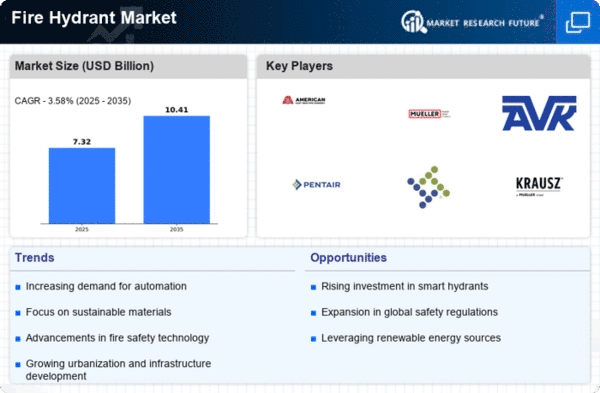
As per MRFR analysis, the Fire Hydrant Market Size was estimated at 7.07 USD Billion in 2024. The Fire Hydrant industry is projected to grow from 7.32 USD Billion in 2025 to 10.41 USD Billion by 2035, exhibiting a compound annual growth rate (CAGR) of 3.58 during the forecast period 2025 - 2035.

Key Market Trends & Highlights

The Fire Hydrant Market is experiencing a dynamic shift driven by technological advancements and sustainability initiatives.

  • North America remains the largest market for fire hydrants, driven by stringent regulatory compliance and fire safety standards.
  • The Asia-Pacific region is emerging as the fastest-growing market, fueled by rapid urbanization and increasing infrastructure development.
  • The fire protection segment continues to dominate the market, while the industrial use segment is witnessing the highest growth rates.
  • Key market drivers include rising awareness of fire safety and government regulations that mandate the installation of fire hydrants in urban areas.

Market Size & Forecast

2024 Market Size 7.07 (USD Billion)
2035 Market Size 10.41 (USD Billion)
CAGR (2025 - 2035) 3.58%

Major Players

American Cast Iron Pipe Company (US), Mueller Water Products (US), AVK Holding A/S (DK), Pentair plc (IE), Tyler Technologies (US), Krausz Industries (IL), Zurn Water Solutions (US), Hawle Wassertechnik (AT)

Our Impact
Enabled $4.3B Revenue Impact for Fortune 500 and Leading Multinationals
Partnering with 2000+ Global Organizations Each Year
30K+ Citations by Top-Tier Firms in the Industry

Fire Hydrant Market Trends

The Fire Hydrant Market is currently experiencing a dynamic evolution, driven by various factors that influence its growth trajectory. Increasing urbanization and the corresponding rise in infrastructure development necessitate enhanced fire safety measures, thereby propelling demand for fire hydrants. Furthermore, the growing awareness regarding fire safety regulations among municipalities and private entities appears to be a significant catalyst for market expansion. As cities continue to modernize, the integration of advanced technologies into fire hydrant systems is becoming more prevalent, suggesting a shift towards smart solutions that enhance operational efficiency and response times. In addition to technological advancements, sustainability concerns are gaining traction within the Fire Hydrant Market. Manufacturers are increasingly focusing on eco-friendly materials and designs that minimize environmental impact. This trend aligns with global efforts to promote sustainable practices across various industries. Moreover, the competitive landscape is evolving, with numerous players striving to innovate and differentiate their offerings. As a result, the Fire Hydrant Market is poised for continued growth, driven by a combination of regulatory pressures, technological innovations, and a heightened emphasis on sustainability.

Technological Advancements

The Fire Hydrant Market is witnessing a notable shift towards the incorporation of smart technologies. Innovations such as remote monitoring systems and automated alerts are enhancing the functionality of fire hydrants, allowing for quicker response times during emergencies. This trend indicates a growing preference for integrated solutions that improve overall fire safety management.

Sustainability Initiatives

There is an increasing focus on sustainability within the Fire Hydrant Market, as manufacturers explore eco-friendly materials and production processes. This trend reflects a broader commitment to reducing environmental impact and aligns with global sustainability goals, potentially influencing purchasing decisions among municipalities and organizations.

Regulatory Compliance

The Fire Hydrant Market is significantly shaped by evolving fire safety regulations. Stricter compliance requirements are prompting municipalities and private entities to invest in modern fire hydrant systems. This trend underscores the importance of adhering to safety standards, thereby driving demand for reliable and efficient fire protection solutions.

Fire Hydrant Market Drivers

Increasing Urbanization

The rapid pace of urbanization globally contributes significantly to the Global Fire Hydrant Market Industry. As cities expand, the demand for effective fire safety measures intensifies. Urban areas, characterized by dense populations and high-rise buildings, necessitate a robust fire hydrant infrastructure to ensure public safety. For instance, metropolitan regions are increasingly integrating advanced fire hydrant systems to meet safety regulations. This trend is expected to drive market growth, with projections indicating that the Global Fire Hydrant Market will reach approximately 7.07 USD Billion in 2024, reflecting the urgent need for enhanced fire protection in urban settings.

Technological Advancements

Innovations in fire hydrant technology are transforming the Global Fire Hydrant Market Industry. The introduction of smart fire hydrants equipped with sensors and remote monitoring capabilities enhances operational efficiency and response times during emergencies. These advancements allow for real-time data collection and analysis, enabling fire departments to optimize their resources effectively. For instance, cities that have adopted smart hydrant systems report improved fire response times and reduced maintenance costs. As the market evolves, the integration of such technologies is expected to bolster growth, contributing to an estimated market value of 10.4 USD Billion by 2035.

Market Trends and Projections

The Global Fire Hydrant Market Industry is characterized by various trends and projections that highlight its growth trajectory. As of 2024, the market is valued at 7.07 USD Billion, with expectations to reach 10.4 USD Billion by 2035. The compound annual growth rate (CAGR) from 2025 to 2035 is projected at 3.58%. These figures indicate a steady increase in demand driven by factors such as urbanization, regulatory compliance, and technological advancements. The market's evolution reflects a growing recognition of the importance of fire safety and the need for reliable fire hydrant systems across diverse regions.

Rising Awareness of Fire Safety

The growing awareness of fire safety among the public and businesses plays a crucial role in the Global Fire Hydrant Market Industry. Educational campaigns and training programs emphasize the importance of fire prevention and the role of hydrants in emergency response. This heightened awareness leads to increased investments in fire safety infrastructure, including the installation of hydrants in strategic locations. As communities recognize the value of proactive fire safety measures, the demand for fire hydrants is likely to rise, further propelling market growth. This trend aligns with the projected market expansion, indicating a robust future for the industry.

Global Infrastructure Development

The ongoing global infrastructure development initiatives significantly impact the Global Fire Hydrant Market Industry. Governments and private sectors are investing heavily in infrastructure projects, including roads, bridges, and public facilities, which necessitate the incorporation of fire safety measures. Fire hydrants are integral to these developments, ensuring that newly constructed areas are equipped with adequate fire protection. As urban and rural areas undergo modernization, the demand for fire hydrants is expected to surge, contributing to the overall market growth. This trend underscores the importance of integrating fire safety into infrastructure planning.

Regulatory Compliance and Safety Standards

Stringent regulatory frameworks and safety standards imposed by governments worldwide are pivotal in shaping the Global Fire Hydrant Market Industry. These regulations mandate the installation and maintenance of fire hydrants in both residential and commercial properties. Compliance with these standards not only ensures public safety but also mitigates the risk of fire-related incidents. For example, many countries have established guidelines that dictate the specifications and placement of fire hydrants. As a result, the market is likely to witness sustained growth, with an anticipated CAGR of 3.58% from 2025 to 2035, driven by the need for adherence to these regulations.


Market Segment Insights

By Application: Fire Protection (Largest) vs. Industrial Use (Fastest-Growing)

The fire hydrant market is primarily segmented into four key applications: Fire Protection, Industrial Use, Municipal Use, and Commercial Use. Among these, Fire Protection continues to hold the largest market share, driven by increasing safety regulations and the need to enhance community safety measures. Municipal Use also plays a significant role, as local governments invest in infrastructure to ensure efficient fire response capabilities. Meanwhile, Commercial Use is maintaining a steady position, thanks to the growth of urban areas and commercial spaces that demand reliable fire protection solutions.

Fire Protection (Dominant) vs. Industrial Use (Emerging)

Fire Protection is the dominant application segment in the fire hydrant market, characterized by extensive installations in urban infrastructure and a robust regulatory environment that mandates their use. This segment benefits from a comprehensive network of hydrants designed to meet the safety requirements of cities and towns. On the other hand, Industrial Use, while currently smaller in market share, is emerging rapidly due to heightened safety standards in industrial operations and an increased focus on risk management. Industries are recognizing the need for effective firefighting infrastructure, thereby driving innovations in hydrant designs tailored for industrial environments, leading to faster growth rates in this application.

By Material: Ductile Iron (Largest) vs. Plastic (Fastest-Growing)

In the Fire Hydrant Market, Ductile Iron dominates the material segment due to its high strength, flexibility, and corrosion resistance, making it a preferred choice for fire hydrant manufacturing. Cast Iron closely follows, offering durability but is less favored due to its vulnerability to rust. Stainless Steel and Plastics hold smaller shares; however, Plastics are increasingly gaining traction due to their lightweight properties and cost-effectiveness, appealing to municipalities looking to reduce installation and maintenance costs. The growth trends within this segment are influenced by the increasing demand for reliable firefighting solutions, particularly in urban areas. The ongoing transition towards lightweight and corrosion-resistant materials drives the adoption of Plastic fire hydrants, marking a shift in preference. Additionally, innovation in manufacturing processes and improvements in material technology facilitate the entry of Ductile Iron and Stainless Steel products into newer markets, bolstering their presence in the industry.

Ductile Iron (Dominant) vs. Plastic (Emerging)

Ductile Iron has established itself as the dominant material in the Fire Hydrant Market, known for its superior mechanical properties, resistance to impact, and ability to withstand extreme weather conditions. This makes it ideal for critical environments where reliability is paramount. Meanwhile, Plastic is emerging as a competitive option, appealing for its cost-effectiveness and lightweight nature. Plastic hydrants are easier to handle during installation and can significantly reduce overall project costs. While Ductile Iron hydrants are built for durability and high performance, the innovation in plastic materials is creating a niche market that offers functional advantages, particularly in regions with less intense weather scenarios and reduced overall demand for traditional heavy materials.

By Type: Wet Barrel (Largest) vs. Dry Barrel (Fastest-Growing)

The Fire Hydrant Market displays a diverse segmentation based on types, including Wet Barrel, Dry Barrel, Post Indicator Valve, and Pumper. Among these, Wet Barrel hydrants hold the largest share due to their widespread adoption in areas with consistent water supply. They are especially prevalent in urban settings since they are capable of functioning efficiently without complex mechanics. Conversely, Dry Barrel hydrants are being recognized as the fastest-growing segment because of their suitability for colder climates where water freezing poses a risk. This increase in demand for Dry Barrel hydrants reflects the industry's response to environmental changes and regional requirements.

Fire Hydrants: Wet Barrel (Dominant) vs. Dry Barrel (Emerging)

Wet Barrel hydrants are characterized by their exposed operational mechanisms, making them ideal for climates where temperatures remain above freezing. They are generally simpler and more cost-effective, contributing to their dominance in regions with reliable water availability. In contrast, Dry Barrel hydrants are designed with a valve located below the frost line to prevent freezing, resulting in their emerging preference in colder locales. These hydrants require more intricate installations and are becoming increasingly popular due to heightened awareness of winter safety and infrastructure investments aimed at enhancing water accessibility during harsh conditions. The growing trends toward sustainability and efficiency in urban planning further bolster the attractiveness of Dry Barrel hydrants.

By Size: 4 Inch (Largest) vs. 6 Inch (Fastest-Growing)

In the Fire Hydrant Market, the size segment displays varied market share distribution. Among the sizes, the 4 Inch hydrants hold the largest share, favored for their versatile application in urban settings where adequate water flow is crucial. Following closely, the 2.5 Inch and 6 Inch segments contribute significantly to the overall market but cater to more specific needs, with the 2.5 Inch being popular for residential access and the 6 Inch being used for larger infrastructure projects. Analysing growth trends within this segment reveals that there is a notable shift towards larger hydrant sizes, especially the 6 Inch models, which are emerging as the fastest-growing category. This growth can be attributed to increasing municipal investments in fire safety and urban development projects, as well as evolving building codes that demand higher performance from fire safety infrastructure.

4 Inch (Dominant) vs. 6 Inch (Emerging)

The 4 Inch fire hydrants are well-regarded in the market, offering a balanced solution with sufficient flow capabilities suitable for most urban firefighting needs. Their standardization in municipal fire solutions has made them a dominant choice among fire services, ensuring consistent performance in emergency situations. In contrast, the 6 Inch hydrants are emerging rapidly, driven by infrastructure upgrades and expanding urban environments where high-volume water discharge is necessary. These hydrants are becoming increasingly popular for their ability to handle greater water supply demands, making them an attractive option for new development areas and commercial sites. Their combination of performance and compliance with modern fire safety regulations positions them as a strong future contender in the market.

Get more detailed insights about Fire Hydrant Market

Regional Insights

North America : Market Leader in Fire Hydrants

North America is poised to maintain its leadership in the fire hydrant market, holding a significant share of 3.5 billion. The region's growth is driven by stringent safety regulations, increasing urbanization, and the need for reliable fire protection systems. Government initiatives aimed at enhancing infrastructure and public safety further catalyze demand for fire hydrants, ensuring a robust market environment. The competitive landscape in North America is characterized by key players such as American Cast Iron Pipe Company, Mueller Water Products, and Zurn Water Solutions. These companies are leveraging advanced technologies and innovative designs to meet the growing demand. The presence of established manufacturers and a well-developed distribution network contribute to the region's market strength, making it a focal point for fire hydrant production and innovation.

Europe : Emerging Market with Growth Potential

Europe's fire hydrant market is valued at 2.0 billion, reflecting a growing emphasis on safety and infrastructure upgrades. The region is witnessing increased investments in fire safety measures, driven by regulatory frameworks that mandate the installation of advanced fire protection systems. Additionally, the rise in urbanization and population density in major cities is propelling the demand for efficient fire hydrant solutions. Leading countries in this market include Germany, France, and the UK, where companies like AVK Holding A/S and Pentair plc are prominent. The competitive landscape is evolving, with a focus on sustainability and innovation. European manufacturers are increasingly adopting eco-friendly materials and technologies, positioning themselves as leaders in the global market. This shift is supported by regulatory bodies advocating for improved fire safety standards.

Asia-Pacific : Rapid Growth in Fire Safety

The Asia-Pacific fire hydrant market, valued at 1.8 billion, is experiencing rapid growth due to urbanization and increasing awareness of fire safety. Governments in countries like China and India are implementing stricter regulations and investing in infrastructure development, which is driving the demand for reliable fire hydrant systems. The region's expanding industrial sector also contributes to the rising need for effective fire protection solutions. Key players in the Asia-Pacific market include local manufacturers and international companies looking to expand their footprint. The competitive landscape is marked by collaborations and partnerships aimed at enhancing product offerings. As the region continues to develop, the focus on advanced technologies and compliance with international safety standards will shape the future of the fire hydrant market.

Middle East and Africa : Emerging Market with Challenges

The Middle East and Africa fire hydrant market, valued at 0.77 billion, is emerging but faces challenges such as regulatory inconsistencies and limited infrastructure. However, the region is witnessing a gradual increase in investments aimed at improving fire safety standards. Governments are recognizing the importance of fire protection systems, leading to a slow but steady growth in demand for fire hydrants. Countries like South Africa and the UAE are at the forefront of this market, with local and international players striving to establish a presence. The competitive landscape is characterized by a mix of established companies and new entrants, focusing on innovative solutions to meet the unique challenges of the region. As awareness of fire safety increases, the market is expected to evolve, driven by both regulatory support and infrastructural development.

Key Players and Competitive Insights

The Fire Hydrant Market is currently characterized by a competitive landscape that is both dynamic and multifaceted. Key growth drivers include increasing urbanization, stringent safety regulations, and the rising demand for efficient water management systems. Major players such as American Cast Iron Pipe Company (US), Mueller Water Products (US), and AVK Holding A/S (DK) are strategically positioned to leverage these trends. American Cast Iron Pipe Company (US) focuses on innovation in materials and manufacturing processes, while Mueller Water Products (US) emphasizes digital transformation and smart water solutions. AVK Holding A/S (DK) is known for its commitment to sustainability and environmentally friendly products. Collectively, these strategies contribute to a competitive environment that is increasingly focused on technological advancement and sustainability.In terms of business tactics, companies are localizing manufacturing to reduce costs and enhance supply chain efficiency. The market structure appears moderately fragmented, with a mix of established players and emerging companies. This fragmentation allows for diverse offerings and competitive pricing, although the influence of key players remains significant in shaping market trends and standards.

In November Mueller Water Products (US) announced a partnership with a leading technology firm to develop advanced smart hydrant systems that integrate IoT capabilities. This strategic move is likely to enhance their product offerings and position them as leaders in the smart water management sector. The integration of IoT technology into fire hydrants could significantly improve response times and operational efficiency for municipalities.

In October AVK Holding A/S (DK) launched a new line of eco-friendly fire hydrants made from recycled materials. This initiative not only aligns with global sustainability goals but also caters to the growing demand for environmentally responsible products. The strategic importance of this launch lies in its potential to attract environmentally conscious customers and enhance brand loyalty in a competitive market.

In September American Cast Iron Pipe Company (US) expanded its manufacturing capabilities by investing in a new facility focused on producing high-performance fire hydrants. This expansion is indicative of their commitment to meeting increasing demand and improving production efficiency. The strategic importance of this investment is underscored by the need for reliable and durable fire protection solutions in urban areas.

As of December current competitive trends in the Fire Hydrant Market are heavily influenced by digitalization, sustainability, and the integration of AI technologies. Strategic alliances are increasingly shaping the landscape, allowing companies to pool resources and expertise to innovate more effectively. Looking ahead, competitive differentiation is expected to evolve from traditional price-based competition to a focus on innovation, technology, and supply chain reliability. This shift suggests that companies that prioritize R&D and sustainable practices will likely gain a competitive edge in the market.

Key Companies in the Fire Hydrant Market include

Industry Developments

Increasing urbanization, growing construction activities, and stringent government regulations regarding fire safety are the key factors driving the market growth.Recent developments in the market include the launch of innovative fire hydrants with advanced features such as remote monitoring and control capabilities. For instance, in 2023, Mueller Water Products introduced the Mueller e-Hydrant, a smart fire hydrant designed to enhance firefighting efficiency and safety.Key players in the market are focusing on strategic partnerships and acquisitions to expand their product portfolios and geographical reach.

In 2022, Xylem acquired Mueller Water Products, a leading manufacturer of fire hydrants, valves, and other water infrastructure products.

Future Outlook

Fire Hydrant Market Future Outlook

The Fire Hydrant Market is projected to grow at a 3.58% CAGR from 2025 to 2035, driven by urbanization, infrastructure development, and regulatory mandates for fire safety.

New opportunities lie in:

  • Integration of smart technology for real-time monitoring and maintenance.
  • Expansion into emerging markets with tailored fire safety solutions.
  • Development of eco-friendly hydrants using sustainable materials.

By 2035, the Fire Hydrant Market is expected to be robust, driven by innovation and increased safety regulations.

Market Segmentation

Fire Hydrant Market Size Outlook

  • 2.5 Inch
  • 4 Inch
  • 6 Inch
  • 8 Inch

Fire Hydrant Market Type Outlook

  • Wet Barrel
  • Dry Barrel
  • Post Indicator Valve
  • Pumper

Fire Hydrant Market Material Outlook

  • Ductile Iron
  • Cast Iron
  • Stainless Steel
  • Plastic

Fire Hydrant Market Application Outlook

  • Fire Protection
  • Industrial Use
  • Municipal Use
  • Commercial Use

Report Scope

MARKET SIZE 20247.07(USD Billion)
MARKET SIZE 20257.32(USD Billion)
MARKET SIZE 203510.41(USD Billion)
COMPOUND ANNUAL GROWTH RATE (CAGR)3.58% (2025 - 2035)
REPORT COVERAGERevenue Forecast, Competitive Landscape, Growth Factors, and Trends
BASE YEAR2024
Market Forecast Period2025 - 2035
Historical Data2019 - 2024
Market Forecast UnitsUSD Billion
Key Companies ProfiledAmerican Cast Iron Pipe Company (US), Mueller Water Products (US), AVK Holding A/S (DK), Pentair plc (IE), Tyler Technologies (US), Krausz Industries (IL), Zurn Water Solutions (US), Hawle Wassertechnik (AT)
Segments CoveredApplication, Material, Type, Size
Key Market OpportunitiesIntegration of smart technology in Fire Hydrant Market enhances efficiency and safety in urban infrastructure.
Key Market DynamicsRising regulatory standards and technological advancements drive innovation and competition in the fire hydrant market.
Countries CoveredNorth America, Europe, APAC, South America, MEA
Leave a Comment

FAQs

What is the expected market size of the Fire Hydrant Market in 2024?

The Fire Hydrant Market is expected to reach a valuation of 7.07 USD Billion in 2024.

What is the expected CAGR of the Fire Hydrant Market from 2025 to 2034?

Fire Hydrant Market is expected to grow with a CAGR of 3.58% in the period 2025-2035

Which region is expected to have the largest market share in the Fire Hydrant Market in 2024?

North America is expected to have the largest market share in the Fire Hydrant Market in 2024.

What are the key applications of Fire Hydrants?

Key applications of Fire Hydrants include providing water for firefighting, flushing water mains, and testing fire pumps.

Who are some of the key competitors in the Fire Hydrant Market?

Key competitors in the Fire Hydrant Market include Mueller Water Products, Clow Valve Company, and McWane, Inc.

What are some of the factors driving growth in the Fire Hydrant Market?

Factors driving growth in the Fire Hydrant Market include increasing urbanization, rising demand for fire safety, and government regulations.

What are some of the challenges facing the Fire Hydrant Market?

Challenges facing the Fire Hydrant Market include aging infrastructure, competition from other firefighting technologies, and environmental concerns.

What are some of the key trends in the Fire Hydrant Market?

Key trends in the Fire Hydrant Market include the adoption of smart fire hydrants, the use of advanced materials, and the focus on sustainability.

Download Free Sample

Kindly complete the form below to receive a free sample of this Report

Compare Licence

×
Features License Type
Single User Multiuser License Enterprise User
Price $4,950 $ $7,250
Maximum User Access Limit 1 User Upto 10 Users Unrestricted Access Throughout the Organization
Free Customization
Direct Access to Analyst
Deliverable Format
Platform Access
Discount on Next Purchase 10% 15% 15%
Printable Versions