×
Request Free Sample ×

Kindly complete the form below to receive a free sample of this Report

* Please use a valid business email

Leading companies partner with us for data-driven Insights

clients tt-cursor
Hero Background
English
Chinese
French
Japanese
Korean
German
Spanish

Facial Paralysis Market Share

ID: MRFR/MED/4486-HCR
100 Pages
Kinjoll Dey
October 2025

Facial Paralysis Market Research Report Information By Type (Bell’s Palsy and Ramsay Hunt Syndrome), By Diagnosis (Electromyography and Computerized Tomography), By Treatment (Medications and Physical Therapy), By End-User (Hospitals and Specialty Centers), And By Region (North America, Europe, Asia-Pacific, And Rest Of The World) –Market Forecast Till 2035

Share:
Download PDF ×

We do not share your information with anyone. However, we may send you emails based on your report interest from time to time. You may contact us at any time to opt-out.

Facial Paralysis Market Infographic
×
Facial Paralysis Market Infographic Full View
Purchase Options

Market Share

Facial Paralysis Market Share Analysis

A successful market percentage positioning approach for Facial Paralysis starts with radical information about the situation's incidence, reasons, and evolving remedy landscape. Companies conduct particular market research to understand the nuances of Facial Paralysis, consisting of the demographic affected, regional variances, and rising medical interventions. Pioneering diagnostic advancements is essential for market positioning. Companies invest in superior diagnostic technology for unique and early detection of the underlying causes of Facial Paralysis. Utilizing imaging techniques, electromyography, and different diagnostic equipment contributes to correct diagnosis, facilitating focused treatment plans. Strategic collaborations with facial rehabilitation specialists, physiotherapists, and healthcare institutions that specialize in Facial Paralysis are essential. These partnerships offer possibilities for clinical trials, actual-world information collection, and feedback from professionals in the field. Recognizing the significance of an affected person-centric technique, agencies put in force guide programs for people with Facial Paralysis. These projects aim to provide sources for emotional help, rehabilitation steering, and coping techniques. Patient-centric programs contribute to stronger consequences for affected persons and foster loyalty to the brand. Expanding into worldwide markets is a strategic flow for agencies looking for improved market proportion in Facial Paralysis answers. Recognizing the worldwide impact of Facial Paralysis situations, businesses tailor their merchandise and market strategies to satisfy the unique wishes of numerous areas. Global expansion no longer broadens the customer base; however, it additionally positions the agency as a global leader in Facial Paralysis control. Adhering to stringent regulatory standards and ensuring excellent merchandise and interventions is non-negotiable. Companies that prioritize regulatory compliance and invest in robust best assurance measures build consideration amongst healthcare specialists and regulatory authorities. Quality warranty reinforces the safety and efficacy of the company's offerings, which is essential for market positioning. Embracing telemedicine and faraway rehabilitation solutions is becoming more and more relevant. Companies are conscious of growing technologies that allow for far-off monitoring and steering for Facial Paralysis rehabilitation sporting events. Integration of virtual fitness solutions aligns the corporation with the evolving healthcare landscape and allows continuous patient care. Crafting strategic advertising campaigns and effective branding is important for market percentage growth. Companies use numerous channels to speak the particular fee propositions of their Facial Paralysis answers. Emphasizing factors consisting of innovation, affected person-centric care, and high-quality outcomes allows for a sturdy brand presence within the market.


Author
Kinjoll Dey
Research Analyst Level I

He is an extremely curious individual currently working in Healthcare and Medical Devices Domain. Kinjoll is comfortably versed in data centric research backed by healthcare educational background. He leverages extensive data mining and analytics tools such as Primary and Secondary Research, Statistical Analysis, Machine Learning, Data Modelling. His key role also involves Technical Sales Support, Client Interaction and Project management within the Healthcare team. Lastly, he showcases extensive affinity towards learning new skills and remain fascinated in implementing them.

Leave a Comment

FAQs

What is the projected growth of the Facial Paralysis market?

The Facial Paralysis market is the expected increase in total market value of 4.23 USD billion over a defined forecast period 2025–2035. It is driven by factors such as demand trends, technological advances, regulatory changes, and geographic expansion.

What is the size of the Facial Paralysis market?

Facial Paralysis market size was valued at approximately 2.53 billion USD in 2024. This figure will reach 4.23 billion USD covering all regions (America, Europe, Asia, MEA and ROW), focusing its segments / services / distribution channels till 2035.

What is the CAGR of the Facial Paralysis market?

Facial Paralysis market is expected to grow at a CAGR of 4.8% between 2025 and 2035.

How much will the Facial Paralysis market be worth by 2035?

Facial Paralysis market is expected to be worth of 4.23 billion USD, reflecting growth driven by usage, technology and global demands by the end of 2035.

How will the Facial Paralysis market perform over the next 10 years?

Over the next 10 years the Facial Paralysis market is expected to shift from usd billion 2.53 to 4.23 billion USD, led by adoption of advanced tech, demographic trends, regulatory approvals, with potential headwinds from 2025 to 2035.

Which region held the largest market share in the facial paralysis market?

North America had the largest share in the market

Market Summary

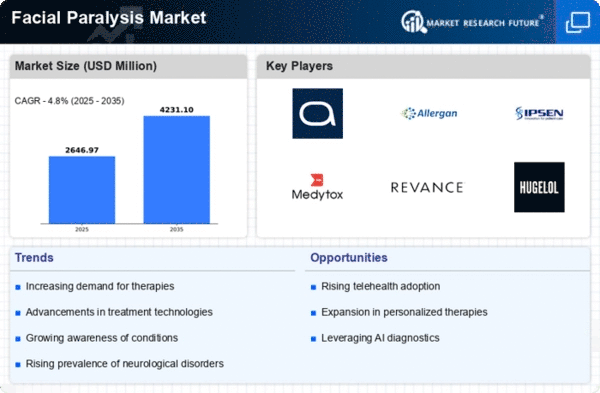
As per MRFR analysis, the Facial Paralysis Market Size was estimated at 2525.73 USD Million in 2024. The Facial Paralysis industry is projected to grow from 2647.01 USD Million in 2025 to 4231.1 USD Million by 2035, exhibiting a compound annual growth rate (CAGR) of 4.8 during the forecast period 2025 - 2035.

Key Market Trends & Highlights

The Facial Paralysis Market is experiencing notable growth driven by technological advancements and increasing awareness.

  • Technological advancements in treatment are enhancing patient outcomes and expanding therapeutic options.
  • Growing awareness and education about facial paralysis are leading to increased patient engagement and demand for services.
  • The rise of telehealth services is facilitating access to care, particularly in remote areas of North America.
  • The increasing incidence of facial paralysis and advancements in medical technology are key drivers propelling market growth, especially in rehabilitation and surgical intervention segments.

Market Size & Forecast

2024 Market Size 2525.73 (USD Million)
2035 Market Size 4231.1 (USD Million)
CAGR (2025 - 2035) 4.8%
Largest Regional Market Share in 2024 North America

Major Players

AbbVie (US), Allergan (US), Ipsen (FR), Medytox (KR), Revance Therapeutics (US), Hugel (KR), Galderma (CH), Medytox (KR), Sientra (US)

Market Trends

The Facial Paralysis Market is currently experiencing a notable evolution, driven by advancements in medical technology and an increasing awareness of treatment options. The rise in neurological disorders and facial nerve injuries has led to a growing demand for effective therapeutic solutions. Furthermore, the market is influenced by the expanding demographic of aging individuals, who are more susceptible to conditions that result in facial paralysis. This demographic shift is prompting healthcare providers to enhance their offerings, thereby fostering innovation in treatment methodologies. In addition, the integration of telemedicine and digital health solutions is reshaping the landscape of the Facial Paralysis Market. Patients are increasingly seeking remote consultations and therapies, which may enhance accessibility and convenience. This trend suggests a potential shift in how healthcare services are delivered, allowing for more personalized care. As the market continues to evolve, stakeholders must remain vigilant to emerging technologies and patient needs, ensuring that they adapt to the changing environment effectively.

Technological Advancements in Treatment

Recent innovations in medical technology are transforming treatment approaches for facial paralysis. New surgical techniques and rehabilitation tools are being developed, which may improve patient outcomes and recovery times. This trend indicates a shift towards more effective and less invasive options.

Growing Awareness and Education

There is an increasing emphasis on educating both healthcare professionals and the public about facial paralysis. Awareness campaigns are likely to enhance understanding of the condition, leading to earlier diagnosis and treatment. This trend may contribute to a more informed patient population.

Rise of Telehealth Services

The adoption of telehealth services is becoming more prevalent in the Facial Paralysis Market. Patients are utilizing remote consultations and therapy sessions, which could improve access to care. This trend suggests a potential transformation in how treatment is delivered, making it more convenient for patients.

Facial Paralysis Market Market Drivers

Rising Incidence of Facial Paralysis

The Global Facial Paralysis Market Industry experiences a notable increase in demand due to the rising incidence of facial paralysis conditions. Factors such as Bell's palsy, stroke, and traumatic injuries contribute to this trend. In 2024, the market is projected to reach 2.53 USD Billion, reflecting the growing need for effective treatment options. As awareness of facial paralysis increases, more individuals seek medical intervention, further driving market growth. The prevalence of these conditions is expected to rise, leading to an estimated market size of 4.23 USD Billion by 2035, indicating a robust CAGR of 4.79% from 2025 to 2035.

Market Segment Insights

By Application: Rehabilitation (Largest) vs. Surgical Intervention (Fastest-Growing)

In the Facial Paralysis Market, the application segment reveals a significant distribution of market share among its key components. Rehabilitation stands out as the largest segment, driven by the increasing prevalence of facial paralysis conditions and growing awareness regarding available therapies. This segment encompasses a variety of interventions aimed at restoring normal function and aesthetics, thus attracting a substantial share of patients seeking recovery. Meanwhile, surgical intervention is identified as the fastest-growing segment due to advancements in surgical techniques and technologies, which enhance treatment outcomes and encourage more patients to opt for these procedures. The growth trends in the facial paralysis market are heavily influenced by several factors, including the rising incidence of neurological disorders and an increasingly aging population, which amplifies the demand for effective rehabilitation and surgical solutions. Continuous research and development in pharmacological treatments and physical therapy methods also contribute to market growth, showcasing an expanding range of therapeutic options. An increased focus on personalized treatment plans and rehabilitation programs tailored to patient needs further emphasizes the dynamic nature of this segment within the larger facial paralysis market.

Rehabilitation (Dominant) vs. Pharmacological Treatment (Emerging)

Rehabilitation is currently the dominant force in the facial paralysis market, reflecting a comprehensive approach to restoring function and quality of life for affected individuals. This segment encompasses a variety of therapies, including speech and facial exercises that enhance facial muscle control. As healthcare providers increasingly recognize the importance of holistic recovery methods, rehabilitation services are being integrated into treatment protocols, ensuring a steady demand. On the other hand, pharmacological treatment is emerging as a promising segment, focusing on alleviating symptoms and improving patient comfort. Innovations in drug development aimed at addressing underlying neurological impairments signal growth potential. Both segments share a common goal of enhancing patient care, yet their strategies and methodologies differ significantly, catering to diverse patient needs.

By End Use: Hospitals (Largest) vs. Clinics (Fastest-Growing)

In the Facial Paralysis Market, the distribution among various end-use segments reveals a significant preference for hospitals, which dominate the landscape. Hospitals are equipped with advanced technologies and specialized staff, enabling them to provide comprehensive care for patients suffering from facial paralysis. Meanwhile, clinics are emerging rapidly, capturing a growing share of the market due to their focus on outpatient services and personalized treatment plans, appealing to patients who prefer less invasive approaches. Growth trends indicate rising patient awareness and an increase in treatment options available, which significantly drive the market. Clinics are seeing a surge in demand as they provide an avenue for early intervention and management of facial paralysis symptoms, which is becoming crucial as more patients seek timely and effective care. The focus on rehabilitation in both hospitals and clinics also lends itself well to the improvement of patient outcomes, thus strengthening this segment overall.

Hospitals (Dominant) vs. Clinics (Emerging)

Hospitals serve as the dominant force in the Facial Paralysis Market due to their extensive resources and multidisciplinary approach to patient care. They offer advanced diagnostics, surgical interventions, and post-operative rehabilitation, making them a preferred choice for patients with severe cases. The presence of specialized medical staff and comprehensive facilities enhances the treatment capabilities within these institutions. On the other hand, clinics are emerging as a viable alternative for patients seeking more accessible and less intimidating environments. They often provide tailored treatment options, such as physical therapy and innovative non-invasive procedures, catering to a growing segment of the population that prefers outpatient care for facial paralysis management. This trend is supported by increasing patient education and a preference for personalized care plans.

By Type of Facial Paralysis: Bell's Palsy (Largest) vs. Trauma-Induced Paralysis (Fastest-Growing)

In the Facial Paralysis Market, Bell's Palsy holds the largest market share among the different types of facial paralysis. This segment's dominance can be attributed to its prevalence, with many cases reported annually. Following it, trauma-induced paralysis is rapidly emerging as a significant contributor, driven by increasing awareness of facial trauma and injuries. Both segments highlight the varied nature of facial paralysis, emphasizing the need for targeted treatment options. The growth trends in the Facial Paralysis Market are shaped by medical advancements and an increasing patient population. Recent years have seen a rise in the diagnosis and treatment of trauma-induced paralysis due to better healthcare resources and societal awareness of facial health. Furthermore, the integration of technology and innovative therapies focused on Bell's Palsy and trauma-induced paralysis instigates further market dynamism and opportunities for growth.

Bell's Palsy (Dominant) vs. Acoustic Neuroma (Emerging)

Bell's Palsy remains the dominant segment in the Facial Paralysis Market, primarily due to its higher incidence and public awareness related to its causes and treatment options. As a unilateral facial paralysis condition, it often manifests suddenly, prompting immediate medical attention. Conversely, acoustic neuroma, though less common, has emerged as an important segment, particularly due to advancements in diagnostic imaging and awareness. Patients with acoustic neuroma typically present with more complex symptoms, which require interdisciplinary treatment approaches, positioning this segment as an emerging focus within the market. Both segments underline the varied etiologies of facial paralysis, urging the need for specialized medical attention and tailored therapeutic interventions.

By Severity Level: Mild (Largest) vs. Severe (Fastest-Growing)

In the Facial Paralysis Market, the segment distribution reveals that Mild cases dominate, making up a significant portion of the overall market share. This prevalence is attributed to a higher incidence of early-stage facial paralysis, where patients often seek treatment that is less invasive and more accessible. Moderate cases also hold a substantial share, while Severe and Complete cases account for a smaller segment but are crucial for targeted therapies and advanced treatment options due to their complexity.

Mild (Dominant) vs. Severe (Emerging)

The Mild severity level remains dominant in the Facial Paralysis Market, characterized by a lower degree of muscle weakness and better overall prognosis for recovery. Patients in this category typically respond well to conservative treatments, including physical therapy and medication, which contribute to a high rate of treatment satisfaction. In contrast, Severe cases are emerging as a focus area, driven by the development of advanced treatment modalities such as surgical interventions and neuromodulation therapies. This shift is fueled by increasing awareness and research into the psychological and social impacts of Severe facial paralysis, making it a vital segment for innovation and investment.

Get more detailed insights about Facial Paralysis Market Research Report – Forecast to 2035

Regional Insights

North America : Market Leader in Facial Treatments

North America is poised to maintain its leadership in the Facial Paralysis Market, holding a significant market share of $1265.0M in 2024. The region's growth is driven by increasing awareness of facial paralysis treatments, advancements in medical technology, and supportive regulatory frameworks. The demand for innovative therapies, including botulinum toxin injections and surgical interventions, is on the rise, fueled by a growing aging population and higher incidences of neurological disorders. The competitive landscape in North America is robust, featuring key players such as AbbVie, Allergan, and Revance Therapeutics. These companies are at the forefront of developing cutting-edge treatments, enhancing patient outcomes. The presence of well-established healthcare infrastructure and favorable reimbursement policies further bolster market growth. As the region continues to innovate, it is expected to attract significant investments, solidifying its position as a market leader.

Europe : Emerging Market with Growth Potential

Europe is witnessing a growing interest in the Facial Paralysis Market, with a market size of $675.0M in 2024. The region's growth is driven by increasing healthcare expenditure, rising awareness of treatment options, and a focus on improving patient quality of life. Regulatory bodies are actively promoting research and development in this field, which is expected to catalyze market expansion. The demand for minimally invasive procedures is also on the rise, contributing to market dynamics. Leading countries in Europe, such as Germany, France, and the UK, are key players in this market. The competitive landscape includes major companies like Ipsen and Galderma, which are investing in innovative therapies. The presence of a well-established healthcare system and supportive regulations enhances the market environment. As Europe continues to embrace advancements in treatment options, it is set to become a significant player in the global market.

Asia-Pacific : Rapidly Growing Market Opportunities

The Asia-Pacific region is emerging as a significant player in the Facial Paralysis Market, with a market size of $450.0M in 2024. The growth is driven by increasing healthcare access, rising disposable incomes, and a growing awareness of facial paralysis treatments. Regulatory support for new therapies and a focus on enhancing healthcare infrastructure are also contributing to market dynamics. The demand for effective treatment options is expected to rise, particularly in urban areas. Countries like South Korea, Japan, and Australia are leading the charge in this market. Key players such as Medytox and Hugel are actively involved in developing innovative solutions. The competitive landscape is characterized by a mix of local and international companies, fostering a dynamic environment. As the region continues to evolve, it is likely to attract investments and partnerships, further enhancing its market position.

Middle East and Africa : Emerging Market with Unique Challenges

The Middle East and Africa region is gradually developing its Facial Paralysis Market, with a market size of $135.73M in 2024. The growth is influenced by increasing healthcare investments, rising awareness of treatment options, and a focus on improving healthcare access. However, challenges such as regulatory hurdles and varying healthcare infrastructure across countries may impact market growth. The demand for effective treatments is expected to rise as awareness increases. Leading countries in this region include South Africa and the UAE, where healthcare systems are evolving. The competitive landscape features both local and international players, with companies exploring opportunities to introduce innovative therapies. As the region continues to develop, it is likely to see increased collaboration and investment in healthcare solutions, enhancing its market potential.

Key Players and Competitive Insights

The Facial Paralysis Market is characterized by a dynamic competitive landscape, driven by advancements in treatment modalities and increasing awareness of facial paralysis conditions. Key players such as AbbVie (US), Allergan (US), and Revance Therapeutics (US) are at the forefront, focusing on innovation and strategic partnerships to enhance their market presence. AbbVie (US) has been particularly active in expanding its product portfolio through research and development, while Allergan (US) emphasizes its established brand reputation and extensive distribution networks. Revance Therapeutics (US) appears to be leveraging its innovative DaxibotulinumtoxinA injection, which may provide longer-lasting effects compared to traditional treatments, thereby positioning itself as a formidable competitor in the market.The market structure is moderately fragmented, with several players vying for market share. Companies are increasingly localizing manufacturing and optimizing supply chains to enhance efficiency and reduce costs. This trend is indicative of a broader strategy among key players to adapt to regional demands and regulatory environments, which collectively influences the competitive dynamics within the market.

In November AbbVie (US) announced a strategic partnership with a leading telehealth provider to enhance patient access to its facial paralysis treatments. This collaboration is expected to facilitate remote consultations and improve patient engagement, thereby potentially increasing treatment adherence and overall market penetration. Such initiatives reflect a growing trend towards integrating digital health solutions into traditional treatment pathways.

In October Revance Therapeutics (US) launched a new marketing campaign aimed at educating healthcare professionals about the benefits of its DaxibotulinumtoxinA injection. This campaign is significant as it not only raises awareness of the product but also positions Revance as a thought leader in the facial paralysis treatment space. By focusing on education, the company may enhance its credibility and foster stronger relationships with healthcare providers.

In September Allergan (US) expanded its clinical trial program for a new formulation aimed at improving the efficacy of its existing treatments. This move underscores the company's commitment to innovation and its proactive approach to addressing unmet medical needs in the facial paralysis market. By investing in research, Allergan is likely to strengthen its competitive edge and maintain its market leadership.

As of December the competitive trends in the Facial Paralysis Market are increasingly defined by digitalization, sustainability, and the integration of artificial intelligence (AI) in treatment protocols. Strategic alliances are becoming more prevalent, as companies recognize the value of collaboration in enhancing product offerings and expanding market reach. Looking ahead, competitive differentiation is expected to evolve, with a shift from price-based competition towards innovation, technology integration, and supply chain reliability. This transition may ultimately redefine how companies position themselves in the market, emphasizing the importance of delivering superior patient outcomes.

Key Companies in the Facial Paralysis Market include

Industry Developments

Future Outlook

Facial Paralysis Market Future Outlook

The Facial Paralysis Market is projected to grow at a 4.8% CAGR from 2025 to 2035, driven by advancements in treatment technologies and increasing awareness.

New opportunities lie in:

  • Development of telehealth platforms for remote patient monitoring
  • Investment in innovative rehabilitation devices for facial muscle training
  • Expansion of targeted marketing strategies for emerging markets

By 2035, the Facial Paralysis Market is expected to achieve substantial growth and enhanced service offerings.

Market Segmentation

Facial Paralysis Market End Use Outlook

  • Hospitals
  • Clinics
  • Home Care
  • Rehabilitation Centers

Facial Paralysis Market Application Outlook

  • Rehabilitation
  • Surgical Intervention
  • Pharmacological Treatment
  • Physical Therapy

Facial Paralysis Market Severity Level Outlook

  • Mild
  • Moderate
  • Severe
  • Complete

Facial Paralysis Market Type of Facial Paralysis Outlook

  • Bell's Palsy
  • Acoustic Neuroma
  • Trauma-Induced Paralysis
  • Congenital Facial Paralysis

Report Scope

MARKET SIZE 20242525.73(USD Million)
MARKET SIZE 20252647.01(USD Million)
MARKET SIZE 20354231.1(USD Million)
COMPOUND ANNUAL GROWTH RATE (CAGR)4.8% (2025 - 2035)
REPORT COVERAGERevenue Forecast, Competitive Landscape, Growth Factors, and Trends
BASE YEAR2024
Market Forecast Period2025 - 2035
Historical Data2019 - 2024
Market Forecast UnitsUSD Million
Key Companies ProfiledAbbVie (US), Allergan (US), Ipsen (FR), Medytox (KR), Revance Therapeutics (US), Hugel (KR), Galderma (CH), Medytox (KR), Sientra (US)
Segments CoveredApplication, End Use, Type of Facial Paralysis, Severity Level
Key Market OpportunitiesAdvancements in neurostimulation therapies enhance treatment options in the Facial Paralysis Market.
Key Market DynamicsRising demand for innovative therapies drives competition and technological advancements in the Facial Paralysis Market.
Countries CoveredNorth America, Europe, APAC, South America, MEA

FAQs

What is the projected growth of the Facial Paralysis market?

The Facial Paralysis market is the expected increase in total market value of 4.23 USD billion over a defined forecast period 2025–2035. It is driven by factors such as demand trends, technological advances, regulatory changes, and geographic expansion.

What is the size of the Facial Paralysis market?

Facial Paralysis market size was valued at approximately 2.53 billion USD in 2024. This figure will reach 4.23 billion USD covering all regions (America, Europe, Asia, MEA and ROW), focusing its segments / services / distribution channels till 2035.

What is the CAGR of the Facial Paralysis market?

Facial Paralysis market is expected to grow at a CAGR of 4.8% between 2025 and 2035.

How much will the Facial Paralysis market be worth by 2035?

Facial Paralysis market is expected to be worth of 4.23 billion USD, reflecting growth driven by usage, technology and global demands by the end of 2035.

How will the Facial Paralysis market perform over the next 10 years?

Over the next 10 years the Facial Paralysis market is expected to shift from usd billion 2.53 to 4.23 billion USD, led by adoption of advanced tech, demographic trends, regulatory approvals, with potential headwinds from 2025 to 2035.

Which region held the largest market share in the facial paralysis market?

North America had the largest share in the market

  1. SECTION I: EXECUTIVE SUMMARY AND KEY HIGHLIGHTS
    1. | 1.1 EXECUTIVE SUMMARY
    2. | 1.1.1 Market Overview
    3. | 1.1.2 Key Findings
    4. | 1.1.3 Market Segmentation
    5. | 1.1.4 Competitive Landscape
    6. | 1.1.5 Challenges and Opportunities
    7. | 1.1.6 Future Outlook
  2. SECTION II: SCOPING, METHODOLOGY AND MARKET STRUCTURE
    1. | 2.1 MARKET INTRODUCTION
    2. | 2.1.1 Definition
    3. | 2.1.2 Scope of the study
    4. |-- 2.1.2.1 Research Objective
    5. |-- 2.1.2.2 Assumption
    6. |-- 2.1.2.3 Limitations
    7. | 2.2 RESEARCH METHODOLOGY
    8. | 2.2.1 Overview
    9. | 2.2.2 Data Mining
    10. | 2.2.3 Secondary Research
    11. | 2.2.4 Primary Research
    12. |-- 2.2.4.1 Primary Interviews and Information Gathering Process
    13. |-- 2.2.4.2 Breakdown of Primary Respondents
    14. | 2.2.5 Forecasting Model
    15. | 2.2.6 Market Size Estimation
    16. |-- 2.2.6.1 Bottom-Up Approach
    17. |-- 2.2.6.2 Top-Down Approach
    18. | 2.2.7 Data Triangulation
    19. | 2.2.8 Validation
  3. SECTION III: QUALITATIVE ANALYSIS
    1. | 3.1 MARKET DYNAMICS
    2. | 3.1.1 Overview
    3. | 3.1.2 Drivers
    4. | 3.1.3 Restraints
    5. | 3.1.4 Opportunities
    6. | 3.2 MARKET FACTOR ANALYSIS
    7. | 3.2.1 Value chain Analysis
    8. | 3.2.2 Porter's Five Forces Analysis
    9. |-- 3.2.2.1 Bargaining Power of Suppliers
    10. |-- 3.2.2.2 Bargaining Power of Buyers
    11. |-- 3.2.2.3 Threat of New Entrants
    12. |-- 3.2.2.4 Threat of Substitutes
    13. |-- 3.2.2.5 Intensity of Rivalry
    14. | 3.2.3 COVID-19 Impact Analysis
    15. |-- 3.2.3.1 Market Impact Analysis
    16. |-- 3.2.3.2 Regional Impact
    17. |-- 3.2.3.3 Opportunity and Threat Analysis
  4. SECTION IV: QUANTITATIVE ANALYSIS
    1. | 4.1 Healthcare, BY Application (USD Million)
    2. | 4.1.1 Rehabilitation
    3. | 4.1.2 Surgical Intervention
    4. | 4.1.3 Pharmacological Treatment
    5. | 4.1.4 Physical Therapy
    6. | 4.2 Healthcare, BY End Use (USD Million)
    7. | 4.2.1 Hospitals
    8. | 4.2.2 Clinics
    9. | 4.2.3 Home Care
    10. | 4.2.4 Rehabilitation Centers
    11. | 4.3 Healthcare, BY Type of Facial Paralysis (USD Million)
    12. | 4.3.1 Bell's Palsy
    13. | 4.3.2 Acoustic Neuroma
    14. | 4.3.3 Trauma-Induced Paralysis
    15. | 4.3.4 Congenital Facial Paralysis
    16. | 4.4 Healthcare, BY Severity Level (USD Million)
    17. | 4.4.1 Mild
    18. | 4.4.2 Moderate
    19. | 4.4.3 Severe
    20. | 4.4.4 Complete
    21. | 4.5 Healthcare, BY Region (USD Million)
    22. | 4.5.1 North America
    23. |-- 4.5.1.1 US
    24. |-- 4.5.1.2 Canada
    25. | 4.5.2 Europe
    26. |-- 4.5.2.1 Germany
    27. |-- 4.5.2.2 UK
    28. |-- 4.5.2.3 France
    29. |-- 4.5.2.4 Russia
    30. |-- 4.5.2.5 Italy
    31. |-- 4.5.2.6 Spain
    32. |-- 4.5.2.7 Rest of Europe
    33. | 4.5.3 APAC
    34. |-- 4.5.3.1 China
    35. |-- 4.5.3.2 India
    36. |-- 4.5.3.3 Japan
    37. |-- 4.5.3.4 South Korea
    38. |-- 4.5.3.5 Malaysia
    39. |-- 4.5.3.6 Thailand
    40. |-- 4.5.3.7 Indonesia
    41. |-- 4.5.3.8 Rest of APAC
    42. | 4.5.4 South America
    43. |-- 4.5.4.1 Brazil
    44. |-- 4.5.4.2 Mexico
    45. |-- 4.5.4.3 Argentina
    46. |-- 4.5.4.4 Rest of South America
    47. | 4.5.5 MEA
    48. |-- 4.5.5.1 GCC Countries
    49. |-- 4.5.5.2 South Africa
    50. |-- 4.5.5.3 Rest of MEA
  5. SECTION V: COMPETITIVE ANALYSIS
    1. | 5.1 Competitive Landscape
    2. | 5.1.1 Overview
    3. | 5.1.2 Competitive Analysis
    4. | 5.1.3 Market share Analysis
    5. | 5.1.4 Major Growth Strategy in the Healthcare
    6. | 5.1.5 Competitive Benchmarking
    7. | 5.1.6 Leading Players in Terms of Number of Developments in the Healthcare
    8. | 5.1.7 Key developments and growth strategies
    9. |-- 5.1.7.1 New Product Launch/Service Deployment
    10. |-- 5.1.7.2 Merger & Acquisitions
    11. |-- 5.1.7.3 Joint Ventures
    12. | 5.1.8 Major Players Financial Matrix
    13. |-- 5.1.8.1 Sales and Operating Income
    14. |-- 5.1.8.2 Major Players R&D Expenditure. 2023
    15. | 5.2 Company Profiles
    16. | 5.2.1 AbbVie (US)
    17. |-- 5.2.1.1 Financial Overview
    18. |-- 5.2.1.2 Products Offered
    19. |-- 5.2.1.3 Key Developments
    20. |-- 5.2.1.4 SWOT Analysis
    21. |-- 5.2.1.5 Key Strategies
    22. | 5.2.2 Allergan (US)
    23. |-- 5.2.2.1 Financial Overview
    24. |-- 5.2.2.2 Products Offered
    25. |-- 5.2.2.3 Key Developments
    26. |-- 5.2.2.4 SWOT Analysis
    27. |-- 5.2.2.5 Key Strategies
    28. | 5.2.3 Ipsen (FR)
    29. |-- 5.2.3.1 Financial Overview
    30. |-- 5.2.3.2 Products Offered
    31. |-- 5.2.3.3 Key Developments
    32. |-- 5.2.3.4 SWOT Analysis
    33. |-- 5.2.3.5 Key Strategies
    34. | 5.2.4 Medytox (KR)
    35. |-- 5.2.4.1 Financial Overview
    36. |-- 5.2.4.2 Products Offered
    37. |-- 5.2.4.3 Key Developments
    38. |-- 5.2.4.4 SWOT Analysis
    39. |-- 5.2.4.5 Key Strategies
    40. | 5.2.5 Revance Therapeutics (US)
    41. |-- 5.2.5.1 Financial Overview
    42. |-- 5.2.5.2 Products Offered
    43. |-- 5.2.5.3 Key Developments
    44. |-- 5.2.5.4 SWOT Analysis
    45. |-- 5.2.5.5 Key Strategies
    46. | 5.2.6 Hugel (KR)
    47. |-- 5.2.6.1 Financial Overview
    48. |-- 5.2.6.2 Products Offered
    49. |-- 5.2.6.3 Key Developments
    50. |-- 5.2.6.4 SWOT Analysis
    51. |-- 5.2.6.5 Key Strategies
    52. | 5.2.7 Galderma (CH)
    53. |-- 5.2.7.1 Financial Overview
    54. |-- 5.2.7.2 Products Offered
    55. |-- 5.2.7.3 Key Developments
    56. |-- 5.2.7.4 SWOT Analysis
    57. |-- 5.2.7.5 Key Strategies
    58. | 5.2.8 Medytox (KR)
    59. |-- 5.2.8.1 Financial Overview
    60. |-- 5.2.8.2 Products Offered
    61. |-- 5.2.8.3 Key Developments
    62. |-- 5.2.8.4 SWOT Analysis
    63. |-- 5.2.8.5 Key Strategies
    64. | 5.2.9 Sientra (US)
    65. |-- 5.2.9.1 Financial Overview
    66. |-- 5.2.9.2 Products Offered
    67. |-- 5.2.9.3 Key Developments
    68. |-- 5.2.9.4 SWOT Analysis
    69. |-- 5.2.9.5 Key Strategies
    70. | 5.3 Appendix
    71. | 5.3.1 References
    72. | 5.3.2 Related Reports

Healthcare Market Segmentation

Healthcare By Application (USD Million, 2025-2035)

  • Rehabilitation
  • Surgical Intervention
  • Pharmacological Treatment
  • Physical Therapy

Healthcare By End Use (USD Million, 2025-2035)

  • Hospitals
  • Clinics
  • Home Care
  • Rehabilitation Centers

Healthcare By Type of Facial Paralysis (USD Million, 2025-2035)

  • Bell's Palsy
  • Acoustic Neuroma
  • Trauma-Induced Paralysis
  • Congenital Facial Paralysis

Healthcare By Severity Level (USD Million, 2025-2035)

  • Mild
  • Moderate
  • Severe
  • Complete
Infographic

Free Sample Request

Kindly complete the form below to receive a free sample of this Report

Get Free Sample

Customer Strories

Compare Licence

×
Features License Type
Single User Multiuser License Enterprise User
Price $4,950 $5,950 $7,250
Maximum User Access Limit 1 User Upto 10 Users Unrestricted Access Throughout the Organization
Free Customization
Direct Access to Analyst
Deliverable Format
Platform Access
Discount on Next Purchase 10% 15% 15%
Printable Versions