×
Request Free Sample ×

Kindly complete the form below to receive a free sample of this Report

* Please use a valid business email

Leading companies partner with us for data-driven Insights

clients tt-cursor
Hero Background
English
Chinese
French
Japanese
Korean
German
Spanish

Facial Cleanser Market Trends

ID: MRFR/CG/8877-HCR
128 Pages
Snehal Singh
October 2025

Facial Cleanser Market Size, Share, Industry Trend & Analysis Research Report Information By Skin Type (Normal Skin, Dry Skin, Oily Skin, Sensitive Skin and Combination Skin), By Product Type (Gel Facial Cleanser, Cream & Lotion Facial Cleanser, Foaming Facial Cleanser, Bar Facial Cleanser and Others), By Gender (Female, Male and Unisex), By End-Use (Household and Commercial), By Distribution Channel (Store-Based and Non-Store Based) And By Region (North America, Europe, Asia-Pacific, And Rest Of The World) –Market Size, Share, Indus... read more

Share:
Download PDF ×

We do not share your information with anyone. However, we may send you emails based on your report interest from time to time. You may contact us at any time to opt-out.

Facial Cleanser Market Infographic
×
Facial Cleanser Market Infographic Full View
Purchase Options

Market Trends

Key Emerging Trends in the Facial Cleanser Market

The facial cleanser market is witnessing substantial trends with the change of consumer preferences, awareness about skincare regiment and a rising interest in eco-friendly beauty products. A notable trend is the growing popularity for mild and moisturizing facial cleansers. Consumer interest in products that effectively cleanse the skin from impurities and makeup, but also hydrate it with ingredients like acid glycerine etc. with botanical extracts has grown significantly. This trend indicates a shift from intense purification to one balanced in caring for skin health and hydrating the skin. Trends within the facial cleanser market are also being influenced by sustainability factors like eco-friendly packaging and ingredients. It answers that by taking recyclable materials, lowering plastic content, and practicing sustainable ingredients sourcing. More and more consumers realize the impact of their habits on our environment, so they turn to look for a facial cleanser that matches this eco-friendly approach towards their beauty routine. This sustainability domain also includes cruelty-free and vegan formulations that consider the ethical aspects of a beauty business. The skincare-as-self-care movement is influencing the facial cleanser market as consumers see their cleansing regime not only a practical step. Brands capitalize on this trend by launching cleansers with sensorial experiences, nice smells, fancy textures and innovative formulas. This approach focuses on the needs of customers looking for a comprehensive skincare regime encompassing both physical health and emotional well-being. A significant trend is innovation in formulation and ingredient technology, with brands introducing high-tech cleansers that address specific skin concerns. Today the market sees an increased production of cleansers from those with exfoliating properties to even others containing antioxidants and vitamins as solutions for differing skin claims. Furthermore, this innovation trend in conformity with consumers’ increasing preferences for personalized skincare solutions enables customers to design a regime based on their specific skin needs. Trends in the facial cleanser market have been influenced by inclusivity and diversity movement, as brands increase their product range to accommodate larger sections of different skin types and tones. There is an increased use of cleansers designed for sensitive skins, oily skin or acne-prone one and regional culturally specific needs. This trend shows a push for inclusiveness, that skincare is not one size fits all and customers are appreciative when brands offer options to cater to their individual skin needs. E-commerce is an important contributor to the way consumers find and buy facial cleansers. Online platforms offer easy access to a vast array of choices, reviews and information about ingredients used in products as well as the benefits associated with them. This e-commerce trend shows the evolving retail environment in skincare, as many more people move online for their beauty requirements especially those seeking individualized formulations or recommendations.


Author
Snehal Singh
Assistant Manager - Research

High acumen in analyzing complex macro & micro markets with more than 6 years of work experience in the field of market research. By implementing her analytical skills in forecasting and estimation into market research reports, she has expertise in Packaging, Construction, and Equipment domains. She handles a team size of 20-25 resources and ensures smooth running of the projects, associated marketing activities, and client servicing.

Leave a Comment

FAQs

How much is the Facial Cleanser market?

The Facial Cleanser market size was valued at USD 24.42 Billion in 2023.

What is the growth rate of the Facial Cleanser market?

The market is witnessed to grow at a CAGR of 5.6%during the forecast period, 2025-2035.

Which Region witnessed the largest market share in the Facial Cleanser market?

North America witnessed the largest share of the market.

Who are the dominant players in the Facial Cleanser market?

The dominant players in the market areL'Oréal (France), Unilever (UK), Procter & Gamble (US), Johnson & Johnson (US), Beiersdorf AG (Germany), Estée Lauder Inc. (US), Shiseido Co. Ltd (Japan), Kao Corporation (Japan), LVMH (France), and AVON COSMETICS (UK).

Which Skin Type led the Facial Cleanser market?

The normal skin category dominated the market in 2023.

Which distribution channel witnessed the largest market share in the Facial Cleanser market?

The store-based channel witnessed the largest share of the market.

Market Summary

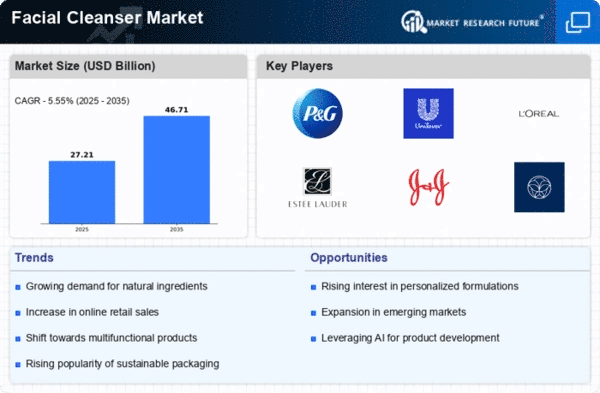
As per MRFR analysis, the Facial Cleanser Market Size was estimated at 25.78 USD Billion in 2024. The Facial Cleanser industry is projected to grow from 27.21 USD Billion in 2025 to 46.71 USD Billion by 2035, exhibiting a compound annual growth rate (CAGR) of 5.55 during the forecast period 2025 - 2035.

Key Market Trends & Highlights

The Facial Cleanser Market is experiencing dynamic growth driven by evolving consumer preferences and innovative product offerings.

  • The market witnesses a notable rise in the demand for natural ingredients, reflecting a shift towards cleaner beauty products. E-commerce continues to expand, facilitating greater accessibility and convenience for consumers in North America and Asia-Pacific. Multifunctional products are gaining traction, particularly among consumers seeking efficiency in their skincare routines. Increasing awareness of skincare and the influence of social media are driving demand, especially for gel cleansers targeting oily skin.

Market Size & Forecast

2024 Market Size 25.78 (USD Billion)
2035 Market Size 46.71 (USD Billion)
CAGR (2025 - 2035) 5.55%
Largest Regional Market Share in 2024 North America

Major Players

<p><a href="https://www.pgcareers.com/us/">Procter &amp; Gamble (US)</a>, Unilever (GB), L'Oreal (FR), <a href="https://www.esteelauder.com/">Estée Lauder (US)</a>, Johnson &amp; Johnson (US), Coty (US), Beiersdorf (DE), Shiseido (JP), Colgate-Palmolive (US)</p>

Market Trends

The Facial Cleanser Market is currently experiencing a dynamic evolution, driven by shifting consumer preferences and an increasing awareness of skincare routines. As individuals become more conscious of the ingredients in their personal care products, there is a noticeable trend towards natural and organic formulations. This inclination towards clean beauty is reshaping product offerings, with brands striving to meet the demand for transparency and sustainability. Furthermore, the rise of e-commerce platforms has transformed the way consumers access and purchase facial cleansers, allowing for greater convenience and a wider selection of products. In addition to the focus on ingredient integrity, the Facial Cleanser Market is witnessing a surge in multifunctional products that cater to diverse skin types and concerns. Consumers are increasingly seeking products that not only cleanse but also provide additional benefits such as hydration, exfoliation, or anti-aging properties. This trend reflects a broader shift towards holistic skincare solutions, where the emphasis is placed on achieving overall skin health rather than merely addressing surface-level issues. As the market continues to evolve, brands that prioritize innovation and consumer education are likely to thrive in this competitive landscape.

Rise of Natural Ingredients

There is a growing preference for facial cleansers formulated with natural and organic ingredients. Consumers are increasingly seeking products that are free from harmful chemicals, which has led brands to reformulate their offerings to align with this demand.

E-commerce Growth

The expansion of online shopping platforms has significantly influenced the Facial Cleanser Market. Consumers now have easier access to a broader range of products, enabling them to make informed choices based on reviews and ingredient transparency.

Multifunctional Products

The market is seeing a trend towards multifunctional facial cleansers that address various skin concerns. These products often combine cleansing with additional benefits, such as hydration or exfoliation, appealing to consumers looking for efficiency in their skincare routines.

Facial Cleanser Market Market Drivers

Market Growth Projections

The Global Facial Cleanser Market Industry is poised for substantial growth, with projections indicating a market value of 25.8 USD Billion in 2024 and an anticipated increase to 46.7 USD Billion by 2035. This growth trajectory reflects a robust CAGR of 5.56% from 2025 to 2035, driven by various factors such as rising consumer awareness, technological advancements, and the increasing demand for natural ingredients. The market's expansion is indicative of evolving consumer preferences and the industry's ability to adapt to changing trends. As brands innovate and diversify their offerings, the Global Facial Cleanser Market is likely to continue its upward momentum, presenting opportunities for both established and emerging players.

Growing Male Grooming Segment

The Global Facial Cleanser Market Industry is witnessing a notable increase in the male grooming segment, which is reshaping traditional perceptions of skincare. Men are increasingly recognizing the importance of facial cleansing as part of their grooming routines, leading to a surge in demand for products specifically designed for male skin. This shift is supported by targeted marketing campaigns and the introduction of specialized formulations. As a result, brands are expanding their product lines to cater to this emerging demographic. The growth of the male grooming segment is expected to contribute significantly to the overall market expansion, aligning with the industry's trajectory towards inclusivity and diversity.

Expansion of E-commerce Platforms

The expansion of e-commerce platforms significantly impacts the Global Facial Cleanser Market Industry. Online shopping provides consumers with convenient access to a wide range of facial cleansers, often accompanied by detailed product information and customer reviews. This accessibility encourages consumers to explore various brands and formulations, thereby driving sales. The COVID-19 pandemic accelerated this trend, but the shift towards online purchasing continues to thrive in 2024 and beyond. As the market adapts to changing consumer behaviors, e-commerce is expected to play a pivotal role in the industry's growth, facilitating a broader reach for brands and enhancing consumer engagement.

Rising Demand for Natural Ingredients

The Global Facial Cleanser Market Industry experiences a notable shift towards products formulated with natural ingredients. Consumers increasingly prioritize skincare solutions that are free from synthetic chemicals, which aligns with a growing awareness of health and environmental sustainability. This trend is reflected in the market, where products containing botanical extracts and organic components are gaining traction. As of 2024, the market is valued at approximately 25.8 USD Billion, with natural formulations contributing significantly to this figure. The demand for clean beauty products is expected to drive innovation and expansion within the industry, as brands strive to meet consumer preferences for transparency and eco-friendliness.

Increased Awareness of Skincare Regimens

The Global Facial Cleanser Market Industry benefits from a growing awareness of the importance of skincare regimens among consumers. Educational campaigns and social media influence have heightened the understanding of proper skin care, leading to an increase in the use of facial cleansers as essential components of daily routines. This trend is particularly evident among younger demographics, who are more inclined to invest in skincare products. As a result, the market is projected to grow at a CAGR of 5.56% from 2025 to 2035, reflecting the increasing commitment to skincare and the rising demand for effective cleansing solutions.

Technological Advancements in Product Formulation

Technological advancements play a crucial role in shaping the Global Facial Cleanser Market Industry. Innovations in formulation techniques, such as microencapsulation and enhanced delivery systems, enable brands to create more effective and user-friendly products. These advancements not only improve the efficacy of facial cleansers but also enhance the overall consumer experience. For instance, the incorporation of smart technology in cleansing devices is gaining popularity, allowing for personalized skincare routines. As the market evolves, these technological improvements are likely to attract a broader consumer base, contributing to the projected growth of the industry, which is expected to reach 46.7 USD Billion by 2035.

Market Segment Insights

By Product Type: Gel Cleanser (Largest) vs. Micellar Water (Fastest-Growing)

In the Facial Cleanser Market, Gel Cleansers hold a significant share, establishing them as the largest segment. Known for their lightweight and refreshing texture, they are preferred by consumers who seek a deep clean without stripping moisture away. Following closely, Cream and Foam Cleansers also command notable market shares due to their hydrating and soothing properties, appealing to various skin types. Meanwhile, Oil Cleansers offer a unique proposition with their ability to dissolve makeup and impurities effortlessly, while Micellar Water is gaining rapid traction for its convenience and gentle cleansing ability. The market dynamics are shifting, primarily influenced by changing consumer preferences toward multifunctional products that promise efficiency and efficacy. The growth of the skincare segment, particularly among urban millennials and Gen Z consumers, has spurred the popularity of Micellar Water as a fast and easy cleansing option. Additionally, the rise in awareness regarding skincare routines and ingredient transparency has propelled the demand for Gel and Foam Cleansers, reflecting a trend towards personalization and product performance in the Facial Cleanser Market.

Gel Cleanser (Dominant) vs. Oil Cleanser (Emerging)

Gel Cleansers are at the forefront of the Facial Cleanser Market, characterized by their light, non-comedogenic formulations that cleanse without excess dryness. They are particularly dominant among consumers with oily to combination skin, as they provide a fresh, clean feel without leaving residues. Brands have successfully marketed Gel Cleansers as suitable for daily use, driven by evolving consumer rituals emphasizing both cleanliness and skin health. Conversely, Oil Cleansers are emerging as a unique segment, thanks to their ability to dissolve stubborn makeup and waterproof formulations easily. They are often accompanied by natural and soothing oils, appealing to consumers seeking gentle yet effective cleansing solutions, especially in a climate of rising popularity around sustainably sourced ingredients.

By Skin Type: Oily Skin (Largest) vs. Dry Skin (Fastest-Growing)

In the Facial Cleanser Market, the skin type segment showcases a diverse distribution of consumers with varying needs. Oily Skin emerges as the largest segment, accounting for a significant portion of market share. Consumers with oily skin often seek products that effectively manage excess sebum and prevent acne breakouts. Following closely, Dry Skin is recognized as the fastest-growing segment due to increasing awareness of skincare and the rising demand for moisturizing formulations. This shift underscores consumers' desire for hydration-focused options that combat skin dryness, especially among those exposed to harsh environmental conditions. Growth trends in the Facial Cleanser Market are influenced by several key factors. The increasing prevalence of skin conditions related to oily and dry skin types plays a crucial role in shaping consumer preferences. Additionally, there is a growing trend toward natural and organic ingredients, which resonates well with consumers seeking gentle yet effective cleansing options. The rise in personalized skincare routines and the enhanced focus on self-care practices further drive the demand for specialized facial cleansers catering to different skin types. As awareness and trends evolve, brands are innovating to capture a wider audience within these segments, ensuring a competitive edge in the market.

Oily Skin (Dominant) vs. Sensitive Skin (Emerging)

Oily Skin cleansers dominate the Facial Cleanser Market, primarily catering to consumers who battle excessive oiliness and acne-related issues. Their formulations often include ingredients like salicylic acid or tea tree oil, known for their efficacy in controlling oil production and preventing breakouts. This dominance is attributed to the prevalence of oily skin types among the population, leading brands to tailor their offerings to meet these specific needs. In contrast, the Sensitive Skin segment is emerging rapidly, characterized by consumers seeking gentle formulations that minimize irritation and inflammation. These cleansers typically feature hypoallergenic and soothing ingredients like chamomile and aloe vera, gaining traction as awareness about the importance of skincare for sensitive skin increases. This growing demand reflects a broader trend towards inclusivity in skincare, as brands expand their range to address diverse skin sensitivities.

By Formulation Type: Natural (Largest) vs. Organic (Fastest-Growing)

In the Facial Cleanser Market, the formulation type segment is characterized by a diverse range of products catering to varying consumer preferences. Currently, 'Natural' formulations hold the largest market share, driven by the increasing consumer awareness regarding the benefits of using products made from natural ingredients. 'Organic' formulations are also gaining momentum, reflecting a growing interest among consumers who are willing to invest in products that align with sustainable and health-conscious choices. As consumers become more informed about the potential harmful effects of synthetic ingredients, the demand for organic facial cleansers continues to soar. Additionally, rising eco-consciousness and the preference for clean beauty products are expected to significantly bolster the growth of both the natural and organic segments. Brands offering innovative formulations that incorporate eco-friendly practices will likely thrive in this evolving market landscape.

Natural (Dominant) vs. Vegan (Emerging)

The Natural formulation segment remains dominant in the Facial Cleanser Market, appealing to consumers who prioritize clean and uncomplicated skincare. Natural ingredients, free from harmful chemicals and additives, resonate well with health-conscious individuals seeking soothing and effective cleansing options. In contrast, the Vegan segment emerges as a noteworthy trend, catering to consumers who advocate for cruelty-free products. Vegan facial cleansers contain no animal products or by-products, aligning with ethical consumerism. The growing popularity of veganism and animal rights awareness has prompted brands to develop innovative vegan formulations. While Natural products dominate, the Vegan segment shows significant potential for expansion as more consumers embrace cruelty-free lifestyles, seeking products that reflect their values while delivering on performance.

By Target Demographic: Women (Largest) vs. Teenagers (Fastest-Growing)

In the Facial Cleanser Market, women represent the largest demographic segment, driven by their diverse skincare needs and brand loyalty. They tend to favor products that not only clean but also provide additional benefits, like hydration and anti-aging properties. Conversely, teenagers are emerging as the fastest-growing segment, increasingly concerned with skin health, influenced by social media trends and peer recommendations. This demographic seeks products that specifically address acne and oil control, shaping a unique niche within the market.

Women (Dominant) vs. Teenagers (Emerging)

The women demographic holds a dominant position in the Facial Cleanser Market, characterized by their preference for high-quality, multifunctional products. Women are often willing to invest in premium brands that offer product intelligence, reflecting their awareness of skincare ingredients and efficacy. They exhibit strong brand loyalty, often influenced by marketing campaigns and endorsements. On the other hand, teenagers, as an emerging segment, are becoming increasingly influential due to their growing awareness of skincare routines. They prefer products that are gentle yet effective, with packaging that resonates with their lifestyle. Teenagers often engage with brands online, prioritizing those that are socially responsible and eco-friendly, thus driving demand for innovative formulations.

By Packaging Type: Pump Bottle (Largest) vs. Tube (Fastest-Growing)

The packaging type segment in the facial cleanser market exhibits varied preferences among consumers. Currently, pump bottles hold the largest share due to their convenience and ease of use, making them popular for both at-home and travel use. Tubes are rapidly gaining traction as the fastest-growing packaging type, appealing to eco-conscious consumers seeking recyclable or easily dispensable options. This combination illustrates a dynamic market where traditional preferences coexist with new sustainability trends. As the market evolves, several growth drivers enhance the appeal of different packaging types. The rise in e-commerce and direct-to-consumer sales channels facilitates diverse packaging options, contributing to increased consumer exploration of tubes, sachets, and refillable systems. Moreover, growing concerns about plastic waste are pushing brands to innovate, resulting in the introduction of more eco-friendly materials and designs that enhance consumer engagement and satisfaction.

Pump Bottle (Dominant) vs. Tube (Emerging)

Pump bottles are the dominant packaging choice in the facial cleanser market, widely recognized for their user-friendly design and ability to dispense the right amount with minimal wastage. This packaging type caters to the everyday user's needs for convenience, hygiene, and targeted application. On the other hand, tubes are emerging as an attractive alternative, increasingly valued for their portability, flexibility, and ease of storage. They allow brands to present different formulas and textures, appealing to diverse consumer preferences. As sustainability becomes a more pressing concern, both packaging types are exploring recyclable materials and designs that appeal to environmentally aware consumers, positioning them well in the evolving market landscape.

Get more detailed insights about Facial Cleanser Market Research Report - Global Forecast till 2035

Regional Insights

North America : Market Leader in Cleanser Sales

North America continues to lead the facial cleanser market, holding a significant share of 10.0 in 2024. The growth is driven by increasing consumer awareness regarding skincare, coupled with a rising demand for natural and organic products. Regulatory support for safe cosmetic ingredients further fuels this trend, as consumers seek transparency in product formulations. The region's robust e-commerce platforms also enhance accessibility, contributing to market expansion. The competitive landscape is characterized by major players such as Procter & Gamble, Unilever, and Estée Lauder, who dominate the market with innovative product offerings. The U.S. remains the largest market, driven by high disposable incomes and a strong preference for premium skincare products. Additionally, the presence of established brands ensures a diverse range of options for consumers, solidifying North America's position as a key player in The Facial Cleanser.

Europe : Diverse Market with Growth Potential

Europe's facial cleanser market, valued at 8.0, is witnessing a shift towards sustainability and clean beauty. The demand for eco-friendly products is rising, driven by stringent regulations on cosmetic ingredients and packaging. The European Union's commitment to reducing plastic waste and promoting biodegradable materials is a significant catalyst for this trend. Consumers are increasingly opting for products that align with their values, enhancing market growth. Leading countries like Germany, France, and the UK are at the forefront of this transformation, with brands such as L'Oreal and Beiersdorf innovating to meet consumer demands. The competitive landscape is vibrant, with a mix of established and emerging brands focusing on natural ingredients and ethical practices. This dynamic environment positions Europe as a key player in The Facial Cleanser, fostering innovation and sustainability.

Asia-Pacific : Rapid Growth in Skincare Demand

The Asia-Pacific region, with a market size of 6.0, is experiencing rapid growth in the facial cleanser sector, driven by increasing urbanization and rising disposable incomes. Consumers are becoming more aware of skincare routines, leading to a surge in demand for diverse cleansing products. Regulatory frameworks are evolving to ensure product safety, which further boosts consumer confidence in purchasing skincare items. The region's young population is also a significant driver of market expansion, as they seek effective and trendy skincare solutions. Countries like Japan, China, and South Korea are leading the charge, with brands such as Shiseido and Coty capitalizing on local preferences for innovative and high-quality products. The competitive landscape is marked by a mix of global and local players, each vying for market share through unique offerings. This dynamic environment positions Asia-Pacific as a burgeoning hub for facial cleanser innovation and growth.

Middle East and Africa : Emerging Market with Unique Challenges

The Middle East and Africa region, valued at 1.78, presents unique challenges and opportunities in the facial cleanser market. The growth is driven by increasing awareness of skincare and a rising middle class seeking quality products. However, regulatory hurdles and varying consumer preferences across countries can impede market penetration. The demand for halal-certified and natural products is particularly strong, reflecting cultural values and consumer expectations in the region. Countries like South Africa and the UAE are leading the market, with local and international brands competing to meet diverse consumer needs. Key players are adapting their strategies to cater to regional preferences, focusing on product efficacy and cultural relevance. This adaptability is crucial for success in the Middle East and Africa's evolving facial cleanser market.

Key Players and Competitive Insights

The Facial Cleanser Market is characterized by a dynamic competitive landscape, driven by evolving consumer preferences and a growing emphasis on skincare. Major players such as Procter & Gamble (US), Unilever (GB), and L'Oreal (FR) are at the forefront, each adopting distinct strategies to enhance their market presence. Procter & Gamble (US) focuses on innovation, particularly in developing eco-friendly formulations, which aligns with the increasing consumer demand for sustainable products. Unilever (GB) emphasizes digital transformation, leveraging e-commerce platforms to reach a broader audience, while L'Oreal (FR) invests heavily in research and development to introduce cutting-edge products that cater to diverse skin types and concerns. Collectively, these strategies contribute to a competitive environment that is both fragmented and concentrated, with key players vying for market share through differentiation and innovation.
In terms of business tactics, companies are increasingly localizing manufacturing to reduce costs and enhance supply chain efficiency. The market structure appears moderately fragmented, with a mix of established brands and emerging players. This fragmentation allows for niche brands to thrive, particularly those that focus on organic and natural ingredients. The collective influence of key players shapes market dynamics, as they engage in strategic partnerships and collaborations to bolster their product offerings and expand their reach.
In November 2025, Estée Lauder (US) announced a partnership with a leading technology firm to integrate AI-driven personalization into their facial cleanser product lines. This strategic move is significant as it allows Estée Lauder (US) to offer tailored skincare solutions, enhancing customer engagement and satisfaction. The integration of AI technology is likely to set a new standard in the industry, pushing competitors to adopt similar innovations to remain relevant.
In October 2025, Shiseido (JP) launched a new line of facial cleansers that utilize advanced botanical extracts, emphasizing their commitment to sustainability and natural ingredients. This initiative not only caters to the growing consumer preference for clean beauty but also positions Shiseido (JP) as a leader in the sustainable skincare segment. The launch reflects a broader trend within the market, where brands are increasingly aligning their product offerings with environmental consciousness.
In September 2025, Coty (US) expanded its distribution channels by entering into a strategic alliance with a prominent online retailer, enhancing its accessibility to consumers. This move is crucial as it allows Coty (US) to tap into the growing e-commerce market, which has become a vital sales channel in the beauty industry. By improving its online presence, Coty (US) is likely to increase its market share and compete more effectively against larger rivals.
As of December 2025, the Facial Cleanser Market is witnessing trends that emphasize digitalization, sustainability, and the integration of advanced technologies such as AI. Strategic alliances are increasingly shaping the competitive landscape, enabling companies to leverage each other's strengths. Looking ahead, competitive differentiation is expected to evolve, with a shift from price-based competition to a focus on innovation, technology, and supply chain reliability. This transition underscores the importance of adapting to consumer demands for quality and sustainability in a rapidly changing market.

Key Companies in the Facial Cleanser Market include

Industry Developments

July 2023: AnyMind Group, a company that deals with end-to-end commerce enablement, announced the launch of "Face Wash" in association with the brand producer of NaturaLUNA… and Japanese celebrity Becky. Face Wash is a 100% natural and foam-based facial cleanser. It was made available on 14th July through the online portal of NautraLUNA.

July 2022: Himalaya Wellness Company, an India-based wellness business, announced the launch of a new television commercial marketing its flagship Purifying Neem Face Wash. The new advertisement aims to educate the population about the science behind pimples and effective methods of solving them.

Future Outlook

Facial Cleanser Market Future Outlook

The Facial Cleanser Market is projected to grow at a 5.55% CAGR from 2025 to 2035, driven by increasing consumer awareness and demand for natural ingredients.

New opportunities lie in:

  • Expansion of e-commerce platforms for direct-to-consumer sales.
  • Development of eco-friendly packaging solutions to attract sustainability-focused consumers.
  • Introduction of personalized skincare regimens through AI-driven consultations.

By 2035, the Facial Cleanser Market is expected to achieve substantial growth, reflecting evolving consumer preferences.

Market Segmentation

Facial Cleanser Market Skin Type Outlook

  • Oily Skin
  • Dry Skin
  • Combination Skin
  • Sensitive Skin
  • Normal Skin

Facial Cleanser Market Product Type Outlook

  • Gel Cleanser
  • Foam Cleanser
  • Cream Cleanser
  • Micellar Water
  • Oil Cleanser

Facial Cleanser Market Packaging Type Outlook

  • Pump Bottle
  • Tube
  • Jar
  • Sachet
  • Refillable

Facial Cleanser Market Formulation Type Outlook

  • Natural
  • Organic
  • Synthetic
  • Vegan
  • Cruelty-Free

Facial Cleanser Market Target Demographic Outlook

  • Teenagers
  • Adults
  • Seniors
  • Men
  • Women

Report Scope

MARKET SIZE 2024 25.78(USD Billion)
MARKET SIZE 2025 27.21(USD Billion)
MARKET SIZE 2035 46.71(USD Billion)
COMPOUND ANNUAL GROWTH RATE (CAGR) 5.55% (2025 - 2035)
REPORT COVERAGE Revenue Forecast, Competitive Landscape, Growth Factors, and Trends
BASE YEAR 2024
Market Forecast Period 2025 - 2035
Historical Data 2019 - 2024
Market Forecast Units USD Billion
Key Companies Profiled Procter & Gamble (US), Unilever (GB), L'Oreal (FR), Estée Lauder (US), Johnson & Johnson (US), Coty (US), Beiersdorf (DE), Shiseido (JP), Colgate-Palmolive (US)
Segments Covered Product Type, Skin Type, Formulation Type, Target Demographic, Packaging Type
Key Market Opportunities Growing demand for natural and organic ingredients in the Facial Cleanser Market presents significant opportunities.
Key Market Dynamics Rising consumer preference for natural ingredients drives innovation and competition in the facial cleanser market.
Countries Covered North America, Europe, APAC, South America, MEA

FAQs

How much is the Facial Cleanser market?

The Facial Cleanser market size was valued at USD 24.42 Billion in 2023.

What is the growth rate of the Facial Cleanser market?

The market is witnessed to grow at a CAGR of 5.6%during the forecast period, 2025-2035.

Which Region witnessed the largest market share in the Facial Cleanser market?

North America witnessed the largest share of the market.

Who are the dominant players in the Facial Cleanser market?

The dominant players in the market areL'Oréal (France), Unilever (UK), Procter &amp; Gamble (US), Johnson &amp; Johnson (US), Beiersdorf AG (Germany), Estée Lauder Inc. (US), Shiseido Co. Ltd (Japan), Kao Corporation (Japan), LVMH (France), and AVON COSMETICS (UK).

Which Skin Type led the Facial Cleanser market?

The normal skin category dominated the market in 2023.

Which distribution channel witnessed the largest market share in the Facial Cleanser market?

The store-based channel witnessed the largest share of the market.

  1. SECTION I: EXECUTIVE SUMMARY AND KEY HIGHLIGHTS
    1. | 1.1 EXECUTIVE SUMMARY
    2. | 1.1.1 Market Overview
    3. | 1.1.2 Key Findings
    4. | 1.1.3 Market Segmentation
    5. | 1.1.4 Competitive Landscape
    6. | 1.1.5 Challenges and Opportunities
    7. | 1.1.6 Future Outlook
  2. SECTION II: SCOPING, METHODOLOGY AND MARKET STRUCTURE
    1. | 2.1 MARKET INTRODUCTION
    2. | 2.1.1 Definition
    3. | 2.1.2 Scope of the study
    4. |-- 2.1.2.1 Research Objective
    5. |-- 2.1.2.2 Assumption
    6. |-- 2.1.2.3 Limitations
    7. | 2.2 RESEARCH METHODOLOGY
    8. | 2.2.1 Overview
    9. | 2.2.2 Data Mining
    10. | 2.2.3 Secondary Research
    11. | 2.2.4 Primary Research
    12. |-- 2.2.4.1 Primary Interviews and Information Gathering Process
    13. |-- 2.2.4.2 Breakdown of Primary Respondents
    14. | 2.2.5 Forecasting Model
    15. | 2.2.6 Market Size Estimation
    16. |-- 2.2.6.1 Bottom-Up Approach
    17. |-- 2.2.6.2 Top-Down Approach
    18. | 2.2.7 Data Triangulation
    19. | 2.2.8 Validation
  3. SECTION III: QUALITATIVE ANALYSIS
    1. | 3.1 MARKET DYNAMICS
    2. | 3.1.1 Overview
    3. | 3.1.2 Drivers
    4. | 3.1.3 Restraints
    5. | 3.1.4 Opportunities
    6. | 3.2 MARKET FACTOR ANALYSIS
    7. | 3.2.1 Value chain Analysis
    8. | 3.2.2 Porter's Five Forces Analysis
    9. |-- 3.2.2.1 Bargaining Power of Suppliers
    10. |-- 3.2.2.2 Bargaining Power of Buyers
    11. |-- 3.2.2.3 Threat of New Entrants
    12. |-- 3.2.2.4 Threat of Substitutes
    13. |-- 3.2.2.5 Intensity of Rivalry
    14. | 3.2.3 COVID-19 Impact Analysis
    15. |-- 3.2.3.1 Market Impact Analysis
    16. |-- 3.2.3.2 Regional Impact
    17. |-- 3.2.3.3 Opportunity and Threat Analysis
  4. SECTION IV: QUANTITATIVE ANALYSIS
    1. | 4.1 Consumer and Retail, BY Product Type (USD Billion)
    2. | 4.1.1 Gel Cleanser
    3. | 4.1.2 Foam Cleanser
    4. | 4.1.3 Cream Cleanser
    5. | 4.1.4 Micellar Water
    6. | 4.1.5 Oil Cleanser
    7. | 4.2 Consumer and Retail, BY Skin Type (USD Billion)
    8. | 4.2.1 Oily Skin
    9. | 4.2.2 Dry Skin
    10. | 4.2.3 Combination Skin
    11. | 4.2.4 Sensitive Skin
    12. | 4.2.5 Normal Skin
    13. | 4.3 Consumer and Retail, BY Formulation Type (USD Billion)
    14. | 4.3.1 Natural
    15. | 4.3.2 Organic
    16. | 4.3.3 Synthetic
    17. | 4.3.4 Vegan
    18. | 4.3.5 Cruelty-Free
    19. | 4.4 Consumer and Retail, BY Target Demographic (USD Billion)
    20. | 4.4.1 Teenagers
    21. | 4.4.2 Adults
    22. | 4.4.3 Seniors
    23. | 4.4.4 Men
    24. | 4.4.5 Women
    25. | 4.5 Consumer and Retail, BY Packaging Type (USD Billion)
    26. | 4.5.1 Pump Bottle
    27. | 4.5.2 Tube
    28. | 4.5.3 Jar
    29. | 4.5.4 Sachet
    30. | 4.5.5 Refillable
    31. | 4.6 Consumer and Retail, BY Region (USD Billion)
    32. | 4.6.1 North America
    33. |-- 4.6.1.1 US
    34. |-- 4.6.1.2 Canada
    35. | 4.6.2 Europe
    36. |-- 4.6.2.1 Germany
    37. |-- 4.6.2.2 UK
    38. |-- 4.6.2.3 France
    39. |-- 4.6.2.4 Russia
    40. |-- 4.6.2.5 Italy
    41. |-- 4.6.2.6 Spain
    42. |-- 4.6.2.7 Rest of Europe
    43. | 4.6.3 APAC
    44. |-- 4.6.3.1 China
    45. |-- 4.6.3.2 India
    46. |-- 4.6.3.3 Japan
    47. |-- 4.6.3.4 South Korea
    48. |-- 4.6.3.5 Malaysia
    49. |-- 4.6.3.6 Thailand
    50. |-- 4.6.3.7 Indonesia
    51. |-- 4.6.3.8 Rest of APAC
    52. | 4.6.4 South America
    53. |-- 4.6.4.1 Brazil
    54. |-- 4.6.4.2 Mexico
    55. |-- 4.6.4.3 Argentina
    56. |-- 4.6.4.4 Rest of South America
    57. | 4.6.5 MEA
    58. |-- 4.6.5.1 GCC Countries
    59. |-- 4.6.5.2 South Africa
    60. |-- 4.6.5.3 Rest of MEA
  5. SECTION V: COMPETITIVE ANALYSIS
    1. | 5.1 Competitive Landscape
    2. | 5.1.1 Overview
    3. | 5.1.2 Competitive Analysis
    4. | 5.1.3 Market share Analysis
    5. | 5.1.4 Major Growth Strategy in the Consumer and Retail
    6. | 5.1.5 Competitive Benchmarking
    7. | 5.1.6 Leading Players in Terms of Number of Developments in the Consumer and Retail
    8. | 5.1.7 Key developments and growth strategies
    9. |-- 5.1.7.1 New Product Launch/Service Deployment
    10. |-- 5.1.7.2 Merger & Acquisitions
    11. |-- 5.1.7.3 Joint Ventures
    12. | 5.1.8 Major Players Financial Matrix
    13. |-- 5.1.8.1 Sales and Operating Income
    14. |-- 5.1.8.2 Major Players R&D Expenditure. 2023
    15. | 5.2 Company Profiles
    16. | 5.2.1 Procter & Gamble (US)
    17. |-- 5.2.1.1 Financial Overview
    18. |-- 5.2.1.2 Products Offered
    19. |-- 5.2.1.3 Key Developments
    20. |-- 5.2.1.4 SWOT Analysis
    21. |-- 5.2.1.5 Key Strategies
    22. | 5.2.2 Unilever (GB)
    23. |-- 5.2.2.1 Financial Overview
    24. |-- 5.2.2.2 Products Offered
    25. |-- 5.2.2.3 Key Developments
    26. |-- 5.2.2.4 SWOT Analysis
    27. |-- 5.2.2.5 Key Strategies
    28. | 5.2.3 L'Oreal (FR)
    29. |-- 5.2.3.1 Financial Overview
    30. |-- 5.2.3.2 Products Offered
    31. |-- 5.2.3.3 Key Developments
    32. |-- 5.2.3.4 SWOT Analysis
    33. |-- 5.2.3.5 Key Strategies
    34. | 5.2.4 Estée Lauder (US)
    35. |-- 5.2.4.1 Financial Overview
    36. |-- 5.2.4.2 Products Offered
    37. |-- 5.2.4.3 Key Developments
    38. |-- 5.2.4.4 SWOT Analysis
    39. |-- 5.2.4.5 Key Strategies
    40. | 5.2.5 Johnson & Johnson (US)
    41. |-- 5.2.5.1 Financial Overview
    42. |-- 5.2.5.2 Products Offered
    43. |-- 5.2.5.3 Key Developments
    44. |-- 5.2.5.4 SWOT Analysis
    45. |-- 5.2.5.5 Key Strategies
    46. | 5.2.6 Coty (US)
    47. |-- 5.2.6.1 Financial Overview
    48. |-- 5.2.6.2 Products Offered
    49. |-- 5.2.6.3 Key Developments
    50. |-- 5.2.6.4 SWOT Analysis
    51. |-- 5.2.6.5 Key Strategies
    52. | 5.2.7 Beiersdorf (DE)
    53. |-- 5.2.7.1 Financial Overview
    54. |-- 5.2.7.2 Products Offered
    55. |-- 5.2.7.3 Key Developments
    56. |-- 5.2.7.4 SWOT Analysis
    57. |-- 5.2.7.5 Key Strategies
    58. | 5.2.8 Shiseido (JP)
    59. |-- 5.2.8.1 Financial Overview
    60. |-- 5.2.8.2 Products Offered
    61. |-- 5.2.8.3 Key Developments
    62. |-- 5.2.8.4 SWOT Analysis
    63. |-- 5.2.8.5 Key Strategies
    64. | 5.2.9 Colgate-Palmolive (US)
    65. |-- 5.2.9.1 Financial Overview
    66. |-- 5.2.9.2 Products Offered
    67. |-- 5.2.9.3 Key Developments
    68. |-- 5.2.9.4 SWOT Analysis
    69. |-- 5.2.9.5 Key Strategies
    70. | 5.3 Appendix
    71. | 5.3.1 References
    72. | 5.3.2 Related Reports

Consumer and Retail Market Segmentation

Consumer and Retail By Product Type (USD Billion, 2025-2035)

  • Gel Cleanser
  • Foam Cleanser
  • Cream Cleanser
  • Micellar Water
  • Oil Cleanser

Consumer and Retail By Skin Type (USD Billion, 2025-2035)

  • Oily Skin
  • Dry Skin
  • Combination Skin
  • Sensitive Skin
  • Normal Skin

Consumer and Retail By Formulation Type (USD Billion, 2025-2035)

  • Natural
  • Organic
  • Synthetic
  • Vegan
  • Cruelty-Free

Consumer and Retail By Target Demographic (USD Billion, 2025-2035)

  • Teenagers
  • Adults
  • Seniors
  • Men
  • Women

Consumer and Retail By Packaging Type (USD Billion, 2025-2035)

  • Pump Bottle
  • Tube
  • Jar
  • Sachet
  • Refillable
Infographic

Free Sample Request

Kindly complete the form below to receive a free sample of this Report

Get Free Sample

Customer Strories

Compare Licence

×
Features License Type
Single User Multiuser License Enterprise User
Price $4,950 $5,950 $7,250
Maximum User Access Limit 1 User Upto 10 Users Unrestricted Access Throughout the Organization
Free Customization
Direct Access to Analyst
Deliverable Format
Platform Access
Discount on Next Purchase 10% 15% 15%
Printable Versions