×
Request Free Sample ×

Kindly complete the form below to receive a free sample of this Report

* Please use a valid business email

Leading companies partner with us for data-driven Insights

clients tt-cursor
Hero Background

Epoxy Adhesives Market

ID: MRFR/CnM/8482-HCR
111 Pages
Chitranshi Jaiswal
February 2026

Epoxy Adhesive Market Size, Share & Industry Analysis Research Report By Formulation (Resin Epoxy, Curing Agent, Additives), By Application Type (Structural, Non-Structural), By Cure Mechanism (Room Temperature Cure, Heat Cure, UV Cure), By Substrate (Metals, Plastics, Composites, Ceramics) and By Regional (North America, Europe, South America, Asia Pacific, Middle East and Africa) - Forecast to 2035

Share:
Download PDF ×

We do not share your information with anyone. However, we may send you emails based on your report interest from time to time. You may contact us at any time to opt-out.

Epoxy Adhesives Market Infographic
Purchase Options

Epoxy Adhesives Market Summary

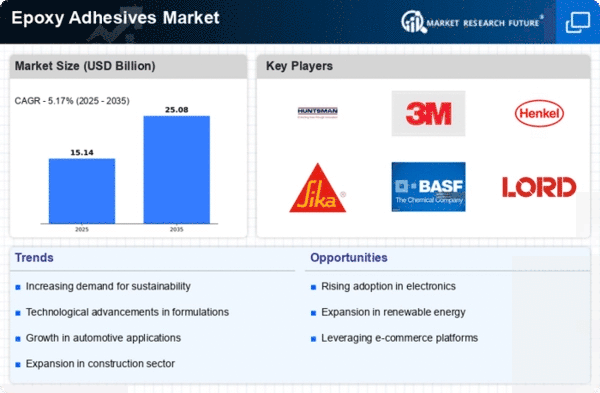
As per MRFR analysis, the Epoxy Adhesives Market Size was estimated at 14.4 USD Billion in 2024. The epoxy adhesives industry is projected to grow from 15.15 USD Billion in 2025 to 25.08 USD Billion by 2035, exhibiting a compound annual growth rate (CAGR) of 5.17 during the forecast period 2025 - 2035.

Key Market Trends & Highlights

The Epoxy Adhesives Market is poised for robust growth driven by diverse applications and technological advancements.

  • North America remains the largest market for epoxy adhesives, reflecting a strong demand across various industries.
  • The Asia-Pacific region is emerging as the fastest-growing market, fueled by rapid industrialization and increasing manufacturing activities.
  • Structural adhesives dominate the market, while electrical encapsulation is witnessing the fastest growth due to advancements in technology.
  • Rising demand in the construction sector and automotive industry growth are key drivers propelling the epoxy adhesives market forward.

Market Size & Forecast

2024 Market Size 14.4 (USD Billion)
2035 Market Size 25.08 (USD Billion)
CAGR (2025 - 2035) 5.17%

Major Players

Huntsman Corporation (US), 3M Company (US), Henkel AG & Co. KGaA (DE), Sika AG (CH), BASF SE (DE), Lord Corporation (US), ITW Performance Polymers (US), Momentive Performance Materials Inc. (US), Dow Inc. (US)

Our Impact
Enabled $4.3B Revenue Impact for Fortune 500 and Leading Multinationals
Partnering with 2000+ Global Organizations Each Year
30K+ Citations by Top-Tier Firms in the Industry

Epoxy Adhesives Market Trends

The Epoxy Adhesives Market is currently experiencing a notable transformation, driven by advancements in technology and increasing demand across various industries. The versatility of epoxy adhesives, characterized by their strong bonding capabilities and resistance to environmental factors, positions them as a preferred choice in sectors such as automotive, construction, and electronics. As manufacturers continue to innovate, the market is likely to witness the introduction of new formulations that enhance performance and sustainability. This evolution is further supported by a growing emphasis on eco-friendly products, which aligns with global trends towards sustainability and environmental responsibility. In addition to technological advancements, the Epoxy Adhesives Market is influenced by shifting consumer preferences and regulatory frameworks. Industries are increasingly seeking adhesives that not only meet performance standards but also comply with stringent environmental regulations. This shift may lead to a rise in demand for bio-based and low-VOC epoxy adhesives, reflecting a broader trend towards sustainable materials. As the market evolves, stakeholders must remain vigilant to adapt to these changes, ensuring that they meet the needs of diverse applications while maintaining compliance with emerging regulations. The future of the Epoxy Adhesives Market appears promising, with opportunities for growth and innovation on the horizon.

Sustainability Focus

The Epoxy Adhesives Market is witnessing a growing emphasis on sustainability, as manufacturers strive to develop eco-friendly formulations. This trend is driven by increasing consumer awareness and regulatory pressures, prompting companies to explore bio-based and low-emission alternatives. As a result, the market is likely to see a rise in demand for adhesives that align with environmental standards.

Technological Advancements

Innovations in adhesive technology are shaping the Epoxy Adhesives Market, with new formulations enhancing performance characteristics. These advancements may include improved curing times, enhanced adhesion properties, and greater resistance to environmental factors. Such developments are expected to broaden the applications of epoxy adhesives across various industries.

Diverse Applications

The versatility of epoxy adhesives is leading to their adoption in a wide range of applications, from automotive to electronics. This trend indicates a growing recognition of the benefits offered by epoxy adhesives, such as durability and strength. As industries continue to evolve, the demand for specialized adhesive solutions is likely to increase.

Epoxy Adhesives Market Drivers

Rising Demand from Automotive Sector

The Global Epoxy Adhesive Market Industry experiences a notable surge in demand driven by the automotive sector. As manufacturers increasingly prioritize lightweight materials to enhance fuel efficiency, epoxy adhesives are favored for their superior bonding capabilities. In 2024, the market is projected to reach 14.4 USD Billion, with automotive applications accounting for a substantial share. The trend towards electric vehicles further amplifies this demand, as these vehicles require robust and durable bonding solutions. This shift indicates a potential growth trajectory, suggesting that the automotive sector will continue to be a pivotal driver for the Global Epoxy Adhesive Market Industry.

Market Segment Insights

By Application: Structural Adhesives (Largest) vs. Electrical Encapsulation (Fastest-Growing)

In the epoxy adhesives market, the application segment showcases a diverse distribution of demand among various values. Structural adhesives hold the largest share, owing to their critical role in various industries such as construction and automotive, where strength and durability are paramount. Meanwhile, electrical encapsulation is gaining traction as a key player, driven by the increasing need for reliable insulation and protection in electrical applications. This segment is particularly relevant with the growth of the electronics sector, which is increasingly demanding advanced materials for device longevity and performance.

Coatings (Dominant) vs. Sealants (Emerging)

Coatings are considered the dominant segment within the application category, known for their versatility in providing functional and aesthetic benefits across numerous industries, including automotive and aerospace. Their ability to enhance surface properties such as corrosion resistance and adhesion makes them a preferred choice in multiple applications. On the other hand, sealants are emerging as a significant value in the market due to growing awareness of their importance in energy efficiency and sustainability in construction projects. With advancements in formulation technologies, sealants offer enhanced performance characteristics, making them increasingly sought after in both residential and commercial sectors.

By End Use: Automotive (Largest) vs. Aerospace (Fastest-Growing)

The epoxy adhesives market shows a robust distribution in its end-use sectors, with automotive applications holding the largest share. This sector benefits from the increasing demand for lightweight and durable materials in vehicle manufacturing. Following closely is the aerospace sector, which, although smaller currently, is gaining momentum due to innovative designs and manufacturing techniques that rely heavily on epoxy adhesives for their high strength and resistance properties. As the focus on fuel efficiency and sustainability intensifies in aerospace, the growth trajectory of epoxy adhesives in this segment is rapidly accelerating. Key drivers include the increasing adoption of advanced materials and technologies, regulatory pressures for reduced emissions, and the rising production rates of aircraft. Consequently, while automotive remains the leader in consumption, aerospace is emerging as the fastest-growing market for epoxy adhesives.

Automotive: Dominant vs. Aerospace: Emerging

The automotive segment of the epoxy adhesives market is characterized by its critical role in vehicle assembly and repair, with a focus on providing strong, durable bonds that enhance structural integrity. As automakers continue to shift towards lightweight materials to improve fuel efficiency, epoxy adhesives are increasingly favored for their superior bonding properties. In comparison, the aerospace segment is marked by its dynamic growth, driven by the need for advanced adhesive solutions that meet stringent safety and performance requirements. This sector is leveraging innovations in epoxy formulations to enable the construction of lighter aircraft, thereby supporting increased fuel efficiency. While automotive adhesives benefit from high volume, aerospace applications are characterized by their complexity and the necessity for cutting-edge technology.

By Formulation Type: One-Part Epoxy Adhesives (Largest) vs. Two-Part Epoxy Adhesives (Fastest-Growing)

The epoxy adhesives market is segmented based on formulation type, exhibiting a diverse distribution among the major types. One-Part Epoxy Adhesives hold a significant portion of the market, favored for their ease of use and quick curing properties, making them versatile for various applications. In contrast, Two-Part Epoxy Adhesives are gaining traction due to their superior performance in demanding applications, showcasing a promising growth trajectory.

One-Part Epoxy Adhesives (Dominant) vs. Two-Part Epoxy Adhesives (Emerging)

One-Part Epoxy Adhesives are widely recognized as the dominant formulation in the market, characterized by their user-friendly application and efficiency. Their ability to cure quickly without mixing makes them ideal for rapid repairs and assembly tasks across various industries, including construction, automotive, and electronics. On the other hand, Two-Part Epoxy Adhesives, while more complex due to the need for mixing components, are emerging as the fastest-growing segment, driven by increasing demand for high-performance bonding solutions. They are particularly favored in aerospace and automotive applications where superior strength and durability are crucial, positioning them as a key player in the future growth of the market.

By Curing Mechanism: Thermal Curing (Largest) vs. UV Curing (Fastest-Growing)

In the epoxy adhesives market, the distribution of market share among curing mechanisms showcases a strong preference for thermal curing, which remains the dominant choice among consumers and industries. This segment benefits from its established technology and is widely used in applications requiring high durability and thermal resistance. Conversely, UV curing is rapidly emerging, appealing to sectors that prioritize speed and efficiency in bonding processes, marking it as a challenger to traditional thermal methods.

Thermal Curing (Dominant) vs. UV Curing (Emerging)

Thermal curing is characterized by its robust bonding capabilities, making it suitable for high-performance applications in automotive and aerospace industries. This method involves the application of heat to initiate the curing process, which results in strong adhesive properties and excellent thermal stability. In contrast, UV curing is gaining traction, especially in packaging and electronics, where rapid processing times can significantly enhance production efficiency. With advancements in UV technology, this segment is witnessing increased investment, leading to improved formulations that respond to diverse surface types, thereby broadening its market appeal.

By Packaging Type: Bulk Packaging (Largest) vs. Cartridge Packaging (Fastest-Growing)

The epoxy adhesives market is primarily segmented by packaging type, with bulk packaging leading the market share due to its cost-effectiveness and suitability for large-scale applications. Meanwhile, cartridge packaging is gaining attention with its convenience and precision in dispensing, marking it as the fastest-growing type in this segment. Sachet and bottle packaging, though smaller in market share, also cater to specific consumer needs, helping diversify the overall market dynamics.

Bulk Packaging (Dominant) vs. Cartridge Packaging (Emerging)

Bulk packaging is characterized by its ability to cater to industrial applications where large quantities of epoxy adhesives are needed. This type is favored for its lower price point per unit and efficiency in bulk operations. On the other hand, cartridge packaging is emerging due to its user-friendly design, allowing for accurate application in smaller projects. The convenient dispensing mechanism of cartridges is particularly appealing in both the consumer and professional markets, indicating a shift towards packaging that enhances usability without compromising performance. As demand for tailored solutions rises, both packaging types are poised to maintain essential roles in the epoxy adhesives landscape.

Get more detailed insights about Epoxy Adhesives Market

Regional Insights

North America : Market Leader in Adhesives

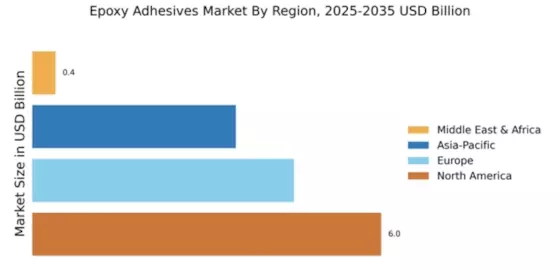
North America is poised to maintain its leadership in the epoxy adhesives market, holding a significant share of 6.0 in 2025. The region's growth is driven by robust demand from the automotive, aerospace, and construction sectors, alongside stringent regulations promoting high-performance materials. The increasing focus on sustainability and innovation further propels market expansion, with companies investing in eco-friendly formulations and advanced technologies. The United States stands as the largest market, supported by key players like Huntsman Corporation, 3M Company, and Dow Inc. These companies are leveraging advanced R&D capabilities to enhance product offerings. The competitive landscape is characterized by strategic partnerships and mergers, aimed at expanding market reach and improving product portfolios. As a result, North America is expected to continue its dominance in The Epoxy Adhesives.

Europe : Innovation and Sustainability Focus

Europe's epoxy adhesives market is projected to reach 4.5 by 2025, driven by increasing demand for sustainable and high-performance materials across various industries. Regulatory frameworks, such as REACH, are pushing manufacturers to innovate and develop eco-friendly products, enhancing market growth. The automotive and construction sectors are particularly influential, as they seek adhesives that meet stringent performance and environmental standards. Germany, France, and the UK are leading countries in this market, with major players like Henkel AG and BASF SE driving innovation. The competitive landscape is marked by a strong emphasis on R&D, with companies investing in new technologies to meet evolving consumer demands. As a result, Europe is becoming a hub for advanced adhesive solutions, positioning itself as a key player in the global market.

Asia-Pacific : Emerging Market Potential

The Asia-Pacific region is witnessing significant growth in the epoxy adhesives market, projected to reach 3.5 by 2025. This growth is fueled by rapid industrialization, urbanization, and increasing demand from sectors such as electronics, automotive, and construction. Governments are also implementing favorable policies to boost manufacturing, which is expected to further drive market expansion. The region's focus on innovation and technology adoption is enhancing the performance of epoxy adhesives. China, Japan, and India are the leading countries in this market, with a growing presence of key players like Sika AG and Momentive Performance Materials. The competitive landscape is evolving, with local manufacturers emerging alongside established global companies. This dynamic environment is fostering innovation and driving down costs, making Asia-Pacific a vital region for the future of epoxy adhesives.

Middle East and Africa : Untapped Market Opportunities

The Middle East and Africa region is gradually emerging in the epoxy adhesives market, with a market size of 0.4 projected for 2025. The growth is primarily driven by increasing construction activities and a rising demand for high-performance adhesives in various applications. Governments are investing in infrastructure development, which is expected to create new opportunities for adhesive manufacturers. Additionally, the region's focus on diversifying economies is fostering a conducive environment for market growth. Countries like the UAE and South Africa are leading the way, with a growing number of local and international players entering the market. The competitive landscape is characterized by a mix of established companies and new entrants, all vying for market share. As the region continues to develop, the epoxy adhesives market is expected to gain momentum, presenting significant opportunities for growth.


Epoxy Adhesives Market Regional Image

Key Players and Competitive Insights

The Epoxy Adhesives Market is currently characterized by a dynamic competitive landscape, driven by innovation, sustainability, and strategic partnerships. Key players such as Huntsman Corporation (US), 3M Company (US), and Henkel AG & Co. KGaA (DE) are actively shaping the market through their distinct operational focuses. Huntsman Corporation (US) emphasizes innovation in product development, particularly in high-performance adhesives tailored for the automotive and aerospace sectors. Meanwhile, 3M Company (US) leverages its extensive research capabilities to enhance product formulations, aiming to meet the growing demand for eco-friendly solutions. Henkel AG & Co. KGaA (DE) adopts a dual strategy of expanding its product portfolio while also pursuing strategic acquisitions to bolster its market presence, particularly in emerging economies. Collectively, these strategies contribute to a competitive environment that is increasingly focused on technological advancement and sustainability.In terms of business tactics, companies are localizing manufacturing to reduce lead times and optimize supply chains, which is particularly crucial in a market that is moderately fragmented. The competitive structure is influenced by the collective actions of these key players, who are not only vying for market share but also striving to enhance operational efficiencies. This localized approach allows for better responsiveness to regional demands, thereby strengthening their competitive positions.

In November Huntsman Corporation (US) announced the launch of a new line of bio-based epoxy adhesives aimed at reducing environmental impact. This strategic move is significant as it aligns with the growing trend towards sustainability, potentially attracting environmentally conscious consumers and industries. The introduction of these products may also enhance Huntsman's competitive edge in sectors that prioritize eco-friendly materials.

In October 3M Company (US) unveiled a new digital platform designed to streamline the ordering process for its epoxy adhesive products. This initiative reflects a broader trend towards digital transformation within the industry, enhancing customer experience and operational efficiency. By integrating advanced technology into its supply chain, 3M positions itself as a forward-thinking leader in the market, likely improving customer loyalty and retention.

In September Henkel AG & Co. KGaA (DE) completed the acquisition of a regional adhesive manufacturer, which is expected to expand its footprint in the Asia-Pacific region. This acquisition not only strengthens Henkel's market presence but also enhances its ability to offer localized solutions tailored to specific customer needs. Such strategic moves indicate a trend towards consolidation in the market, as companies seek to leverage synergies and enhance their competitive advantages.

As of December the Epoxy Adhesives Market is witnessing trends that emphasize digitalization, sustainability, and the integration of AI technologies. Strategic alliances are increasingly shaping the competitive landscape, allowing companies to pool resources and expertise. The shift from price-based competition to a focus on innovation and supply chain reliability is evident, suggesting that future competitive differentiation will hinge on technological advancements and sustainable practices. Companies that can effectively navigate these trends are likely to emerge as leaders in the evolving market.

Key Companies in the Epoxy Adhesives Market include

Industry Developments

  • Q2 2024: Henkel opens new adhesives production facility in India to meet growing demand Henkel inaugurated a new adhesives manufacturing plant in Kurkumbh, India, in April 2024, expanding its production capacity for epoxy and other industrial adhesives to serve automotive and electronics customers in the region.
  • Q2 2024: Dow launches new DOWSIL™ EA-3838 Fast Adhesive for electronics assembly Dow introduced DOWSIL™ EA-3838, a new fast-curing epoxy adhesive designed for high-throughput electronics assembly, targeting manufacturers of consumer electronics and automotive components.
  • Q3 2024: 3M announces partnership with Siemens Mobility for advanced epoxy adhesive solutions in rail infrastructure 3M and Siemens Mobility entered a strategic partnership in July 2024 to co-develop and supply high-performance epoxy adhesives for use in next-generation rail vehicles and infrastructure projects.
  • Q3 2024: Sika expands epoxy adhesive production with new plant in Mexico Sika AG opened a new manufacturing facility in Querétaro, Mexico, in August 2024, increasing its capacity for epoxy adhesives to support growth in the automotive and construction sectors in Latin America.
  • Q4 2024: Huntsman launches Araldite 2080, a new low-odor, fast-curing epoxy adhesive for industrial applications Huntsman introduced Araldite 2080 in October 2024, a new epoxy adhesive formulated for rapid assembly and improved worker safety, targeting industrial and transportation markets.
  • Q4 2024: Evonik debuts sustainable epoxy adhesive line with bio-based content Evonik launched a new range of epoxy adhesives with high bio-based content in November 2024, aiming to meet sustainability targets for automotive and electronics manufacturers.
  • Q1 2025: BASF announces investment in new epoxy adhesive R&D center in Germany BASF revealed plans in January 2025 to invest in a dedicated research and development center for epoxy adhesives in Ludwigshafen, Germany, to accelerate innovation for automotive and electronics applications.
  • Q1 2025: H.B. Fuller acquires specialty epoxy adhesives business from a Japanese manufacturer H.B. Fuller completed the acquisition of a specialty epoxy adhesives business from a Japanese company in February 2025, expanding its product portfolio for electronics and industrial customers.
  • Q2 2025: Arkema launches new high-temperature resistant epoxy adhesive for aerospace applications Arkema introduced a new high-temperature resistant epoxy adhesive in May 2025, specifically designed for bonding composite materials in aerospace manufacturing.
  • Q2 2025: Lord Corporation secures multi-year contract to supply epoxy adhesives to major EV battery manufacturer Lord Corporation announced in June 2025 that it has signed a multi-year supply agreement to provide advanced epoxy adhesives for battery assembly to a leading electric vehicle battery producer.
  • Q3 2025: Permabond unveils new medical-grade epoxy adhesive for device assembly Permabond launched a new medical-grade epoxy adhesive in July 2025, designed for use in the assembly of diagnostic and therapeutic medical devices, meeting stringent biocompatibility standards.
  • Q3 2025: Jowat SE opens new technical center for epoxy adhesive innovation in Germany Jowat SE inaugurated a new technical center in Detmold, Germany, in August 2025, focused on developing next-generation epoxy adhesives for industrial and automotive applications.

Future Outlook

Epoxy Adhesives Market Future Outlook

The Epoxy Adhesives Market is projected to grow at a 5.17% CAGR from 2025 to 2035, driven by increasing demand in automotive, construction, and electronics sectors.

New opportunities lie in:

  • Development of eco-friendly epoxy formulations
  • Expansion into emerging markets with tailored solutions
  • Integration of smart adhesive technologies for enhanced performance

By 2035, the market is expected to solidify its position as a leader in adhesive solutions.

Market Segmentation

Epoxy Adhesives Market End Use Outlook

  • Automotive
  • Aerospace
  • Construction
  • Electronics
  • Marine

Epoxy Adhesives Market Application Outlook

  • Structural Adhesives
  • Electrical Encapsulation
  • Coatings
  • Sealants
  • Potting Compounds

Epoxy Adhesives Market Packaging Type Outlook

  • Bulk Packaging
  • Cartridge Packaging
  • Sachet Packaging
  • Bottle Packaging

Epoxy Adhesives Market Curing Mechanism Outlook

  • Thermal Curing
  • UV Curing
  • Moisture Curing
  • Chemical Curing

Epoxy Adhesives Market Formulation Type Outlook

  • One-Part Epoxy Adhesives
  • Two-Part Epoxy Adhesives
  • Modified Epoxy Adhesives
  • High-Temperature Epoxy Adhesives

Report Scope

MARKET SIZE 202414.4(USD Billion)
MARKET SIZE 202515.15(USD Billion)
MARKET SIZE 203525.08(USD Billion)
COMPOUND ANNUAL GROWTH RATE (CAGR)5.17% (2025 - 2035)
REPORT COVERAGERevenue Forecast, Competitive Landscape, Growth Factors, and Trends
BASE YEAR2024
Market Forecast Period2025 - 2035
Historical Data2019 - 2024
Market Forecast UnitsUSD Billion
Key Companies ProfiledHuntsman Corporation (US), 3M Company (US), Henkel AG & Co. KGaA (DE), Sika AG (CH), BASF SE (DE), Lord Corporation (US), ITW Performance Polymers (US), Momentive Performance Materials Inc. (US), Dow Inc. (US)
Segments CoveredApplication, End Use, Formulation Type, Curing Mechanism, Packaging Type
Key Market OpportunitiesGrowing demand for eco-friendly formulations in the Epoxy Adhesives Market presents significant opportunities for innovation.
Key Market DynamicsRising demand for eco-friendly formulations drives innovation and competition in the epoxy adhesives market.
Countries CoveredNorth America, Europe, APAC, South America, MEA
Leave a Comment

FAQs

What was the market size of the Epoxy Adhesive Market in 2024?

The Epoxy Adhesive Market was valued at USD 14.40 billion in 2024.

What is the expected CAGR of the Epoxy Adhesive Market from 2025 to 2034?

Epoxy Adhesives Market is projected to grow at a CAGR of 5.17% during the forecast period, 2025-2035

Which region is expected to hold the largest share of the Epoxy Adhesive Market in 2034?

Asia Pacific is expected to hold the largest share of the Epoxy Adhesive Market in 2034.

Which application is expected to drive the growth of the Epoxy Adhesive Market?

Automotive is expected to be the largest application segment of the Epoxy Adhesive Market.

Who are the key competitors in the Epoxy Adhesive Market?

Key competitors in the Epoxy Adhesive Market include Henkel, 3M, Sika, Huntsman, and Arkema.

What are the challenges facing the Epoxy Adhesive Market?

Challenges facing the Epoxy Adhesive Market include the rising cost of raw materials and the increasing demand for eco-friendly alternatives.

What are the opportunities for growth in the Epoxy Adhesive Market?

Opportunities for growth in the Epoxy Adhesive Market include the increasing demand for lightweight materials and the growing use of adhesives in construction.

What are the trends in the Epoxy Adhesive Market?

Trends in the Epoxy Adhesive Market include the development of new, high-performance adhesives and the increasing use of adhesives in emerging applications.

How is the Epoxy Adhesive Market expected to evolve in the future?

The Epoxy Adhesive Market is expected to continue to grow in the future, driven by the increasing demand for lightweight materials and the growing use of adhesives in construction.

Download Free Sample

Kindly complete the form below to receive a free sample of this Report

Compare Licence

×
Features License Type
Single User Multiuser License Enterprise User
Price $4,950 $5,950 $7,250
Maximum User Access Limit 1 User Upto 10 Users Unrestricted Access Throughout the Organization
Free Customization
Direct Access to Analyst
Deliverable Format
Platform Access
Discount on Next Purchase 10% 15% 15%
Printable Versions