×
Request Free Sample ×

Kindly complete the form below to receive a free sample of this Report

* Please use a valid business email

Leading companies partner with us for data-driven Insights

clients tt-cursor
Hero Background

EO IR Gimbal Market

ID: MRFR/AD/29713-HCR
111 Pages
Sejal Akre
February 2026

EO/IR Gimbal Market Size, Share, Industry Trend & Analysis Research Report By Gimbal Technology (Electro-Optical Gimbals, Infrared Gimbals, Multi-Sensor Gimbals), By Application Area (Military Surveillance, Commercial Aerial Photography, Search and Rescue Operations, Infrastructure Inspection), By Stabilization Type (2-Axis Stabilization, 3-Axis Stabilization, Multi-Axis Stabilization), By Payload Capacity (Lightweight Gimbals, Medium Weight Gimbals, Heavyweight Gimbals), By Control Mechanism (Manual Control, Remote Control, Autonomous Control) and By Regional (North America, Europe, South America, Asia Pacific, Middle East and Africa) - Forecast to 2035.

Share:
Download PDF ×

We do not share your information with anyone. However, we may send you emails based on your report interest from time to time. You may contact us at any time to opt-out.

EO IR Gimbal Market Infographic
Purchase Options

EO IR Gimbal Market Summary

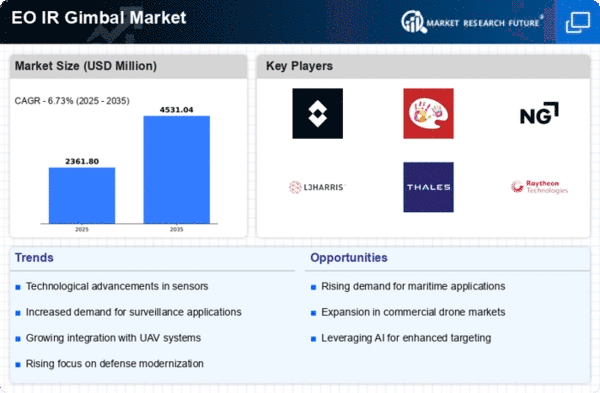
As per MRFR analysis, the EO IR Gimbal Market Size was estimated at 2212.87 USD Million in 2024. The EO IR Gimbal industry is projected to grow from 2361.84 in 2025 to 4531.04 by 2035, exhibiting a compound annual growth rate (CAGR) of 6.73 during the forecast period 2025 - 2035.

Key Market Trends & Highlights

The EO IR Gimbal Market is experiencing robust growth driven by technological advancements and increasing security demands.

  • Technological advancements are propelling the EO IR gimbal market towards enhanced performance and capabilities.
  • North America remains the largest market, while Asia-Pacific is emerging as the fastest-growing region in this sector.
  • The surveillance segment dominates the market, whereas military operations are witnessing the fastest growth due to evolving defense needs.
  • Key drivers include the rising demand for security solutions and ongoing investments in defense and aerospace sectors.

Market Size & Forecast

2024 Market Size 2212.87 (USD Million)
2035 Market Size 4531.04 (USD Million)
CAGR (2025 - 2035) 6.73%

Major Players

FLIR Systems (US), Leonardo (IT), Northrop Grumman (US), L3Harris Technologies (US), Thales Group (FR), Raytheon Technologies (US), Teledyne Technologies (US), Sierra Nevada Corporation (US), Hensoldt (DE)

Our Impact
Enabled $4.3B Revenue Impact for Fortune 500 and Leading Multinationals
Partnering with 2000+ Global Organizations Each Year
30K+ Citations by Top-Tier Firms in the Industry

EO IR Gimbal Market Trends

The EO IR Gimbal Market is currently experiencing a notable evolution, driven by advancements in technology and increasing demand across various sectors. The integration of electro-optical and infrared capabilities into gimbal systems enhances surveillance, reconnaissance, and targeting applications. This trend appears to be fueled by the growing need for enhanced situational awareness in military and defense operations, as well as in commercial sectors such as agriculture and infrastructure monitoring. Furthermore, the rise of unmanned aerial vehicles (UAVs) has significantly contributed to the proliferation of EO IR gimbals, as these systems are essential for effective aerial imaging and data collection. In addition to technological advancements, the EO IR Gimbal Market is influenced by the increasing emphasis on security and safety measures globally. Governments and organizations are investing in sophisticated surveillance systems to address emerging threats and ensure public safety. This heightened focus on security is likely to drive demand for EO IR gimbals, as they provide critical capabilities for monitoring and threat detection. Moreover, the trend towards miniaturization and lightweight designs in gimbal technology suggests a shift towards more versatile applications, enabling deployment in a wider range of platforms, including portable and mobile systems. Overall, the EO IR Gimbal Market appears poised for continued growth, with evolving applications and technological innovations shaping its future.

Technological Advancements

The EO IR Gimbal Market is witnessing rapid technological progress, particularly in sensor integration and image stabilization. Enhanced electro-optical and infrared sensors are being developed, allowing for improved image quality and operational effectiveness. This trend is likely to expand the range of applications for gimbals, making them more appealing to various industries.

Increased Demand for Security Solutions

There is a growing global emphasis on security and surveillance, which is driving the demand for EO IR gimbals. Organizations and governments are investing in advanced monitoring systems to address security challenges. This trend suggests that EO IR gimbals will play a crucial role in enhancing situational awareness and threat detection.

Miniaturization and Versatility

The trend towards miniaturization in gimbal technology is notable, as manufacturers are developing lighter and more compact systems. This evolution allows for greater versatility in deployment across different platforms, including UAVs and portable systems. Such advancements may broaden the market's reach and application scope.

Market Segment Insights

By Application: Surveillance (Largest) vs. Military Operations (Fastest-Growing)

The EO IR Gimbal Market exhibits a diverse application landscape, with Surveillance maintaining the largest market share among the segment values. This predominance is driven by increasing demand for security solutions across various sectors, including civilian, governmental, and military use. The need for real-time imagery and data analysis continues to push Surveillance to the forefront, representing a critical pillar in the overall market distribution. Meanwhile, applications such as Search and Rescue, Wildlife Monitoring, and Infrastructure Inspection hold smaller portions of the market but are crucial in specialized scenarios requiring high-precision imaging and surveillance capabilities. Growth trends within the EO IR Gimbal Market are significantly influenced by technological advancements and rising awareness of security needs globally, particularly in Military Operations, which is recognized as the fastest-growing segment. Innovations in imaging technology, combined with an increase in defense budgets and military expenditure, have fostered robust growth in this area. Additionally, the rising frequency of natural disasters has increased the emphasis on Search and Rescue operations, further enhancing the demand for EO IR Gimbals in critical situations. Each of these segments contributes uniquely to the evolving landscape of the EO IR Gimbal Market, driving future developments.

Surveillance (Dominant) vs. Search and Rescue (Emerging)

In the EO IR Gimbal Market, Surveillance stands out as the dominant application segment, reflecting its extensive adoption across various industries due to the critical need for security monitoring and reconnaissance. This application benefits from advancements in camera technology and enhanced sensor capabilities, leading to more reliable and versatile surveillance solutions. In contrast, Search and Rescue is an emerging segment that, while it represents a smaller share of the market, is gaining momentum due to increasing government and organizational investments in disaster response systems. The evolution of EO IR Gimbals for Search and Rescue applications focuses on portability, ease of deployment, and enhanced image processing, addressing the specific needs for rapid action during emergencies.

By End Use: Defense (Largest) vs. Commercial (Fastest-Growing)

The EO IR Gimbal Market exhibits a diverse range of segment values, with Defense holding the largest share. This segment is heavily influenced by governmental contracts and military funding, which bolster its prominence. Following closely, Commercial applications are gaining traction across various industries, leveraging the versatility of EO IR gimbal technology for enhanced surveillance and monitoring capabilities. As the market evolves, Environmental Monitoring and Public Safety segments are also solidifying their positions, driven by increasing concerns for public safety and ecological impacts.

Defense (Dominant) vs. Commercial (Emerging)

In the EO IR Gimbal Market, the Defense sector stands out as the dominant segment, fueled by substantial investments in military modernization and advanced reconnaissance technologies. The demand for precision targeting and situational awareness drives innovation and adoption of EO IR systems within defense applications. Conversely, the Commercial sector represents an emerging segment, rapidly gaining popularity due to the rising needs for real-time monitoring in industries such as security, agriculture, and energy. The flexibility of EO IR gimbals for diverse operational scenarios enhances their appeal, positioning the Commercial segment as a significant player for future growth.

By Technology: Electro-Optical (Largest) vs. Infrared (Fastest-Growing)

Within the EO IR Gimbal Market, the technology segment is marked by a diverse distribution of shares among various technologies. Electro-Optical systems currently dominate the market, owing to their versatility and effectiveness in various applications, including surveillance and target acquisition. In contrast, the Infrared segment is experiencing rapid growth, driven by advancements in thermal imaging systems and an increasing need for enhanced surveillance capabilities in defense and security sectors.

Technology: Electro-Optical (Dominant) vs. Infrared (Emerging)

Electro-Optical systems are recognized as the dominant force in the EO IR Gimbal Market, thanks to their precision and high-resolution imaging capabilities, which have made them indispensable for defense, commercial, and industrial applications. Meanwhile, the Infrared segment represents an emerging market that is gaining traction due to its ability to operate effectively in low-light conditions, making it essential for nighttime operations and clandestine surveillance. The growth of infrared technology is also spurred by its integration with advanced imaging systems, paving the way for enhanced situational awareness and operational efficiency.

By Mounting Type: Vehicle-Mounted (Largest) vs. Aerial (Fastest-Growing)

The EO IR Gimbal Market shows diverse segmentation in mounting types. The Vehicle-Mounted segment currently leads the market, benefiting from increased military and defense applications. In contrast, the Aerial segment is rapidly gaining traction due to the proliferation of drones and UAVs, which are increasingly integrated with EO IR gimbals, reflecting market demands for aerial surveillance solutions.

Mounting Type: Vehicle-Mounted (Dominant) vs. Aerial (Emerging)

The Vehicle-Mounted gimbal systems are characterized by their robustness and versatility, often utilized in defense vehicles for reconnaissance and targeting. Their dominant position stems from the strategic need for mobile surveillance on the ground. Conversely, the Aerial gimbal systems are emerging prominently, driven by innovations in drone technology. These systems are compact and lightweight, suitable for high-resolution imaging and surveillance tasks from the sky. The growth in drone usage highlights their importance in civil and military applications, making aerial gimbals an exciting segment to watch.

By Payload Capacity: Medium Weight (Largest) vs. Lightweight (Fastest-Growing)

In the EO IR Gimbal Market, the payload capacity segment showcases a diverse distribution among various categories. The medium weight category dominates the landscape due to its balanced performance and adaptability, making it the preferred choice across military and commercial applications. Conversely, the lightweight segment, although smaller in overall market share, is rapidly gaining traction due to its emerging applications in drone technologies and portable surveillance systems, highlighting a shift towards mobility and efficiency. The growth trends within this segment are influenced by technological advancements and increasing demand for multi-functional systems. The rise in aerial platforms using lighter payload options leads to an enhanced focus on lightweight gimbals, which offer agility without sacrificing operational capabilities. This evolution is fostering innovations, with manufacturers investing in research to optimize designs and functionalities that cater to various operational needs, thereby propelling the lightweight category to become the fastest-growing segment in the market.

Medium Weight (Dominant) vs. Ultra Heavy Weight (Emerging)

The medium weight category in the EO IR Gimbal Market is recognized for its versatility and performance, enabling it to fulfill a wide range of operational needs from short-range reconnaissance to tactical surveillance. Its widespread acceptance in various fields, including defense, law enforcement, and commercial sectors, solidifies its dominant position. Meanwhile, the ultra heavy weight segment is an emerging player, primarily catering to specialized applications that require higher payload capabilities, such as heavy-duty surveillance and reconnaissance operations. Despite its nascent market presence, the ultra heavy weight gimbals are gaining importance due to their extensive functionalities and durability, enabling them to operate effectively under harsh conditions, thus carving out a niche for themselves.

Get more detailed insights about EO IR Gimbal Market

Regional Insights

North America : Market Leader in Technology

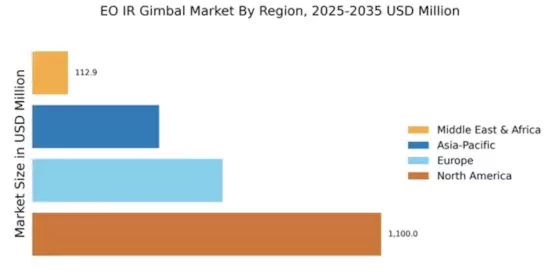
North America continues to lead the EO IR Gimbal market, holding a significant share of 1100.0M in 2024. The region's growth is driven by increasing defense budgets, technological advancements, and a rising demand for surveillance and reconnaissance systems. Regulatory support for defense innovations further catalyzes market expansion, ensuring that North America remains at the forefront of EO IR Gimbal technology. The competitive landscape is robust, with key players such as FLIR Systems, Northrop Grumman, and L3Harris Technologies dominating the market. The U.S. is the primary contributor, leveraging its advanced military capabilities and extensive R&D investments. This concentration of expertise and resources positions North America as a critical hub for EO IR Gimbal development and deployment.

Europe : Growing Defense Investments

Europe is witnessing a notable increase in the EO IR Gimbal market, valued at 600.0M in 2024. The growth is fueled by heightened defense spending among EU nations, driven by geopolitical tensions and the need for enhanced border security. Regulatory frameworks are evolving to support advanced surveillance technologies, creating a conducive environment for market growth. Leading countries like Germany, France, and the UK are at the forefront, with companies such as Thales Group and Leonardo playing pivotal roles. The competitive landscape is characterized by collaborations and partnerships aimed at innovation. As European nations prioritize defense modernization, the EO IR Gimbal market is set for significant expansion.

Asia-Pacific : Emerging Market Potential

The Asia-Pacific region is emerging as a significant player in the EO IR Gimbal market, valued at 400.0M in 2024. The growth is driven by increasing military expenditures, modernization of defense forces, and a rising demand for surveillance capabilities. Countries are investing in advanced technologies to enhance their defense readiness, supported by favorable government policies and initiatives. Key players in this region include major defense contractors and local manufacturers, with countries like India, Japan, and Australia leading the charge. The competitive landscape is evolving, with a mix of established firms and new entrants striving to capture market share. As regional tensions rise, the demand for EO IR Gimbals is expected to accelerate further.

Middle East and Africa : Strategic Defense Investments

The Middle East and Africa region is witnessing a gradual increase in the EO IR Gimbal market, currently valued at 112.87M in 2024. The growth is primarily driven by rising defense budgets and the need for enhanced surveillance capabilities in conflict-prone areas. Governments are increasingly investing in advanced technologies to bolster national security, supported by international partnerships and collaborations. Countries like the UAE and South Africa are leading the market, with a focus on acquiring advanced defense systems. The competitive landscape includes both local and international players, striving to meet the growing demand. As regional security challenges persist, the EO IR Gimbal market is poised for steady growth.


EO IR Gimbal Market Regional Image

Key Players and Competitive Insights

The EO IR Gimbal Market is characterized by a dynamic competitive landscape, driven by advancements in sensor technology, increasing defense budgets, and the growing demand for surveillance and reconnaissance capabilities. Key players such as FLIR Systems (US), Leonardo (IT), and Northrop Grumman (US) are strategically positioned to leverage these trends. FLIR Systems (US) focuses on innovation in thermal imaging and sensor integration, while Leonardo (IT) emphasizes partnerships with defense agencies to enhance its product offerings. Northrop Grumman (US) adopts a strategy of regional expansion, particularly in Asia-Pacific, to tap into emerging markets. Collectively, these strategies contribute to a competitive environment that is increasingly focused on technological advancement and strategic collaborations.In terms of business tactics, companies are localizing manufacturing to reduce costs and enhance supply chain resilience. The market structure appears moderately fragmented, with several players vying for market share. However, the influence of key players is substantial, as they set industry standards and drive technological innovation. This competitive structure fosters an environment where smaller firms may struggle to keep pace with the rapid advancements made by larger entities.

In November FLIR Systems (US) announced a partnership with a leading drone manufacturer to integrate its EO IR gimbal systems into next-generation unmanned aerial vehicles (UAVs). This collaboration is strategically significant as it positions FLIR to capitalize on the growing UAV market, enhancing its product portfolio and expanding its customer base. The integration of advanced gimbal systems into UAVs is likely to improve operational capabilities for surveillance and reconnaissance missions.

In October Leonardo (IT) unveiled a new EO IR gimbal system designed for maritime applications, showcasing its commitment to innovation in specialized markets. This launch is indicative of Leonardo's strategy to diversify its offerings and cater to specific industry needs, particularly in naval defense. By focusing on niche markets, Leonardo aims to strengthen its competitive edge and establish itself as a leader in maritime surveillance technologies.

In September Northrop Grumman (US) secured a contract with a European defense agency to supply advanced EO IR gimbal systems for ground-based surveillance. This contract not only underscores Northrop Grumman's strong foothold in the European market but also highlights its ability to meet the increasing demand for sophisticated surveillance solutions. The strategic importance of this contract lies in its potential to enhance Northrop Grumman's reputation as a reliable supplier in the defense sector.

As of December current competitive trends in the EO IR Gimbal Market include a pronounced shift towards digitalization, sustainability, and the integration of artificial intelligence (AI) in product offerings. Strategic alliances are increasingly shaping the landscape, enabling companies to pool resources and expertise to drive innovation. Looking ahead, competitive differentiation is likely to evolve from traditional price-based competition to a focus on technological innovation, reliability in supply chains, and the ability to deliver customized solutions that meet the specific needs of clients.

Key Companies in the EO IR Gimbal Market include

Industry Developments

Recent developments in the  EO/IR gimbal market have been shaped by advancements in sensor technologies and growth in defense spending across various nations. The increasing demand for high-precision stabilization systems in defense applications, including unmanned aerial vehicles (UAVs) and missiles, has driven innovation. Additionally, the rise in commercial applications, particularly in surveillance and reconnaissance, is opening new avenues for gimbal manufacturers. The shift towards smaller and more versatile gimbal systems has led to strategic partnerships and collaborations among key players, enhancing product offerings.

Market participants are also responding to the growing emphasis on autonomous systems, integrating advanced features like enhanced thermal imaging and AI capabilities. The ongoing geopolitical tensions and increased focus on national security are further pushing governments to invest in advanced EO/IR gimbal systems, indicating a robust growth trajectory for this market segment. As of 2024, maintaining technological leadership and expanding into emerging markets remains crucial for stakeholders aiming to capitalize on the anticipated expansion through 2032.

Future Outlook

EO IR Gimbal Market Future Outlook

The EO IR Gimbal Market is projected to grow at a 6.73% CAGR from 2025 to 2035, driven by advancements in surveillance technology and increasing defense budgets.

New opportunities lie in:

  • Integration of AI for enhanced target tracking capabilities.
  • Development of compact, lightweight gimbals for UAV applications.
  • Expansion into commercial sectors like agriculture and infrastructure monitoring.

By 2035, the EO IR Gimbal Market is expected to achieve substantial growth, reflecting evolving technological demands.

Market Segmentation

EO IR Gimbal Market End Use Outlook

  • Defense
  • Commercial
  • Aerospace
  • Public Safety
  • Environmental Monitoring

EO IR Gimbal Market Technology Outlook

  • Electro-Optical
  • Infrared
  • Laser
  • Hybrid
  • Multi-Sensor

EO IR Gimbal Market Application Outlook

  • Surveillance
  • Search and Rescue
  • Military Operations
  • Wildlife Monitoring
  • Infrastructure Inspection

EO IR Gimbal Market Mounting Type Outlook

  • Fixed
  • Portable
  • Vehicle-Mounted
  • Aerial
  • Ground

EO IR Gimbal Market Payload Capacity Outlook

  • Lightweight
  • Medium Weight
  • Heavy Weight
  • Ultra Heavy Weight
  • Variable Weight

Report Scope

MARKET SIZE 20242212.87(USD Million)
MARKET SIZE 20252361.84(USD Million)
MARKET SIZE 20354531.04(USD Million)
COMPOUND ANNUAL GROWTH RATE (CAGR)6.73% (2025 - 2035)
REPORT COVERAGERevenue Forecast, Competitive Landscape, Growth Factors, and Trends
BASE YEAR2024
Market Forecast Period2025 - 2035
Historical Data2019 - 2024
Market Forecast UnitsUSD Million
Key Companies ProfiledFLIR Systems (US), Leonardo (IT), Northrop Grumman (US), L3Harris Technologies (US), Thales Group (FR), Raytheon Technologies (US), Teledyne Technologies (US), Sierra Nevada Corporation (US), Hensoldt (DE)
Segments CoveredApplication, End Use, Technology, Mounting Type, Payload Capacity
Key Market OpportunitiesIntegration of advanced artificial intelligence in EO IR Gimbal systems enhances operational efficiency and target acquisition.
Key Market DynamicsTechnological advancements and increasing defense budgets drive demand for enhanced Electro-Optical Infrared Gimbal systems.
Countries CoveredNorth America, Europe, APAC, South America, MEA
Leave a Comment

FAQs

What is the projected market size of the EO/IR Gimbal Market in 2034?

The EO/IR Gimbal Market is projected to be valued at 4.25 USD Billion in 2034.

What is the expected CAGR for the EO/IR Gimbal Market from 2024 to 2034?

The expected CAGR for the EO/IR Gimbal Market is 6.7 from 2025 to 2034.

Which region is expected to have the largest market share in the EO/IR Gimbal Market by 2034?

North America is expected to have the largest market share at 1.3 USD Billion by 2034.

What is the market size of the Electro-Optical Gimbals segment in 2034?

The Electro-Optical Gimbals segment is projected to reach a market size of 1.5 USD Billion in 2034.

How much is the Infrared Gimbals segment expected to grow by 2034?

The Infrared Gimbals segment is expected to grow to a market size of 1.15 USD Billion by 2034.

Which key player is projected to contribute significantly to the EO/IR Gimbal Market?

Major players like AeroVironment, SAAB, and Kongsberg are expected to significantly contribute to the market.

What is the market value of the Multi-Sensor Gimbals segment in 2023?

The Multi-Sensor Gimbals segment is valued at 0.45 USD Billion in 2023.

What is the projected market size for Europe in the EO/IR Gimbal Market by 2034?

Europe's market size is projected to reach 0.9 USD Billion by 2034.

What is the anticipated market value for the South America region in 2034?

The anticipated market value for South America is 0.25 USD Billion in 2034.

What are the expected trends influencing the growth of the EO/IR Gimbal Market?

Technological advancements and increased demand for surveillance are expected to drive market growth.

Download Free Sample

Kindly complete the form below to receive a free sample of this Report

Compare Licence

×
Features License Type
Single User Multiuser License Enterprise User
Price $4,950 $ $7,250
Maximum User Access Limit 1 User Upto 10 Users Unrestricted Access Throughout the Organization
Free Customization
Direct Access to Analyst
Deliverable Format
Platform Access
Discount on Next Purchase 10% 15% 15%
Printable Versions