×
Request Free Sample ×

Kindly complete the form below to receive a free sample of this Report

* Please use a valid business email

Leading companies partner with us for data-driven Insights

clients tt-cursor
Hero Background

Edge Analytics Market

ID: MRFR/ICT/2301-HCR
100 Pages
Shubham Munde
February 2026

Edge Analytics Market Size, Share and Trends Analysis Report By Component (Solutions, Services), By Deployment (Cloud, On-Premise), By Business Application (Sales, Marketing, HR, Operations, Finance), By Verticals (Government, IT and Telecommunication, Manufacturing, Healthcare and Travel and Hospitality) And By Region (North America, Europe, Asia-Pacific, And Rest Of The World) –Market Forecast Till 2035

Share:
Download PDF ×

We do not share your information with anyone. However, we may send you emails based on your report interest from time to time. You may contact us at any time to opt-out.

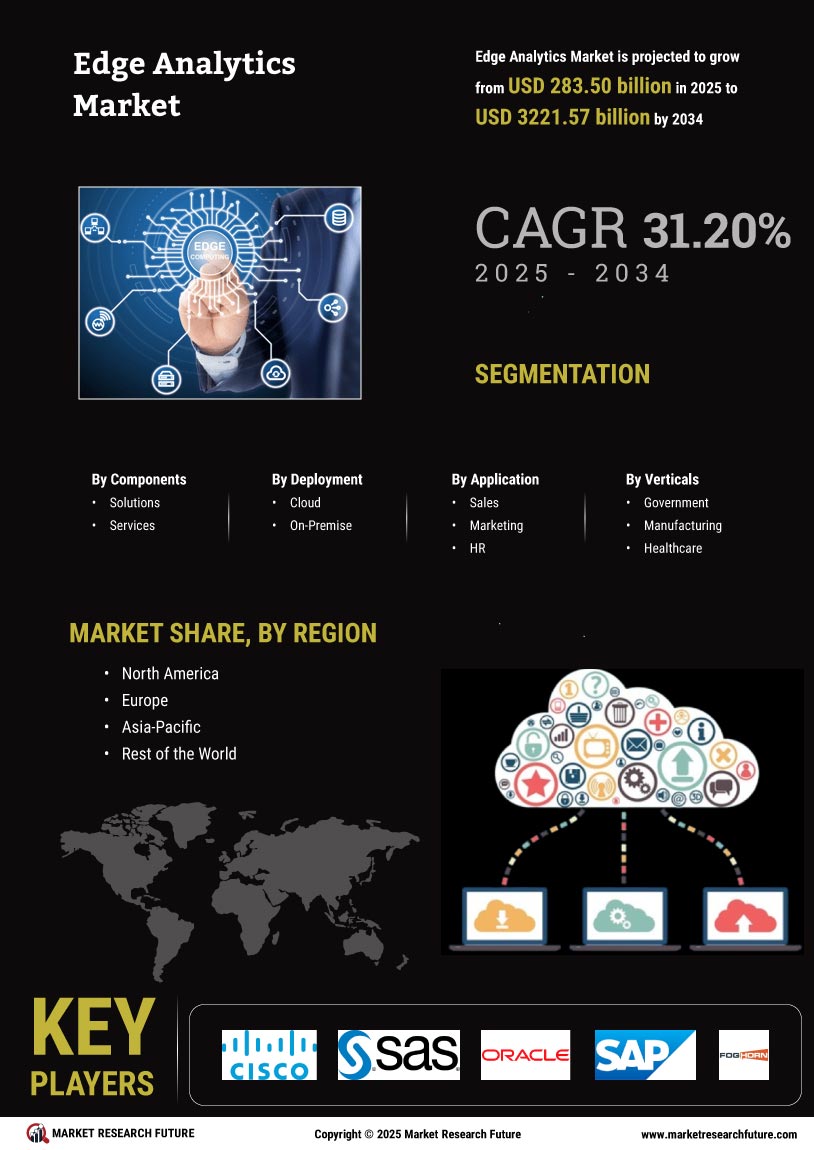
Edge Analytics Market Infographic
Purchase Options

Edge Analytics Market Summary

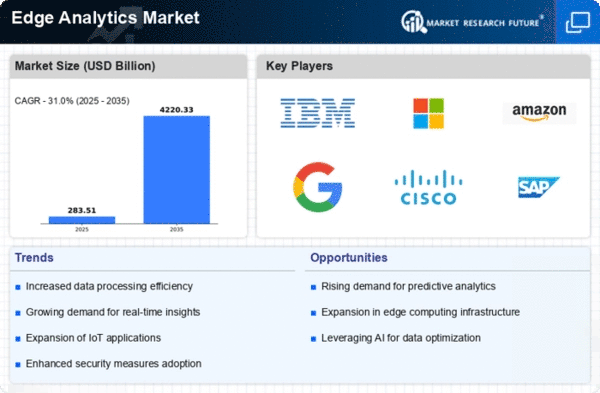
As per MRFR analysis, the Edge Analytics Market Size was estimated at 216.42 USD Billion in 2024. The Edge Analytics industry is projected to grow from 283.51 in 2025 to 4220.33 by 2035, exhibiting a compound annual growth rate (CAGR) of 31.0 during the forecast period 2025 - 2035.

Key Market Trends & Highlights

The Edge Analytics Market is poised for substantial growth driven by technological advancements and increasing data demands.

  • North America remains the largest market for edge analytics, driven by widespread IoT adoption and advanced infrastructure.
  • The Asia-Pacific region is emerging as the fastest-growing market, fueled by rapid digital transformation and increasing investments in smart technologies.
  • Predictive maintenance continues to dominate the market, while real-time data processing is gaining traction as a critical segment for future growth.
  • Key market drivers include the rising demand for real-time data processing and the expansion of 5G technology, which enhance operational efficiency and data privacy compliance.

Market Size & Forecast

2024 Market Size 216.42 (USD Billion)
2035 Market Size 4220.33 (USD Billion)
CAGR (2025 - 2035) 31.0%

Major Players

IBM (US), Microsoft (US), Amazon (US), Google (US), Cisco (US), SAP (DE), Oracle (US), Siemens (DE), Dell Technologies (US)

Our Impact
Enabled $4.3B Revenue Impact for Fortune 500 and Leading Multinationals
Partnering with 2000+ Global Organizations Each Year
30K+ Citations by Top-Tier Firms in the Industry

Edge Analytics Market Trends

The Edge Analytics Market is currently experiencing a transformative phase, driven by the increasing demand for real-time data processing and analysis. Organizations are recognizing the necessity of making informed decisions swiftly, which has led to a growing reliance on edge computing solutions. This shift allows data to be processed closer to its source, thereby reducing latency and enhancing operational efficiency. As industries continue to embrace digital transformation, the Edge Analytics Market is poised for substantial growth, with various sectors exploring innovative applications to leverage data insights effectively. Moreover, the proliferation of Internet of Things (IoT) devices is further propelling the Edge Analytics Market. These devices generate vast amounts of data that require immediate analysis to optimize performance and improve user experiences. Consequently, businesses are investing in edge analytics technologies to harness this data effectively. The integration of artificial intelligence and machine learning into edge analytics solutions is also becoming increasingly prevalent, enabling organizations to derive deeper insights and automate decision-making processes. As the landscape evolves, the Edge Analytics Market is likely to witness continued advancements, fostering a more data-driven approach across multiple industries.

Increased Adoption of IoT Devices

The rise of Internet of Things devices is significantly influencing the Edge Analytics Market. As more devices connect to networks, the volume of data generated increases, necessitating efficient processing at the edge. This trend indicates a shift towards decentralized data management, allowing organizations to respond to insights in real-time.

Integration of AI and Machine Learning

The incorporation of artificial intelligence and machine learning technologies into edge analytics solutions is becoming more prevalent. This integration enhances the ability to analyze data at the source, enabling predictive analytics and automated decision-making, which could lead to improved operational efficiencies.

Focus on Data Security and Privacy

As organizations increasingly rely on edge analytics, there is a growing emphasis on data security and privacy. Companies are prioritizing the implementation of robust security measures to protect sensitive information processed at the edge, suggesting a trend towards more secure analytics frameworks.

Edge Analytics Market Drivers

Growth of IoT Devices

The proliferation of Internet of Things (IoT) devices significantly influences the Global Edge Analytics Market Industry. With billions of connected devices generating vast amounts of data, the need for localized data processing becomes paramount. Edge analytics allows for the analysis of data at the source, reducing latency and bandwidth usage. For example, smart cities utilize edge analytics to manage traffic flow and optimize energy consumption. The market is poised for substantial growth, with a projected CAGR of 31.37% from 2025 to 2035, indicating that as IoT adoption continues, edge analytics will play a crucial role in managing and interpreting the data generated.

Need for Cost-Effective Solutions

The pursuit of cost-effective solutions drives the Global Edge Analytics Market Industry as organizations seek to optimize their operational expenditures. Edge analytics can reduce the costs associated with data transmission and storage by processing data locally. For example, retail businesses utilize edge analytics to analyze customer behavior in-store, allowing for targeted marketing strategies without incurring high data transfer costs. This focus on cost efficiency is expected to contribute to the market's growth trajectory, particularly as businesses aim to maximize their return on investment. As such, the demand for affordable edge analytics solutions is likely to rise.

Enhanced Data Security and Privacy

In an era where data breaches are prevalent, the Global Edge Analytics Market Industry is witnessing a heightened focus on data security and privacy. By processing data at the edge, organizations can minimize the risk of sensitive information being transmitted over networks, thereby enhancing security. Industries such as finance and healthcare are particularly sensitive to data privacy concerns. For instance, edge analytics can enable financial institutions to analyze transactions locally, reducing exposure to cyber threats. As regulatory frameworks evolve, the emphasis on secure data handling is likely to propel the adoption of edge analytics solutions, further driving market growth.

Advancements in Edge Computing Technology

Technological advancements in edge computing are pivotal to the evolution of the Global Edge Analytics Market Industry. Innovations such as improved hardware capabilities and sophisticated algorithms enhance the efficiency of edge analytics solutions. For instance, the integration of artificial intelligence and machine learning at the edge allows for more complex data analysis and decision-making processes. This technological evolution is expected to contribute to the market's expansion, with projections indicating a growth to 4226.7 USD Billion by 2035. As organizations seek to leverage these advancements, the demand for edge analytics solutions is likely to increase, fostering a competitive landscape.

Rising Demand for Real-Time Data Processing

The Global Edge Analytics Market Industry experiences a surge in demand for real-time data processing capabilities. Organizations across various sectors, including manufacturing and healthcare, increasingly rely on instantaneous data insights to enhance operational efficiency. For instance, in smart manufacturing, edge analytics enables real-time monitoring of equipment, leading to predictive maintenance and reduced downtime. This trend is reflected in the projected market growth, with the industry expected to reach 210.2 USD Billion in 2024. As businesses recognize the value of timely data, the adoption of edge analytics solutions is likely to accelerate, driving further investments in this technology.

Market Segment Insights

By Application: Predictive Maintenance (Largest) vs. Real-Time Data Processing (Fastest-Growing)

The Edge Analytics Market is witnessing a robust distribution among various application segments, with predictive maintenance emerging as the largest contributor. This segment capitalizes on advanced analytics to foresee potential equipment failures, thereby enabling organizations to minimize downtime and optimize operations. In contrast, real-time data processing is gaining traction and rapidly expanding, driven by the surge in IoT devices and the demand for instantaneous insights from data streams. Growth trends in the Edge Analytics Market are significantly influenced by technological advances and the increasing reliance on data-driven decision-making across industries. Predictive maintenance is bolstered by industries like manufacturing and energy, where operational efficiency is paramount. Simultaneously, the real-time data processing segment is propelled by the need for immediate analytical capabilities in sectors such as finance and healthcare, making it a critical area for innovation and investment.

Predictive Maintenance (Dominant) vs. Fraud Detection (Emerging)

Predictive maintenance stands as the dominant force in the Edge Analytics Market, characterized by its capability to leverage sensor data and machine learning algorithms to forecast equipment failures proactively. It helps organizations in various sectors such as manufacturing, automotive, and utilities adhere to maintenance schedules that prevent operational disruptions. On the other hand, fraud detection is emerging strongly as organizations ramp up their efforts to protect against cyber threats and fraudulent activities. This application relies on complex algorithms and real-time analytics to identify unusual patterns and behaviors, making it essential for sectors like banking and insurance. Both segments exhibit unique strengths, with predictive maintenance focusing on operational longevity and fraud detection aiming to safeguard financial integrity.

By End Use: Manufacturing (Largest) vs. Telecommunications (Fastest-Growing)

The Edge Analytics Market demonstrates a diverse distribution of market share across various end-use sectors, with manufacturing leading as the most significant segment. This dominance stems from the industry's increasing demand for real-time data processing and analytics, which enhances operational efficiency and decision-making. Following closely are healthcare and retail, which leverage edge analytics for improved patient outcomes and enhanced customer experiences, respectively. Telecommunications is also a noteworthy player as it adopts edge computing technology for better service delivery and network management. Growth trends in the Edge Analytics Market are driven by the rising need for efficient data processing solutions across various sectors. Manufacturing continues to thrive due to advancements in automation and IoT integration, while the healthcare sector is increasingly reliant on real-time data for critical health decisions. The retail segment is leveraging insights from edge analytics to tailor customer experiences effectively. Meanwhile, telecommunications is experiencing rapid growth as it transitions toward 5G networks, significantly enhancing edge analytics' capabilities and usage across multiple applications.

Manufacturing: Dominant vs. Telecommunications: Emerging

The manufacturing sector stands out as the dominant force in the Edge Analytics Market due to its substantial reliance on data-driven insights to streamline processes and improve operational efficiency. This sector prioritizes robust edge analytics solutions to manage vast amounts of data generated by IoT devices, facilitating predictive maintenance and real-time decision-making. On the other hand, the telecommunications sector is emerging as a key player in edge analytics, fueled by the rollout of 5G technology. This transition enables telecom companies to harness edge computing capabilities, enhancing service quality and operational agility. As both sectors continue to evolve, the interplay between established dominance and emerging innovation will shape the future landscape of edge analytics.

By Deployment Model: Cloud-Based (Largest) vs. Hybrid (Fastest-Growing)

In the Edge Analytics Market, the deployment model segment shows a clear distribution of market share, primarily led by Cloud-Based solutions which cater to a significant portion of businesses seeking agility and scalability. This model enables organizations to manage their data analytics without heavy infrastructure investments, making it a preferred choice for many enterprises. Meanwhile, the Hybrid deployment model is gaining traction as it allows companies to leverage both cloud and on-premises capabilities, thus providing flexibility and enhanced data security. The growth trends in the deployment model segment are largely driven by the increasing need for real-time analytics and the rise of IoT devices requiring edge processing. Companies are increasingly adopting Hybrid models as they provide a balanced approach to data management, offering both speed and security. Additionally, the expansion of 5G networks is further propelling the adoption of edge analytics solutions, enabling faster data processing at the edge and changing the dynamics of cloud integration.

Cloud-Based (Dominant) vs. Hybrid (Emerging)

The Cloud-Based deployment model stands out as the dominant force in the Edge Analytics Market, favored for its scalability and cost-effectiveness. Businesses utilizing cloud solutions can easily deploy analytics tools without extensive hardware investments, thereby accelerating their data processes. On the other hand, the Hybrid model is emerging as a compelling alternative for organizations that need to balance operational agility with data sovereignty. This model allows businesses to maintain sensitive data on-premises while taking advantage of cloud scalability for less sensitive operations. As data privacy concerns continue to influence corporate strategies, the Hybrid model is expected to gain wider acceptance, appealing to industries where compliance and security are paramount.

By Data Source: IoT Devices (Largest) vs. Social Media (Fastest-Growing)

In the Edge Analytics Market, IoT Devices hold the largest market share among data sources, reflecting the critical role of connected devices in generating vast amounts of data. Social Media follows closely behind, demonstrating significant engagement and content generation that contributes to the data landscape. The diverse nature of data from these sources enhances market analysis, driving innovation in edge computing technologies. Growth trends indicate that while IoT Devices form the backbone of data generation, Social Media is rapidly expanding due to increased user interaction and content creation. This trend is propelled by advancements in technology and the rising need for real-time analytics in social platforms. As businesses strive for better customer insights, the integration of social media analytics is becoming paramount, positioning it as the fastest-growing data source in the market.

IoT Devices (Dominant) vs. Sensors (Emerging)

IoT Devices dominate the Edge Analytics Market due to their ability to generate real-time data from numerous interconnected devices, facilitating immediate insights and responses. These devices are integral for industries such as manufacturing, healthcare, and transportation, where decision-making relies heavily on data accuracy and timeliness. Sensors, while currently an emerging source, are entering the market with innovative technologies that provide critical data for various applications. As sensor technology evolves, particularly with advancements in artificial intelligence and machine learning, their market position is strengthening, leading to an increased adoption across different sectors. The synergy between IoT Devices and sensors is expected to redefine data collection and analysis methodologies in the near future.

By Technology: Machine Learning (Largest) vs. Artificial Intelligence (Fastest-Growing)

The Edge Analytics Market showcases significant opportunities across key technological segments, particularly in Machine Learning, Artificial Intelligence, and Natural Language Processing. Machine Learning holds the largest share of the market, driven by its ability to analyze vast datasets in real-time. In contrast, while Artificial Intelligence is gaining momentum rapidly, it is crucial in automating processes and enhancing decision-making capabilities at the edge, thus marking itself as a leading player in terms of growth.

Technology: Machine Learning (Dominant) vs. Natural Language Processing (Emerging)

Machine Learning is currently the dominant technology in the Edge Analytics Market, characterized by its efficiency in predictive analytics and automation, enabling businesses to leverage data insights for immediate actions. On the other hand, Natural Language Processing is emerging as a vital player, facilitating machine understanding and interaction with human language, thus broadening the scope of analytics applications. As organizations continue to seek advanced analytics solutions, the integration of Natural Language Processing with existing Machine Learning frameworks presents an exciting growth trajectory, addressing the increasing demand for intuitive and accessible data interactions.

Get more detailed insights about Edge Analytics Market

Regional Insights

North America : Market Leader in Edge Analytics

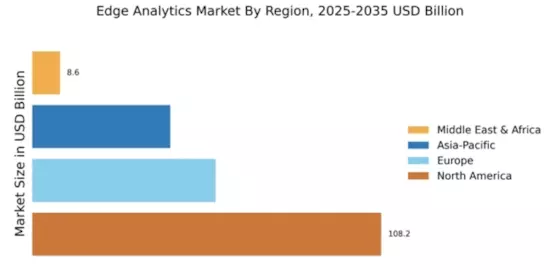
North America is poised to maintain its leadership in the Edge Analytics market, holding a significant market share of $108.21M in 2025. The region's growth is driven by increasing demand for real-time data processing and analytics, particularly in sectors like healthcare, finance, and manufacturing. Regulatory support for data privacy and security further catalyzes market expansion, as organizations seek to comply with stringent regulations while leveraging data insights for competitive advantage. The competitive landscape in North America is robust, featuring key players such as IBM, Microsoft, and Amazon, who are investing heavily in innovative solutions. The U.S. stands out as a primary market, supported by a strong technological infrastructure and a high adoption rate of IoT devices. This environment fosters collaboration among tech giants and startups alike, driving continuous advancements in Edge Analytics capabilities.

Europe : Emerging Market with Growth Potential

Europe is witnessing a notable rise in the Edge Analytics market, projected to reach $56.83M by 2025. The region's growth is fueled by increasing investments in smart city initiatives and the adoption of Industry 4.0 practices. Regulatory frameworks, such as the GDPR, are also shaping the market, encouraging organizations to adopt analytics solutions that ensure data compliance while enhancing operational efficiency. Leading countries like Germany, the UK, and France are at the forefront of this growth, with a strong presence of key players such as SAP and Siemens. The competitive landscape is characterized by a mix of established firms and innovative startups, all vying to capture market share. As organizations increasingly recognize the value of real-time analytics, the demand for Edge Analytics solutions is expected to surge, positioning Europe as a significant player in the global market.

Asia-Pacific : Rapid Growth in Emerging Economies

The Asia-Pacific region is experiencing rapid growth in the Edge Analytics market, projected to reach $42.78M by 2025. This growth is primarily driven by the increasing adoption of IoT devices and the need for real-time data processing across various sectors, including manufacturing and retail. Governments in the region are also promoting digital transformation initiatives, which serve as catalysts for market expansion, enhancing the demand for advanced analytics solutions. Countries like China, India, and Japan are leading the charge, with a burgeoning number of tech startups and established companies investing in Edge Analytics capabilities. The competitive landscape is becoming increasingly dynamic, with major players like Oracle and Cisco actively participating in the market. As organizations strive to harness the power of data, the Edge Analytics market in Asia-Pacific is set for significant growth in the coming years.

Middle East and Africa : Emerging Frontier for Analytics

The Middle East and Africa (MEA) region is emerging as a frontier for the Edge Analytics market, with a projected size of $8.6M by 2025. The growth is driven by increasing investments in digital infrastructure and smart city projects, particularly in countries like the UAE and South Africa. Regulatory initiatives aimed at enhancing data governance and security are also contributing to the market's development, as organizations seek to leverage analytics for improved decision-making. Leading countries in the MEA region are beginning to recognize the potential of Edge Analytics, with a growing number of local and international players entering the market. The competitive landscape is evolving, with companies focusing on tailored solutions to meet regional needs. As awareness of the benefits of real-time analytics grows, the MEA market is expected to attract more investments and partnerships, paving the way for future growth.

Edge Analytics Market Regional Image

Key Players and Competitive Insights

The Edge Analytics Market is currently characterized by a dynamic competitive landscape, driven by the increasing demand for real-time data processing and decision-making capabilities. Key players such as IBM (US), Microsoft (US), and Amazon (US) are strategically positioning themselves through innovation and partnerships, which collectively enhance their operational focus. IBM (US) emphasizes its commitment to AI-driven analytics, while Microsoft (US) leverages its cloud infrastructure to integrate edge analytics seamlessly into its offerings. Amazon (US) continues to expand its edge computing services, indicating a robust strategy aimed at capturing a larger market share. These strategies not only foster competition but also stimulate advancements in technology and service delivery across the sector.In terms of business tactics, companies are increasingly localizing their operations to optimize supply chains and enhance service delivery. The Edge Analytics Market appears moderately fragmented, with a mix of established players and emerging startups. This structure allows for diverse approaches to market entry and growth, as key players leverage their strengths to influence market dynamics. The collective influence of these companies shapes a competitive environment where innovation and customer-centric solutions are paramount.

In November IBM (US) announced a strategic partnership with a leading telecommunications provider to enhance its edge analytics capabilities. This collaboration aims to integrate advanced AI algorithms into the telecommunications infrastructure, thereby enabling real-time data processing at the network edge. The significance of this move lies in its potential to improve service delivery and operational efficiency, positioning IBM (US) as a frontrunner in the edge analytics domain.Similarly, in October 2025, Microsoft (US) launched a new suite of edge analytics tools designed specifically for the manufacturing sector. This initiative reflects Microsoft's focus on digital transformation and its commitment to providing tailored solutions that address industry-specific challenges. The introduction of these tools is likely to enhance productivity and operational insights for manufacturers, further solidifying Microsoft's competitive stance in the market.

In September Amazon (US) expanded its AWS IoT services to include enhanced edge analytics capabilities, allowing businesses to process data closer to the source. This strategic enhancement is indicative of Amazon's ongoing efforts to dominate the edge computing landscape. By facilitating faster data processing and reducing latency, Amazon (US) is likely to attract a broader customer base, reinforcing its market leadership.

As of December current trends in the Edge Analytics Market are heavily influenced by digitalization, sustainability, and the integration of AI technologies. Strategic alliances among key players are shaping the competitive landscape, fostering innovation and collaborative solutions. The shift from price-based competition to a focus on technological advancement and supply chain reliability is evident. Moving forward, competitive differentiation will likely hinge on the ability to innovate and adapt to evolving market demands, underscoring the importance of agility and strategic foresight in this rapidly changing environment.

Key Companies in the Edge Analytics Market include

Industry Developments

  • Q2 2024: Siemens launches new Industrial Edge Analytics Market platform for manufacturing sector Siemens announced the launch of its Industrial Edge Analytics Market platform, designed to enable real-time data processing and analytics at the edge for manufacturing environments. The platform aims to improve operational efficiency and reduce latency for industrial clients.
  • Q2 2024: NVIDIA and Microsoft partner to deliver edge AI analytics solutions for enterprise customers NVIDIA and Microsoft announced a strategic partnership to integrate NVIDIA’s edge AI hardware with Microsoft Azure’s cloud and edge analytics services, targeting enterprise customers seeking scalable, real-time analytics at the edge.
  • Q3 2024: Edge Impulse raises $60M Series C to expand edge analytics platform for IoT devices Edge Impulse, a startup specializing in edge analytics for IoT, secured $60 million in Series C funding to accelerate product development and expand its global reach in the industrial and consumer IoT markets.
  • Q3 2024: Cisco acquires edge analytics startup KineticEdge for $350 million Cisco announced the acquisition of KineticEdge, a company specializing in edge analytics software for distributed networks, to strengthen its portfolio in real-time data processing and analytics at the network edge.
  • Q4 2024: Amazon Web Services unveils AWS Edge Analytics Market Suite for real-time industrial data processing AWS launched its Edge Analytics Market Suite, a new set of tools and services designed to process and analyze industrial data at the edge, reducing the need for data transfer to the cloud and enabling faster decision-making.
  • Q4 2024: Intel opens new edge analytics R&D center in Munich Intel inaugurated a new research and development center in Munich focused on advancing edge analytics technologies, with an emphasis on AI-powered data processing for automotive and industrial applications.
  • Q1 2025: HPE wins $120M contract to deploy edge analytics for European smart grid project Hewlett Packard Enterprise secured a $120 million contract to provide edge analytics infrastructure for a major European smart grid initiative, aiming to enhance real-time monitoring and energy efficiency.
  • Q1 2025: FogHorn appoints new CEO to accelerate edge analytics growth strategy FogHorn, a leader in edge analytics software, announced the appointment of a new CEO, signaling a renewed focus on expanding its market presence and accelerating product innovation.
  • Q2 2025: Google Cloud partners with ABB to deliver edge analytics for industrial automation Google Cloud and ABB announced a partnership to integrate Google’s edge analytics capabilities with ABB’s industrial automation solutions, targeting manufacturing and energy sector clients.
  • Q2 2025: Siemens acquires edge analytics firm StreamAnalyze to boost IoT offerings Siemens acquired StreamAnalyze, a Swedish edge analytics company, to enhance its IoT portfolio and provide advanced real-time analytics for industrial customers.
  • Q3 2025: Schneider Electric launches EcoStruxure Edge Analytics Market for smart buildings Schneider Electric introduced EcoStruxure Edge Analytics Market, a new solution aimed at enabling real-time data analysis and automation in smart building environments.
  • Q3 2025: Dell Technologies announces global expansion of edge analytics services Dell Technologies revealed plans to expand its edge analytics services globally, focusing on providing real-time data processing solutions for manufacturing, healthcare, and retail sectors.

Future Outlook

Edge Analytics Market Future Outlook

The Edge Analytics Market is projected to grow at a 31.0% CAGR from 2025 to 2035, driven by increased data generation, IoT adoption, and demand for real-time insights.

New opportunities lie in:

  • Development of AI-driven edge analytics platforms for real-time decision-making.
  • Integration of edge analytics in smart manufacturing for operational efficiency.
  • Expansion of edge analytics solutions in healthcare for predictive patient monitoring.

By 2035, the Edge Analytics Market is expected to be a pivotal component of data-driven strategies globally.

Market Segmentation

Edge Analytics Market End Use Outlook

  • Manufacturing
  • Healthcare
  • Retail
  • Telecommunications

Edge Analytics Market Technology Outlook

  • Machine Learning
  • Artificial Intelligence
  • Natural Language Processing

Edge Analytics Market Application Outlook

  • Predictive Maintenance
  • Real-Time Data Processing
  • Data Visualization
  • Fraud Detection

Edge Analytics Market Data Source Outlook

  • IoT Devices
  • Social Media
  • Enterprise Applications
  • Sensors

Edge Analytics Market Deployment Model Outlook

  • On-Premises
  • Cloud-Based
  • Hybrid

Report Scope

MARKET SIZE 2024216.42(USD Billion)
MARKET SIZE 2025283.51(USD Billion)
MARKET SIZE 20354220.33(USD Billion)
COMPOUND ANNUAL GROWTH RATE (CAGR)31.0% (2025 - 2035)
REPORT COVERAGERevenue Forecast, Competitive Landscape, Growth Factors, and Trends
BASE YEAR2024
Market Forecast Period2025 - 2035
Historical Data2019 - 2024
Market Forecast UnitsUSD Billion
Key Companies ProfiledIBM (US), Microsoft (US), Amazon (US), Google (US), Cisco (US), SAP (DE), Oracle (US), Siemens (DE), Dell Technologies (US)
Segments CoveredApplication, End Use, Deployment Model, Data Source, Technology
Key Market OpportunitiesIntegration of artificial intelligence in Edge Analytics Market enhances real-time data processing capabilities.
Key Market DynamicsRising demand for real-time data processing drives innovation and competition in the Edge Analytics Market.
Countries CoveredNorth America, Europe, APAC, South America, MEA

Market Highlights

Author
Shubham Munde
Research Analyst Level II

With a technical background in information technology & semiconductors, Shubham has 4.5+ years of experience in market research and analytics with the tasks of data mining, analysis, and project execution. He is the POC for our clients, for their consulting projects running under the ICT/Semiconductor domain. Shubham holds a Bachelor’s in Information and Technology and a Master of Business Administration (MBA). Shubham has executed over 150 research projects for our clients under the brand name Market Research Future in the last 2 years. His core skill is building the research respondent relation for gathering the primary information from industry and market estimation for niche markets. He is having expertise in conducting secondary & primary research, market estimations, market projections, competitive analysis, analysing current market trends and market dynamics, deep-dive analysis on market scenarios, consumer behaviour, technological impact analysis, consulting, analytics, etc. He has worked on fortune 500 companies' syndicate and consulting projects along with several government projects. He has worked on the projects of top tech brands such as IBM, Google, Microsoft, AWS, Meta, Oracle, Cisco Systems, Samsung, Accenture, VMware, Schneider Electric, Dell, HP, Ericsson, and so many others. He has worked on Metaverse, Web 3.0, Zero-Trust security, cyber-security, blockchain, quantum computing, robotics, 5G technology, High-Performance computing, data centers, AI, automation, IT equipment, sensors, semiconductors, consumer electronics and so many tech domain projects.

Leave a Comment

FAQs

How much is the edge analytics market?

The edge analytics market size was valued at USD 216.41 Billion in 2024.

What is the growth rate of the edge analytics market?

The market is projected to grow at a CAGR of 31.2% during the forecast period, 2025 - 2034.

Which region held the largest market share in the edge analytics market?

Asia Pacific had the largest share of the market.

Who are the key players in the edge analytics market?

The key players in the market are AGT International Inc. (Switzerland), Cisco Corporation (U.S.), SAS Institute (U.S.), Oracle Corporation (U.S.), SAP SE (Germany), Foghorn Systems (U.S.), Apigee Corporation (U.S.), and others.

Which component led the edge analytics market?

The solutions category dominated the market in 2024.

Which vertical had the largest market share in the edge analytics market?

The manufacturing had the largest share in the market.

Download Free Sample

Kindly complete the form below to receive a free sample of this Report

Compare Licence

×
Features License Type
Single User Multiuser License Enterprise User
Price $4,950 $5,950 $7,250
Maximum User Access Limit 1 User Upto 10 Users Unrestricted Access Throughout the Organization
Free Customization
Direct Access to Analyst
Deliverable Format
Platform Access
Discount on Next Purchase 10% 15% 15%
Printable Versions