×
Request Free Sample ×

Kindly complete the form below to receive a free sample of this Report

* Please use a valid business email

Leading companies partner with us for data-driven Insights

clients tt-cursor
Hero Background
English
Chinese
French
Japanese
Korean
German
Spanish

ECG Cables Lead Wires Market Share

ID: MRFR/HC/9583-CR
120 Pages
Kinjoll Dey
December 2022

ECG Cables and Lead Wires Market Research Report Information By Usability (Reusable and Disposable), By Material (Thermoplastic Elastomer and Thermoplastic Polyurethane), By End User (Hospitals & Clinics and Ambulatory Surgical Centers), By Type (12-Lead ECG Lead Wires, 6-Lead ECG Lead Wires, 5-Lead ECG Lead Wires, 3-Lead ECG Lead Wires and Single-lead ECG), And By Region (North America, Europe, Asia-Pacific, And Rest Of The World) –Market Forecast Till 2035

Share:
Download PDF ×

We do not share your information with anyone. However, we may send you emails based on your report interest from time to time. You may contact us at any time to opt-out.

ECG Cables Lead Wires Market Infographic
Purchase Options

Market Share

ECG Cables Lead Wires Market Share Analysis

Recognizing key application regions like emergency clinics, facilities, and mobile consideration settings is significant. Understanding the requirements of these portions frames the establishment for designated situating procedures. A key vital move includes fitting ECG cables and lead wires to take care of the different observing requirements inside the healthcare business. Offering adjustable arrangements that address the special necessities of various healthcare settings improves item significance and draws in a more extensive client base. Keeping an upper hand in the ECG Cables and Lead Wires Market requires constant development. Interest in innovative work is fundamental to present cables and wires with further developed strength, adaptability, and transmission quality. Remaining at the edge of innovative progressions guarantees that items stay interesting to healthcare suppliers. Finding some kind of balance among valuing and execution is basic. Through comprehensive market research, organizations can decide passable cost ranges for their ECG cables and lead wires. Giving practical arrangements without settling on quality draws in a different client range, including enormous medical clinics and more modest healthcare offices. Building areas of strength for a presence is a critical component in market share situating. Laying out a broad circulation organization and shaping key organizations overall empower organizations to contact a more extensive crowd. Adjusting items to fulfill global guidelines and teaming up with neighborhood wholesalers improve market infiltration. Focusing on patient comfort and health in the plan of ECG cables and lead wires can be a competitive edge. Developments that diminish skin bothering, upgrade adaptability, and guarantee secure associations add to a positive market picture and cultivate brand dependability among healthcare suppliers. Teaching healthcare professionals about the highlights, advantages, and best practices of utilizing ECG cables and lead wires is urgent for market situating. Offering instructional courses, studios, and instructive materials assists healthcare suppliers with advancing the utilization of these items, cultivating client authenticity.


Author
Kinjoll Dey
Senior Research Analyst

He is an extremely curious individual currently working in Healthcare and Medical Devices Domain. Kinjoll is comfortably versed in data centric research backed by healthcare educational background. He leverages extensive data mining and analytics tools such as Primary and Secondary Research, Statistical Analysis, Machine Learning, Data Modelling. His key role also involves Technical Sales Support, Client Interaction and Project management within the Healthcare team. Lastly, he showcases extensive affinity towards learning new skills and remain fascinated in implementing them.

Leave a Comment

FAQs

What is the current market valuation of the ECG Cables Lead Wires Market?

<p>As of 2024, the ECG Cables Lead Wires Market was valued at approximately 2392.37 USD Million.</p>

What is the projected market size for the ECG Cables Lead Wires Market by 2035?

<p>The market is expected to reach a valuation of around 4934.03 USD Million by 2035.</p>

What is the expected CAGR for the ECG Cables Lead Wires Market during the forecast period?

<p>The ECG Cables Lead Wires Market is projected to grow at a CAGR of 6.8% from 2025 to 2035.</p>

Which companies are considered key players in the ECG Cables Lead Wires Market?

<p>Key players in the market include Medtronic, Philips, GE Healthcare, Nihon Kohden, and Schiller AG.</p>

What are the primary applications of ECG cables lead wires?

<p>The primary applications include Monitoring, Diagnostic, Therapeutic, Research, and Emergency, with Diagnostic leading at 1600.0 USD Million by 2035.</p>

How does the market segment by end use look for ECG Cables Lead Wires?

<p>By 2035, Hospitals are projected to dominate the end-use segment, reaching approximately 1700.0 USD Million.</p>

What types of ECG cables lead wires are available in the market?

The market includes Single Lead Wires, Multi Lead Wires, Pre-wired Cables, Custom Lead Wires, and Disposable Lead Wires, with Multi Lead Wires expected to reach 1200.0 USD Million.

What materials are commonly used in ECG cables lead wires?

Common materials include Silicone, PVC, Polyurethane, Latex, and Conductive Fabric, with PVC projected to reach 1500.0 USD Million by 2035.

What connector types are utilized in ECG cables lead wires?

Connector types include Snap Connector, Pin Connector, Alligator Clip Connector, Banana Plug Connector, and Lemo Connector, with Pin Connector expected to reach 1000.0 USD Million.

How does the ECG Cables Lead Wires Market compare across different regions?

While specific regional data is not provided, the overall growth trends suggest a robust demand across various healthcare settings globally.

Market Summary

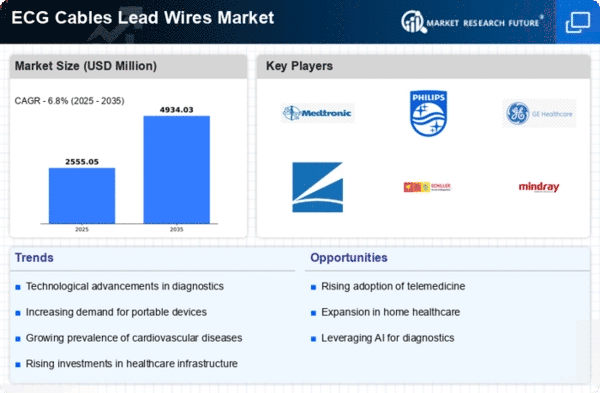
As per MRFR analysis, the ECG Cables Lead Wires Market Size was estimated at 2392.37 USD Million in 2024. The ECG Cables Lead Wires industry is projected to grow from 2555.09 in 2025 to 4934.03   by 2035, exhibiting a compound annual growth rate (CAGR) of 6.8% during the forecast period 2025 - 2035.

Key Market Trends & Highlights

The ECG Cables Lead Wires Market is poised for substantial growth driven by technological advancements and increasing healthcare demands.

  • North America remains the largest market for ECG cables lead wires, driven by advanced healthcare infrastructure and high adoption rates. The Asia-Pacific region is emerging as the fastest-growing market, fueled by increasing investments in healthcare technology and rising patient populations. In the cardiology segment, ECG cables lead wires continue to dominate, while the Holter monitoring segment is witnessing rapid growth due to rising demand for continuous cardiac monitoring. Key market drivers include technological advancements in ECG cables lead wires and the rising demand for home healthcare solutions, reflecting a shift towards patient-centric care.

Market Size & Forecast

2024 Market Size 2392.37 (USD Million)
2035 Market Size 4934.03 (USD Million)
CAGR (2025 - 2035) 6.8%
Largest Regional Market Share in 2024 North America

Major Players

Medtronic (US), <a href="https://www.philips.co.in/healthcare/product/HC989803172151/patient-cable-ecg-5-lead-grabber-telemetry-lead-set">Philips </a>(NL), GE Healthcare (US), Nihon Kohden (JP), Schiller AG (CH), Mindray (CN), Welch Allyn (US), Cardiac Science (US), 3M (US)

Market Trends

The ECG Cables Lead Wires Market is currently experiencing notable growth, driven by advancements in medical technology and an increasing emphasis on patient monitoring. As healthcare providers seek to enhance diagnostic accuracy and improve patient outcomes, the demand for high-quality ECG cables and lead wires is on the rise. This market is characterized by a diverse range of products, catering to various medical settings, including hospitals, clinics, and home care environments.

The integration of innovative materials and designs is likely to play a crucial role in shaping the future landscape of this market. Moreover, the growing prevalence of cardiovascular diseases and the aging population are contributing factors that appear to bolster the ECG Cables Lead Wires Market. Healthcare systems are increasingly investing in advanced monitoring solutions, which may lead to a surge in the adoption of these essential components. As the market evolves, manufacturers are expected to focus on enhancing product durability and compatibility with various ECG machines, thereby addressing the specific needs of healthcare professionals. Overall, the ECG Cables Lead Wires Market seems poised for continued expansion, reflecting broader trends in the healthcare sector that prioritize efficiency and patient care.

Technological Advancements

The ECG Cables Lead Wires Market is witnessing a shift towards the incorporation of advanced technologies. Innovations in materials and design are enhancing the performance and reliability of these products. Manufacturers are increasingly focusing on developing cables that offer improved signal quality and durability, which may lead to better patient monitoring outcomes.

Rising Demand for Home Healthcare

There is a growing trend towards home healthcare solutions, which is influencing the ECG Cables Lead Wires Market. As more patients receive care in their homes, the need for portable and user-friendly ECG monitoring devices is increasing. This shift is prompting manufacturers to create lead wires that are compatible with home-based monitoring systems.

Focus on Patient Safety

Patient safety remains a paramount concern within the healthcare industry, and this is reflected in the ECG Cables Lead Wires Market. There is an increasing emphasis on developing products that minimize the risk of electrical interference and enhance patient comfort. This focus on safety is likely to drive innovation and quality improvements in the market.

ECG Cables Lead Wires Market Market Drivers

Market Growth Projections

The Global ECG Cables and Lead Wires Market Industry is projected to experience substantial growth in the coming years. With a market value of 2.39 USD Billion in 2024, it is expected to reach 4.93 USD Billion by 2035, reflecting a robust compound annual growth rate of 6.81% from 2025 to 2035. This growth trajectory indicates a rising demand for ECG monitoring solutions, driven by factors such as technological advancements, increasing healthcare expenditure, and the growing prevalence of cardiovascular diseases. The market's expansion is indicative of the critical role that ECG cables and lead wires play in modern healthcare systems.

Growing Geriatric Population

The global increase in the geriatric population is a crucial driver for the Global ECG Cables and Lead Wires Market Industry. Older adults are more susceptible to cardiovascular diseases, necessitating regular monitoring and diagnostic assessments. As the population aged 65 and above continues to rise, healthcare systems are adapting to meet the growing demand for ECG monitoring solutions. This demographic shift is expected to contribute to the market's growth, with projections indicating a market value of 4.93 USD Billion by 2035. The need for specialized ECG cables and lead wires tailored for elderly patients further emphasizes the importance of this market segment.

Regulatory Support and Standards

Regulatory support and the establishment of standards for ECG devices play a pivotal role in shaping the Global ECG Cables and Lead Wires Market Industry. Governments and health organizations are implementing stringent regulations to ensure the safety and efficacy of medical devices, including ECG cables and lead wires. Compliance with these regulations not only enhances product quality but also fosters consumer confidence in ECG monitoring solutions. As manufacturers align their products with regulatory standards, the market is likely to witness increased adoption of advanced ECG technologies, further driving growth in this sector.

Increasing Healthcare Expenditure

Rising healthcare expenditure across various regions is a significant factor influencing the Global ECG Cables and Lead Wires Market Industry. Governments and private sectors are investing heavily in healthcare infrastructure, leading to enhanced access to advanced medical technologies. This trend is particularly evident in developing countries, where improved healthcare funding is facilitating the acquisition of modern ECG equipment. As healthcare budgets expand, the demand for high-quality ECG cables and lead wires is expected to grow. The anticipated compound annual growth rate of 6.81% from 2025 to 2035 reflects the market's potential as healthcare systems prioritize cardiac care.

Technological Advancements in ECG Devices

Technological innovations in ECG devices significantly contribute to the growth of the Global ECG Cables and Lead Wires Market Industry. The introduction of wireless ECG monitoring systems and improved lead wire designs enhances the accuracy and convenience of cardiac monitoring. These advancements facilitate real-time data transmission, allowing healthcare professionals to make timely decisions. As the market evolves, the integration of artificial intelligence and machine learning into ECG devices is anticipated to further enhance diagnostic capabilities. This technological evolution not only improves patient care but also expands the market potential, as healthcare facilities increasingly adopt these advanced solutions.

Rising Prevalence of Cardiovascular Diseases

The increasing incidence of cardiovascular diseases globally drives the demand for ECG cables and lead wires. As per health statistics, cardiovascular diseases remain a leading cause of mortality worldwide, necessitating effective monitoring solutions. The Global ECG Cables and Lead Wires Market Industry is poised to benefit from this trend, as healthcare providers seek advanced diagnostic tools to manage patient care. The market is projected to reach 2.39 USD Billion in 2024, reflecting a growing need for reliable and efficient ECG monitoring solutions. This trend underscores the importance of ECG cables and lead wires in enhancing patient outcomes and reducing healthcare costs.

Market Segment Insights

By Application: Monitoring (Largest) vs. Therapeutic (Fastest-Growing)

<p>In the ECG Cables Lead Wires Market, the application segment showcases a diverse distribution among various categories. 'Monitoring' holds the largest share, heavily utilized in both clinical and home settings for continuous heart monitoring. Following closely are 'Diagnostic' and 'Therapeutic' applications, which also play significant roles in patient care, with each segment contributing to advancements in non-invasive heart monitoring technologies. 'Emergency' and 'Research' applications, while crucial, hold smaller market shares but are important for specialized situations and clinical trials respectively. The growth trends in this market are heavily influenced by technological advancements, particularly in remote monitoring capabilities. The 'Therapeutic' segment is experiencing rapid growth due to increasing demand for precision medicine and personalized healthcare. Additionally, the rise in chronic cardiovascular diseases is propelling the 'Monitoring' segment, as healthcare professionals seek efficient ways to manage patients remotely, further driving innovations in the ECG cables and lead wires space.</p>

<p>Monitoring (Dominant) vs. Emergency (Emerging)</p>

<p>The 'Monitoring' application segment stands as the dominant force within the ECG Cables Lead Wires Market, characterized by its extensive use in hospitals and outpatient facilities for real-time heart rate tracking and arrhythmia detection. This segment benefits from continuous technological innovations aimed at enhancing patient outcomes and reducing hospital stays. In contrast, the 'Emergency' application segment, though smaller, is labeled as emerging due to its critical role during acute cardiac events. It is gaining traction as healthcare systems enhance their emergency response protocols and technologies, focusing on rapid diagnosis and treatment. As the healthcare landscape shifts towards bolstering emergency care capabilities, the demand for specialized ECG lead wires tailored for this segment is anticipated to rise.</p>

By End Use: Hospitals (Largest) vs. Home Care (Fastest-Growing)

<p>The ECG Cables Lead Wires Market shows a varied distribution of market share among its end-use segments. Hospitals currently hold the largest share as they are the primary settings for cardiac monitoring and diagnostic assessments. Clinics and diagnostic laboratories also contribute significantly to the market, albeit at a lower scale. Home care settings are emerging as key players in the segment, providing essential monitoring solutions for patients outside traditional healthcare facilities, reflecting changing patient preferences towards at-home care.</p>

<p>Hospital (Dominant) vs. Home Care (Emerging)</p>

<p>Hospitals are recognized as the dominant force in the ECG Cables Lead Wires Market, leveraging established infrastructure and continuous demand for cardiac monitoring. They often utilize advanced ECG technology, ensuring optimal patient care and compliance with healthcare regulations. Meanwhile, home care is an emerging segment gaining momentum due to the growing preference for telehealth and remote monitoring solutions. Patients are increasingly inclined to receive care in the comfort of their homes, spurred by technological advancements in medical devices. Together, these segments reflect the evolving landscape of patient care and the increasing importance placed on accessibility and convenience.</p>

By Type: Single Lead Wires (Largest) vs. Disposable Lead Wires (Fastest-Growing)

<p>In the ECG Cables Lead Wires Market, the segment distribution illustrates that Single Lead Wires command the largest market share, driven by their simplicity and widespread applicability in various clinical settings. Multi Lead Wires also hold a significant portion of the market, valued for their capability to connect multiple electrodes, while Pre-wired Cables cater to specialized applications. Custom Lead Wires provide tailored solutions, but their share is comparatively smaller. Disposable Lead Wires are gaining traction, particularly in environments emphasizing hygiene and infection control. The growth trends in this segment reflect an increasing emphasis on patient safety and comfort, pushing the demand for Disposable Lead Wires which are perceived as more hygienic. The rise in cardiovascular diseases is further propelling the need for ECG monitoring devices, thus influencing the demand for Multi Lead Wires to support more extensive monitoring setups. Technological advancements in ECG cable designs and materials are also contributing to the expansion of the market, particularly for Custom Lead Wires that meet specific clinical needs and regulations.</p>

<p>Single Lead Wires (Dominant) vs. Disposable Lead Wires (Emerging)</p>

<p>Single Lead Wires are recognized as the dominant force in the ECG Cables Lead Wires Market due to their reliability and ease of use in routine ECG monitoring. They serve as the essential connection point between the ECG machine and the patient, facilitating accurate readings in a variety of healthcare settings. On the other hand, Disposable Lead Wires are emerging as a crucial segment, driven by growing concerns over cross-contamination and the necessity for increased infection control in clinical environments. These wires are designed for single-use, enhancing patient safety while aligning with hospital protocols for hygiene. As the healthcare industry continues to adapt to stricter regulations regarding equipment sterilization, Disposable Lead Wires are increasingly favored, signaling a shift towards safer, more sanitary monitoring solutions.</p>

By Material: Silicone (Largest) vs. PVC (Fastest-Growing)

In the ECG Cables Lead Wires Market, the material segment showcases a diverse distribution among its key players. Silicone leads the market as the largest segment, owing to its excellent flexibility, durability, and resistance to environmental factors. Its stability in various temperature conditions makes it a preferred choice for medical applications. Following Silicone, PVC is emerging rapidly, capturing attention due to its cost-effectiveness and versatility in different applications, including wiring and insulation. Polyurethane and Latex, while critical, hold smaller shares in comparison but are gaining traction as the industry evolves. Growth trends in the material segment are a reflection of the increasing demand for high-performance cables in medical devices. The advancements in material technology, particularly in Silicone and PVC, are driving innovation and enhancing performance characteristics of ECG lead wires. The push for more reliable and durable materials is fueled by the rapid technological advancements in healthcare, which require wires that can withstand stringent sterilization processes and provide longevity without compromising flexibility. This dynamic is further accelerated by growing regulatory standards and the shift towards more sustainable materials, fostering an ecosystem in which all these materials are constantly reassessed for optimal performance in ECG applications.

Silicone (Dominant) vs. Polyurethane (Emerging)

Silicone has established itself as the dominant material in the ECG Cables Lead Wires Market due to its unique properties, including superior flexibility, temperature resistance, and chemical stability. Its life span and effectiveness in arduous conditions make it the go-to choice for many manufacturers, ensuring patient safety and device reliability. Conversely, Polyurethane is recognized as an emerging material, gaining traction for its lightweight nature and strength. While it may not yet equal Silicone in overall market presence, its moisture resistance properties are becoming increasingly valued in medical applications. As such, Polyurethane is likely to carve out its niche in the market, driven by ongoing advancements and an increasing focus on innovative manufacturing processes.

By Connector Type: Snap Connector (Largest) vs. Lemo Connector (Fastest-Growing)

<p>In the ECG Cables Lead Wires Market, the Snap Connector leads in market share, favored for its user-friendly design and reliable connection. This segment accounts for a significant portion of the market due to its widespread use in both clinical and home healthcare settings. Following closely are the Pin and Alligator Clip Connectors, which also maintain a strong presence, particularly in specialized applications. The Banana Plug Connector and Lemo Connector, while less dominant, are carving niches for themselves in high-performance scenarios, reflecting diverse end-user needs. The growth trajectory of the Connector Type segment is propelled by technological advancements and increasing demand for reliable medical equipment. The Snap Connector's ease of use continues to be a prime driver as healthcare providers seek efficient solutions for patient care. The Lemo Connector is witnessing rapid growth, driven by its application in cutting-edge medical devices, showcasing a trend toward specialization and higher performance standards in the market.</p>

<p>Snap Connector (Dominant) vs. Lemo Connector (Emerging)</p>

<p>The Snap Connector is recognized as the dominant player in the ECG Cables Lead Wires Market due to its robust design and ease of operation, making it the preferred choice in various healthcare applications. It delivers consistent performance and reliability, ensuring minimal patient discomfort during monitoring procedures. On the other hand, the Lemo Connector exhibits significant emerging potential, especially in advanced medical technology where precision and durability are paramount. Its high-quality manufacturing caters to sophisticated devices, positioning it favorably among both manufacturers and end-users who prioritize reliability and efficiency in critical healthcare environments. As healthcare technology evolves, the demand for both connector types will likely continue to grow, reflecting their importance in enhancing patient care.</p>

Get more detailed insights about ECG Cables and Lead Wires Market Research Report—Global Forecast till 2035

Regional Insights

North America : Market Leader in ECG Technology

North America is poised to maintain its leadership in the ECG Cables Lead Wires Market, holding a significant market share of 1195.0M in 2024. The region's growth is driven by increasing healthcare expenditures, technological advancements, and a rising prevalence of cardiovascular diseases. Regulatory support and initiatives aimed at improving healthcare infrastructure further catalyze demand for ECG cables, ensuring robust market expansion. The competitive landscape in North America is characterized by the presence of major players such as Medtronic, GE Healthcare, and Philips. These companies are investing heavily in R&D to innovate and enhance product offerings. The U.S. remains the largest market, supported by a well-established healthcare system and high adoption rates of advanced medical technologies. This competitive environment fosters continuous improvement and growth in the ECG cables sector.

Europe : Growing Demand for ECG Solutions

Europe's ECG Cables Lead Wires Market is projected to grow significantly, with a market size of 700.0M. The region benefits from a strong regulatory framework that promotes the adoption of advanced medical technologies. Increasing awareness of cardiovascular health and the aging population are key drivers of demand. Additionally, government initiatives aimed at improving healthcare access and quality are expected to further boost market growth in the coming years. Leading countries in this region include Germany, France, and the UK, where major players like Philips and Schiller AG are actively competing. The competitive landscape is marked by strategic partnerships and collaborations aimed at enhancing product offerings. The presence of a robust healthcare infrastructure and a focus on innovation positions Europe as a vital market for ECG cables, ensuring sustained growth and development.

Asia-Pacific : Emerging Market Potential

The Asia-Pacific region is witnessing rapid growth in the ECG Cables Lead Wires Market, with a market size of 400.0M. Factors such as increasing healthcare investments, rising awareness of cardiovascular diseases, and a growing aging population are driving demand. Additionally, government initiatives aimed at enhancing healthcare infrastructure and access to medical technologies are expected to further propel market growth in this region. Countries like China, Japan, and India are leading the market, with significant contributions from local manufacturers and global players like Nihon Kohden and Mindray. The competitive landscape is evolving, with companies focusing on product innovation and strategic collaborations to capture market share. As healthcare systems in these countries continue to develop, the demand for ECG cables is anticipated to rise significantly, making Asia-Pacific a key player in the global market.

Middle East and Africa : Developing Healthcare Landscape

The Middle East and Africa (MEA) region is gradually emerging in the ECG Cables Lead Wires Market, with a market size of 97.37M. The growth is primarily driven by increasing investments in healthcare infrastructure and rising awareness of cardiovascular diseases. Governments are implementing policies to improve healthcare access, which is expected to enhance the demand for ECG cables in the region. Additionally, the growing prevalence of chronic diseases is a significant catalyst for market expansion. Countries such as South Africa and the UAE are leading the market, with a focus on improving healthcare services. The competitive landscape includes both local and international players, with companies like 3M and Cardiac Science making notable contributions. As the region continues to develop its healthcare capabilities, the ECG cables market is set to experience substantial growth, presenting numerous opportunities for stakeholders.

Key Players and Competitive Insights

The ECG Cables Lead Wires Market is currently characterized by a competitive landscape that is both dynamic and multifaceted. Key growth drivers include the increasing prevalence of cardiovascular diseases, advancements in medical technology, and a growing emphasis on patient monitoring systems. Major players such as Medtronic (US), Philips (NL), and GE Healthcare (US) are strategically positioned to leverage these trends. Medtronic (US) focuses on innovation and product development, particularly in enhancing the functionality and reliability of their ECG cables.
Philips (NL) emphasizes digital transformation, integrating advanced analytics into their product offerings, while GE Healthcare (US) is pursuing regional expansion, particularly in emerging markets, to capture a larger share of the growing demand for cardiac monitoring solutions.The business tactics employed by these companies reflect a concerted effort to optimize supply chains and localize manufacturing. The market structure appears moderately fragmented, with a mix of established players and emerging companies vying for market share. This fragmentation allows for a diverse range of products and innovations, although the collective influence of key players like Medtronic (US) and Philips (NL) tends to dominate market trends and consumer preferences.
In November Medtronic (US) announced a partnership with a leading telehealth provider to enhance remote patient monitoring capabilities. This strategic move is likely to bolster Medtronic's position in the market by integrating their ECG cables with advanced telehealth solutions, thereby addressing the growing demand for remote healthcare services. Such partnerships may also facilitate better patient outcomes through continuous monitoring and timely interventions.
In October Philips (NL) launched a new line of ECG cables designed specifically for pediatric patients, showcasing their commitment to innovation and specialization. This product launch not only addresses a niche market but also reflects Philips' strategy to diversify its offerings and cater to specific patient demographics. The introduction of specialized products could enhance customer loyalty and expand Philips' market reach.
In September GE Healthcare (US) expanded its manufacturing capabilities in Asia, aiming to streamline production and reduce lead times for ECG cables. This strategic expansion is indicative of GE's focus on supply chain optimization, which is crucial in meeting the increasing global demand for medical devices. By enhancing local production, GE Healthcare (US) may improve its responsiveness to market changes and customer needs.
As of December current competitive trends in the ECG Cables Lead Wires Market are increasingly defined by digitalization, sustainability, and the integration of artificial intelligence (AI) into product development. Strategic alliances are becoming more prevalent, as companies recognize the value of collaboration in driving innovation and enhancing product offerings. Looking ahead, competitive differentiation is likely to evolve from traditional price-based competition to a focus on technological advancements, supply chain reliability, and innovative solutions that address specific healthcare challenges. This shift underscores the importance of adaptability and forward-thinking strategies in maintaining a competitive edge in the market.

Key Companies in the ECG Cables Lead Wires Market include

Industry Developments

October 2022 Heart Test Laboratories, Inc., a medical technology company committed to saving lives by transforming an ECG with artificial intelligence (AI), has announced that the European Patent Office (EPO) has granted them a patent. The patent specifically covers the MyoVista device as well as the ECG electrode and cable connector designs made by the business.

February 2022 Boston Scientific, a reputable manufacturer of medical devices with headquarters in Massachusetts, USA, announced the successful acquisition of Baylis Medical, a manufacturer of oncology and cardiology medical equipment with headquarters in Canada. Boston Scientific made a payment of $175 billion to complete the acquisition process. Boston Scientific's structural cardiac offerings have been bolstered as a result of the deal.

August 2021 The California-based medical technology business "Intersect ENT" and the Dublin, Ireland-based medical device company "Medtronic" have successfully concluded an agreement, according to the announcement. In accordance with the contract, Medtronic would pay $1.1 billion ($28.2 per share) to purchase Intersect.

Future Outlook

ECG Cables Lead Wires Market Future Outlook

The ECG Cables Lead Wires Market is projected to grow at a 6.8% CAGR from 2025 to 2035, driven by technological advancements, increasing healthcare expenditure, and rising demand for diagnostic equipment.

New opportunities lie in:

  • <p>Development of wireless ECG lead wire technology for enhanced patient mobility. Expansion into emerging markets with tailored ECG solutions. Partnerships with <a href="https://www.marketresearchfuture.com/reports/telemedicine-market-2216">telemedicine </a>platforms to integrate ECG monitoring services.</p>

By 2035, the ECG Cables Lead Wires Market is expected to achieve substantial growth and innovation.

Market Segmentation

ECG Cables Lead Wires Market Type Outlook

  • Single Lead Wires
  • Multi Lead Wires
  • Reusable Lead Wires
  • Disposable Lead Wires

ECG Cables Lead Wires Market End Use Outlook

  • Hospitals
  • Ambulatory Surgical Centers
  • Diagnostic Centers
  • Home Care Settings

ECG Cables Lead Wires Market Material Outlook

  • Silicone
  • PVC
  • Polyurethane
  • Latex

ECG Cables Lead Wires Market Application Outlook

  • Cardiology
  • Emergency Care
  • Telemetry
  • Stress Testing
  • Holter Monitoring

ECG Cables Lead Wires Market Connector Type Outlook

  • Snap Connector
  • Pin Connector
  • Alligator Clip Connector
  • Banana Plug Connector

Report Scope

MARKET SIZE 2024 2392.37(USD Million)
MARKET SIZE 2025 2555.09(USD Million)
MARKET SIZE 2035 4934.03(USD Million)
COMPOUND ANNUAL GROWTH RATE (CAGR) 6.8% (2025 - 2035)
REPORT COVERAGE Revenue Forecast, Competitive Landscape, Growth Factors, and Trends
BASE YEAR 2024
Market Forecast Period 2025 - 2035
Historical Data 2019 - 2024
Market Forecast Units USD Million
Key Companies Profiled Medtronic (US), Philips (NL), GE Healthcare (US), Nihon Kohden (JP), Schiller AG (CH), Mindray (CN), Welch Allyn (US), Cardiac Science (US), 3M (US)
Segments Covered Application, End Use, Type, Material, Connector Type
Key Market Opportunities Integration of advanced materials and smart technology enhances performance in the ECG Cables Lead Wires Market.
Key Market Dynamics Rising demand for advanced ECG monitoring drives innovation in cables and lead wires technology and manufacturing processes.
Countries Covered North America, Europe, APAC, South America, MEA

FAQs

What is the current market valuation of the ECG Cables Lead Wires Market?

<p>As of 2024, the ECG Cables Lead Wires Market was valued at approximately 2392.37 USD Million.</p>

What is the projected market size for the ECG Cables Lead Wires Market by 2035?

<p>The market is expected to reach a valuation of around 4934.03 USD Million by 2035.</p>

What is the expected CAGR for the ECG Cables Lead Wires Market during the forecast period?

<p>The ECG Cables Lead Wires Market is projected to grow at a CAGR of 6.8% from 2025 to 2035.</p>

Which companies are considered key players in the ECG Cables Lead Wires Market?

<p>Key players in the market include Medtronic, Philips, GE Healthcare, Nihon Kohden, and Schiller AG.</p>

What are the primary applications of ECG cables lead wires?

<p>The primary applications include Monitoring, Diagnostic, Therapeutic, Research, and Emergency, with Diagnostic leading at 1600.0 USD Million by 2035.</p>

How does the market segment by end use look for ECG Cables Lead Wires?

<p>By 2035, Hospitals are projected to dominate the end-use segment, reaching approximately 1700.0 USD Million.</p>

What types of ECG cables lead wires are available in the market?

The market includes Single Lead Wires, Multi Lead Wires, Pre-wired Cables, Custom Lead Wires, and Disposable Lead Wires, with Multi Lead Wires expected to reach 1200.0 USD Million.

What materials are commonly used in ECG cables lead wires?

Common materials include Silicone, PVC, Polyurethane, Latex, and Conductive Fabric, with PVC projected to reach 1500.0 USD Million by 2035.

What connector types are utilized in ECG cables lead wires?

Connector types include Snap Connector, Pin Connector, Alligator Clip Connector, Banana Plug Connector, and Lemo Connector, with Pin Connector expected to reach 1000.0 USD Million.

How does the ECG Cables Lead Wires Market compare across different regions?

While specific regional data is not provided, the overall growth trends suggest a robust demand across various healthcare settings globally.

  1. SECTION I: EXECUTIVE SUMMARY AND KEY HIGHLIGHTS
    1. | 1.1 EXECUTIVE SUMMARY
    2. | | 1.1.1 Market Overview
    3. | | 1.1.2 Key Findings
    4. | | 1.1.3 Market Segmentation
    5. | | 1.1.4 Competitive Landscape
    6. | | 1.1.5 Challenges and Opportunities
    7. | | 1.1.6 Future Outlook
  2. SECTION II: SCOPING, METHODOLOGY AND MARKET STRUCTURE
    1. | 2.1 MARKET INTRODUCTION
    2. | | 2.1.1 Definition
    3. | | 2.1.2 Scope of the study
    4. | | | 2.1.2.1 Research Objective
    5. | | | 2.1.2.2 Assumption
    6. | | | 2.1.2.3 Limitations
    7. | 2.2 RESEARCH METHODOLOGY
    8. | | 2.2.1 Overview
    9. | | 2.2.2 Data Mining
    10. | | 2.2.3 Secondary Research
    11. | | 2.2.4 Primary Research
    12. | | | 2.2.4.1 Primary Interviews and Information Gathering Process
    13. | | | 2.2.4.2 Breakdown of Primary Respondents
    14. | | 2.2.5 Forecasting Model
    15. | | 2.2.6 Market Size Estimation
    16. | | | 2.2.6.1 Bottom-Up Approach
    17. | | | 2.2.6.2 Top-Down Approach
    18. | | 2.2.7 Data Triangulation
    19. | | 2.2.8 Validation
  3. SECTION III: QUALITATIVE ANALYSIS
    1. | 3.1 MARKET DYNAMICS
    2. | | 3.1.1 Overview
    3. | | 3.1.2 Drivers
    4. | | 3.1.3 Restraints
    5. | | 3.1.4 Opportunities
    6. | 3.2 MARKET FACTOR ANALYSIS
    7. | | 3.2.1 Value chain Analysis
    8. | | 3.2.2 Porter's Five Forces Analysis
    9. | | | 3.2.2.1 Bargaining Power of Suppliers
    10. | | | 3.2.2.2 Bargaining Power of Buyers
    11. | | | 3.2.2.3 Threat of New Entrants
    12. | | | 3.2.2.4 Threat of Substitutes
    13. | | | 3.2.2.5 Intensity of Rivalry
    14. | | 3.2.3 COVID-19 Impact Analysis
    15. | | | 3.2.3.1 Market Impact Analysis
    16. | | | 3.2.3.2 Regional Impact
    17. | | | 3.2.3.3 Opportunity and Threat Analysis
  4. SECTION IV: QUANTITATIVE ANALYSIS
    1. | 4.1 Healthcare, BY Application (USD Million)
    2. | | 4.1.1 Monitoring
    3. | | 4.1.2 Diagnostic
    4. | | 4.1.3 Therapeutic
    5. | | 4.1.4 Research
    6. | | 4.1.5 Emergency
    7. | 4.2 Healthcare, BY End Use (USD Million)
    8. | | 4.2.1 Hospitals
    9. | | 4.2.2 Clinics
    10. | | 4.2.3 Home Care
    11. | | 4.2.4 Ambulatory Surgical Centers
    12. | | 4.2.5 Diagnostic Laboratories
    13. | 4.3 Healthcare, BY Type (USD Million)
    14. | | 4.3.1 Single Lead Wires
    15. | | 4.3.2 Multi Lead Wires
    16. | | 4.3.3 Pre-wired Cables
    17. | | 4.3.4 Custom Lead Wires
    18. | | 4.3.5 Disposable Lead Wires
    19. | 4.4 Healthcare, BY Material (USD Million)
    20. | | 4.4.1 Silicone
    21. | | 4.4.2 PVC
    22. | | 4.4.3 Polyurethane
    23. | | 4.4.4 Latex
    24. | | 4.4.5 Conductive Fabric
    25. | 4.5 Healthcare, BY Connector Type (USD Million)
    26. | | 4.5.1 Snap Connector
    27. | | 4.5.2 Pin Connector
    28. | | 4.5.3 Alligator Clip Connector
    29. | | 4.5.4 Banana Plug Connector
    30. | | 4.5.5 Lemo Connector
    31. | 4.6 Healthcare, BY Region (USD Million)
    32. | | 4.6.1 North America
    33. | | | 4.6.1.1 US
    34. | | | 4.6.1.2 Canada
    35. | | 4.6.2 Europe
    36. | | | 4.6.2.1 Germany
    37. | | | 4.6.2.2 UK
    38. | | | 4.6.2.3 France
    39. | | | 4.6.2.4 Russia
    40. | | | 4.6.2.5 Italy
    41. | | | 4.6.2.6 Spain
    42. | | | 4.6.2.7 Rest of Europe
    43. | | 4.6.3 APAC
    44. | | | 4.6.3.1 China
    45. | | | 4.6.3.2 India
    46. | | | 4.6.3.3 Japan
    47. | | | 4.6.3.4 South Korea
    48. | | | 4.6.3.5 Malaysia
    49. | | | 4.6.3.6 Thailand
    50. | | | 4.6.3.7 Indonesia
    51. | | | 4.6.3.8 Rest of APAC
    52. | | 4.6.4 South America
    53. | | | 4.6.4.1 Brazil
    54. | | | 4.6.4.2 Mexico
    55. | | | 4.6.4.3 Argentina
    56. | | | 4.6.4.4 Rest of South America
    57. | | 4.6.5 MEA
    58. | | | 4.6.5.1 GCC Countries
    59. | | | 4.6.5.2 South Africa
    60. | | | 4.6.5.3 Rest of MEA
  5. SECTION V: COMPETITIVE ANALYSIS
    1. | 5.1 Competitive Landscape
    2. | | 5.1.1 Overview
    3. | | 5.1.2 Competitive Analysis
    4. | | 5.1.3 Market share Analysis
    5. | | 5.1.4 Major Growth Strategy in the Healthcare
    6. | | 5.1.5 Competitive Benchmarking
    7. | | 5.1.6 Leading Players in Terms of Number of Developments in the Healthcare
    8. | | 5.1.7 Key developments and growth strategies
    9. | | | 5.1.7.1 New Product Launch/Service Deployment
    10. | | | 5.1.7.2 Merger & Acquisitions
    11. | | | 5.1.7.3 Joint Ventures
    12. | | 5.1.8 Major Players Financial Matrix
    13. | | | 5.1.8.1 Sales and Operating Income
    14. | | | 5.1.8.2 Major Players R&D Expenditure. 2023
    15. | 5.2 Company Profiles
    16. | | 5.2.1 Medtronic (US)
    17. | | | 5.2.1.1 Financial Overview
    18. | | | 5.2.1.2 Products Offered
    19. | | | 5.2.1.3 Key Developments
    20. | | | 5.2.1.4 SWOT Analysis
    21. | | | 5.2.1.5 Key Strategies
    22. | | 5.2.2 Philips (NL)
    23. | | | 5.2.2.1 Financial Overview
    24. | | | 5.2.2.2 Products Offered
    25. | | | 5.2.2.3 Key Developments
    26. | | | 5.2.2.4 SWOT Analysis
    27. | | | 5.2.2.5 Key Strategies
    28. | | 5.2.3 GE Healthcare (US)
    29. | | | 5.2.3.1 Financial Overview
    30. | | | 5.2.3.2 Products Offered
    31. | | | 5.2.3.3 Key Developments
    32. | | | 5.2.3.4 SWOT Analysis
    33. | | | 5.2.3.5 Key Strategies
    34. | | 5.2.4 Nihon Kohden (JP)
    35. | | | 5.2.4.1 Financial Overview
    36. | | | 5.2.4.2 Products Offered
    37. | | | 5.2.4.3 Key Developments
    38. | | | 5.2.4.4 SWOT Analysis
    39. | | | 5.2.4.5 Key Strategies
    40. | | 5.2.5 Schiller AG (CH)
    41. | | | 5.2.5.1 Financial Overview
    42. | | | 5.2.5.2 Products Offered
    43. | | | 5.2.5.3 Key Developments
    44. | | | 5.2.5.4 SWOT Analysis
    45. | | | 5.2.5.5 Key Strategies
    46. | | 5.2.6 Mindray (CN)
    47. | | | 5.2.6.1 Financial Overview
    48. | | | 5.2.6.2 Products Offered
    49. | | | 5.2.6.3 Key Developments
    50. | | | 5.2.6.4 SWOT Analysis
    51. | | | 5.2.6.5 Key Strategies
    52. | | 5.2.7 Welch Allyn (US)
    53. | | | 5.2.7.1 Financial Overview
    54. | | | 5.2.7.2 Products Offered
    55. | | | 5.2.7.3 Key Developments
    56. | | | 5.2.7.4 SWOT Analysis
    57. | | | 5.2.7.5 Key Strategies
    58. | | 5.2.8 Cardiac Science (US)
    59. | | | 5.2.8.1 Financial Overview
    60. | | | 5.2.8.2 Products Offered
    61. | | | 5.2.8.3 Key Developments
    62. | | | 5.2.8.4 SWOT Analysis
    63. | | | 5.2.8.5 Key Strategies
    64. | | 5.2.9 Bionet (KR)
    65. | | | 5.2.9.1 Financial Overview
    66. | | | 5.2.9.2 Products Offered
    67. | | | 5.2.9.3 Key Developments
    68. | | | 5.2.9.4 SWOT Analysis
    69. | | | 5.2.9.5 Key Strategies
    70. | 5.3 Appendix
    71. | | 5.3.1 References
    72. | | 5.3.2 Related Reports
  6. LIST OF FIGURES
    1. | 6.1 MARKET SYNOPSIS
    2. | 6.2 NORTH AMERICA MARKET ANALYSIS
    3. | 6.3 US MARKET ANALYSIS BY APPLICATION
    4. | 6.4 US MARKET ANALYSIS BY END USE
    5. | 6.5 US MARKET ANALYSIS BY TYPE
    6. | 6.6 US MARKET ANALYSIS BY MATERIAL
    7. | 6.7 US MARKET ANALYSIS BY CONNECTOR TYPE
    8. | 6.8 CANADA MARKET ANALYSIS BY APPLICATION
    9. | 6.9 CANADA MARKET ANALYSIS BY END USE
    10. | 6.10 CANADA MARKET ANALYSIS BY TYPE
    11. | 6.11 CANADA MARKET ANALYSIS BY MATERIAL
    12. | 6.12 CANADA MARKET ANALYSIS BY CONNECTOR TYPE
    13. | 6.13 EUROPE MARKET ANALYSIS
    14. | 6.14 GERMANY MARKET ANALYSIS BY APPLICATION
    15. | 6.15 GERMANY MARKET ANALYSIS BY END USE
    16. | 6.16 GERMANY MARKET ANALYSIS BY TYPE
    17. | 6.17 GERMANY MARKET ANALYSIS BY MATERIAL
    18. | 6.18 GERMANY MARKET ANALYSIS BY CONNECTOR TYPE
    19. | 6.19 UK MARKET ANALYSIS BY APPLICATION
    20. | 6.20 UK MARKET ANALYSIS BY END USE
    21. | 6.21 UK MARKET ANALYSIS BY TYPE
    22. | 6.22 UK MARKET ANALYSIS BY MATERIAL
    23. | 6.23 UK MARKET ANALYSIS BY CONNECTOR TYPE
    24. | 6.24 FRANCE MARKET ANALYSIS BY APPLICATION
    25. | 6.25 FRANCE MARKET ANALYSIS BY END USE
    26. | 6.26 FRANCE MARKET ANALYSIS BY TYPE
    27. | 6.27 FRANCE MARKET ANALYSIS BY MATERIAL
    28. | 6.28 FRANCE MARKET ANALYSIS BY CONNECTOR TYPE
    29. | 6.29 RUSSIA MARKET ANALYSIS BY APPLICATION
    30. | 6.30 RUSSIA MARKET ANALYSIS BY END USE
    31. | 6.31 RUSSIA MARKET ANALYSIS BY TYPE
    32. | 6.32 RUSSIA MARKET ANALYSIS BY MATERIAL
    33. | 6.33 RUSSIA MARKET ANALYSIS BY CONNECTOR TYPE
    34. | 6.34 ITALY MARKET ANALYSIS BY APPLICATION
    35. | 6.35 ITALY MARKET ANALYSIS BY END USE
    36. | 6.36 ITALY MARKET ANALYSIS BY TYPE
    37. | 6.37 ITALY MARKET ANALYSIS BY MATERIAL
    38. | 6.38 ITALY MARKET ANALYSIS BY CONNECTOR TYPE
    39. | 6.39 SPAIN MARKET ANALYSIS BY APPLICATION
    40. | 6.40 SPAIN MARKET ANALYSIS BY END USE
    41. | 6.41 SPAIN MARKET ANALYSIS BY TYPE
    42. | 6.42 SPAIN MARKET ANALYSIS BY MATERIAL
    43. | 6.43 SPAIN MARKET ANALYSIS BY CONNECTOR TYPE
    44. | 6.44 REST OF EUROPE MARKET ANALYSIS BY APPLICATION
    45. | 6.45 REST OF EUROPE MARKET ANALYSIS BY END USE
    46. | 6.46 REST OF EUROPE MARKET ANALYSIS BY TYPE
    47. | 6.47 REST OF EUROPE MARKET ANALYSIS BY MATERIAL
    48. | 6.48 REST OF EUROPE MARKET ANALYSIS BY CONNECTOR TYPE
    49. | 6.49 APAC MARKET ANALYSIS
    50. | 6.50 CHINA MARKET ANALYSIS BY APPLICATION
    51. | 6.51 CHINA MARKET ANALYSIS BY END USE
    52. | 6.52 CHINA MARKET ANALYSIS BY TYPE
    53. | 6.53 CHINA MARKET ANALYSIS BY MATERIAL
    54. | 6.54 CHINA MARKET ANALYSIS BY CONNECTOR TYPE
    55. | 6.55 INDIA MARKET ANALYSIS BY APPLICATION
    56. | 6.56 INDIA MARKET ANALYSIS BY END USE
    57. | 6.57 INDIA MARKET ANALYSIS BY TYPE
    58. | 6.58 INDIA MARKET ANALYSIS BY MATERIAL
    59. | 6.59 INDIA MARKET ANALYSIS BY CONNECTOR TYPE
    60. | 6.60 JAPAN MARKET ANALYSIS BY APPLICATION
    61. | 6.61 JAPAN MARKET ANALYSIS BY END USE
    62. | 6.62 JAPAN MARKET ANALYSIS BY TYPE
    63. | 6.63 JAPAN MARKET ANALYSIS BY MATERIAL
    64. | 6.64 JAPAN MARKET ANALYSIS BY CONNECTOR TYPE
    65. | 6.65 SOUTH KOREA MARKET ANALYSIS BY APPLICATION
    66. | 6.66 SOUTH KOREA MARKET ANALYSIS BY END USE
    67. | 6.67 SOUTH KOREA MARKET ANALYSIS BY TYPE
    68. | 6.68 SOUTH KOREA MARKET ANALYSIS BY MATERIAL
    69. | 6.69 SOUTH KOREA MARKET ANALYSIS BY CONNECTOR TYPE
    70. | 6.70 MALAYSIA MARKET ANALYSIS BY APPLICATION
    71. | 6.71 MALAYSIA MARKET ANALYSIS BY END USE
    72. | 6.72 MALAYSIA MARKET ANALYSIS BY TYPE
    73. | 6.73 MALAYSIA MARKET ANALYSIS BY MATERIAL
    74. | 6.74 MALAYSIA MARKET ANALYSIS BY CONNECTOR TYPE
    75. | 6.75 THAILAND MARKET ANALYSIS BY APPLICATION
    76. | 6.76 THAILAND MARKET ANALYSIS BY END USE
    77. | 6.77 THAILAND MARKET ANALYSIS BY TYPE
    78. | 6.78 THAILAND MARKET ANALYSIS BY MATERIAL
    79. | 6.79 THAILAND MARKET ANALYSIS BY CONNECTOR TYPE
    80. | 6.80 INDONESIA MARKET ANALYSIS BY APPLICATION
    81. | 6.81 INDONESIA MARKET ANALYSIS BY END USE
    82. | 6.82 INDONESIA MARKET ANALYSIS BY TYPE
    83. | 6.83 INDONESIA MARKET ANALYSIS BY MATERIAL
    84. | 6.84 INDONESIA MARKET ANALYSIS BY CONNECTOR TYPE
    85. | 6.85 REST OF APAC MARKET ANALYSIS BY APPLICATION
    86. | 6.86 REST OF APAC MARKET ANALYSIS BY END USE
    87. | 6.87 REST OF APAC MARKET ANALYSIS BY TYPE
    88. | 6.88 REST OF APAC MARKET ANALYSIS BY MATERIAL
    89. | 6.89 REST OF APAC MARKET ANALYSIS BY CONNECTOR TYPE
    90. | 6.90 SOUTH AMERICA MARKET ANALYSIS
    91. | 6.91 BRAZIL MARKET ANALYSIS BY APPLICATION
    92. | 6.92 BRAZIL MARKET ANALYSIS BY END USE
    93. | 6.93 BRAZIL MARKET ANALYSIS BY TYPE
    94. | 6.94 BRAZIL MARKET ANALYSIS BY MATERIAL
    95. | 6.95 BRAZIL MARKET ANALYSIS BY CONNECTOR TYPE
    96. | 6.96 MEXICO MARKET ANALYSIS BY APPLICATION
    97. | 6.97 MEXICO MARKET ANALYSIS BY END USE
    98. | 6.98 MEXICO MARKET ANALYSIS BY TYPE
    99. | 6.99 MEXICO MARKET ANALYSIS BY MATERIAL
    100. | 6.100 MEXICO MARKET ANALYSIS BY CONNECTOR TYPE
    101. | 6.101 ARGENTINA MARKET ANALYSIS BY APPLICATION
    102. | 6.102 ARGENTINA MARKET ANALYSIS BY END USE
    103. | 6.103 ARGENTINA MARKET ANALYSIS BY TYPE
    104. | 6.104 ARGENTINA MARKET ANALYSIS BY MATERIAL
    105. | 6.105 ARGENTINA MARKET ANALYSIS BY CONNECTOR TYPE
    106. | 6.106 REST OF SOUTH AMERICA MARKET ANALYSIS BY APPLICATION
    107. | 6.107 REST OF SOUTH AMERICA MARKET ANALYSIS BY END USE
    108. | 6.108 REST OF SOUTH AMERICA MARKET ANALYSIS BY TYPE
    109. | 6.109 REST OF SOUTH AMERICA MARKET ANALYSIS BY MATERIAL
    110. | 6.110 REST OF SOUTH AMERICA MARKET ANALYSIS BY CONNECTOR TYPE
    111. | 6.111 MEA MARKET ANALYSIS
    112. | 6.112 GCC COUNTRIES MARKET ANALYSIS BY APPLICATION
    113. | 6.113 GCC COUNTRIES MARKET ANALYSIS BY END USE
    114. | 6.114 GCC COUNTRIES MARKET ANALYSIS BY TYPE
    115. | 6.115 GCC COUNTRIES MARKET ANALYSIS BY MATERIAL
    116. | 6.116 GCC COUNTRIES MARKET ANALYSIS BY CONNECTOR TYPE
    117. | 6.117 SOUTH AFRICA MARKET ANALYSIS BY APPLICATION
    118. | 6.118 SOUTH AFRICA MARKET ANALYSIS BY END USE
    119. | 6.119 SOUTH AFRICA MARKET ANALYSIS BY TYPE
    120. | 6.120 SOUTH AFRICA MARKET ANALYSIS BY MATERIAL
    121. | 6.121 SOUTH AFRICA MARKET ANALYSIS BY CONNECTOR TYPE
    122. | 6.122 REST OF MEA MARKET ANALYSIS BY APPLICATION
    123. | 6.123 REST OF MEA MARKET ANALYSIS BY END USE
    124. | 6.124 REST OF MEA MARKET ANALYSIS BY TYPE
    125. | 6.125 REST OF MEA MARKET ANALYSIS BY MATERIAL
    126. | 6.126 REST OF MEA MARKET ANALYSIS BY CONNECTOR TYPE
    127. | 6.127 KEY BUYING CRITERIA OF HEALTHCARE
    128. | 6.128 RESEARCH PROCESS OF MRFR
    129. | 6.129 DRO ANALYSIS OF HEALTHCARE
    130. | 6.130 DRIVERS IMPACT ANALYSIS: HEALTHCARE
    131. | 6.131 RESTRAINTS IMPACT ANALYSIS: HEALTHCARE
    132. | 6.132 SUPPLY / VALUE CHAIN: HEALTHCARE
    133. | 6.133 HEALTHCARE, BY APPLICATION, 2024 (% SHARE)
    134. | 6.134 HEALTHCARE, BY APPLICATION, 2024 TO 2035 (USD Million)
    135. | 6.135 HEALTHCARE, BY END USE, 2024 (% SHARE)
    136. | 6.136 HEALTHCARE, BY END USE, 2024 TO 2035 (USD Million)
    137. | 6.137 HEALTHCARE, BY TYPE, 2024 (% SHARE)
    138. | 6.138 HEALTHCARE, BY TYPE, 2024 TO 2035 (USD Million)
    139. | 6.139 HEALTHCARE, BY MATERIAL, 2024 (% SHARE)
    140. | 6.140 HEALTHCARE, BY MATERIAL, 2024 TO 2035 (USD Million)
    141. | 6.141 HEALTHCARE, BY CONNECTOR TYPE, 2024 (% SHARE)
    142. | 6.142 HEALTHCARE, BY CONNECTOR TYPE, 2024 TO 2035 (USD Million)
    143. | 6.143 BENCHMARKING OF MAJOR COMPETITORS
  7. LIST OF TABLES
    1. | 7.1 LIST OF ASSUMPTIONS
    2. | | 7.1.1
    3. | 7.2 North America MARKET SIZE ESTIMATES; FORECAST
    4. | | 7.2.1 BY APPLICATION, 2025-2035 (USD Million)
    5. | | 7.2.2 BY END USE, 2025-2035 (USD Million)
    6. | | 7.2.3 BY TYPE, 2025-2035 (USD Million)
    7. | | 7.2.4 BY MATERIAL, 2025-2035 (USD Million)
    8. | | 7.2.5 BY CONNECTOR TYPE, 2025-2035 (USD Million)
    9. | 7.3 US MARKET SIZE ESTIMATES; FORECAST
    10. | | 7.3.1 BY APPLICATION, 2025-2035 (USD Million)
    11. | | 7.3.2 BY END USE, 2025-2035 (USD Million)
    12. | | 7.3.3 BY TYPE, 2025-2035 (USD Million)
    13. | | 7.3.4 BY MATERIAL, 2025-2035 (USD Million)
    14. | | 7.3.5 BY CONNECTOR TYPE, 2025-2035 (USD Million)
    15. | 7.4 Canada MARKET SIZE ESTIMATES; FORECAST
    16. | | 7.4.1 BY APPLICATION, 2025-2035 (USD Million)
    17. | | 7.4.2 BY END USE, 2025-2035 (USD Million)
    18. | | 7.4.3 BY TYPE, 2025-2035 (USD Million)
    19. | | 7.4.4 BY MATERIAL, 2025-2035 (USD Million)
    20. | | 7.4.5 BY CONNECTOR TYPE, 2025-2035 (USD Million)
    21. | 7.5 Europe MARKET SIZE ESTIMATES; FORECAST
    22. | | 7.5.1 BY APPLICATION, 2025-2035 (USD Million)
    23. | | 7.5.2 BY END USE, 2025-2035 (USD Million)
    24. | | 7.5.3 BY TYPE, 2025-2035 (USD Million)
    25. | | 7.5.4 BY MATERIAL, 2025-2035 (USD Million)
    26. | | 7.5.5 BY CONNECTOR TYPE, 2025-2035 (USD Million)
    27. | 7.6 Germany MARKET SIZE ESTIMATES; FORECAST
    28. | | 7.6.1 BY APPLICATION, 2025-2035 (USD Million)
    29. | | 7.6.2 BY END USE, 2025-2035 (USD Million)
    30. | | 7.6.3 BY TYPE, 2025-2035 (USD Million)
    31. | | 7.6.4 BY MATERIAL, 2025-2035 (USD Million)
    32. | | 7.6.5 BY CONNECTOR TYPE, 2025-2035 (USD Million)
    33. | 7.7 UK MARKET SIZE ESTIMATES; FORECAST
    34. | | 7.7.1 BY APPLICATION, 2025-2035 (USD Million)
    35. | | 7.7.2 BY END USE, 2025-2035 (USD Million)
    36. | | 7.7.3 BY TYPE, 2025-2035 (USD Million)
    37. | | 7.7.4 BY MATERIAL, 2025-2035 (USD Million)
    38. | | 7.7.5 BY CONNECTOR TYPE, 2025-2035 (USD Million)
    39. | 7.8 France MARKET SIZE ESTIMATES; FORECAST
    40. | | 7.8.1 BY APPLICATION, 2025-2035 (USD Million)
    41. | | 7.8.2 BY END USE, 2025-2035 (USD Million)
    42. | | 7.8.3 BY TYPE, 2025-2035 (USD Million)
    43. | | 7.8.4 BY MATERIAL, 2025-2035 (USD Million)
    44. | | 7.8.5 BY CONNECTOR TYPE, 2025-2035 (USD Million)
    45. | 7.9 Russia MARKET SIZE ESTIMATES; FORECAST
    46. | | 7.9.1 BY APPLICATION, 2025-2035 (USD Million)
    47. | | 7.9.2 BY END USE, 2025-2035 (USD Million)
    48. | | 7.9.3 BY TYPE, 2025-2035 (USD Million)
    49. | | 7.9.4 BY MATERIAL, 2025-2035 (USD Million)
    50. | | 7.9.5 BY CONNECTOR TYPE, 2025-2035 (USD Million)
    51. | 7.10 Italy MARKET SIZE ESTIMATES; FORECAST
    52. | | 7.10.1 BY APPLICATION, 2025-2035 (USD Million)
    53. | | 7.10.2 BY END USE, 2025-2035 (USD Million)
    54. | | 7.10.3 BY TYPE, 2025-2035 (USD Million)
    55. | | 7.10.4 BY MATERIAL, 2025-2035 (USD Million)
    56. | | 7.10.5 BY CONNECTOR TYPE, 2025-2035 (USD Million)
    57. | 7.11 Spain MARKET SIZE ESTIMATES; FORECAST
    58. | | 7.11.1 BY APPLICATION, 2025-2035 (USD Million)
    59. | | 7.11.2 BY END USE, 2025-2035 (USD Million)
    60. | | 7.11.3 BY TYPE, 2025-2035 (USD Million)
    61. | | 7.11.4 BY MATERIAL, 2025-2035 (USD Million)
    62. | | 7.11.5 BY CONNECTOR TYPE, 2025-2035 (USD Million)
    63. | 7.12 Rest of Europe MARKET SIZE ESTIMATES; FORECAST
    64. | | 7.12.1 BY APPLICATION, 2025-2035 (USD Million)
    65. | | 7.12.2 BY END USE, 2025-2035 (USD Million)
    66. | | 7.12.3 BY TYPE, 2025-2035 (USD Million)
    67. | | 7.12.4 BY MATERIAL, 2025-2035 (USD Million)
    68. | | 7.12.5 BY CONNECTOR TYPE, 2025-2035 (USD Million)
    69. | 7.13 APAC MARKET SIZE ESTIMATES; FORECAST
    70. | | 7.13.1 BY APPLICATION, 2025-2035 (USD Million)
    71. | | 7.13.2 BY END USE, 2025-2035 (USD Million)
    72. | | 7.13.3 BY TYPE, 2025-2035 (USD Million)
    73. | | 7.13.4 BY MATERIAL, 2025-2035 (USD Million)
    74. | | 7.13.5 BY CONNECTOR TYPE, 2025-2035 (USD Million)
    75. | 7.14 China MARKET SIZE ESTIMATES; FORECAST
    76. | | 7.14.1 BY APPLICATION, 2025-2035 (USD Million)
    77. | | 7.14.2 BY END USE, 2025-2035 (USD Million)
    78. | | 7.14.3 BY TYPE, 2025-2035 (USD Million)
    79. | | 7.14.4 BY MATERIAL, 2025-2035 (USD Million)
    80. | | 7.14.5 BY CONNECTOR TYPE, 2025-2035 (USD Million)
    81. | 7.15 India MARKET SIZE ESTIMATES; FORECAST
    82. | | 7.15.1 BY APPLICATION, 2025-2035 (USD Million)
    83. | | 7.15.2 BY END USE, 2025-2035 (USD Million)
    84. | | 7.15.3 BY TYPE, 2025-2035 (USD Million)
    85. | | 7.15.4 BY MATERIAL, 2025-2035 (USD Million)
    86. | | 7.15.5 BY CONNECTOR TYPE, 2025-2035 (USD Million)
    87. | 7.16 Japan MARKET SIZE ESTIMATES; FORECAST
    88. | | 7.16.1 BY APPLICATION, 2025-2035 (USD Million)
    89. | | 7.16.2 BY END USE, 2025-2035 (USD Million)
    90. | | 7.16.3 BY TYPE, 2025-2035 (USD Million)
    91. | | 7.16.4 BY MATERIAL, 2025-2035 (USD Million)
    92. | | 7.16.5 BY CONNECTOR TYPE, 2025-2035 (USD Million)
    93. | 7.17 South Korea MARKET SIZE ESTIMATES; FORECAST
    94. | | 7.17.1 BY APPLICATION, 2025-2035 (USD Million)
    95. | | 7.17.2 BY END USE, 2025-2035 (USD Million)
    96. | | 7.17.3 BY TYPE, 2025-2035 (USD Million)
    97. | | 7.17.4 BY MATERIAL, 2025-2035 (USD Million)
    98. | | 7.17.5 BY CONNECTOR TYPE, 2025-2035 (USD Million)
    99. | 7.18 Malaysia MARKET SIZE ESTIMATES; FORECAST
    100. | | 7.18.1 BY APPLICATION, 2025-2035 (USD Million)
    101. | | 7.18.2 BY END USE, 2025-2035 (USD Million)
    102. | | 7.18.3 BY TYPE, 2025-2035 (USD Million)
    103. | | 7.18.4 BY MATERIAL, 2025-2035 (USD Million)
    104. | | 7.18.5 BY CONNECTOR TYPE, 2025-2035 (USD Million)
    105. | 7.19 Thailand MARKET SIZE ESTIMATES; FORECAST
    106. | | 7.19.1 BY APPLICATION, 2025-2035 (USD Million)
    107. | | 7.19.2 BY END USE, 2025-2035 (USD Million)
    108. | | 7.19.3 BY TYPE, 2025-2035 (USD Million)
    109. | | 7.19.4 BY MATERIAL, 2025-2035 (USD Million)
    110. | | 7.19.5 BY CONNECTOR TYPE, 2025-2035 (USD Million)
    111. | 7.20 Indonesia MARKET SIZE ESTIMATES; FORECAST
    112. | | 7.20.1 BY APPLICATION, 2025-2035 (USD Million)
    113. | | 7.20.2 BY END USE, 2025-2035 (USD Million)
    114. | | 7.20.3 BY TYPE, 2025-2035 (USD Million)
    115. | | 7.20.4 BY MATERIAL, 2025-2035 (USD Million)
    116. | | 7.20.5 BY CONNECTOR TYPE, 2025-2035 (USD Million)
    117. | 7.21 Rest of APAC MARKET SIZE ESTIMATES; FORECAST
    118. | | 7.21.1 BY APPLICATION, 2025-2035 (USD Million)
    119. | | 7.21.2 BY END USE, 2025-2035 (USD Million)
    120. | | 7.21.3 BY TYPE, 2025-2035 (USD Million)
    121. | | 7.21.4 BY MATERIAL, 2025-2035 (USD Million)
    122. | | 7.21.5 BY CONNECTOR TYPE, 2025-2035 (USD Million)
    123. | 7.22 South America MARKET SIZE ESTIMATES; FORECAST
    124. | | 7.22.1 BY APPLICATION, 2025-2035 (USD Million)
    125. | | 7.22.2 BY END USE, 2025-2035 (USD Million)
    126. | | 7.22.3 BY TYPE, 2025-2035 (USD Million)
    127. | | 7.22.4 BY MATERIAL, 2025-2035 (USD Million)
    128. | | 7.22.5 BY CONNECTOR TYPE, 2025-2035 (USD Million)
    129. | 7.23 Brazil MARKET SIZE ESTIMATES; FORECAST
    130. | | 7.23.1 BY APPLICATION, 2025-2035 (USD Million)
    131. | | 7.23.2 BY END USE, 2025-2035 (USD Million)
    132. | | 7.23.3 BY TYPE, 2025-2035 (USD Million)
    133. | | 7.23.4 BY MATERIAL, 2025-2035 (USD Million)
    134. | | 7.23.5 BY CONNECTOR TYPE, 2025-2035 (USD Million)
    135. | 7.24 Mexico MARKET SIZE ESTIMATES; FORECAST
    136. | | 7.24.1 BY APPLICATION, 2025-2035 (USD Million)
    137. | | 7.24.2 BY END USE, 2025-2035 (USD Million)
    138. | | 7.24.3 BY TYPE, 2025-2035 (USD Million)
    139. | | 7.24.4 BY MATERIAL, 2025-2035 (USD Million)
    140. | | 7.24.5 BY CONNECTOR TYPE, 2025-2035 (USD Million)
    141. | 7.25 Argentina MARKET SIZE ESTIMATES; FORECAST
    142. | | 7.25.1 BY APPLICATION, 2025-2035 (USD Million)
    143. | | 7.25.2 BY END USE, 2025-2035 (USD Million)
    144. | | 7.25.3 BY TYPE, 2025-2035 (USD Million)
    145. | | 7.25.4 BY MATERIAL, 2025-2035 (USD Million)
    146. | | 7.25.5 BY CONNECTOR TYPE, 2025-2035 (USD Million)
    147. | 7.26 Rest of South America MARKET SIZE ESTIMATES; FORECAST
    148. | | 7.26.1 BY APPLICATION, 2025-2035 (USD Million)
    149. | | 7.26.2 BY END USE, 2025-2035 (USD Million)
    150. | | 7.26.3 BY TYPE, 2025-2035 (USD Million)
    151. | | 7.26.4 BY MATERIAL, 2025-2035 (USD Million)
    152. | | 7.26.5 BY CONNECTOR TYPE, 2025-2035 (USD Million)
    153. | 7.27 MEA MARKET SIZE ESTIMATES; FORECAST
    154. | | 7.27.1 BY APPLICATION, 2025-2035 (USD Million)
    155. | | 7.27.2 BY END USE, 2025-2035 (USD Million)
    156. | | 7.27.3 BY TYPE, 2025-2035 (USD Million)
    157. | | 7.27.4 BY MATERIAL, 2025-2035 (USD Million)
    158. | | 7.27.5 BY CONNECTOR TYPE, 2025-2035 (USD Million)
    159. | 7.28 GCC Countries MARKET SIZE ESTIMATES; FORECAST
    160. | | 7.28.1 BY APPLICATION, 2025-2035 (USD Million)
    161. | | 7.28.2 BY END USE, 2025-2035 (USD Million)
    162. | | 7.28.3 BY TYPE, 2025-2035 (USD Million)
    163. | | 7.28.4 BY MATERIAL, 2025-2035 (USD Million)
    164. | | 7.28.5 BY CONNECTOR TYPE, 2025-2035 (USD Million)
    165. | 7.29 South Africa MARKET SIZE ESTIMATES; FORECAST
    166. | | 7.29.1 BY APPLICATION, 2025-2035 (USD Million)
    167. | | 7.29.2 BY END USE, 2025-2035 (USD Million)
    168. | | 7.29.3 BY TYPE, 2025-2035 (USD Million)
    169. | | 7.29.4 BY MATERIAL, 2025-2035 (USD Million)
    170. | | 7.29.5 BY CONNECTOR TYPE, 2025-2035 (USD Million)
    171. | 7.30 Rest of MEA MARKET SIZE ESTIMATES; FORECAST
    172. | | 7.30.1 BY APPLICATION, 2025-2035 (USD Million)
    173. | | 7.30.2 BY END USE, 2025-2035 (USD Million)
    174. | | 7.30.3 BY TYPE, 2025-2035 (USD Million)
    175. | | 7.30.4 BY MATERIAL, 2025-2035 (USD Million)
    176. | | 7.30.5 BY CONNECTOR TYPE, 2025-2035 (USD Million)
    177. | 7.31 PRODUCT LAUNCH/PRODUCT DEVELOPMENT/APPROVAL
    178. | | 7.31.1
    179. | 7.32 ACQUISITION/PARTNERSHIP
    180. | | 7.32.1

Healthcare Market Segmentation

Healthcare By Application (USD Million, 2025-2035)

  • Monitoring
  • Diagnostic
  • Therapeutic
  • Research
  • Emergency

Healthcare By End Use (USD Million, 2025-2035)

  • Hospitals
  • Clinics
  • Home Care
  • Ambulatory Surgical Centers
  • Diagnostic Laboratories

Healthcare By Type (USD Million, 2025-2035)

  • Single Lead Wires
  • Multi Lead Wires
  • Pre-wired Cables
  • Custom Lead Wires
  • Disposable Lead Wires

Healthcare By Material (USD Million, 2025-2035)

  • Silicone
  • PVC
  • Polyurethane
  • Latex
  • Conductive Fabric

Healthcare By Connector Type (USD Million, 2025-2035)

  • Snap Connector
  • Pin Connector
  • Alligator Clip Connector
  • Banana Plug Connector
  • Lemo Connector
Infographic

Free Sample Request

Kindly complete the form below to receive a free sample of this Report

Get Free Sample

Customer Strories

Compare Licence

×
Features License Type
Single User Multiuser License Enterprise User
Price $4,950 $5,950 $7,250
Maximum User Access Limit 1 User Upto 10 Users Unrestricted Access Throughout the Organization
Free Customization
Direct Access to Analyst
Deliverable Format
Platform Access
Discount on Next Purchase 10% 15% 15%
Printable Versions