
×
Request Free Sample ×

Kindly complete the form below to receive a free sample of this Report

* Please use a valid business email

Leading companies partner with us for data-driven Insights

clients tt-cursor
Hero Background
English
Chinese
French
Japanese
Korean
German
Spanish

E sports Market Share

ID: MRFR/ICT/9757-CR
200 Pages
Aarti Dhapte
July 2025

E sports Market Size, Share and Trends Analysis Research Report By Game Type (First-Person Shooter, Multiplayer Online Battle Arena, Real-Time Strategy, Sports, Battle Royale), By Revenue Source (Sponsorship, Media Rights, Merchandising, Ticket Sales, In-Game Purchases), By Platform (PC, Console, Mobile), By Participant Type (Professional Players, Amateur Players, Spectators) and By Regional (North America, Europe, South America, Asia Pacific, Middle East and Africa) - Forecast to 2035

Share:
Download PDF ×

We do not share your information with anyone. However, we may send you emails based on your report interest from time to time. You may contact us at any time to opt-out.

E Sports Market Infographic
×
E Sports Market Infographic Full View
Purchase Options

Market Share

E Sports Market Share Analysis

The Esports market is experiencing dynamic trends driven by the surging popularity of competitive gaming, technological advancements, and the increasing mainstream recognition of esports as a form of entertainment. One notable trend shaping this market is the continuous growth of esports viewership. Esports tournaments and leagues attract millions of viewers globally, both online and through traditional broadcasting platforms. Live streaming on Twitch and YouTube gaming has become a major change in the world of esports as now the fans get an opportunity to enjoy their favourite games and games experts in real time. This development, however, has caused esports to resemble the conventional sports, contests which many participate including fans who are sometimes referred to as enthusiasts, as well as sponsorship and advertising companies who seek to invest in esports.

The development of esports infrastructures will continue be central in Esports market, same focus on the creation of professional-grade gaming venues, training facilities and broadcasting studios. Esports companies along with many other stakeholders are now spending mechanized money on creating the best show venue to host tournaments, for providing upgraded facilities for professional players to rehearse and for improving the production quality of esports entertainment. Such condition of the infrastructure is not only increasing the expertise and authenticity of esports as a sport but likewise, it is attracting larger audiences and has been making traditional sports organizations invest massively in the same.

Games diversification in esports has a potential effect on the Market needs since it is one of the trends affecting the Esports market. While popular titles like League of Legends, Dota 2, and Counter-Strike: The popularity of multiplayer FPS games like Global Offensive also increase, which is the situation in the case of games belonging to new genres that are also gaining attention. Like Fortnite and Apex Legends that employ the battle royal genre or mobile esports games, the environment is being expanded and both a broader audience and the advertisers and sponsors that attracted them are being attracted to it. The varied options present them with resilience and adaptability at the same.

Another major breakthrough has been this trend of the arrival of large number of regional and absolutely franchise-based esports leagues which is similar to the traditional sports leagues. For example, organizations known as franchises, such as Overwatch League and Championship Series of League of Legends (LCS), have delocalized from the beginning, providing a local identity as well as strengthening the connection with their fans, by following their teams in their region.

A key trend in esports industry is a monetizing of the esports revenues which are directed through various revenue channels. Sports teams have been able to create earnings through sponsorships, advertisements, merchandise selling and other media rights agreements. Also, the rise of esports betting and there is also the feature for virtual in-game deals which are the new revenue sources.

The virtual and augmented reality (VR/AR) technology is nowadays common to have in esports. They introduce VR competitions and AR-enhanced broadcasts that are designed to engage both athletes and spectators in the process. From inexpensive cups to scientific instruments capable of detecting and analyzing pollutants, plastics have become a ubiquitous component of our daily lives.

The fact that giant – scale multi sport events that carry the status of Asian games and Olympics are welcoming e-sports is a sign that refers to the fact that e – sport profession has finally found a place in a world of serious sport. While discussions about esports' place in traditional sporting events continue, its inclusion in major tournaments underscores the industry's growth and acceptance on a global scale.

Author
Aarti Dhapte
Team Lead - Research

She holds an experience of about 6+ years in Market Research and Business Consulting, working under the spectrum of Information Communication Technology, Telecommunications and Semiconductor domains. Aarti conceptualizes and implements a scalable business strategy and provides strategic leadership to the clients. Her expertise lies in market estimation, competitive intelligence, pipeline analysis, customer assessment, etc.

Leave a Comment

FAQs

What is the current market size of the Esports Market?

As of 2024, the Esports Market is valued at 2.5 USD Billion.

What is the expected market size of the Esports Market in 2035?

By 2035, the Esports Market is projected to reach a valuation of 10.5 USD Billion.

What is the expected CAGR for the Esports Market from 2025 to 2035?

The expected CAGR for the Esports Market from 2025 to 2035 is 13.93%.

Which region holds the largest share of the Esports Market in 2024?

North America holds the largest share of the Esports Market in 2024, valued at 0.714 USD Billion.

What will be the market value of the North America region in 2035?

By 2035, the North America region is expected to reach a market value of 3.111 USD Billion.

What are the top game types contributing to the Esports Market?

The top game types include First-Person Shooter, Multiplayer Online Battle Arena, Real-Time Strategy, Sports, and Battle Royale.

What is the market value of First-Person Shooter games in 2024?

In 2024, the market value for First-Person Shooter games is estimated at 0.8 USD Billion.

Who are some of the major players in the Esports Market?

Major players in the Esports Market include Bandai Namco Entertainment, Valve Corporation, NVIDIA, and Riot Games.

What is the expected market value for the Asia Pacific region in 2035?

The Asia Pacific region is projected to have a market value of 2.749 USD Billion by 2035.

What is the expected market value for the Sports game type in 2035?

The Sports game type is expected to reach a market value of 2.6 USD Billion by 2035.

Market Summary

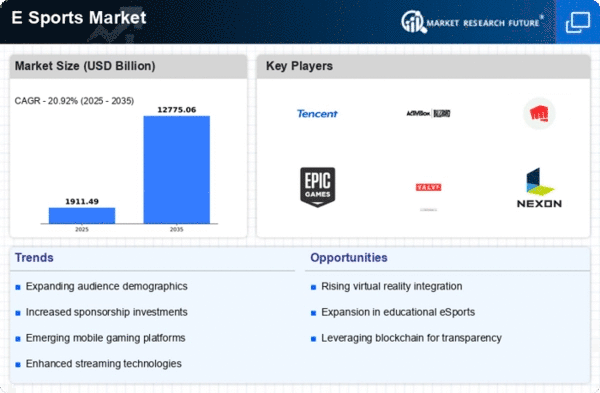
As per MRFR analysis, the E Sports Market Size was estimated at 1580.79 USD Billion in 2024. The E Sports industry is projected to grow from 1911.5 USD Billion in 2025 to 12775.06 USD Billion by 2035, exhibiting a compound annual growth rate (CAGR) of 20.92 during the forecast period 2025 - 2035.

Key Market Trends & Highlights

The E Sports Market is experiencing robust growth driven by technological advancements and diverse revenue streams.

  • The rise of mobile gaming is reshaping the competitive landscape, particularly in the Asia-Pacific region.
  • North America remains the largest market, with First Person Shooter games leading in popularity.
  • Streaming platforms are witnessing increased investment, enhancing viewer engagement and monetization opportunities.
  • The expansion of competitive gaming and integration of E Sports in education are key drivers propelling market growth.

Market Size & Forecast

2024 Market Size 1580.79 (USD Billion)
2035 Market Size 12775.06 (USD Billion)
CAGR (2025 - 2035) 20.92%
Largest Regional Market Share in 2024 North America

Major Players

Tencent (CN), Activision Blizzard (US), Riot Games (US), Epic Games (US), Valve Corporation (US), Nexon (KR), Bandai Namco Entertainment (JP), Electronic Arts (US), Ubisoft (FR)

Market Trends

The E Sports Market is currently experiencing a dynamic evolution, characterized by a surge in viewership and participation across various demographics. This growth is driven by the increasing accessibility of gaming platforms and the proliferation of high-speed internet, which facilitates seamless online experiences. Moreover, the integration of advanced technologies, such as virtual reality and augmented reality, appears to enhance user engagement, creating immersive environments that captivate audiences. As a result, the market is witnessing a diversification of content, with a broader array of games appealing to different segments of players and viewers alike. In addition, the E Sports Market is becoming increasingly intertwined with traditional sports, as partnerships and sponsorships between gaming organizations and established sports entities are on the rise. This convergence suggests a potential for cross-promotion and shared audiences, which could further bolster the market's growth trajectory. Furthermore, the emergence of collegiate and amateur leagues indicates a growing recognition of E Sports as a legitimate competitive platform, fostering talent development and community engagement. Overall, the E Sports Market is poised for continued expansion, driven by innovation and evolving consumer preferences.

Rise of Mobile Gaming

The E Sports Market is witnessing a notable shift towards mobile gaming, as smartphones become the primary devices for many players. This trend indicates a broader audience reach, allowing individuals to engage with competitive gaming from virtually anywhere. Mobile titles are increasingly designed for competitive play, attracting both casual gamers and serious competitors.

Increased Investment in Infrastructure

Investment in infrastructure is becoming a critical trend within the E Sports Market. Organizations are focusing on building state-of-the-art arenas and training facilities, which enhances the overall experience for players and fans. This development suggests a commitment to elevating the professionalism of E Sports, potentially attracting more sponsorships and partnerships.

Growth of Streaming Platforms

The proliferation of streaming platforms dedicated to E Sports is reshaping how audiences consume content. These platforms provide real-time access to tournaments and gameplay, fostering community interaction and engagement. This trend indicates a shift in content consumption habits, as viewers increasingly prefer live, interactive experiences over traditional media.

E Sports Market Market Drivers

Diverse Revenue Streams

The Global Esports Market Industry benefits from a diverse range of revenue streams, including sponsorships, advertising, merchandise sales, and ticket sales for live events. This multifaceted approach to revenue generation enables the industry to remain resilient and adaptable to market fluctuations. Sponsorship deals with major brands, such as Intel and Coca-Cola, provide substantial financial support, while advertising revenue from streaming platforms contributes to overall growth. As the industry evolves, new revenue opportunities, such as in-game purchases and digital collectibles, are likely to emerge. This diversification of income sources positions the Global Esports Market Industry for sustained growth and profitability.

Market Growth Projections

The Global Esports Market Industry is projected to experience remarkable growth, with estimates indicating a market value of 10.5 USD Billion by 2035. This growth trajectory reflects the increasing acceptance of esports as a legitimate form of entertainment and competition. Factors contributing to this expansion include rising viewership, increased participation rates, and the ongoing development of esports infrastructure. The projected CAGR of 13.94% for the period of 2025-2035 underscores the industry's potential for long-term success. As more stakeholders enter the market, the Global Esports Market Industry is likely to evolve, adapting to changing consumer preferences and technological advancements.

Youth Engagement and Demographics

The Global Esports Market Industry is significantly influenced by the engagement of younger demographics, particularly Generation Z and Millennials, who are increasingly drawn to competitive gaming. This demographic shift is evident in the growing number of esports tournaments and events tailored to younger audiences. As these individuals prioritize digital entertainment, the industry is likely to see a sustained increase in participation and viewership. The appeal of esports as a social activity, combined with the rise of online communities, fosters a sense of belonging among players and fans. This trend suggests that the Global Esports Market Industry will continue to thrive as it aligns with the preferences of younger generations.

Technological Advancements in Gaming

Technological advancements play a crucial role in the evolution of the Global Esports Market Industry. Innovations in hardware and software enhance the gaming experience, allowing for more immersive and competitive gameplay. The rise of virtual reality and augmented reality technologies offers new opportunities for game developers and players alike. Furthermore, improvements in internet connectivity and streaming capabilities enable seamless broadcasting of esports events to global audiences. As these technologies continue to develop, they are likely to attract more participants and viewers, contributing to the projected CAGR of 13.94% for the period of 2025-2035. This growth reflects the industry's adaptability and potential for future expansion.

Rising Popularity of Competitive Gaming

The Global Esports Market Industry experiences a surge in popularity as competitive gaming becomes a mainstream entertainment option. With an estimated market value of 2.5 USD Billion in 2024, the industry attracts millions of viewers and participants worldwide. Major tournaments, such as the League of Legends World Championship, draw in large audiences, showcasing the appeal of esports. This growing interest is further fueled by the increasing accessibility of gaming platforms and the rise of streaming services, which allow fans to engage with their favorite games and players. As a result, the Global Esports Market Industry is poised for substantial growth in the coming years.

Investment from Traditional Sports Organizations

The Global Esports Market Industry benefits from significant investments by traditional sports organizations, which recognize the potential of esports as a lucrative venture. Notable franchises, such as the NBA and NFL, have established their own esports leagues, thereby legitimizing the industry and attracting a broader audience. This influx of capital not only enhances the competitive landscape but also facilitates the development of infrastructure and talent. As traditional sports entities continue to invest in esports, the market is expected to expand, potentially reaching a valuation of 10.5 USD Billion by 2035. This trend indicates a convergence of sports and gaming, further solidifying esports' position in the entertainment sector.

Market Segment Insights

By Game Genre: First Person Shooter (Largest) vs. Multiplayer Online Battle Arena (Fastest-Growing)

In the E Sports market, the distribution of game genres showcases a competitive landscape dominated by the First Person Shooter (FPS) category, which captures a significant market share. Games like Call of Duty and Counter-Strike have built a loyal audience, contributing to FPS's leading position. Meanwhile, the Multiplayer Online Battle Arena (MOBA) genre, popularized by titles such as League of Legends and Dota 2, continues to expand rapidly, attracting new players and investments. The growth trends in the E Sports market indicate that while FPS games hold a strong position, MOBAs are emerging as the fastest-growing segment. The increasing accessibility of gaming platforms and the rise of online streaming are key drivers. Additionally, competitive events and tournaments in MOBAs are gaining popularity, enhancing community engagement and driving player retention in the genre.

FPS (Dominant) vs. MOBA (Emerging)

The First Person Shooter (FPS) genre stands as a dominant force in the E Sports market, characterized by its intense and competitive gameplay. Titles like Counter-Strike: Global Offensive and Overwatch have created a robust ecosystem of professional tournaments and sponsorships. The genre's immersive experience and community-driven content keep players engaged and attract a diverse audience. In contrast, the Multiplayer Online Battle Arena (MOBA) genre, represented by games such as League of Legends, is an emerging player that is redefining competitive gaming. With its strategic depth and teamwork focus, it offers a unique appeal. The regular updates, expansions, and active competitive scene contribute to its rapid growth, positioning MOBAs as a key player in the evolving E Sports landscape.

By Platform: PC (Largest) vs. Mobile (Fastest-Growing)

In the E Sports Market, the distribution of platform usage underscores the significance of PC gaming, which dominates a substantial share of the market. With robust hardware capabilities and versatile gaming experiences, PCs have long been favored by serious gamers, leading to a strong competitive environment. Meanwhile, mobile gaming has emerged as a significant player, rapidly gaining traction among casual gamers and offering unprecedented accessibility, contributing to a shift in market dynamics. Growth trends in the E Sports platform segment reveal an exciting trajectory. Mobile gaming is witnessing exponential growth driven by increased smartphone penetration and the development of high-quality mobile titles. As infrastructure improves and 5G technology becomes widespread, the cloud gaming segment is also poised for rapid expansion, providing gamers with the ability to access high-performance games without the need for expensive hardware, further democratizing the E Sports landscape.

PC (Dominant) vs. Cloud Gaming (Emerging)

In the E Sports Market, PC gaming stands out as the dominant platform, favored for its superior graphics, processing power, and extensive game libraries. PC gamers enjoy a diverse ecosystem that supports a wide range of gaming genres, from fast-paced shooters to immersive role-playing games. Conversely, cloud gaming is an emerging platform that leverages cloud technology to offer streaming of high-quality games without the necessity for advanced hardware. This innovation allows players to engage in E Sports across various devices, attracting those unable or unwilling to invest in high-end gaming rigs. While PC maintains its leadership position due to its established infrastructure, cloud gaming is rapidly gaining popularity, appealing to a broader audience and enhancing overall accessibility.

By Monetization Model: Free to Play (Largest) vs. Pay to Play (Fastest-Growing)

The monetization models in the eSports market are primarily divided into four segments: Free to Play, Pay to Play, Subscription, and In Game Purchases. Among these, Free to Play remains the largest segment, captivating a vast user base by offering accessibility without upfront costs. This model allows games to reach more players and generate revenue through various other strategies. Pay to Play, while not as large, has seen significant growth and is the fastest-growing segment as more gamers are willing to pay for high-quality experiences and exclusive content. The eSports market's growth is fueled by the increasing popularity of competitive gaming and a shift toward digital experiences. Factors such as the rise of live streaming platforms and community engagement have propelled the Free to Play model, while innovations in game design for Pay to Play models have attracted players seeking premium experiences. In Game Purchases also contribute to growth, enhancing gameplay and retention, while Subscription models are gradually making headway by offering gamers consistent updates and exclusive content for a fixed fee.

Free to Play (Dominant) vs. Pay to Play (Emerging)

The Free to Play model is dominant in the eSports market, owing to its ability to attract a large number of players by eliminating barriers to entry. Gamers can access games without financial commitment, encouraging a broader audience and driving participation. In contrast, the Pay to Play model is emerging as more gamers prefer to invest in high-quality gaming experiences and premium content. This model is gradually gaining traction due to an increasing segment of dedicated players who are willing to pay for additional features or to enhance their gaming experience. Both models, while distinct, reflect the diverse preferences of gamers and the dynamism of the eSports landscape.

By Audience Demographics: Age Group (Largest) vs. Gender (Fastest-Growing)

In the E Sports Market, the audience demographics reveal a diverse distribution across age groups and gender. The largest segment comprises the 18-34 age range, which accounts for a significant portion of the total viewership. This age group is most engaged with competitive gaming, driving both viewership and participation in tournaments. Gender demographics also play a critical role, with male audiences historically dominant, but the female segment is rapidly gaining traction, reflecting increasing competition and opportunities for inclusivity within gaming.

Age Group: 18-34 (Dominant) vs. Gender: Female (Emerging)

The 18-34 age group remains the dominant force within the E Sports Market, representing the core demographic that engages deeply with competitive gaming content, both as players and viewers. Their familiarity with digital platforms and gaming culture positions them favorably for continuous market engagement. Conversely, the female demographic, though traditionally underrepresented, is emerging as a vital segment. With growing representation in gaming communities and professional teams, the female audience is attracting attention and investment, contributing to an overall increase in female gamers, which signifies a promising shift in market dynamics.

By Event Type: Online Tournaments (Largest) vs. LAN Events (Fastest-Growing)

In the E Sports Market, Online Tournaments currently hold the largest market share, capitalizing on the increasing popularity of competitive gaming among a global audience. Meanwhile, LAN Events have seen a surge in interest, with more gamers eager for in-person experiences, emphasizing community engagement and live interactions. Exhibitions and Charity Events, while important, contribute significantly less to the market share compared to these two dominant segments.

Online Tournaments (Dominant) vs. LAN Events (Emerging)

Online Tournaments are characterized by their accessibility and convenience, allowing players from different regions to compete without geographic constraints, thereby attracting more participants and viewers. LAN Events, as an emerging segment, foster a unique camaraderie and competitive spirit among gamers, supported by sponsors eager to tap into live audiences. As connectivity improves and gaming cultures grow, LAN Events are becoming increasingly significant in driving engagement, making them a vital component of the overall E Sports ecosystem.

Get more detailed insights about E-sports Market Research Report - Global Forecast till 2035

Regional Insights

North America : Leading Market for E Sports

North America continues to lead the E Sports market, holding a significant share of 790.39M in 2025. The growth is driven by increasing viewership, sponsorship deals, and a robust gaming culture. Regulatory support and investment in infrastructure further enhance market dynamics, making it a prime location for E Sports events and tournaments. The region's technological advancements and high internet penetration also contribute to its growth trajectory. The competitive landscape is dominated by key players such as Activision Blizzard, Riot Games, and Epic Games, all based in the US. These companies are at the forefront of innovation, creating popular titles that attract millions of players and viewers. The presence of major gaming events and a strong community of gamers solidify North America's position as the epicenter of the E Sports industry. With a growing audience and increasing revenue streams, the region is poised for continued success.

Europe : Emerging E Sports Hub

Europe's E Sports market is rapidly expanding, with a market size of 450.0M in 2025. The region benefits from a diverse gaming community and strong regulatory frameworks that support E Sports development. Countries like Germany, the UK, and France are leading the charge, with increasing investments in E Sports infrastructure and events. The rise of online streaming platforms has also fueled demand, making E Sports more accessible to a wider audience. The competitive landscape features prominent players such as Ubisoft and Bandai Namco Entertainment, which are investing heavily in E Sports initiatives. The region is characterized by a mix of established franchises and emerging titles, creating a vibrant ecosystem. As European countries continue to embrace E Sports, the market is expected to grow significantly, driven by fan engagement and sponsorship opportunities. "The European gaming market is set to grow significantly, driven by innovation and community engagement," European Gaming Commission.

Asia-Pacific : Rapidly Growing E Sports Market

The Asia-Pacific region is witnessing a surge in the E Sports market, with a size of 290.0M in 2025. This growth is fueled by a massive youth population, increasing internet accessibility, and a cultural shift towards gaming as a mainstream entertainment option. Countries like China and South Korea are at the forefront, with significant investments in E Sports leagues and tournaments, supported by favorable government policies that promote digital entertainment. The competitive landscape is vibrant, featuring major players like Tencent and NCSOFT, which dominate the market with popular titles. The region's unique gaming culture, characterized by high engagement and community participation, further enhances its appeal. As E Sports continues to gain traction, the Asia-Pacific market is expected to expand rapidly, driven by technological advancements and a growing fan base.

Middle East and Africa : Emerging E Sports Frontier

The Middle East and Africa (MEA) region is emerging as a new frontier in the E Sports market, with a size of 50.4M in 2025. The growth is driven by increasing interest in gaming, supported by investments in infrastructure and events. Governments in the region are recognizing the potential of E Sports as a tool for youth engagement and economic development, leading to favorable policies that encourage growth in this sector. Countries like South Africa and the UAE are leading the charge, hosting major E Sports tournaments and attracting international attention. The competitive landscape is evolving, with local and international players entering the market. As the region continues to develop its gaming ecosystem, the potential for growth in the E Sports market is significant, driven by a young population eager to engage in competitive gaming. "The MEA region is poised for growth in E Sports, driven by youth engagement and investment in infrastructure," Middle East Gaming Association.

Key Players and Competitive Insights

The E Sports Market is currently characterized by a dynamic competitive landscape, driven by rapid technological advancements and an increasing global audience. Major players such as Tencent (CN), Activision Blizzard (US), and Riot Games (US) are at the forefront, each employing distinct strategies to enhance their market presence. Tencent (CN) continues to leverage its vast ecosystem, focusing on strategic investments and partnerships to expand its influence in the gaming sector. Activision Blizzard (US) emphasizes innovation through the development of new game titles and the enhancement of existing franchises, while Riot Games (US) concentrates on community engagement and competitive integrity, fostering a loyal player base that drives sustained growth.The business tactics employed by these companies reflect a moderately fragmented market structure, where collaboration and competition coexist. Localizing content and optimizing supply chains are critical tactics that enhance operational efficiency and market responsiveness. The collective influence of these key players shapes the competitive environment, as they navigate the complexities of consumer preferences and technological advancements.

In November Tencent (CN) announced a strategic partnership with a leading cloud service provider to enhance its gaming infrastructure. This move is poised to improve the gaming experience for users, potentially increasing player retention and attracting new audiences. The partnership underscores Tencent's commitment to leveraging technology to maintain its competitive edge in the E Sports Market.

In October Activision Blizzard (US) launched a new initiative aimed at promoting diversity and inclusion within its gaming communities. This initiative not only aligns with contemporary social values but also positions the company as a leader in fostering a welcoming environment for all players. Such strategic actions may enhance brand loyalty and attract a broader demographic, thereby expanding its market share.

In September Riot Games (US) introduced a new competitive league format for its flagship title, which aims to increase viewer engagement and enhance the overall spectator experience. This strategic shift is likely to attract more sponsorships and advertising revenue, further solidifying Riot's position in the market. By prioritizing the spectator experience, Riot Games demonstrates an understanding of the evolving dynamics of E Sports viewership.

As of December current trends in the E Sports Market indicate a strong focus on digitalization, sustainability, and the integration of AI technologies. Strategic alliances are increasingly shaping the competitive landscape, as companies collaborate to enhance their technological capabilities and market reach. Looking ahead, competitive differentiation is expected to evolve, with a shift from price-based competition to a focus on innovation, technology, and supply chain reliability. This transition may redefine success in the E Sports Market, as companies strive to meet the demands of an ever-evolving consumer base.

Key Companies in the E Sports Market include

Industry Developments

The Esports Market has been witnessing significant developments recently, with substantial growth attributed to increasing viewership and investment from major companies. Bandai Namco Entertainment and Riot Games continue to expand their game portfolios, while Valve Corporation is enhancing its competitive environment through multiple tournaments. The investment activities by Tencent are noteworthy, with the company acquiring stakes in various gaming entities, thereby influencing market dynamics. In September 2023, Activision Blizzard and Microsoft announced an agreement to enhance their gaming ecosystem, showcasing strategic partnerships as key trends in the industry. 

Electronic Arts, capitalizing on the popularity of its sports franchises, remains focused on elevating esports experiences for fans. The Overwatch League has restructured its league format, aiming to boost viewer engagement. Furthermore, NVIDIA and PGL are working together to leverage advanced technology, aiding in the overall growth of esports events. The substantial influx of venture capital and sponsorships across the market indicates a promising future, with strong upward valuations for companies involved in esports, echoing the increasing significance of this sector on a global scale. These developments have reinforced the position of esports as a prominent entertainment avenue worldwide.

 

Future Outlook

E Sports Market Future Outlook

The E Sports Market is projected to grow at a 20.92% CAGR from 2024 to 2035, driven by technological advancements, increased sponsorship, and expanding audience engagement.

New opportunities lie in:

  • Development of immersive virtual reality gaming experiences
  • Creation of subscription-based content platforms for exclusive tournaments
  • Expansion of mobile eSports leagues targeting emerging markets

By 2035, the E Sports Market is poised for substantial growth, solidifying its position as a leading entertainment sector.

Market Segmentation

E Sports Market Platform Outlook

  • PC
  • Console
  • Mobile
  • Cloud Gaming

E Sports Market Event Type Outlook

  • Online Tournaments
  • LAN Events
  • Exhibitions
  • Charity Events

E Sports Market Game Genre Outlook

  • First Person Shooter
  • Multiplayer Online Battle Arena
  • Real Time Strategy
  • Sports Simulation
  • Fighting

E Sports Market Monetization Model Outlook

  • Free to Play
  • Pay to Play
  • Subscription
  • In Game Purchases

E Sports Market Audience Demographics Outlook

  • Age Group
  • Gender
  • Income Level
  • Geographic Location

Report Scope

MARKET SIZE 20241580.79(USD Billion)
MARKET SIZE 20251911.5(USD Billion)
MARKET SIZE 203512775.06(USD Billion)
COMPOUND ANNUAL GROWTH RATE (CAGR)20.92% (2025 - 2035)
REPORT COVERAGERevenue Forecast, Competitive Landscape, Growth Factors, and Trends
BASE YEAR2024
Market Forecast Period2025 - 2035
Historical Data2019 - 2024
Market Forecast UnitsUSD Billion
Key Companies ProfiledTencent (CN), Activision Blizzard (US), Riot Games (US), Epic Games (US), Valve Corporation (US), Nexon (KR), Bandai Namco Entertainment (JP), Electronic Arts (US), Ubisoft (FR)
Segments CoveredGame Genre, Platform, Monetization Model, Audience Demographics, Event Type
Key Market OpportunitiesIntegration of virtual reality technology enhances immersive experiences in the E Sports Market.
Key Market DynamicsRising consumer engagement and technological advancements are reshaping competitive dynamics within the E Sports Market.
Countries CoveredNorth America, Europe, APAC, South America, MEA

FAQs

What is the current market size of the Esports Market?

As of 2024, the Esports Market is valued at 2.5 USD Billion.

What is the expected market size of the Esports Market in 2035?

By 2035, the Esports Market is projected to reach a valuation of 10.5 USD Billion.

What is the expected CAGR for the Esports Market from 2025 to 2035?

The expected CAGR for the Esports Market from 2025 to 2035 is 13.93%.

Which region holds the largest share of the Esports Market in 2024?

North America holds the largest share of the Esports Market in 2024, valued at 0.714 USD Billion.

What will be the market value of the North America region in 2035?

By 2035, the North America region is expected to reach a market value of 3.111 USD Billion.

What are the top game types contributing to the Esports Market?

The top game types include First-Person Shooter, Multiplayer Online Battle Arena, Real-Time Strategy, Sports, and Battle Royale.

What is the market value of First-Person Shooter games in 2024?

In 2024, the market value for First-Person Shooter games is estimated at 0.8 USD Billion.

Who are some of the major players in the Esports Market?

Major players in the Esports Market include Bandai Namco Entertainment, Valve Corporation, NVIDIA, and Riot Games.

What is the expected market value for the Asia Pacific region in 2035?

The Asia Pacific region is projected to have a market value of 2.749 USD Billion by 2035.

What is the expected market value for the Sports game type in 2035?

The Sports game type is expected to reach a market value of 2.6 USD Billion by 2035.

  1. SECTION I: EXECUTIVE SUMMARY AND KEY HIGHLIGHTS
    1. | 1.1 EXECUTIVE SUMMARY
  2. SECTION II: SCOPING, METHODOLOGY AND MARKET STRUCTURE
    1. | 2.1 MARKET INTRODUCTION
    2. | 2.2 RESEARCH METHODOLOGY
  3. SECTION III: QUALITATIVE ANALYSIS
    1. | 3.1 MARKET DYNAMICS
    2. | 3.2 MARKET FACTOR ANALYSIS
  4. SECTION IV: QUANTITATIVE ANALYSIS
    1. | 4.1 Information and Communications Technology, BY Game Genre (USD Billion)
    2. | 4.2 Information and Communications Technology, BY Platform (USD Billion)
    3. | 4.3 Information and Communications Technology, BY Monetization Model (USD Billion)
    4. | 4.4 Information and Communications Technology, BY Audience Demographics (USD Billion)
    5. | 4.5 Information and Communications Technology, BY Event Type (USD Billion)
    6. | 4.6 Information and Communications Technology, BY Region (USD Billion)
  5. SECTION V: COMPETITIVE ANALYSIS
    1. | 5.1 Competitive Landscape
    2. | 5.2 Company Profiles
    3. | 5.3 Appendix

E-sports Market Segmentation

Market Segmentation Overview

  • Detailed segmentation data will be available in the full report
  • Comprehensive analysis by multiple parameters
  • Regional and country-level breakdowns
  • Market size forecasts by segment
Infographic

Free Sample Request

Kindly complete the form below to receive a free sample of this Report

Get Free Sample

Customer Strories

Compare Licence

×
Features License Type
Single User Multiuser License Enterprise User
Price $4,950 $5,950 $7,250
Maximum User Access Limit 1 User Upto 10 Users Unrestricted Access Throughout the Organization
Free Customization
Direct Access to Analyst
Deliverable Format
Platform Access
Discount on Next Purchase 10% 15% 15%
Printable Versions