×
Request Free Sample ×

Kindly complete the form below to receive a free sample of this Report

* Please use a valid business email

Leading companies partner with us for data-driven Insights

clients tt-cursor
Hero Background

Docker Monitoring Market

ID: MRFR/ICT/39084-HCR
100 Pages
Aarti Dhapte
February 2026

Docker Monitoring Market Research Report: By Type (On-Premises, Cloud-Based), By Deployment Model (Agent-Based, Agentless), By Monitoring Capabilities (Performance Monitoring, Availability Monitoring, Security Monitoring, Health Monitoring), By Enterprise Size (Small and Medium-Sized Enterprises (SMEs), Large Enterprises), By Industry Verticals (Information Technology (IT) and Telecom, Financial Services, Healthcare, Manufacturing, Retail) and By Regional (North America, Europe, South America, Asia Pacific, Middle East and Africa) - Forecast to 2035.

Share:
Download PDF ×

We do not share your information with anyone. However, we may send you emails based on your report interest from time to time. You may contact us at any time to opt-out.

Docker Monitoring Market Infographic
Purchase Options

Docker Monitoring Market Summary

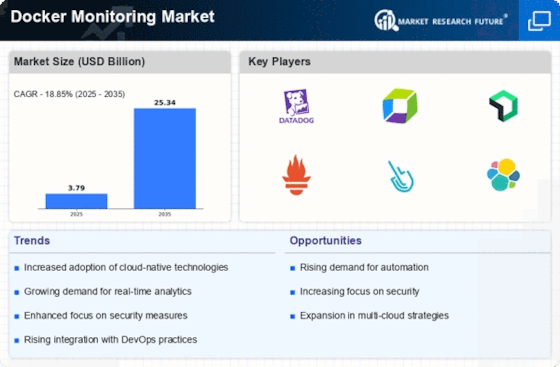
As per Market Research Future analysis, the Docker Monitoring Market Size was estimated at 3.791 USD Billion in 2024. The Docker Monitoring industry is projected to grow from 4.506 USD Billion in 2025 to 25.34 USD Billion by 2035, exhibiting a compound annual growth rate (CAGR) of 18.85% during the forecast period 2025 - 2035

Key Market Trends & Highlights

The Docker Monitoring Market is experiencing robust growth driven by technological advancements and evolving user needs.

  • The integration of AI and Machine Learning is transforming Docker monitoring capabilities, enhancing predictive analytics and automation.
  • North America remains the largest market for Docker monitoring solutions, while Asia-Pacific is emerging as the fastest-growing region.
  • Cloud-Based solutions dominate the market, yet On-Premises offerings are witnessing rapid growth due to specific enterprise needs.
  • The increased adoption of containerization and the growing complexity of IT environments are key drivers propelling market expansion.

Market Size & Forecast

2024 Market Size 3.791 (USD Billion)
2035 Market Size 25.34 (USD Billion)
CAGR (2025 - 2035) 18.85%

Major Players

Datadog (US), Dynatrace (US), New Relic (US), Prometheus (DE), Sysdig (US), Elastic (US), Splunk (US), AppDynamics (US)

Our Impact
Enabled $4.3B Revenue Impact for Fortune 500 and Leading Multinationals
Partnering with 2000+ Global Organizations Each Year
30K+ Citations by Top-Tier Firms in the Industry

Docker Monitoring Market Trends

The Docker Monitoring Market is currently experiencing a notable evolution, driven by the increasing adoption of containerization technologies across various industries. Organizations are recognizing the necessity of monitoring solutions to ensure optimal performance, security, and resource management within their containerized environments. As businesses strive for greater efficiency and agility, the demand for sophisticated monitoring tools that provide real-time insights into application performance and infrastructure health appears to be on the rise. This trend is further fueled by the growing complexity of microservices architectures, which necessitate advanced monitoring capabilities to manage interdependencies and ensure seamless operations. Moreover, the Docker Monitoring Market is likely to witness a surge in the integration of artificial intelligence and machine learning technologies. These innovations may enhance predictive analytics, enabling organizations to proactively address potential issues before they escalate. Additionally, the emphasis on compliance and security within containerized applications suggests that monitoring solutions will increasingly incorporate features that address regulatory requirements. As the landscape continues to evolve, stakeholders in the Docker Monitoring Market must remain vigilant and adaptable to emerging trends and technologies that could shape the future of container management and monitoring solutions.

Integration of AI and Machine Learning

The incorporation of artificial intelligence and machine learning into Docker monitoring solutions is becoming more prevalent. These technologies can facilitate predictive analytics, allowing organizations to identify potential issues before they arise, thus enhancing operational efficiency.

Focus on Security and Compliance

As organizations increasingly deploy containerized applications, there is a growing emphasis on security and compliance. Monitoring solutions are evolving to include features that address regulatory requirements, ensuring that organizations can maintain compliance while managing their container environments.

Rise of Multi-Cloud Strategies

The trend towards multi-cloud strategies is influencing the Docker Monitoring Market. Organizations are seeking monitoring solutions that can seamlessly operate across various cloud environments, providing a unified view of performance and resource utilization.

Docker Monitoring Market Drivers

Growing Complexity of IT Environments

The Docker Monitoring Market is significantly influenced by the growing complexity of IT environments. As organizations adopt microservices architectures and hybrid cloud solutions, the need for comprehensive monitoring tools becomes paramount. The intricate nature of these environments necessitates advanced monitoring solutions that can provide visibility across multiple containers and services. Market data indicates that organizations are increasingly investing in monitoring tools to manage this complexity effectively. Consequently, the Docker Monitoring Market is likely to see a rise in demand for solutions that offer centralized monitoring, alerting, and reporting functionalities, enabling IT teams to maintain operational efficiency.

Increased Adoption of Containerization

The Docker Monitoring Market experiences a notable surge in demand due to the increasing adoption of containerization technologies. Organizations are increasingly recognizing the benefits of containerization, such as improved resource utilization and faster deployment times. According to recent data, the containerization market is projected to grow at a compound annual growth rate of over 25% in the coming years. This trend drives the need for effective monitoring solutions to ensure optimal performance and security of containerized applications. As businesses migrate to containerized environments, the Docker Monitoring Market is poised to expand, providing tools that facilitate real-time monitoring, performance analytics, and troubleshooting capabilities.

Regulatory Compliance and Security Concerns

The Docker Monitoring Market is increasingly shaped by regulatory compliance and security concerns. As organizations face stringent regulations regarding data protection and privacy, the need for monitoring solutions that ensure compliance becomes essential. Effective monitoring tools can help organizations track and audit containerized applications, ensuring adherence to regulatory standards. Additionally, the rise in cyber threats necessitates robust security monitoring capabilities. Market data suggests that organizations investing in security-focused monitoring solutions can reduce the risk of breaches by up to 40%. This trend emphasizes the importance of the Docker Monitoring Market in providing solutions that address both compliance and security challenges.

Demand for Enhanced Performance and Reliability

The Docker Monitoring Market is driven by the escalating demand for enhanced performance and reliability of applications. As businesses strive to deliver seamless user experiences, the need for robust monitoring solutions becomes critical. Organizations are increasingly seeking tools that can provide insights into application performance, resource utilization, and potential bottlenecks. Recent studies suggest that companies utilizing effective monitoring solutions can achieve up to 30% improvement in application performance. This trend underscores the importance of the Docker Monitoring Market, as it offers solutions that empower organizations to proactively address performance issues and ensure high availability of their containerized applications.

Focus on Cost Efficiency and Resource Optimization

The Docker Monitoring Market is significantly impacted by the focus on cost efficiency and resource optimization among organizations. As businesses seek to maximize their return on investment, they are increasingly turning to monitoring solutions that provide insights into resource utilization and operational costs. Effective monitoring tools enable organizations to identify underutilized resources and optimize their infrastructure, leading to substantial cost savings. Market analysis indicates that organizations that implement comprehensive monitoring solutions can reduce operational costs by up to 20%. This trend highlights the critical role of the Docker Monitoring Market in helping organizations achieve their cost-efficiency goals.


Market Segment Insights

By Type: Cloud-Based (Largest) vs. On-Premises (Fastest-Growing)

In the Docker Monitoring Market, the 'Type' segment reveals a clear distribution, with Cloud-Based solutions dominating the landscape. This segment's share is significantly bolstered by its scalability and ease of use, appealing to enterprises looking for flexibility and quick deployment. Conversely, the On-Premises segment, though smaller in market share, is gaining traction as organizations seek tighter control over their data and infrastructure, indicating a shift in some sectors toward traditional solutions. Growth trends in this market are largely driven by the increasing adoption of containerized applications and microservices architecture, pushing organizations to invest in robust monitoring solutions. Cloud-Based monitoring continues to excel due to advancements in automation and integrated tools, while On-Premises solutions are increasingly viewed as essential for compliance and security-sensitive industries. This dual trajectory showcases the market's diverse needs and the evolving preferences of IT teams.

Type: Cloud-Based (Dominant) vs. On-Premises (Emerging)

Cloud-Based Docker monitoring solutions are at the forefront of market adoption, favored for their low maintenance requirements and the ability to quickly scale. These solutions facilitate real-time monitoring and analytics, which are crucial for organizations aiming to optimize container performance and management. On the other hand, On-Premises Docker monitoring systems are emerging as a viable choice for businesses prioritizing data security and compliance. These systems allow organizations to maintain direct control over their infrastructure and tailor their monitoring solutions to meet specific regulatory standards. While Cloud-Based solutions lead in terms of market penetration, the increasing emphasis on security is driving interest in On-Premises systems, marking a notable trend in the Docker Monitoring Market.

By Deployment Model: Agent-Based (Largest) vs. Agentless (Fastest-Growing)

In the Docker Monitoring Market, the Agent-Based deployment model holds the largest share among the available options. This model is favored by many organizations due to its comprehensive monitoring capabilities and real-time data collection. It allows for deeper insights into container instances, leading to better resource management and operational efficiency. Conversely, the Agentless deployment model, while currently smaller in share, is gaining traction due to its ease of integration and minimal overhead, making it attractive for organizations aiming for a lightweight monitoring solution. As businesses increasingly migrate to cloud-native architectures, the demand for flexible and efficient monitoring solutions is on the rise. The Agentless model is rapidly emerging as the fastest-growing approach, especially among startups and smaller enterprises that prioritize quick deployment without the need for additional agents. This shift is driven by the increasing need for agility, scalability, and reduced resource consumption, allowing companies to adapt more swiftly to changing operational demands while maintaining effective monitoring capabilities.

Agent-Based (Dominant) vs. Agentless (Emerging)

The Agent-Based deployment model is regarded as the dominant choice in the Docker Monitoring Market, providing robust monitoring solutions that deliver rich insights into container performance. This model requires the installation of agents within containerized environments, enabling organizations to gather detailed metrics on resource usage, performance bottlenecks, and system health. Due to its depth of monitoring and diagnostic capabilities, organizations can optimize their container deployments effectively. In contrast, the Agentless model is seen as an emerging alternative, appealing to businesses that prefer a straightforward, non-intrusive approach. This model leverages existing APIs and integrations, reducing overhead and simplifying the monitoring process. As a result, it increasingly appeals to teams looking to enhance operational efficiency without complex configurations.

By Monitoring Capabilities: Performance Monitoring (Largest) vs. Security Monitoring (Fastest-Growing)

In the Docker Monitoring Market, Performance Monitoring holds the largest market share, driven by the increasing requirement for organizations to ensure optimal application performance. Organizations are increasingly adopting solutions that allow real-time monitoring of containerized applications. Additionally, Security Monitoring, while smaller in market share compared to Performance Monitoring, has emerged as the fastest-growing segment. The rising significance of cybersecurity amid increasing container adoption fuels this growth.

Performance Monitoring: Dominant vs. Security Monitoring: Emerging

Performance Monitoring serves as a dominant segment in the Docker Monitoring Market, characterized by its comprehensive capabilities in tracking application responsiveness and resource utilization. It enables organizations to react promptly to application inefficiencies, which is critical in maintaining user satisfaction and operational efficiency. In contrast, Security Monitoring, recognized as an emerging segment, focuses on safeguarding containerized environments from vulnerabilities and attacks. As cyber threats evolve, this segment's capabilities in identifying and mitigating risks are becoming increasingly vital, attracting new investments and innovations, thereby establishing a competitive foothold.

By Enterprise Size: Small and Medium-Sized Enterprises (SMEs) (Largest) vs. Large Enterprises (Fastest-Growing)

In the Docker Monitoring Market, Small and Medium-Sized Enterprises (SMEs) represent the largest segment, accounting for a significant portion of market share. The growing adoption of containerization technologies among SMEs has led to a substantial demand for monitoring solutions that provide insights into performance, efficiency, and resource optimization. Meanwhile, Large Enterprises, while smaller in market share, are recognized as the fastest-growing segment as they increasingly migrate to cloud-based infrastructures to enhance scalability and operational agility.

Enterprise Size: SMEs (Dominant) vs. Large Enterprises (Emerging)

The Docker Monitoring Market reflects a distinct dichotomy between Small and Medium-Sized Enterprises (SMEs) and Large Enterprises. SMEs have established themselves as the dominant player in this market, leveraging Docker monitoring tools to streamline operations and improve service delivery. Their nimble nature allows for swift adaptations to emerging technologies. Conversely, Large Enterprises are considered the emerging segment, characterized by their substantial investments in digital transformation. They prioritize robust monitoring solutions to handle complex deployments across various environments, driven by the need for enhanced security, compliance, and resource management. Both segments are crucial, as SMEs drive volume, while Large Enterprises pave the way for innovation.

By Industry Verticals: Information Technology (IT) and Telecom (Largest) vs. Financial Services (Fastest-Growing)

The Docker Monitoring Market shows a diverse range of shares across its primary industry verticals. Information Technology (IT) and Telecom holds the largest share, driven by the increasing adoption of containerized applications and microservices architecture. This segment benefits from the robust demand for scalable and efficient infrastructure solutions. In contrast, Financial Services is emerging as the fastest-growing segment, as organizations seek agile monitoring solutions to comply with stringent regulations and enhance cybersecurity measures.

IT and Telecom: Dominant vs. Financial Services: Emerging

The Information Technology (IT) and Telecom sector remains the dominant player in the Docker Monitoring Market, characterized by continuous innovation and the need for efficient resource management. Companies within this vertical leverage containerized solutions to enhance development cycles and deliver cloud-native applications. Conversely, the Financial Services sector is seen as the emerging segment, rapidly adopting Docker monitoring solutions to address the growing concerns around data security, regulatory compliance, and operational efficiency. As financial institutions increasingly transition to digital platforms, the demand for sophisticated monitoring tools that ensure reliability and security in container environments is expected to grow significantly.

Get more detailed insights about Docker Monitoring Market

Regional Insights

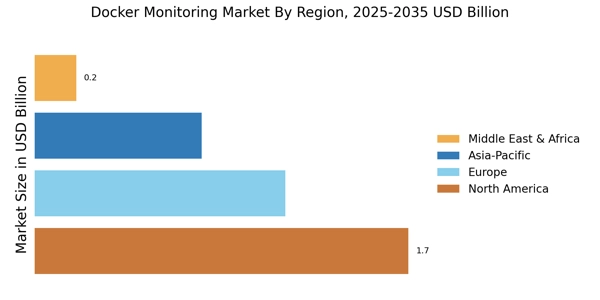
The regional landscape of the Docker Monitoring Market exhibits significant variations in terms of market size, growth potential, and competitive dynamics. North America holds a dominant position, accounting for a substantial share of the revenue due to the presence of major technology hubs and early adoption of cloud computing. Europe follows closely, driven by a strong focus on digital transformation and a favorable regulatory environment. The APAC region is expected to witness the fastest growth over the forecast period, fueled by the rapid adoption of cloud-based technologies and increasing investments in infrastructure.

South America and MEA represent emerging markets with growing potential, offering opportunities for market expansion.

Docker Monitoring Market Regional Image

Key Players and Competitive Insights

Major players in Docker Monitoring Market industry are constantly striving to gain a competitive edge in the market. Leading Docker Monitoring Market players are focusing on developing innovative solutions and expanding their product portfolios to cater to the evolving needs of customers. 
The Docker Monitoring Market development is driven by factors such as the increasing adoption of container-based technologies, growing demand for real-time monitoring and analytics, and the need for efficient resource utilization. The Docker Monitoring Market Competitive Landscape is characterized by the presence of several established players as well as emerging startups. Key market players are investing in research and development to enhance their offerings and stay ahead in the competition.Grafana Labs, a leading provider of open-source monitoring and visualization solutions, has a strong presence in the Docker Monitoring Market. 
The company's flagship product, Grafana, is widely used for monitoring and visualizing metrics and logs from Docker containers. Grafana Labs offers a range of features such as customizable dashboards, alerting and notifications, and integrations with various data sources. The company has a strong community of users and developers, contributing to the growth and innovation of its products.
Another major player in the Docker Monitoring Market is Datadog. Datadog provides a comprehensive monitoring and analytics platform for cloud-native environments, including Docker containers. The company's platform offers real-time monitoring, log management, and performance analysis capabilities. Datadog's strength lies in its ability to provide deep visibility into the performance and health of Docker containers, helping users identify and resolve issues quickly. The company has a strong customer base, including large enterprises and technology companies.

Key Companies in the Docker Monitoring Market include

Industry Developments

The Docker Monitoring Market is projected to reach USD 15.1 billion by 2032, exhibiting a CAGR of 18.85% during the forecast period (2024-2032). The increasing adoption of containerization and microservices architecture is driving the market growth. Docker monitoring tools provide visibility into the performance and health of Docker containers, enabling organizations to optimize resource utilization, identify performance bottlenecks, and ensure the reliability and availability of their applications.Recent developments in the market include the integration of artificial intelligence (AI) and machine learning (ML) capabilities into Docker monitoring tools. 

This integration enables the automation of anomaly detection, predictive analytics, and root cause analysis, further enhancing the efficiency and accuracy of monitoring. Additionally, the growing adoption of cloud-based Docker monitoring solutions is driving market growth due to the benefits of scalability, cost-effectiveness, and ease of deployment.

Future Outlook

Docker Monitoring Market Future Outlook

The Docker Monitoring Market is projected to grow at 18.85% CAGR from 2025 to 2035, driven by increasing cloud adoption, containerization, and demand for real-time monitoring solutions.

New opportunities lie in:

  • Development of AI-driven predictive analytics tools for proactive monitoring.
  • Integration of Docker monitoring with existing IT service management platforms.
  • Expansion into emerging markets with tailored monitoring solutions for local businesses.

By 2035, the Docker Monitoring Market is expected to be robust, reflecting substantial growth and innovation.

Market Segmentation

Docker Monitoring Market Type Outlook

  • On-Premises
  • Cloud-Based

Docker Monitoring Market Enterprise Size Outlook

  • Small and Medium-Sized Enterprises (SMEs)
  • Large Enterprises

Docker Monitoring Market Deployment Model Outlook

  • Agent-Based
  • Agentless

Docker Monitoring Market Industry Verticals Outlook

  • Information Technology (IT) and Telecom
  • Financial Services
  • Healthcare
  • Manufacturing
  • Retail

Docker Monitoring Market Monitoring Capabilities Outlook

  • Performance Monitoring
  • Availability Monitoring
  • Security Monitoring
  • Health Monitoring

Report Scope

MARKET SIZE 20243.791(USD Billion)
MARKET SIZE 20254.506(USD Billion)
MARKET SIZE 203525.34(USD Billion)
COMPOUND ANNUAL GROWTH RATE (CAGR)18.85% (2025 - 2035)
REPORT COVERAGERevenue Forecast, Competitive Landscape, Growth Factors, and Trends
BASE YEAR2024
Market Forecast Period2025 - 2035
Historical Data2019 - 2024
Market Forecast UnitsUSD Billion
Key Companies ProfiledDatadog (US), Dynatrace (US), New Relic (US), Prometheus (DE), Sysdig (US), Elastic (US), Splunk (US), AppDynamics (US)
Segments CoveredType, Deployment Model, Monitoring Capabilities, Enterprise Size, Industry Verticals, Regional
Key Market OpportunitiesIntegration of artificial intelligence for enhanced performance analytics in the Docker Monitoring Market.
Key Market DynamicsRising demand for containerized applications drives innovation in Docker monitoring solutions and competitive market dynamics.
Countries CoveredNorth America, Europe, APAC, South America, MEA
Leave a Comment

FAQs

What is the current valuation of the Docker Monitoring Market as of 2024?

The Docker Monitoring Market was valued at 3.791 USD Billion in 2024.

What is the projected market size for the Docker Monitoring Market by 2035?

The market is projected to reach 25.34 USD Billion by 2035.

What is the expected CAGR for the Docker Monitoring Market during the forecast period 2025 - 2035?

The expected CAGR for the Docker Monitoring Market during 2025 - 2035 is 18.85%.

Which companies are considered key players in the Docker Monitoring Market?

Key players in the market include Datadog, Dynatrace, New Relic, Prometheus, Sysdig, Elastic, Splunk, and AppDynamics.

What are the primary segments of the Docker Monitoring Market?

The primary segments include Type, Deployment Model, Monitoring Capabilities, Enterprise Size, and Industry Verticals.

How does the market valuation for Cloud-Based and On-Premises solutions compare?

Both Cloud-Based and On-Premises solutions were valued at 1.8955 USD Billion in 2024.

What is the market size for different monitoring capabilities in 2024?

In 2024, Performance Monitoring was valued at 1.2 USD Billion, while Availability and Security Monitoring were each valued at 0.9 USD Billion.

What is the market size for Docker Monitoring in Small and Medium-Sized Enterprises versus Large Enterprises?

Both Small and Medium-Sized Enterprises and Large Enterprises were valued at 1.8955 USD Billion in 2024.

Which industry verticals are driving the Docker Monitoring Market?

The leading industry verticals include Information Technology and Telecom, Financial Services, Healthcare, Manufacturing, and Retail.

What is the projected growth for the Docker Monitoring Market in the next decade?

The Docker Monitoring Market is expected to experience substantial growth, reaching 25.34 USD Billion by 2035.

Download Free Sample

Kindly complete the form below to receive a free sample of this Report

Compare Licence

×
Features License Type
Single User Multiuser License Enterprise User
Price $4,950 $5,950 $7,250
Maximum User Access Limit 1 User Upto 10 Users Unrestricted Access Throughout the Organization
Free Customization
Direct Access to Analyst
Deliverable Format
Platform Access
Discount on Next Purchase 10% 15% 15%
Printable Versions