×
Request Free Sample ×

Kindly complete the form below to receive a free sample of this Report

* Please use a valid business email

Leading companies partner with us for data-driven Insights

clients tt-cursor
Hero Background

Distributed Antenna Market

ID: MRFR/SEM/1861-HCR
200 Pages
Shubham Munde
February 2026

Distributed Antenna Market Size, Share and Research Report By Application (Commercial Buildings, Smart Cities, Transportation Hubs, Industrial Sites), By Technology (Active Distributed Antenna Systems, Passive Distributed Antenna Systems, Hybrid Distributed Antenna Systems), By End Use (Telecommunications, Public Safety, Transportation, Broadcasting), By Frequency Band (Low Band, Mid Band, High Band, Very High Band) and By Regional (North America, Europe, South America, Asia Pacific, Middle East and Africa) - Industry Forecast Till 2035

Share:
Download PDF ×

We do not share your information with anyone. However, we may send you emails based on your report interest from time to time. You may contact us at any time to opt-out.

Distributed Antenna Market Infographic
Purchase Options

Distributed Antenna Market Summary

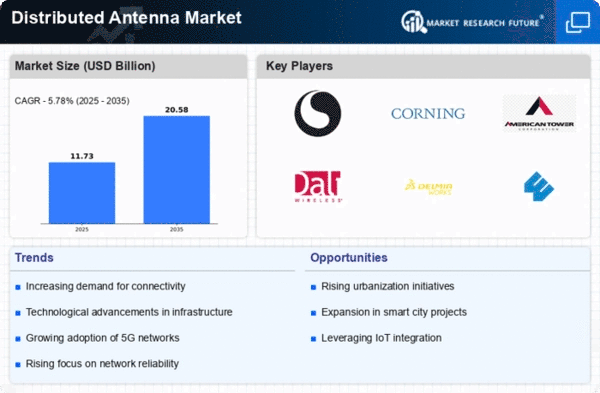
As per MRFR analysis, the Distributed Antenna Market Size was estimated at 11.09 USD Billion in 2024. The Distributed Antenna industry is projected to grow from 11.73 USD Billion in 2025 to 20.58 USD Billion by 2035, exhibiting a compound annual growth rate (CAGR) of 5.78 during the forecast period 2025 - 2035.

Key Market Trends & Highlights

The Distributed Antenna Market is poised for substantial growth driven by technological advancements and increasing demand for connectivity.

  • The market is witnessing a notable integration with smart technologies, enhancing overall communication capabilities.
  • Public safety communications remain a focal point, particularly in North America, where regulatory support is robust.
  • Emerging markets in Asia-Pacific are experiencing rapid expansion, driven by the increasing need for reliable connectivity solutions.
  • Rising demand for high-speed connectivity and the increased adoption of 5G technology are key drivers propelling market growth.

Market Size & Forecast

2024 Market Size 11.09 (USD Billion)
2035 Market Size 20.58 (USD Billion)
CAGR (2025 - 2035) 5.78%

Major Players

CommScope (US), Corning (US), American Tower Corporation (US), Dali Wireless (CA), SOLiD (KR), Zinwave (GB), MobiTV (US), AT&T (US), Verizon (US)

Our Impact
Enabled $4.3B Revenue Impact for Fortune 500 and Leading Multinationals
Partnering with 2000+ Global Organizations Each Year
30K+ Citations by Top-Tier Firms in the Industry

Distributed Antenna Market Trends

The Distributed Antenna Market is currently experiencing a notable transformation, driven by the increasing demand for enhanced wireless communication. As urban areas expand and the number of connected devices rises, the need for reliable and efficient network coverage becomes paramount. Distributed antenna systems (DAS) are emerging as a viable solution to address these challenges, providing improved signal strength and quality in densely populated environments. This market is characterized by a diverse range of applications, including commercial buildings, stadiums, and transportation hubs, where seamless connectivity is essential. Furthermore, advancements in technology are facilitating the integration of DAS with existing infrastructure, thereby enhancing overall network performance. In addition to technological advancements, regulatory frameworks are evolving to support the deployment of distributed antenna systems. Governments are recognizing the importance of robust communication networks for economic growth and public safety. This has led to increased investments in infrastructure development, which, in turn, is likely to propel the Distributed Antenna Market forward. As stakeholders continue to explore innovative solutions, the market appears poised for sustained growth, with potential opportunities arising from the integration of smart city initiatives and the Internet of Things (IoT). The future landscape of the Distributed Antenna Market seems promising, as it adapts to the ever-changing demands of modern communication.

Integration with Smart Technologies

The Distributed Antenna Market is witnessing a trend towards the integration of smart technologies. This includes the incorporation of IoT devices and smart building systems, which enhance the functionality of distributed antenna systems. Such integration not only improves connectivity but also optimizes energy consumption and operational efficiency.

Focus on Public Safety Communications

There is a growing emphasis on public safety communications within the Distributed Antenna Market. Stakeholders are increasingly recognizing the necessity for reliable communication systems in emergency situations. This trend is driving investments in DAS solutions that ensure uninterrupted connectivity for first responders and emergency services.

Expansion in Emerging Markets

Emerging markets are becoming a focal point for growth in the Distributed Antenna Market. As these regions develop their telecommunications infrastructure, there is a rising demand for advanced communication solutions. This trend suggests that companies may seek to establish a presence in these markets to capitalize on the increasing need for effective wireless coverage.

Distributed Antenna Market Drivers

Expansion of 5G Networks

The rollout of 5G networks is poised to significantly impact the Global Distributed Antenna Market Industry. With its promise of higher speeds and lower latency, 5G technology necessitates advanced infrastructure, including distributed antenna systems. DAS plays a crucial role in enhancing 5G coverage, particularly in urban areas where traditional cell towers may be insufficient. As 5G adoption accelerates, the market is expected to grow at a CAGR of 6.78% from 2025 to 2035. This growth indicates a strong correlation between the expansion of 5G networks and the increasing deployment of DAS, as service providers seek to optimize their network performance.

Market Growth Projections

The Global Distributed Antenna Market Industry is projected to experience substantial growth in the coming years. With a market value expected to reach 9.72 USD Billion in 2024 and an anticipated increase to 20 USD Billion by 2035, the industry is on a promising trajectory. The compound annual growth rate (CAGR) of 6.78% from 2025 to 2035 suggests a sustained demand for distributed antenna systems as connectivity needs evolve. This growth is likely to be fueled by advancements in technology, increasing urbanization, and the expansion of 5G networks, positioning DAS as a critical element in the future of telecommunications.

Increased Adoption of Smart Devices

The proliferation of smart devices is a significant driver for the Global Distributed Antenna Market Industry. As consumers increasingly rely on smartphones, tablets, and IoT devices, the demand for seamless wireless connectivity intensifies. Distributed antenna systems are essential in ensuring that these devices maintain optimal performance, particularly in environments with high user density. The anticipated growth of the market to 20 USD Billion by 2035 underscores the importance of DAS in supporting the connectivity needs of a growing number of smart devices. This trend suggests that businesses and service providers must invest in robust DAS solutions to meet consumer expectations.

Rising Need for Network Reliability

The increasing reliance on wireless communication for both personal and business applications underscores the need for network reliability within the Global Distributed Antenna Market Industry. Distributed antenna systems enhance the reliability of wireless networks by mitigating dead zones and improving signal quality. As organizations prioritize uninterrupted connectivity for critical operations, the adoption of DAS is likely to rise. This trend is particularly relevant in sectors such as healthcare, education, and public safety, where reliable communication is essential. The anticipated growth of the market to 20 USD Billion by 2035 reflects the increasing recognition of DAS as a vital component of modern communication infrastructure.

Growing Demand for Enhanced Connectivity

The Global Distributed Antenna Market Industry is experiencing a surge in demand for enhanced connectivity solutions. As urbanization continues to rise, the need for reliable wireless communication becomes paramount. Distributed antenna systems (DAS) provide a solution by improving signal strength and coverage in densely populated areas. This trend is particularly evident in metropolitan regions where high data traffic is prevalent. The market is projected to reach 9.72 USD Billion in 2024, indicating a robust growth trajectory. Enhanced connectivity not only supports mobile users but also facilitates the deployment of smart city initiatives, further driving the adoption of DAS.

Regulatory Support for Infrastructure Development

Government regulations and initiatives aimed at improving telecommunications infrastructure are driving the Global Distributed Antenna Market Industry. Many countries are implementing policies to facilitate the deployment of advanced communication technologies, including DAS. This regulatory support is crucial for ensuring that urban areas receive the necessary infrastructure to support growing connectivity demands. As governments recognize the importance of robust telecommunications networks for economic growth, investments in DAS are likely to increase. This trend may contribute to the market's projected growth, as stakeholders align their strategies with government objectives to enhance connectivity.


Market Segment Insights

By Application: Public Safety (Largest) vs. Telecommunications (Fastest-Growing)

The application segment of the Distributed Antenna Market is prominently led by Public Safety, which commands a significant share due to the increasing emphasis on reliable communication in emergency and security situations. This segment encompasses various solutions aimed at enhancing public communication infrastructure in urban areas, ensuring seamless connectivity during critical incidents. Following closely is Telecommunications, which is rapidly expanding as the demand for mobile connectivity surges and the rollout of 5G networks accelerates. This trend is driving investments in distributed antenna systems, thereby intensifying competition in the market.

Public Safety (Dominant) vs. Telecommunications (Emerging)

Public Safety stands as the dominant application within the Distributed Antenna Market, characterized by its essential role in maintaining effective communication during emergencies. This segment is bolstered by regulatory requirements and a societal push towards enhancing safety measures. In contrast, Telecommunications is seen as an emerging powerhouse, primarily due to the rising consumer demand for connectivity and innovations in mobile technology. As 5G becomes more mainstream, telecommunications applications are expected to proliferate, requiring robust distributed antenna systems to support increased data traffic and user connectivity.

By End Use: Residential (Largest) vs. Commercial (Fastest-Growing)

The Distributed Antenna Market is predominantly driven by the Residential segment, which holds the largest market share. This segment benefits from the increasing demand for reliable communication networks and high-speed internet connectivity in homes. Additionally, urbanization and the rise of smart homes are contributing factors for the Residential segment’s strong position in the market. On the other hand, the Commercial segment is witnessing the fastest growth due to the rising need for enhanced wireless coverage in various commercial establishments. The growing trends of remote work, coupled with the need for increased connectivity in offices, retail spaces, and public venues, are propelling investments in distributed antenna systems.

Residential (Dominant) vs. Commercial (Emerging)

In the Distributed Antenna Market, the Residential segment stands out as the dominant player, largely thanks to the exponential growth in the number of connected devices and the demand for seamless connectivity in homes. This segment encapsulates various use cases, from smart home applications to streamed entertainment, fostering consumer reliance on robust wireless networks. In contrast, the Commercial segment is emerging rapidly, driven by both the increasing adaptation of distributed antenna systems in office buildings and retail environments to improve customer experience and operational efficiency. The demand for comprehensive in-building coverage is leading commercial enterprises to prioritize these solutions, positioning this segment for significant growth in the market.

By Technology: Active Antenna System (Largest) vs. Small Cell Technology (Fastest-Growing)

In the Distributed Antenna Market, the Active Antenna System emerges as the largest segment, significantly dominating the landscape with its efficient performance and robust capabilities. The market share distribution reveals that while Active Antenna Systems hold a substantial share, Passive Antenna Systems and Hybrid Antenna Systems also play notable roles, catering to various applications and deployment scenarios. Small Cell Technology, although currently smaller in share compared to Active Systems, has been gaining momentum rapidly as network demand increases.

Technology: Active Antenna System (Dominant) vs. Small Cell Technology (Emerging)

The Active Antenna System is characterized by its ability to process signals internally, which enhances both efficiency and performance, making it a preferred choice for many enterprises. This segment is often deployed in high-density environments, such as urban areas, where reliable coverage is imperative. Conversely, Small Cell Technology, which includes low-powered cellular radio access nodes, is emerging as a crucial component in improving capacity and coverage in challenging spaces. With the rise in mobile data demand, Small Cells are witnessing rapid adoption, pointing towards a future where both technologies will coexist and complement each other.

By Frequency Band: Mid Band (Largest) vs. Ultra High Band (Fastest-Growing)

The Distributed Antenna Market is primarily segmented into Low Band, Mid Band, High Band, and Ultra High Band frequencies. Mid Band holds the largest market share due to its balanced performance, providing significant coverage and capacity across urban and suburban areas. In contrast, Ultra High Band is emerging rapidly, capturing the attention of operators due to its ability to support advanced applications and higher data rates, appealing to demanding consumer needs in metropolitan regions.

Mid Band: Dominant vs. Ultra High Band: Emerging

Mid Band frequencies are characterized by their optimal balance of coverage and capacity, making them the dominant choice for most Distributed Antenna Systems. This segment enables a longer range transmission with sufficient data speed, facilitating various applications such as video streaming and mobile internet. Conversely, Ultra High Band frequencies are becoming increasingly relevant as they support high-density environments and ultra-fast broadband services. The emergence of 5G technology is propelling Ultra High Band into the spotlight, catering to ultra-low latency requirements and massive device connectivity, essential for smart cities and IoT deployments.

By Component: Antenna (Largest) vs. Amplifier (Fastest-Growing)

The Distributed Antenna Market shows a varied distribution among the component segment values. Antennas represent the largest share, dominating the market due to their fundamental role in signal distribution and reception. Amplifiers, while a smaller segment, are growing rapidly, propelled by the increasing demand for enhanced signal strength in urban and densely populated areas. This shift is significant as it underscores the evolution of network infrastructure and the need for seamless connectivity.

Antenna (Dominant) vs. Amplifier (Emerging)

Antennas have established themselves as the dominant component in the Distributed Antenna Market, serving as the backbone of communication systems by facilitating the distribution of wireless signals. Their critical importance in various applications, from telecommunications to public safety, underscores their market supremacy. Meanwhile, amplifiers are emerging strongly as the need for improved signal quality intensifies, particularly in urban environments where interference and obstacles affect performance. The innovation in amplifier technology showcases advancements in signal processing, enhancing their attractiveness to both consumers and businesses looking to improve connectivity and reach.

Get more detailed insights about Distributed Antenna Market

Regional Insights

North America : Market Leader in Innovation

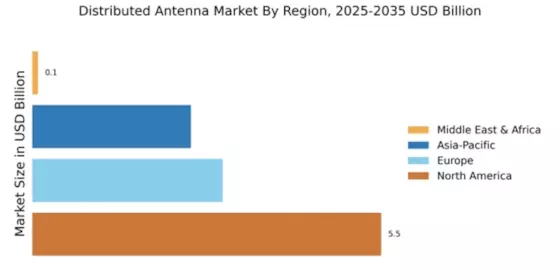
North America is poised to maintain its leadership in the Distributed Antenna Market, holding a significant market share of 5.5 in 2025. The region's growth is driven by increasing demand for enhanced mobile connectivity, particularly in urban areas. Regulatory support for infrastructure development and the rollout of 5G technology are key catalysts, fostering a favorable environment for market expansion. The focus on improving network reliability and coverage is also propelling investments in distributed antenna systems. The competitive landscape in North America is robust, featuring key players such as CommScope, Corning, and American Tower Corporation. These companies are leveraging advanced technologies to enhance their offerings and meet the growing demand for high-capacity networks. The presence of major telecommunications providers like AT&T and Verizon further strengthens the market, ensuring a continuous push towards innovation and improved service delivery. The region's commitment to technological advancement positions it as a critical hub for the distributed antenna market.

Europe : Emerging Market with Growth Potential

Europe is witnessing a notable rise in the Distributed Antenna Market, with a market size of 3.0 in 2025. The growth is fueled by increasing mobile data consumption and the need for improved network coverage in densely populated areas. Regulatory initiatives aimed at enhancing telecommunications infrastructure are also contributing to market expansion. The push for 5G deployment across various European nations is expected to further accelerate demand for distributed antenna systems, making it a key area of focus for stakeholders. Leading countries in this region include Germany, the UK, and France, where significant investments are being made in telecommunications infrastructure. The competitive landscape features companies like Zinwave and SOLiD, which are actively developing innovative solutions to meet market demands. The presence of strong regulatory frameworks ensures a conducive environment for growth, as evidenced by the European Commission's commitment to enhancing digital connectivity across member states. "The European Union aims to ensure that all citizens have access to high-speed internet by 2025," highlights the urgency of infrastructure development.

Asia-Pacific : Rapid Growth in Connectivity Solutions

The Asia-Pacific region is experiencing rapid growth in the Distributed Antenna Market, projected to reach a size of 2.5 in 2025. This growth is driven by the increasing adoption of mobile devices and the demand for seamless connectivity in urban environments. Countries in this region are investing heavily in telecommunications infrastructure, supported by government initiatives aimed at enhancing digital connectivity. The rise of smart cities and IoT applications is further propelling the need for advanced distributed antenna systems. Key players in the Asia-Pacific market include SOLiD and Dali Wireless, which are focusing on innovative solutions tailored to local needs. Countries like China, Japan, and South Korea are leading the charge, with significant investments in 5G technology and network enhancements. The competitive landscape is characterized by a mix of established companies and emerging startups, all vying to capture market share in this dynamic environment. The region's commitment to technological advancement positions it as a critical player in The Distributed Antenna.

Middle East and Africa : Emerging Market with Untapped Potential

The Middle East and Africa region is at the nascent stage of development in the Distributed Antenna Market, with a market size of 0.09 in 2025. The growth potential is significant, driven by increasing mobile penetration and the demand for improved network infrastructure. Governments in the region are recognizing the importance of telecommunications in economic development, leading to initiatives aimed at enhancing connectivity. The ongoing digital transformation is expected to create new opportunities for distributed antenna systems in various sectors. Countries like South Africa and the UAE are leading the way in adopting advanced telecommunications solutions. The competitive landscape is gradually evolving, with both local and international players entering the market. Companies are focusing on building partnerships to enhance service delivery and expand their reach. As the region continues to invest in infrastructure, the distributed antenna market is expected to gain momentum, presenting lucrative opportunities for stakeholders.

Distributed Antenna Market Regional Image

Key Players and Competitive Insights

The Distributed Antenna Market is currently characterized by a dynamic competitive landscape, driven by the increasing demand for enhanced mobile connectivity and the proliferation of IoT devices. Key players such as CommScope (US), Corning (US), and American Tower Corporation (US) are strategically positioned to leverage their technological expertise and extensive networks. CommScope (US) focuses on innovation in antenna technology, while Corning (US) emphasizes partnerships to expand its market reach. American Tower Corporation (US) is actively pursuing acquisitions to enhance its infrastructure capabilities. Collectively, these strategies contribute to a competitive environment that is increasingly focused on technological advancement and market expansion.
In terms of business tactics, companies are localizing manufacturing and optimizing supply chains to enhance operational efficiency. The market structure appears moderately fragmented, with several key players exerting influence over various segments. This fragmentation allows for niche players to thrive, while larger corporations consolidate their positions through strategic mergers and acquisitions, thereby shaping the overall competitive dynamics.
In November 2025, CommScope (US) announced a partnership with a leading telecommunications provider to deploy advanced distributed antenna systems (DAS) across urban centers. This strategic move is likely to enhance network reliability and capacity, addressing the growing demand for seamless connectivity in densely populated areas. Such initiatives not only bolster CommScope's market presence but also signify a shift towards collaborative approaches in addressing infrastructure challenges.
In October 2025, Corning (US) unveiled a new line of fiber-based distributed antenna systems designed to support 5G networks. This innovation is pivotal as it aligns with the industry's shift towards high-speed connectivity solutions. By investing in cutting-edge technology, Corning (US) positions itself as a leader in the market, potentially capturing a larger share of the growing demand for 5G infrastructure.
In September 2025, American Tower Corporation (US) completed the acquisition of a regional DAS provider, significantly expanding its portfolio of wireless infrastructure. This acquisition is strategically important as it enhances American Tower's ability to offer comprehensive solutions to its clients, thereby solidifying its competitive edge in the market. The integration of new technologies and services is expected to drive revenue growth and improve service delivery.
As of December 2025, current competitive trends indicate a strong emphasis on digitalization, sustainability, and AI integration within the Distributed Antenna Market. Strategic alliances are increasingly shaping the landscape, enabling companies to pool resources and expertise to tackle complex challenges. Looking ahead, competitive differentiation is likely to evolve from traditional price-based competition to a focus on innovation, technological advancements, and supply chain reliability. This shift underscores the importance of agility and responsiveness in meeting the demands of a rapidly changing market.

Key Companies in the Distributed Antenna Market include

Industry Developments

  • Q2 2024: Boingo Wireless Launches Neutral Host Distributed Antenna Market System at Kansas City International Airport’s New Terminal Boingo Wireless announced the deployment of a new neutral host distributed antenna system (DAS) at Kansas City International Airport’s new terminal, designed to enhance wireless connectivity for travelers and airport operations.
  • Q2 2024: CommScope Launches Next-Generation ERA® Digital Distributed Antenna Market System CommScope introduced its latest ERA® Digital DAS platform, which supports 5G and private wireless networks, aiming to improve in-building wireless coverage for enterprise and public venues.
  • Q2 2024: SOLiD Announces Partnership with JMA Wireless to Expand Distributed Antenna Market System Solutions SOLiD and JMA Wireless entered a partnership to jointly deliver advanced distributed antenna system (DAS) solutions for large venues and enterprise buildings in North America.
  • Q3 2024: Corning Expands Distributed Antenna Market System Manufacturing Facility in North Carolina Corning announced the expansion of its DAS manufacturing facility in Hickory, North Carolina, to meet growing demand for in-building wireless infrastructure.
  • Q3 2024: Advanced RF Technologies (ADRF) Launches New 5G-Ready Distributed Antenna Market System Platform ADRF unveiled a new 5G-ready DAS platform designed to support both public safety and commercial wireless services in large buildings and campuses.
  • Q3 2024: Boingo Wireless Selected to Deploy Distributed Antenna Market System at Las Vegas Convention Center Boingo Wireless was awarded a contract to design and deploy a distributed antenna system at the Las Vegas Convention Center, enhancing wireless coverage for events and visitors.
  • Q4 2024: CommScope Appoints New Vice President to Lead Distributed Antenna Market System Business CommScope announced the appointment of a new Vice President to oversee its global distributed antenna system (DAS) business segment.
  • Q4 2024: SOLiD Secures Contract to Provide Distributed Antenna Market System for Major U.S. Hospital Network SOLiD was awarded a contract to supply and install a distributed antenna system across multiple facilities in a leading U.S. hospital network, aiming to improve wireless connectivity for healthcare operations.
  • Q1 2025: JMA Wireless Launches XRAN® Distributed Antenna Market System for 5G Private Networks JMA Wireless introduced its XRAN® DAS platform, targeting 5G private network deployments in enterprise and industrial environments.
  • Q1 2025: Boingo Wireless and AT&T Partner to Expand Distributed Antenna Market System Coverage at Major U.S. Airports Boingo Wireless and AT&T announced a partnership to expand DAS coverage at several major U.S. airports, aiming to enhance wireless connectivity for travelers.
  • Q2 2025: Corning Wins Contract to Deploy Distributed Antenna Market System at New York City Skyscraper Corning secured a contract to install a distributed antenna system in a newly constructed skyscraper in New York City, providing enhanced wireless coverage for tenants.
  • Q2 2025: Advanced RF Technologies (ADRF) Raises $30 Million in Series C Funding to Accelerate Distributed Antenna Market System Innovation ADRF closed a $30 million Series C funding round to support the development and commercialization of next-generation distributed antenna system solutions.

Future Outlook

Distributed Antenna Market Future Outlook

The Distributed Antenna Market is projected to grow at a 5.78% CAGR from 2025 to 2035, driven by increasing demand for enhanced connectivity and the proliferation of smart devices.

New opportunities lie in:

  • Expansion into smart city infrastructure projects
  • Development of 5G-ready antenna systems
  • Partnerships with telecom operators for network densification

By 2035, the market is expected to be robust, driven by technological advancements and increased connectivity demands.

Market Segmentation

Distributed Antenna Market End Use Outlook

  • Residential
  • Commercial
  • Industrial
  • Government
  • Educational

Distributed Antenna Market Component Outlook

  • Antenna
  • Amplifier
  • Cabling
  • Connectors
  • Repeaters

Distributed Antenna Market Technology Outlook

  • Active Antenna System
  • Passive Antenna System
  • Hybrid Antenna System
  • Small Cell Technology

Distributed Antenna Market Application Outlook

  • Public Safety
  • Telecommunications
  • Transportation
  • Commercial
  • Healthcare

Distributed Antenna Market Frequency Band Outlook

  • Low Band
  • Mid Band
  • High Band
  • Ultra High Band

Report Scope

MARKET SIZE 2024 11.09(USD Billion)
MARKET SIZE 2025 11.73(USD Billion)
MARKET SIZE 2035 20.58(USD Billion)
COMPOUND ANNUAL GROWTH RATE (CAGR) 5.78% (2025 - 2035)
REPORT COVERAGE Revenue Forecast, Competitive Landscape, Growth Factors, and Trends
BASE YEAR 2024
Market Forecast Period 2025 - 2035
Historical Data 2019 - 2024
Market Forecast Units USD Billion
Key Companies Profiled CommScope (US), Corning (US), American Tower Corporation (US), Dali Wireless (CA), SOLiD (KR), Zinwave (GB), MobiTV (US), AT&T (US), Verizon (US)
Segments Covered Application, End Use, Technology, Frequency Band, Component
Key Market Opportunities Integration of 5G technology enhances connectivity, driving growth in the Distributed Antenna Market.
Key Market Dynamics Rising demand for enhanced connectivity drives innovation and competition in the Distributed Antenna Market.
Countries Covered North America, Europe, APAC, South America, MEA

Market Highlights

Author
Shubham Munde
Research Analyst Level II

With a technical background in information technology & semiconductors, Shubham has 4.5+ years of experience in market research and analytics with the tasks of data mining, analysis, and project execution. He is the POC for our clients, for their consulting projects running under the ICT/Semiconductor domain. Shubham holds a Bachelor’s in Information and Technology and a Master of Business Administration (MBA). Shubham has executed over 150 research projects for our clients under the brand name Market Research Future in the last 2 years. His core skill is building the research respondent relation for gathering the primary information from industry and market estimation for niche markets. He is having expertise in conducting secondary & primary research, market estimations, market projections, competitive analysis, analysing current market trends and market dynamics, deep-dive analysis on market scenarios, consumer behaviour, technological impact analysis, consulting, analytics, etc. He has worked on fortune 500 companies' syndicate and consulting projects along with several government projects. He has worked on the projects of top tech brands such as IBM, Google, Microsoft, AWS, Meta, Oracle, Cisco Systems, Samsung, Accenture, VMware, Schneider Electric, Dell, HP, Ericsson, and so many others. He has worked on Metaverse, Web 3.0, Zero-Trust security, cyber-security, blockchain, quantum computing, robotics, 5G technology, High-Performance computing, data centers, AI, automation, IT equipment, sensors, semiconductors, consumer electronics and so many tech domain projects.

Leave a Comment

FAQs

What was the projected market size of the Distributed Antenna Market in 2024?

The Distributed Antenna Market was valued at 9.72 billion USD in 2024.

What will the Distributed Antenna Market be valued at by 2035?

The market is projected to reach a value of 20.0 billion USD by 2035.

What is the expected CAGR for the Distributed Antenna Market from 2025 to 2035?

The expected CAGR for the market during this period is 6.78 percent.

Which region dominated the Distributed Antenna Market in 2024?

North America dominated the market with a value of 4.3 billion USD in 2024.

What are the expected market values for Commercial Buildings in 2024 and 2035?

The market for Commercial Buildings is expected to be valued at 3.0 billion USD in 2024 and 6.2 billion USD by 2035.

What was the estimated value for the Smart Cities segment in 2024?

The Smart Cities segment was valued at 2.5 billion USD in 2024.

What market value is projected for the Transportation Hubs application by 2035?

The Transportation Hubs application is projected to reach a value of 4.5 billion USD by 2035.

Who are the key competitors in the Distributed Antenna Market?

Major players include Nokia, CommScope, Corning, and American Tower Corporation, among others.

What was the market value for the Industrial Sites application segment in 2024?

The Industrial Sites application segment was valued at 2.02 billion USD in 2024.

What is the projected market value for the Asia Pacific region in 2035?

The Asia Pacific region is projected to reach a market value of 3.8 billion USD by 2035.

Download Free Sample

Kindly complete the form below to receive a free sample of this Report

Compare Licence

×
Features License Type
Single User Multiuser License Enterprise User
Price $4,950 $5,950 $7,250
Maximum User Access Limit 1 User Upto 10 Users Unrestricted Access Throughout the Organization
Free Customization
Direct Access to Analyst
Deliverable Format
Platform Access
Discount on Next Purchase 10% 15% 15%
Printable Versions