×
Request Free Sample ×

Kindly complete the form below to receive a free sample of this Report

* Please use a valid business email

Leading companies partner with us for data-driven Insights

clients tt-cursor
Hero Background
English
Chinese
French
Japanese
Korean
German
Spanish

Diesel Engine Catalyst Market Trends

ID: MRFR/AT/6848-CR
119 Pages
Swapnil Palwe
October 2020

Diesel Engine Catalyst Market Research Report Information by Technology (DOC, DPF, SCR, Others), Application (On-Road and Off-Road), Sales Channel (OEM and Aftermarket) and Region - Forecast till 2035

Share:
Download PDF ×

We do not share your information with anyone. However, we may send you emails based on your report interest from time to time. You may contact us at any time to opt-out.

Diesel Engine Catalyst Market Infographic
×
Diesel Engine Catalyst Market Infographic Full View
Purchase Options

Market Trends

Key Emerging Trends in the Diesel Engine Catalyst Market

All the evolution of the diesel engine catalyst market trends is based on several drivers that influence the automotive and industrial world. A significant trend is the increased focus on the environmental sustainability and regulation. All over the world, governments are putting in place various strict emission standards to address many issues around air quality and climate change. Thus, there is a rising need for the sophisticated catalyst technologies that can eliminate harmful emissions from the diesel engines. Another very interesting tendency is the ever-growing generation of new catalyst materials and also designs. The diesel engine catalyst market manufacturers are spending a significant amount of time and capital on research for developing highly efficient and long-lasting catalyst. Better catalysts not only help to comply with the emission standards but also contribute to improving the overall performance of an engine. This trend is motivated by the need for improved and dependable solutions to respond to the fast- developing needs of automotive as well as the industrial sectors. Diesel engine catalyst market trends have also been greatly affected by the emergence of the electric vehicles (EVs). Although electric vehicles are increasingly becoming popular in the market, diesel engines remain a very important element of heavy-duty applications like trucks, buses and industrial equipment. As a result, there is alot of parallel attention to the improvement of catalyst technologies that can clean up the diesel engines and make them much less polluting. This move is a great reflection of the ability of this industry to quickly adjust as well as the coexistence among many propulsion technologies. In addition, globalization and international trade act as the factors which impact the diesel engine catalyst market. However, as the industrial activities and transportation networks go global in their scale, the demand for diesel engines increases globally. This has contributed to an increase in the uptake of catalyst solutions around different regions so as to meet the diverse emission controls. Market competitors are actively ensuring that their products and services serve an increasingly global customer base, thereby driving the development of the diesel engine catalyst markets. Cost-effectiveness is a another very important contributor to the market trends. Manufacturers are focussed on the development of catalyst solutions that do not only help to comply with the environmental standards but also fit into the users’ budgets. As to the catalyst technologies, they should become more affordable as there are some industries that cannot work without the diesel engines. This trend reveals the industry's dedication to offering affordable and environmentally friendly methods, leading it to widely spread across various industries.

Author
Swapnil Palwe
Team Lead - Research

With a technical background as Bachelor's in Mechanical Engineering, with MBA in Operations Management , Swapnil has 6+ years of experience in market research, consulting and analytics with the tasks of data mining, analysis, and project execution. He is the POC for our clients, for their consulting projects running under the Automotive/A&D domain. Swapnil has worked on major projects in verticals such as Aerospace & Defense, Automotive and many other domain projects. He has worked on projects for fortune 500 companies' syndicate and consulting projects along with several government projects.

Leave a Comment

FAQs

At what rate is the diesel engine catalyst market expected to expand?

The diesel engine catalyst market is projected to grow at 7.9% CAGR.

Which region is supposed to dominate the diesel engine catalyst market?

The diesel engine catalyst market is poised to be dominated by APAC market.

On the basis of application, which are the segments of the diesel engine catalyst market?

The application based segments of the diesel engine catalyst market are off-road and on-road.

Which application based segment is anticipated to hold the largest share?

The on-road segment is anticipated to account for the pole position.

By sales channel, which segment is expected to lead the market?

The OEM segment resonates strong potential and is supposed to drive market growth.

Who are the key contributors to the development of the diesel engine catalyst market?

The key contributors are Johnson Matthey (UK), BASF SE (Germany), Magneti Marelli S.p.A. (Italy), SANGO Co., Ltd (Japan), Perkins Engines Company Limited (UK), Umicore N.V. (Belgium), CDTi Advanced Materials, Inc. (US), Eberspächer (Germany), Nett Technologies Inc. (Canada), and Continental AG (Germany).

Market Summary

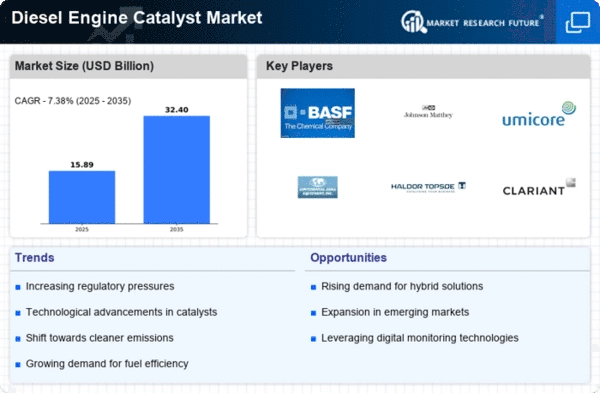
As per MRFR analysis, the Diesel Engine Catalyst Market Size was estimated at 14.8 USD Billion in 2024. The Diesel Engine Catalyst industry is projected to grow from 15.9 USD Billion in 2025 to 32.4 USD Billion by 2035, exhibiting a compound annual growth rate (CAGR) of 7.38 during the forecast period 2025 - 2035.

Key Market Trends & Highlights

The Diesel Engine Catalyst Market is poised for growth driven by regulatory compliance and technological advancements.

  • North America remains the largest market for diesel engine catalysts, driven by stringent emission regulations. The Asia-Pacific region is emerging as the fastest-growing market, fueled by increasing industrialization and urbanization. The automotive segment dominates the market, while the power generation segment is witnessing rapid growth due to rising energy demands. Key market drivers include regulatory compliance and technological advancements in catalyst materials, which are essential for reducing emissions.

Market Size & Forecast

2024 Market Size 14.8 (USD Billion)
2035 Market Size 32.4 (USD Billion)
CAGR (2025 - 2035) 7.38%
Largest Regional Market Share in 2024 North America

Major Players

BASF SE (DE), Johnson Matthey PLC (GB), Umicore SA (BE), Continental AG (DE), Haldor Topsoe A/S (DK), Clariant AG (CH), Tenneco Inc. (US), Eagle Industry Co., Ltd. (JP), SABIC (SA)

Market Trends

The Diesel Engine Catalyst Market is currently experiencing a transformative phase, driven by increasing regulatory pressures aimed at reducing emissions from diesel engines. This shift is largely influenced by global initiatives to combat air pollution and climate change, prompting manufacturers to innovate and enhance their catalytic technologies. The market appears to be evolving towards more efficient catalysts that not only meet stringent emission standards but also improve overall engine performance.

Furthermore, advancements in catalyst materials, such as the incorporation of precious metals and novel substrates, suggest a potential for enhanced durability and effectiveness in various operating conditions. In addition to regulatory influences, the Diesel Engine Catalyst Market is also shaped by the growing demand for diesel engines in commercial transportation and industrial applications.

As economies expand, the need for reliable and efficient transportation solutions becomes paramount. This trend indicates a sustained interest in diesel engines, which, despite facing competition from alternative fuel sources, continue to be favored for their fuel efficiency and torque characteristics. Consequently, the market is likely to witness a surge in research and development efforts aimed at optimizing catalyst formulations to cater to evolving engine technologies and performance requirements.

Regulatory Compliance and Emission Standards

The Diesel Engine Catalyst Market is increasingly influenced by stringent emission regulations imposed by governments worldwide. These regulations necessitate the development of advanced catalysts that can effectively reduce harmful emissions, thereby driving innovation within the industry.

Technological Advancements in Catalyst Materials

Recent advancements in catalyst materials, including the use of novel substrates and enhanced precious metal formulations, are reshaping the Diesel Engine Catalyst Market. These innovations aim to improve catalyst efficiency, durability, and overall performance in diverse operating conditions.

Growing Demand in Commercial Transportation

The Diesel Engine Catalyst Market is experiencing heightened demand due to the expansion of commercial transportation sectors. As industries seek reliable and efficient diesel engines, the need for effective catalysts to meet performance and emission standards becomes increasingly critical.

Diesel Engine Catalyst Market Market Drivers

Market Growth Projections

The Global Diesel Engine Catalyst Market Industry is projected to experience substantial growth in the coming years. With an estimated market value of 33.0 USD Billion in 2024, the industry is expected to expand significantly, reaching approximately 73.4 USD Billion by 2035. This growth trajectory suggests a compound annual growth rate (CAGR) of 7.53% from 2025 to 2035. Such projections indicate a robust demand for diesel engine catalysts driven by regulatory pressures, technological advancements, and the increasing need for sustainable transportation solutions. The market's expansion reflects the ongoing evolution of the diesel engine sector and its adaptation to contemporary environmental challenges.

Market Dynamics and Competitive Landscape

The Global Diesel Engine Catalyst Market Industry is characterized by dynamic market conditions and a competitive landscape. Key players are continuously striving to enhance their product offerings and expand their market presence through strategic partnerships and collaborations. This competitive environment fosters innovation, leading to the development of more efficient and cost-effective catalytic solutions. Additionally, the entry of new players into the market introduces fresh perspectives and technologies, further stimulating growth. As competition intensifies, the industry is likely to witness advancements that align with evolving consumer preferences and regulatory demands.

Regulatory Compliance and Emission Standards

The Global Diesel Engine Catalyst Market Industry is significantly influenced by stringent regulatory compliance and emission standards imposed by governments worldwide. These regulations aim to reduce harmful emissions from diesel engines, thereby promoting the adoption of advanced catalytic technologies. For instance, the European Union's Euro 6 standards and the United States Environmental Protection Agency's Tier 4 regulations necessitate the use of effective catalysts to meet these requirements. As a result, manufacturers are increasingly investing in innovative catalyst solutions, which is projected to drive the market's growth. The industry's value is expected to reach 33.0 USD Billion in 2024, reflecting the urgency for compliance.

Technological Advancements in Catalytic Converters

Technological advancements play a pivotal role in shaping the Global Diesel Engine Catalyst Market Industry. Innovations in catalyst formulations and designs enhance the efficiency of diesel engines in reducing nitrogen oxides and particulate matter. For example, the development of selective catalytic reduction (SCR) systems has shown promising results in lowering emissions while maintaining engine performance. These advancements not only improve compliance with regulations but also contribute to fuel efficiency, appealing to consumers and manufacturers alike. As the industry evolves, it is anticipated that the market will grow at a CAGR of 7.53% from 2025 to 2035, reaching an estimated 73.4 USD Billion by 2035.

Rising Demand for Diesel Engines in Emerging Economies

The Global Diesel Engine Catalyst Market Industry is experiencing a surge in demand for diesel engines, particularly in emerging economies. Countries such as India and Brazil are witnessing rapid industrialization and urbanization, leading to increased utilization of diesel engines in transportation and construction sectors. This trend necessitates the implementation of effective diesel engine catalysts to mitigate environmental impacts. As these economies expand, the demand for cleaner and more efficient diesel engines is likely to grow, further propelling the catalyst market. The industry's growth in these regions indicates a potential for substantial market expansion in the coming years.

Increased Focus on Sustainable Transportation Solutions

The Global Diesel Engine Catalyst Market Industry is increasingly aligned with the global shift towards sustainable transportation solutions. Governments and organizations are prioritizing the reduction of carbon footprints, leading to a heightened focus on cleaner diesel technologies. This shift is evident in initiatives promoting the use of biodiesel and renewable diesel, which require compatible catalytic systems for optimal performance. As the automotive industry adapts to these sustainable practices, the demand for advanced diesel engine catalysts is expected to rise. This trend not only supports environmental goals but also presents opportunities for innovation within the catalyst market.

Market Segment Insights

By Application: Automotive (Largest) vs. Power Generation (Fastest-Growing)

In the Diesel Engine Catalyst Market, the application segment is primarily dominated by the <a href="https://www.marketresearchfuture.com/reports/automotive-industry-7683">automotive industry</a>, which significantly captures the majority share. This dominance is primarily due to the increasing demand for cleaner emissions and stricter regulations that automotive manufacturers face globally. Following automotive, the industrial applications hold a substantial share as well, leveraging diesel engines for various machinery and equipment. On the other hand, the marine and power generation applications are emerging segments, with power generation notably recognized as the fastest-growing area. The increasing need for sustainable power solutions and the transition towards cleaner energy generation methods are driving growth. Additionally, as more marine operators seek to comply with international emissions standards, investment in diesel engine catalysts is expected to rise in this segment.

Automotive (Dominant) vs. Power Generation (Emerging)

The automotive segment of the Diesel Engine Catalyst Market remains dominant due to the high volume of diesel vehicles in operation, coupled with regulatory pressures aimed at reducing emissions. Diesel engine catalysts are crucial for automotive applications to meet stringent environmental standards. Meanwhile, the power generation segment is classified as emerging, driven by the need for reducing emissions in power plants that rely on diesel generators. This sector is leveraging advancements in catalyst technologies, which facilitate enhanced performance and compliance with regulations. As energy demands grow globally, the transition to cleaner diesel solutions in power generation is creating new opportunities, positioning it as a key player in the future of the Diesel Engine Catalyst Market.

By End Use: Passenger Vehicles (Largest) vs. Heavy-Duty Vehicles (Fastest-Growing)

The Diesel Engine Catalyst Market is witnessing significant distribution across various end-use segments, with passenger vehicles holding the largest share. This segment benefits from a stable demand driven by consistent vehicle sales and stringent emission regulations, which incentivize the adoption of advanced catalytic technologies. In contrast, the heavy-duty vehicle segment, while smaller, is rapidly gaining traction, attributed to the growing logistics and transportation sectors that are demanding cleaner emissions to meet environmental standards. Growth trends indicate that the heavy-duty vehicles segment is the fastest-growing in the Diesel Engine Catalyst Market. This growth is spurred by the increasing emphasis on sustainability within the commercial transportation industry and the implementation of government regulations aimed at reducing harmful emissions. Meanwhile, the passenger vehicle segment is expected to maintain its dominance as manufacturers integrate more advanced catalysts to enhance fuel efficiency and comply with regulatory frameworks, further fortifying the need for diesel engine catalysts across both segments.

Passenger Vehicles (Dominant) vs. Heavy-Duty Vehicles (Emerging)

In the Diesel Engine Catalyst Market, passenger vehicles are distinguished as the dominant segment due to their high vehicle registration rates and the increased focus on reducing emissions. These vehicles utilize advanced catalytic converters that play a critical role in diminishing harmful exhaust emissions. On the other hand, heavy-duty vehicles are emerging as a vital segment due to the increasing number of freight and transportation operations worldwide. They require robust and efficient catalysts to meet stringent regulations while maintaining performance. Heavy-duty vehicles, equipped with advanced diesel engines requiring specialized catalysts, represent a burgeoning area of growth as global standards for emissions tighten, pushing manufacturers to innovate and improve catalyst technologies to satisfy current and future market demands.

By Catalyst Type: Selective Catalytic Reduction (Largest) vs. Diesel Oxidation Catalyst (Fastest-Growing)

The Diesel Engine Catalyst Market showcases a distinct segmentation in its catalyst types, with Selective Catalytic Reduction (SCR) taking the lead as the largest segment. SCR technology is widely adopted due to its effectiveness in reducing nitrogen oxides (NOx) emissions, a crucial requirement due to increasing environmental regulations. In contrast, Diesel Oxidation Catalyst (DOC) is emerging rapidly, driven by the growing diesel vehicle market and the need for stringent emission control solutions.

Technology: SCR (Dominant) vs. DOC (Emerging)

Selective Catalytic Reduction (SCR) represents the dominant technology in the Diesel Engine Catalyst Market, attributed to its superior ability to convert harmful NOx emissions into harmless nitrogen and water. This process makes SCR vital for meeting regulatory standards and diesel engine performance. On the other hand, Diesel Oxidation Catalyst (DOC) is gaining traction as an emerging solution, particularly among newer diesel engines. DOC plays a significant role by enabling the oxidation of carbon monoxide and hydrocarbons, thus enhancing overall efficiency. Both technologies engage distinct customer bases, with SCR positioned as a crucial component for more stringent regulations, while DOC caters to those seeking efficient and effective means of emission reduction.

By Material Type: Ceramic (Largest) vs. Metal (Fastest-Growing)

In the Diesel Engine Catalyst Market, the material type segment has a significant share distribution, predominantly held by ceramic catalysts. These materials are recognized for their robust thermal stability and exceptional durability, making them a preferred choice for many diesel engine applications. In contrast, metal catalysts are gaining traction, attributed to their efficiency and ability to meet stringent emission regulations, positioning themselves as a critical player in the market.

Material: Ceramic (Dominant) vs. Metal (Emerging)

Ceramic catalysts dominate the Diesel Engine Catalyst Market due to their advantageous properties, such as high surface area and resistance to thermal degradation, which enhance their catalytic performance. This makes them particularly suitable for heavy-duty applications in trucks and industrial machinery. On the other hand, metal catalysts are emerging, driven by advancements in technology and increasing environmental regulations. Their ability to provide faster reactions and reduce harmful emissions makes them appealing, particularly in newer engine designs, leading to a dynamic shift in preference among manufacturers toward this innovative material.

By Emission Standard: Euro 6 (Largest) vs. EPA Tier 4 (Fastest-Growing)

The Diesel Engine Catalyst Market is significantly shaped by varying emission standards, with Euro 6 emerging as the dominant segment owing to its stringent regulations across Europe. This has resulted in robust adoption rates among manufacturers who prioritize compliance with these standards, leading to Euro 6 capturing the largest share in the market compared to its competitors. Meanwhile, EPA Tier 3 and Tier 4 standards also reflect substantial participation, albeit at relatively lower levels, as manufacturers adapt to evolving regulatory landscapes. As the push for cleaner diesel engine technologies intensifies, growth trends indicate that EPA Tier 4 is rapidly gaining traction, driven by stringent emission regulations in the United States. The introduction of advanced catalytic technologies and an increasing focus on environmental sustainability further complement this trend, positioning EPA Tier 4 as the fastest-growing segment. Manufacturers are keenly investing in innovations that facilitate compliance with these rigorous standards, shaping the market dynamics accordingly.

Euro 6 (Dominant) vs. EPA Tier 4 (Emerging)

Euro 6 stands out as the dominant emission standard in the Diesel Engine Catalyst Market due to its comprehensive approach to regulating nitrogen oxides and particulate matter emissions. Its stringent requirements have mandated significant technological advancements in catalysts, compelling manufacturers to innovate continually. Euro 6 technologies are widely adopted in vehicles, reflecting a robust demand trajectory in regions like Europe where compliance is critical. Conversely, EPA Tier 4 represents an emerging force, focusing on reducing harmful emissions in off-road and non-road diesel engines. This segment is gaining momentum as U.S. regulations tighten, prompting manufacturers to enhance catalyst efficiency and durability. The growth in the Tier 4 sector can be attributed to increased governmental focus on environmental protection and the growing adoption of diesel engines in diverse applications.

Get more detailed insights about Diesel Engine Catalyst Market Research Report - Global Forecast till 2035

Regional Insights

North America : Market Leader in Catalysts

North America is poised to maintain its leadership in the US diesel engine catalyst market, holding a significant market share of 6.5 in 2024. The region's growth is driven by stringent environmental regulations and a rising demand for cleaner emissions. The push for sustainable transportation solutions is further catalyzing market expansion, with government initiatives promoting advanced catalytic technologies. The United States stands as the primary market, supported by key players like BASF SE and Johnson Matthey PLC. The competitive landscape is characterized by innovation and strategic partnerships among leading manufacturers. As the region invests in R&D for next-generation catalysts, the market is expected to flourish, ensuring compliance with evolving emission standards.

Europe : Regulatory-Driven Market Growth

Europe's diesel engine catalyst market is projected to grow significantly, with a market size of 4.5 in 2025. The region's growth is primarily driven by stringent EU regulations aimed at reducing vehicle emissions. The European Commission's Green Deal and other initiatives are fostering innovation in catalyst technologies, making the market increasingly competitive and sustainable. Leading countries such as Germany, France, and the UK are at the forefront of this market, hosting major players like Umicore SA and Clariant AG. The competitive landscape is marked by a focus on eco-friendly solutions and advanced manufacturing processes. As Europe continues to prioritize environmental sustainability, the demand for efficient diesel engine catalysts is expected to rise, enhancing market dynamics.

Asia-Pacific : Emerging Market Potential

The Asia-Pacific region is witnessing a burgeoning diesel engine catalyst market, with a size of 3.5 in 2025. The growth is fueled by increasing vehicle production and rising environmental concerns. Countries like China and India are implementing stricter emission regulations, which are propelling the demand for advanced catalytic solutions. The region's focus on sustainable transportation is further enhancing market prospects. China leads the market, supported by key players such as Tenneco Inc. and Haldor Topsoe A/S. The competitive landscape is evolving, with local manufacturers emerging alongside established global players. As the region invests in cleaner technologies, the diesel engine catalyst market is expected to expand, aligning with global sustainability goals.

Middle East and Africa : Untapped Market Opportunities

The Middle East and Africa (MEA) region represents an emerging market for diesel engine catalysts, with a market size of 0.3 in 2025. The growth potential is driven by increasing vehicle ownership and a gradual shift towards stricter emission standards. Governments in the region are beginning to recognize the importance of environmental regulations, which is expected to stimulate demand for diesel catalysts in the coming years. Countries like South Africa and the UAE are leading the way in adopting cleaner technologies. The competitive landscape is still developing, with opportunities for both local and international players to establish a foothold. As the region progresses towards sustainable practices, the diesel engine catalyst market is likely to see significant growth, attracting investments and innovations.

Key Players and Competitive Insights

The Diesel Engine Catalyst Market is currently characterized by a competitive landscape that is both dynamic and multifaceted. Key growth drivers include stringent emissions regulations, increasing demand for fuel efficiency, and a growing emphasis on sustainability. Major players such as BASF SE (Germany), Johnson Matthey PLC (United Kingdom), and Umicore SA (Belgium) are strategically positioned to leverage these trends. BASF SE (Germany) focuses on innovation in catalyst formulations, aiming to enhance performance while reducing environmental impact. Meanwhile, Johnson Matthey PLC (United Kingdom) emphasizes partnerships with automotive manufacturers to develop tailored solutions that meet specific regulatory requirements. Umicore SA (Belgium) is actively pursuing regional expansion, particularly in emerging markets, to capitalize on the rising demand for cleaner technologies. Collectively, these strategies shape a competitive environment that is increasingly focused on technological advancement and regulatory compliance.
In terms of business tactics, companies are localizing manufacturing to reduce lead times and optimize supply chains. The market structure appears moderately fragmented, with several key players exerting influence over their respective segments. This fragmentation allows for a diverse range of products and innovations, although it also intensifies competition among established and emerging firms.
In November 2025, BASF SE (Germany) announced a collaboration with a leading automotive manufacturer to develop next-generation diesel catalysts that significantly reduce NOx emissions. This strategic move underscores BASF's commitment to innovation and positions the company as a frontrunner in meeting evolving regulatory standards. The partnership is expected to enhance BASF's market share while contributing to cleaner air initiatives.
In October 2025, Johnson Matthey PLC (United Kingdom) launched a new line of catalysts designed specifically for heavy-duty diesel engines, which are increasingly under scrutiny for emissions. This product introduction reflects the company's proactive approach to addressing market needs and regulatory pressures. By focusing on heavy-duty applications, Johnson Matthey aims to solidify its position in a niche yet critical segment of the market.
In September 2025, Umicore SA (Belgium) expanded its production capacity in Asia to meet the growing demand for diesel catalysts in the region. This expansion is indicative of Umicore's strategy to enhance its The Diesel Engine Catalyst dynamics. By increasing capacity, Umicore is likely to improve its supply chain efficiency and better serve its customers in a rapidly evolving market.
As of December 2025, current competitive trends in the Diesel Engine Catalyst Market include a pronounced shift towards digitalization, sustainability, and the integration of AI technologies. Strategic alliances are increasingly shaping the landscape, enabling companies to pool resources and expertise to drive innovation. Looking ahead, competitive differentiation is expected to evolve from traditional price-based competition to a focus on technological advancements, reliability in supply chains, and sustainable practices. This shift may redefine market dynamics, compelling companies to innovate continuously to maintain their competitive edge.

Key Companies in the Diesel Engine Catalyst Market include

Industry Developments

In March 2019, Johnson Matthey launched an innovative, automatically regenerating Active DPF diesel particulate filter (DPF) system for stationary diesel engines.

Major Key Players

    • Johnson Matthey (UK)
    • MagnetiMarelliS.p.A. (Italy)
    • BASF SE (Germany)
    • SANGO Co., Ltd (Japan)
    • Perkins Engines Company Limited (UK)
    • CDTi Advanced Materials, Inc. (US)
    • Nett Technologies Inc. (Canada)
    • Continental AG (Germany)

Future Outlook

Diesel Engine Catalyst Market Future Outlook

The Diesel Engine Catalyst Market is projected to grow at a 7.38% CAGR from 2025 to 2035, driven by stringent emission regulations, technological advancements, and increasing demand for cleaner fuels.

New opportunities lie in:

  • Development of advanced catalyst formulations for improved efficiency
  • Expansion into emerging markets with tailored solutions
  • Integration of digital monitoring systems for real-time performance optimization

By 2035, the market is expected to achieve robust growth, driven by innovation and regulatory compliance.

Market Segmentation

Diesel Engine Catalyst Market End Use Outlook

  • Passenger Vehicles
  • Commercial Vehicles
  • Heavy-Duty Vehicles

Diesel Engine Catalyst Market Application Outlook

  • Automotive
  • Industrial
  • Marine
  • Power Generation

Diesel Engine Catalyst Market Catalyst Type Outlook

  • Selective Catalytic Reduction
  • Diesel Oxidation Catalyst
  • Lean NOx Trap

Diesel Engine Catalyst Market Material Type Outlook

  • Ceramic
  • Metal
  • Composite

Diesel Engine Catalyst Market Emission Standard Outlook

  • Euro 6
  • EPA Tier 3
  • EPA Tier 4

Report Scope

MARKET SIZE 2024 14.8(USD Billion)
MARKET SIZE 2025 15.9(USD Billion)
MARKET SIZE 2035 32.4(USD Billion)
COMPOUND ANNUAL GROWTH RATE (CAGR) 7.38% (2025 - 2035)
REPORT COVERAGE Revenue Forecast, Competitive Landscape, Growth Factors, and Trends
BASE YEAR 2024
Market Forecast Period 2025 - 2035
Historical Data 2019 - 2024
Market Forecast Units USD Billion
Key Companies Profiled BASF SE (DE), Johnson Matthey PLC (GB), Umicore SA (BE), Continental AG (DE), Haldor Topsoe A/S (DK), Clariant AG (CH), Tenneco Inc. (US), Eagle Industry Co., Ltd. (JP), SABIC (SA)
Segments Covered Application, End Use, Catalyst Type, Material Type, Emission Standard
Key Market Opportunities Advancements in catalyst formulations enhance efficiency and compliance with stringent emissions regulations in the Diesel Engine Catalyst Market.
Key Market Dynamics Rising regulatory pressures drive innovation in diesel engine catalyst technologies and enhance market competitiveness.
Countries Covered North America, Europe, APAC, South America, MEA

FAQs

At what rate is the diesel engine catalyst market expected to expand?

The diesel engine catalyst market is projected to grow at 7.9% CAGR.

Which region is supposed to dominate the diesel engine catalyst market?

The diesel engine catalyst market is poised to be dominated by APAC market.

On the basis of application, which are the segments of the diesel engine catalyst market?

The application based segments of the diesel engine catalyst market are off-road and on-road.

Which application based segment is anticipated to hold the largest share?

The on-road segment is anticipated to account for the pole position.

By sales channel, which segment is expected to lead the market?

The OEM segment resonates strong potential and is supposed to drive market growth.

Who are the key contributors to the development of the diesel engine catalyst market?

The key contributors are Johnson Matthey (UK), BASF SE (Germany), Magneti Marelli S.p.A. (Italy), SANGO Co., Ltd (Japan), Perkins Engines Company Limited (UK), Umicore N.V. (Belgium), CDTi Advanced Materials, Inc. (US), Eberspächer (Germany), Nett Technologies Inc. (Canada), and Continental AG (Germany).

  1. SECTION I: EXECUTIVE SUMMARY AND KEY HIGHLIGHTS
    1. | 1.1 EXECUTIVE SUMMARY
    2. | 1.1.1 Market Overview
    3. | 1.1.2 Key Findings
    4. | 1.1.3 Market Segmentation
    5. | 1.1.4 Competitive Landscape
    6. | 1.1.5 Challenges and Opportunities
    7. | 1.1.6 Future Outlook
  2. SECTION II: SCOPING, METHODOLOGY AND MARKET STRUCTURE
    1. | 2.1 MARKET INTRODUCTION
    2. | 2.1.1 Definition
    3. | 2.1.2 Scope of the study
    4. |-- 2.1.2.1 Research Objective
    5. |-- 2.1.2.2 Assumption
    6. |-- 2.1.2.3 Limitations
    7. | 2.2 RESEARCH METHODOLOGY
    8. | 2.2.1 Overview
    9. | 2.2.2 Data Mining
    10. | 2.2.3 Secondary Research
    11. | 2.2.4 Primary Research
    12. |-- 2.2.4.1 Primary Interviews and Information Gathering Process
    13. |-- 2.2.4.2 Breakdown of Primary Respondents
    14. | 2.2.5 Forecasting Model
    15. | 2.2.6 Market Size Estimation
    16. |-- 2.2.6.1 Bottom-Up Approach
    17. |-- 2.2.6.2 Top-Down Approach
    18. | 2.2.7 Data Triangulation
    19. | 2.2.8 Validation
  3. SECTION III: QUALITATIVE ANALYSIS
    1. | 3.1 MARKET DYNAMICS
    2. | 3.1.1 Overview
    3. | 3.1.2 Drivers
    4. | 3.1.3 Restraints
    5. | 3.1.4 Opportunities
    6. | 3.2 MARKET FACTOR ANALYSIS
    7. | 3.2.1 Value chain Analysis
    8. | 3.2.2 Porter's Five Forces Analysis
    9. |-- 3.2.2.1 Bargaining Power of Suppliers
    10. |-- 3.2.2.2 Bargaining Power of Buyers
    11. |-- 3.2.2.3 Threat of New Entrants
    12. |-- 3.2.2.4 Threat of Substitutes
    13. |-- 3.2.2.5 Intensity of Rivalry
    14. | 3.2.3 COVID-19 Impact Analysis
    15. |-- 3.2.3.1 Market Impact Analysis
    16. |-- 3.2.3.2 Regional Impact
    17. |-- 3.2.3.3 Opportunity and Threat Analysis
  4. SECTION IV: QUANTITATIVE ANALYSIS
    1. | 4.1 Automobile, BY Application (USD Billion)
    2. | 4.1.1 Automotive
    3. | 4.1.2 Industrial
    4. | 4.1.3 Marine
    5. | 4.1.4 Power Generation
    6. | 4.2 Automobile, BY End Use (USD Billion)
    7. | 4.2.1 Passenger Vehicles
    8. | 4.2.2 Commercial Vehicles
    9. | 4.2.3 Heavy-Duty Vehicles
    10. | 4.3 Automobile, BY Catalyst Type (USD Billion)
    11. | 4.3.1 Selective Catalytic Reduction
    12. | 4.3.2 Diesel Oxidation Catalyst
    13. | 4.3.3 Lean NOx Trap
    14. | 4.4 Automobile, BY Material Type (USD Billion)
    15. | 4.4.1 Ceramic
    16. | 4.4.2 Metal
    17. | 4.4.3 Composite
    18. | 4.5 Automobile, BY Emission Standard (USD Billion)
    19. | 4.5.1 Euro 6
    20. | 4.5.2 EPA Tier 3
    21. | 4.5.3 EPA Tier 4
    22. | 4.6 Automobile, BY Region (USD Billion)
    23. | 4.6.1 North America
    24. |-- 4.6.1.1 US
    25. |-- 4.6.1.2 Canada
    26. | 4.6.2 Europe
    27. |-- 4.6.2.1 Germany
    28. |-- 4.6.2.2 UK
    29. |-- 4.6.2.3 France
    30. |-- 4.6.2.4 Russia
    31. |-- 4.6.2.5 Italy
    32. |-- 4.6.2.6 Spain
    33. |-- 4.6.2.7 Rest of Europe
    34. | 4.6.3 APAC
    35. |-- 4.6.3.1 China
    36. |-- 4.6.3.2 India
    37. |-- 4.6.3.3 Japan
    38. |-- 4.6.3.4 South Korea
    39. |-- 4.6.3.5 Malaysia
    40. |-- 4.6.3.6 Thailand
    41. |-- 4.6.3.7 Indonesia
    42. |-- 4.6.3.8 Rest of APAC
    43. | 4.6.4 South America
    44. |-- 4.6.4.1 Brazil
    45. |-- 4.6.4.2 Mexico
    46. |-- 4.6.4.3 Argentina
    47. |-- 4.6.4.4 Rest of South America
    48. | 4.6.5 MEA
    49. |-- 4.6.5.1 GCC Countries
    50. |-- 4.6.5.2 South Africa
    51. |-- 4.6.5.3 Rest of MEA
  5. SECTION V: COMPETITIVE ANALYSIS
    1. | 5.1 Competitive Landscape
    2. | 5.1.1 Overview
    3. | 5.1.2 Competitive Analysis
    4. | 5.1.3 Market share Analysis
    5. | 5.1.4 Major Growth Strategy in the Automobile
    6. | 5.1.5 Competitive Benchmarking
    7. | 5.1.6 Leading Players in Terms of Number of Developments in the Automobile
    8. | 5.1.7 Key developments and growth strategies
    9. |-- 5.1.7.1 New Product Launch/Service Deployment
    10. |-- 5.1.7.2 Merger & Acquisitions
    11. |-- 5.1.7.3 Joint Ventures
    12. | 5.1.8 Major Players Financial Matrix
    13. |-- 5.1.8.1 Sales and Operating Income
    14. |-- 5.1.8.2 Major Players R&D Expenditure. 2023
    15. | 5.2 Company Profiles
    16. | 5.2.1 BASF SE (DE)
    17. |-- 5.2.1.1 Financial Overview
    18. |-- 5.2.1.2 Products Offered
    19. |-- 5.2.1.3 Key Developments
    20. |-- 5.2.1.4 SWOT Analysis
    21. |-- 5.2.1.5 Key Strategies
    22. | 5.2.2 Johnson Matthey PLC (GB)
    23. |-- 5.2.2.1 Financial Overview
    24. |-- 5.2.2.2 Products Offered
    25. |-- 5.2.2.3 Key Developments
    26. |-- 5.2.2.4 SWOT Analysis
    27. |-- 5.2.2.5 Key Strategies
    28. | 5.2.3 Umicore SA (BE)
    29. |-- 5.2.3.1 Financial Overview
    30. |-- 5.2.3.2 Products Offered
    31. |-- 5.2.3.3 Key Developments
    32. |-- 5.2.3.4 SWOT Analysis
    33. |-- 5.2.3.5 Key Strategies
    34. | 5.2.4 Continental AG (DE)
    35. |-- 5.2.4.1 Financial Overview
    36. |-- 5.2.4.2 Products Offered
    37. |-- 5.2.4.3 Key Developments
    38. |-- 5.2.4.4 SWOT Analysis
    39. |-- 5.2.4.5 Key Strategies
    40. | 5.2.5 Haldor Topsoe A/S (DK)
    41. |-- 5.2.5.1 Financial Overview
    42. |-- 5.2.5.2 Products Offered
    43. |-- 5.2.5.3 Key Developments
    44. |-- 5.2.5.4 SWOT Analysis
    45. |-- 5.2.5.5 Key Strategies
    46. | 5.2.6 Clariant AG (CH)
    47. |-- 5.2.6.1 Financial Overview
    48. |-- 5.2.6.2 Products Offered
    49. |-- 5.2.6.3 Key Developments
    50. |-- 5.2.6.4 SWOT Analysis
    51. |-- 5.2.6.5 Key Strategies
    52. | 5.2.7 Tenneco Inc. (US)
    53. |-- 5.2.7.1 Financial Overview
    54. |-- 5.2.7.2 Products Offered
    55. |-- 5.2.7.3 Key Developments
    56. |-- 5.2.7.4 SWOT Analysis
    57. |-- 5.2.7.5 Key Strategies
    58. | 5.2.8 Eagle Industry Co., Ltd. (JP)
    59. |-- 5.2.8.1 Financial Overview
    60. |-- 5.2.8.2 Products Offered
    61. |-- 5.2.8.3 Key Developments
    62. |-- 5.2.8.4 SWOT Analysis
    63. |-- 5.2.8.5 Key Strategies
    64. | 5.2.9 SABIC (SA)
    65. |-- 5.2.9.1 Financial Overview
    66. |-- 5.2.9.2 Products Offered
    67. |-- 5.2.9.3 Key Developments
    68. |-- 5.2.9.4 SWOT Analysis
    69. |-- 5.2.9.5 Key Strategies
    70. | 5.3 Appendix
    71. | 5.3.1 References
    72. | 5.3.2 Related Reports

Automobile Market Segmentation

Automobile By Application (USD Billion, 2025-2035)

  • Automotive
  • Industrial
  • Marine
  • Power Generation

Automobile By End Use (USD Billion, 2025-2035)

  • Passenger Vehicles
  • Commercial Vehicles
  • Heavy-Duty Vehicles

Automobile By Catalyst Type (USD Billion, 2025-2035)

  • Selective Catalytic Reduction
  • Diesel Oxidation Catalyst
  • Lean NOx Trap

Automobile By Material Type (USD Billion, 2025-2035)

  • Ceramic
  • Metal
  • Composite

Automobile By Emission Standard (USD Billion, 2025-2035)

  • Euro 6
  • EPA Tier 3
  • EPA Tier 4
Infographic

Free Sample Request

Kindly complete the form below to receive a free sample of this Report

Get Free Sample

Customer Strories

Compare Licence

×
Features License Type
Single User Multiuser License Enterprise User
Price $4,950 $5,950 $7,250
Maximum User Access Limit 1 User Upto 10 Users Unrestricted Access Throughout the Organization
Free Customization
Direct Access to Analyst
Deliverable Format
Platform Access
Discount on Next Purchase 10% 15% 15%
Printable Versions